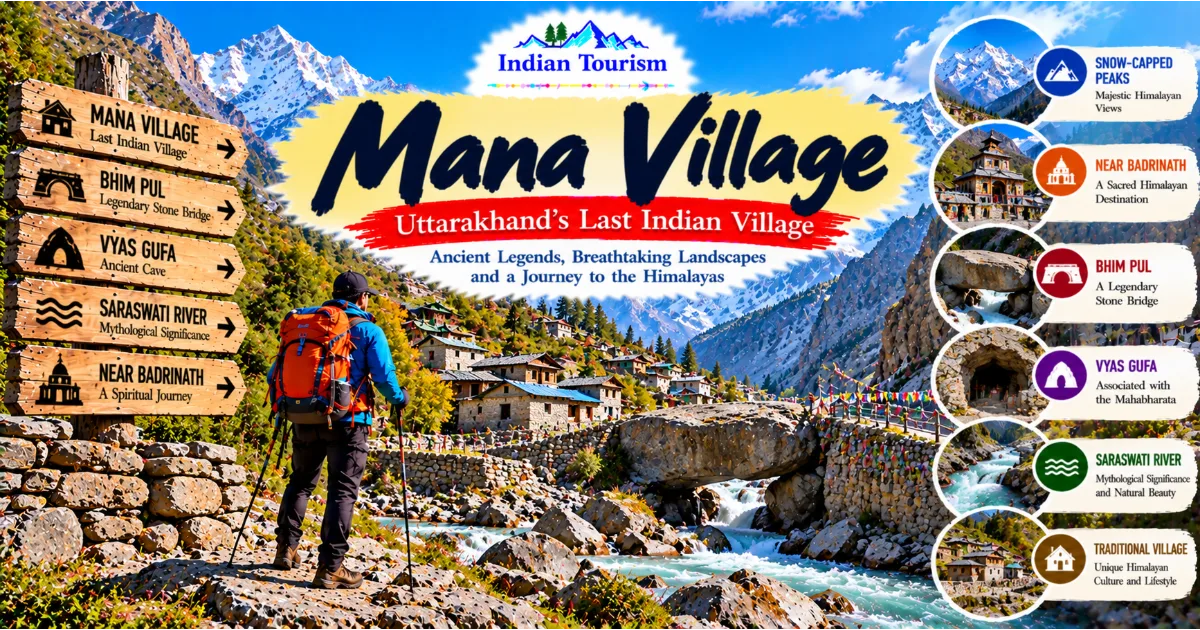
Mana Village, near Badrinath in Uttarakhand’s Chamoli district, is a remarkable Himalayan settlement known for its dramatic mountain scenery, traditional stone houses, ancient legends, and cultural heritage.
Situated at approximately 3,200 metres above sea level, Mana offers travellers a glimpse of life in the high Himalayas, where geography, spirituality, and local traditions are closely connected.
Its proximity to Badrinath, Bhim Pul, Vyas Gufa, and the source region of the Saraswati River makes it an unforgettable destination for anyone exploring the Garhwal Himalayas.
Discovering Mana Village
Uttarakhand is home to destinations that combine natural beauty with stories passed down through generations. Some places are famous for their temples, others for their mountain landscapes, and some for the distinctive culture of their communities. Mana Village brings these elements together in a setting surrounded by towering Himalayan mountains.
Located a short distance from Badrinath, Mana has traditionally been described as the last Indian village near the Indo-Tibetan border. This description reflects its geographical position and historical identity, although border classifications and administrative terminology can change. Travellers should use current official information when discussing its status and should remember that access to sensitive border areas is subject to government rules.
The village sits in a high-altitude environment where winters are severe and the growing season is relatively short. Traditional houses, narrow lanes, stone structures, and mountain views create an atmosphere different from that of the larger towns in the region.
Continue Reading
Mana is also associated with stories from the Mahabharata. Local traditions connect the area with the Pandavas, the sage Vyasa, and the legendary journey towards heaven. Places such as Bhim Pul and Vyas Gufa have become important stops for pilgrims and visitors interested in the relationship between Himalayan geography and Indian epic traditions.
For travellers, Mana offers more than a quick photograph beside a village sign. It provides an opportunity to explore local architecture, learn about regional culture, observe the surrounding landscape, and understand how religious stories shape the identity of a mountain settlement.
Where Is Mana Village Located?
Mana Village is situated in Chamoli district in the Garhwal region of Uttarakhand. It lies near Badrinath, one of the most important pilgrimage destinations in the state, and is reached by road from Joshimath through the wider Alaknanda valley.
The village stands at roughly 3,200 metres above sea level. At this elevation, weather conditions can change quickly, temperatures may fall even during the warmer months, and physical activity can feel more demanding than at lower elevations.
The surrounding landscape is dominated by high mountains, rocky slopes, river valleys, and areas of sparse vegetation. The Alaknanda river system shapes much of the wider region, while nearby mountain streams and rugged terrain contribute to its distinctive character.
Mana's location makes it a natural addition to a Badrinath pilgrimage itinerary. Visitors can often explore the village and its nearby cultural landmarks during the same journey, provided access conditions and local operating arrangements permit.
However, travellers should not assume that every route or attraction will remain accessible throughout the year. Heavy snowfall, landslides, road closures, and seasonal restrictions can affect travel in this part of the Himalayas.
Why Mana Village Is Special
A Village Shaped by the Himalayas
Mana's mountain environment influences almost every aspect of its appearance and daily life. The settlement is surrounded by steep slopes and dramatic peaks, while its traditional architecture reflects the need to adapt to a cold and demanding climate.
Stone and wood have historically been important building materials in many Himalayan settlements. Their use reflects local availability, practical requirements, and building knowledge developed over generations.
The village's narrow lanes and traditional structures provide a different experience from modern urban environments. Travellers can observe how settlements develop around the limitations of mountain terrain, where level ground is scarce and weather influences construction and movement.
Mana's appeal comes partly from this relationship between the built environment and the surrounding landscape. It is not simply a collection of buildings placed against a mountain backdrop. Its character has developed through the interaction of geography, culture, and local livelihoods.
A Place Connected with the Mahabharata
Mana is closely associated with traditions connected to the Mahabharata, one of India's most influential epics. Several landmarks in and around the village are linked through local belief to the Pandavas and the sage Vyasa.
According to popular tradition, the Pandavas passed through the wider region during their final journey towards heaven. Other stories associate the area with the composition or narration of the Mahabharata.
These associations make Mana important to visitors who wish to explore the cultural geography of Indian epics. The landscape provides a setting in which religious narratives, mountain features, and local traditions are connected.
It is important to distinguish religious tradition from independently established historical fact. The legends associated with Mana are meaningful elements of local culture and faith, but their precise historical origins cannot always be verified.
Visitors can appreciate these stories without treating every legendary association as a confirmed historical event. Understanding the distinction allows travellers to respect both cultural heritage and historical evidence.
The Traditional Himalayan Lifestyle
Mana's identity is also connected with the communities that have lived in this high-altitude region. Mountain settlements develop practices suited to their environment, including seasonal movement, local food traditions, and methods of adapting to cold weather.
Historically, communities in the wider Himalayan border region participated in seasonal trade and maintained cultural connections across mountain routes. Political boundaries and modern restrictions have changed these patterns, but the historical importance of regional exchange remains part of the area's wider story.
Visitors may encounter local shops, traditional food, handicrafts, and other products associated with the village. Availability varies with the season and tourism activity.
When purchasing goods, travellers should ask about the products and pay fair prices. Respectful interaction with local residents helps ensure that tourism supports the community rather than treating village life as a performance.
Bhim Pul: The Legendary Stone Bridge
One of Mana's most famous attractions is Bhim Pul, a large natural stone formation spanning a narrow section of a gorge near the Saraswati River.
According to local legend, Bhim, one of the Pandava brothers in the Mahabharata, placed a massive stone across the gorge to help Draupadi cross the river during their journey through the Himalayas. This story gives the formation its name and makes it an important stop for visitors interested in epic traditions.
The surrounding landscape is dramatic. Water moves through a rocky channel, and steep mountain surfaces create a powerful sense of scale. The bridge-like formation appears especially striking when viewed against the rugged terrain.
Bhim Pul demonstrates how natural features can acquire cultural significance through storytelling. Across India, mountains, rivers, caves, and rock formations are frequently connected with religious narratives. These associations influence how people experience the landscape and how destinations become part of pilgrimage traditions.
Visitors should remain on safe, permitted paths when viewing the formation. The nearby river can flow forcefully, and rocks may become slippery because of spray, rain, or ice.
Photography should never take priority over safety. Avoid climbing unstable surfaces or approaching exposed edges simply to obtain a closer view.
Vyas Gufa: The Cave of Sage Vyasa
Vyas Gufa is another well-known attraction near Mana. It is traditionally associated with Maharishi Vyasa, the revered sage connected with the Mahabharata and other important works within Hindu religious tradition.
Popular accounts describe Vyasa as narrating the Mahabharata while Lord Ganesha recorded the epic. The cave is included in this broader cultural tradition, and many pilgrims visit the site to reflect on the story of the epic's creation.
The cave and its surroundings provide a quieter experience than the open village lanes. Its religious associations make it meaningful for visitors interested in Indian philosophy, literature, mythology, and pilgrimage.
The traditions surrounding Vyas Gufa are an important part of India's cultural heritage. However, the cave's precise historical connection to the composition of the Mahabharata cannot be established simply through the existence of the site or its local name.
Travellers can approach the cave as a place where faith, memory, and landscape intersect. Such an approach allows visitors to appreciate its cultural importance without confusing religious tradition with archaeological proof.
When visiting, follow local instructions, respect worshippers, and avoid loud behaviour. Ask permission before photographing people or religious activities.
The Saraswati River and Its Dramatic Gorge
The Saraswati River near Mana is associated with both geographical interest and religious tradition. The river emerges through rugged mountain terrain and flows through a narrow rocky channel near the village.
The sound of rushing water contrasts with the stillness of the surrounding mountains. The exposed rocks and steep gorge create a striking natural scene, making the area popular among visitors and photographers.
In Hindu tradition, the name Saraswati carries deep cultural significance. It is associated with the goddess of knowledge, learning, music, and wisdom. The presence of a river bearing this name adds another layer of meaning to the landscape.
The Saraswati River in this region should not automatically be equated with every historical or mythological reference to Saraswati found in Indian literature. The name has several cultural and geographical associations, and individual traditions should be understood within their own contexts.
Visitors should observe the river from safe viewpoints. Mountain water can be extremely cold and fast-moving, and the surrounding rocks may be unstable or slippery.
Avoid throwing coins, food, plastic, or other materials into the water. Respect for the river's cultural importance should be accompanied by practical efforts to protect its natural environment.
Mana and the Badrinath Pilgrimage
Mana's proximity to Badrinath makes it an important part of many journeys through Uttarakhand's sacred Himalayan landscape.
Badrinath is one of the principal pilgrimage sites associated with Lord Vishnu and forms part of the Char Dham pilgrimage tradition in Uttarakhand. The temple attracts devotees from across India and beyond during its seasonal opening period.
For many visitors, a trip to Mana complements the religious experience of Badrinath. The village offers additional cultural landmarks, mountain scenery, and opportunities to understand the stories associated with the region.
The two destinations can often be included in the same itinerary, but visitors should allow enough time for travel, walking, and changing weather conditions. During busy pilgrimage periods, roads and nearby attractions can become crowded.
Travellers should check the current opening dates and access arrangements for Badrinath before planning a journey. Temple schedules, road conditions, and seasonal restrictions can affect the overall itinerary.
Best Time to Visit Mana Village
Late Spring and Early Summer
Late spring and early summer can be suitable for exploring Mana, depending on snow conditions and the opening of the wider Badrinath route.
As the weather becomes more favourable, access to high-altitude destinations generally improves. The surrounding landscape can reveal rocky slopes, flowing streams, and mountain views that remain difficult to reach during winter.
Temperatures may still be cold, particularly in the early morning and evening. Visitors should carry warm layers even if the daytime weather appears comfortable.
This period can be attractive for pilgrims and travellers who want to explore Mana alongside Badrinath. However, the opening of individual roads and facilities depends on official arrangements and prevailing conditions.
Summer Pilgrimage Season
Summer is a busy period for Badrinath and nearby attractions. Mana receives visitors who combine village sightseeing with temple visits and journeys through the upper Alaknanda valley.
The weather can be relatively favourable for walking around the village, although rainfall and sudden changes in temperature remain possible.
Travellers should expect increased activity during major pilgrimage periods. Accommodation and transport should be arranged in advance when possible, and sufficient time should be allowed for traffic and queues.
Visitors seeking a quieter experience may prefer to explore early in the day, subject to opening arrangements and local instructions.
Monsoon Travel
The monsoon brings rainfall to Uttarakhand and can make the surrounding mountains appear misty and dramatic. However, heavy rain also increases the risk of landslides, falling rocks, road damage, and travel disruption.
The road network through the mountains can be affected by weather events, and journey times may change without much notice.
Travellers should check official weather and road advisories before setting out. If conditions are unsafe, postpone the trip rather than attempting to complete the itinerary.
Walking surfaces around the village and river may become slippery, so footwear with good grip is advisable.
Autumn
Autumn can provide clear mountain views and cooler conditions, depending on the weather. It may be a rewarding time for photography and for travellers who want to experience the wider region after the main monsoon period.
However, temperatures begin to fall as the season progresses, and the operating schedule of pilgrimage facilities can change. Visitors should confirm current arrangements before travelling.
The high-altitude setting means that warm clothing remains important even on sunny days.
Winter
Winter conditions around Mana can be severe. Snowfall, freezing temperatures, and road closures can make access difficult or impossible.
Visitors should not assume that the village can be explored in the same way throughout the year. The Badrinath region has a seasonal travel pattern, and the availability of accommodation and transport can change significantly during winter.
Anyone considering winter travel should obtain current information from official authorities and local operators. Never attempt to cross closed roads or enter restricted areas because a navigation application suggests a route is available.
How to Reach Mana Village
By Air
Jolly Grant Airport near Dehradun is a commonly used airport for travellers visiting the Garhwal Himalayas. From the airport, visitors continue by road towards Rishikesh, Joshimath, and Badrinath.
The road journey is long and passes through mountainous terrain. Travel time depends on traffic, road conditions, weather, and any restrictions in force.
Travellers arriving by air should avoid arranging a schedule that requires them to reach Mana immediately after landing. An overnight stop along the route may make the journey more comfortable.
By Train
Rishikesh and Haridwar are commonly used railway gateways for journeys into the Garhwal region. From either location, visitors continue by road towards Joshimath and Badrinath.
The final journey includes mountain roads, steep gradients, and sections where travel can be slower than expected. Road conditions should be checked before departure.
Travellers should also consider the time needed for rest breaks and the possibility of delays during the pilgrimage season.
By Road
Mana is reached from Badrinath by road, subject to the current access arrangements. Visitors usually travel through Joshimath and the wider Alaknanda valley.
The route offers mountain views, river scenery, and settlements along the way. However, the journey requires patience and attention to road conditions.
Use reliable transport and follow official directions. Avoid travelling after dark where road conditions, weather, or local guidance make it inadvisable.
Places to Explore Near Mana
Badrinath Temple
Badrinath Temple is the principal religious attraction in the immediate area. Dedicated to Lord Vishnu, it is an important pilgrimage destination and part of Uttarakhand's Char Dham tradition.
The temple and surrounding settlement can be busy during the pilgrimage season. Visitors should check current opening times, local instructions, and arrangements for worship.
Those interested in culture and religion may find it useful to learn about the temple's traditions before visiting. Respectful behaviour helps preserve the atmosphere of the sacred site.
Vasudhara Falls
Vasudhara Falls is a well-known waterfall in the wider Badrinath region. The route to the falls involves walking through high-altitude terrain, and its suitability depends on weather, physical fitness, and current local conditions.
The surrounding landscape can be impressive, with rocky mountains and open views. However, the walk should not be treated as a casual stroll for every visitor.
Travellers should seek current guidance about access, route conditions, and the time required. Carry water, suitable footwear, and warm clothing, and avoid attempting the walk in unsafe weather.
Joshimath
Joshimath is an important town in Chamoli district and a common base for journeys to Badrinath and other destinations in the region.
The town provides transport connections, accommodation, shops, and other services that may be useful before or after visiting Mana. It also has religious and cultural significance within the wider Garhwal Himalayas.
Travellers can use Joshimath as a practical stop to rest, arrange transport, and obtain local information before continuing into higher mountain areas.
The Alaknanda Valley
The Alaknanda valley forms a major geographical feature of this part of Uttarakhand. Its river, mountain slopes, settlements, and road corridors create a landscape that changes with elevation and season.
Travelling through the valley provides opportunities to observe how rivers shape the terrain and how communities adapt to mountainous conditions.
Visitors should take care at roadside viewpoints and avoid stopping in unsafe locations. The best way to enjoy the landscape is to use authorised stops and follow the driver's guidance.
Local Culture and Traditions
Mana's cultural identity is shaped by its Himalayan location, religious associations, and history of life near mountain routes.
The wider region has long been connected with pilgrimage, seasonal movement, and cultural exchange. Local traditions reflect the importance of religious sites, the demands of mountain weather, and the practical challenges of maintaining settlements at high elevations.
The stories associated with Bhim Pul and Vyas Gufa are especially important in shaping how visitors understand Mana. These traditions connect the landscape to the Mahabharata and provide a cultural framework through which people interpret the mountains.
Visitors should approach these traditions respectfully. Religious narratives can carry deep meaning even when their historical details cannot be independently verified.
Local food, handicrafts, and small businesses may also offer insight into everyday life. Buying from local sellers can support the village economy, provided transactions are respectful and prices are agreed clearly.
Food to Try in the Region
Food in and around Mana reflects the broader culinary traditions of Uttarakhand, although the range of available dishes depends on the season and the establishments operating locally.
Travellers may find simple meals such as rice, lentils, vegetables, flatbreads, and familiar North Indian preparations. Local dishes may be available in nearby settlements or at accommodation facilities.
Because the area is remote and tourism operates seasonally, visitors should not assume that every restaurant or shop will be open. Confirm meal arrangements in advance, particularly when travelling with children or people who have dietary requirements.
Carry suitable snacks for longer journeys and walking routes. Dispose of all packaging responsibly and avoid leaving food waste beside rivers or on mountain trails.
Photography in Mana Village
Mana offers a wide range of photographic subjects, including traditional houses, mountain scenery, river gorges, stone formations, village lanes, and religious landmarks.
The surrounding landscape changes considerably with weather and light. Clear mornings may reveal distant peaks, while mist and cloud can create a different atmosphere around the village.
Photographers should look beyond the most familiar viewpoints. Details such as stone walls, traditional building features, and the relationship between the village and its mountain setting can help communicate the character of the place.
However, photography should remain respectful. Ask before photographing residents or entering private spaces, and follow restrictions at religious sites and sensitive locations.
Avoid standing in roads or unsafe areas for a photograph. Near the Saraswati River and Bhim Pul, slippery rocks and strong currents make it especially important to maintain a safe distance.
Responsible Tourism in Mana
Responsible tourism is essential in high-altitude destinations where natural conditions are demanding and local facilities may be limited.
Visitors should carry their waste back to suitable disposal points, avoid littering near rivers, and refrain from damaging stone structures or other heritage features.
Religious landmarks should be treated with respect. Do not carve names into rocks, disturb worshippers, or leave offerings made from plastic and other materials that could pollute the environment.
Support local businesses when possible, and ask permission before photographing residents or private property. These small actions help ensure that tourism remains beneficial to the community.
Travellers should also respect road closures and seasonal restrictions. Mountain conditions can change rapidly, and official decisions about access should always take priority over personal travel plans.
Common Mistakes to Avoid
One common mistake is assuming that Mana is accessible throughout the year. High-altitude weather and seasonal road arrangements can limit access, so current information should be checked before departure.
Another mistake is underestimating the cold. Even during the warmer travel season, mornings and evenings can be chilly. Layered clothing is more practical than relying on a single heavy garment.
Visitors sometimes try to include too many nearby destinations in one day. The mountain road network, walking distances, and changing weather can make an ambitious schedule uncomfortable or unsafe.
It is also important not to confuse local legends with confirmed historical evidence. The stories associated with the village are culturally significant, but visitors should describe them as traditions or beliefs when their historical details cannot be verified.
Finally, avoid littering, disrespectful photography, and unsafe behaviour near rivers or rocky viewpoints. Respect for the environment and local community is central to a meaningful visit.
A Practical Travel Plan
A visit to Mana can be combined with Badrinath as part of a broader journey through Chamoli district. Travellers can use Joshimath as an overnight stop before continuing towards Badrinath, then explore Mana when access and weather permit.
Allow enough time to visit the village and its main cultural landmarks without rushing. If planning to visit additional locations such as Vasudhara Falls, confirm the walking requirements and current route conditions in advance.
Book accommodation according to the season and check whether meals and transport are available. During the busy pilgrimage period, advance planning can help reduce delays.
Keep the itinerary flexible because mountain travel is influenced by weather, road conditions, and official instructions. A safe and thoughtful visit is more valuable than completing every planned stop.
Who Should Visit Mana Village?
Mana is an appealing destination for travellers interested in Himalayan landscapes, Indian epics, religious traditions, mountain architecture, and village culture.
Photographers may appreciate the combination of rocky terrain, rivers, traditional structures, and dramatic mountain views. Pilgrims can explore the cultural landmarks near Badrinath, while history and literature enthusiasts may find the stories associated with Vyas Gufa and Bhim Pul particularly meaningful.
Families can also enjoy the village if they plan according to the altitude, weather, and walking requirements. Visitors with mobility limitations should confirm accessibility before travelling because some lanes and paths may be uneven.
Those expecting luxury shopping, nightlife, or a large commercial tourist centre may find Mana quieter and more traditional than anticipated. Its appeal lies in its landscape, cultural associations, and mountain setting.
Conclusion
Mana Village is one of Uttarakhand's most distinctive Himalayan destinations, combining traditional settlement life with dramatic mountain scenery and stories associated with India's great epic traditions. Its proximity to Badrinath, Bhim Pul, Vyas Gufa, and the Saraswati River makes it an important stop for travellers exploring the cultural and geographical landscape of Chamoli district.
A rewarding visit requires preparation. Travellers should check seasonal access, plan mountain transport carefully, carry suitable clothing, and follow local instructions. They should also respect religious traditions, protect the river environment, and treat the village as a living community rather than simply a scenic attraction.
For anyone exploring Uttarakhand, Mana offers an opportunity to experience how geography, faith, history, and everyday life come together in the high Himalayas. Its stories and landscapes make it a memorable destination for visitors willing to travel thoughtfully and respectfully.
Hashtags
#ManaVillage #UttarakhandTourism #Chamoli #Badrinath #IndianTourism