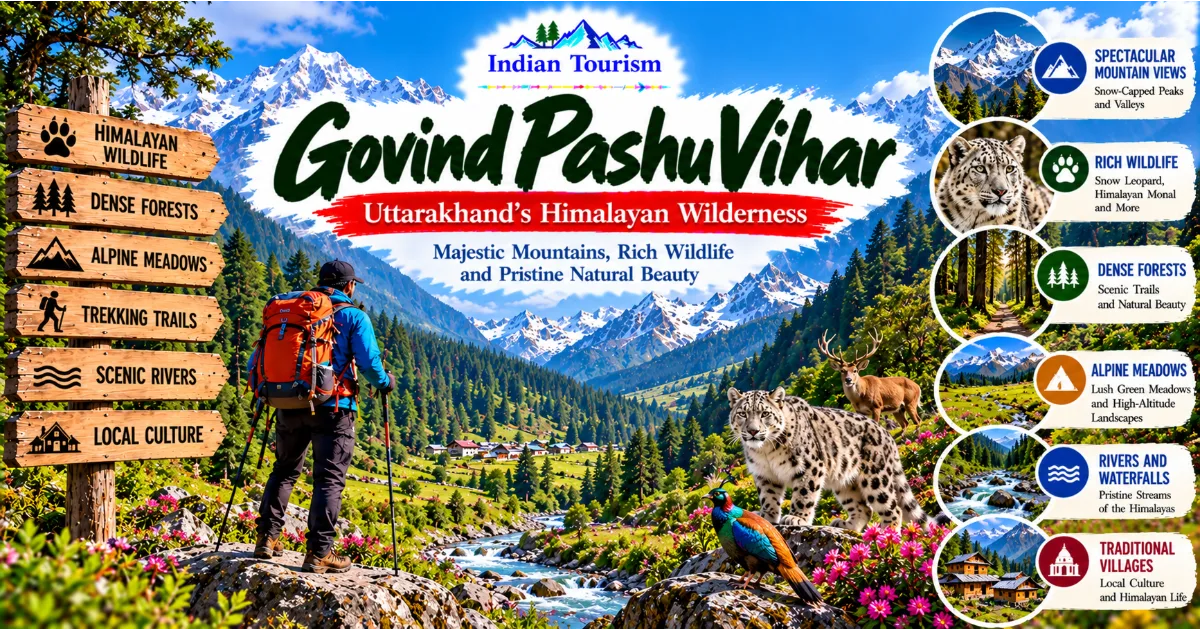
Govind Pashu Vihar National Park and Wildlife Sanctuary is a protected Himalayan landscape in Uttarkashi district, Uttarakhand, known for its forests, mountain valleys, wildlife habitats, and spectacular trekking routes.
Located in the upper Tons River region, this protected area offers travellers an opportunity to explore the natural diversity of the Garhwal Himalayas while discovering the importance of wildlife conservation and responsible mountain tourism.
Its landscapes include wooded slopes, alpine meadows, rushing streams, and remote mountain environments that appeal to nature lovers, trekkers, photographers, and conservation enthusiasts.
Introduction: Discovering a Protected Himalayan Landscape
Uttarakhand is home to some of India's most remarkable natural environments, ranging from river valleys and forested foothills to snow-covered Himalayan peaks. Among these landscapes, Govind Pashu Vihar occupies a special place because it combines ecological importance with opportunities for mountain exploration. Its protected forests and high-altitude habitats form part of a wider Himalayan ecosystem that supports wildlife, vegetation, rivers, and communities whose lives are closely connected to the mountains.
Continue Reading
Located in Uttarkashi district, the protected area is associated with the upper Tons valley and the mountain region around Sankri. It is widely known among trekkers because several popular routes, including trails towards Har Ki Dun and other high-altitude destinations, pass through or are associated with this landscape. However, the area's importance extends beyond trekking. It is also a place where conservation, biodiversity, traditional mountain life, and sustainable tourism intersect.
The landscape changes considerably with elevation. Lower slopes contain forest environments, while higher areas feature open meadows, rugged mountain terrain, and alpine habitats. Seasonal changes influence the appearance of the vegetation, the movement of water, and the accessibility of trekking routes. These variations make the protected area interesting throughout the year, although different seasons require different levels of preparation.
Visitors who explore Govind Pashu Vihar should understand that they are entering a natural environment rather than a conventional tourist park. Facilities can be limited in remote sections, wildlife sightings are unpredictable, and weather conditions may change rapidly. Respecting local rules, minimising waste, and following experienced guidance help protect both visitors and the fragile ecosystems that make this region special.
Where Is Govind Pashu Vihar Located?
Govind Pashu Vihar National Park and Wildlife Sanctuary is situated in Uttarkashi district in the Garhwal region of Uttarakhand. Its landscape forms part of the western Garhwal Himalayas, where mountain rivers, forested valleys, high ridges, and remote settlements create a varied natural environment.
The protected area is closely associated with the upper Tons River basin. The Tons River and its tributaries shape the surrounding terrain, carrying water through valleys and supporting vegetation across different elevations. The river system is also connected to the wider Yamuna basin, illustrating how mountain environments influence water resources far beyond the immediate region.
Sankri is an important gateway for travellers exploring this part of Uttarakhand. The village provides access to several trekking routes and serves as a useful base for arranging local transport, accommodation, and trekking support. From the Sankri region, routes lead towards forests, villages, meadows, and high-altitude landscapes associated with the protected area.
The precise location of individual trails, campsites, and access points varies according to the route being followed. Visitors should confirm current entry arrangements and trekking requirements before travelling. Some routes may have seasonal restrictions or require specific permissions, and conditions can change because of weather, trail damage, or conservation considerations.
The protected landscape is not a single viewpoint or a small recreational site. It covers a varied mountain environment in which forests, rivers, wildlife habitats, and high-altitude terrain form interconnected ecological systems. Understanding this geographical diversity helps visitors appreciate why conservation is important throughout the region.
Understanding the National Park and Wildlife Sanctuary
Govind Pashu Vihar is known as both a national park and wildlife sanctuary landscape. These designations reflect its importance for protecting natural habitats and wildlife in the Himalayan region. Although the names are often used together when discussing the destination, travellers should check the current official classification, boundaries, and rules applicable to the particular place they plan to visit.
Protected areas help conserve ecosystems that might otherwise face increasing pressure from development, resource extraction, uncontrolled tourism, and habitat disturbance. In mountainous environments, the effects of damage can be especially difficult to reverse because steep slopes, thin soils, and harsh weather can slow natural recovery.
The protected landscape includes different habitats that support a variety of plants and animals. Forests at lower elevations provide cover and food for wildlife, while higher areas offer different conditions for species adapted to colder temperatures and more exposed terrain. Rivers and streams connect these habitats and contribute to the wider ecological system.
Conservation does not mean that a landscape has no human history. Mountain communities have lived in and around these regions for generations, developing agricultural practices, local knowledge, and cultural relationships with the environment. Effective conservation needs to recognise both ecological needs and the legitimate interests of local communities.
For visitors, the most important principle is that access to a protected landscape comes with responsibilities. Rules about camping, waste, wildlife observation, forest access, and the use of local resources should be followed carefully. A visit becomes more meaningful when travellers understand that the purpose of conservation is to protect the environment for the long term, not simply to maintain an attractive setting for photographs.
The Upper Tons River and Its Natural Importance
The Tons River is an important geographical feature of the region surrounding Govind Pashu Vihar. Its waters move through deep Himalayan valleys, gathering contributions from streams that descend from higher slopes. The resulting river system helps shape the terrain and supports natural processes across the landscape.
Mountain rivers carry water, sediment, nutrients, and organic material from higher elevations towards lower valleys. Their flow patterns change with rainfall, snowmelt, and seasonal weather. These changes influence riverbanks, nearby vegetation, and the conditions encountered by people travelling through the region.
The river environment also supports a variety of habitats. Aquatic and waterside ecosystems depend on water quality, flow, temperature, and the condition of the surrounding land. Disturbance in one part of the system can affect other areas downstream, which is why protecting mountain catchments is important.
For travellers, the Tons valley provides beautiful scenery and a sense of the scale of the Himalayan landscape. Streams crossing rocky terrain, forested slopes rising above the water, and distant mountain ridges create opportunities for observation and photography. However, visitors should not assume that every stretch of water is safe to approach.
Riverbanks can be unstable, and water levels may rise quickly after heavy rain or snowmelt. Fast-flowing water can be dangerous even when it appears shallow. Trekkers should follow local guidance, avoid unnecessary crossings, and remain away from slippery rocks and unstable edges.
The river should also be treated as a vital natural resource rather than a place for waste disposal. Plastic, food scraps, detergents, and other pollutants can damage aquatic habitats and affect communities that depend on clean water. Responsible visitors carry their rubbish away and avoid activities that contaminate streams.
Forests of the Garhwal Himalayas
Forests form an important part of Govind Pashu Vihar's natural character. The vegetation varies with altitude, slope orientation, soil conditions, rainfall, and temperature. These differences create a changing landscape in which forest environments gradually transition towards more open mountain habitats.
At lower and middle elevations, visitors may encounter substantial forest cover, including coniferous trees and other vegetation suited to the local climate. Forest trails can provide shade, shelter from wind, and opportunities to observe the smaller details of the natural environment.
A forest is much more than a collection of trees. Its structure includes shrubs, grasses, fungi, insects, birds, mammals, and organisms living within the soil. These components interact through processes such as pollination, decomposition, seed dispersal, and nutrient cycling.
Trees help stabilise soil on many slopes, while roots and vegetation influence how water moves across the landscape. Forest cover can reduce some forms of erosion and provide habitats that support biodiversity. The health of the forest therefore affects more than the appearance of the scenery.
Seasonal changes create different experiences for visitors. Spring may bring fresh growth and flowering plants, while summer can produce greener landscapes. Autumn may change the appearance of some vegetation, and winter can introduce snow or frost at higher elevations.
Visitors should avoid breaking branches, carving into trees, collecting plants, or leaving rubbish along forest trails. These actions may seem minor when performed by one person, but their effects accumulate when many visitors use the same route.
Quiet observation is often the best way to appreciate the forest. Listening to birds, noticing differences in vegetation, and watching how light moves between the trees can reveal details that are easy to miss when rushing towards a destination.
Alpine Meadows and High-Altitude Habitats
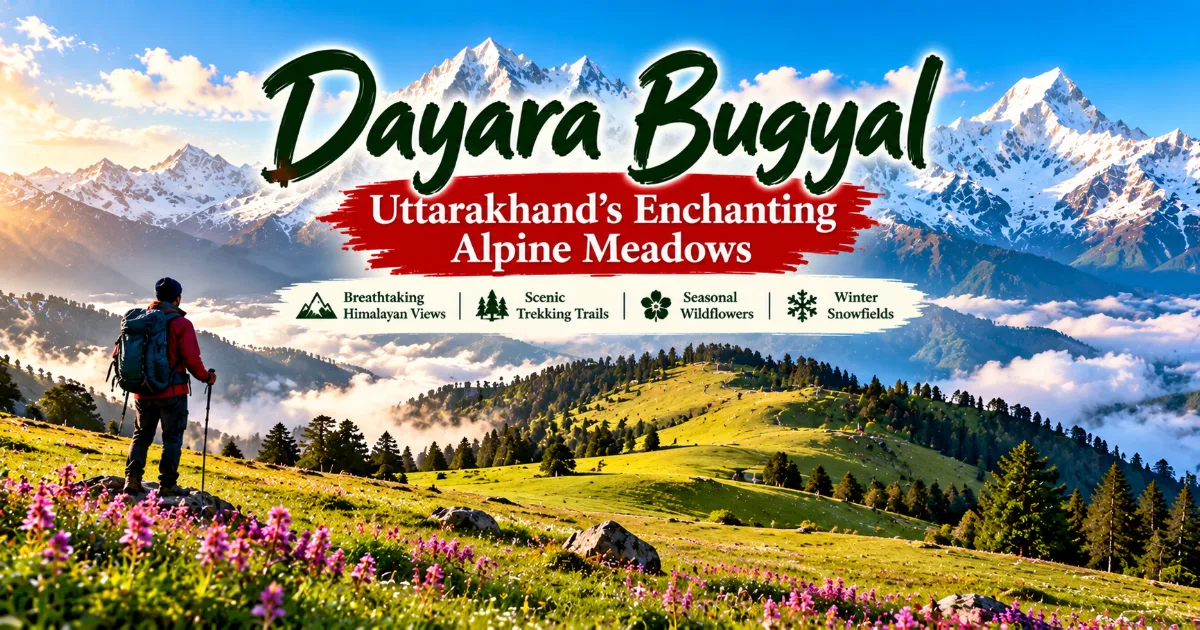
As the terrain rises, forests gradually give way in places to more open mountain landscapes. Alpine meadows and other high-altitude habitats form an important part of the protected region, creating environments that differ significantly from the wooded slopes below.
These landscapes may contain grasses, low-growing plants, shrubs, and seasonal flowers adapted to cold temperatures and short growing periods. Their appearance depends on elevation, rainfall, snow cover, and the time of year. Some areas may look lush during the growing season, while others remain rocky or snow-covered for long periods.
Alpine environments can appear resilient because they occupy dramatic mountain terrain, but many are ecologically sensitive. Plants may grow slowly, and damaged ground can take a long time to recover. Repeated trampling can affect vegetation, compact soil, and contribute to erosion.
Meadows may also have significance for local livelihoods, including seasonal grazing where permitted. Their use and management can reflect long-established relationships between mountain communities and the surrounding environment. Visitors should not assume that every open area is available for unrestricted camping or recreation.
The open landscape provides impressive views of surrounding ridges and valleys. On clear days, distant peaks can create a sense of scale that is difficult to experience in forested sections. Changes in cloud cover and sunlight may transform the appearance of the mountains within minutes.
Travellers should remain aware of weather and exposure. Open terrain can become cold and windy quickly, even when the day begins with comfortable temperatures. Warm clothing, rain protection, and careful route planning remain important.
Appreciating an alpine meadow means recognising its ecological value. Visitors should stay on established paths, avoid picking flowers, and leave the landscape undisturbed for wildlife, local communities, and future travellers.
Wildlife and Biodiversity
One of the major reasons for protecting Govind Pashu Vihar is the biodiversity associated with its varied Himalayan habitats. Differences in altitude and vegetation allow different species to occupy distinct ecological niches, creating a complex natural system.
The wider region is associated with Himalayan wildlife, including mammals and birds adapted to forested slopes and high-altitude environments. Species commonly discussed in relation to the broader protected landscape include Himalayan musk deer, Himalayan monal, and other mountain wildlife. The presence of a particular species at a particular location should never be assumed, and sightings depend on habitat, season, animal behaviour, and disturbance levels.
Mammals may be difficult to observe because many are naturally cautious and avoid people. Dense vegetation, steep terrain, and changing weather make wildlife detection challenging. Visitors should therefore avoid judging the value of a visit solely by whether they see a large animal.
Birdwatching can be rewarding because different forest types and elevations provide a variety of habitats. The colours, calls, and movements of birds may be easier to notice during quiet periods when the trail is less busy. Binoculars and a field guide can help interested visitors identify species without approaching them.
Wildlife conservation depends on protecting habitat as well as individual animals. Forest loss, disturbance, pollution, and poorly managed tourism can affect food availability, movement patterns, and breeding areas. Maintaining connected habitats helps wildlife move through the landscape and respond to seasonal changes.
Visitors should never feed wild animals, attempt to touch them, or move close for a photograph. Food waste can attract animals to campsites and settlements, creating risks for both wildlife and people. If an animal is encountered, maintaining distance and following local guidance are the appropriate responses.
The most rewarding wildlife experience is often one that does not involve a close encounter. A bird calling from the forest, tracks on a trail, or the sight of an animal moving naturally through its habitat can reveal the richness of the ecosystem without disturbing it.
Snow Leopards and the Importance of Himalayan Conservation
The snow leopard is one of the most recognisable animals associated with the high mountains of Asia. Its thick coat, powerful limbs, and long tail are adaptations to life in cold, rugged environments. The species has also become a symbol of the challenges involved in conserving wildlife across remote mountain landscapes.
Snow leopards inhabit suitable high-altitude areas of the Himalayas and other mountain ranges of Central and South Asia. However, their distribution is not uniform, and a visitor should not assume that the animals are present or readily observable at every Himalayan protected area.
In mountainous regions, snow leopards depend on suitable prey, connected habitat, and conditions that allow them to move across extensive territories. Conservation efforts can involve habitat protection, monitoring, research, and cooperation with communities whose livelihoods overlap with wildlife habitat.
The relationship between predators and livestock can create challenges for pastoral and mountain communities. Conservation approaches are more likely to succeed when they recognise local concerns and support practical ways to reduce conflict. Community participation can contribute to wildlife protection while helping households manage risks.
For visitors to Govind Pashu Vihar, the broader lesson is that wildlife conservation requires more than hoping to see rare animals. It depends on protecting the natural systems that allow species to survive, reducing disturbance, and supporting responsible management of the landscape.
Travellers should avoid spreading unverified claims about recent sightings or promising encounters that cannot be guaranteed. Responsible nature tourism communicates uncertainty honestly and focuses on the value of the habitat itself.
Even without seeing a snow leopard, visitors can appreciate the importance of maintaining healthy mountain ecosystems. The continued existence of wildlife depends on decisions made by authorities, researchers, local communities, and people who visit the region.
Birds of the Protected Landscape
The forests and mountain habitats of Govind Pashu Vihar offer opportunities for observing Himalayan birdlife. Birds occupy different ecological roles, from consuming insects and seeds to dispersing plants and contributing to food webs.
The Himalayan monal is one of the best-known birds associated with the broader Himalayan region. Its striking plumage makes it particularly recognisable, although seeing one in the wild is never guaranteed. The species illustrates the diversity of birdlife supported by mountain habitats.
Other birds may be associated with forests, open slopes, and higher elevations. The species encountered during a visit depend on the exact location, season, altitude, and habitat conditions. A visitor walking through a dense forest may observe different birds from someone travelling across an open meadow.
Birdwatching does not require expensive equipment. Patience, quiet movement, and attention to sound can be enough to begin appreciating birdlife. Binoculars can make observation easier, while a field guide can help identify birds by their shape, colour, calls, and behaviour.
Early morning can be productive for bird observation in many environments, although activity patterns vary by species and weather. Visitors should remain on established trails and avoid entering sensitive habitat to obtain a closer view.
Bird photography requires particular care. Approaching nests, disturbing breeding birds, or repeatedly playing recorded calls can create unnecessary stress. A good photograph is never more important than the welfare of the animal.
For travellers who enjoy learning about ecosystems, birds provide an accessible introduction to the protected area's biodiversity. Their presence can reveal differences between habitats and help visitors notice details that might otherwise be overlooked.
Har Ki Dun and the Wider Trekking Landscape
Govind Pashu Vihar is closely associated with Har Ki Dun, one of Uttarakhand's well-known multi-day trekking destinations. The Har Ki Dun route takes visitors through forested valleys, traditional settlements, streams, and open mountain landscapes, offering a gradual introduction to the natural and cultural character of the region.
The trek is attractive to people who want to experience the Himalayas through walking rather than simply viewing them from a road. The route changes as it moves through different elevations, allowing trekkers to observe variations in vegetation, terrain, and settlement patterns.
Har Ki Dun also offers an opportunity to understand the relationship between conservation and tourism. Trekking can provide income for local guides, accommodation providers, transport services, and other businesses. At the same time, increased visitor numbers can create pressure on trails, water resources, waste management, and sensitive habitats.
Responsible trekking requires careful planning and respect for local regulations. Visitors should confirm current access requirements, follow designated routes, and avoid leaving waste behind. They should also recognise that villages along the trail are living communities rather than places created solely for tourism.
The route's cultural dimension is as important as its scenery. Traditional settlements reveal how people have adapted to mountain conditions over generations. Agricultural practices, architecture, and local customs help explain the relationship between communities and the surrounding landscape.
Travellers should allow sufficient time to appreciate the journey instead of treating it only as a race towards a viewpoint. A slower approach makes it easier to notice wildlife signs, changing vegetation, village life, and the natural features that give the valley its distinctive character.
Har Ki Dun demonstrates how a protected landscape can support both recreation and conservation when visitors, local communities, and authorities work towards responsible use.
Bali Pass and High-Altitude Adventure
The Bali Pass Trek is another demanding route associated with the wider upper Tons and Yamunotri mountain region. Reaching approximately 4,950 metres, the pass offers experienced trekkers a challenging journey through remote valleys and high-altitude terrain.
Unlike lower forest walks, the Bali Pass route requires serious preparation. The elevation, steep slopes, exposure to weather, and potential presence of snow or ice can make the crossing demanding. A person's general fitness does not guarantee that they will respond well to high altitude.
The trek may involve long walking days and sections where movement requires specialist equipment and experienced guidance. Conditions can change rapidly, and a route that is manageable in one season may be significantly more difficult in another.
The association between Govind Pashu Vihar and high-altitude trekking highlights the variety of experiences available in the region. Visitors can explore forested routes and traditional villages, while experienced trekkers may choose more demanding mountain journeys when conditions permit.
However, the existence of a trekking route does not mean that every visitor should attempt it. People should choose a journey that matches their experience, physical preparation, equipment, and ability to respond to changing conditions.
For a high-altitude route such as Bali Pass, a reliable trekking operator, appropriate acclimatisation, and a clear emergency plan are essential. Trekkers should be willing to delay or abandon a crossing when weather, health, or terrain makes the journey unsafe.
Responsible adventure tourism recognises that mountain objectives are secondary to safety. The protected landscape should be appreciated through journeys that respect both the natural environment and the limits of the people travelling through it.
Local Communities and Traditional Mountain Life
The landscape surrounding Govind Pashu Vihar is not an untouched wilderness without human history. Communities have lived in the wider region for generations, developing ways of life shaped by elevation, climate, agricultural opportunities, and access to resources.
Mountain villages often reflect a close relationship between settlement patterns and geography. Homes are built where terrain allows, fields occupy suitable slopes or flatter areas, and paths connect households with neighbouring settlements and natural resources. The arrangement of a village can reveal how people have adapted to the limitations of the mountain environment.
Agriculture and livestock management remain important to many households in the wider region. The types of crops grown and the timing of agricultural work depend on local conditions. Seasonal activities influence daily routines and can determine when people travel, cultivate land, or manage animals.
Traditional knowledge can also include an understanding of weather patterns, plants, local water sources, and mountain routes. Such knowledge develops through experience and is often passed between generations. Visitors can learn from local guides and residents, provided they approach these interactions respectfully.
Tourism can create economic opportunities through guiding, transport, food services, accommodation, and the sale of local products. These benefits are not automatic, however. Their distribution depends on the way tourism is organised and the opportunities available to local businesses.
Travellers can contribute positively by using legitimate local services, paying agreed charges, respecting working environments, and avoiding intrusive photography. They should not assume that residents are available to provide information or entertainment simply because visitors have arrived.
The most meaningful cultural encounters occur when visitors recognise local people as individuals and community members rather than part of a tourist attraction. Respectful interaction can create a deeper understanding of mountain life while supporting a more responsible form of tourism.
Local Culture, Beliefs, and Himalayan Traditions
The Garhwal Himalayas contain a rich variety of religious practices, folk traditions, and local stories. Mountains, rivers, forests, and villages often hold cultural significance that extends beyond their geographical features.
The wider upper Tons region is associated with distinctive local traditions, including stories connected to the Mahabharata and worship practices that differ from those familiar to visitors elsewhere in India. These traditions demonstrate how large cultural narratives can be interpreted through local histories and community identities.
Visitors should approach religious traditions with respect and avoid treating unfamiliar practices as curiosities. A shrine or temple may have rules about entry, photography, clothing, or behaviour. Asking before entering a sacred space and following local instructions are simple ways to show consideration.
Local stories may connect particular mountains or valleys with divine figures, ancestral events, or moral lessons. Such narratives contribute to a community's relationship with the landscape and can help explain why certain places hold special meaning.
It is important to distinguish cultural belief from verified historical evidence without dismissing either. A traditional story can be meaningful because of its place in community life, even when it is not an independently documented historical account.
Cultural learning should also recognise variation. Practices may differ between villages, families, and religious settings, and there may be more than one interpretation of a story. Visitors should listen carefully rather than assuming that one account represents the entire region.
By learning about local culture alongside the natural environment, travellers gain a more complete understanding of Govind Pashu Vihar. The protected landscape is part of a living region where nature, livelihood, memory, and belief remain interconnected.
Best Time to Visit Govind Pashu Vihar
The best time to visit Govind Pashu Vihar depends on the activity planned, the altitude of the chosen route, and current weather and access conditions. A forest walk, a multi-day trek, and a high-altitude crossing may have very different seasonal requirements.
Spring can bring fresh vegetation and renewed activity across many parts of the region. Forests begin to develop new growth, and flowering plants may appear in suitable habitats. Temperatures can still be cold, especially at higher elevations and during the early morning.
Summer may offer greener landscapes and opportunities for trekking on routes that are accessible under prevailing conditions. However, the beginning and progression of the monsoon can bring heavy rainfall, slippery paths, cloud cover, landslides, and rising water levels.
The monsoon period requires particular caution in Uttarakhand. Mountain roads can be disrupted, trails may become unstable, and river crossings can become dangerous. Travellers should check current forecasts and follow local advice before deciding whether to proceed.
Autumn often brings cooler air and potentially clearer views in suitable weather. It can be an appealing period for landscape photography and trekking, although nights become cold as the season advances.
Winter changes the character of the higher terrain. Snow and ice may affect access, and some routes may become unsuitable for visitors without the necessary experience and equipment. Lower areas can also experience cold temperatures and travel disruptions.
There is no single season that guarantees ideal conditions across the entire protected area. Visitors should choose dates based on the actual route, the activity planned, and current guidance from local authorities or reputable operators.
How to Reach Govind Pashu Vihar
Travellers generally approach the upper Tons region through Uttarkashi district, with Sankri serving as an important gateway for many trekking routes. The journey involves reaching the wider region by road and then continuing towards the selected trailhead or settlement.
For visitors arriving from outside Uttarakhand, Dehradun is a common starting point for onward road travel into the mountains. The exact route and travel duration depend on the point of origin, road conditions, traffic, and weather. Mountain journeys can take longer than expected because of winding roads, narrow sections, and occasional disruptions.
Sankri provides a base for arranging transport, accommodation, and trekking support. However, not every part of Govind Pashu Vihar is directly accessible from the village. The route depends on the destination within the protected landscape and the permissions or arrangements required.
Before departure, visitors should confirm the current entry point, trekking itinerary, transport options, accommodation, and any applicable permits or registration requirements. These details may change, so recent local information is more reliable than an old travel account.
Public transport availability can vary, particularly for the final sections of a mountain journey. Travellers should confirm schedules and avoid relying on a very tight connection. Allowing extra time is sensible when roads may be affected by weather.
Mobile connectivity may be limited along remote trails. Keep important information accessible offline, carry a suitable power supply for essential devices, and tell a trusted person about the planned itinerary and expected return.
Visitors should also understand that the protected area is a large landscape rather than a single entrance with uniform facilities. Choosing a specific destination before travelling helps ensure that transport, permits, and walking arrangements are appropriate.
What to Pack for a Visit
Packing requirements depend on whether the visit involves a short nature walk, a village-based stay, a multi-day trek, or a high-altitude route. The common principle is to prepare for changing mountain weather while avoiding unnecessary weight.
Useful items may include:
Comfortable footwear with suitable grip for the intended route.
Layered clothing appropriate for the expected temperatures.
A waterproof jacket and protection for belongings during rain.
A refillable water bottle and a suitable method for treating water when necessary.
Sun protection, including sunglasses and sunscreen.
Personal medication and a basic first-aid kit.
A headlamp for journeys that may begin early or finish late.
A small bag for carrying rubbish back to an appropriate disposal point.
An offline map or other reliable route information.
Additional specialist equipment if required by the selected trek and current conditions.
High-altitude routes require more careful equipment planning than ordinary forest walks. Snow and ice may require technical equipment, and visitors should not attempt to use specialist gear without appropriate instruction.
Travellers should confirm which items are provided by a trekking operator and which must be carried personally. This avoids unnecessary duplication while ensuring that essential equipment is available.
Food and water arrangements should also be planned in advance, particularly for remote routes. Facilities may be limited, and visitors should not assume that food, safe drinking water, or charging points will be available at every stop.
A sensible packing list balances comfort, safety, and environmental responsibility. Carrying less can make walking easier, but essential protective and emergency items should never be omitted simply to reduce weight.
Responsible Tourism in a Protected Area
Responsible tourism is essential for maintaining the ecological value of Govind Pashu Vihar. The protected landscape supports wildlife, forests, rivers, and mountain communities, all of which can be affected by poorly managed visitor activity.
The first responsibility is to manage waste carefully. Visitors should carry out plastic wrappers, bottles, batteries, and other rubbish rather than leaving them along trails or at campsites. Waste should be disposed of only through suitable facilities.
Staying on established trails helps reduce erosion and protects vegetation. Creating shortcuts may damage fragile ground and encourage others to follow the same route. This can gradually widen paths and affect surrounding habitats.
Wildlife should be observed from a distance. Feeding animals, approaching them for photographs, or leaving food scraps can change their behaviour and create risks. Visitors should follow local instructions and avoid entering restricted areas.
Water sources require particular care. Avoid dumping waste or washing with detergents directly in streams. Clean water is important for both natural ecosystems and the communities living downstream.
Campfires should not be started unless local rules explicitly permit them and conditions are safe. Fires can damage vegetation, consume limited natural resources, and create wildfire risks.
Visitors should also respect local residents, cultural sites, and community rules. Ask permission before photographing people or private property, and use legitimate local services where possible.
Tourism can support conservation when it creates incentives to protect the landscape and provides fair opportunities for local livelihoods. However, tourism alone does not guarantee environmental protection. Visitors, businesses, communities, and authorities all have roles in ensuring that access remains compatible with conservation objectives.
The most responsible visit is one that allows people to enjoy the region while minimising unnecessary disturbance. Leaving the landscape clean, following local guidance, and respecting wildlife are practical actions that make a difference.
Photography Opportunities in Govind Pashu Vihar
The protected landscape offers varied photographic subjects, from forest trails and flowing streams to mountain ridges, open meadows, and traditional settlements. The diversity of habitats allows photographers to explore different compositions during the same journey.
Forests provide opportunities to photograph light filtering through trees, patterns in bark, vegetation on the forest floor, and the relationship between plants and the terrain. Streams create movement and texture, while distant mountain views can reveal the scale of the surrounding landscape.
Open meadows and higher viewpoints may offer broad panoramas when visibility is good. Cloud formations can add atmosphere, and changes in sunlight may create contrasts between illuminated ridges and shaded valleys.
Photographers should remain aware of safety while using cameras. Narrow paths, unstable rocks, steep slopes, and riverbanks are not suitable places to focus entirely on a screen. Secure equipment so that it does not interfere with balance or safe movement.
Wildlife photography requires additional care. Do not approach animals, disturb nests, block movement, or use food to attract wildlife. Respect any restrictions on photography in protected or sensitive locations.
Cultural photography should be equally respectful. Ask permission before photographing residents, homes, religious activities, or private spaces. Some people may not wish to be photographed, and their decision should be accepted without pressure.
A photograph can help communicate the beauty of Govind Pashu Vihar, but it should not come at the expense of the environment or the people who live there. Observing patiently and travelling responsibly produce more meaningful experiences than chasing a perfect image.
Why Conservation Matters for Future Generations
Mountain ecosystems are important for biodiversity, water systems, climate processes, and the livelihoods of communities across the Himalayan region. Protected landscapes such as Govind Pashu Vihar contribute to maintaining habitats and ecological relationships that extend beyond their boundaries.
Forests and other vegetation influence soil stability and the movement of water across slopes. Healthy habitats provide food, shelter, and breeding areas for wildlife. Rivers connect upper mountain environments with lower valleys, carrying water and sediment through wider catchments.
Climate change presents additional challenges for mountain environments. Changes in temperature, precipitation, snow cover, and the timing of seasonal events can influence vegetation, water availability, and wildlife habitats. The precise effects differ across locations and species, making continued research and monitoring important.
Tourism can add pressure when visitor numbers exceed the capacity of trails, campsites, waste systems, and local services. Uncontrolled construction or disturbance can damage habitats, while litter and pollution can affect both wildlife and communities.
Conservation requires a combination of measures, including habitat protection, scientific research, effective management, community participation, and responsible visitor behaviour. No single action can address every challenge, but each contributes to the wider effort.
Local communities should be recognised as important partners in conservation. Their knowledge of the landscape and their experience of changing conditions can help inform management decisions. Conservation programmes are more likely to be sustainable when they consider local livelihoods and provide meaningful opportunities for participation.
Visitors also have a role. Choosing responsible operators, respecting restrictions, reducing waste, and learning about the environment can support a culture of conservation.
Protecting Govind Pashu Vihar is not only about preserving a beautiful destination for future tourists. It is about maintaining a living Himalayan landscape whose ecological and cultural value extends far beyond any single visit.
Who Should Visit Govind Pashu Vihar?
Govind Pashu Vihar can appeal to a wide range of travellers, but the appropriate experience depends on individual interests, fitness, and preparation. Nature lovers may appreciate the forests and river valleys, while birdwatchers and wildlife enthusiasts may enjoy learning about the region's biodiversity.
Trekkers can explore routes associated with the upper Tons valley and the surrounding mountains. The difficulty varies considerably between routes, so visitors should select an itinerary suited to their experience rather than assuming that every trail has the same level of challenge.
Photographers may find opportunities to capture landscapes, vegetation, traditional settlements, and changing weather. Cultural travellers can learn about local architecture, agricultural practices, and regional traditions by visiting communities respectfully.
Families and casual visitors should choose accessible activities that match the abilities of everyone travelling. A short nature walk and a high-altitude trek are very different experiences, and a route should never be selected simply because it appears attractive in photographs.
People who expect luxury facilities, immediate road access to every viewpoint, or guaranteed wildlife sightings may find remote sections less suitable. Services can be basic, weather may disrupt plans, and nature does not operate according to a fixed schedule.
Visitors with health concerns should seek appropriate advice before attempting demanding mountain activities. High-altitude routes require additional caution, and physical fitness alone does not eliminate altitude-related risks.
The region is most rewarding for people who are curious, prepared, and willing to adapt. Whether the goal is a gentle introduction to Himalayan scenery or a demanding trek, responsible planning helps ensure that the experience remains enjoyable and safe.
Practical Travel Tips
Before visiting Govind Pashu Vihar, decide which part of the protected landscape you want to explore. The region contains different habitats and trekking routes, so a clear destination makes it easier to plan transport, accommodation, and the necessary permissions.
Check current information about access, trail conditions, weather, and local regulations. A route that was open during one season may be affected by snow, rainfall, landslides, or conservation restrictions at another time.
Allow flexibility in the itinerary. Mountain roads and trekking trails can be affected by weather, and attempting to maintain a rigid schedule may create unnecessary pressure. Extra time can help when transport is delayed or conditions require a change of plan.
Choose accommodation and trekking services that explain their arrangements clearly. Ask about meals, equipment, guide support, emergency procedures, and the facilities available along the route. Reliable information is particularly important for remote or high-altitude journeys.
Carry sufficient drinking water and follow safe water-treatment practices. Do not assume that clear streams are free from harmful microorganisms. Pack essential medication and keep important information available without relying on mobile connectivity.
Respect local communities and the natural environment. Ask before photographing people, follow instructions at religious sites, and carry rubbish back for proper disposal.
Finally, be realistic about your physical abilities. Choose a route that suits your experience, take appropriate breaks, and follow local advice when conditions change. The best travel experience is one that combines enjoyment with sound judgement.
Conclusion: Exploring Uttarakhand's Living Himalayan Wilderness
Govind Pashu Vihar offers a compelling view of the natural and cultural richness of the Garhwal Himalayas. Its forests, rivers, alpine meadows, wildlife habitats, and mountain routes reveal a landscape shaped by elevation, weather, water, and the relationships between people and nature.
For trekkers, the region provides access to memorable journeys through changing terrain. For wildlife enthusiasts, it offers an opportunity to learn about the ecosystems that support Himalayan species. For cultural travellers, the surrounding settlements reveal how mountain communities have adapted to their environment over generations.
The protected landscape also carries responsibilities. Its ecological value depends on conserving habitats, managing human activity, protecting water sources, and respecting the needs of local communities. Visitors can contribute by following local rules, minimising waste, avoiding disturbance to wildlife, and choosing responsible travel services.
No single visit can reveal every aspect of such a varied region. Weather may limit visibility, wildlife may remain hidden, and some routes may be inaccessible at particular times. These limitations are part of travelling in a living mountain environment, not reasons to overlook its value.
Govind Pashu Vihar is worth discovering with patience and preparation. It reminds travellers that the Himalayas are not simply a collection of scenic viewpoints. They are complex ecological systems and living cultural landscapes that deserve long-term protection.
By approaching the region thoughtfully, visitors can enjoy its natural beauty while supporting the wider goal of preserving Uttarakhand's Himalayan wilderness for future generations.
Topic Tags: Govind Pashu Vihar, Uttarakhand Tourism, Himalayan Wildlife, Nature Conservation, Garhwal Himalayas
#GovindPashuVihar #UttarakhandTourism #IndianTourism #HimalayanWildlife #NatureConservation