
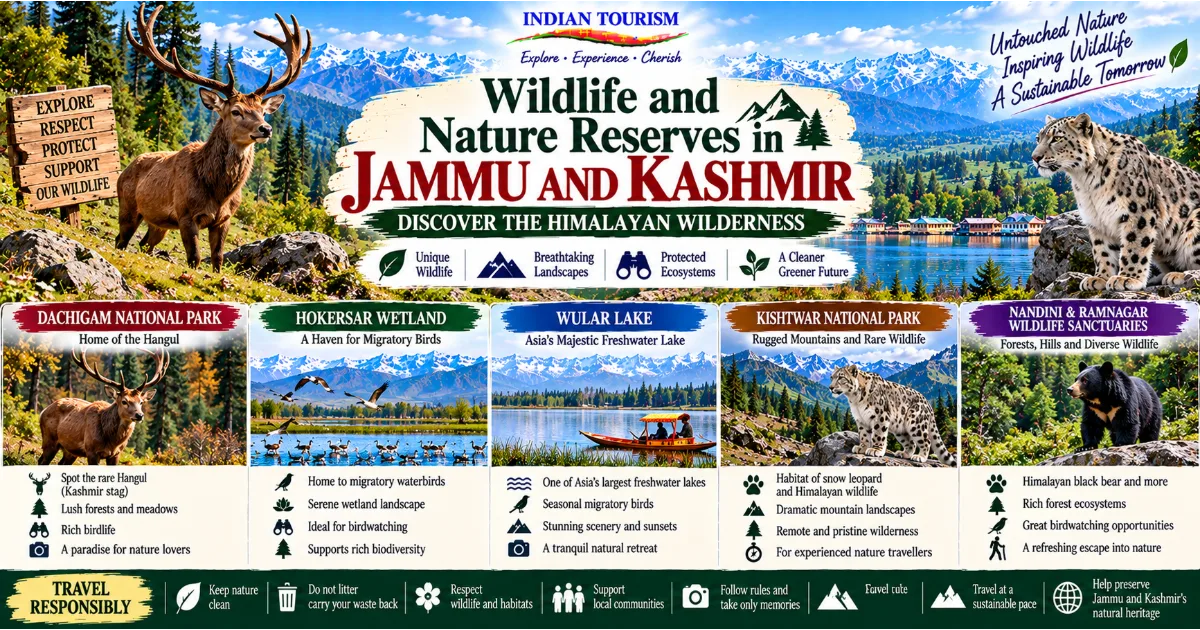
Explore the Wild Side of Jammu and Kashmir
Jammu and Kashmir is widely celebrated for its snow-covered mountains, sparkling lakes, green meadows, traditional villages and historic cultural landmarks. Beyond these familiar attractions lies another remarkable dimension of the region: its wildlife, forests, wetlands, alpine ecosystems and protected natural landscapes.
From the high-altitude habitats of the Himalayas to the wetlands surrounding the Kashmir Valley, Jammu and Kashmir supports a diverse range of plants and animals. Its changing elevation creates different environments within relatively short geographical distances. Forested hills, river valleys, grasslands, alpine meadows and wetlands each provide habitats for species adapted to their particular conditions.
The region is especially significant for wildlife enthusiasts because it includes habitats associated with the endangered Hangul, or Kashmir stag, the elusive snow leopard, Himalayan black bears, musk deer, mountain birds and numerous migratory waterbirds. Some animals are rarely seen, even by experienced visitors, while others may be observed more easily in suitable habitats and seasons.
Nature tourism provides opportunities to learn about these environments, appreciate wildlife and understand the importance of conservation. Visitors can explore designated nature trails, observe birds in wetlands, discover forest landscapes with authorised guides and learn about the ecological importance of protected areas.
However, wildlife tourism requires patience and respect. Animals do not follow sightseeing schedules, and their welfare must take priority over photographs. Entering restricted habitats, feeding wild animals, making excessive noise or leaving waste behind can cause harm. Responsible visitors recognise that a successful wildlife experience is not measured by how many animals they see, but by how thoughtfully they observe the natural world.
This guide explores the wildlife and nature reserves of Jammu and Kashmir, including major protected landscapes, important species, birdwatching opportunities, seasonal considerations and practical advice for responsible nature travel.
1. Understanding the Natural Diversity of Jammu and Kashmir
The ecological diversity of Jammu and Kashmir is closely connected to its geography. Elevation, temperature, rainfall, snowfall and vegetation change across the region, creating a wide variety of habitats.
Lower valleys and forested hills support different plants and animals from the high-altitude areas near the Himalayan ranges. Wetlands provide feeding and resting grounds for waterbirds, while alpine meadows offer seasonal vegetation for herbivores. Dense forests provide shelter for mammals and birds that depend on woodland habitats.
This diversity means that wildlife experiences vary considerably between destinations. A visitor exploring a wetland near Srinagar may encounter waterbirds, while someone visiting a high-altitude landscape may be interested in signs of mountain wildlife. A forest walk in Jammu may reveal a different combination of vegetation and birdlife from a meadow in the Kashmir Valley.
Forest ecosystems
Forests are essential to the ecological health of the region. They provide habitat for wildlife, help regulate water flows, protect soil from erosion and contribute to the broader mountain environment.
Different forest types occur according to elevation, exposure and local climate. Coniferous trees are prominent in many mountain landscapes, while other areas support mixed forests and broadleaf vegetation.
Forest ecosystems can be affected by habitat fragmentation, fires, waste, infrastructure development and disturbance caused by human activity. Responsible tourism should therefore focus on using permitted routes, preventing fires, avoiding litter and following guidance from forest authorities.
Alpine meadows
Alpine and subalpine meadows are among the most visually striking landscapes in Jammu and Kashmir. During suitable seasons, they may display green grasses, seasonal flowers and expansive mountain views.
These areas are also important ecological habitats. Grazing animals, insects, birds and other wildlife depend on vegetation and the seasonal availability of food.
Meadows should not be treated simply as open spaces for unrestricted recreation. Repeated trampling, vehicle movement and careless waste disposal can damage sensitive vegetation. Visitors should remain on designated paths and follow local access restrictions.
Wetlands and freshwater habitats
Wetlands provide valuable habitat for resident and migratory birds. They can support feeding, resting and breeding activities while contributing to water storage and ecological processes.
The wetlands of the Kashmir Valley are especially important for birdwatching. Their seasonal character means that the number and types of birds present can change throughout the year.
Wetland conservation depends on water quality, habitat protection, appropriate land management and careful control of disturbance. Visitors can contribute by observing birds quietly, avoiding sensitive areas and never throwing waste into the water.
2. Dachigam National Park: A Major Wildlife Destination
<escape>Dachigam National Park</escape> is one of the best-known protected areas in Jammu and Kashmir. Located near Srinagar, it is particularly important for the conservation of the Hangul, also known as the Kashmir stag.
The park's landscape includes forested slopes, mountain streams, grasslands and varied vegetation. Changes in elevation create different habitats within the protected area, supporting a range of wildlife.
For nature enthusiasts visiting Srinagar, Dachigam offers an opportunity to learn about the region's ecological heritage without travelling to a distant mountain district. However, entry arrangements, permitted routes and visitor access must be confirmed through the relevant authorities before a visit.
The Hangul: A symbol of Kashmir's wildlife
The Hangul is a distinctive deer associated with the Kashmir Valley and is one of the region's most important conservation priorities. Its survival depends on suitable habitat, effective protection and the management of pressures affecting its population.
The species has faced serious conservation challenges, making the protection of its remaining habitat especially important. Habitat disturbance, fragmentation and other ecological pressures can affect wildlife populations, although the significance of each threat varies over time and by location.
Dachigam is closely associated with efforts to protect the Hangul. Conservation work requires habitat management, monitoring, research and cooperation among authorities and local communities.
Visitors should not expect to see a Hangul simply because they enter the park. Wildlife sightings depend on season, habitat conditions, animal behaviour and access restrictions. The more responsible objective is to appreciate the protected landscape and understand why conservation matters.
Other wildlife in Dachigam
Dachigam supports other mammals and birds associated with Himalayan forest environments. Depending on the habitat and conditions, the wider region may support Himalayan black bears, leopards and various forest birds.
Animals are naturally cautious around people, and many remain hidden for much of the day. A quiet walk with an authorised guide may provide an opportunity to learn about animal tracks, vegetation and ecological relationships even when no large mammal is visible.
Planning a visit
Because Dachigam is a protected area, visitors should check current access rules, opening arrangements and any seasonal restrictions before travelling. Do not assume that all trails are open or that independent entry is permitted.
Wear suitable footwear and weather-appropriate clothing. Follow instructions from park staff, avoid making noise and never leave food or waste behind.
Photography should be conducted without disturbing animals or obstructing other visitors. Do not attempt to approach wildlife for a closer photograph.
3. The Hangul and the Importance of Wildlife Conservation
The Hangul deserves special attention because it represents both the ecological significance of the Kashmir Valley and the challenges involved in conserving threatened wildlife.
The species is associated with forested and mountainous habitats, where access to food, suitable cover and relatively undisturbed landscapes is important. Its conservation depends on understanding how animals use their habitat and how human activities affect their movement and survival.
Why habitat protection matters
Wildlife requires more than a protected boundary on a map. Animals need appropriate vegetation, water, shelter and the ability to move through suitable habitat.
If habitat becomes fragmented or heavily disturbed, a species may struggle even when part of its former range remains intact. Conservation therefore involves protecting the quality and connectivity of habitats as well as preventing direct harm to individual animals.
The role of scientific monitoring
Wildlife monitoring helps researchers and authorities understand population trends, habitat use and emerging threats. Field observations, camera-based monitoring and other scientific methods can contribute to conservation planning when used appropriately.
Population estimates can vary according to survey methods and the period in which data are collected. Visitors should rely on current information from credible wildlife authorities rather than repeating unverified figures encountered in travel discussions.
How travellers can help
Visitors can support Hangul conservation by following park rules, avoiding off-trail movement and respecting wildlife viewing restrictions. Choosing knowledgeable guides and supporting responsible nature tourism can also help increase awareness of the importance of protected habitats.
Do not attempt to locate animals by following tracks into restricted areas or pressuring local guides to guarantee a sighting. Conservation should always take priority over the expectations of a tourist.
4. Kishtwar National Park: A Mountain Wilderness
Kishtwar National Park lies in the Jammu region and is associated with rugged mountain terrain, deep valleys and high-altitude habitats. Its landscape is very different from the accessible meadows and urban attractions that many visitors associate with Jammu and Kashmir.
The park's mountainous environment is important for wildlife adapted to steep slopes, forests and high elevations. The broader region is associated with species such as the snow leopard, Himalayan black bear, musk deer and other mountain wildlife, although the presence and likelihood of seeing any species depend on the precise habitat and current ecological information.
Kishtwar National Park is particularly relevant to travellers interested in remote landscapes, biodiversity and the challenges of conservation in mountainous areas.
Why the landscape is important
Mountain habitats can be difficult to access and study. Steep terrain, changing weather and long distances create challenges for wildlife monitoring and visitor management.
These landscapes also provide ecological functions beyond wildlife habitat. Forests and mountain catchments contribute to water systems, while vegetation helps stabilise soil and support a range of organisms.
Protecting these areas requires a balance between conservation, community needs and carefully managed access.
Wildlife viewing expectations
A visit to a remote mountain area should not be planned around guaranteed sightings of rare animals. Many species are elusive, naturally occur at low densities or use habitats that are difficult to reach safely.
Visitors may learn more from the landscape itself, including vegetation, mountain geology, birdlife and signs of wildlife, than from a direct encounter with a large mammal.
Before planning a trip, confirm whether visitor access is permitted, what local arrangements are available and whether a qualified guide is necessary. Do not assume that the park has the same tourism infrastructure as a major national park elsewhere in India.
Safety and preparation
Remote mountain travel requires careful preparation. Check current access conditions, weather information and local travel guidance. Carry suitable clothing, water, food, communication equipment and essential supplies appropriate to the route.
Avoid entering remote areas without reliable information about the terrain and transport arrangements. If local authorities advise against travel, postpone the visit.
5. Hemis-Style High-Altitude Wildlife Experiences in the Himalayan Region
High-altitude wildlife experiences in the Himalayas are often associated with the search for the snow leopard. In Jammu and Kashmir, this interest is relevant to mountainous landscapes where the species may occur, including parts of the broader high-altitude region.
The snow leopard is a highly elusive mountain cat adapted to cold, rugged environments. Its camouflage, wide-ranging movements and preference for difficult terrain make it challenging to observe.
Travellers should distinguish between a destination that supports high-altitude wildlife and a formally established wildlife-viewing programme. Not every mountain region offers organised snow leopard tourism, and access to particular areas may be restricted or unsuitable for visitors.
Understanding the snow leopard
The snow leopard is adapted to rocky slopes and mountain environments where prey availability and habitat conditions influence its distribution. Its conservation is connected to the protection of mountain ecosystems and the management of pressures affecting both the predator and the animals on which it depends.
Threats can include habitat disturbance, conflict with livestock owners, changes in prey availability and other pressures that vary by location. Conservation efforts may involve research, habitat protection and cooperation with communities living near wildlife areas.
Responsible observation
Visitors interested in snow leopards should work with credible wildlife specialists or authorised local operators where such experiences are available. They should not assume that sightings can be guaranteed.
Never chase an animal, use excessive noise or attempt to approach it for a photograph. Do not ask a guide to enter restricted terrain or disturb wildlife to improve the chance of a sighting.
In many cases, a responsible wildlife experience means observing from a distance, learning about the species and accepting that the animal may remain unseen.
6. Wetlands of the Kashmir Valley: A Paradise for Birdwatchers
The Kashmir Valley contains wetlands that provide habitat for numerous resident and migratory birds. These areas can be especially rewarding for visitors who enjoy birdwatching, photography and quiet observation.
Wetlands are not merely scenic water bodies. They support ecological processes, provide food and shelter for birds and other wildlife, and form part of the wider landscape used by local communities.
The birdlife present at any particular wetland changes according to season, water levels, vegetation and migration patterns.
Hokersar Wetland
Hokersar Wetland, near Srinagar, is one of the important wetland habitats associated with migratory birds in Kashmir. During suitable periods, the wetland can attract waterbirds travelling along migration routes.
The site is particularly relevant to birdwatchers interested in seasonal bird movements and wetland ecology. However, bird numbers and species vary throughout the year, and visitors should check current local conditions before planning a visit.
Observe birds from permitted locations and avoid entering areas where access is restricted. Wetland vegetation and shallow-water habitats can be sensitive to disturbance.
Wular Lake
Wular Lake is one of the major freshwater lakes in the region and forms an important part of the wider ecological landscape of Kashmir. Its size, surrounding wetlands and connection to local livelihoods make it significant beyond its value as a visitor attraction.
The lake and associated habitats support a range of birdlife, although specific sightings depend on season and conditions.
Visitors should respect local fishing activities, avoid littering and follow guidance concerning boating and access. The lake is a working environment for surrounding communities, so tourism should not interfere unnecessarily with their activities.
Shallabugh Wetland Conservation Reserve
Shallabugh is another important wetland area associated with bird habitat in the Kashmir Valley. It can be of interest to birdwatchers and people seeking to understand the ecological importance of wetlands.
As with other protected or sensitive wetland environments, visitors should check current access arrangements and avoid disturbing birds, particularly in areas used for feeding or breeding.
The best wildlife experience may involve quiet observation with binoculars rather than attempting to move closer to the birds.
7. Birdwatching in Jammu and Kashmir
Birdwatching is one of the most accessible ways to experience the region's biodiversity. It does not always require long treks or specialised equipment, although good preparation can improve the experience.
Birds can be observed in wetlands, forests, meadows, agricultural landscapes and other suitable habitats. The variety of species depends on location, elevation, season and the availability of food and shelter.
What makes the region attractive to birdwatchers?
The contrast between wetlands and mountain environments creates opportunities to observe different bird communities. Waterbirds may be found in suitable wetland habitats, while forests support woodland birds and higher elevations offer different species adapted to mountain conditions.
Migratory birds add a seasonal dimension to birdwatching. Their arrival and departure depend on weather, ecological conditions and migration patterns, so sightings cannot be guaranteed on a particular date.
Equipment for birdwatching
Binoculars can make it easier to observe birds without approaching them. A field guide or reliable bird identification application may help visitors learn the names and characteristics of different species.
A notebook can be useful for recording observations, including location, time, habitat and identifying features. Beginners do not need expensive equipment to enjoy the activity.
Photography should never take priority over the welfare of birds. Avoid using playback sounds excessively or moving close to nests to obtain a photograph.
Birdwatching etiquette
Move quietly and remain at a respectful distance. Do not feed birds or disturb nesting areas. Follow local instructions and stay on permitted paths.
If you join a guided birdwatching experience, ask the guide about the best way to observe wildlife without disturbing it. Responsible birdwatching combines curiosity with restraint.
8. Wildlife of Jammu: Forests, Hills and Protected Habitats
The Jammu region includes forests, river valleys, foothills and mountain environments that support a range of wildlife. Its ecological character differs from that of the Kashmir Valley, providing opportunities to understand another dimension of Jammu and Kashmir's biodiversity.
Wildlife experiences in the region may include birdwatching, forest interpretation and visits to authorised protected areas. The species present depend on the location, elevation and habitat conditions.
Nandini Wildlife Sanctuary
Nandini Wildlife Sanctuary is located in the Jammu region and is associated with forest habitats and wildlife conservation. Its proximity to Jammu makes it a potentially relevant destination for travellers interested in nature near the city, subject to current access arrangements.
Visitors should verify whether the sanctuary is open, what routes are permitted and whether guided visits are available. Do not assume that a protected area automatically offers a developed tourist trail or guaranteed wildlife sightings.
Ramnagar Wildlife Sanctuary
Ramnagar Wildlife Sanctuary is another protected area in the Jammu region. Its forest environment contributes to the wider network of habitats that support regional biodiversity.
A visit should be planned with attention to current rules, road access and safety guidance. Visitors should remain on authorised routes and avoid activities that could disturb wildlife or damage vegetation.
Why forest conservation matters
Forests provide shelter, food and breeding habitat for many species. They also help protect soil, support water systems and contribute to the resilience of mountain landscapes.
Forest conservation is influenced by land use, fire management, infrastructure, grazing practices and other factors. Responsible visitors can help by preventing litter, avoiding unauthorised fires and respecting the instructions of forest authorities.
9. The Snow Leopard: An Elusive Icon of the Mountains
The snow leopard is among the most fascinating animals associated with high mountain ecosystems. Its ability to move across steep, rocky terrain and blend into its surroundings has earned it a reputation as one of the most difficult large mammals to observe in the wild.
For wildlife enthusiasts, the possibility of seeing a snow leopard can be exciting. However, travellers should understand that its presence in a broader mountain region does not guarantee that a particular site is suitable for wildlife viewing.
Adaptations to high-altitude life
Snow leopards possess physical characteristics suited to cold, rugged environments. Their thick fur, long tail and powerful limbs help them navigate challenging terrain and cope with mountain conditions.
Their natural behaviour is generally secretive. They may travel across large areas while remaining difficult to detect, even when signs of their presence are known.
Conservation challenges
The conservation of snow leopards depends on healthy mountain habitats and the availability of suitable prey. Human-wildlife conflict can arise when predators attack livestock, creating challenges for local communities.
Conservation approaches may include research, habitat protection and measures that help reduce conflict. The appropriate solutions differ according to local conditions and community needs.
How tourists should behave
Visitors should never attempt to track a snow leopard independently in unfamiliar terrain or follow an animal into unsafe areas. Any organised wildlife observation should follow current rules and rely on knowledgeable, responsible practitioners.
Do not demand a sighting as part of a paid trip. Wildlife is unpredictable, and ethical operators should explain the limits of observation clearly.
10. Himalayan Black Bears and Other Mountain Mammals
The Himalayan black bear is associated with forested habitats in parts of the Himalayan region, including areas of Jammu and Kashmir. It is a powerful wild animal that should be treated with caution and respect.
Bear sightings are not guaranteed, and travellers should never attempt to attract an animal with food. Feeding wildlife can change natural behaviour and create dangerous interactions between animals and people.
Avoid attracting wildlife
Store food securely where camping or staying in areas with relevant wildlife risks. Do not leave food waste around accommodation or picnic sites.
If local authorities provide guidance about bear activity, follow it carefully. Do not approach an animal for a photograph, and do not attempt to drive it away yourself.
Other mountain wildlife
Depending on habitat and elevation, the region may support species such as musk deer, leopards, foxes, marmots and other mammals. The distribution and abundance of these animals vary, and some are difficult to observe.
A responsible nature visit should focus on understanding habitat and behaviour rather than compiling a checklist of sightings.
11. Musk Deer and the Importance of Forest Habitats
Musk deer are associated with forested and mountainous habitats in parts of the Himalayan region. They are generally elusive animals, and their survival depends on suitable habitat and effective protection.
The term musk deer refers to a group of species known for distinctive biological characteristics. Their conservation is important because some populations have been affected by hunting and pressures on their habitats.
Protecting suitable habitat
Musk deer require environments that provide food, shelter and suitable conditions for survival. Changes to forest structure, human disturbance and other pressures can affect their ability to thrive.
Visitors can contribute by avoiding restricted areas, remaining on permitted trails and respecting forest management instructions.
Avoid wildlife product purchases
Travellers should never buy products made from protected wildlife or materials of uncertain legality. Wildlife trade can create pressure on vulnerable species.
If a souvenir appears to contain animal parts or products associated with protected species, choose a different item unless its legality and origin can be reliably established.
12. Nature Walks and Forest Trails
Nature walks provide an accessible way to explore Jammu and Kashmir's landscapes without requiring a demanding trek. A suitable walk can introduce visitors to vegetation, birds, streams, mountain views and the relationships between different habitats.
The quality of the experience depends on choosing a route appropriate to the season, weather and the visitor's abilities.
Choose suitable routes
Ask local authorities, accommodation hosts or qualified guides about permitted trails. Check whether the route is open and whether any special requirements apply.
Avoid entering private land or restricted forest areas without permission. A path visible on a map may not be an authorised public route.
Observe the smaller details
A nature walk does not need a large animal sighting to be rewarding. Visitors can notice changes in vegetation, bird calls, insects, stream conditions and the relationship between forest and meadow habitats.
Taking time to observe the landscape can create a deeper appreciation of the region's ecology.
Prepare for changing conditions
Wear suitable footwear and clothing. Carry drinking water, weather protection and essential supplies according to the route.
Mountain weather can change quickly, so avoid setting out on a demanding walk without checking conditions. Inform someone of your plan if you are walking in a remote area.
13. Best Time for Wildlife and Nature Tourism
There is no single best season for every wildlife destination in Jammu and Kashmir. The right time depends on the species you hope to observe, the habitat, accessibility and your preferred activities.
Spring: March to May
Spring brings changing temperatures and renewed vegetation in many locations. It can be a suitable period for nature walks and observing the seasonal activity of birds, depending on the destination.
Higher elevations may remain cold or experience snow, while lower areas may become more accessible. Visitors should check current weather and road conditions before travelling.
Summer: June to August
Summer is popular for mountain scenery, forest walks and visits to accessible natural areas. Some higher routes become easier to reach, although conditions remain variable.
Popular destinations can be busy, and rainfall may affect trails or roads. Book accommodation where necessary and allow flexibility in your itinerary.
Autumn: September to November
Autumn can provide pleasant conditions for selected outdoor activities and opportunities to observe seasonal changes in vegetation. It may also coincide with interesting birdwatching periods in suitable wetlands.
Nights become colder as the season progresses, and higher areas may experience early winter conditions. Check access information before travelling.
Winter: December to February
Winter can transform the region's forests, mountains and meadows. It may offer distinctive scenery, but cold temperatures, snowfall and access restrictions can make some wildlife areas difficult to reach.
Birdwatching opportunities vary by wetland and season. Before visiting a protected area, confirm that it is open and that the relevant facilities are available.
14. Responsible Wildlife Photography
Wildlife photography can encourage interest in conservation, but it can also create pressure on animals when photographers seek close encounters or dramatic images.
A responsible photographer understands that the animal's welfare is more important than the photograph.
Use distance rather than pursuit
Binoculars and suitable camera lenses allow observation from a distance. Do not chase animals, surround them or attempt to make them move into a better position.
If an animal changes its behaviour because of your presence, you may already be too close. Increase the distance and follow local guidance.
Avoid disturbing nests and breeding sites
Birds and other animals may be particularly sensitive during breeding periods. Never approach nests or dens to obtain a photograph.
Do not remove vegetation or move natural objects to improve a composition. A wildlife photograph should not require damaging the habitat.
Follow photography restrictions
Some protected areas may limit camera equipment, photography locations or visitor movement. Confirm the rules before entering.
Avoid using drones unless their use is specifically permitted. Drones can disturb wildlife and may be subject to additional legal or safety restrictions.
Share images responsibly
When posting wildlife photographs, avoid revealing the precise location of sensitive species if doing so could encourage disturbance. Follow the advice of conservation authorities and knowledgeable wildlife practitioners.
15. Responsible Camping and Outdoor Recreation
Camping can provide a close connection with the natural environment, but it requires careful preparation and compliance with local rules.
Not every meadow, forest or lakeside area is suitable for camping. Some locations may be protected, privately owned or subject to seasonal restrictions.
Confirm whether camping is permitted
Use authorised campsites or locations where camping is explicitly allowed. Ask about fire rules, sanitation, waste collection and any restrictions on access.
Do not assume that an empty area is available for public use. Obtain permission where necessary.
Manage waste properly
Carry rubbish out and avoid leaving food scraps. Waste can attract animals, alter their behaviour and create risks for both wildlife and people.
Human waste must also be managed responsibly according to the local rules and conditions. Use designated facilities where available and follow guidance from qualified outdoor leaders.
Avoid unsafe fires
Never light a fire in a prohibited area or during conditions that create a risk of spreading flames. Use permitted equipment and follow local fire-safety guidance.
Extinguish any authorised fire completely and ensure that no embers remain. In many situations, avoiding an open fire altogether is the safer choice.
Respect the night environment
Keep noise and artificial lighting to a reasonable level. Bright lights and loud activity can affect wildlife and disturb other visitors.
A responsible camping experience should leave the location in the same condition, or better condition, than it was found.
16. How Tourism Can Support Conservation
Tourism can contribute to conservation when it is carefully planned and local communities share in its benefits. Visitor spending may support guides, accommodation providers, transport operators and other workers whose livelihoods are connected to nature tourism.
Tourism can also create opportunities for environmental education. Visitors who learn about the Hangul, wetlands, forests and mountain wildlife may become more aware of the importance of habitat protection.
However, tourism does not automatically protect nature. Poorly managed visitor activity can damage habitats, increase waste and create pressure on local resources.
Choose operators who respect wildlife
Ask how a wildlife tour is conducted and whether the operator follows relevant rules. Avoid providers who promise guaranteed sightings of rare animals or encourage visitors to approach wildlife closely.
Responsible operators should explain that animals are unpredictable and that some locations may be restricted.
Support local conservation awareness
Where legitimate programmes or educational activities are available, visitors may choose to support them through appropriate participation or donations. Confirm the identity and purpose of an organisation before contributing.
Do not assume that every activity advertised as conservation-focused has a measurable environmental benefit. Ask for clear information about its purpose and how funds or resources are used.
Recognise the importance of communities
People living near wildlife habitats may experience both benefits and challenges associated with conservation. Their knowledge, needs and participation are important to long-term protection.
Visitors should avoid blaming local communities for environmental problems without understanding the wider circumstances. Responsible conservation requires cooperation, appropriate infrastructure and fair consideration of local livelihoods.
17. A Five-Day Wildlife and Nature Itinerary
A short nature-focused holiday can introduce travellers to the protected landscapes and wildlife habitats of Jammu and Kashmir. The following itinerary is illustrative and should be adapted according to current access rules, transport conditions and seasonal information.
Day One: Arrive in Srinagar
Arrive in Srinagar and settle into suitable accommodation. Use the day to explore the city and prepare for the nature-focused part of the trip.
Confirm access arrangements for the protected areas you hope to visit. Ask about current weather, transport and any restrictions that may affect your plans.
Day Two: Explore Dachigam's Natural Heritage
If access is permitted and arrangements are available, visit Dachigam National Park to learn about its habitats and the conservation of the Hangul.
Follow the instructions of park staff and any authorised guide. Do not expect guaranteed wildlife sightings, and use the visit to understand the park's ecological significance.
Day Three: Discover Wetland Birdlife
Plan a visit to a suitable wetland such as Hokersar, Wular Lake or another accessible site, after confirming current conditions and entry arrangements.
Bring binoculars if available and observe birds quietly from permitted areas. Avoid disturbing feeding or resting birds and take all waste away with you.
Day Four: Explore a Suitable Forest or Mountain Landscape
Choose an accessible forest, meadow or nature trail appropriate to the season. A guided walk can help you understand local vegetation, birdlife and the relationship between the landscape and nearby communities.
Check the weather before leaving and avoid routes that exceed your experience.
Day Five: Review and Return
Allow time for a relaxed morning, a final local meal and your onward journey. Avoid adding a long excursion if it would create unnecessary travel pressure or risk missing a departure.
The itinerary can be adjusted for families, birdwatchers and experienced nature travellers. The most important principle is to choose suitable destinations and follow local guidance rather than attempting to visit every protected area in a short period.
18. Practical Safety Advice for Nature Travellers
Wildlife and nature tourism require a different approach from sightseeing in a city. Remote environments may have limited services, difficult terrain and rapidly changing weather.
Before travelling, check current advisories, road conditions and protected-area rules. Confirm whether the destination is open and whether a guide, permit or other arrangement is required.
Carry suitable footwear, warm clothing, rain protection, drinking water and essential medication. The items required will depend on the route and season.
Do not approach wildlife or attempt to handle injured animals. If you encounter an animal that appears distressed or poses a risk, maintain distance and contact the appropriate local authority or wildlife personnel.
Avoid entering forests or high-altitude terrain alone if you lack the experience needed for the route. Tell someone where you are going and when you expect to return.
Mobile connectivity may be unreliable in remote areas. Do not assume that emergency communication will always be available. Plan accordingly and follow local guidance.
For families, choose accessible activities and keep children within sight. Teach them not to feed animals, approach unfamiliar wildlife or leave permitted paths.
19. Common Mistakes to Avoid During Wildlife Tourism
One common mistake is expecting wildlife sightings to happen on demand. Animals move according to food availability, weather, breeding cycles and their own behaviour. A responsible visitor accepts that nature cannot be scheduled like a museum tour.
Another mistake is assuming that every scenic location is open to visitors. Protected areas may have restrictions, and access arrangements can change according to season or conservation needs. Always check current rules before travelling.
Feeding wildlife is also harmful. It can alter natural behaviour, increase conflict and expose animals to unsuitable food. Never leave food behind in an attempt to attract animals.
Some visitors underestimate the challenges of mountain weather. A sunny morning does not guarantee safe conditions later in the day. Check forecasts, carry appropriate equipment and postpone activities when necessary.
Finally, travellers may focus so much on photographs that they overlook the landscape itself. Slowing down, listening to birds and observing vegetation can create a richer experience than trying to record every moment.
20. Building a More Nature-Friendly Future for Tourism
The long-term future of wildlife tourism in Jammu and Kashmir depends on the relationship between environmental protection, community participation and thoughtful visitor behaviour.
Protected areas require appropriate management, scientific monitoring, habitat protection and effective enforcement. Wetlands need attention to water quality and ecological conditions. Forests require careful management, while mountain destinations need practical systems for waste, transport and visitor access.
Tourism businesses can contribute by managing waste, conserving water, communicating environmental rules and training staff to guide visitors responsibly. Local communities should have opportunities to participate in tourism decisions and benefit from legitimate economic activity.
Travellers also have a role. They can choose responsible operators, follow restrictions, avoid litter and share accurate information about the places they visit.
No single visitor can solve every environmental challenge. However, responsible choices can reduce avoidable harm and encourage businesses to maintain better practices.
The goal should be a tourism system that allows people to enjoy nature while protecting the habitats and communities that make those experiences possible. This requires patience, cooperation and a willingness to place long-term environmental health above short-term convenience.
Conclusion: Discover Nature Without Disturbing It
Jammu and Kashmir's wildlife and natural landscapes are among its most valuable treasures. From the Hangul habitat of Dachigam to the wetlands of the Kashmir Valley, from the forests of Jammu to the rugged mountain environments associated with elusive wildlife, the region offers many opportunities to learn about the natural world.
These experiences become meaningful when visitors approach them with respect. Quiet birdwatching, a permitted nature walk, an educational visit to a protected area or a conversation with a knowledgeable local guide can reveal the complexity of the region's ecosystems.
The best wildlife journey is not necessarily the one that produces the most photographs or the longest list of animal sightings. It is the one that helps travellers understand how habitats function, why species need protection and how human activity affects the natural environment.
Before travelling, check current access rules, choose activities appropriate to your experience and follow local guidance. During the visit, avoid littering, feeding animals, disturbing vegetation or entering restricted areas. Support responsible local services and recognise the importance of communities living alongside wildlife habitats.
Jammu and Kashmir's natural heritage deserves to be appreciated with care. By practising responsible nature tourism, visitors can enjoy its forests, lakes, wetlands and mountain landscapes while helping preserve these environments for future generations.
Travel with curiosity, observe with patience and leave nature undisturbed. The true reward of a wildlife journey is not simply seeing an animal in the wild, but understanding why that animal and its habitat deserve to remain protected.
#IndianTourism #JammuAndKashmir #WildlifeTourism #NatureReserves #DachigamNationalPark #Hangul #SnowLeopard #Birdwatching #KashmirWetlands #HimalayanWildlife #NatureConservation #ResponsibleTourism #EcoTourism #ExploreIndia
