
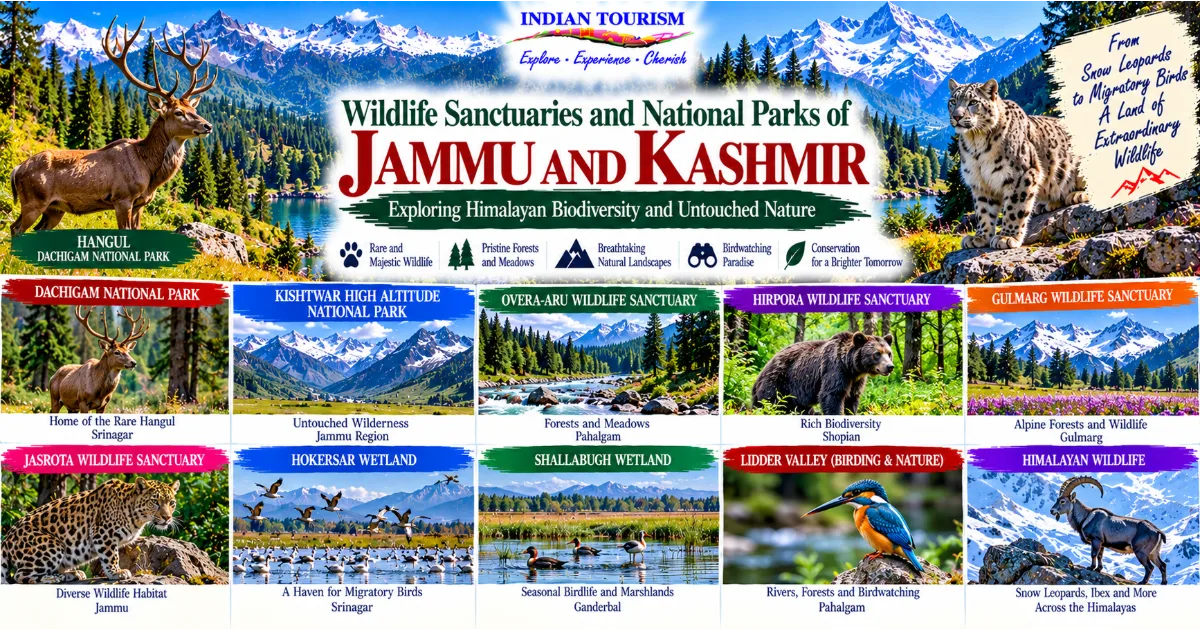
Discovering the Wild Side of Jammu and Kashmir
Jammu and Kashmir is widely celebrated for its snow-covered mountains, sparkling lakes, green meadows and historic gardens. Beyond these familiar attractions lies a remarkable natural world of alpine forests, wetlands, grasslands, mountain valleys and protected habitats. These landscapes provide shelter to diverse wildlife and offer travellers opportunities to experience nature beyond traditional sightseeing.
The region's varied geography creates habitats for many kinds of animals and birds. The Himalayan mountains support species adapted to cold temperatures and rugged terrain, while forested slopes provide shelter for mammals and woodland birds. Wetlands attract migratory and resident waterbirds, and open meadows support grazing animals and smaller wildlife. Each habitat contributes to the ecological richness of Jammu and Kashmir.
Some of the region's most significant natural destinations include Dachigam National Park near Srinagar, Kishtwar High Altitude National Park in the Jammu region, and the protected wetland and forest landscapes found across the Kashmir Valley and surrounding mountains. Wildlife sanctuaries such as Overa-Aru, Hirpora, Gulmarg and Jasrota represent different ecological environments. Wetlands including Hokersar and other important bird habitats provide opportunities for observing seasonal wildlife.
Wildlife tourism requires a different approach from visiting monuments or urban attractions. Animals move according to their own patterns, and sightings cannot be guaranteed. A successful nature trip depends on patience, suitable timing, quiet observation and respect for conservation rules. Visitors must also understand that protected areas are not simply recreational spaces. They are essential habitats where wildlife needs protection from disturbance, habitat loss and pollution.
This guide explores important national parks, wildlife sanctuaries and wetlands of Jammu and Kashmir. It explains their ecological importance, the wildlife travellers may encounter, seasonal considerations and practical ways to enjoy nature responsibly.
Dachigam National Park: Home of the Hangul
Dachigam National Park is one of the best-known protected natural areas in Jammu and Kashmir. Located near Srinagar, the park is particularly important for the conservation of the hangul, also known as the Kashmir stag. This rare deer is closely associated with the forests and mountain habitats of the Kashmir Valley and has become a symbol of the region's wildlife conservation efforts.
The name Dachigam is commonly interpreted as referring to ten villages, reflecting the area's historical associations with local settlements. Over time, the landscape became known for its ecological importance and was established as a protected area. Its proximity to Srinagar makes it one of the more accessible places for visitors interested in understanding the region's natural heritage, although access to particular areas remains subject to conservation and administrative rules.
Dachigam contains a variety of habitats, including forested slopes, streams, meadows and higher mountain terrain. These environments support different plants and animals, with wildlife distribution changing according to elevation and season. The lower areas and higher reaches can offer very different ecological conditions.
The hangul is the park's most celebrated species. Its survival depends on suitable habitat, access to food, protection from disturbance and effective conservation management. The species has faced serious pressures over time, making the protection of its remaining population particularly important. Visitors should not expect guaranteed sightings, because wildlife movements are influenced by season, weather, vegetation and human activity.
Dachigam is also associated with other Himalayan wildlife, including black bears, leopards and various smaller mammals and birds. The presence of these species does not mean that every visitor will see them. Many animals are naturally cautious and avoid people, especially in areas where they experience regular disturbance.
Birdwatchers may find the park interesting because its varied habitats support different bird species. Forest edges, streams and open clearings can offer opportunities to observe birds, provided visitors remain quiet and use appropriate viewing equipment.
Access arrangements, guided visits and permitted activities may vary. Travellers should confirm current rules before visiting and should never enter restricted areas in an attempt to find wildlife. Dachigam is most rewarding when approached as a conservation landscape rather than a place where animal sightings can be demanded on schedule.
Kishtwar High Altitude National Park: Wilderness in the Jammu Himalayas
Kishtwar High Altitude National Park is an important protected area in the Jammu region. Its mountainous terrain, forests, valleys and high-altitude habitats provide a different wildlife experience from the landscapes around Srinagar.
The park lies within a region characterised by steep slopes, rugged mountain scenery and changing elevations. Such geographical variation creates a range of ecological conditions, from forested areas to alpine environments. The diversity of habitats supports wildlife adapted to different temperatures, vegetation types and terrain.
High-altitude protected areas are especially important for species that depend on relatively undisturbed mountain environments. The wider region is associated with elusive Himalayan mammals, including large carnivores and mountain ungulates. However, the presence of a species within a broader region should not be taken as a promise of sightings at a particular location.
The park also contributes to the protection of mountain ecosystems that regulate water flows, support vegetation and provide habitat for birds and other wildlife. Forests and alpine landscapes play important roles in maintaining ecological balance, while mountain streams connect different parts of the landscape.
For travellers, Kishtwar offers a nature experience that is different from the more developed tourist destinations of Kashmir. The surrounding mountains can be dramatic, but travel requires careful preparation. Roads, weather and access arrangements may limit movement, and facilities may be less developed than in major tourist towns.
Visitors should obtain current information about permitted routes, local guidance and any requirements that apply to their intended journey. Trekking or entering remote terrain without adequate preparation can create risks for both travellers and wildlife.
The best approach is to plan realistically, use reliable local information and respect conservation restrictions. Kishtwar's value lies in its mountain wilderness and ecological importance, making it particularly relevant to travellers who appreciate nature and are willing to explore responsibly.
Overa-Aru Wildlife Sanctuary: Forests and Meadows Near Pahalgam
Overa-Aru Wildlife Sanctuary is associated with the Pahalgam region and the surrounding mountain landscapes of southern Kashmir. Its forests, meadows and valleys form part of an ecological area that supports Himalayan wildlife and contributes to the natural appeal of the region.
The sanctuary is located in a landscape known for its scenic beauty. Visitors travelling through the Pahalgam area encounter river valleys, wooded slopes and open grasslands, although the protected sanctuary itself has rules governing access and activity. It is important to distinguish between the wider tourist destination and the specific areas where wildlife protection regulations apply.
The sanctuary's varied habitats are important for animals adapted to mountain environments. Depending on the area and season, the wider landscape may support species such as Himalayan black bears, musk deer, leopards and other mammals. Birdlife also contributes to the ecological richness of the region.
Wildlife observation in a forest sanctuary requires patience. Animals may remain hidden among trees or move through the landscape during times when visitors are not present. Travellers should avoid loud noises and should never approach animals in an attempt to improve a photograph.
The surrounding Pahalgam region offers opportunities for nature walks and landscape photography in authorised areas. Visitors should check which routes are open to the public and whether a local guide is recommended. Some areas may be unsuitable for casual exploration because of terrain, wildlife concerns or access restrictions.
The sanctuary's importance extends beyond tourism. Healthy forests and meadows help maintain soil stability, support water systems and provide habitat for native species. Protecting these environments is essential for the long-term health of the wider landscape.
Visitors can contribute by avoiding litter, staying on permitted paths and supporting local businesses that respect conservation requirements. Overa-Aru demonstrates how nature tourism can complement established destinations when visitors understand the difference between recreational access and protected wildlife habitat.
Hirpora Wildlife Sanctuary: Protecting Mountain Habitats
Hirpora Wildlife Sanctuary, located in the Shopian area of southern Kashmir, protects an important landscape of forests and mountain habitats. Its ecological value comes from the combination of terrain, vegetation and the presence of wildlife adapted to the Himalayan environment.
The sanctuary lies in a region where mountain slopes, forest cover and open areas create varied habitats. Such landscapes support ecological connections between different parts of the mountains, allowing animals to move in search of food, shelter and suitable breeding areas.
The wider region is associated with species such as the Kashmir musk deer and other Himalayan wildlife, although sightings are uncommon and depend on local conditions. Musk deer are particularly difficult to observe because they are shy animals that generally avoid human activity. Their protection depends on maintaining suitable habitat and reducing disturbance.
Hirpora is also important in the broader context of wildlife conservation in Kashmir. Protected forests help maintain biodiversity, preserve vegetation and support the natural systems that influence water availability and soil stability.
Visitors interested in the sanctuary should confirm current access rules before travelling. Protected areas may have restrictions on entry, photography, vehicle movement and other activities. Some places are more appropriate for authorised research or conservation work than for ordinary tourism.
Travellers should not attempt to enter dense forest areas independently in search of animals. Doing so can be unsafe and may disturb wildlife. A responsible visit begins with understanding the rules and accepting that nature cannot be controlled for sightseeing.
Hirpora is a reminder that some of Jammu and Kashmir's most valuable natural destinations are not necessarily designed for large visitor numbers. Their importance often lies in the habitat they preserve rather than in the facilities available to tourists.
Gulmarg Wildlife Sanctuary: Forests Beyond the Famous Meadows
Gulmarg is widely known for its meadows, mountain views and winter activities, but the surrounding landscape also includes important forest habitats. Gulmarg Wildlife Sanctuary protects a natural environment that differs from the developed visitor areas associated with the destination.
The sanctuary contains forested slopes and mountain ecosystems that support native wildlife. Its vegetation provides food and shelter for animals and birds, while the surrounding terrain forms part of the wider ecological network of the Pir Panjal region.
The forests around Gulmarg are associated with Himalayan wildlife, including species adapted to woodland and mountain environments. However, wildlife encounters are unpredictable. Visitors should appreciate the sanctuary as a protected habitat rather than expect to see large animals during an ordinary sightseeing trip.
The contrast between Gulmarg's popular meadows and its protected forests offers an important lesson about tourism. A destination can support recreation and hospitality while also containing areas where human activity must be carefully managed. Protected habitats may have different rules from the open tourist spaces nearby.
Travellers should check which areas are open to visitors and avoid entering restricted forest zones. Walking routes, transport arrangements and seasonal access can vary, especially during winter or periods of severe weather.
For people staying in Gulmarg, learning about the sanctuary adds depth to the visit. The forests are part of the ecological system that supports the area's scenic appeal, stabilises slopes and provides habitat for wildlife.
Responsible tourism requires visitors to respect wildlife, avoid littering and keep noise under control. By understanding the difference between recreational areas and conservation zones, travellers can appreciate Gulmarg's natural beauty without placing unnecessary pressure on its protected landscapes.
Jasrota Wildlife Sanctuary: A Different Ecological Landscape in Jammu
Jasrota Wildlife Sanctuary, in the Kathua district of the Jammu region, offers a wildlife experience that differs from the high-altitude landscapes of Kashmir. Its environment reflects the warmer foothill and lower-elevation conditions found in parts of Jammu.
The sanctuary protects forest habitat and contributes to the conservation of native animals and birds. Its landscape is shaped by vegetation, seasonal weather and the relationship between forested areas and nearby settlements.
The ecological conditions of the Jammu region differ from those of the Kashmir Valley. Temperatures can be higher, and the types of vegetation and wildlife habitats vary accordingly. This diversity is one reason the wider territory supports a range of species and ecosystems.
Jasrota is relevant to travellers interested in exploring wildlife beyond the famous mountain destinations. It can also help visitors understand that Jammu and Kashmir's biodiversity is not limited to snow-covered peaks and alpine meadows.
Wildlife sightings depend on the season, the condition of the habitat and the movement of animals. Visitors should remain quiet and observe from appropriate locations rather than trying to approach or feed wildlife.
Before planning a visit, travellers should confirm current entry arrangements, road access and any restrictions on activities. Facilities may differ from those found in major tourist centres, so transport and other arrangements should be planned in advance.
Protected areas are valuable because they maintain habitats that may otherwise be affected by development and human pressure. Visitors can support their conservation by following local guidance, keeping the environment clean and avoiding disturbance to animals.
Jasrota adds an important regional perspective to wildlife tourism in Jammu and Kashmir. It demonstrates the ecological variety that exists between the lower Jammu landscape and the higher mountains of the north.
Hokersar Wetland: A Haven for Birds Near Srinagar
Hokersar Wetland is one of the important wetland habitats near Srinagar. It is known for its role in supporting waterbirds, including migratory species that visit the Kashmir Valley during suitable seasons.
Wetlands provide several essential ecological services. They support aquatic plants and invertebrates, offer feeding and resting places for birds, and contribute to the natural management of water. Their shallow waters and vegetation create habitats that differ significantly from forests and alpine landscapes.
Hokersar is particularly relevant to birdwatchers because seasonal changes influence the number and variety of birds present. During migration periods, wetland habitats can attract birds travelling over long distances. The exact species and numbers observed vary from year to year, depending on weather, water conditions and wider migration patterns.
Birdwatching is best approached quietly and patiently. Visitors should use binoculars where possible, remain at a suitable distance and avoid disturbing birds when they are feeding or resting. Sudden movements, loud noises and attempts to approach nests can cause unnecessary stress.
The wetland also faces environmental pressures. Changes in water quality, waste, habitat disturbance and surrounding land use can affect its ecological condition. Conservation depends on protecting vegetation, managing human activity and maintaining the natural functions of the wetland.
Access arrangements may be limited or subject to local rules. Travellers should confirm where visitors are permitted and whether guided observation is available. Not every section of a wetland should be treated as an open recreational area.
Hokersar is a valuable destination for travellers interested in birdlife and environmental education. It offers a different experience from the region's mountains and lakes, showing how wetlands contribute to the biodiversity of Jammu and Kashmir.
Shallabugh Wetland: Seasonal Birdlife and Marshland Ecology
Shallabugh Wetland, in the Ganderbal area, is another important wetland landscape in the Kashmir Valley. Its marshes, shallow waters and vegetation provide habitats for birds and other wildlife, making it significant for biodiversity and nature conservation.
Wetlands are dynamic environments. Water levels, plant growth and the availability of food change through the year, influencing which species use the area and when. Migratory birds may visit during particular seasons, while resident species depend on the wetland throughout the year.
For nature enthusiasts, Shallabugh offers an opportunity to understand the ecological importance of marshland environments. Such habitats may appear less dramatic than mountain scenery, but they support complex food webs and provide essential resting and feeding areas for birds.
Birdwatching requires careful observation and respect for the habitat. Visitors should avoid entering sensitive areas, disturbing vegetation or approaching birds too closely. Photography should be undertaken without causing repeated disturbance.
Wetlands can be vulnerable to pollution, changes in water flow, encroachment and other human pressures. Their protection requires long-term management and cooperation between conservation authorities and local communities.
Travellers should verify access arrangements before visiting. Some areas may have limited public access, and visitors should follow instructions about permitted viewpoints, vehicle movement and photography.
Shallabugh is especially suitable for people interested in bird conservation, seasonal wildlife and the natural systems that support the Kashmir Valley. It reminds visitors that biodiversity depends not only on forests and mountains but also on wetlands that are often overlooked during conventional sightseeing.
Hokersar and Other Wetlands: The Importance of Migratory Birds
The wetlands of Jammu and Kashmir form part of a broader network of habitats used by birds during seasonal movement. Migratory birds travel between breeding and non-breeding areas in response to changes in temperature, food availability and environmental conditions.
Wetlands provide places where birds can rest, feed and regain energy during these journeys. Shallow water, aquatic plants and invertebrates can supply food, while open areas may provide suitable resting locations. The condition of these habitats can influence whether birds return in later seasons.
Birdwatching in the region can therefore be more than a recreational activity. It can help visitors appreciate the international importance of local ecosystems and the connections between distant geographical areas. A bird seen in a Kashmir wetland may have travelled across several regions before arriving.
The best time for observing migratory birds depends on the species and the seasonal pattern of movement. Travellers should consult current local information rather than assume that the same birds will appear in the same numbers every year.
A responsible birdwatching visit should minimise disturbance. Use binoculars or a camera with a suitable lens, remain on permitted paths and avoid approaching nests or roosting sites. Feeding wild birds should be avoided unless specifically permitted under a recognised management programme.
Wetlands also support local livelihoods and contribute to water regulation. Protecting them benefits both wildlife and communities, making their conservation an important part of sustainable tourism.
Visitors who include wetlands in their Jammu and Kashmir itinerary can gain a broader understanding of the region's natural heritage. These habitats provide a valuable contrast to the forests, meadows and high mountains that dominate many travel photographs.
Wildlife of Jammu and Kashmir: Species and Natural Habitats
The wildlife of Jammu and Kashmir reflects the region's changing elevation, climate and vegetation. Different habitats support different species, and the distribution of animals depends on food, shelter, water and the level of human disturbance.
The hangul is among the most important species associated with the Kashmir Valley. Its conservation highlights the challenges involved in protecting a rare animal within a landscape that also supports settlements and human activity.
The Himalayan black bear is associated with forested areas and mountain habitats. Like other bears, it is a powerful wild animal that should never be approached or fed. Visitors should store food responsibly and follow local guidance in areas where bears may be present.
Leopards inhabit parts of the region, but they are elusive and often remain unseen by visitors. Their presence is ecologically important because large predators contribute to the balance of natural food webs.
Musk deer are another notable group of Himalayan mammals. These animals are generally shy and difficult to observe. Their survival depends on suitable habitat and effective protection from threats.
The wider region also supports a variety of birds, small mammals and other wildlife. Forests, grasslands, wetlands and alpine environments each provide different resources, contributing to overall biodiversity.
Visitors should avoid assuming that a protected area guarantees sightings of particular animals. Wildlife is not a staged attraction, and its movements cannot be predicted precisely. The best nature experiences often involve observing plants, tracks, bird calls and the broader environment rather than seeing a large mammal.
Understanding habitat diversity makes wildlife tourism more rewarding. It encourages travellers to appreciate the ecological systems that support animals rather than focusing exclusively on photographs of individual species.
Best Time to Visit Wildlife Areas in Jammu and Kashmir
The best season for wildlife tourism depends on the protected area, the species of interest and the activities permitted. Spring can be attractive for exploring lower-elevation forests and wetlands, with fresh vegetation and changing bird activity. However, weather can remain variable, particularly in mountain areas.
Summer is often a practical period for visiting many accessible mountain destinations. Roads and trails may be easier to use under suitable conditions, while alpine landscapes become more accessible than during winter. High-altitude routes still require careful planning, and access to protected areas may be restricted.
Autumn can offer attractive scenery in forested areas, and wetlands may become especially interesting as seasonal bird movements develop. The timing of migration varies, so birdwatchers should consult current local observations.
Winter brings cold temperatures and may restrict access to higher areas. Some wetlands continue to support wintering birds, but conditions can be difficult and outdoor visits require appropriate clothing and preparation.
Wildlife viewing should never be planned around a guarantee of seeing a particular animal. Species may move away from accessible areas, remain hidden or change their activity patterns. Travellers should choose a season based on the habitat and the experience they want rather than relying on fixed expectations.
Before departure, confirm park opening arrangements, road conditions, guide availability and any restrictions. Protected areas may close sections for conservation, safety or management reasons.
A flexible itinerary is essential. Nature tourism is most rewarding when visitors allow time for observation and accept that weather and wildlife behaviour can change the experience.
Practical Tips for Wildlife Photography and Birdwatching
Wildlife photography requires patience, appropriate equipment and respect for animals. A telephoto lens or binoculars can help visitors observe wildlife without approaching too closely. However, equipment should never be used to justify entering restricted areas or disturbing animals.
Visitors should remain quiet and move slowly. Sudden noises can frighten birds and mammals, while groups that crowd an animal may interfere with its natural behaviour. If an animal changes its behaviour because of the presence of people, visitors should increase their distance.
Feeding wildlife is generally harmful because it can change animal behaviour, encourage dependence on human food and create dangerous encounters. Visitors should keep food securely stored and follow instructions concerning waste.
Birdwatchers should learn to identify species through shape, calls, flight patterns and habitat. A field guide or offline reference can be useful, especially where mobile connectivity is limited. Recording observations can make a visit educational even when photographs are difficult to obtain.
Photography rules differ between protected areas. Drones, flash photography, tripods and other equipment may be restricted. Travellers should confirm the current rules before visiting.
Appropriate clothing and footwear are important for outdoor observation. Forest trails may be uneven, wet or steep, while wetlands can contain muddy surfaces and unstable ground. Visitors should not leave established paths unless authorised to do so.
Finally, remember that a good wildlife photograph is never more important than the safety of the animal or the visitor. Responsible photography records nature without changing its behaviour or damaging its habitat.
Responsible Wildlife Tourism and Conservation
Wildlife tourism can create economic opportunities for local guides, accommodation providers and transport services. When managed carefully, it can also build public support for habitat protection. However, poorly managed tourism can disturb animals, damage vegetation and increase waste.
Visitors should follow all instructions from park authorities and local guides. Restricted areas should remain off limits, and wildlife should never be chased or surrounded for photographs. Animals require space to feed, rest, breed and move through their habitat.
Waste management is particularly important in remote forests and mountain areas. Plastic packaging, food scraps and other rubbish can harm wildlife and remain in the environment for long periods. Visitors should carry their waste back and dispose of it appropriately.
Responsible tourism also includes respecting local communities. Many people live near protected areas and depend on surrounding natural resources. Travellers should seek permission before photographing individuals, respect private property and use legitimate local services.
Choosing knowledgeable local guides can improve both safety and understanding. A guide familiar with the landscape may explain local ecology, cultural practices and current access conditions while helping visitors avoid sensitive areas.
Conservation requires more than the protection of individual animals. Healthy habitats, clean water, connected forest landscapes and suitable food sources are essential for wildlife survival. Visitors can support these goals by following rules and encouraging responsible practices.
Jammu and Kashmir's protected areas are valuable natural assets. Their future depends on conservation planning, community participation and visitors who recognise that nature must be protected rather than controlled for entertainment.
Conclusion: Exploring the Natural Heritage of Jammu and Kashmir
The national parks, wildlife sanctuaries and wetlands of Jammu and Kashmir reveal a side of the region that extends far beyond its famous lakes, gardens and mountain resorts. Dachigam National Park is particularly important for the conservation of the hangul, while Kishtwar High Altitude National Park protects valuable mountain habitats. Overa-Aru, Hirpora, Gulmarg and Jasrota provide further examples of the varied landscapes that support wildlife.
Wetlands such as Hokersar and Shallabugh demonstrate the importance of marshland habitats and migratory birds. These environments may receive less attention than alpine mountains, but they are essential to biodiversity and the ecological health of the region.
Wildlife tourism requires patience, preparation and respect. Animals may remain hidden, access can be restricted and weather may affect travel plans. The absence of a particular sighting does not diminish the value of observing a forest, listening to birds or learning about the ecological relationships that sustain a landscape.
Travellers should confirm current access arrangements, follow the instructions of conservation authorities and avoid disturbing wildlife. Responsible photography, careful waste management and support for legitimate local services can help ensure that tourism benefits both communities and protected habitats.
Jammu and Kashmir's wildlife heritage is a reminder that the region's beauty is not limited to its scenery. Its forests, wetlands and mountain ecosystems support living communities of plants and animals whose survival depends on careful protection.
By exploring these places with curiosity and responsibility, visitors can develop a deeper appreciation of the natural world and contribute to the conservation of Jammu and Kashmir's remarkable biodiversity.
#IndianTourism #JammuAndKashmir #WildlifeTourism #DachigamNationalPark #Hangul #KishtwarNationalPark #OveraAruWildlifeSanctuary #HirporaWildlifeSanctuary #GulmargWildlifeSanctuary #JasrotaWildlifeSanctuary #HokersarWetland #ShallabughWetland #Birdwatching #HimalayanWildlife #NatureConservation #ResponsibleTourism #Biodiversity #ExploreIndia
