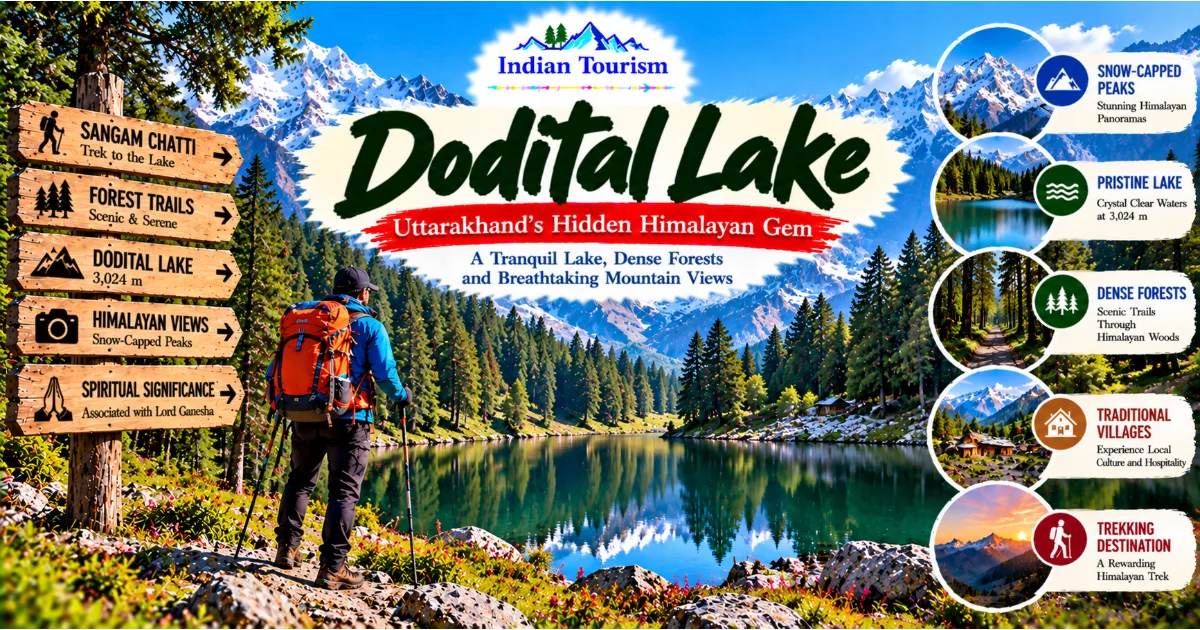
Dodital Lake is a beautiful freshwater lake tucked into the Garhwal Himalayas of Uttarakhand, surrounded by dense forests, mountain trails, and peaceful natural landscapes.
Located at approximately 3,024 metres above sea level in Uttarkashi district, it attracts trekkers, nature lovers, photographers, and travellers seeking a quieter Himalayan experience.
With its clear waters, forested surroundings, and traditional mountain villages along the approach, Dodital offers a memorable combination of natural beauty, trekking, and local culture.
Discovering Dodital Lake
Uttarakhand is home to many extraordinary landscapes, from dramatic Himalayan peaks and alpine meadows to sacred rivers, dense forests, and remote mountain villages. Among these destinations, Dodital Lake stands out for its peaceful atmosphere and distinctive natural setting. Unlike places known primarily for crowded viewpoints or large tourist facilities, Dodital invites visitors to slow down and experience the Himalayas through walking, observation, and time spent in nature.
The lake lies in the Uttarkashi region of the Garhwal Himalayas. Surrounded by forested mountain slopes, it forms an important destination along a trekking route that passes through changing landscapes and traditional settlements. The journey offers a gradual transition from inhabited valleys to quieter forest environments, allowing visitors to appreciate the relationship between mountain communities and their natural surroundings.
Dodital is often described as a hidden Himalayan gem because reaching it generally requires a trek rather than a direct road journey. This relative accessibility barrier helps preserve the feeling of remoteness that many visitors seek. The destination is particularly attractive to travellers who want to experience the mountains beyond the better-known hill stations and pilgrimage centres.
Continue Reading
The lake is also associated with local religious traditions and is popularly linked to Lord Ganesha in Hindu belief. This cultural connection adds another dimension to the destination, although visitors should approach religious stories and local customs with respect and an understanding that traditions may be explained differently by different people.
For many travellers, the appeal of Dodital lies in the combination of the lake itself and the route leading to it. The forest trails, mountain air, seasonal vegetation, quiet settlements, and changing views create an experience that extends beyond reaching a single destination. A thoughtfully planned journey allows visitors to appreciate the landscape at a comfortable pace while respecting the environment.
Where Is Dodital Lake Located?
Dodital Lake is situated in Uttarkashi district in Uttarakhand, northern India. The lake lies at an elevation of approximately 3,024 metres above sea level, placing it within a high-altitude Himalayan environment where weather conditions can differ considerably from those in the lower valleys.
The surrounding region forms part of the Garhwal Himalayas, an area known for its mountain forests, river valleys, trekking routes, and cultural traditions. The landscape around Dodital includes woodland, steep slopes, smaller clearings, and mountain streams that contribute to the area's natural character.
A common approach to the lake begins from the Sangam Chatti area, which can be reached by road from Uttarkashi. From there, trekkers follow a mountain trail through settlements and forested terrain. The route is commonly associated with villages such as Agoda and other small settlements along the trekking corridor, although the exact itinerary can vary according to the route chosen and current local conditions.
The walk involves gradual elevation gain, uneven ground, and sections that may become difficult during wet or snowy weather. Visitors should not underestimate the effort required simply because the destination is known for its tranquil lake rather than a technical summit.
The remoteness of Dodital is part of its attraction, but it also means that services may be limited compared with established tourist towns. Accommodation, food, communication, and emergency assistance should be considered before starting the trek.
Why Dodital Lake Is Special
A Peaceful Himalayan Lake
The lake is the central attraction of Dodital. Its waters reflect the surrounding landscape under favourable weather conditions, creating a calm setting that contrasts with the steep mountain terrain around it.
The appearance of the water changes with light, cloud cover, and season. On a clear day, the surface may reflect nearby trees and sections of the sky. When mist moves through the surrounding forest, the atmosphere can become quieter and more mysterious.
Visitors should remember that the lake is a natural environment, not a controlled recreational facility. Swimming, washing with soap, feeding animals, or leaving waste near the water can damage its ecological balance. The most responsible way to enjoy Dodital is to observe the landscape without disturbing it.
Forests and Mountain Trails
The route to Dodital passes through forested sections that offer shade, natural sounds, and changing vegetation. Walking beneath trees provides a different experience from travelling through open alpine meadows or exposed mountain ridges.
Forest trails may include roots, stones, muddy patches, and uneven surfaces. The condition of the path varies with rainfall, snowfall, and the number of people using it. Suitable footwear and careful walking are therefore important throughout the journey.
The forest also contributes to the health of the wider mountain ecosystem. Trees help stabilise slopes, support biodiversity, influence water movement, and provide habitat for wildlife. Visitors who stay on established trails help reduce damage to vegetation and limit soil erosion.
A Sense of Remoteness
Dodital offers a chance to experience a quieter part of Uttarakhand. The absence of extensive urban development around the lake allows the natural environment to remain the focus of the visit.
For travellers accustomed to busy roads, crowded markets, and constant digital communication, the relative quiet can be refreshing. The sounds of wind, birds, flowing water, and footsteps on the trail may become more noticeable when there are fewer distractions.
However, remoteness should not be confused with complete isolation from practical responsibilities. Visitors still need to plan transport, food, accommodation, equipment, and emergency arrangements. A peaceful destination is best enjoyed when basic needs have been considered in advance.
Cultural Significance
Dodital is associated with Hindu traditions connected to Lord Ganesha. The lake's name and the surrounding region are often discussed in connection with religious stories, and some visitors come because of this cultural association as well as the natural scenery.
Religious traditions are an important part of Uttarakhand's broader cultural landscape. Sacred places can serve as centres of local identity, seasonal observances, and community memory. Travellers should approach these traditions with curiosity and respect rather than assuming that every story has one universally accepted version.
Visitors should follow local instructions concerning worship areas, religious practices, and appropriate behaviour. If a ritual or gathering is taking place, observing quietly and asking permission before taking photographs is a considerate approach.
The Trek to Dodital Lake
The trek is an essential part of the Dodital experience. It allows visitors to move gradually from road-accessible areas into the forested landscape of the higher Himalayas.
Sangam Chatti is commonly used as a starting point for the route. From there, trekkers generally proceed through mountain paths and settlements before continuing towards the lake. Agoda is one of the villages associated with the trekking corridor, and the route provides opportunities to see how people live in the region.
The trek is often completed over multiple days, depending on the itinerary, pace, weather, and overnight stops. Some travellers may prefer a gradual schedule that allows time for acclimatisation and rest, while more experienced trekkers may select a different arrangement with a qualified local guide.
The difficulty of the route varies. Although it does not require technical climbing under ordinary conditions, it involves sustained walking at altitude. Wet ground, snow, cold weather, and steep sections can increase the challenge.
Travellers should confirm the latest route conditions before setting out. Trail access, camping arrangements, accommodation, and local restrictions may change. Advice from local guides and accommodation providers is particularly valuable because they are better positioned to understand current conditions.
A steady pace is preferable to rushing. Regular breaks, suitable food, adequate water, and appropriate clothing help make the journey more comfortable. Visitors should also leave enough time to reach their planned overnight stop before darkness.
Choosing the Best Time to Visit Dodital
Spring: Forests Begin to Awaken
Spring can be an attractive period for travellers who enjoy fresh vegetation and changing mountain scenery. As temperatures begin to rise, the lower sections of the route may become more comfortable for walking, although cold conditions can continue at higher elevations.
The forest environment may show signs of seasonal renewal, and the contrast between fresh vegetation and the surrounding mountain slopes can create excellent opportunities for nature observation.
Conditions depend on the preceding winter. Snow or wet patches may remain on some sections of the trail, so visitors should confirm accessibility before travelling.
Warm layers remain important because temperatures can fall after sunset and in shaded areas. A spring visit should be planned around current weather conditions rather than assumptions based on the season alone.
Summer: Comfortable Trekking Conditions
Summer is a popular period for exploring many Himalayan trekking routes because daytime temperatures are often more comfortable than in winter. The forest trails around Dodital may be easier to navigate when the route is free of substantial snow.
This season suits travellers who want to combine walking, photography, and time near the lake. Longer daylight hours can provide more flexibility, although a sensible start time and a realistic daily schedule remain important.
Visitors should carry sufficient water and suitable protection against sunlight. Even when temperatures feel moderate, prolonged walking can be tiring, particularly at higher elevations.
Summer conditions can also change quickly in the mountains. A clear morning does not guarantee that the afternoon will remain dry, so rain protection should be included in the packing plan.
Monsoon: Lush Scenery and Additional Risks
The monsoon brings rainfall to Uttarakhand, often making forests and lower mountain slopes appear especially green. Mist may move through the trees, creating a distinctive atmosphere along the trail.
However, this period can also bring slippery paths, heavy rain, poor visibility, landslides, and road disruptions. Mountain streams may rise quickly, and sections of the trail may become difficult to cross safely.
For these reasons, travellers should exercise additional caution during the rainy season. Check local weather forecasts and trail conditions, and follow advice from local authorities or guides.
If the route is considered unsafe, postponing the trek is the responsible choice. A beautiful landscape is not worth risking injury by continuing through dangerous weather.
Autumn: Clearer Mountain Atmosphere
Autumn can offer rewarding conditions for travellers who value mountain views and cooler weather. After the monsoon, periods of clearer skies may improve visibility across the surrounding landscape.
The forest and trail can also develop a different seasonal character as vegetation changes. Photography enthusiasts may appreciate the combination of subdued forest colours, mountain light, and reflections on the lake.
Temperatures become colder as the season progresses, particularly in the early morning and evening. Warm clothing and suitable sleeping arrangements are important for overnight stays.
Visitors should check the timing of their trip carefully because the transition towards winter can bring changing trail conditions and falling temperatures.
Winter: Cold Weather and Snow
Winter can transform the Dodital region into a much colder mountain environment. Snow may affect sections of the route, and the lake's surroundings can take on a quieter appearance.
This season requires careful preparation. Snow-covered trails can be difficult to follow, ice can make walking hazardous, and low temperatures increase the importance of appropriate clothing and equipment.
Travellers without winter trekking experience should avoid attempting the route independently in challenging conditions. A qualified local guide can help assess the trail and determine whether the journey is appropriate.
Winter access should never be assumed. Check the latest local information before making arrangements, and be prepared to change the itinerary if snowfall or other conditions create unacceptable risks.
What to See and Do at Dodital
Enjoy the Lake's Natural Setting
Spending time near the lake is the main activity for many visitors. Rather than arriving, taking a photograph, and immediately leaving, travellers can allow time to observe the surrounding landscape.
The reflections on the water, the trees around the shoreline, and the movement of clouds can make the setting feel different from one moment to the next. Sitting quietly at a suitable permitted location can be a rewarding way to experience the environment.
Visitors should remain mindful of local rules and avoid damaging the shoreline. Do not leave food waste, plastic packaging, or other rubbish near the water.
Explore the Forest Environment
The surrounding forest provides opportunities to notice the details of the Himalayan landscape. Tree forms, moss, fallen leaves, streams, and changes in vegetation can make the walk interesting even when distant mountain views are obscured.
Nature observation is particularly rewarding when travellers slow down and avoid making unnecessary noise. Birds and other animals may be more likely to remain undisturbed when people keep their distance.
Visitors should not remove plants, collect wildlife, or venture off established trails simply to reach a photographic viewpoint. Protecting the forest helps preserve the environment that makes the destination special.
Experience Village Life Along the Route
The settlements along the trekking route provide a glimpse into the everyday life of mountain communities. Villages such as Agoda are part of the human landscape through which trekkers travel before reaching the lake.
A stay in local accommodation may provide opportunities to learn about regional food, agriculture, weather, and the practical challenges of living in a mountainous area. Such experiences can help visitors understand Uttarakhand beyond its scenic attractions.
Travellers should be respectful guests. Ask permission before photographing residents, follow household instructions, and avoid entering private land without permission.
Where possible, using local guides and accommodation providers can help tourism contribute to the livelihoods of people who live in the region.
Photograph the Changing Landscape
Dodital provides several kinds of photographic subjects, including the lake, forest trails, vegetation, mountain scenery, and village life. Each offers a different way to document the journey.
Photographers should consider light, weather, and composition rather than trying to capture everything at once. Early and late daylight may provide softer conditions, but the best opportunities depend on the weather.
Protect cameras and phones from moisture and cold. Carry spare power if needed, and keep electronic equipment secure while walking on uneven ground.
Photography should never take priority over safety. Avoid standing on unstable ground or approaching the water's edge where footing is uncertain.
How to Reach Dodital Lake
By Air
Jolly Grant Airport near Dehradun is a commonly used airport for travellers visiting Uttarakhand. From the airport, the journey continues by road towards Uttarkashi and the starting point of the trek.
Travel time depends on road conditions, traffic, weather, and the exact itinerary. Mountain journeys can take longer than expected, so travellers should leave a comfortable margin when planning connections.
If arriving late in the day, consider staying overnight at a suitable town before continuing towards the trekking route. Beginning a demanding trek after a long journey can increase fatigue and reduce the time available for safe walking.
By Train
Travellers can use railway services to reach Dehradun or Rishikesh and then continue by road. The most practical option depends on train availability, departure times, and the planned road route.
The journey towards Uttarkashi involves mountain roads, so it is wise to allow flexibility. Heavy rainfall, traffic, or other disruptions can affect travel times.
Confirm transport arrangements in advance, especially if the trip depends on reaching a particular village before starting the trek.
By Road
Road travel connects Uttarkashi with the areas commonly used to access Dodital. Sangam Chatti is a recognised starting point for the trekking route, and local transport or a prearranged vehicle may be required to reach it.
Travellers should confirm the exact starting location with their guide or accommodation provider. Transport options can vary, and current road conditions may affect the best approach.
Avoid assuming that a vehicle can reach the lake itself. The final journey is completed on foot, and the walking distance and time depend on the chosen route and itinerary.
On Foot
The trekking route leads from the road-accessible starting area through forest and mountain terrain to Dodital. The walk should be planned according to fitness, altitude, season, and the condition of the trail.
A local guide can provide route knowledge and help visitors make sensible decisions when weather or trail conditions change. For first-time trekkers, guided travel can also make the experience less stressful.
Carry the equipment appropriate to the season and confirm overnight arrangements before departure. The route is best approached as a planned mountain journey rather than an improvised day outing.
Where to Stay
Accommodation for the Dodital trek may include guesthouses, homestays, and other locally arranged options in villages along the route. Depending on the itinerary and current conditions, camping arrangements may also be possible where permitted.
Travellers should confirm what is available before setting out. Do not assume that every stop will have rooms, meals, electricity, mobile connectivity, or hot water.
An overnight stay before the trek can make the journey more comfortable by allowing visitors to rest after road travel and organise their equipment. Staying in a village along the route may also provide a chance to experience local hospitality and understand the region more closely.
If camping is planned, check current regulations and local requirements. Use only permitted camping areas and follow all fire, waste, and sanitation rules.
During popular trekking periods, arranging accommodation in advance is sensible. Travellers should also clarify meal arrangements, payment requirements, and whether drinking water will be available.
What to Pack for Dodital Lake
Packing should reflect the season, the length of the trek, and the latest weather forecast. A practical list includes the following essentials.
1. Trekking footwear: Wear shoes with suitable grip and support for uneven forest paths and rocky sections.
2. Layered clothing: Carry warm layers that can be added or removed as temperatures change. A warm jacket is useful even when lower elevations feel comfortable.
3. Rain protection: A waterproof jacket and protective bag cover can help during periods of uncertain weather.
4. Drinking water: Carry enough water for the day's walk and confirm safe refill options with your guide.
5. Energy-rich snacks: Pack suitable food for the trek and carry all wrappers back for proper disposal.
6. Sun protection: Sunglasses, sunscreen, and a hat can be useful even in cool mountain weather.
7. Personal medication: Bring any medication you require and a basic personal first-aid supply.
8. Navigation and communication: Keep your phone charged and carry a power bank. Do not rely entirely on mobile connectivity in remote areas.
9. Identification and emergency information: Carry valid identification and share your itinerary with someone you trust.
10. Waste bag: Keep a reusable bag for carrying rubbish until it can be disposed of responsibly.
For winter travel, additional equipment may be necessary. Ask an experienced local guide what is appropriate for the actual trail conditions rather than relying only on a general packing list.
Fitness and Altitude Awareness
Dodital lies at approximately 3,024 metres above sea level. At this elevation, some visitors may experience altitude-related symptoms, particularly if they ascend quickly or are not accustomed to high-altitude environments.
Physical fitness helps with the demands of trekking, but it does not eliminate the risk of altitude illness. Travellers should maintain a manageable pace, allow time for adjustment, eat adequately, and pay attention to changes in how they feel.
Potential symptoms can include headache, nausea, dizziness, unusual tiredness, or reduced appetite. Symptoms that become severe, worsen, or occur alongside breathlessness at rest, confusion, or difficulty walking require urgent medical attention. The correct response may include stopping the ascent and descending with appropriate assistance.
Anyone with a medical condition or concerns about high-altitude exercise should seek professional medical advice before the trip. Travellers should also be honest about their fitness and avoid allowing group pressure to determine how far they continue.
The purpose of a trek is to enjoy the journey safely. Turning back because of illness, weather, or exhaustion is a sensible decision, not a failure.
Local Culture and Responsible Tourism
The Dodital region is part of a living cultural landscape. Mountain communities in Uttarkashi district have developed ways of life shaped by geography, seasonal weather, agriculture, local traditions, and access to services.
Visitors can support local livelihoods by using local guides, arranging accommodation through community businesses, and purchasing appropriate local products. Fair payment and respectful behaviour help create a more positive relationship between visitors and residents.
Responsible tourism also means recognising that remote mountain environments can be vulnerable to careless activity. Plastic waste, food scraps, improper sanitation, and unauthorised fires can harm the surroundings and create problems for local communities.
Travellers should carry waste back, avoid disturbing wildlife, follow local instructions, and use permitted trails and campsites. They should also be considerate about noise, especially near the lake and in areas where other visitors are seeking a quiet experience.
Respect for religious traditions is equally important. If visitors encounter a place of worship or a local ceremony, they should observe any applicable rules and ask permission before photographing people or rituals.
A successful visit should benefit the traveller without placing an unnecessary burden on the people and environment that make the destination special.
Wildlife and Ecological Importance
The forests and surrounding mountain terrain form part of a broader Himalayan ecological system. The area supports plant life and provides habitat for animals adapted to the conditions of the Garhwal region.
Wildlife is not always easy to observe. Animals may remain hidden, move away from people, or be active when visitors are not present. A quiet trek through a healthy forest can be valuable even when no large animal is seen.
Visitors should avoid feeding wildlife or attempting to attract animals for photographs. Human food can change animal behaviour and create unhealthy dependence. Approaching animals too closely can also cause stress and create danger for both people and wildlife.
The lake and surrounding forest should be treated as connected parts of the same environment. Rubbish left along the trail can eventually move into drainage channels and streams. Improper disposal of waste near the water can affect the wider ecosystem.
Simple actions make a difference. Staying on established trails, carrying out rubbish, and respecting local conservation guidance help protect the landscape for future visitors.
Dodital Lake for First-Time Trekkers
Dodital can appeal to people who are beginning to explore Himalayan trekking, provided they understand that the journey requires preparation and sustained walking.
First-time trekkers should build basic endurance before the trip by walking regularly and practising on uneven ground. Comfortable footwear, a suitable backpack, and clothing that can handle changing temperatures are also important.
It is useful to plan the trek over a realistic number of days rather than trying to complete the route too quickly. Overnight stops can make the journey more manageable and allow visitors to experience the region without unnecessary pressure.
A local guide can help with navigation, trail conditions, and practical decisions. This is particularly valuable during wet weather, snowfall, or periods when visibility is poor.
Beginners should not compare their pace with that of more experienced trekkers. The correct pace is one that allows the group to continue safely while maintaining enough energy for the return journey.
Common Mistakes to Avoid
One common mistake is assuming that a lake trek is easy simply because the destination is not a mountain summit. The route still involves altitude, uneven ground, and changing weather, all of which can increase the difficulty.
Another mistake is beginning the trek without checking local conditions. Rainfall, snow, trail damage, or restrictions can change the route and affect travel times. Confirming the latest information is essential.
Some visitors also pack too little warm clothing. Conditions near the lake can be colder than those in the lower valleys, especially in the morning and after sunset. Layered clothing is more useful than relying on a single heavy garment.
Travellers should avoid carrying unnecessary weight while also ensuring that essential equipment is not left behind. A well-organised backpack makes walking easier and reduces fatigue.
Finally, visitors should never leave rubbish at the lake or along the trail. Carrying waste back is a basic responsibility, particularly in remote environments where collection facilities may be limited.
A Practical Travel Plan
A comfortable Dodital itinerary begins with travel to the Uttarkashi region and an overnight stay before the trek. This provides time to rest, arrange transport to the starting point, and confirm the latest trail conditions.
The following day, travellers can begin the trek at a suitable time and proceed at a steady pace. The exact overnight stop should depend on the chosen route, the group's fitness, and the guidance of a local operator.
Once at the lake, visitors can spend time observing the water, photographing the surroundings, and appreciating the forest environment. The visit should be planned around daylight and current weather conditions rather than an inflexible schedule.
The return journey should include sufficient time for breaks and unexpected delays. Travellers should avoid rushing to meet a road transport connection after completing the trek.
Before departure, confirm accommodation, meals, guide availability, transport, and any local requirements. A flexible itinerary is particularly important in the Himalayas because weather and road conditions can change rapidly.
Who Should Visit Dodital Lake?
Dodital is well suited to travellers who enjoy forests, lakes, mountain scenery, and multi-day walking experiences. Nature enthusiasts may appreciate the quieter environment, while photographers can explore the changing appearance of the water and surrounding vegetation.
Travellers interested in local culture may also enjoy the settlements along the approach. Staying in locally operated accommodation can provide a broader understanding of mountain life and create opportunities for meaningful interaction.
The destination may suit first-time trekkers who are prepared to build their fitness, choose an appropriate season, and use a guide when needed. However, people who are unable to walk on uneven terrain or who are unwilling to prepare for cold weather should carefully assess whether the route is suitable for them.
Visitors seeking extensive luxury facilities directly beside the lake may need to adjust their expectations. Dodital's appeal comes from its natural setting and trekking experience rather than from large resorts or developed entertainment facilities.
Conclusion
Dodital Lake offers a memorable opportunity to discover the quieter side of Uttarakhand's Garhwal Himalayas. Its freshwater setting, forested approach, traditional mountain villages, and cultural associations create an experience that combines natural beauty with regional heritage.
Located at approximately 3,024 metres above sea level, the lake rewards visitors who prepare carefully and allow enough time to enjoy the journey. Seasonal weather, trail conditions, and altitude should all be considered before departure, especially for travellers who are new to Himalayan trekking.
Responsible travel is essential to preserving the destination. Visitors should respect local communities, follow guidance from experienced guides, avoid disturbing wildlife, and carry their waste back for proper disposal.
For those seeking an alternative to crowded tourist centres, Dodital offers the chance to experience the Himalayas through quiet trails, forest landscapes, and time beside a mountain lake. With sensible planning and a respectful approach, the journey can become a meaningful part of exploring Uttarakhand.
Hashtags
#DoditalLake #UttarakhandTourism #GarhwalHimalayas #HimalayanTrekking #IndianTourism