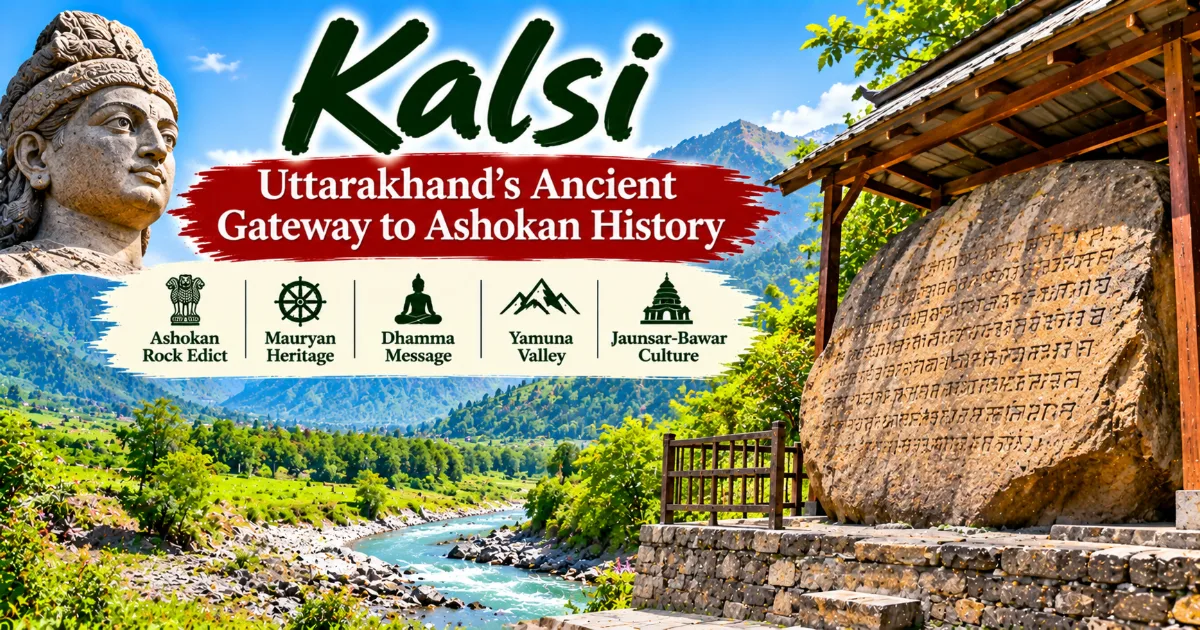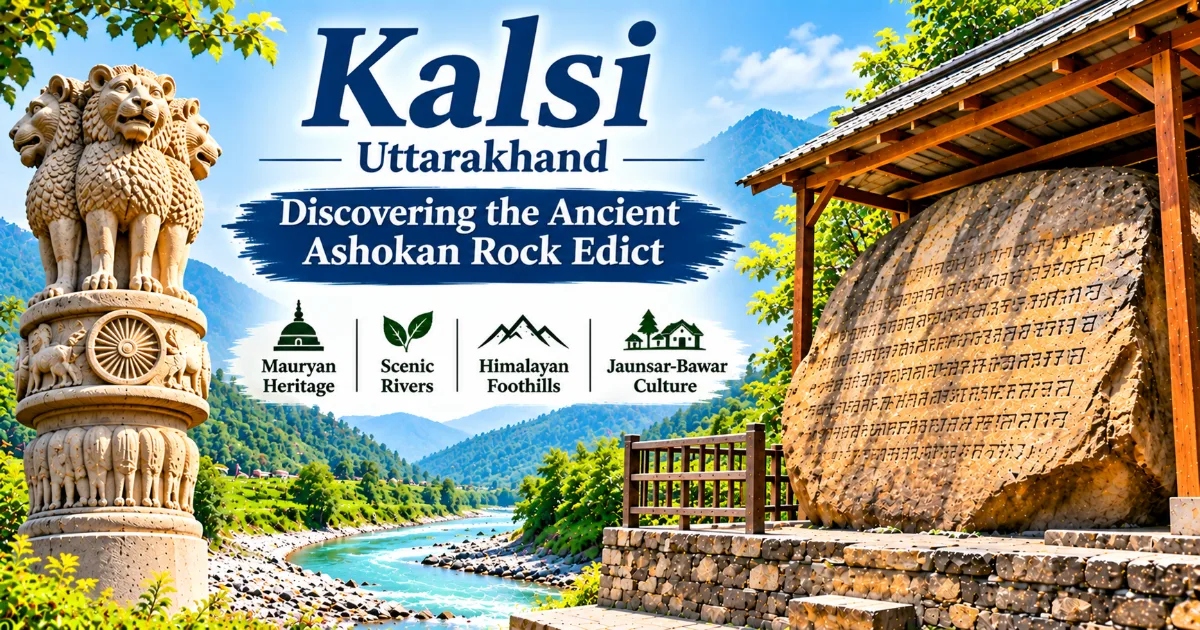
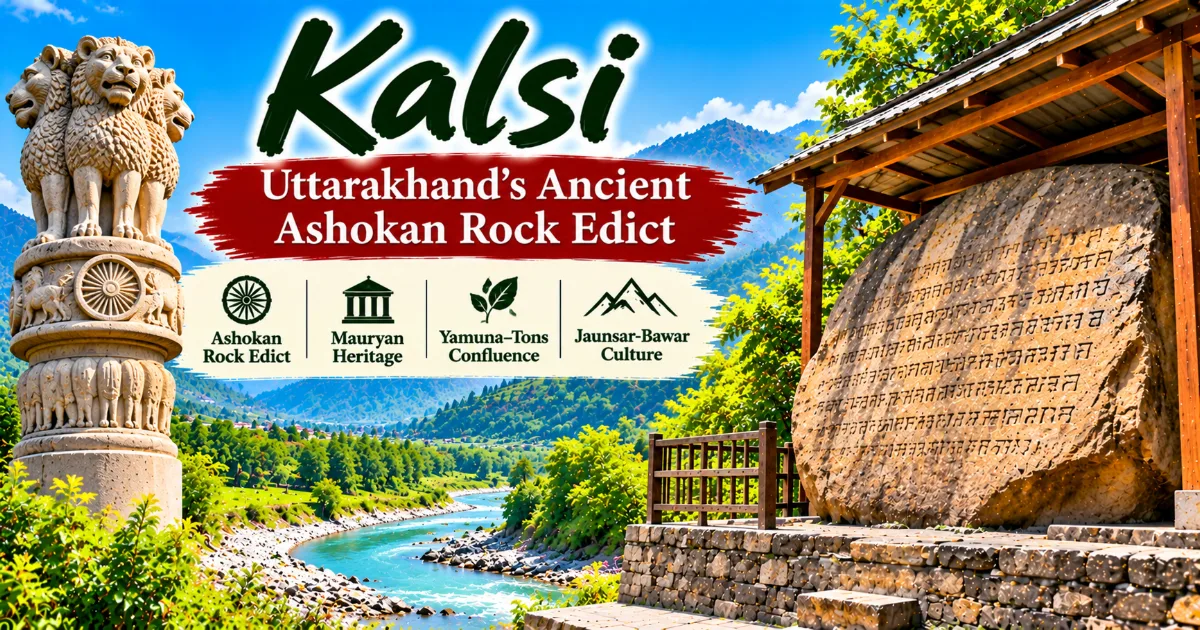
Kalsi, in Uttarakhand's Dehradun district, sits in the Himalayan foothills near the confluence of the Yamuna and Tons rivers. Its main draw is a rock edict of Emperor Ashoka. A visit lets you explore the legacy of the Mauryan Empire, see an ancient inscription up close and learn about the cultural history of the region.
A Journey into Ancient Indian History
Most people know Uttarakhand for its mountains, sacred rivers, pilgrimage routes and hill towns. Fewer know that the state also holds archaeological and historical sites showing how people, kingdoms and ideas shaped the region over many centuries. Kalsi is one of them.
In the western part of Dehradun district, this settlement is best known for its Ashokan Rock Edict. Ashoka was one of the most influential rulers in ancient Indian history, and the inscription records his policy of Dhamma: moral conduct, compassion, respect and concern for the welfare of people and living beings.
Carved during the Mauryan Empire, which reached its height under Ashoka in the third century BCE, the edict is a direct record of the emperor's ideas and of the administrative and ethical messages he wanted spread across his empire.
Continue Reading
Around the site, the Yamuna and Tons rivers run past forested hills and rural settlements, which makes for a quiet trip. The town also works as a stop for travellers heading to Chakrata, Vikasnagar and other parts of western Uttarakhand.
This is not a conventional hill-station holiday. Come here if you enjoy archaeology, history and geography, and want to see how an ancient imperial message has survived in a place still shaped by rivers, mountains and local communities.
Where Is Kalsi Located?
The settlement lies in Dehradun district in the western part of Uttarakhand, near the meeting point of the Yamuna and Tons rivers, an area with both geographical and cultural importance.
It sits on the road network that connects Vikasnagar with Chakrata and other parts of the Jaunsar-Bawar region. That makes it easy to reach for anyone planning a road journey through the western Himalayan foothills.
Don't expect a large commercial tourist centre. Think of it instead as a historical and regional destination: the main attraction is the Ashokan Rock Edict, with the river landscape and nearby cultural areas as a backdrop.
The Yamuna is the main geographical feature here, and the Tons, one of its major tributaries, joins it nearby. That confluence gives the area its distinctive shape and some useful geographical context for visitors.
Travellers can include Kalsi in an itinerary covering Vikasnagar, Dakpathar and Chakrata. With more time, explore the villages of Jaunsar-Bawar, a region known for its own cultural traditions.
The Ashokan Rock Edict: Kalsi’s Most Important Heritage Attraction
The Ashokan Rock Edict is the reason Kalsi holds a place in Indian history. It belongs to the wider tradition of royal edicts issued by Emperor Ashoka during the Mauryan period.
In the third century BCE, Ashoka ruled a large empire. After the devastating Kalinga War, he became closely associated with a policy of Dhamma, moral responsibility and concern for the welfare of people and animals.
Rather than rely only on royal officials and court announcements, he had his messages carved into rocks and pillars across his empire. Those inscriptions are now valuable evidence of his approach to governance, public welfare, religious tolerance and ethical behaviour.
What makes the Kalsi inscription special is location: it shows that this imperial communication network reached the region that is now Uttarakhand.
Carved on a natural rock surface, the edict has survived more than two thousand years. That is why modern visitors and researchers can still come face to face with a historical message written for people of that time.
Scholars treat it as a primary source on the political, cultural and ethical ideas of the Mauryan period, far more than an old stone with writing.
Who Was Emperor Ashoka?
One of the most important rulers of the Mauryan Empire, Ashoka belonged to the Mauryan dynasty, which Chandragupta Maurya had founded in the fourth century BCE.
He became emperor in the third century BCE and ruled a vast territory. His reign is remembered for the expansion of Mauryan influence and for the large body of inscriptions left by his administration.
In the traditional account of his life, the Kalinga War was the turning point. His own inscriptions, particularly the Thirteenth Major Rock Edict, describe the suffering it caused and his remorse over the destruction and loss of life.
After that, his public messages leaned more and more on Dhamma. The word describes a broad ethical approach to life and governance, rather than the rules of one religious institution.
Compassion, respect for parents and elders, generosity, moderation, kindness towards servants and concern for living beings were the qualities he encouraged. He also promoted respect among followers of different religious traditions.
Speaking in the ruler's own voice, these inscriptions are valuable because they show directly how he presented his principles and responsibilities to the public.
At Kalsi, visitors can connect the history of this influential emperor with a real place in Uttarakhand.
Understanding the Fourteen Major Rock Edicts
The inscription here belongs to the group known as the Fourteen Major Rock Edicts of Ashoka.
Each edict covers a different part of the emperor's ideas and policies: moral conduct, public welfare, religious tolerance, non-violence, administrative responsibility and the relationship between the ruler and his subjects.
Copies were set up across the Mauryan Empire and its wider sphere of influence. Where they were placed shows how Ashoka used written communication to reach communities over a large area.
For historians, this set of edicts is key to understanding early Indian political communication. It shows that inscriptions could work as a durable public medium for a ruler's ethical and administrative messages.
So the Kalsi inscription should be read alongside other Ashokan inscriptions found across the Indian subcontinent, as one point in a much wider network.
Students of ancient history can use it to study how archaeological evidence, political authority and the spread of ideas fit together.
The Language and Script of the Kalsi Inscription
Written in Prakrit using the Brahmi script, the edict is a clear example of how both were used during the Mauryan period.
Prakrit covers a group of Middle Indo-Aryan languages spoken in different parts of ancient India, and the language of Ashokan inscriptions shifted with geography and local linguistic habits.
Brahmi was one of the major writing systems of ancient India. It matters well beyond Ashoka because it became the ancestor of many later Indian scripts used across the subcontinent.
At Kalsi, you can see how written communication carried royal messages in a form that communities within the region could access.
At first the carved characters may look impenetrable. They make more sense once you know they preserve an early form of written public communication, from a time when paper records were not how a king made announcements.
For anyone curious about the history of Indian writing, how inscriptions developed, or the role of language in administration, the monument is a useful place to start.
Please don't touch the carved letters or try to trace them. The inscription is an irreplaceable archaeological record and needs careful conservation.
What Does Ashoka’s Dhamma Mean?
Of all the ideas associated with the Kalsi inscription, Ashoka's policy of Dhamma is the most important.
It was a broad ethical approach built on responsible behaviour, compassion and social harmony. It did not mean a set of ceremonies or a demand that everyone follow one religious tradition.
In his messages, Ashoka asked people to treat others with consideration, respect parents and elders, practise generosity and avoid unnecessary cruelty.
Respect for different religious communities was another theme, and an important one in an empire where people followed diverse traditions and beliefs.
Government had its own duties under Dhamma. Ashoka presented the ruler as someone who should care for the welfare of subjects, not focus only on territorial expansion and military power.
His inscriptions also mention public welfare measures, including medical treatment, roads, wells and the welfare of living beings.
Reading any single edict precisely takes careful historical study. Taken together, though, they show Ashoka trying to tie moral behaviour to public administration.
This inscription gives that chapter in the history of ethical governance a regional anchor.
The Elephant Carving and Its Historical Significance
The edict is also known for an engraved elephant figure associated with the inscription, which adds artistic interest to the site.
Elephants have long held symbolic importance in Indian culture. They appear in religious traditions, royal imagery and artistic representations across many different historical periods.
With Ashokan inscriptions, animal imagery can be read alongside the emperor's concern for living beings and his mix of visual and written communication.
If you are interested in ancient Indian art and symbolism, the carving is what makes this monument distinctive.
Interpret it with care, though. Rely on archaeological explanations and recognised scholarship rather than assuming every visual detail has one accepted meaning.
Together, the inscription and the carved figure make Kalsi worth a visit for anyone interested in how ancient writing and visual expression worked side by side.
Why Is the Kalsi Edict Important for Uttarakhand?
This edict links the present-day state with the political and cultural world of the Mauryan Empire, which gives it a special place in Uttarakhand's historical geography.
Uttarakhand is usually introduced through its religious and Himalayan heritage. Here there is direct archaeological evidence of ancient imperial communication in the region.
It also shows that the history of the Himalayan foothills goes back further than the later kingdoms, pilgrimage routes and medieval settlements that get most of the attention.
Being near major rivers, the site lets you study how geography shaped settlement, movement and communication.
Students and researchers get a physical historical source that can be compared with other Ashokan edicts to map the reach of Mauryan political communication.
On the tourism side, the monument could anchor heritage travel that complements the state's natural and religious attractions.
Preserving and interpreting it matters for Kalsi itself and for how Uttarakhand understands its own history.
The Yamuna and Tons Rivers: The Geography Around Kalsi
Two rivers define the setting around Kalsi: the Yamuna and the Tons.
The Yamuna is one of the major rivers of northern India. It rises in the Yamunotri region of Uttarakhand and flows through several northern states before joining the Ganga at Prayagraj.
Its major tributary, the Tons, runs through the western Himalayan region and meets the Yamuna near Kalsi.
That confluence is the area's main geographical feature. Valleys like this have long shaped settlement patterns, farming and movement between different parts of the Himalayan foothills.
Around Kalsi you will see river channels, mountain slopes, cultivated fields and forest. The scenery changes with rainfall, river levels and seasonal vegetation.
If you are interested in geography, the spot is a good place to see how tributaries, river valleys and mountain drainage systems fit together.
Local communities have always depended on these rivers for water, agriculture and movement, so they are part of the region's cultural identity too.
Watch the rivers only from safe, permitted spots. Water levels and currents can change, particularly during the monsoon.
Jaunsar-Bawar: Exploring the Cultural Region Near Kalsi
The settlement is also a convenient access point for the wider Jaunsar-Bawar region of Uttarakhand.
Jaunsar-Bawar has its own cultural traditions, village architecture, festivals and social customs, and a local identity that differs in several ways from other parts of Garhwal and Kumaon.
Houses, farming practices and community celebrations all reflect how people here have adapted to the mountains.
Folk music, dance and local festivals are passed down through generations and remain strong expressions of community identity.
Approach these customs with respect and curiosity. They are not tourist entertainment; they are the living heritage of the people who call the region home.
From Kalsi, travellers with enough time can head into nearby villages and learn about local traditions through respectful conversation.
Traditional Architecture and Village Life
Village buildings in Jaunsar-Bawar show local materials, climate and traditional construction knowledge at work.
Mountain houses have long been built from locally available stone and wood, with designs that respond to seasonal weather, slopes and the practical needs of rural life.
In some villages, older houses and community structures still show traditional building techniques. How they look varies with local resources and each settlement's history.
Agriculture remains central to village life, with terraced fields growing crops suited to the local climate and elevation.
Travelling through rural areas, you can see the fields, the traditional homes and how settlements sit on the mountain terrain.
Not every village is a public tourist attraction, however. Respect private property, don't enter homes without permission and ask before photographing residents.
Spending money with local businesses and services helps tourism benefit village economies.
Nearby Attractions to Explore from Kalsi
Several places in western Uttarakhand pair well with Kalsi, adding river scenery, forested hills or more cultural heritage to the trip.
Dakpathar
Near Vikasnagar, Dakpathar is linked with the Yamuna and the region's water-management infrastructure.
It is a good place to look at the river and see how water infrastructure has shaped the region's development.
Anyone interested in geography or engineering may find it informative. Access to operational facilities may be restricted, so stick to authorised public locations.
Vikasnagar
An important town in Dehradun district, Vikasnagar is a useful transit point for travellers exploring Kalsi and nearby destinations.
You will find markets, places to eat and transport services here.
If you prefer staying in a larger settlement, it makes a practical base for day trips into the surrounding region.
Chakrata
A popular hill destination in Dehradun district, Chakrata is known for its forests, mountain scenery and peaceful atmosphere.
It offers a different experience from Kalsi: one is primarily a heritage destination, while people go to Chakrata for its natural environment and hill-station character.
On a longer itinerary you can do both, leaving time for history and for mountain sightseeing.
Tiger Falls
Tiger Falls, one of the best-known natural attractions in the Chakrata region, is a waterfall surrounded by forested mountain terrain.
Anyone interested in nature and photography may find the excursion worthwhile. Getting there involves walking, and weather can affect the route.
Check local access conditions first and keep away from unsafe areas near the water.
Best Time to Visit Kalsi
You can visit Kalsi for much of the year. The most comfortable season depends on the weather and the kind of trip you want.
Spring: March to April
Spring is a pleasant time to explore Kalsi and the surrounding region. Temperatures are generally comfortable, and the hillsides start to show fresh seasonal growth.
It is a good time to see the Ashokan Rock Edict, walk along the nearby rivers and continue towards Chakrata.
If you want to combine heritage sightseeing with time outdoors, spring works particularly well.
Summer: May to June
Many people travel through Uttarakhand in summer. Down in the foothills, Kalsi can be warmer than higher hill destinations, though the rivers and mountains still make for good sightseeing.
Plan outdoor visits for the cooler parts of the day and carry enough drinking water.
It is also a sensible season to pair Kalsi with higher destinations such as Chakrata.
Monsoon: July to September
The monsoon brings rainfall and fresh greenery to the region, and the surrounding countryside can look particularly attractive during these months.
Heavy rain may affect roads, river conditions and access to some outdoor locations, though. Landslides and local flooding can also cause delays.
Check weather forecasts and road updates before you leave, and avoid riverbanks during heavy rainfall or when water levels are rising.
Autumn: October to November
Autumn is one of the most comfortable times to explore Kalsi.
Rainfall generally drops off, and conditions are usually suitable for historical sites and time outdoors.
It is a particularly good season for a road journey through western Uttarakhand.
Winter: December to February
Winter brings cooler temperatures, particularly in the mornings and evenings. Sitting at a lower elevation than Chakrata, Kalsi has winter conditions that are generally different from those of higher mountain areas.
Carry suitable clothing and check the weather before travelling.
When roads and weather stay favourable, winter can be a pleasant season for historical sightseeing.
How to Reach Kalsi
Access is mainly by road, and the town's place on the regional road network makes it easy to visit from Dehradun, Vikasnagar and Chakrata.
By Road
Road travel is the most convenient way to reach Kalsi.
From Dehradun, head towards Vikasnagar and then on to Kalsi. The drive passes through the western part of the district, with views of a changing landscape along the way.
Coming from Chakrata, you can also fit Kalsi into your plans, depending on your route and road conditions.
Private vehicles and hired taxis give you the most flexibility. Local transport may also be available, but confirm schedules and return arrangements first.
By Rail
Dehradun Railway Station is the nearest major railway station most visitors to Kalsi use.
It has rail connections with several major cities, and from Dehradun you continue to Kalsi by road.
By Air
Jolly Grant Airport near Dehradun is the nearest major airport most visitors use.
From the airport, arrange road transport towards Kalsi.
Travel time depends on traffic, weather and route. Try to travel in daylight, particularly if you don't know the regional roads.
Suggested One-Day Kalsi Itinerary
A single day is enough to see the main historical attraction and still enjoy the surrounding countryside at an easy pace.
Set off from Dehradun or Vikasnagar in the morning and allow enough time for the drive.
On arrival, go straight to the Ashokan Rock Edict. Spend time on its historical importance, the Brahmi script and the connection with Emperor Ashoka.
View the inscription from the permitted area and read any explanatory information on site. A little reading beforehand makes the monument much more meaningful.
Afterwards, head to suitable viewpoints around the Yamuna and Tons rivers, following local safety instructions.
With time to spare, explore nearby areas or continue towards Chakrata.
Return before late evening, leaving enough time for mountain and foothill roads.
Suggested Two-Day Kalsi and Chakrata Itinerary
Two days suit travellers who want to combine ancient history with the scenery of western Uttarakhand.
Day 1: Kalsi Heritage and River Landscapes
Leave Dehradun and travel to Kalsi.
Visit the Ashokan Rock Edict and explore its historical significance, spending time on the Mauryan period and the importance of Ashoka's inscriptions.
Later, explore suitable spots around the Yamuna and Tons rivers. If time allows, stop at Vikasnagar or Dakpathar before reaching your accommodation.
Day 2: Chakrata and Natural Attractions
Drive up to Chakrata and explore its forested surroundings.
Weather and access permitting, include Tiger Falls or another suitable natural attraction.
Enjoy the mountain scenery and learn more about the cultural life of Jaunsar-Bawar.
Then return to Dehradun or continue your journey according to your schedule.
Over the two days you get heritage, geography and nature in roughly equal measure.
Kalsi for History Students and Researchers
Students of history, archaeology and ancient Indian civilisation will get the most out of Kalsi.
Here they can examine a primary historical source instead of relying only on textbook descriptions.
Topics range from the Mauryan Empire and Ashoka's reign to the development of Brahmi writing and the role of inscriptions in ancient administration.
Comparing this edict with other Ashokan edicts also shows how the emperor communicated with people across a geographically extensive political territory.
For archaeology students, the site shows why conservation matters and how hard it is to protect ancient inscriptions.
Teachers and educational groups can use the visit to connect classroom learning with a real monument. Plan group visits responsibly, though, with attention to site regulations and conservation requirements.
Kalsi for Families and Educational Travel
Families who want to introduce children to ancient Indian history may find Kalsi a good outing.
Seeing the Ashokan Rock Edict in person gives children a tangible link to the Mauryan period and can spark curiosity about historical writing, rulers and ancient societies.
Parents can explain how messages were carved into stone to preserve them for future generations, and how historians use inscriptions, monuments and archaeological evidence to reconstruct the past.
Combine the visit with a scenic drive and some time by the nearby rivers.
Prepare children for a heritage-focused day, not one built around amusement facilities or extensive commercial attractions.
Supervise young visitors around the monument and nearby roads, and teach them not to touch, scratch or damage the inscription.
Food and Local Cuisine Around Kalsi
Travelling through Kalsi and the wider Jaunsar-Bawar region is a chance to try local food.
Uttarakhand's cuisine reflects the state's geographical diversity, farming practices and seasonal ingredients.
In nearby towns and local establishments you may find traditional Garhwali and regional preparations. Mandua roti, chainsoo, phaanu, kafuli and aloo ke gutke are among the well-known dishes associated with Uttarakhand.
Food availability in smaller settlements may be limited. Plan your meals according to your route.
Vikasnagar and other larger settlements have more restaurants and places for refreshments.
If you want traditional cuisine, ask local establishments about seasonal dishes and freshly prepared regional meals.
Accommodation Options Near Kalsi
This is a heritage stop, not a large accommodation centre. Most travellers find it easier to stay in nearby towns or hill destinations.
Vikasnagar is practical if you want access to markets, restaurants and transport.
Chakrata suits those who want to combine the visit with a mountain holiday and stay in a hill setting.
Dehradun is another option if you would rather use a major city as your base and make a day trip to Kalsi.
Before booking, check the property's exact location, road access, parking, food availability and facilities.
If you are visiting several places in western Uttarakhand, choose accommodation in the direction of your onward journey.
Conservation of the Ashokan Rock Edict
This edict is an irreplaceable historical record. It has survived for more than two millennia. That long survival is exactly why conservation matters so much now.
Ancient inscriptions are vulnerable to weathering, environmental exposure and human interference. Even small actions, such as rubbing the surface or tracing letters, can cause damage.
View the monument only from permitted areas and follow the instructions of site authorities.
Do not scratch, write on or place objects against the rock surface, and never apply water, chemicals or any other material to make the inscription look clearer.
Photography is fine, but do it without touching the monument or blocking other visitors.
Public awareness is part of conservation too. Once people understand why the inscription matters, they are more likely to treat it as a shared cultural resource and not just a background for photographs.
In the end, Kalsi's heritage depends on responsible visitors, effective conservation and continued public interest in ancient Indian history.
Responsible Tourism in the Kalsi Region
Responsible tourism protects both the historical monument and the natural surroundings of Kalsi.
Don't litter around the heritage site, roads or river areas. Carry reusable water bottles where practical and take all waste back to proper disposal points.
Stay out of restricted areas and do not try to access operational infrastructure near the rivers.
Riverbanks can be dangerous, particularly during the monsoon. Avoid swimming in unfamiliar spots and keep away from unstable edges.
In nearby villages, respect local customs and private property, and ask permission before photographing residents or entering private spaces.
Where possible, use regional food services, transport providers and accommodation to support local businesses.
Keep noise down near heritage and natural sites. A visit to Kalsi means more when the place is treated with respect.
Travel Tips Before Visiting Kalsi
Read a short introduction to Emperor Ashoka and the Mauryan Empire before you go. Knowing the background makes the inscription easier to appreciate.
Carry drinking water, sun protection and comfortable walking shoes.
Check the site's current visiting arrangements and any local access instructions before departure.
Drive in daylight, especially if you plan to continue towards Chakrata or other mountain destinations.
In the monsoon, check weather and road conditions, and avoid unnecessary travel near rivers when water levels are high.
Never touch or try to clean the inscription. Follow all conservation instructions.
Travelling with children or an educational group? Explain why archaeological monuments need protecting.
Mountain road conditions and travel times vary, so keep your itinerary flexible if you plan to see nearby attractions.
Why Kalsi Belongs on an Uttarakhand Itinerary
A trip to Kalsi is different from the usual mountain holiday. The main attraction is an ancient inscription that connects Uttarakhand with one of the most influential periods of Indian history, rather than a viewpoint, waterfall or market.
Through the Ashokan Rock Edict, visitors can learn about the Mauryan Empire, ancient writing systems and the development of ethical ideas in governance.
Nearby, the Yamuna and Tons rivers add geographical interest, and Jaunsar-Bawar and Chakrata open up cultural and nature-based travel.
For Uttarakhand tourism, Kalsi is an example of heritage destinations that get less attention than major hill stations but have real educational and historical value.
Promoting such places can encourage more balanced tourism across the state. It can also support local economies while raising awareness about the need to protect archaeological monuments.
Anyone interested in the deeper history of Uttarakhand should include Kalsi in their travel plans.
The Legacy of Ashoka in Kalsi
In this corner of the Himalayan foothills, ancient Indian history and the natural setting are found side by side.
Preserved on the rock is a message from the Mauryan period, a direct link to Emperor Ashoka's ideas about moral responsibility, compassion and public welfare.
The surrounding rivers, mountain slopes and nearby villages add geographical and cultural depth to the journey, and the trip combines easily with Chakrata, Vikasnagar and other destinations in western Uttarakhand.
History enthusiasts, students, families and travellers who want to see a side of Uttarakhand beyond its popular hill stations and pilgrimage routes will find the visit especially rewarding.
The inscription is a reminder that history is not preserved only in books. At Kalsi, it also survives in a monument, in the surrounding land and in a written record left by earlier generations more than two thousand years ago.