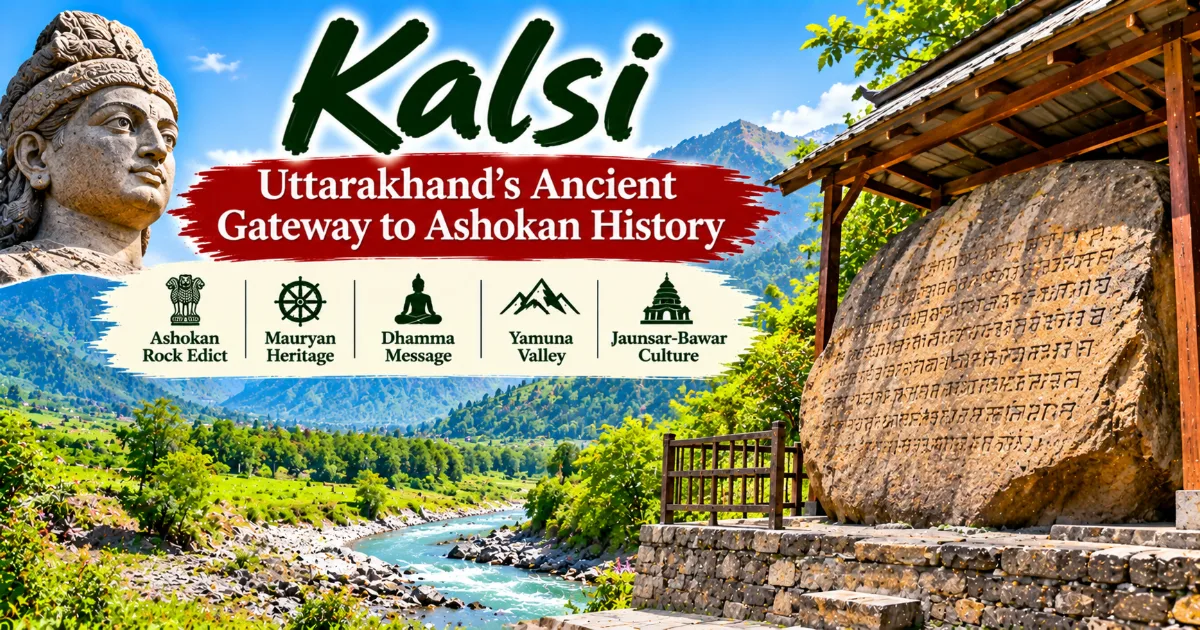
Discover Kalsi, a remarkable heritage destination in Dehradun district where the history of Emperor Ashoka meets the landscapes of the Yamuna Valley. Home to one of the most significant ancient inscriptions in northern India, Kalsi offers travellers an opportunity to explore India's early history, understand the spread of Buddhist ideas, and experience the cultural landscape of the Jaunsar-Bawar region.
Introduction: A Small Village with a Remarkable Historical Legacy
Uttarakhand is widely recognised for its Himalayan mountains, sacred rivers, pilgrimage destinations, alpine meadows and picturesque hill towns. Yet, beyond its celebrated natural attractions, the state also preserves places that reveal important chapters of India's ancient history. One such destination is Kalsi, a small town in the Dehradun district that holds an extraordinary place in the country's archaeological and cultural heritage.
Situated near the confluence of the Yamuna and Tons rivers, Kalsi is best known for its ancient rock edict associated with Emperor Ashoka of the Mauryan Empire. The inscription is among the important surviving records of Ashoka's rule and provides valuable evidence of the political, ethical and cultural ideas that shaped the Indian subcontinent during the third century BCE.
For travellers interested in history, archaeology, architecture and cultural tourism, Kalsi offers an experience that is different from the usual Himalayan holiday. It is not a destination where the main attraction is a luxury resort, a crowded marketplace or an elaborate adventure activity. Its importance lies in a historical monument that has survived for more than two thousand years and continues to communicate ideas about governance, compassion, responsibility and public welfare.
Continue Reading
The surrounding landscape adds another dimension to the visit. The Yamuna Valley, nearby villages, agricultural fields, river scenery and traditional settlements create a setting in which history and everyday life remain closely connected. Kalsi is therefore an ideal destination for travellers who want to understand Uttarakhand beyond its popular tourist circuits.
Where Is Kalsi Located?
Kalsi is located in the Dehradun district of Uttarakhand, in the northwestern part of the state. It lies in the broader Yamuna Valley region and serves as an important settlement along the route connecting Dehradun with the Jaunsar-Bawar area and neighbouring hill regions.
The town is positioned close to the meeting point of the Yamuna and Tons rivers. This geographical location has contributed to the historical and cultural importance of the surrounding area. Rivers have traditionally supported settlements, agriculture, movement and trade, and the valleys of the western Himalayan region have long provided natural routes between different communities.
Kalsi is also associated with the cultural landscape of Jaunsar-Bawar, a region known for its distinctive traditions, village architecture, agricultural practices and social customs. The region's cultural identity is different in several respects from that of the central Himalayan areas of Uttarakhand.
Its location makes Kalsi suitable for a day trip from Dehradun, although travellers who want to explore the surrounding villages and landscapes can plan a longer visit. The journey offers changing views of the Doon Valley, river valleys, cultivated land and the lower Himalayan foothills.
The Ashokan Rock Edict: Kalsi's Most Important Attraction
The principal reason Kalsi holds a special position on India's historical map is the Ashokan Rock Edict. This ancient inscription is associated with Emperor Ashoka, one of the most influential rulers of the Mauryan Empire.
Ashoka ruled during the third century BCE, a period when the Mauryan Empire controlled a vast territory across much of the Indian subcontinent. His reign is particularly significant because of the transformation in his political and personal outlook following the Kalinga War.
The war caused extensive suffering and loss of life. According to Ashoka's own inscriptions, the destruction deeply affected him and encouraged a change in his approach to kingship. He increasingly promoted Dhamma, an ethical framework that emphasised compassion, self-control, respect for different religious traditions, kindness towards living beings and responsible conduct.
Rather than relying only on royal announcements transmitted through officials, Ashoka used inscriptions carved into rocks and pillars to communicate his ideas across different parts of his empire. These inscriptions provide some of the most important historical evidence about his reign.
The Kalsi inscription belongs to this remarkable tradition of public communication. It records messages associated with Ashoka's policy of Dhamma and demonstrates how the emperor attempted to make ethical principles part of public life.
For visitors, standing before the inscription is an opportunity to encounter history through an original archaeological record rather than through a modern reconstruction or a museum display.
Understanding the Historical Importance of the Inscription
The Ashokan inscriptions are among the most valuable sources for understanding the Mauryan period. They reveal aspects of the emperor's administrative priorities, ethical thinking and relationship with the people under his rule.
The inscriptions were placed in locations where travellers, local populations and officials could encounter them. Their distribution suggests an organised effort to communicate royal messages over a large geographical area.
The Kalsi rock edict is especially important because it represents the northern reach of Ashoka's inscriptional tradition. It helps historians understand how the Mauryan ruler communicated his ideas in regions beyond the major political centres of the empire.
The inscription is written in the Brahmi script and uses the Prakrit language. These details are important for understanding the development of writing and language in ancient India. The Brahmi script became the foundation for many later writing systems used across the subcontinent.
The inscription also reflects the relationship between political authority and moral responsibility. Ashoka's messages were not limited to celebrating military victories or recording royal achievements. They communicated expectations about how people should behave towards one another and how rulers should exercise power.
This makes Kalsi a particularly meaningful destination for students of history, political science, archaeology and ancient Indian culture.
Emperor Ashoka and the Mauryan Empire
To understand the significance of Kalsi, it is useful to understand the historical background of the Mauryan Empire.
The Mauryan Empire emerged in the fourth century BCE under Chandragupta Maurya. With the guidance traditionally associated with Chanakya, Chandragupta established a powerful political system that expanded across large parts of the Indian subcontinent.
His successors continued to strengthen the empire. Ashoka became emperor in the third century BCE and presided over one of the most extensive phases of Mauryan power.
The empire had a developed administrative structure, with officials responsible for governance, revenue collection, communication and regional administration. Roads and other routes helped connect distant territories, while royal officers carried instructions from the imperial centre to different regions.
The Kalinga War became a turning point in Ashoka's reign. The suffering caused by the conflict influenced his approach to government and encouraged him to promote Dhamma as a guiding principle.
Ashoka did not simply abandon the responsibilities of an emperor. Instead, he increasingly presented good governance as a responsibility that included public welfare, ethical behaviour and concern for human and animal life.
The inscriptions found across the subcontinent are evidence of this approach. They help modern readers understand how a ruler attempted to communicate a common ethical message across communities with different languages, beliefs and local traditions.
Kalsi preserves one part of this larger historical story.
What Was Dhamma?
One of the central ideas associated with Ashoka's inscriptions is Dhamma. It is important to understand that Ashoka's Dhamma should not be reduced to a narrow religious instruction.
In his public messages, Dhamma represented a broad set of ethical principles intended to guide individual conduct and social relationships. These included respect for parents and elders, kindness towards servants and workers, generosity, restraint, truthfulness and consideration for other religious communities.
Ashoka also encouraged compassion towards living beings and expressed concern about unnecessary violence. His messages promoted moderation and discouraged behaviour that created hostility between people.
This ethical framework was particularly significant in an empire containing diverse populations. Different regions had their own languages, religious practices and cultural traditions. A shared moral approach could help strengthen social harmony without requiring everyone to follow an identical religious identity.
The Kalsi inscription provides visitors with a connection to this wider vision of ethical governance.
For modern travellers, its message can encourage reflection on questions that remain relevant today. What responsibilities should governments have towards ordinary citizens? How can different communities coexist peacefully? Why should public power be exercised with restraint and compassion?
These questions make the monument more than an archaeological attraction. It is also a place where ancient political thought can be considered in relation to contemporary society.
The Archaeological Value of Kalsi
Kalsi is important not only because of the message recorded on the rock but also because of its value as an archaeological site.
Ancient inscriptions provide direct evidence of the past. Unlike later historical accounts, which may have been written long after the events they describe, inscriptions can preserve official messages from the period in which they were created.
The language, script, physical placement and condition of an inscription all contribute to its historical interpretation. Researchers examine these elements to understand chronology, political geography, communication systems and cultural developments.
The Kalsi inscription contributes to the study of Brahmi writing and the spread of Ashoka's messages across different regions. It also helps historians understand the geographical extent of Mauryan influence and the importance of routes connecting northern India.
The monument should therefore be viewed as part of a larger archaeological landscape rather than as an isolated stone object.
Its preservation is important for future generations. Exposure to weather, human activity and environmental changes can affect ancient surfaces. Responsible tourism and careful management of archaeological sites are necessary to protect such heritage.
Visitors should avoid touching, scratching or marking the inscribed surface. The monument is a historical record that cannot simply be recreated if it is damaged.
Kalsi and the Yamuna Valley
The geographical setting of Kalsi is an important part of its appeal. The town lies in the Yamuna Valley, where river systems, agricultural land and the lower Himalayan landscape create a distinctive natural environment.
The Yamuna is one of northern India's most important rivers. Its upper course passes through mountainous terrain before continuing towards the plains. The river has shaped settlement patterns, agricultural practices and cultural traditions across the regions through which it flows.
The Tons River is another important waterway in this area. Its meeting with the Yamuna creates a geographically significant landscape and connects Kalsi with the wider river system of the western Himalayan region.
The valleys around Kalsi are characterised by a combination of cultivated slopes, forested areas, villages and mountain views. Depending on the season and weather, the landscape can appear particularly green, dry, misty or clear.
Travellers should take time to observe the surroundings rather than limiting their visit to the archaeological monument. The river valley offers opportunities for photography, quiet exploration and understanding the relationship between geography and local settlement.
However, visitors should remember that rivers and mountain streams can become dangerous during heavy rainfall. Approaching the water requires caution, particularly during the monsoon season.
Exploring the Jaunsar-Bawar Cultural Region
Kalsi is closely connected with the wider cultural region of Jaunsar-Bawar. This region is known for its distinctive social traditions, festivals, architecture and village life.
The communities of Jaunsar-Bawar have preserved cultural practices that reflect the area's geographical setting and historical development. Traditional houses, local agricultural systems, community celebrations and customary social arrangements contribute to the region's identity.
The architecture of the area often reflects the practical requirements of mountain living. Traditional buildings use locally available materials and are adapted to the climate and terrain. In some villages, older wooden and stone structures remain important elements of the built environment.
Local festivals provide opportunities to understand the relationship between community life, agriculture, religious traditions and seasonal cycles. Music, dance and collective celebrations form an important part of the region's cultural expression.
Travellers should approach these traditions with respect and curiosity. Cultural tourism should not treat local customs as performances created solely for visitors. Communities have their own reasons for preserving traditions, and visitors should respect their privacy and local expectations.
Kalsi can serve as a starting point for understanding this cultural landscape. A visit that combines the Ashokan monument with nearby settlements can offer a richer experience than a brief stop at the inscription alone.
Traditional Architecture and Village Life
The villages around Kalsi offer an opportunity to observe how people have adapted to life in the Himalayan foothills.
Traditional homes in the broader Jaunsar-Bawar region may use stone, timber and other locally available construction materials. Their design often reflects practical concerns such as temperature, rainfall, slope conditions and the availability of building resources.
Agriculture remains an important part of life in many settlements. Fields and terraced slopes demonstrate how communities have adapted farming to uneven terrain. Crops and agricultural activities vary according to altitude, soil, rainfall and local conditions.
Village life is closely connected with family networks, community relationships and seasonal work. Visitors may notice a slower rhythm of daily activity compared with larger towns.
These settlements should be explored thoughtfully. Narrow roads, private homes and working agricultural spaces are not public attractions in the same way as a designated monument. Ask permission before photographing people or entering private property.
Supporting local shops and services can help ensure that tourism contributes to the surrounding economy.
Best Time to Visit Kalsi
Kalsi can be visited during much of the year, but the experience changes according to the season.
Spring: March to April
Spring is a pleasant period for exploring the area. Temperatures are generally more comfortable than during the peak summer months, and the surrounding landscape begins to show signs of seasonal renewal.
This is a good time for visitors interested in combining historical sightseeing with short drives through the countryside. The weather can support outdoor exploration, although travellers should check local conditions before departure.
Summer: May to June
Summer can be suitable for a visit to Kalsi, particularly for travellers coming from the warmer plains. The lower Himalayan setting may offer a more comfortable environment than some lowland destinations, although daytime temperatures can still rise.
It is advisable to visit the monument during the morning or later afternoon. Carry drinking water, sun protection and comfortable footwear.
Monsoon: July to September
The monsoon brings rainfall to the region. The surrounding landscape becomes greener, and the river valleys can look especially beautiful.
However, heavy rain may create difficult road conditions, landslides and increased river flow. Travellers should check weather forecasts and local road information before planning a journey.
Avoid unnecessary movement near riverbanks during periods of heavy rainfall. The beauty of the monsoon landscape should never encourage visitors to ignore water-related risks.
Autumn: October to November
Autumn is one of the most attractive periods for exploring Kalsi. Rainfall generally reduces, visibility can improve and the surrounding countryside often becomes suitable for photography and sightseeing.
Travellers interested in history, village exploration and scenic drives may find this season particularly rewarding.
Winter: December to February
Winter brings cooler temperatures, especially in the mornings and evenings. Kalsi does not have the same high-altitude winter conditions as many Himalayan destinations, but visitors should still carry warm clothing.
The quieter atmosphere can be appealing to travellers who prefer less crowded sightseeing. Check local weather and road conditions before travelling.
How to Reach Kalsi
Kalsi is accessible by road from Dehradun and other towns in the region.
By Road
Road travel is the most practical way to reach Kalsi. Dehradun is the major urban centre from which many visitors begin their journey.
Travellers can hire a taxi, drive a private vehicle or use available local transport services. The journey passes through the lower Himalayan landscape and offers views of the Doon Valley and surrounding countryside.
Road conditions can vary according to weather and maintenance work. During the monsoon, travellers should allow additional time and check for local restrictions.
By Rail
Dehradun Railway Station is the nearest major railway station for visitors travelling from other parts of India. It is connected with several important cities through regular train services.
From the station, travellers can continue towards Kalsi by road.
By Air
Jolly Grant Airport near Dehradun is the nearest major airport. Visitors arriving by air can arrange road transport from the airport to Kalsi.
Flight availability and schedules may vary, so travellers should confirm their travel arrangements before departure.
Suggested One-Day Kalsi Itinerary
A one-day visit can cover the principal historical attraction and provide time to appreciate the surrounding landscape.
Morning: Begin from Dehradun
Start early from Dehradun. An early departure allows visitors to avoid some of the daytime traffic and spend more time exploring the destination.
Enjoy the changing landscape as the road moves away from the city and towards the Yamuna Valley.
Late Morning: Visit the Ashokan Rock Edict
Spend sufficient time at the Ashokan Rock Edict. Read the available interpretation material, observe the monument carefully and understand the historical background before leaving.
A little preparation about Emperor Ashoka and the Mauryan Empire can make the visit much more meaningful.
Afternoon: Explore the Surrounding Area
Explore the accessible surroundings of Kalsi and learn about the cultural setting of the Jaunsar-Bawar region. Depending on time, local conditions and available transport, visitors can include a short drive through nearby settlements.
Choose a local place for a meal where available, and respect local customs.
Late Afternoon: Enjoy the Yamuna Valley Landscape
Spend some time appreciating the valley scenery. Photography, landscape observation and a relaxed drive can complete the experience.
Return to Dehradun before it becomes too late, especially if travelling during the monsoon or winter.
Who Should Visit Kalsi?
Kalsi is particularly suitable for travellers who enjoy destinations with historical and cultural significance.
History enthusiasts will appreciate the connection with Emperor Ashoka and the Mauryan period. The rock edict provides a direct link to an important chapter of ancient Indian history.
Students and educators can use the destination to understand inscriptions, ancient scripts, political history and the development of ethical ideas in India.
Archaeology enthusiasts may find the monument especially interesting because of its historical inscription and importance in the study of early Indian writing.
Cultural travellers can explore the wider Jaunsar-Bawar region and learn about its traditions, architecture and village life.
Slow travellers and photographers can appreciate the river valley, surrounding settlements and quieter landscape.
Families can also visit Kalsi as an educational excursion, provided that children are supervised around the monument, roads and river areas.
Photography and Travel Experiences
Kalsi offers a different kind of photography experience from Uttarakhand's famous mountain viewpoints.
The Ashokan Rock Edict is the principal subject for heritage photography. Visitors should follow site rules and avoid any activity that could damage the monument.
The surrounding landscape provides opportunities for river valley photography, rural scenes, agricultural fields and views of the lower Himalayan foothills.
Photographers interested in cultural subjects should remember that people and private spaces deserve respect. Always seek permission before taking close-up photographs of individuals, homes or community activities.
Natural light can change the appearance of the landscape throughout the day. Morning and late afternoon often provide pleasant conditions for outdoor photography.
The purpose of photography should be to document and appreciate the destination without disturbing its historical or cultural environment.
Food and Local Cuisine
A visit to Kalsi can also provide an opportunity to experience the food traditions of the surrounding region.
The wider Jaunsar-Bawar area has a food culture shaped by local agriculture, climate and community practices. Traditional meals may include locally grown grains, seasonal vegetables, pulses and preparations suited to mountain life.
Food habits vary between households and settlements, so visitors should not assume that every local dish is available at every eating establishment.
Travellers can ask local residents or food providers about regional specialities and choose freshly prepared meals where available.
If planning a longer exploration beyond Kalsi, it is sensible to carry drinking water and some basic snacks. Food options may be more limited in smaller settlements than in Dehradun.
Responsible Tourism at a Historical Site
Kalsi's significance depends on the survival of its archaeological heritage. Visitors have an important role in protecting this legacy.
The Ashokan inscription should never be scratched, painted, marked or used as a surface for placing objects. Even seemingly minor contact can contribute to deterioration over time.
Visitors should follow the instructions of site authorities and avoid crossing restricted areas. If photography rules are displayed, follow them carefully.
Do not leave plastic bottles, food wrappers or other waste behind. Carry waste until an appropriate disposal facility is available.
When visiting nearby villages, respect private property, local customs and community spaces. Ask before photographing residents or entering homes.
Support local businesses when possible. Purchasing local products, using local services and respecting the people who live in the region can help make tourism more beneficial to the destination.
Responsible tourism is particularly important at places where the principal attraction is an irreplaceable historical monument.
Kalsi as an Educational Destination
Kalsi has considerable educational value because it allows visitors to connect historical information with a surviving monument.
Students studying ancient Indian history can explore the Mauryan Empire, Ashoka's reign, the Kalinga War and the development of Dhamma. The inscription also provides an opportunity to discuss the importance of archaeological evidence in historical research.
Students of language and literature can learn about Brahmi and Prakrit. The development of writing systems is an important part of understanding how societies recorded laws, ideas, religious messages and administrative information.
Those studying political science can consider Ashoka's approach to governance and public responsibility. His inscriptions offer examples of how rulers communicated expectations about ethical behaviour and social harmony.
For educators, Kalsi can become a field-learning destination where classroom discussions are connected to a real historical site. A visit can encourage students to ask questions, examine evidence and understand the difference between historical interpretation and unsupported assumptions.
Families can also introduce children to the importance of preserving heritage. Seeing an ancient inscription can make history more tangible than reading about it only in a textbook.
Why Kalsi Deserves More Attention in Uttarakhand Tourism
Uttarakhand tourism is often associated with pilgrimage, adventure, wildlife and mountain holidays. These categories are important, but they do not represent the full diversity of the state.
Kalsi demonstrates the importance of including archaeological and heritage destinations in the broader tourism conversation.
Its Ashokan inscription connects Uttarakhand with one of the most influential periods in ancient Indian history. The monument also provides a valuable opportunity to understand the development of early writing and the relationship between political authority and moral principles.
The surrounding Jaunsar-Bawar region adds cultural depth to the experience. Visitors can learn about local architecture, traditional practices and the relationship between communities and their geographical environment.
Kalsi can also contribute to more balanced tourism development by encouraging travellers to explore destinations beyond the most heavily visited circuits. This can create opportunities for local transport providers, food establishments, guides and small businesses.
However, increasing visitor numbers should not become the only measure of success. The protection of the archaeological site and the dignity of local communities must remain central to tourism planning.
A heritage destination is valuable not simply because it attracts visitors but because it preserves knowledge that can be shared with future generations.
Travel Tips Before Visiting Kalsi
Before planning a trip, check local weather and road conditions, particularly during the monsoon.
Carry drinking water, sun protection and comfortable walking shoes. If travelling during winter, bring warm clothing for the morning and evening.
Learn a little about Emperor Ashoka and the Mauryan Empire before visiting the rock edict. Understanding the historical background will help you appreciate the inscription more deeply.
Check the current visiting arrangements and any restrictions at the monument before departure. Facilities and opening arrangements may change.
Do not assume that every part of the surrounding region has restaurants, fuel stations or accommodation options. Plan essential requirements in advance.
If you intend to explore nearby villages, consider arranging reliable local transport and allow sufficient time for the journey.
Most importantly, treat the monument as a protected historical record. Avoid touching or marking the inscription and follow all site instructions.
Final Thoughts: A Journey into India's Ancient Past
Kalsi may not have the dramatic snow-covered peaks or famous pilgrimage crowds associated with many Uttarakhand destinations, but its historical importance makes it one of the region's most meaningful places to explore.
The Ashokan Rock Edict offers a rare opportunity to encounter a message from the ancient Mauryan period in the very landscape where it has survived for centuries. It connects visitors with Emperor Ashoka, the transformation of his approach to governance and the ethical principles he attempted to communicate across his empire.
The surrounding Yamuna Valley and Jaunsar-Bawar cultural region make the journey even more rewarding. They provide a setting in which archaeological heritage, traditional settlements and natural landscapes can be experienced together.
For travellers who want to discover the many layers of Uttarakhand, Kalsi deserves a place on the itinerary. It reminds us that the state's heritage is not limited to temples, mountains and pilgrimage routes. Its history also includes inscriptions, ancient political ideas, cultural exchange and the development of India's early written traditions.
A visit to Kalsi is ultimately a journey into a past that continues to offer lessons for the present. It is a destination where a simple rock inscription becomes a window into an extraordinary period of Indian civilisation.
#Kalsi #UttarakhandTourism #AshokanRockEdict #IndianHistory #ExploreUttarakhand