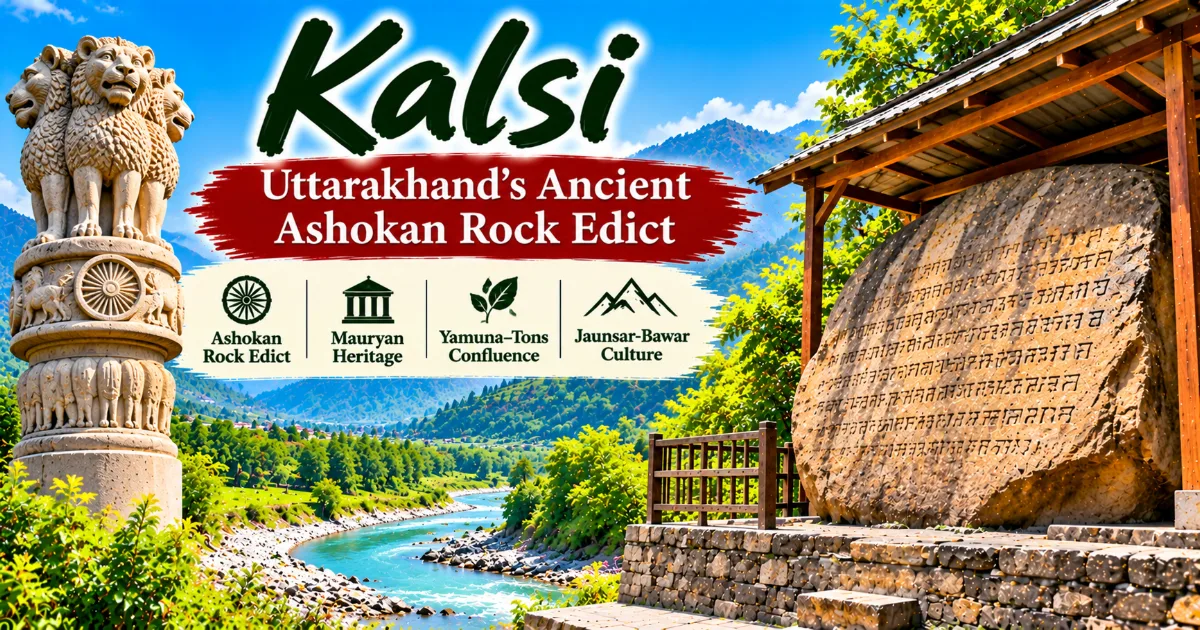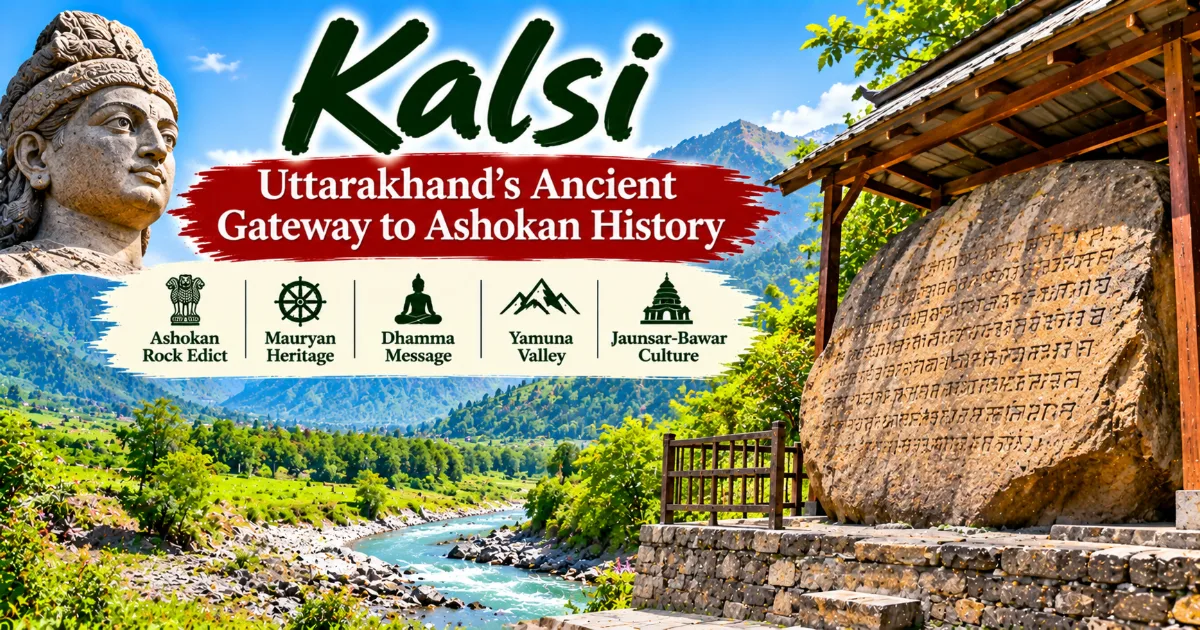
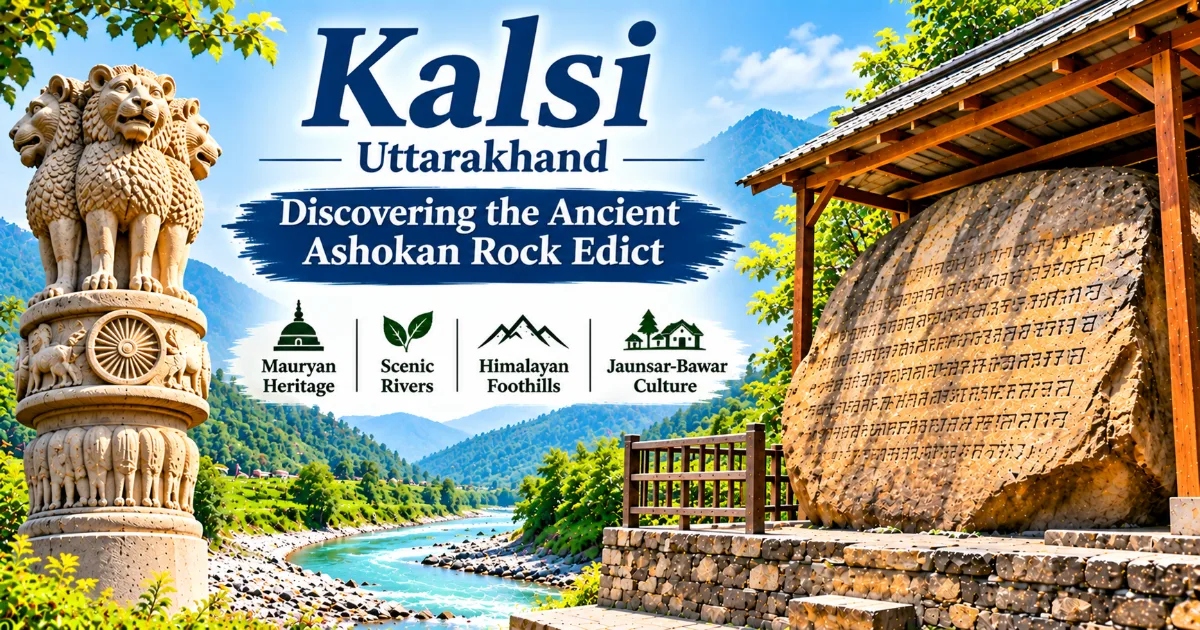
Most people know Uttarakhand for its snow-covered mountains, sacred rivers, ancient temples, alpine meadows and quiet hill settlements. Away from the usual pilgrimage routes there is a historical site that ties the Himalayan region to one of the most influential periods in ancient Indian history. In Kalsi, a small settlement in the Dehradun district, stands a rock inscription commissioned by Emperor Ashoka during the third century BCE. Known as the Kalsi Rock Edict, it lets you meet the political and ethical history of the Mauryan Empire on the ground of present-day Uttarakhand.
History here is not kept inside a museum or a reconstructed monument. An ancient emperor's message was engraved on a natural rock surface, and visitors can stand in front of an inscription that has survived for more than two thousand years. That it sits in the Himalayan foothills shows the region was linked to wider networks of administration, communication and cultural exchange in ancient India, long before the hill stations and pilgrimage towns of today existed.
There is natural beauty too. Near the confluence of the Yamuna and Tons rivers, the settlement is ringed by green hills, farmland and forested slopes. It is quieter than the crowded pilgrimage centres and popular hill stations of Uttarakhand. If you like history, archaeology or slow travel, you have good reasons to include Kalsi when exploring the state.
The inscription matters, and so does the wider view of Uttarakhand it opens up. These mountains were never only places of religious significance or scenery. For a very long time routes ran through them, connecting communities, kingdoms, trade networks and cultural traditions on either side of the ranges. Kalsi is a good place to start understanding those connections.
Continue Reading
Where Is Kalsi Located?
You will find Kalsi in the Dehradun district of Uttarakhand, in the northwestern part of the state. It belongs to the broader Jaunsar-Bawar region, known for its own cultural traditions and traditional architecture. Because the settlement sits near the meeting point of the Yamuna and Tons rivers, its surroundings are interesting for their geography as well as their history.
This is a transition zone between the Himalayan foothills and the higher mountains. Riverbanks, wooded hills and cultivated fields give way to villages spread across the slopes. Compared with central Dehradun the terrain is far less urbanised, and the drive towards Kalsi shows a quieter side of the district.
The rivers shaped much of this region. For centuries they provided water for farming and guided the movement of people through valleys and mountain corridors. The Yamuna and Tons valleys also link settlements at different elevations, forming routes between the plains and the Himalayan interior.
Travellers can treat Kalsi as a historical excursion from Dehradun, or fold it into a longer journey through Jaunsar-Bawar and nearby mountain destinations. It suits anyone who wants a heritage stop combined with scenic drives and a first look at the cultural geography of western Uttarakhand.
The Kalsi Rock Edict: Kalsi's Link to Ancient India
The most important attraction here is the Ashokan Rock Edict, an inscription associated with Emperor Ashoka of the Mauryan dynasty. His reign fell in the third century BCE, and he became known for his efforts to promote the principles of Dhamma after the Kalinga War. Placed across different parts of the Indian subcontinent, his inscriptions are among the most important historical records of ancient India.
What sets the Kalsi inscription apart is that it marks the northern reach of Ashoka's known rock edict network. Mauryan administration and communication, in other words, extended towards the Himalayan foothills. So the ancient history of Uttarakhand was tied to developments across a much larger geographical area.
Engraved on a natural rock surface, the edict differs from a modern monument built to commemorate an event. It is an original historical document, still in the landscape where it was placed. Standing by the rock, you can see that its written message was meant to carry ideas well beyond the royal court.
It belongs to the tradition of Ashokan Major Rock Edicts. These texts set out the emperor's approach to governance, moral conduct, public welfare and relations between religious communities. Royal authority is part of it, but they also show how Ashoka tried to spread a broader ethical vision to people in different regions of his empire.
Few places let you meet ancient history in its original material setting like this. Photograph the rock by all means, but remember what it is: a surviving record of political thought and of writing used as an instrument of governance.
Who Was Emperor Ashoka?
Emperor Ashoka was one of the most influential rulers of the Mauryan Empire, which emerged in the fourth century BCE and grew into one of the largest political powers in ancient South Asia. Its founder, Chandragupta Maurya, built a powerful empire centred on Pataliputra, present-day Patna. Later in the same dynasty came Ashoka, who is generally placed in the third century BCE.
His reign is closely tied to the Kalinga War, a conflict that caused immense suffering and loss of life. By his own inscriptions' account, the war's consequences affected him deeply. He expressed remorse over the destruction caused by military conquest and came to stress Dhamma as a guiding principle of governance.
In the inscriptions, Dhamma means a broad ethical approach to life and public conduct. It covered respect for parents and elders, kindness towards living beings, restraint, generosity, proper treatment of servants and respect for different religious traditions. No narrow religious identity was attached to it. Rather, this was a moral framework that he hoped to encourage throughout all of his territories.
None of this meant giving up the duties of kingship. Instead, his inscriptions suggest he wanted royal authority linked with welfare and concern for the people. Officials were told to pay attention to public needs, and he promoted values that could support social harmony.
He had his inscriptions placed where people would come across them. Engraving royal messages on rocks and pillars was an important step in the history of public communication, because it carried the ruler's words to regions far beyond the capital.
The edict at Kalsi formed part of that wider effort, and it is worth seeing it in that light. Its edict shows that Ashoka's administration counted the Himalayan foothills within its reach, and that the emperor's ideas were communicated here.
What Does the Kalsi Rock Edict Tell Us?
The Major Rock Edicts deal with several themes of ethical governance and public responsibility. At Kalsi this tradition survives in the northwestern Himalayan foothills, which is what makes the inscription here so important.
Among their messages are compassion, restraint, respect for different religious communities and concern for the welfare of people and animals. Some passages turn to the responsibilities of officials and to moral conduct in everyday life.
A central idea is that good governance should not be measured only by military strength or territorial expansion. A ruler should also look after the well-being of subjects, encourage ethical behaviour and reduce unnecessary suffering. That was a weighty political message at a time when royal power was usually tied to conquest and military achievement.
Respect between religious communities comes up too. People are advised not to praise their own traditions by unfairly criticising others, and this point on mutual respect is one of the most widely discussed parts of Ashoka's public philosophy.
So the Kalsi inscription is evidence of how these ideas travelled beyond the central regions of the Mauryan Empire. It also shows how much written records matter for reconstructing ancient political and cultural history.
Keep in mind that this is an archaeological source. Its interpretation rests on historical study, linguistic analysis and comparison with other Ashokan inscriptions. Without explanatory information a modern visitor may struggle to read it, yet its historical importance is clear even before every line is understood.
The Language and Script of the Inscription
The languages and scripts of Ashokan inscriptions matter as much as their messages. At Kalsi the edict is written in Prakrit using the Brahmi script, which makes it valuable for studying ancient Indian languages, writing systems and public communication.
Prakrit refers to a group of Middle Indo-Aryan languages and language forms used in different parts of ancient India. Using it allowed royal messages to reach a wider population than a highly specialised literary language might have done.
Brahmi is one of the most important ancient scripts in the history of South Asian writing and the ancestor of several later scripts used across the Indian subcontinent. When it was deciphered in the nineteenth century, largely through the work of James Prinsep, scholars could finally read Ashoka's inscriptions and reconstruct important parts of early Indian history.
Several fields of study draw on the Kalsi inscription. Historians use it to understand the Mauryan period and Ashoka's policies, while linguists study its language and writing system. Archaeologists look at its physical location and preservation, and students of political thought read its messages about ethical governance.
All this gives a visit more depth. Beyond its link to a famous emperor, the rock is evidence of how writing developed and was used to communicate ideas across a large geographical area.
Why Was the Inscription Placed in Kalsi?
Nobody can say with complete certainty why Kalsi was chosen for the inscription. Its geographical position, though, offers useful clues about why the area may have mattered.
The settlement lies near an important river junction, in a region that links different valleys and settlements. Waterways have long served as natural corridors for movement, and mountain routes connected communities at different elevations. A spot close to these connections would have been a sensible place to put a royal message in front of people travelling through.
It also tells us the Himalayan foothills were not cut off from the wider political and cultural developments of ancient India. Local communities here may have had their own traditions and political structures while keeping ties with larger powers and neighbouring territories.
An Ashokan edict does not mean every village in the surrounding mountains was run the same way as the imperial centres. Ancient political control could vary a great deal between central regions, frontier areas and communities in difficult terrain. Even so, this part of the foothills was important enough to receive an official royal message.
For many visitors, that is the most interesting part of coming here. Questions follow naturally: which ancient travel routes passed this way, and how did a large empire deal with mountain societies?
Kalsi and the Historical Geography of Uttarakhand
Uttarakhand's historical geography was shaped by its rivers, mountain passes, valleys and settlements. Sitting between the northern plains and the higher Himalayan regions, the state's terrain has steered migration, trade, pilgrimage, agriculture and political relationships for many centuries.
The Yamuna and Tons river valleys are part of this larger picture. They offer natural routes through mountainous terrain and join communities that steep slopes and ridges would otherwise separate. Settlements grew up around water, cultivable land and the paths that led between villages and wider markets.
Seen in this setting, Kalsi's importance becomes clearer. Its Ashokan inscription ties the region to the Mauryan period, and the surrounding Jaunsar-Bawar area keeps cultural traditions formed over a long relationship between mountain communities and their environment.
The state's past goes well beyond the building of temples and the growth of pilgrimage routes. Local kingdoms, regional chiefs, trade networks, farming communities, oral traditions and the movement of people across the Himalayas all belong to it, and Kalsi is one important piece of that picture.
With this in mind, a visit becomes more than a scenic outing. You start to see how geography shaped the societies here and how historical events reached the foothills of the Himalayas.
Exploring the Jaunsar-Bawar Region
Jaunsar-Bawar, a culturally distinct region in western Uttarakhand, is easy to start exploring from Kalsi. The region is known for its traditional villages, wooden houses, local festivals and community practices.
Jaunsari culture grew up in close relationship with the mountains. Traditional houses tend to use locally available materials and are built for seasonal weather. Farming, livestock rearing and forest resources have long been central to village life.
Social customs, music, dance forms and festivals here have their own character. They differ between communities and villages, so it is better to learn about them through respectful interaction than through generalisations. Depending on the season and location, you might come across local celebrations, traditional clothing, folk performances or old village architecture.
Travelling slowly pays off. Rather than treating Kalsi as a short stop for the rock inscription, spend some time in the surrounding villages and countryside. Talking with local residents, browsing small markets and learning about traditional livelihoods make for a richer trip.
Remember that villages are living places, not open-air attractions. Take photographs respectfully, especially of people, and ask permission before entering private property or photographing individuals.
Natural Beauty Around Kalsi
History enthusiasts mostly come for the Ashokan Rock Edict, but the countryside is a big part of the trip as well. Expect river valleys, forested slopes, cultivated fields and distant mountain views.
The Yamuna and Tons rivers give the surroundings their particular character. Their valleys shape the terrain and feed the vegetation and farming. Depending on season and weather, the hills may look bright green, dry and golden, or covered in mist.
Around Kalsi there are scenic drives and short walks to enjoy. Along the way you can take in the countryside, watch local farming and enjoy the slower pace of the foothills.
The area has not been developed as a large commercial hill station. Visitors who want the landscape and local character to stay central may see that as a plus. It does mean planning transport, meals and accommodation carefully instead of expecting the facilities of major tourist centres.
For nature lovers, Kalsi works as a base for exploring nearby parts of the Dehradun district and the Jaunsar-Bawar region. Often the best moments come on the road itself, as rivers, forests and mountain settlements change from one bend to the next.
Best Time to Visit Kalsi
You can visit for much of the year. Which season suits you best depends on the kind of trip you have in mind, whether that is sightseeing at the edict, photography or a longer drive through the hills.
Spring: March to April
Spring is a pleasant time to explore. Temperatures are usually more comfortable than in peak summer, and the vegetation starts its seasonal growth, which suits countryside photography and relaxed sightseeing.
With moderate weather you can walk around the rock edict and nearby areas without intense heat. It is also a good season for combining Kalsi with other destinations in the Dehradun district.
Summer: May to June
Summer can be warm, particularly during the afternoon. Still, Kalsi stays more pleasant than the hotter urban areas of the plains. Plan outdoor activities for the morning or later afternoon and carry enough drinking water.
Road trips and longer explorations work in this season, though temperatures and weather conditions should be checked before travelling, as both can change from one week to the next.
Monsoon: July to September
Rain turns the whole area green, and forests, fields and hills look their best after a downpour. Heavy rain, however, can affect road conditions and increase the risk of landslides or travel delays in mountainous areas.
If you plan a monsoon trip, check local weather and road advisories, avoid travelling during intense rainfall and keep your schedule flexible. River levels can rise quickly, so stay away from unsafe riverbanks and follow local guidance.
Autumn: October to November
Autumn is one of the most comfortable times to visit Kalsi. Skies are often clearer and visibility is good, which suits history, photography and road trips.
Settled weather also makes it easier to add nearby cultural and natural destinations to the trip.
Winter: December to February
Early mornings and evenings turn cold in winter, so pack warm clothing. Fewer people travel then, and the quieter atmosphere appeals to visitors who prefer less crowded places.
Before a winter visit, check road conditions and accommodation availability. Weather can change quickly in the hills, so stay flexible.
How to Reach Kalsi
Roads connect Kalsi with Dehradun and other parts of Uttarakhand. The drive runs through the foothills and slowly brings you into the river valleys and hills of the region.
By Road
Driving is the most practical option. From Dehradun you can go by private vehicle or taxi, and depending on your starting point, traffic and road conditions, the journey may take a few hours. Look at the route before leaving, since travel time can vary a good deal.
The road journey itself can be an enjoyable part of the trip. Shifting scenery, small settlements and river views give a good sense of the geography of western Uttarakhand.
By Rail
Dehradun is the most convenient major railway station for visitors travelling by train. At the railway station you can arrange a taxi or continue by road towards Kalsi.
Coming from other parts of India? Check current train schedules and onward road transport before fixing your itinerary.
By Air
Jolly Grant Airport near Dehradun is the nearest major airport for this part of Uttarakhand. Visitors then continue towards Kalsi by road, with journey time depending on traffic and the route you pick.
Arrange onward transport in advance, particularly if you land late in the day.
How Much Time Should You Spend in Kalsi?
How long you need depends on whether you only want the Ashokan Rock Edict or the surrounding region as well.
A half-day visit may be enough for travellers who want to see the inscription and spend some time exploring the immediate surroundings. If local culture and the countryside interest you as much as the history, give it a full day.
Two days make for a more relaxed trip. Spend the first on the rock edict and Kalsi's geographical setting, and use the second for nearby villages and other destinations, depending on road conditions and available transport.
To combine Kalsi with a longer exploration of Jaunsar-Bawar, plan a three-day or longer itinerary. That leaves time for village visits and scenic drives without rushing.
Suggested Travel Itineraries
One-Day Kalsi Heritage Trip
Leave Dehradun early in the morning and head to Kalsi, where you can spend time at the Ashokan Rock Edict. Read whatever interpretation material is available to get the historical background of the inscription. Afterwards, walk around the area, look at the river landscape and have a relaxed lunch before returning to Dehradun.
This plan suits travellers with limited time who still want to see one of Uttarakhand's important archaeological sites.
Two-Day History and Landscape Trip
Day one: travel from Dehradun to Kalsi and explore the rock edict, taking time over the historical importance of Ashoka's inscriptions and the site's location. Wander through the surrounding countryside, then stay in suitable accommodation in the region or return to a nearby base.
Day two: visit selected villages and scenic areas in Jaunsar-Bawar. Look at traditional architecture, try local food and notice how the settlements fit into the mountain landscape. Return to Dehradun at the end.
Three-Day Jaunsar-Bawar Exploration
With three days you can explore at a slower pace. Start with Kalsi and the Ashokan Rock Edict. On the second day, visit selected villages and learn about local culture and traditional livelihoods. Keep the third for a scenic drive or another nearby destination that current road conditions allow.
Choose this one if you want history and countryside together rather than a quick sightseeing trip.
Food to Try Around Kalsi
Food tells you a lot about Uttarakhand's culture. Around Kalsi and Jaunsar-Bawar, cooking follows local agriculture, climate and whatever ingredients are at hand.
Expect dishes built on grains, lentils, seasonal vegetables and local produce. Traditional meals in the broader Garhwal region include mandua roti, local lentil preparations and seasonal vegetable dishes. What is on offer differs between eateries and villages, so ask about local specialities instead of expecting every dish everywhere.
Mandua, also known as finger millet, is an important traditional grain in many parts of Uttarakhand. Cooks use it in different preparations, and it is valued for its nutritional qualities. Local lentils and pulses are another staple of traditional meals.
Where possible, eat at locally run places if regional cuisine interests you. Eating local food supports small businesses and gives you a better understanding of the area's culinary traditions.
State any dietary restrictions clearly before ordering. Smaller settlements may have few restaurants, so carry suitable snacks for longer road journeys.
Accommodation and Travel Planning
Since Kalsi is not a large commercial tourism centre, accommodation choices may be more limited than in Dehradun or the popular hill stations. Before you set off, find out which guesthouses, small hotels and homestays in the wider area have rooms.
Dehradun makes a convenient base if you want more hotels, restaurants and transport, and Kalsi is then an easy day trip. For a longer stay in the region, look for accommodation closer to your planned route.
When choosing where to stay, think about road access, basic facilities, food and the distance to the places you want to see. During weekends and holiday periods, advance reservations can help you avoid last-minute difficulties.
Rural places rarely have the services of a major tourist town. Mobile connectivity, transport and access to medical facilities may vary, so planning ahead matters most for families, senior travellers and anyone on a longer road journey.
Photography at Kalsi
Photographers interested in historical architecture, inscriptions and landscapes will find plenty to shoot here.
The Ashokan Rock Edict is the obvious subject for heritage photography. Document the rock surface and its setting, but follow the site's photography rules and never touch, mark or interfere with the inscription. Old surfaces damage easily, and even harmless-looking actions can add to their deterioration.
River valleys and hills nearby make good landscape subjects. Light is softer in the morning and late afternoon, and passing weather changes the mood across the hills.
In villages, be sensitive. Ask before photographing residents, homes, ceremonies or private spaces, and do not treat local people as curiosities. Respect people's privacy and the cultural context of the place.
Try to build a set of pictures that shows the inscription, the wider landscape and everyday life of the region, all without disturbing the people or the heritage that give Kalsi its meaning.
Kalsi for Students and History Enthusiasts
For students of history, archaeology, political science, linguistics and Indian culture, Kalsi is especially useful. Here classroom learning meets a surviving historical source in the Ashokan Rock Edict.
Anyone studying the Mauryan Empire can see how Ashoka sent royal messages across different parts of his empire. The inscription also opens up discussion of how political power relates to ethical responsibility.
Archaeology students get an example of an inscription preserved on a natural rock surface, with all the questions about conservation, documentation, interpretation and protection of heritage sites that come with it.
In linguistics, the edict shows Prakrit and Brahmi used for ancient public communication. How scripts developed, and how inscriptions were later deciphered, is a clear case of written evidence feeding historical reconstruction.
Regional history comes into it as well. The site's location shows that the Himalayan foothills were part of wider political developments, and that history should not be told only from major capitals and famous urban centres.
Teachers and educational groups will get more out of a visit if students arrive with some background. Knowing about Ashoka, the Mauryan Empire and why he put up his inscriptions helps them see why the site matters.
Responsible Tourism and Heritage Conservation
Because of its historical importance, Kalsi needs careful visitors. The Ashokan Rock Edict is a fragile archaeological record, and keeping it depends on how people behave at the site and on long-term conservation work.
Never scratch, paint, carve or write on the rock surface, and do not try to take away pieces of stone or anything else from the site. Even small damage harms an irreplaceable monument.
Follow the site authorities' instructions and respect any limits on photography, movement or access. Do not leave litter around the monument or anywhere in the natural environment nearby.
Show the same care in the surrounding villages. Use local businesses where possible, buy local products and treat residents with respect. Ask before entering private spaces, and do not disturb farm work or community events.
Treat the rivers and hills around Kalsi with equal care. Do not dump waste, cut down on single-use plastic and leave wildlife alone. Never step into unsafe river areas just for a photograph.
Heritage tourism does most good when it builds awareness and helps preservation. A visit to Kalsi should leave the site and its surroundings as undisturbed as possible.
Practical Travel Tips Before Visiting
Plan the journey in advance, particularly if travelling from outside Dehradun. Current road conditions are worth checking, and it helps to allow extra time for traffic or unexpected delays.
Carry drinking water, basic medicines, comfortable walking shoes and weather-appropriate clothing for the season you travel in. In warmer months a hat and sun protection help; in winter, bring warm layers.
Smaller establishments may not always accept digital payments, so keep some cash. Mobile connectivity and network coverage can be patchy in rural and mountainous areas.
If the inscription is your main reason for coming, read about Ashoka's Major Rock Edicts beforehand. You will understand the site's historical context much better.
Avoid rushing through the visit. Spend time looking at the location and how it sits in the surrounding landscape, and think about what it means for an ancient public message to survive into the modern world.
Travelling with children? Explain why historical monuments need protecting. Once they understand that the rock inscription is an original record from ancient history, the visit becomes a real lesson.
Who Should Visit Kalsi?
Travellers who enjoy history, archaeology and cultural exploration will get the most from Kalsi. If the Mauryan Empire and Emperor Ashoka interest you, the rock edict will mean a great deal.
Students and researchers can treat it as an educational destination, where historical texts and academic debate meet a physical archaeological record.
Slow travellers may like the quiet and the chance to explore the river valleys and villages nearby. Photographers who enjoy pairing heritage subjects with landscapes will be happy too.
Families looking for an educational day trip from Dehradun can consider Kalsi, as long as transport and travel time are planned properly. However, anyone expecting a large entertainment complex, long shopping streets or resort-style attractions should look elsewhere.
In short, come here if you value history, local culture and the quieter character of the Himalayan foothills.
Why Kalsi Deserves a Place on Uttarakhand's Tourism Map
Uttarakhand usually gets introduced through a familiar list. Travellers think of Rishikesh, Haridwar, Mussoorie, Nainital, Kedarnath, Badrinath and the many scenic valleys that draw visitors every year. Those places matter, but they cover only part of the state's history and culture.
A trip here is different. It does not depend on dramatic commercial attractions or large tourism infrastructure. What makes it important is a historical record linking the Himalayan foothills with the Mauryan Empire and the reign of Emperor Ashoka.
Standing at the inscription, you start to think about how ideas moved across ancient India. Rulers used written messages to reach people in different regions, and the mountains belonged to broader networks of political and cultural contact.
The surrounding forests, hills, villages and rivers add another layer, creating a setting in which history and geography can be understood side by side. Local cultural traditions round out the journey.
Promoting places like Kalsi could also spread tourism more evenly in Uttarakhand. When travellers visit heritage sites and rural settlements as well as popular hill stations and pilgrimage centres, more local businesses and communities share the income.
Any development should respect the character of the region, though. Better interpretation, responsible infrastructure and heritage conservation are worth more than uncontrolled commercialisation. The aim should be to make Kalsi easier to understand and visit while protecting the historical site and its surroundings.
Standing Before Ashoka's Words
For anyone interested in the history of ancient India, few places in Uttarakhand mean as much as Kalsi. Its Ashokan Rock Edict is a rare link to the Mauryan period, preserving the message of an emperor who tried to tie political authority to ethical responsibility and public welfare.
Standing in front of the inscription is a very different experience from reading about Ashoka in a school textbook. These words were carved into stone more than two thousand years ago, and they still connect the present with a period that shaped the history of the Indian subcontinent.
The countryside of rivers, hills and villages makes the journey just as rewarding for visitors interested in geography and local culture. The site also opens the door to the wider Jaunsar-Bawar region, where traditional lifestyles and local cultural practices remain an important part of community identity.
Come here to understand a lesser-known chapter of Uttarakhand's past, and to see that the history of the Himalayas reaches far beyond temples and pilgrimage routes. If you want ancient history, quiet countryside and local culture in one trip, put Kalsi on your itinerary.