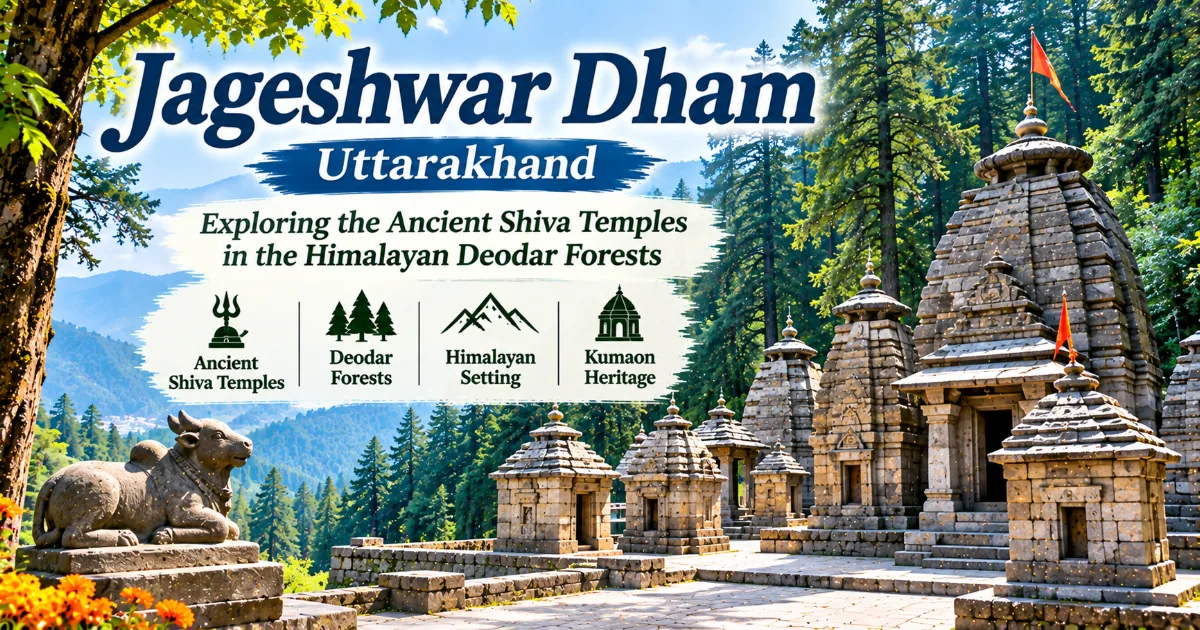
Uttarakhand has many old pilgrimage sites, places where ancient temples, mountain scenery, sacred rivers and centuries-old traditions sit side by side. Among them, Jageshwar Dham holds a special place. Set in the Almora district of the Kumaon region, this is a cluster of ancient stone temples, most of them dedicated to Lord Shiva, standing inside dense deodar forest in the calm of the Himalayan foothills. People know it for that cluster of temples, for a building style found in few other places and for the part it has played in the religious and cultural history of the region.
Large pilgrimage centres often grow up around shops and heavy commercial activity. Here, by contrast, the experience is more intimate. Temples stand close together in a forested valley, so the buildings and the trees seem part of one place. You can walk through the complex at your own pace, look closely at the stone carvings, study how each temple is built and stay a while in the quiet. Bells ring, small traditional shrines line the paths and the tall deodars rise overhead, and that combination stays with most visitors long after they leave.
Worship is only part of the story, because this is also an important archaeological and heritage site. Different phases of Himalayan temple building are represented here, and together they show the craft traditions that grew up in Kumaon over many centuries. Historians, architects, archaeologists, photographers, pilgrims and anyone interested in Indian heritage will all find something worthwhile.
The site also belongs to the wider sacred geography of Kumaon. Almora is close by, which makes it easy to pair a visit with traditional hill settlements, viewpoints, forest walks and other cultural sights in the region.
For anyone touring Uttarakhand, Jageshwar Dham shows a quieter chapter of the state's heritage: how faith, local craftsmanship, the forest and regional history together shaped one of the most distinctive temple sites in the Himalayas.
Continue Reading
Where Is Jageshwar Dham Located?
You will find Jageshwar Dham in the Almora district of Uttarakhand, within the Kumaon region. Its temples sit in a forested valley at about 1,870 metres above sea level, ringed by mountains and tall deodar trees that give the area a strongly Himalayan feel.
Road distance from Almora town is around 35 kilometres. How long the drive takes depends on traffic, weather and the state of the road, which winds through traditional settlements, forested slopes and some fine stretches of Kumaon countryside.
That setting has done much to shape the place, both as a sacred site and as a natural one. Compared with most busy tourist centres, the valley is quiet, and the forest gives the temples a natural frame. Surrounded by mountains, it feels remote, yet getting there from Almora is not difficult.
Rather than one isolated building, the complex is a group of many stone temples and shrines packed into a fairly small area. Their close arrangement means a single visit covers a good number of them.
An itinerary covering Almora, Binsar and other places in the Kumaon hills can easily include Jageshwar. Plan it as a dedicated heritage trip, or as one stop on a wider tour of the region's culture and nature.
The Historical Importance of Jageshwar
Among the ancient temple complexes of Kumaon, Jageshwar ranks near the top. Its importance rests on how many temples survive, how they were built and the religious traditions still practised there.
Broadly, the temples are linked to different periods of early medieval Indian temple architecture. Historical and archaeological studies place much of the complex in the early medieval centuries, though individual buildings may date from different rounds of construction and repair.
Its growth reflects the strength of Shaivism in the Himalayas. Shaivism is a major tradition within Hinduism that places Lord Shiva at the centre of devotion and philosophy. Over the centuries, Shiva temples were founded across the Indian subcontinent, and the Himalayan region became a major area for pilgrimage and spiritual practice.
Building temples in the mountains took skilled artisans, a supply of stone and knowledge of local conditions. At Jageshwar you can see how builders adapted wider Indian temple forms to the terrain and tastes of Kumaon.
Never a single building project, the complex preserves evidence of several centuries of artistic work, along with a long history of religious patronage, craftsmanship and continuous worship.
Important monuments in the complex are protected and maintained by the Archaeological Survey of India, which marks the site as part of India's national heritage.
The Sacred Association with Lord Shiva
Above all, Jageshwar is a major Shaivite pilgrimage site. Its religious identity is bound up with Lord Shiva, who is worshipped here in several forms across the temples.
Tradition links the name Jageshwar itself with Shiva, and devotees from Kumaon and other parts of India have long come here to worship. Having so many Shiva temples in a single valley gives the complex its particular religious character.
Inside many of the temples are Shiva lingams, which represent Shiva's presence in aniconic form. The lingam is one of the most widely recognised symbols of Shiva worship and is central to many Hindu temple traditions.
Pilgrims come to pray, perform rituals and seek blessings. Offerings may include water, flowers, leaves and other traditional items, and practice varies with the temple, the occasion and the devotee's own tradition.
Much of the sacred feeling comes from the setting: the forested valley, the mountains all around and the sound of temple bells. Many visitors find that this makes worship here feel quite different from that in larger city temples.
Even if you are not coming for religious reasons, the complex is a good way to understand the place of Shiva worship in Uttarakhand's cultural history.
The Jageshwar Temple Complex
Most people come for the stone temples, and there are a great many of them: more than one hundred temples and shrines of different sizes, though the figure you hear depends on how individual structures are counted.
All of them stand within a fairly small area, which makes the complex one of the most striking heritage sites in Kumaon. Shared stone construction, carving and temple forms tie the group together.
A few temples are large and prominent; others are small shrines standing right beside them. Together they make up a whole field of temples rather than a single monumental building.
Standing so close together, they are easy to compare for scale, design and decoration. Some have more elaborate entrances and sculptural details, while others keep to simpler architectural forms.
Notice, too, how the site grew over time: new shrines were added, older ones were maintained and building styles shifted from one period to the next.
Take your time here. Rather than heading straight for the biggest temple, look at the smaller shrines, the carved stones and the details around the courtyard, since they tell much of the site's history.
Dandeshwar Temple
Dandeshwar Temple is one of the key temples of the Jageshwar area. Standing near the main temple cluster, it is known for its distinctive architecture and its religious importance.
Dedicated to Lord Shiva, it belongs to the wider sacred ground of Jageshwar. Its stone construction and traditional design follow the building traditions that developed in the Kumaon region.
If you want to understand how individual temples relate to the larger complex, this is a good place to look. Dandeshwar is part of Jageshwar, yet it has its own setting and its own architectural character.
Forest surrounds the temple, so the setting adds a good deal to the visit, and the route through the area gives views of the hills and the vegetation that define this part of Kumaon.
Those interested in architecture should look at the temple's proportions, stonework and layout. Such details say a lot about the craftsmanship and building methods of earlier periods.
Mrityunjaya Temple
Another important shrine inside the Jageshwar complex is the Mrityunjaya Temple. Here Lord Shiva is honoured in his Mrityunjaya form, which is connected with overcoming death, with protection and with spiritual liberation.
Devotees who come to Jageshwar to pray for health, well-being and protection hold this shrine in particular regard. Given the religious meaning of the Mrityunjaya form of Shiva, the shrine has become a central part of the pilgrimage.
In architectural terms, it adds to the variety of buildings across the complex. Its presence also shows how different aspects of Shiva worship each have their own shrine within the same sacred site.
Please approach the temple with respect for the religious activities that take place here. During prayer times and festivals the area can get crowded, so give devotees room to perform their worship.
Other Important Temples and Shrines
Beyond these two, Jageshwar has several other temples dedicated to different forms of Shiva and to related Hindu deities. There is no single central shrine. Instead, the site is a collection of religious buildings that grew up over different periods.
So many temples in one valley suggest that Jageshwar was once a major religious centre, where several forms of worship were practised side by side. Buildings vary in size and detail, which gives anyone interested in history plenty to look at.
Some shrines stand out for their religious associations; others are more interesting for their architecture. With enough time, you can see the different ways builders used stone, placed entrances and decorated sacred spaces.
Don't overlook the smaller shrines, even if they are easy to walk past. They add to the overall character of Jageshwar and show that the complex took shape over a long period rather than in a single building phase.
Understanding the Architecture of Jageshwar
Anyone interested in Indian temple architecture should put Jageshwar on their list. Its buildings show features of the North Indian Nagara tradition, adapted to local conditions and to the artistic practices of Kumaon.
A curved, tower-like superstructure rising above the sanctum usually identifies the Nagara style. Designs vary from temple to temple, but the core idea is a sacred inner chamber that houses the main deity.
Many of the temples here are built of stone. That gives them a solid, heavy look and reflects what building material was available locally in the Himalayas.
Nearly every temple has a sanctum, called the garbhagriha, where the principal deity is worshipped. Some also have entrance porches and other added elements, and the exact layout differs from one temple to the next.
Look closely at the stone surfaces and you can see how precisely the artisans worked. Carved details, decorative bands and sculptural elements add visual interest to each building.
Why does this matter? Jageshwar shows a broad Indian temple tradition taking on a distinct regional form. These are not simply copies of buildings found elsewhere; they reflect the art and culture of Kumaon.
Architecture students and researchers can study temple proportions, building materials, carving techniques and how religious function shaped architectural form.
The Deodar Forests of Jageshwar
For many visitors, the forest is what they remember most. Tall deodar trees surround the temple complex, keeping it calm and setting it apart from most other heritage sites.
Deodar is a Himalayan cedar closely tied to the mountains. Tall growth, evergreen foliage and strong timber are its hallmarks. Deodar forests grow in parts of the western Himalayas and are a major part of the region's natural environment.
Here the trees make a striking backdrop for the stone temples. Tall and densely packed, they throw shifting patterns of light and shade across the complex all day. In the morning, sunlight filters through the branches and lights up parts of the temple complex. Later in the day the forest feels cooler and more sheltered.
Temples and forest are hard to separate at Jageshwar, and that relationship is central to the identity of the place. The trees do more than surround the heritage site; they shape how you experience it.
Remember that the forest is a living habitat, not just scenery. Do not litter, damage trees, disturb wildlife or play loud music. Looking after the surroundings is how the atmosphere that makes Jageshwar special survives.
The Jageshwar Monsoon and Seasonal Landscape
This forested valley looks quite different from one season to the next. In the monsoon the vegetation turns a deeper green and mist often hangs over the hills. Rain freshens everything, but it also makes paths slippery and can disrupt road travel.
Photographers in particular may find the monsoon beautiful. Even so, check weather forecasts and road conditions before planning a trip during heavy rain.
Spring and summer are more comfortable for exploring the temples and the area around them. Throughout, the forest remains the main feature, and the surrounding hills are good for easy walks and scenic drives.
Autumn usually brings clearer views and pleasant weather. That makes it a good time for visitors who want to combine the temples with sightseeing in Almora and other parts of Kumaon.
Winter is colder, especially in the morning and evening, so carry warm clothing and check the local weather before you set off. Cold weather can make the forest and stone temples look especially atmospheric, though it may also make long stretches outdoors less comfortable.
Best Time to Visit Jageshwar Dham
Much of the year is suitable for a visit. Which season is best depends on what you want from the trip.
March to April: Spring
Spring is a pleasant time to explore. Temperatures are usually comfortable and the forest starts to change with the season. Walking around the temple complex, you avoid both the hard cold of winter and the heavy monsoon rain.
Families, heritage travellers and photographers looking for a relaxed visit will find it suits them well.
May to June: Summer
Summer is a popular time in the Kumaon hills, since it is usually cooler there than across much of the northern plains. A longer summer holiday can take in Almora, nearby places and Jageshwar together.
School holidays can bring more visitors to the temple complex, so book accommodation early.
July to September: Monsoon
Rain turns the forested valley green and brings mist. The scenery can be beautiful, but heavy rainfall can make the roads difficult.
During severe weather, avoid unnecessary travel and check official advisories before you leave. Paths around the temples may also be slippery.
October to November: Autumn
For many, autumn is the most comfortable time to visit Jageshwar. Days are often pleasant, and visibility tends to be better than in the monsoon.
Heritage visits, photography and road trips through Kumaon are particularly rewarding at this time.
December to February: Winter
Expect cold weather and pack warm clothing. Early mornings and evenings can be especially chilly.
If you like quiet heritage sites, winter has its own appeal, as long as you prepare for the cold and check road conditions.
Jageshwar During Religious Festivals
Jageshwar is still a working pilgrimage site, and its religious festivals show another side of its cultural life.
Each year the Jageshwar Monsoon Festival, also called the Shravani Mela, is held in the Hindu month of Shravan. That month matters especially to devotees of Lord Shiva, and pilgrims come to the temples to pray and join in the religious activities.
Shravan has long been regarded as an important month for Shiva worship. Devotees may fast, pour water over Shiva lingams and take part in temple rituals, and the whole place takes on a more devotional mood.
Coming during the festival shows you how much the temple complex still matters to worshippers. Pilgrims, local residents, vendors and visitors from other areas all gather together.
Expect crowds, though. If you prefer a quieter visit, go outside the major religious occasions. Those who want to experience the festival should arrange transport and accommodation early and follow local instructions.
Festival dates follow the Hindu calendar, so they shift from year to year. Confirm this year's schedule before making travel plans.
How to Reach Jageshwar Dham
Roads link Jageshwar to Almora and other major towns in Kumaon, and driving is the most practical way to get to the temple complex.
By Road
Travellers usually come via Almora, the main nearby town, approximately 35 kilometres away depending on the route. The drive follows mountain roads through forest and small settlements.
You can go by private car, taxi or whatever local transport is running. Check the current road situation and transport availability before you set off.
By Rail
Kathgodam is one of the main railway stations for Almora and the surrounding Kumaon region. From there, continue by road to Almora and on to Jageshwar.
Check train timings and onward transport before travelling, especially in holiday periods.
By Air
Pantnagar Airport is one option for flying into the Kumaon region. Before planning around it, check flight availability and how you will get on by road.
Some travellers find it easier to fly to Delhi or another major hub and continue by rail or road.
Local Transport
Taxis and private vehicles are the easiest way to get around Jageshwar and nearby places. How much local transport is available depends on the season and time of day.
If you plan to visit several places, consider hiring a vehicle for the whole trip instead of relying on occasional local services.
Suggested Travel Itineraries
One-Day Jageshwar Heritage Visit
Leave Almora in the morning and drive to Jageshwar. Once there, walk through the main temple complex and take your time over the architecture, the stone carvings and the religious life of the place.
See the main Jageshwar temples, Dandeshwar Temple and Mrityunjaya Temple, leaving enough time for each. Break for an unhurried lunch among the trees before heading back to Almora.
Choose this plan if you are short of time but still want to see the main heritage sites.
Two-Day Jageshwar and Almora Trip
Day one: travel from Almora to Jageshwar and explore the temple complex, learning about its architectural history and religious traditions. Depending on availability and preference, stay near Jageshwar or go back to Almora for the night.
Day two: spend it in Almora, with its cultural sights, local markets and viewpoints. Together the two days give you both ancient temple heritage and Kumaoni hill-town life.
Three-Day Kumaon Heritage and Nature Trip
With three days, you can see Jageshwar without rushing and add other places in the region.
Give the first day to Jageshwar and the forest around it. Spend the second in Almora, among its traditional markets, temples and viewpoints. On the third, head to a nearby nature spot such as Binsar, if travel time and road conditions allow.
This route suits travellers who like architecture and culture as much as forests and mountain scenery.
Nearby Places to Explore
Several places in Kumaon pair well with Jageshwar. Which ones you choose depends on your time, the roads and what kind of trip you want.
Almora
Almora is one of the main cultural towns of Kumaon, known for its traditional markets, mountain views, temples and regional food. With its strong historical character, it makes a convenient base for trips to Jageshwar.
Walk through the local bazaar, look at the old buildings and learn something about Kumaoni culture.
Binsar
Forest and mountain views are what bring people to Binsar. Here you will find the Binsar Wildlife Sanctuary, which protects a range of Himalayan habitats and wildlife.
Nature lovers, birdwatchers and anyone who enjoys forest walks may want to add Binsar to a Jageshwar trip. Check travel time and road conditions before trying to fit both into one day.
Katarmal Sun Temple
Also in the Almora district, the Katarmal Sun Temple is another important heritage site. Dedicated to the Sun God, it is known for its old architecture and stone construction.
Seen after the Shiva temples of Jageshwar, it makes an interesting contrast and fits well into a longer Kumaon heritage route.
Kasar Devi
Kasar Devi is best known for its hilltop temple and the panoramic views it gives over the surrounding hills. Over the years the area has also drawn travellers interested in spirituality, meditation and nature.
Kasar Devi can be combined with Almora and Jageshwar, provided you allow enough travel time.
Local Food to Try in the Jageshwar Region
Eating local is part of any trip to Kumaon. Traditional Kumaoni cooking is shaped by local farming, seasonal produce, the climate and home cooking habits.
Expect dishes made with local grains, lentils, leafy greens and traditional spices. Meals tend to be simple and nutritious, and closely tied to farming life in the mountains.
Bhatt Ki Churkani
Made with black soybeans known locally as bhatt, bhatt ki churkani is a traditional Kumaoni dish. Cooks usually season it with spices and serve it with rice or other local sides.
Anyone curious about Kumaoni food should look out for it.
Aloo Ke Gutke
A popular Kumaoni potato dish, aloo ke gutke is made by cooking potatoes with regional spices. Local chutneys usually come on the side.
Versions of it turn up all over Kumaon, and it is closely tied to the region's food culture.
Mandua Roti
Mandua, or finger millet, is an important traditional grain in Uttarakhand. Mandua roti, a flatbread made from millet flour, is often eaten with vegetables, lentils or other local sides.
Bal Mithai
Of all the sweets linked to Almora, bal mithai is among the best known. Traditionally it is made from khoya and coated with small sugar balls, and sweet shops around Almora sell it.
Around Jageshwar itself, food options may be limited compared with larger towns. Plan meals ahead, and try the local cuisine properly in Almora.
Accommodation Options Around Jageshwar
Places to stay around Jageshwar are fewer than in larger tourist towns. Depending on the season, you may find guesthouses, small hotels, homestays and other options in the surrounding area.
Almora has a much wider range of accommodation than the area around the temples. As a base, it is practical if you want more choice of restaurants, transport and other facilities.
Staying near Jageshwar helps if you want to see the temples early in the morning or enjoy the quiet of the forested valley. Confirm availability, facilities and transport before you book.
When choosing a room, families and older travellers should think about road access, room facilities, meals and how far it is to medical services.
Demand rises during major festivals and peak holiday periods, so booking in advance is the best way to avoid last-minute difficulties.
Photography at Jageshwar
Few heritage sites in Uttarakhand photograph as well as Jageshwar. Old stone temples under tall deodars make a distinctive subject for both architecture and landscape shots.
Among the temples you can photograph stone towers, carved details, doorways and the way the shrines are laid out across the complex. Architecture enthusiasts can record the differences between individual temples and how they sit in relation to each other.
Light under the trees changes through the day. Early morning is especially good, when the sun slants into the valley through the branches. Misty weather can add atmosphere to the scene, though visibility then varies a good deal.
Follow the site rules and don't disturb people at prayer. Flash or certain equipment may be restricted in some areas, so ask before taking photographs inside active shrines.
Never climb on the temples, touch fragile carvings without need or use the monuments as props in ways that could damage them. Good heritage photography builds appreciation; it should not put conservation at risk.
Jageshwar for Architecture Students and Researchers
Students of architecture, archaeology, history and cultural studies have a lot to learn at Jageshwar.
Here you can trace how regional temple architecture developed. Look at how the sanctum, tower, entrance and decoration relate to each other, and at how stone was used for building in mountain country.
With so many different buildings, the complex is ideal for comparison. Instead of studying one temple, you can see how buildings within a single religious centre vary in design and scale.
History students can follow the growth of Shaivism in the Himalayas and the role temples played in local society. For archaeology students, there are conservation problems, questions of material preservation and the work of documenting historic buildings.
Researchers interested in cultural landscapes can study how the temple complex relates to the deodar forest around it. Few places show more clearly how a natural setting can become bound up with religious identity and heritage.
Study trips work best when students get some background before they arrive. Knowing the broad chronology of the temples, the Nagara architectural tradition and the religious importance of Shiva worship makes the visit far more useful.
Jageshwar for Families and Cultural Travellers
Families who like to mix travel with learning will get a lot out of Jageshwar. Children can see ancient buildings up close, find out how temples were built and learn how religion has shaped the history of the region.
Parents can use the visit to talk about why heritage buildings need protecting and why places of worship deserve respect. Architecture, local culture and how people live with their environment all come up easily here.
Cultural travellers will notice how Jageshwar brings several sides of Kumaon together. The temples carry its religious traditions, the building work shows regional craftsmanship and the forest shows how much natural landscapes matter in Himalayan life.
Slow travellers will like it too. Wandering through the complex and taking in the forest is often more rewarding than racing through a long list of sights.
Travelling with elderly relatives? Bear in mind the walking involved and the uneven ground in parts of the complex. Comfortable footwear and an unhurried schedule make the visit much easier.
Responsible Tourism and Temple Conservation
Active worship continues here, yet this is also an important archaeological site. Keeping it intact for the future depends on the combined efforts of authorities, local communities, religious institutions and visitors all doing their part.
Follow every instruction posted at the temple complex. Don't touch or damage carved surfaces, write on the stones or try to take away any historical material.
Leave no plastic, food wrappers or other litter in the forest or around the temples. Where you can, carry a reusable water bottle, and put waste only in the bins provided.
Treat the deodar forest as the important natural habitat it is. That means no loud music, no fires, no harm to trees and nothing that disturbs wildlife.
Dress suitably for a religious site and respect any rituals in progress. When taking photographs, don't interrupt worshippers or enter restricted areas.
Supporting local businesses is part of responsible tourism too. Eat at local places, buy regional products and use locally run services where you can.
Heritage tourism should help the surrounding community while protecting the site's history and ecology. Jageshwar's long-term future depends on keeping that balance.
Practical Travel Tips Before Visiting
Plan the journey with care, especially if you are coming from outside Kumaon. Before you leave, check road conditions, weather forecasts and what transport is running.
Wear comfortable walking shoes, since you will be on your feet moving between temples. Stone surfaces can get slippery in the rain, so take extra care in the monsoon.
Even in the warmer months, pack something warm if you plan to be there early in the morning or in the evening. Temperatures in the forested valley can be lower than in the plains.
Keep essential medicines, drinking water and some cash with you. Smaller shops may not take every form of payment, and mobile coverage is patchy in places.
History enthusiasts should read up on the Nagara style of architecture and the development of Shaivism before they go. A little preparation helps you understand the buildings beyond what they look like on the surface.
Don't cram too many places into one day. Mountain roads take time, and unexpected weather or traffic can easily upset your schedule.
Going for a religious festival? Confirm the dates and local arrangements in advance, and expect bigger crowds and more demand for rooms.
Why Jageshwar Is Different from Other Himalayan Destinations
Plenty of Himalayan destinations are known for mountain views, adventure sports or religious importance. What sets this one apart is the way it joins heritage and nature.
Here the temples are part of the landscape. The stone buildings stand inside a deodar forest, and the trees are central to how the place looks and feels, so the forest and the built heritage seem to run into each other.
Its concentration of temples also sets it apart from sites where one big shrine dominates. At Jageshwar you meet a whole group of buildings from different stages of religious and architectural history.
Being in Kumaon matters as well. Kumaon has its own cultural identity, and the temples help explain the historical traditions that grew up in the eastern part of Uttarakhand.
For history lovers, then, Jageshwar is more than a pretty backdrop. Here you can study ancient craftsmanship, religious institutions and how regional architecture changed over time.
Why Jageshwar Deserves More Attention in Uttarakhand Tourism
Uttarakhand's tourism image is usually built around its big pilgrimage sites and popular hill stations. These draw large crowds and matter a great deal to the state's tourism economy. Yet the state also has many heritage sites that deserve to be better known.
Jageshwar is one of them. Its temples are a key chapter in the architectural and religious history of Kumaon, and its forest setting feels very different from the more commercial tourist spots elsewhere.
Promoting it could lead more travellers to discover the cultural wealth of the Almora district. Wider promotion could also spread visitors across more places, bringing work to local hotels and homestays, guides, drivers and small businesses.
Any growth in visitor numbers needs careful handling, though. Both the temples and the forest around them need protection. Development should mean better visitor information, responsible infrastructure, conservation and support for local communities.
Handled that way, Jageshwar can become an important destination for heritage trips, study tours and cultural travel while keeping the quiet that makes it special.
Why Jageshwar Is Worth More Than a Brief Stop
Few heritage sites in Uttarakhand match Jageshwar Dham. Ancient stone temples, a deep connection with Lord Shiva and a beautiful deodar forest make it memorable for pilgrims and travellers alike.
Through its temples you can read the architectural traditions of Kumaon, built up over centuries of craftsmanship, religious patronage and cultural change. That so many temples stand in one valley shows how important Jageshwar became as a centre of worship and pilgrimage.
Around them, tall deodars, mountain slopes and a calm atmosphere invite you to slow down and notice how nature and heritage fit together.
If you are exploring Almora and the wider Kumaon region, give Jageshwar more than a quick visit. History is carved in its stone, worship here is still a living tradition, and the Himalayan forest shows its quieter side.
Go, and you will see a different side of Uttarakhand, one shaped by ancient architecture, lasting faith, regional craftsmanship and the quiet presence of the Himalayan forests.