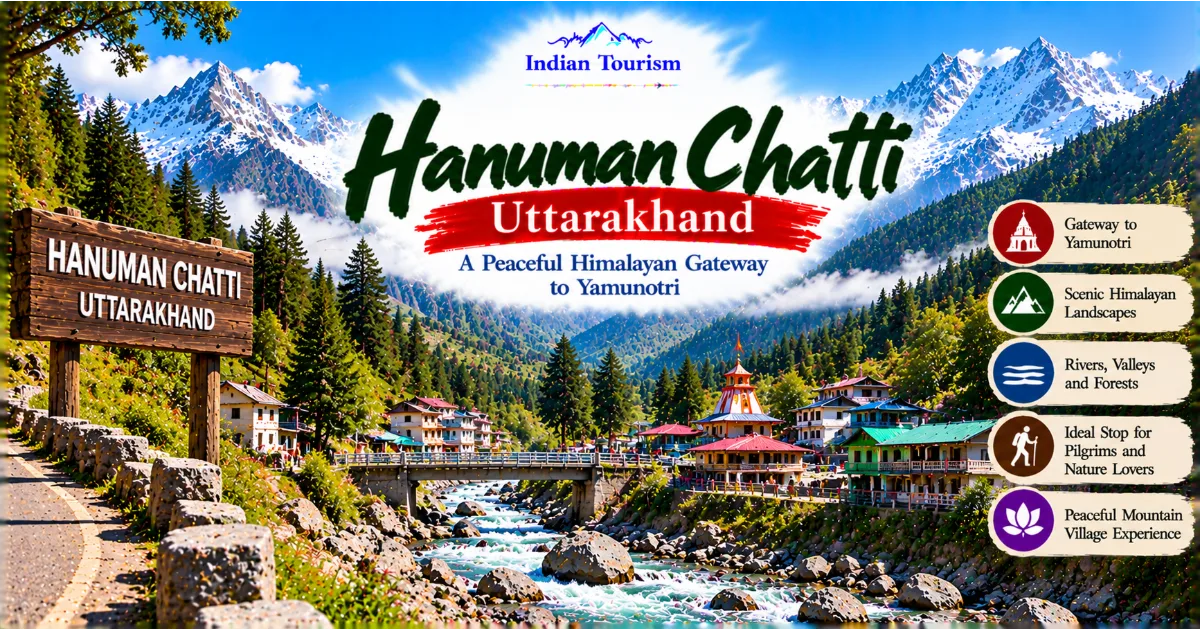
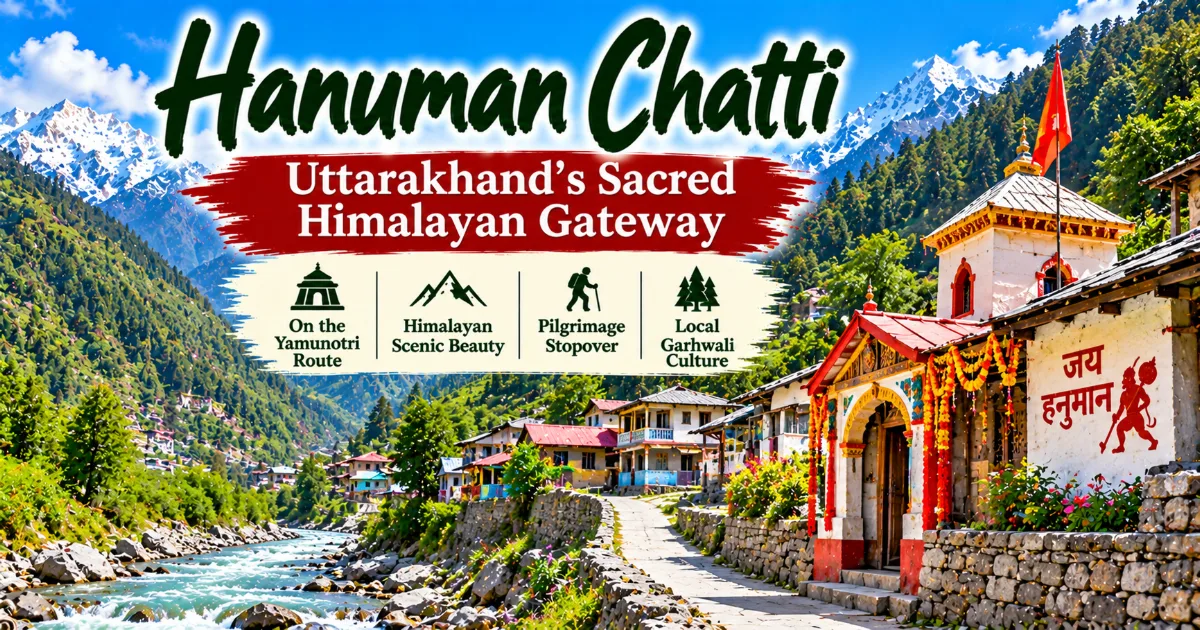
Situated in the beautiful upper Yamuna Valley of Uttarkashi district, Hanuman Chatti is a small Himalayan settlement with an important place in the religious and travel landscape of Uttarakhand. Located along the traditional route towards Yamunotri, this mountain destination is surrounded by forested slopes, flowing streams, steep valleys and spectacular Himalayan scenery. Its significance comes from its association with the Yamunotri pilgrimage, its local religious traditions and its position along a historic mountain travel corridor.
Hanuman Chatti is often overshadowed by the famous Yamunotri Temple and the nearby settlements of Barkot and Janki Chatti. However, travellers who explore this region beyond the main pilgrimage route can discover a destination shaped by mountain geography, local culture and centuries of religious movement. It offers an opportunity to understand how small Himalayan settlements support pilgrimage, preserve traditional practices and adapt to the challenges of life in the mountains.
Discovering Hanuman Chatti in Uttarakhand
Hanuman Chatti lies in the upper Yamuna Valley in Uttarkashi district, within the Garhwal region of Uttarakhand. The settlement is associated with the traditional Yamunotri route and is surrounded by the mountain landscape that defines this part of the state.
The geography of the area is shaped by steep hillsides, river valleys, forested slopes and narrow mountain roads. Settlements are often located along the valley floor or on relatively accessible sections of the mountainside. The river system provides water for local communities and contributes to the natural character of the region.
Continue Reading
Hanuman Chatti is a destination where the experience of travelling through the Himalayas becomes closely connected with the religious and cultural traditions of the region. Pilgrims, local residents, transport operators and seasonal visitors all contribute to the activity of the settlement.
Unlike large tourist towns, Hanuman Chatti has a relatively small-scale mountain character. Its importance is not based on extensive commercial attractions but on its location along the Yamunotri pilgrimage corridor and its connection with local religious traditions.
The surrounding landscape changes throughout the year. Spring brings fresh greenery to the hillsides, summer attracts pilgrims and visitors, monsoon transforms the valley with rainfall and dense vegetation, and winter brings colder conditions that can affect access to higher settlements.
For travellers interested in understanding Uttarakhand beyond its best-known destinations, Hanuman Chatti offers a meaningful introduction to the upper Yamuna Valley.
The Religious Significance of Hanuman Chatti
The name Hanuman Chatti reflects the religious association of the settlement with Lord Hanuman, one of the most widely worshipped figures in Hindu tradition. Hanuman is revered for devotion, courage, strength, loyalty and selfless service.
Across India, temples dedicated to Hanuman are visited by devotees seeking strength, protection and spiritual reassurance. In the Himalayan region, religious sites often have a close relationship with mountain travel routes. Pilgrims traditionally stop at temples and sacred locations during their journeys, offering prayers before continuing towards higher-altitude destinations.
Hanuman Chatti forms part of this wider religious landscape. Its association with the Yamunotri route gives it importance for people travelling through the upper valley.
The religious identity of a Himalayan settlement is not always represented by a single large temple. It may also be reflected in local shrines, traditional beliefs, seasonal ceremonies and the everyday practices of residents.
Visitors should take time to understand the local religious environment respectfully. Temple customs, prayer timings and access arrangements may vary, and travellers should follow instructions from local authorities or temple caretakers.
The presence of religious places along mountain routes also reflects the historical relationship between faith and travel in Uttarakhand. Pilgrimage was not simply a journey from one town to another. It involved passing through forests, river valleys and mountain settlements, with places of worship providing spiritual meaning along the way.
Hanuman Chatti and the Yamunotri Pilgrimage
One of the most important reasons travellers visit this region is its connection with Yamunotri, one of the four sacred destinations of Uttarakhand's Char Dham pilgrimage.
The traditional Char Dham circuit includes Yamunotri, Gangotri, Kedarnath and Badrinath. These four destinations occupy an important position in Hindu pilgrimage traditions and attract devotees from across India.
Yamunotri is associated with Goddess Yamuna, the sacred river deity whose source region lies in the high Himalayas. The temple is located in a mountainous environment where access depends strongly on seasonal weather conditions.
The traditional journey towards Yamunotri passes through settlements that provide accommodation, food, transport and other essential services to pilgrims. Hanuman Chatti is part of this wider network of mountain settlements.
For many pilgrims, the journey itself is an important part of the religious experience. The route passes through changing landscapes, from lower mountain valleys to higher-altitude surroundings. The physical effort involved in travelling through the Himalayas adds another dimension to the pilgrimage.
Hanuman Chatti helps illustrate how smaller settlements contribute to this journey. Their importance may not always be reflected in large tourism advertisements, but they form part of the infrastructure and cultural landscape that make mountain pilgrimage possible.
Visitors should remember that the Yamunotri pilgrimage route is affected by seasonal conditions. Road access, walking arrangements, local transport and facilities can change. Travellers should verify the current route and official guidance before planning their visit.
Understanding the Traditional Yamunotri Route
The Yamunotri route has developed through generations of religious travel and local movement. Its settlements are connected by mountain roads and pathways that follow the geography of the upper Yamuna Valley.
Barkot is an important regional base for journeys towards Yamunotri. Travellers commonly use it to organise accommodation and onward transport.
From Barkot, the journey continues through the upper valley towards the Yamunotri region. The route passes through mountain settlements and landscapes that gradually become more rugged.
Hanuman Chatti is associated with this traditional corridor. It provides a useful point for understanding the relationship between pilgrimage and settlement patterns in the region.
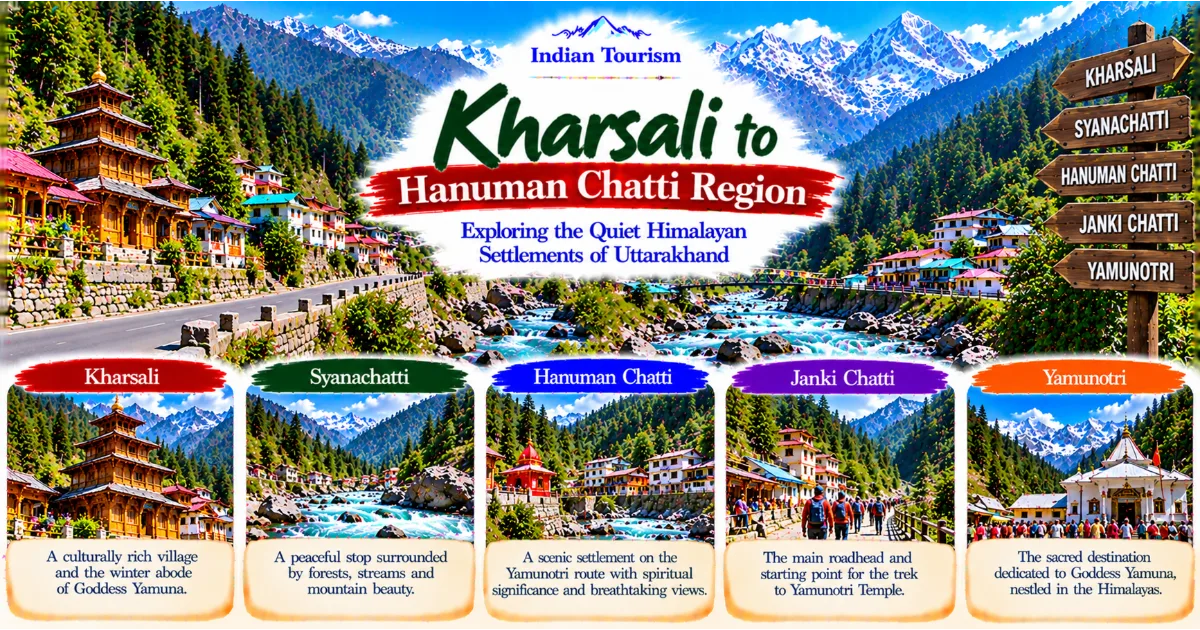
Janki Chatti is especially important in the modern pilgrimage journey because it serves as the principal starting point for the traditional final trek towards Yamunotri Temple. Facilities and transport arrangements in this area support the movement of pilgrims during the pilgrimage season.
The route demonstrates how different settlements perform different functions. Some provide larger accommodation facilities, others support transport and supplies, while religious locations maintain the spiritual traditions associated with the journey.
The development of modern roads has changed the way pilgrims travel through the valley. Earlier journeys depended more heavily on traditional footpaths and animal-based transport. Road access has made the region more accessible, although mountain travel continues to involve physical and environmental challenges.
For travellers, understanding the route helps create a more informed itinerary. Rather than treating every settlement as an isolated attraction, visitors can appreciate the connected cultural and geographical landscape of the Yamuna Valley.
The Natural Landscape Around Hanuman Chatti
The surroundings of Hanuman Chatti are an important part of its appeal. The settlement lies within a Himalayan landscape characterised by steep slopes, river systems, forest vegetation and mountain ridges.
The upper Yamuna Valley is shaped by the movement of water through a mountainous environment. Rivers and streams cut through valleys, while smaller channels support local ecosystems and agricultural activities.
The forested slopes around the settlement contribute to the region's ecological character. Vegetation varies according to altitude, exposure and seasonal conditions. Lower slopes may support different types of forest growth from the higher mountain areas.
During spring and summer, the valley becomes greener as vegetation develops and water flows through the mountain channels. The landscape can appear especially vibrant after periods of rainfall, although the monsoon also increases the risk of landslides and road disruption.
Autumn often brings a clearer atmosphere after the monsoon. The surrounding mountains can become more visible, and the changing light creates attractive conditions for landscape photography.
Winter introduces a different environment. Temperatures fall, and higher areas may receive snowfall. Access to some locations can become difficult, and visitors must pay close attention to local travel information.
The natural beauty of Hanuman Chatti is not limited to distant mountain views. It can also be experienced through smaller details such as the sound of flowing water, the movement of clouds across the slopes, the vegetation along the road and the changing character of the valley throughout the day.
The Yamuna River and Its Himalayan Environment
The Yamuna River is one of the most significant rivers in northern India. Its religious, cultural and historical importance extends far beyond Uttarakhand, but its identity is deeply connected with the Himalayan region.
The upper Yamuna Valley forms part of the river's mountain environment. Here, water flows through narrow valleys and steep terrain before continuing towards the plains.
The river is important to local communities because mountain settlements depend on natural water systems for domestic use, agriculture and livestock. Streams and smaller channels also contribute to the ecological balance of the valley.
The Yamuna is worshipped as a sacred river in Hindu tradition. Goddess Yamuna is associated with purity, protection and spiritual significance. Yamunotri Temple represents one of the most important religious locations connected with this tradition.
For visitors travelling through Hanuman Chatti, the river landscape provides an opportunity to understand the relationship between religious belief and natural geography.
However, the river should not be viewed only as a scenic attraction. It is an essential ecological and community resource. Pollution, careless disposal of waste and unplanned development can affect the health of mountain water systems.
Visitors should avoid throwing plastic, food packaging or other waste into streams and rivers. They should also follow local guidance when approaching riverbanks, especially during periods of heavy rainfall or increased water flow.
Respect for the river is an important part of responsible travel in the Yamuna Valley.
Traditional Mountain Settlements and Local Architecture
Hanuman Chatti and the surrounding settlements reflect the architectural practices that have developed in the Garhwal Himalayas.
Traditional mountain architecture is influenced by climate, available materials, terrain and local construction knowledge. Houses in Himalayan villages often use stone and timber, with designs adapted to cold winters, rainfall and the practical requirements of mountain living.
Stone is commonly used in foundations and walls, while timber may be used for structural elements, doors, windows, balconies and roof components.
The combination of these materials creates buildings that reflect local craftsmanship. Traditional houses may include sloping roofs to help manage rain and snowfall, compact interior spaces and wooden details that add both practical and visual value.
In many mountain settlements, the arrangement of houses follows the shape of the available land. Narrow pathways connect homes, fields and community spaces. The layout may also reflect historical access routes, water sources and the location of religious structures.
Architecture in this region is not simply a tourism attraction. It represents the knowledge and labour of local communities.
Modern construction has introduced new materials and designs, but traditional buildings remain valuable records of regional identity. Preserving them requires maintenance, local participation and an understanding of their original construction methods.
Visitors should appreciate village architecture without disturbing private property. Taking photographs from public pathways is generally more respectful than entering residential areas without permission.
Local Culture and the Garhwali Way of Life
The culture of Hanuman Chatti is connected with the wider traditions of Garhwal. The region has a distinctive cultural identity shaped by mountain geography, religious practices, agriculture, festivals, music and community relationships.
Garhwali communities have developed ways of life suited to the demands of mountain environments. Daily activities are influenced by the seasons, availability of water, agricultural cycles and access to markets.
Family and community relationships remain important in village life. People often depend on cooperation for agricultural activities, household responsibilities and the management of local resources.
Religion is another important part of cultural identity. Temples, local deities and seasonal ceremonies contribute to the social and spiritual life of communities.
Traditional festivals may involve prayers, gatherings, music and food. Their timing and customs can differ between villages and local traditions.
The Garhwali language is widely associated with the cultural identity of the region, although Hindi is also commonly used for communication with visitors and across different parts of Uttarakhand.
Travellers can learn about local culture through respectful conversations with residents and local service providers. Asking about traditional food, seasonal celebrations and village history can make a visit more meaningful.
However, cultural exploration should not turn into an intrusion. Residents should not be expected to perform traditions or provide explanations simply because visitors are present.
A thoughtful traveller observes, listens and respects the community's everyday life.
Traditional Food of the Yamuna Valley
Food is an important part of the travel experience in Uttarakhand. Garhwali cuisine reflects the agricultural conditions, climate and traditional ingredients of the Himalayan region.
Many local preparations use grains, pulses, leafy vegetables and seasonal produce. These ingredients have historically been important because they can be cultivated or sourced within mountain environments.
Mandua, also known as finger millet, is one of the traditional grains associated with Uttarakhand. It is used to prepare rotis and other dishes. The grain has remained important in mountain food traditions because of its suitability for local agricultural conditions.
Jhangora, or barnyard millet, is another traditional ingredient. It is used in preparations such as jhangora ki kheer, a well-known regional dessert.
Phaanu is a traditional pulse-based dish prepared in different ways across Garhwal. It is often valued as a nourishing meal.
Kafuli is made using leafy greens and other ingredients. It reflects the use of seasonal vegetables in local cooking.
Chainsoo is another recognised Garhwali dish prepared using roasted black gram. Its distinctive flavour makes it a popular example of regional cuisine.
Local food availability in Hanuman Chatti may vary according to the season and the type of accommodation or eating establishment. Smaller mountain settlements may have limited menus compared with larger towns.
Travellers should try local preparations when available and communicate dietary requirements clearly. Supporting local food establishments can also help small businesses benefit from tourism.
Food is more than a practical requirement during travel. It offers a way to understand the relationship between agriculture, climate and culture in the Himalayan region.
Agriculture and Livelihoods in the Upper Yamuna Valley
Agriculture has historically supported communities throughout the Garhwal Himalayas. The steep terrain of the region requires farming practices that differ from those used in large plains.
Terrace farming is one of the most recognisable features of mountain agriculture. Farmers create relatively level sections along hillsides, often supported by stone boundaries. These terraces make it possible to cultivate land that would otherwise be difficult to use.
The crops grown in the region depend on altitude, soil conditions, rainfall and seasonal temperatures. Traditional grains, pulses and vegetables form part of local food systems.
Livestock may also contribute to household livelihoods. Animals provide milk, manure and other resources, while their care forms part of everyday agricultural activity.
Tourism has created additional economic opportunities in the Yamunotri region. Accommodation providers, transport operators, food businesses, small shops and other service providers may benefit from seasonal visitor movement.
However, tourism is not a replacement for the traditional economy. Agriculture, livestock management and local skills remain important to community resilience.
Responsible tourism can support local livelihoods when visitors choose locally operated services and purchase products from small businesses.
It is also important to recognise that tourism income may fluctuate considerably. The pilgrimage season, road conditions, weather and wider economic circumstances can influence the number of visitors.
A sustainable approach should support diverse local livelihoods rather than making communities entirely dependent on seasonal tourism.
Nearby Destination: Janki Chatti
Janki Chatti is one of the most important settlements near the Yamunotri pilgrimage route. It serves as the principal starting point for the traditional trek towards Yamunotri Temple.
The settlement is associated with pilgrimage facilities, accommodation, food services and transport arrangements. During the main pilgrimage season, it becomes an active centre for visitors preparing to continue towards the shrine.
Janki Chatti offers a different experience from Hanuman Chatti. Its importance is closely connected with the final stage of the Yamunotri journey, while Hanuman Chatti represents an earlier part of the traditional mountain corridor.
Travellers can include both settlements in a wider exploration of the upper Yamuna Valley. The journey provides an opportunity to observe the changing geography and the role of different villages in supporting pilgrimage.
Because Janki Chatti can become busy during peak pilgrimage periods, visitors should allow sufficient time for accommodation and transport arrangements.
Nearby Destination: Kharsali Village
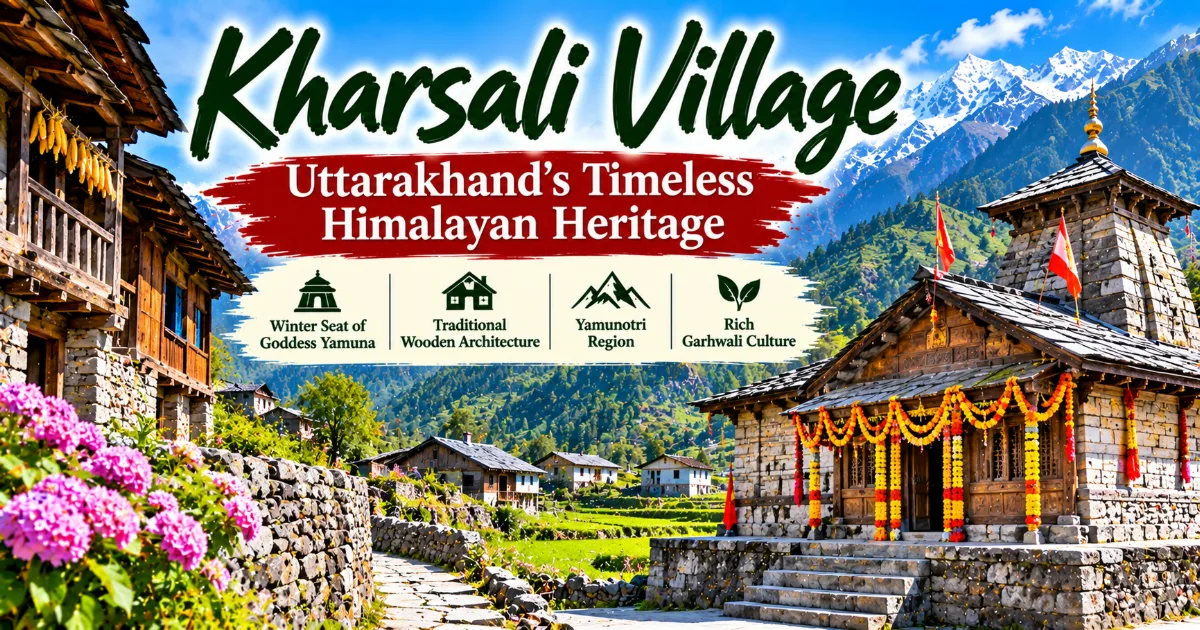
Kharsali is another important destination in the Yamunotri region. It is particularly significant because it serves as the winter residence of Goddess Yamuna.
When Yamunotri Temple closes for the winter season, the ceremonial idol of Goddess Yamuna is brought to Kharsali according to established religious customs. Worship continues in the village until the main shrine reopens.
Kharsali is also known for its traditional Himalayan architecture and the ancient Shani Dev Temple. Its wooden and stone structures provide an opportunity to understand the architectural heritage of the region.
A visit to Kharsali adds a cultural dimension to a journey through Hanuman Chatti. While the two settlements have different roles, both are connected with the religious geography of the Yamuna Valley.
Visitors interested in temple traditions, local architecture and seasonal religious practices should consider including Kharsali in their itinerary when road and weather conditions permit.
Nearby Destination: Barkot
Barkot is an important town in Uttarkashi district and serves as a regional base for journeys towards Yamunotri.
Compared with smaller settlements along the upper valley, Barkot generally offers a wider range of accommodation, food and travel facilities. It is used by pilgrims and tourists organising their onward journey towards the Yamunotri region.
The town is also surrounded by mountain scenery and provides access to different parts of the western Garhwal region.
For travellers approaching from Dehradun or other parts of Uttarakhand, Barkot can be a practical place to arrange an overnight stay before continuing towards the upper valley.
Including Barkot in a Hanuman Chatti itinerary can help make the journey more comfortable, particularly for visitors who prefer to travel gradually rather than completing long mountain drives in one day.
Best Time to Visit Hanuman Chatti
The best time to visit Hanuman Chatti depends on weather, road conditions and the kind of experience travellers want.
Spring: March to April
Spring brings a gradual transition from winter towards warmer conditions. The surrounding vegetation begins to recover, and the mountain landscape becomes increasingly green.
Temperatures can still be cold, especially during early mornings and evenings. Visitors should carry warm clothing and check road conditions before travelling.
Spring can be suitable for travellers interested in quieter village exploration, provided the necessary roads and facilities are accessible.
Summer: May to June
Summer is one of the main travel periods for the Yamunotri region. The weather is generally more comfortable than winter, and the pilgrimage season attracts a large number of devotees.
Hanuman Chatti can be explored as part of a wider journey towards Janki Chatti and Yamunotri.
Accommodation and transport demand may increase during busy periods. Travellers should plan their arrangements in advance and allow additional time for traffic and local travel conditions.
Monsoon: July to August
The monsoon brings rainfall and lush greenery to the upper Yamuna Valley. The landscape becomes vibrant, but this period can also create significant travel challenges.
Heavy rainfall may lead to landslides, road closures, falling rocks and changes in river conditions. Mountain roads can become difficult to navigate.
Travellers should monitor official weather forecasts and road advisories. Flexible itineraries are essential during the monsoon.
Autumn: September to October
Autumn is often an attractive period for exploring the Himalayan valleys. Rainfall generally decreases, and mountain visibility may improve.
The surrounding slopes and river valleys offer beautiful scenery, while the weather can be suitable for village walks and photography.
Visitors should check the Yamunotri pilgrimage calendar because the temple's closing date changes according to the religious calendar.
Winter: November to February
Winter brings cold temperatures and possible snowfall to the higher areas of the Yamunotri region. Travel conditions can become difficult, and some facilities may operate seasonally.
Visitors planning a winter journey should confirm road access, accommodation and local arrangements before departure.
The winter worship tradition at Kharsali is an important cultural feature of this season, making the nearby village particularly significant for devotees.
How to Reach Hanuman Chatti
Hanuman Chatti is generally approached by road through the mountain routes connecting the Yamuna Valley with other parts of Uttarakhand.
By Road
Road travel is the principal way to reach Hanuman Chatti. Travellers commonly approach through Dehradun, Mussoorie and Barkot before continuing towards the upper Yamuna Valley.
Barkot is an important regional point for arranging onward travel. From there, the route continues through mountain roads towards the Yamunotri region.
Travel times can vary considerably because of road conditions, traffic, weather and seasonal restrictions. Visitors should avoid relying on estimates based only on distance.
By Train
Dehradun is a commonly used railway access point for visitors travelling towards the Garhwal Himalayas. From Dehradun, the remaining journey towards Hanuman Chatti must be completed by road.
The most suitable railway route depends on the traveller's starting location and available train services.
By Air
Jolly Grant Airport near Dehradun is commonly used by travellers visiting this part of Uttarakhand.
From the airport, visitors need to arrange road transport towards Barkot and the upper Yamuna Valley.
Mountain journeys require more time than comparable distances on plains highways. Travellers should plan adequate rest periods and avoid unnecessary night driving on unfamiliar mountain roads.
Accommodation and Facilities
Hanuman Chatti is a relatively small mountain settlement, and facilities may be more limited than those available in larger towns.
Travellers should confirm accommodation availability before arrival, especially outside the main pilgrimage season. Some facilities may operate according to seasonal demand.
Barkot and Janki Chatti provide additional accommodation options for visitors exploring the Yamunotri region. These locations may be more suitable for travellers seeking a wider choice of guesthouses, hotels and food services.
When selecting accommodation, consider road access, food availability, drinking water, heating arrangements and proximity to planned activities.
Mountain settlements may experience changes in electricity supply, mobile connectivity and water availability. Visitors should carry essential medicines, personal items and sufficient cash.
It is also sensible to keep travel documents and emergency contact information accessible. Those continuing towards higher-altitude locations should prepare appropriate clothing and footwear.
Responsible Tourism in Hanuman Chatti
The Himalayan environment is beautiful but ecologically sensitive. Responsible tourism is essential to protecting the landscapes and communities that make the region distinctive.
Visitors should avoid littering, especially near rivers, temples and mountain pathways. Plastic bottles, food packaging and other waste can remain in the environment for long periods.
Waste disposal facilities may be limited in smaller settlements. Travellers should carry non-biodegradable waste back to locations where proper disposal is possible.
Water should be used carefully. Mountain communities depend on local sources for household needs, agriculture and livestock.
Visitors should also respect religious customs. Temples and shrines are places of worship, not simply photography locations. Dress appropriately, follow instructions and ask permission before taking photographs of ceremonies or individuals.
Supporting local businesses is another important part of responsible travel. Choosing locally operated accommodation, transport and food services helps distribute tourism income within the region.
Travellers should avoid damaging vegetation, entering agricultural fields without permission or disturbing livestock.
Responsible tourism also involves understanding natural hazards. During heavy rainfall, avoid unstable slopes and riverbanks. Follow official road closures and weather warnings rather than attempting unsafe journeys.
The goal should be to experience the destination while leaving its environment and community life undisturbed.
Photography and Exploring the Mountain Landscape
Hanuman Chatti offers opportunities for photography that focus on both the natural environment and the cultural landscape.
The surrounding mountains provide a setting for wide landscape images. River channels, forested slopes, village structures and changing cloud formations add variety to the scenery.
Photography during early morning or late afternoon may reveal different light conditions across the valley. The changing weather can create dramatic views, although visitors should always prioritise safety over reaching a particular viewpoint.
Cultural photography can focus on traditional buildings, religious structures and everyday details of village life. However, photographing residents, temple interiors or religious ceremonies requires sensitivity.
Always ask permission when photographing individuals or private property. Follow local rules at religious sites and avoid interrupting worship.
Travellers interested in documenting the region should also pay attention to the small details of mountain life. Traditional construction materials, agricultural terraces, local shops and the arrangement of houses provide insight into how communities function in a challenging environment.
A photograph can preserve a visual memory, but understanding the place requires time, observation and respect.
Environmental Challenges Facing the Upper Yamuna Valley
The upper Yamuna Valley faces several environmental challenges common to Himalayan regions. These include landslides, changing rainfall patterns, pressure from tourism, waste management difficulties and the impact of infrastructure development.
Mountain slopes are naturally vulnerable to erosion and slope failure. Heavy rainfall can increase the risk of landslides, particularly where slopes have been disturbed by construction or road widening.
Road infrastructure is essential for local communities and pilgrimage movement, but development must consider the geological conditions of the region.
Tourism also creates pressure on waste management systems. During busy pilgrimage periods, increased visitor numbers can lead to more plastic packaging, food waste and pressure on local facilities.
Water systems require careful protection. Rivers and streams are important for both local livelihoods and the wider ecosystem. Pollution can affect communities downstream as well as the natural environment.
Climate change may influence snowfall, rainfall, temperature patterns and seasonal water availability. These changes can create uncertainty for communities that depend on agriculture, tourism and natural resources.
Visitors can contribute to environmental protection through simple actions. Carry reusable water bottles, avoid single-use plastic where possible, use local waste facilities responsibly and follow official travel guidance.
The long-term future of mountain tourism depends on protecting the natural systems that make these destinations possible.
Why Hanuman Chatti Deserves a Place on Your Uttarakhand Itinerary
Hanuman Chatti deserves attention because it represents an important part of the cultural and geographical landscape of the upper Yamuna Valley.
It is connected with the Yamunotri pilgrimage, surrounded by Himalayan scenery and linked with traditional mountain settlements. Its significance is not based on large commercial attractions but on its position within a wider network of religious and community life.
For pilgrims, Hanuman Chatti provides a connection with the traditional journey towards Yamunotri. For cultural travellers, it offers an opportunity to understand the religious traditions of Garhwal. For nature enthusiasts, it provides access to a landscape shaped by rivers, forests and steep mountain slopes.
The settlement also helps visitors understand the role of smaller Himalayan communities. Tourism often focuses on famous temples and popular hill stations, but the experience of travelling through Uttarakhand is shaped by many smaller places that provide essential services and preserve regional traditions.
Exploring Hanuman Chatti as part of a wider Yamuna Valley journey can create a more complete understanding of the region.
Suggested Two-Day Exploration of the Yamuna Valley
A two-day journey can provide a useful introduction to Hanuman Chatti and the surrounding settlements, depending on road conditions and available facilities.
Day One: Barkot and Hanuman Chatti
Begin the journey from Barkot after checking weather and road conditions. Travel towards the upper Yamuna Valley, allowing time to enjoy the mountain scenery and observe the changing landscape.
On reaching Hanuman Chatti, explore the settlement and learn about its association with the Yamunotri pilgrimage. Spend time understanding the local religious environment and the role of the village along the traditional route.
If local facilities are available, enjoy a meal and speak with local service providers about the region's seasonal travel conditions.
Return to suitable accommodation in the area or continue to a location with confirmed lodging arrangements.
Day Two: Janki Chatti and Kharsali
Continue towards Janki Chatti, the principal starting point for the traditional final trek to Yamunotri Temple.
Travellers who have planned a pilgrimage can follow current official guidance for the journey. Those not undertaking the trek can explore the settlement and its surroundings.
If road and weather conditions permit, include Kharsali in the itinerary. The village is especially interesting for its association with the winter worship of Goddess Yamuna and its traditional architecture.
Return towards Barkot or another suitable base according to the onward travel plan.
This itinerary is flexible and should be adjusted according to road access, seasonal conditions, temple schedules and the physical requirements of the travellers.
Important Travel Tips Before Visiting
Check current road conditions and weather forecasts before travelling. Mountain routes can be affected by rainfall, landslides and seasonal closures.
Confirm accommodation availability in advance, particularly during the main Yamunotri pilgrimage season.
Carry warm clothing because temperatures can change quickly, even when daytime conditions appear comfortable.
Wear comfortable footwear suitable for uneven village pathways and mountain surroundings.
Carry essential medicines, personal documents and sufficient cash. Do not assume that every facility will be available in smaller settlements.
Respect temple customs and local traditions. Ask permission before photographing residents or private property.
Avoid littering and carry back non-biodegradable waste. Use water responsibly and avoid disturbing natural habitats.
If continuing towards Yamunotri, understand the physical requirements of the route and follow official instructions regarding transport, walking arrangements and safety.
Finally, keep the itinerary flexible. A safe and respectful journey is more valuable than completing every planned stop.
Conclusion: Discovering the Quiet Heritage of Hanuman Chatti
Hanuman Chatti is an important part of the upper Yamuna Valley's religious and cultural landscape. Its association with the Yamunotri pilgrimage, its mountain surroundings and its connection with traditional Himalayan settlements make it a meaningful destination for travellers exploring Uttarakhand.
The village provides a different perspective from the better-known pilgrimage centres. It helps visitors understand how smaller settlements contribute to religious journeys, support local livelihoods and preserve the traditions of the Garhwal Himalayas.
Its natural surroundings reveal the beauty and challenges of mountain life. Rivers, forests, steep slopes and seasonal weather shape the landscape as well as the daily routines of local communities.
A visit to Hanuman Chatti can become more meaningful when combined with nearby destinations such as Janki Chatti, Kharsali and Barkot. Together, these places reveal the connected geography and cultural heritage of the Yamuna Valley.
As tourism continues to grow in Uttarakhand, destinations such as Hanuman Chatti deserve attention for their cultural importance rather than only their commercial potential. Protecting local traditions, supporting community livelihoods and respecting the mountain environment should remain central to tourism development.
For travellers seeking a deeper understanding of the Garhwal Himalayas, Hanuman Chatti is more than a stop along the road to Yamunotri. It is a place where faith, landscape and everyday mountain life come together.
#HanumanChatti #UttarakhandTourism #Yamunotri #GarhwalHimalayas #ExploreUttarakhand