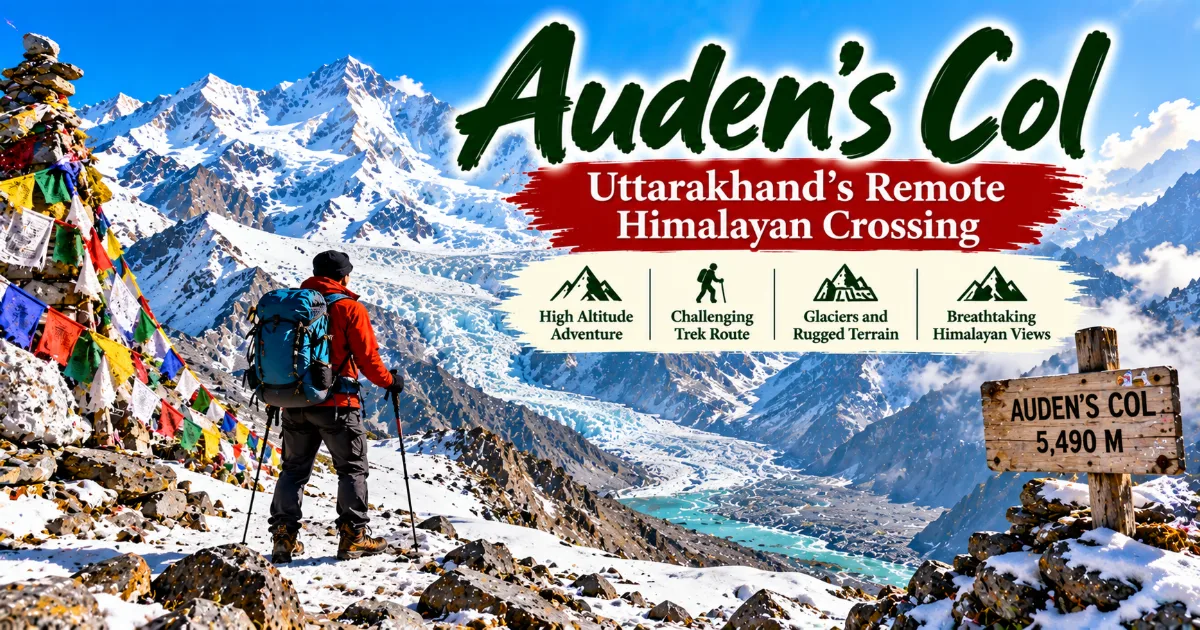
Auden’s Col is one of the most challenging and spectacular high-altitude mountain crossings in Uttarakhand, connecting the Gangotri region with the remote Bhilangana valley through a demanding Himalayan landscape of glaciers, steep ridges and snow-covered peaks.
Situated at approximately 5,490 metres above sea level, this high mountain pass attracts experienced trekkers seeking an expedition beyond conventional Himalayan trails. Its dramatic terrain, isolation and technical challenges make it a destination that demands careful preparation, professional guidance and respect for the unpredictable nature of the mountains.
Understanding Auden’s Col
Auden’s Col is located in the Garhwal Himalayas of Uttarakhand, within the broader mountainous region associated with Gangotri and the upper Bhagirathi valley. The pass forms part of a demanding trekking route that links the Gangotri side of the mountains with the Khatling Glacier region and the Bhilangana valley. It is considered one of the more serious high-altitude trekking objectives in the Indian Himalayas because of its combination of elevation, glacier travel, difficult terrain and exposure to changing weather.
Unlike popular treks that follow established paths through forests and meadows, the Auden’s Col crossing involves extended travel through remote mountain environments. Trekkers may encounter moraine fields, steep snow slopes, crevassed glaciers and sections where the route is not clearly marked. The exact conditions depend on the season, recent snowfall, glacier movement and the experience of the expedition team.
The pass is not a destination for casual hikers or first-time trekkers. It requires excellent physical preparation, suitable technical equipment and the support of experienced mountain professionals. Even fit trekkers can find the route demanding because high altitude reduces physical performance and makes recovery slower.
Continue Reading
For those who have the necessary experience and preparation, Auden’s Col offers a remarkable opportunity to explore the more inaccessible side of Uttarakhand's Himalayan wilderness. The journey is as much about understanding the mountain environment as it is about reaching the pass itself.
Who Was Auden?
The name Auden’s Col is associated with John Bicknell Auden, a British geologist and explorer who worked in the Himalayan region during the twentieth century. His geological investigations contributed to the understanding of the mountains and their complex rock formations.
A mountain pass named after an explorer reflects a history in which scientific surveys, geographical exploration and mountaineering helped document remote parts of the Himalayas. Such expeditions often involved travelling through difficult terrain with limited maps, rudimentary equipment and considerable uncertainty.
Today, Auden’s Col is better known among experienced trekkers and expedition planners than among general tourists. Its reputation comes from the seriousness of the crossing and the extraordinary landscape through which it passes.
The name also reflects the long relationship between scientific exploration and Himalayan travel. Geologists, cartographers, climbers and researchers have all contributed to documenting the region, although the mountains remain complex environments where conditions can change considerably from one season to another.
The Geography of Auden’s Col
The terrain around Auden’s Col belongs to the high Garhwal Himalayas, a landscape shaped by tectonic activity, glacial movement, snowfall and erosion. Massive mountain ridges separate deep valleys, while glaciers occupy high basins and feed streams that eventually join larger river systems.
The pass lies at an elevation of approximately 5,490 metres. At this height, the atmosphere contains substantially less available oxygen than at sea level. Walking uphill with a heavy backpack can become exhausting, and even routine activities require more effort than they would at lower elevations.
The surrounding mountains include steep slopes, exposed rock, snowfields and glacial terrain. These features create spectacular views, but they also make navigation and route selection difficult. A route that appears straightforward from a distance may contain hidden crevasses, unstable snow bridges or sections of loose rock.
Glaciers are not static surfaces. Their ice moves, cracks develop, and meltwater can alter the landscape. Crevasses may be concealed by fresh snow, making them difficult to recognise without specialised knowledge. This is one of the reasons glacier crossings require experienced guides and appropriate safety systems.
The weather adds another layer of complexity. Strong winds, snowfall, low cloud and sudden drops in temperature can reduce visibility and increase the risk of hypothermia. The combination of altitude, terrain and weather makes Auden’s Col a serious mountaineering objective rather than a conventional walking route.
Why Auden’s Col Is Considered a Difficult Trek
Auden’s Col is challenging because several demanding conditions occur together. High altitude, glacier travel, steep ascents and descents, remote camps and limited opportunities for rapid evacuation all contribute to its difficulty.
High Altitude
At nearly 5,500 metres, Auden’s Col places trekkers in an environment where the body receives less oxygen with each breath. Even people who exercise regularly may struggle with the pace required at this elevation.
Acclimatisation is essential. Trekkers should ascend gradually, allow time for their bodies to adjust and monitor symptoms carefully. Headaches, nausea, dizziness, unusual fatigue and disturbed sleep can indicate altitude-related problems. Severe symptoms require urgent attention, and continuing higher can be dangerous.
Fitness alone does not protect someone from altitude sickness. A person who is exceptionally strong at sea level can still develop serious symptoms at high elevation.
Glacier Travel
The crossing may involve travel over glaciers and associated moraine. Glacier surfaces can contain open crevasses, snow-covered cracks and unstable sections that are difficult to identify without experience.
Depending on conditions, glacier travel may require ropes, harnesses, crampons, ice axes and other technical equipment. Knowing how to carry this equipment is not enough. Trekkers must understand how to use it correctly and how to respond when a member of the group encounters difficulty.
Equipment requirements should be determined by an experienced expedition leader after assessing the route and current conditions. Travellers should not attempt to cross glaciers independently based on photographs or online descriptions.
Steep Ascents and Descents
The approach to the pass and the descent on the opposite side may involve steep terrain. Loose rock, snow and ice can make footing uncertain, particularly when the weather deteriorates.
Descending can be as demanding as climbing. Fatigue affects balance and judgement, while carrying a heavy pack increases the consequences of a slip. The expedition must therefore be planned around safe movement rather than the desire to cover a particular distance each day.
Isolation
Auden’s Col is far from the services available in major towns. Mobile connectivity may be absent, and medical facilities cannot be reached quickly from every part of the route.
An expedition must account for the possibility of delays caused by weather, route conditions or health problems. A responsible team carries suitable emergency equipment, has a clear communication plan and understands how to respond if a member cannot continue.
The Route Through the Garhwal Himalayas
Auden’s Col is commonly approached from the Gangotri side and crossed towards the Khatling Glacier and Bhilangana valley region. The route is usually undertaken as a multi-day expedition rather than a short trek.
The precise itinerary depends on the expedition operator, weather, glacier conditions, permitted access and the physical ability of the group. Some descriptions include different camps or variations in the approach, so travellers should not assume that every published route follows exactly the same line.
Starting from the Gangotri Region
Gangotri is an important gateway for journeys into the upper Himalayan landscape. The settlement is associated with the sacred Ganga and serves as a starting point for several trekking routes in the surrounding mountains.
Before beginning an expedition, trekkers typically organise transport, confirm permissions, inspect equipment and review the expected weather. The first part of the journey may involve established trails before the terrain becomes more remote and demanding.
Spending time in the region before ascending can also help with acclimatisation, although the appropriate schedule depends on the individual's previous altitude exposure and the planned itinerary.
Moving Towards the High Mountain Camps
As the route moves away from the more accessible areas, the landscape becomes increasingly rugged. Forests give way to exposed terrain, and the trail may pass through rocky sections, glacial deposits and high mountain valleys.
The daily schedule must allow sufficient time for slow movement, rest and changing conditions. Expedition leaders may adjust the location of camps or delay progress if weather or terrain creates additional risks.
The route should not be treated as a fixed sequence of distances to complete regardless of conditions. In high mountains, the safest decision may be to remain at camp, change the itinerary or turn back.
Crossing Auden’s Col
The crossing itself is the defining challenge of the expedition. Trekkers approach a high mountain saddle surrounded by steep slopes and glacial terrain. Conditions may include snow, ice, loose stones and exposed sections requiring careful movement.
The pass is not a broad, comfortable viewpoint reached by a simple walk. Its difficulty depends on the route taken and the conditions encountered during the expedition. Snowfall, wind and changes in glacier surfaces can affect how safely the crossing can be completed.
Experienced leaders determine whether the group should proceed. If conditions are unsafe, abandoning the attempt is the correct decision. Reaching the pass is an objective, but returning safely is the priority.
Descending Towards the Khatling Glacier Region
After crossing the pass, the route continues towards the Khatling Glacier region and the Bhilangana valley. The descent can be physically demanding and may involve steep or unstable terrain.
Trekkers should not assume that the hardest part is finished once they reach the highest point. Long descents can strain knees and ankles, while fatigue increases the likelihood of mistakes. The group must maintain a steady pace and follow the expedition leader's instructions.
The landscape on the far side of the pass provides a different perspective on the high Himalayas, with glaciers, rocky slopes and remote valleys creating a sense of isolation that is increasingly rare on heavily visited trekking routes.
Khatling Glacier and the Bhilangana Valley
The Khatling Glacier is an important geographical feature associated with the Auden’s Col crossing. Located in the Garhwal Himalayas, it occupies a high mountain environment where ice, rock and meltwater interact to shape the valley.
Glaciers contribute to the seasonal flow of mountain rivers. Their meltwater enters streams that eventually form part of larger drainage systems, supporting ecosystems and communities farther downstream. Changes in glacier conditions can therefore have consequences well beyond the immediate mountain landscape.
The Bhilangana valley is associated with the river of the same name, which flows through the Garhwal region before joining the wider river network. The valley contains a mixture of rugged mountain terrain and inhabited areas at lower elevations.
The transition from the high glacier environment towards the valley illustrates how rapidly Himalayan landscapes change with altitude. Bare rock, ice and sparse vegetation gradually give way to more extensive plant life and human settlements as the elevation decreases.
For trekkers, the region offers a powerful reminder that the high mountains are connected to the lives of people living far below them. Water, soil, vegetation and seasonal weather form part of a larger environmental system that extends from the glaciers to the plains.
The Natural Beauty of Auden’s Col
The appeal of Auden’s Col extends beyond the challenge of crossing a high mountain pass. Its remote location offers views of a Himalayan landscape where glaciers, steep ridges and snow-covered peaks dominate the horizon.
Snow-Covered Peaks
The surrounding peaks create a dramatic skyline. Their appearance changes with the movement of clouds and the angle of sunlight. Early morning may reveal sharply defined ridges, while afternoon cloud can soften the landscape and conceal distant summits.
These views can be especially impressive for trekkers who have spent several days moving through lower valleys. The gradual transition into a high mountain environment gives the landscape a sense of scale that is difficult to appreciate from a road-accessible viewpoint.
Glacial Valleys
Glacial valleys contain evidence of the powerful forces that shaped the Himalayas. U-shaped valleys, moraine deposits and exposed rock reveal how moving ice has modified the terrain over time.
The colours of a glacier landscape may include grey rock, white snow, blue ice and the muted tones of high-altitude vegetation. Meltwater streams can add movement and sound to an otherwise stark environment.
These landscapes are beautiful but fragile. Visitors should avoid unstable edges and follow the route chosen by their expedition team.
Silence and Isolation
One of the most memorable aspects of remote Himalayan travel is the absence of the noise associated with cities and busy tourist destinations. Wind, flowing water, shifting snow and the sounds of a trekking group may be the only noticeable interruptions.
This quiet environment encourages travellers to slow down and pay attention to their surroundings. However, isolation should not be confused with safety. Remote areas offer fewer options for emergency assistance, making preparation essential.
Wildlife and Vegetation Around the Route
The wider Garhwal Himalayan landscape supports a range of wildlife and plant communities, although the species visible along the Auden’s Col route depend on altitude, season and habitat.
Lower valleys may contain forests and shrubland, while higher terrain supports alpine plants adapted to short growing seasons and cold temperatures. As the route climbs, vegetation becomes less abundant and eventually gives way to exposed rock, snow and ice.
Mountain animals are adapted to difficult environmental conditions. Some inhabit forested slopes, while others move across open alpine terrain. Sightings are never guaranteed, especially along demanding routes where human presence may be limited but the terrain remains extensive.
Trekkers should observe wildlife without approaching or feeding animals. Carrying binoculars can improve the experience while reducing the temptation to move closer. Animals require undisturbed access to feeding and shelter areas, particularly during periods when food is scarce.
Plants should not be collected, and flowers should be left in place. High-altitude vegetation often grows slowly and may take considerable time to recover from trampling. Staying on established routes helps reduce unnecessary damage.
The ecological value of the region lies not only in its most famous animals but also in the connected habitats that allow mountain life to survive across a wide range of elevations.
Best Time to Plan an Auden’s Col Expedition
The suitable season for Auden’s Col depends on snow conditions, glacier stability, weather patterns and the judgement of experienced expedition teams. A calendar date alone cannot establish whether a crossing is safe.
Some expedition plans target periods when weather and snow conditions are expected to be comparatively favourable. However, conditions vary from year to year, and the route may remain unsuitable even during a traditionally preferred period.
Early Season
Early-season conditions may involve substantial snow cover and difficult approaches. Snow can obscure crevasses and make navigation more complicated. Low temperatures and unsettled weather can also affect the expedition.
The condition of the route must be assessed by experienced professionals rather than inferred from reports from previous years.
Main Trekking Season
During a suitable trekking window, the weather may allow better opportunities for travel, but high-altitude conditions remain unpredictable. Glacier movement, snow bridges and exposed slopes can create hazards even during periods of apparently good weather.
An expedition should proceed only when the route has been assessed and the team has the required experience and equipment.
Late Season
Later in the season, colder temperatures and changing snowfall may make the crossing more difficult. Shorter daylight hours can also reduce the amount of time available for safe movement.
Trekkers should not choose a late-season departure simply because it fits their schedule. Current conditions and professional guidance should determine whether the expedition is appropriate.
The essential rule is simple: no season guarantees safety at Auden’s Col. A responsible expedition operator will assess the actual conditions and may postpone or cancel a crossing if necessary.
Physical Preparation for Auden’s Col
Preparation for Auden’s Col should begin well before the planned departure. The route requires more than the ability to walk several kilometres on level ground. Trekkers need endurance, leg strength, balance and the ability to function while carrying a backpack at altitude.
Cardiovascular training can include brisk walking, hiking, cycling or other sustained activities suited to the individual's fitness level. The aim is to improve endurance gradually rather than to exhaust the body through sudden increases in training intensity.
Hill walking and stair climbing can help prepare the legs for sustained ascents and descents. Strength training for the legs, hips and core may improve stability on uneven ground. Balance exercises can also be useful, although they do not replace technical glacier training.
Training should progress gradually, with adequate recovery between demanding sessions. Anyone who has been inactive for a long period or has a medical condition should seek appropriate medical advice before starting an intensive programme.
Physical fitness cannot replace acclimatisation. A strong trekker may still develop altitude-related illness, and no training routine can guarantee that a person will tolerate nearly 5,500 metres comfortably.
Trekkers should also be honest about their experience. A person who has completed several moderate Himalayan treks may still lack the technical skills required for glacier travel. Previous experience at altitude is valuable, but the specific demands of Auden’s Col must be considered separately.
Equipment Required for the Expedition
The equipment needed for Auden’s Col depends on the route, weather and expedition plan. Because glacier travel and high-altitude conditions may be involved, the equipment list should be prepared with a qualified expedition leader.
Suitable mountaineering boots, warm layered clothing, waterproof outerwear, gloves, head protection and appropriate socks are fundamental. Clothing must provide insulation while allowing moisture to escape during exertion.
Technical equipment may include crampons, an ice axe, a climbing harness, ropes, helmets and other safety systems. The exact requirements depend on the route and conditions. Trekkers must know how to use the equipment safely and should not rely on carrying it without proper instruction.
A sleeping system appropriate for expected temperatures, a suitable sleeping mat, a reliable backpack and essential personal supplies are also important. The expedition team should determine what equipment will be carried individually and what will be managed collectively.
Navigation tools, emergency communication equipment and first-aid supplies are important because the route is remote. Mobile phones may not have a reliable signal, so emergency planning must not depend on ordinary cellular connectivity.
Sun protection is essential at high altitude. Ultraviolet exposure can be intense, particularly when sunlight reflects from snow and ice. Sunglasses suitable for mountain conditions, sunscreen and protective clothing help reduce exposure.
Equipment should be inspected before departure. Damaged buckles, worn footwear or unsuitable gloves can become serious problems in cold and remote conditions.
Altitude Sickness and Emergency Preparedness
Altitude-related illness is one of the most important medical concerns on an Auden’s Col expedition. The body needs time to adapt to reduced oxygen availability, and the speed of ascent influences the risk.
Early symptoms can include headache, nausea, dizziness, unusual tiredness and difficulty sleeping. These symptoms should be taken seriously, particularly when they develop after ascending to a higher camp.
The appropriate response depends on the symptoms and their severity. Trekkers should not continue ascending when they may be developing altitude sickness. Severe or worsening symptoms require urgent medical assessment, and descent may be necessary.
Confusion, difficulty walking normally, severe breathlessness at rest or a rapid deterioration in condition may indicate a life-threatening emergency. The expedition team should have a clear plan for seeking assistance and moving the affected person to a safer elevation.
Cold exposure creates another risk. Hypothermia can develop when the body loses heat faster than it can produce it, especially in wet, windy or cold conditions. Shivering, confusion, poor coordination and unusual behaviour require immediate attention.
A responsible expedition includes emergency procedures, suitable equipment and clear communication among team members. Participants should understand the plan before entering remote terrain.
Travel insurance should be reviewed carefully. Ordinary travel insurance may exclude high-altitude trekking, mountaineering or helicopter evacuation. Trekkers should verify the exact coverage rather than assuming that all mountain activities are included.
Permits and Local Regulations
Auden’s Col lies within a sensitive high-altitude environment, and access may be subject to permits and other restrictions. Requirements can change according to administrative rules, conservation priorities and current safety conditions.
Before travelling, confirm the applicable permissions with the relevant authorities and an experienced expedition operator. Ask whether the planned route, overnight stops and any associated protected areas require separate authorisation.
Do not rely entirely on information from old blogs or social media posts. Regulations and access arrangements may have changed since the account was written.
The expedition team should also explain what happens if the route becomes unsafe or a crossing is cancelled. Clear expectations about safety decisions, refunds, alternate itineraries and emergency arrangements can help avoid pressure to continue in unsuitable conditions.
Respecting official restrictions is particularly important in remote mountain areas, where rescue operations can be difficult and environmental damage may be slow to repair.
Responsible Tourism in Remote Mountain Areas
Remote Himalayan travel brings visitors into landscapes where waste management, rescue facilities and other services are limited. Every expedition should therefore minimise its environmental footprint.
All non-biodegradable waste should be carried out and disposed of through appropriate facilities. Food packaging, batteries and other waste should never be left at campsites or along the route.
Human waste must be managed according to local rules and the expedition operator's established procedures. The location and method of disposal should protect water sources and reduce environmental contamination.
Trekkers should avoid disturbing wildlife, damaging vegetation or removing natural objects. Camps should be established only where permitted, and the team should leave the site in a condition that minimises evidence of its presence.
Respect for local communities is equally important. Guides, porters and other mountain workers provide essential knowledge and support. Their safety, working conditions, equipment and fair treatment should be part of the decision when choosing an expedition operator.
Responsible tourism also includes accepting that nature sets limits. If a storm, unstable glacier or other hazard makes the crossing unsafe, turning back is the appropriate response. A cancelled summit or pass crossing is not a failure when it prevents injury or loss of life.
How to Choose an Expedition Operator
Choosing a qualified expedition operator is one of the most important decisions for anyone considering Auden’s Col. The operator should have relevant experience with high-altitude glacier travel and a clear understanding of the route's technical requirements.
Ask about the experience of the expedition leader, the qualifications and responsibilities of guides, the group's size and the safety procedures used during glacier crossings. A company that offers only general trekking experience may not be suitable for this objective.
Equipment arrangements should be explained clearly. Confirm which technical items are supplied, which participants must bring and how equipment is inspected before use.
Emergency planning deserves particular attention. Ask how the team handles altitude sickness, severe weather, injuries and delays. Find out what communication systems are available and how the operator coordinates assistance in remote areas.
A responsible operator should be willing to postpone or cancel the expedition when conditions are unsafe. Be cautious of promises that guarantee a crossing regardless of weather or glacier conditions.
The cheapest package is not necessarily the best choice for a serious high-altitude expedition. Competent leadership, reliable equipment and thoughtful safety planning are more important than a low advertised price.
Is Auden’s Col Suitable for Beginners?
Auden’s Col is not an appropriate choice for beginners or travellers whose experience is limited to easy walking trails. Its elevation, glacier terrain, remoteness and potential technical demands require preparation beyond ordinary hiking fitness.
Beginners interested in Himalayan trekking should build experience progressively. Starting with established trails at lower elevations can help develop endurance, equipment familiarity and an understanding of mountain weather.
As experience increases, trekkers can progress to more demanding routes that provide opportunities to learn navigation, campcraft and safe movement on uneven terrain. Technical training should be obtained from qualified instructors before attempting glacier travel.
A staged approach helps travellers recognise their limits before entering a location where mistakes can have serious consequences. The Himalayas offer many extraordinary journeys, and there is no need to choose one of the most demanding crossings as a first experience.
For Auden’s Col, the appropriate question is not simply whether someone is physically strong enough to attempt the route. It is whether they possess the experience, skills, equipment and judgement required for the specific conditions.
A Sample Expedition Planning Framework
Auden’s Col should not be planned as a fixed sightseeing itinerary. The length and structure of the expedition depend on the route, acclimatisation needs, camp locations and current conditions.
The first stage involves preparation in the Gangotri region, including checking permits, inspecting equipment and reviewing the route with the expedition leader. The team should also discuss emergency procedures and agree on conditions that would require a change of plan.
The following stage involves moving through the approach valleys and designated camps. Daily distances should be adjusted to the group's ability and the conditions encountered. Rest and acclimatisation days may be necessary, and the schedule should include flexibility for delays.
The crossing itself should only be attempted after the leader has assessed weather, snow and glacier conditions. The group must have the appropriate equipment and technical support. If the route is unsafe, the plan should change rather than forcing the crossing.
After reaching the opposite side, the team continues towards the planned exit through the Khatling Glacier region and Bhilangana valley, following the authorised route. The descent should be planned carefully because fatigue and difficult terrain can remain serious concerns.
The total number of days should be determined by a qualified operator rather than selected solely to fit a short holiday. An itinerary that provides sufficient time for acclimatisation and changing conditions is more responsible than one that depends on every stage proceeding perfectly.
Why Auden’s Col Deserves Respect
Auden’s Col represents the demanding side of Himalayan exploration. Its appeal comes from the combination of remote geography, glacier travel, high-altitude terrain and the satisfaction of undertaking a carefully prepared expedition.
Yet the same qualities that make the crossing remarkable also make it dangerous. The landscape is not a controlled environment, and conditions can change beyond the control of even experienced trekkers.
Respecting the mountains means recognising that preparation has limits. Strong fitness, expensive equipment and professional support can reduce risk, but they cannot eliminate it. Good decisions depend on observation, communication and a willingness to change plans.
The route also encourages a broader understanding of adventure travel. A meaningful expedition is not defined only by reaching the pass. It includes the preparation, teamwork, environmental responsibility and judgement required to travel safely through a difficult landscape.
For those with the appropriate experience, Auden’s Col can be an unforgettable Himalayan journey. For others, it can serve as inspiration to develop the skills needed for more demanding mountain travel in the future.
Conclusion
Auden’s Col is one of Uttarakhand's most formidable high-altitude crossings, linking the Gangotri side of the Garhwal Himalayas with the remote Khatling Glacier and Bhilangana valley region. At approximately 5,490 metres, it offers dramatic views of glaciers, steep mountain ridges and an environment shaped by ice, rock and extreme weather.
The crossing demands far more than enthusiasm. Trekkers need strong physical preparation, relevant high-altitude experience, technical skills, suitable equipment and qualified expedition support. They must also understand the risks of altitude sickness, glacier travel, sudden weather changes and limited emergency access.
For visitors who are not prepared for such conditions, the wider Gangotri and Uttarkashi regions offer many other ways to experience Uttarakhand's natural beauty and cultural heritage. For experienced mountaineers, Auden’s Col remains an ambitious objective that should be approached with humility and careful planning.
Ultimately, the greatest achievement in the Himalayas is not simply reaching a high pass. It is travelling responsibly, protecting the landscape and returning safely with a deeper appreciation of the mountains.
#AudensCol #UttarakhandTourism #GarhwalHimalayas #HighAltitudeTrekking #HimalayanAdventure