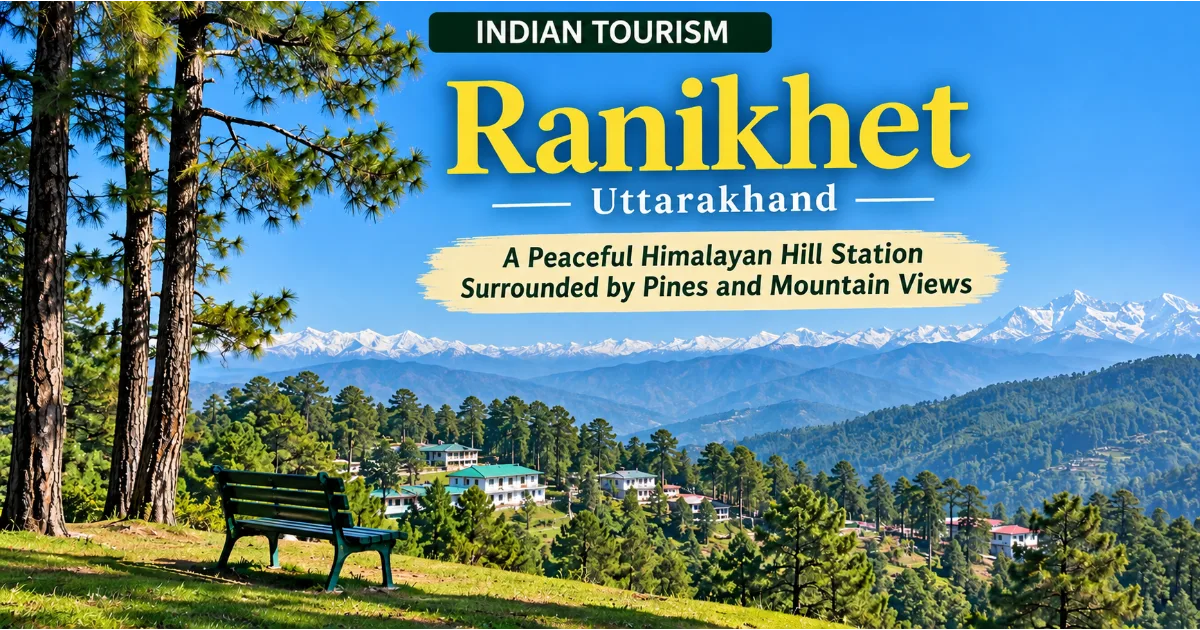
Ranikhet is a quiet hill station in the Kumaon Himalayas of Uttarakhand, with pine forests, colonial-era buildings, old temples and a strong Kumaoni culture. It sits in the Almora district and makes a calmer alternative to crowded tourist towns. Quiet roads, forested hills, open meadows and distant Himalayan views draw travellers who want rest, nature, some history and a slower pace of life.
The name Ranikhet translates to the Queen's Meadow. According to local legend, a queen was so taken with the area that it came to carry her name. How much of this is history and how much folklore is hard to say, but the name fits the place: open green spaces ringed by hills and forest. Ranikhet is also tied to the Kumaon Regiment of the Indian Army, and its old cantonment still shows the British-era planning of a hill station.
There is no single famous sight here. You can visit the historic Jhula Devi Temple, see the orchards at Chaubatia, walk through pine and oak forests, stop in traditional villages and take in mountain views from several viewpoints. The town also gives access to other parts of Kumaon, so it works well as a base for a longer journey through the mountains.
This guide covers Ranikhet's geography, history, major attractions, temples, natural surroundings, local culture, food, accommodation, best travel seasons, transport options and practical advice. Whether you want a family holiday, a quiet trip as a couple, a photography trip or a few days in the forests, there are plenty of reasons to spend time in this part of Uttarakhand.
Continue Reading
Understanding Ranikhet and Its Himalayan Setting
The town lies in the Kumaon region of Uttarakhand at an elevation of approximately 1,800 metres above sea level. Ridges, slopes, valleys and forested hills make up the terrain around it. Pine and oak grow thickly here along with other Himalayan vegetation, and on clear days you can see distant snow-covered ranges far to the north.
Instead of one compact commercial centre, the settlement is spread over several local areas. That sets it apart from many busy hill stations. Homes, cantonment areas, market streets, forest roads and open spaces are scattered across the hills, and you will notice the mood shift as you move from the busier market towards the quieter forest.
For most visitors, the forest is the main draw. Trees cover the hills, and many roads run through shaded stretches where sunlight filters between the branches. In spring, flowering trees and new growth bring colour to the slopes. Summer is a pleasant escape from the heat of the plains, while autumn often has clear skies and good visibility. In winter it gets much colder, with occasional snowfall on the higher ground nearby, though snow in the town itself is not guaranteed.
On the wider Kumaon travel circuit, the town is a natural stop. You can include it in a route that takes in Almora, Nainital, Kausani, Binsar and other destinations in the region. If you like to travel slowly, spend several days here and use it as a base for short trips and time in the countryside.
The History and Identity of Ranikhet
Local traditions, colonial-era administration and a long, continuing link with the Indian Army have all shaped this town. You can still see these influences in its buildings, roads and institutions, and in the feel of daily life on its streets.
The Legend Behind the Name
In translation the name means the Queen's Meadow. Local tradition says a queen was captivated by the beauty of the place and chose it for its calm and its views, and the settlement later became known as Ranikhet.
As with many place-name stories in the Himalayan region, the account survives mainly through local memory rather than written records. What it shows is how the people who have lived here saw their land and imagined its past. With its open meadows, mountain views and forests all around, the name suits it well.
The Colonial Period
Under British rule the town grew into a hill station. Its cool climate and height made it attractive for colonial administration and for military establishments. In the nineteenth century the British set up a cantonment here, and over time the town gained the planned roads, institutional buildings and open grounds typical of military hill settlements.
Some buildings, churches, old structures and parts of the cantonment layout still show that colonial influence. Yet the colonial story is only part of it. Kumaoni communities, traditional farming, religious practice and ties with nearby settlements had shaped this area for far longer.
Ranikhet and the Kumaon Regiment
Of all the institutions linked with the town, the best known is the Kumaon Regimental Centre. Army presence is a large part of local character, and you notice it soon after arriving. The Kumaon Regiment has a distinguished history in the Indian Army, and that link gives Ranikhet a special place in the military heritage of Uttarakhand. Its regimental museum covers the regiment's history, traditions, achievements and service.
Keep in mind that this is still an active cantonment. Some roads, buildings and military facilities may be off limits to visitors. Follow local instructions, respect security arrangements and do not photograph restricted installations.
Major Places to Visit in Ranikhet
Attractions range from gardens and forest walks to temples and historical sites. A few are close to town, while others need a short drive through the surrounding hills.
Chaubatia Gardens
Chaubatia Gardens is among the best-known sights near Ranikhet. This horticultural area, a short distance from the main town, is known for its orchards and mountain setting. It is a good place to see what fruit growing looks like in the Kumaon hills.
Apple, pear, peach, plum and apricot trees all grow in the region. Each season changes the look of the orchards: spring brings blossom, and later in the year you may see fruit forming or the harvest under way, depending on the crop and local conditions.
If you like quiet outdoor spaces, you will enjoy Chaubatia. It suits photography and easy walks, and you get a sense of how orchards fit into the mountain environment. On clear days there are good views of the Himalayan ranges.
Do not assume that every orchard is open to the public. Parts of the area are managed for agricultural or institutional purposes, so follow local guidance and do not damage plants or wander into restricted areas.
Jhula Devi Temple
Dedicated to Goddess Durga, Jhula Devi Temple near Ranikhet is known for the huge number of bells offered by devotees. They hang all around the temple complex and give it its unmistakable look.
According to local belief, the goddess grants the wishes of those who pray with faith. People who feel their prayers were answered often come back to offer a bell in thanks. Over time this practice has made it one of the most recognisable religious sites in the region.
A visit shows the living religious traditions of Kumaon: worship, rows of bells and the quiet devotion of pilgrims. Dress respectfully, keep silent where appropriate and follow the instructions of temple authorities.
You can combine Jhula Devi Temple with other nearby sights on a half-day trip from Ranikhet.
Ram Mandir
On a hill near Ranikhet stands Ram Mandir, a temple dedicated to Lord Rama. It draws devotees as well as visitors curious about the religious life of Kumaon.
It is a peaceful spot, and worth the trip if you like smaller religious places away from busy tourist centres. Depending on the route and local conditions, you may need to climb steps or walk up sloping paths. Give yourself enough time and do not rush; the setting and atmosphere matter as much as the building itself.
Kumaon Regimental Centre Museum
The Kumaon Regimental Centre Museum covers the history and traditions of the Kumaon Regiment. Anyone interested in India's military heritage, or in the soldiers who came from the Himalayan region, should stop here.
On display are photographs, memorabilia, equipment and records of military service. These exhibits trace how the regiment developed and its role in different periods of Indian military history.
A visit also makes clear that Ranikhet is more than a holiday town. Its ties with the armed forces have shaped its institutions, local identity and daily life. Museum timings, access rules and photography policies may change, so confirm current arrangements before you go.
Golf Ground
Ranikhet's golf ground stands out. A wide open ground ringed by forested hills, it contrasts sharply with the dense trees around it and makes a good spot for photographs and an unhurried look around.
The course belongs to the cantonment and has a long history. It shows another side of Ranikhet: the planned green spaces that are part of the town's character.
Respect any access restrictions and keep out of areas reserved for players or authorised users. Even when you cannot go in, the surrounding hills and forest can be enjoyed from permitted viewpoints.
Majkhali
Majkhali, near Ranikhet, is known for mountain views and quiet surroundings. Go here if you want to see the countryside beyond the main town.
The area looks its best on clear days, when distant Himalayan peaks may be visible. Open slopes, villages and the natural setting make it good for photography and slow, leisurely exploring.
If you enjoy road journeys through the hills, the drive is half the point, with views of forests, valleys and settlements changing as you go.
Bhalu Dam
Bhalu Dam is a small water body in the forest around Ranikhet. Visitors come here for a quiet natural setting, well away from busy roads and commercial areas.
In comfortable weather the dam and its surroundings make a pleasant, easy outing, a chance to take in the forest at a slower pace.
The state of access roads and walking routes can change with the weather. Check local information before setting out, and keep away from slippery edges or unstable ground.
Sunset and Mountain Viewpoints
Several spots around Ranikhet give broad views of the mountains and valleys. Instead of relying on one viewpoint, try a few different accessible ones during your stay.
Early morning is often best, because the air may be clearer before clouds build. At sunset the hills can change colour, although visibility depends on the weather and season.
Never stop a vehicle somewhere unsafe just to take a photograph. Use designated viewpoints or safe open spaces, and take extra care on narrow mountain roads.
Exploring the Natural Beauty Around Ranikhet
Forests, orchards, meadows and mountain slopes are what bring most people here, and they offer something different in every season.
Pine Forests and Oak Woodlands
Pine and oak make up much of the forest around the town, along with other species of the middle Himalayan region. These woods affect the local climate and are home to wildlife, including many birds and insects.
A walk through them is one of the simplest and best things to do in the area. Shade, birdsong and the shifting light all make you slow down.
Explore responsibly, though. Stay on established paths, never light fires, carry back all waste and leave wildlife alone. It is also sensible to avoid isolated forest trails after dark.
Himalayan Mountain Views
From this height you can see distant Himalayan peaks when the air is clear. Which peaks show up depends on weather, season and exactly where you stand.
Views tend to be best after a spell of clear weather, when there is less dust and moisture in the air. Visibility can be excellent in winter and parts of autumn, but you will need warm clothing for the cold.
No view is guaranteed on any given visit. Clouds, haze and sudden weather changes can hide the ranges, so keep your expectations flexible and enjoy the forests and valleys even when the snow peaks stay hidden.
Birdwatching
Himalayan and foothill bird species are drawn to the forests around Ranikhet. Depending on the location and season, you may see laughingthrushes, bulbuls, woodpeckers, flycatchers, tits and other woodland birds.
Early morning is usually the most productive time. Patience, quiet and a pair of binoculars help. If you are new to birdwatching, start with common birds around gardens, forest edges and quiet roads.
When taking photographs, do not disturb nesting sites or stress the birds. Playing loud recorded calls and going close to nests should be avoided.
Seasonal Flowers and Orchards
Each season gives Ranikhet a different look. Spring stands out, with flowering trees and new growth changing the hills; the orchards are at their prettiest and the slopes turn green again. In summer everything stays green, while autumn brings a softer light and often clearer mountain views. The winter months are quieter, with colder mornings and occasional frost in some areas.
If flowers or fruit growing interest you, time your trip to the season you want to see; the orchards will not look the same all year.
Temples and Spiritual Experiences Around Ranikhet
Religion runs deep in Kumaoni culture. Temples around Ranikhet are more than sights to tick off: they are active places of worship tied to local traditions, family visits and seasonal observances.
Traditional Worship and Local Beliefs
Kumaon has temples to many forms of the divine, including the goddess in her various manifestations, Lord Shiva, Lord Vishnu and other deities. Many shrines are linked to local legends and village traditions.
At places such as Jhula Devi Temple, you can see faith expressed through offerings, prayers and community participation. The bells are a clear case of a local belief becoming part of a temple's physical form.
Visit these places with respect. Photography may not be allowed in some areas, and certain rituals may be private or open only to devotees.
Festivals and Religious Gatherings
Festivals in Kumaon follow the farming calendar, the turn of the seasons and religious tradition. Celebrations may include temple gatherings, music, traditional food and community participation.
Timing and form vary from village to village. If you hope to see a festival, check local calendars and ask residents or tourism information centres for confirmed dates. Taking part respectfully will teach you more about the region than visiting monuments alone ever could.
Understanding Kumaoni Culture and Village Life
This part of Uttarakhand has its own cultural identity. You can see Kumaoni traditions in the language, food, architecture, music, festivals, clothing and farming.
Language and Hospitality
Kumaoni is the local language, while Hindi is widely used for everyday communication. English may be understood in tourist establishments and by some residents, but do not assume everyone is comfortable speaking it.
Learning a few simple Hindi greetings and speaking politely make conversations easier. Many residents have strong ties to their villages, their families and local customs.
Traditional Houses and Settlements
Traditional houses in Kumaon are built for the climate, the terrain and the building materials at hand. Older ones may have stone walls, timber elements and sloping roofs suited to mountain weather.
Around the villages you will often find farm terraces, orchards and patches of forest. Together they show how communities have adapted to steep slopes and changing seasons.
If you walk through a village, remember that homes, courtyards, fields and water sources are private or community spaces. Always ask permission before photographing people or entering private property.
Agriculture and Rural Livelihoods
Farming still shapes daily life in many communities around Ranikhet. Terraced fields grow crops suited to the local climate and soil conditions, and fruit growing adds to the regional economy.
Through the year, fields are prepared, planted, harvested or left fallow depending on the season, and seeing this work is part of experiencing Kumaon. Be a responsible visitor: do not walk through crops, damage orchard trees or treat working farms as open tourist attractions.
Local Food to Try in Ranikhet
Eating local is one of the easiest ways into Kumaoni culture. In Ranikhet you will find familiar North Indian meals alongside traditional dishes from the wider Kumaon region.
Bhatt Ki Churkani
This traditional Kumaoni dish is made with black soybeans, known locally as bhatt. The beans are cooked with spices and often served with rice. Bhatt ki Churkani is hearty food, and it shows how much mountain cooking relies on ingredients that grow nearby.
Aloo Ke Gutke
For something simpler, try Aloo ke Gutke, a popular Kumaoni potato dish. The potatoes are cooked with regional spices and usually served with local accompaniments. People eat it as a snack or as part of a larger meal.
Kafuli
A thick dish of leafy greens from Uttarakhand, Kafuli has an earthy flavour. Cooks generally use whatever greens are available locally, and recipes vary between households and areas.
Phaanu
Phaanu uses lentils that are soaked and then cooked slowly. It is a filling meal and a good example of how much the region relies on pulses in everyday cooking.
Bal Mithai
Among the best-known sweets of Kumaon is Bal Mithai. It is made from roasted khoya and coated with small sugar balls, and travellers often hunt for it in markets across the region.
Singori
Another traditional Kumaoni sweet, Singori is khoya wrapped in a leaf. The way it is presented makes it an easy regional speciality to remember.
Local Food Experiences
Look for traditional dishes in local restaurants, small eateries and some homestays. Not every place serves the full range of Kumaoni cuisine, so if regional food matters to you, ask about availability in advance.
Eating these dishes also helps keep local food traditions going, and it shows you how mountain communities cook with seasonal ingredients.
Best Time to Visit Ranikhet
You can visit Ranikhet for much of the year, and each season feels different. When to go depends on what you want most: pleasant weather, clear mountain views, green hills or a quiet winter.
March to June: Spring and Summer
Spring and early summer are among the most comfortable times to visit. Compared with the plains, temperatures are generally pleasant, which makes sightseeing, walking and time outdoors easy.
Orchards and fresh growth add colour to the hills. It is a good time for families, couples and anyone who wants to see several attractions in a single trip without facing extreme cold.
May and June can get busier with the summer holidays. If you are coming on popular holiday dates, book accommodation and transport in advance.
July to September: Monsoon
In the monsoon the hills turn a deep green. Forests, fields and slopes look fresh, and the region can be especially lovely after rain.
Heavy rain can also cause problems. Roads may turn slippery, visibility drops and landslides may block routes in the wider mountain region, so check weather forecasts and road conditions before you set off. Monsoon travel suits visitors with flexible schedules who are comfortable changing their plans around the weather.
October to November: Autumn
For clear skies and mountain views, autumn is an excellent choice. After the monsoon the air often clears, and the hills look calm and freshly washed.
Daytime temperatures are generally comfortable, while mornings and evenings turn noticeably cooler. It is a good season for sightseeing, photography and unhurried exploring.
December to February: Winter
Winter in Ranikhet is cold. Temperatures can drop sharply, especially at night and in the early morning. Higher areas nearby may get snowfall, but snow in Ranikhet town is not guaranteed every winter.
Pack warm clothing and confirm in advance what heating arrangements your accommodation provides. If you enjoy quiet surroundings and cold mountain weather, winter can be a very good time to come.
How to Reach Ranikhet
Roads link Ranikhet with several important towns in Uttarakhand and the wider Kumaon region. These are mountain roads, so travel times vary with traffic, weather and road conditions.
By Road
Most people arrive by road. The town is connected with Kathgodam, Haldwani, Nainital, Almora and other settlements in Kumaon.
You can come by private vehicle, taxi or whatever bus services are running. If you are driving yourself, you should be comfortable on hill roads and avoid driving at night unless you must, especially in rain or fog.
The drive is worth it on its own, with forests, villages, terraced fields and valley views changing along the way.
By Train
Kathgodam is the nearest major railway station commonly used by travellers heading to Ranikhet. Trains connect it with several cities, though frequency and schedules depend on the route and season.
From there, continue by taxi, private vehicle or other road transport. Expect the onward journey to take several hours depending on traffic and road conditions.
By Air
Pantnagar Airport is one of the nearest airports in the wider region, but flights may be limited and schedules can change. Confirm current services before you plan your journey.
If you are coming from a distant city, it is often more practical to fly into a larger airport and continue by rail or road.
Suggested Ranikhet Travel Itineraries
How long to stay depends on how much of the surrounding region you want to see. A short visit covers the main attractions; a longer one leaves time for villages, forest walks and nearby destinations.
One-Day Ranikhet Visit
With one day, stick to a few nearby attractions. Start the morning at Chaubatia Gardens and give yourself time to explore the orchards and the views around them. Then head on to Jhula Devi Temple and Ram Mandir, depending on time and access.
Spend the afternoon around the cantonment and at permitted viewpoints. If time allows, add the golf ground area or a scenic drive towards Majkhali.
This plan works if you are only passing through the region, but one day is not enough time to enjoy Ranikhet at a relaxed pace.
Two-Day Ranikhet Itinerary
On the first day, cover Chaubatia Gardens, Jhula Devi Temple, Ram Mandir and the main town. Set aside time for the local history and military heritage, subject to museum access and timings.
Day two can go to Majkhali and Bhalu Dam, depending on road conditions and local access. Take a long, relaxed lunch and spend the rest of the day on forest roads or in nearby villages.
Two days give a much better balance between sightseeing and rest.
Three-Day Ranikhet Itinerary
Three days let you explore the region without rushing. Spend the first on the main attractions, including Chaubatia Gardens and the temples. On the second, focus on the regimental museum, the golf ground surroundings and the local markets. Keep the third for Majkhali, Bhalu Dam and some time in the countryside.
If you are interested in photography or birdwatching, use the extra time for early-morning visits to accessible forest areas, when the light is soft and the birds are most active.
Accommodation in Ranikhet
Places to stay include hotels, guesthouses, resorts and homestays. Which suits you depends on budget, the kind of surroundings you want and the type of holiday.
Hotels and Resorts
Hotels and resorts suit visitors who want organised services, a restaurant on site and help arranging local travel. Some have views of the surrounding hills, while others sit closer to the market or main roads. Before booking, confirm the exact location, road access, parking arrangements, meals and, in winter, heating.
Homestays
For local hospitality and a chance to learn about Kumaoni food and traditions, choose a homestay. Living with a local family gives a more personal view of village life and regional customs than a hotel can. Be clear about what you expect, particularly meals, transport, hot water and accessibility.
Choosing the Right Location
If you want easy access to shops and transport, stay closer to the main town. Those looking for quiet surroundings may prefer properties outside the busier areas.
Isolated places may need private transport, however. Before you book, check the distance from major attractions and whether taxis are easy to find.
Shopping in Ranikhet
Shopping here is low-key and relaxed, not a major attraction in itself. Local markets sell everyday products, regional food items, woollen clothing, souvenirs and locally produced goods.
Regional Food Products
You may find traditional sweets, locally made preserves and other regional food products. Bal Mithai and Singori are closely tied to Kumaon and make good edible souvenirs. Always check packaging, storage instructions and expiry dates before buying food to carry home.
Woollen Clothing and Handicrafts
Local shops may also stock woollen garments, shawls and some handicrafts. If you want to support regional artisans, ask where and how items were made. Buying directly from local producers, where possible, helps small businesses and keeps traditional skills alive.
Ranikhet for Different Types of Travellers
With nature, culture, history and religious sites all within reach, the town works for many kinds of trip.
For Families
Families will appreciate the calm, the gardens, the scenic drives and the cultural attractions, and children may enjoy the orchards, open spaces and forest. Plan travel times carefully and do not try to cover too many places in one day. Mountain roads and walking routes can tire young children and older family members alike.
For Couples
For couples wanting a quiet mountain holiday, the forest roads, viewpoints, gardens and peaceful places to stay all lend themselves to rest. Skip the tightly packed sightseeing schedule in favour of slow mornings, local food and short excursions.
For Nature Lovers
Nature lovers can explore the forests, orchards, bird habitats and the way the hills change with the seasons. The area especially suits people who like watching quietly outdoors. Birdwatching, photography and nature walks can easily fill a longer stay.
For History Enthusiasts
History enthusiasts will find Ranikhet's colonial-era development and military links useful for understanding hill settlements and the Indian Army. The regimental museum, where accessible, is the obvious stop. Look too at the older buildings and the cantonment layout, while respecting restricted areas.
For Senior Citizens
Older travellers may like the calm atmosphere and pleasant climate. Hilly terrain can be hard for anyone with limited mobility, though. Choose accommodation with easy vehicle access, check whether there are lifts or ground-floor rooms if you need them and avoid steep walking routes.
Responsible Tourism in Ranikhet
The town stays beautiful only if its forests, water sources, villages and surroundings stay clean. Tourism can support the local economy, but visitors should take care not to put needless pressure on the environment.
Avoid Littering
Plastic bottles, food wrappers and disposable packaging spoil forest areas and put wildlife at risk. Carry a reusable water bottle where practical and take all waste back to designated disposal points.
Respect Wildlife
Birds and other animals live in the forests around Ranikhet. Do not feed wildlife, chase animals for photographs or go near nests and resting places. Watching quietly is the best way to enjoy them.
Protect Water Resources
Mountain communities depend on local water sources, and supply can vary with the season. Use water carefully, particularly in dry periods. Never wash vehicles or dump waste near streams, springs and water bodies.
Support Local Businesses
Choosing local guides, homestays, restaurants and shops spreads tourism income across the region. Buying genuine regional products also supports local producers.
Follow Cantonment Rules
Several active military establishments operate in and around the town. Some locations have restricted access and limits on photography. Follow all security instructions and never try to enter prohibited areas.
Practical Travel Tips for Visiting Ranikhet
A little basic preparation makes the whole trip to Ranikhet much easier and more comfortable.
Pack clothing suitable for the season. Even in summer, mornings and evenings can be cool. In winter, bring proper thermal layers, jackets, gloves and comfortable footwear.
Check weather and road conditions. Mountain weather can change quickly, particularly during the monsoon. Confirm road conditions before travelling and allow extra time for delays.
Keep some cash available. Digital payments are common in many establishments, but smaller shops and remote locations may have limited connectivity or payment facilities.
Book accommodation in advance during holidays. Summer vacations and popular long weekends can push up demand, and booking early gives you more choice.
Expect patchy mobile connectivity. Network coverage can vary across the surrounding hills. Download important maps and keep accommodation and transport details accessible offline.
Bring essential medicines. Pack any personal medication and basic first-aid supplies. If you have specific medical needs, plan for them before you leave.
Start sightseeing early. Morning travel often provides better visibility and allows more time to explore before afternoon weather changes.
Avoid unsafe roadside stops. Narrow roads and blind curves can make casual stopping dangerous. Use designated parking areas and safe viewpoints.
Respect local customs. Dress appropriately at temples, ask before photographing residents and follow instructions at religious and military locations.
Nearby Destinations to Explore from Ranikhet
You can easily pair Ranikhet with other places in Kumaon on a longer Uttarakhand journey.
Almora
Almora is known for traditional Kumaoni culture, old market areas, temples and mountain views. It feels different from Ranikhet, with more emphasis on its historic town and its cultural heritage.
Nainital
One of Uttarakhand's most recognised hill stations, Nainital has its lake, surrounding hills, viewpoints and busy markets, and is popular with families and holidaymakers.
Pairing it with Ranikhet shows you two quite different kinds of mountain tourism. Nainital is more commercially developed, while its neighbour is quieter, with a cantonment and forest atmosphere.
Kausani
Wide Himalayan views and a calm setting are what Kausani is known for. It is a good addition to the route if you are interested in mountain photography and scenery.
Binsar
Binsar draws nature lovers and birdwatchers in particular with its forest, wildlife and mountain views.
Naukuchiatal and Bhimtal
These two lake destinations are good for quiet sightseeing and, where available, water activities. You can fit them into a wider Kumaon itinerary depending on travel time and road conditions.
Do not try to see every destination in one trip. Give each place enough time and the holiday will be more comfortable and more rewarding.
Frequently Asked Questions About Ranikhet
Where is Ranikhet located? It is a hill station in the Almora district of Uttarakhand, in the Kumaon region of the Indian Himalayas.
What is Ranikhet famous for? It is best known for its forested surroundings, Himalayan views, Chaubatia Gardens, Jhula Devi Temple, colonial-era cantonment heritage and its link with the Kumaon Regiment.
How many days are enough for Ranikhet? Two to three days are enough to see the main attractions at a relaxed pace. Stay longer if you want to explore nearby villages and destinations.
Is Ranikhet suitable for a family holiday? Yes. Its peaceful environment, gardens, temples and scenic drives all make it a good choice for families. Adjust the itinerary to your children's ages and the mobility needs of older family members.
Does Ranikhet receive snowfall? Snow is possible in the wider region during winter, but not guaranteed in the town every year. If you are hoping for snow, check recent local weather conditions before you travel.
What is the nearest railway station? Kathgodam is the nearest major railway station commonly used by visitors travelling to Ranikhet. You will need road transport for the onward journey.
Is Ranikhet suitable for a honeymoon? Yes. Couples who prefer quiet surroundings, nature, scenic drives and relaxed accommodation can enjoy Ranikhet as a honeymoon destination.
Is Ranikhet crowded? Generally it is quieter than some of Uttarakhand's more commercially popular hill stations. Even so, visitor numbers do rise during summer holidays, long weekends and festival periods.
Can Ranikhet be visited during the monsoon? Yes, it can, but be ready for rain, reduced visibility and possible road disruptions. Check weather forecasts and road conditions before departure.
What local food should visitors try? Popular regional dishes and sweets include Bhatt ki Churkani, Aloo ke Gutke, Kafuli, Phaanu, Bal Mithai and Singori.
Experience Ranikhet Slowly
This hill town shows a quieter side of Uttarakhand tourism. There is no single landmark or adventure activity here. Instead you get mountain scenery, forest roads, traditional temples, orchards, military heritage and Kumaoni culture together, in a place that makes you slow down and notice everyday life in the Himalayas.
There is something for most interests, from the flowering orchards of Chaubatia and the bell-covered grounds of Jhula Devi Temple to the history of the Kumaon Regimental Centre and the quiet slopes of Majkhali. Nature lovers have the forests, devotees the temples, and curious visitors the history; anyone tired of crowded cities has the calm.
Plan enough time for unhurried exploring. Rather than treating Ranikhet as a quick stop on the way somewhere else, spend a few days on its villages, food, forests and cultural traditions. You will come away knowing far more about Kumaon and the people who have shaped these mountains.
If you are exploring Uttarakhand, give this town a place on your route among the region's hill destinations. The mountains set the scene, the forests set the mood, and the local culture gives the trip its character.