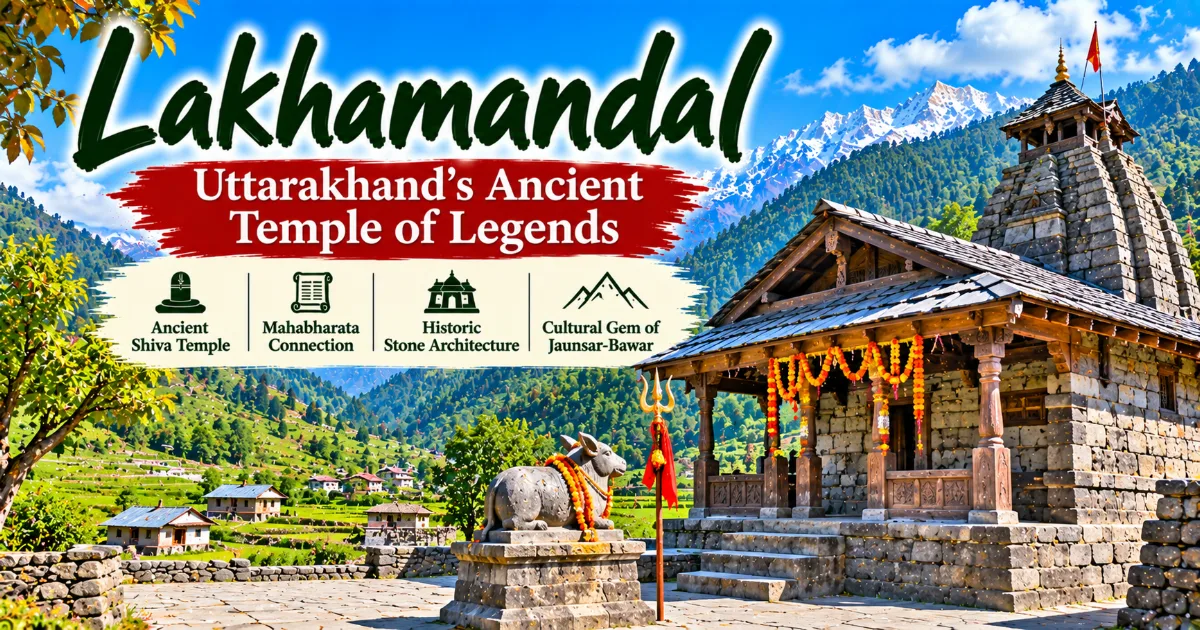
Hidden in the Jaunsar-Bawar region of Uttarakhand's Dehradun district, Lakhamandal is an ancient temple settlement known for its association with Lord Shiva, traditional stone architecture and legends from the Mahabharata. Located amid the beautiful landscapes of the Yamuna Valley, this historic destination offers a fascinating combination of mythology, archaeology, religious traditions and Himalayan culture. Its ancient temples and sculptural remains make it an important place for travellers interested in discovering the lesser-known heritage of Uttarakhand.
Lakhamandal is particularly associated with the story of the Lakshagriha, the house of lac mentioned in the Mahabharata. According to local tradition, this region is connected with the attempt to destroy the Pandavas through a palace made of combustible materials. Although the historical relationship between the surviving archaeological site and the epic narrative requires careful interpretation, the legend has become an important part of the area's cultural identity.
Beyond mythology, Lakhamandal deserves attention for its historic temple complex, stone sculptures, traditional religious practices and the distinctive culture of Jaunsar-Bawar. It is a destination where visitors can explore a quieter side of Uttarakhand, away from the crowded routes of the state's most famous hill stations and pilgrimage centres.
Discovering Lakhamandal in the Jaunsar-Bawar Region
Lakhamandal is situated in the Jaunsar-Bawar region of Dehradun district, in the western part of Uttarakhand. The area is known for its distinctive cultural traditions, mountain settlements, agricultural landscapes and historical connections with the wider Himalayan region.
Continue Reading
The journey towards Lakhamandal takes visitors through a landscape of winding mountain roads, river valleys, forested slopes and traditional villages. The region has a character different from the more familiar tourist destinations of Mussoorie and Nainital. Its appeal lies in its heritage, community traditions and relatively peaceful rural surroundings.
Lakhamandal is best understood as a cultural and archaeological destination rather than simply a temple stop. The surviving structures and sculptural remains provide evidence of an important religious centre that developed over time. The site also reflects the long-standing relationship between religious institutions and settlements in the western Himalayan region.
The temple complex attracts devotees as well as visitors interested in ancient Indian architecture. Its association with Lord Shiva gives it religious importance, while its connection with the Mahabharata makes it particularly interesting to people who enjoy exploring India's epic traditions.
The surrounding region adds another dimension to the visit. Jaunsar-Bawar has a distinct cultural identity, with traditional houses, local festivals, agricultural practices, music and community customs that have developed through generations.
A journey to Lakhamandal therefore offers more than a visit to an ancient temple. It provides an opportunity to understand the relationship between mythology, history, architecture and living Himalayan culture.
The Meaning and Significance of the Name Lakhamandal
The name Lakhamandal is commonly associated with the words relating to lac and a settlement or collection of structures. This association has strengthened the connection between the place and the Mahabharata story of Lakshagriha.
In the epic narrative, the Lakshagriha was a palace constructed using highly combustible materials, including lac. The structure was intended to become a trap for the Pandavas. The story describes how they escaped from the planned destruction through an underground passage.
Local traditions associate Lakhamandal with this episode. The connection has become one of the best-known elements of the site's identity and attracts visitors who want to explore locations associated with the Mahabharata.
However, it is important to distinguish between religious tradition, local belief and archaeological evidence. The surviving temple complex is a historical and religious site, while the identification of the area with the exact location of the epic Lakshagriha belongs to the realm of traditional association and interpretation.
This distinction does not reduce the cultural importance of the legend. Stories from the Mahabharata have shaped the identities of many places across India. They connect communities with shared narratives and provide a framework through which local landscapes acquire religious and historical meaning.
For visitors, Lakhamandal offers an opportunity to explore both dimensions: the ancient temple heritage that can be observed at the site and the epic traditions preserved through local memory.
The Mahabharata Connection: The Legend of Lakshagriha
The Mahabharata is one of India's most influential epic narratives. It tells the story of the Kuru dynasty, the conflict between the Pandavas and Kauravas, and the events that eventually lead to the great battle of Kurukshetra.
One of the important episodes in the early part of the story concerns the Lakshagriha, also known as the house of lac.
According to the epic, Duryodhana and his associates wanted to eliminate the Pandavas because they were viewed as rivals to his political ambitions. A plan was developed to send the Pandavas to a specially constructed palace made from combustible materials. The structure was designed to catch fire and trap its occupants.
The Pandavas were warned about the danger. With the help of Vidura's advice and careful planning, they prepared an underground escape route. When the palace was set on fire, they were able to escape through the passage and avoid the planned destruction.
This episode is remembered as an example of political intrigue, betrayal, intelligence and survival. It also marks an important stage in the larger narrative of the Pandavas' struggle.
Lakhamandal is traditionally connected with this story. Local accounts and the name of the settlement have helped preserve the association over generations.
Visitors should understand that the Mahabharata connection is part of the site's cultural and religious heritage. It should not automatically be treated as archaeological confirmation of every detail in the epic narrative.
The story nevertheless gives Lakhamandal a special place in the imagination of travellers interested in India's ancient literature. It transforms the visit into an exploration of how epic traditions continue to shape the identity of real landscapes and settlements.
The Ancient Shiva Temple Complex
The central attraction of Lakhamandal is its ancient temple complex dedicated to Lord Shiva. The site contains historic temple structures and sculptural remains that reflect the religious importance of the settlement.
Lord Shiva is one of the principal deities in Hindu tradition. He is worshipped in different forms as the destroyer and transformer within the Hindu understanding of the cosmic cycle. He is also associated with meditation, asceticism, protection and the Himalayan landscape.
The association between Shiva and the Himalayas is particularly strong. Many sacred sites dedicated to the deity are located in mountainous regions, where natural landscapes contribute to the spiritual atmosphere of worship.
Lakhamandal forms part of this wider tradition. Its temple complex reflects a history of religious activity that extends beyond the present-day visitor experience.
The main temple is associated with Shiva worship and is an important place for local devotees. The presence of other sculptures and architectural remains suggests that the site developed as a religious centre with a broader history.
Visitors may observe stone construction, carved elements and sculptural features that reflect the craftsmanship of earlier periods. The arrangement of structures and remains provides an opportunity to understand how temple spaces were designed and used.
The temple continues to be a place of worship, so visitors should approach it with respect. Religious activities may take place during the day, and local customs should be followed.
Architectural Heritage of Lakhamandal
The architecture of Lakhamandal is one of the most valuable aspects of the site. The temple complex contains stone structures that demonstrate traditional building techniques and artistic practices associated with the Himalayan region.
Stone has been an important construction material across the Garhwal and Jaunsar-Bawar areas. It is locally available in many mountain landscapes and can be used to create durable foundations, walls and temple structures.
Ancient temple builders developed methods for arranging stone blocks and creating architectural forms that could withstand the local environment. Their work required an understanding of material strength, structural balance and decorative design.
At Lakhamandal, the surviving structures offer an opportunity to observe this craftsmanship. Visitors interested in heritage architecture can examine the arrangement of stone elements, the shape of temple structures and the carved details that remain visible.
The site also illustrates how religious architecture can preserve artistic traditions. Temples were not only places of worship. They were centres of community life, artistic expression and cultural continuity.
Sculptures, decorative elements and architectural fragments can provide clues about the religious ideas and artistic preferences of the period in which they were created.
The study of such sites requires careful archaeological interpretation. Different structures may belong to different phases of construction, repair or religious use. It is therefore better to appreciate the complex as a historic site that developed over time rather than assume that every surviving element belongs to a single period.
For travellers, the architectural experience is especially rewarding when approached slowly. Observing the details of stonework and the relationship between structures can reveal more than a quick visit focused only on photography.
The Stone Sculptures and Religious Imagery
Lakhamandal is known for its sculptural remains, which form an important part of its archaeological and religious character.
Stone sculptures have played a significant role in Indian temple traditions. They represent deities, divine attendants, mythological figures and symbolic elements connected with religious beliefs.
In Hindu temple architecture, sculpture is not merely decoration. It can communicate stories, represent philosophical ideas and establish the sacred identity of a structure.
The sculptures at Lakhamandal provide an opportunity to explore the artistic language of ancient religious traditions. Visitors may notice carved figures and stone elements associated with the broader Shaiva tradition.
The surviving sculptures should be viewed with care. Weathering, erosion and the passage of time can affect the details of stone carvings. Some elements may also have been moved or preserved separately as part of conservation efforts.
The presence of sculptures at a site can help historians and archaeologists understand its religious associations and artistic development. However, identifying individual figures or assigning exact dates requires specialist evidence.
Visitors interested in art history can benefit from reading official interpretive information at the site or consulting reliable archaeological publications before travelling.
It is important not to touch, climb on or move sculptural remains. Such actions can damage fragile heritage material.
The sculptures of Lakhamandal are part of a cultural record that has survived across generations. Protecting them is essential for future visitors and researchers.
The Significance of the Shiva Linga Tradition
Shiva worship is an important part of the religious identity of Lakhamandal. One of the central symbols associated with Lord Shiva is the Shiva Linga.
The Shiva Linga represents the divine presence of Shiva and is worshipped in temples throughout India. It is associated with creation, continuity and the formless nature of the divine.
In traditional worship, devotees offer water, flowers, leaves and other sacred materials according to established customs. The rituals may vary according to regional traditions and temple practices.
The presence of Shiva-related worship at Lakhamandal connects the site with a broader network of sacred places dedicated to the deity.
For devotees, visiting the temple is a spiritual experience. For cultural travellers, it offers insight into the continuity of religious practices in the Himalayan region.
Religious sites such as Lakhamandal also demonstrate how sacred traditions remain connected with local communities. The temple is not simply an archaeological structure. It continues to have a place in the spiritual life of the surrounding region.
Visitors should respect the rules governing worship spaces and follow instructions from temple authorities.
Jaunsar-Bawar: A Distinct Cultural Region
Lakhamandal is located within the wider Jaunsar-Bawar region, which is known for its distinctive cultural identity.
The region has a history, language, architecture and social traditions that differ in several ways from those of other parts of Uttarakhand. Its communities have maintained customs shaped by geography, agriculture, historical connections and local religious beliefs.
Traditional houses in Jaunsar-Bawar often reflect the practical requirements of mountain living. Stone and timber have historically been important materials, while the arrangement of homes may follow the contours of the land.
The cultural identity of the region is also expressed through music, dance, festivals, clothing and community gatherings.
Local traditions have been preserved through families and village institutions. Seasonal celebrations and religious observances provide opportunities for communities to maintain their shared identity.
Visitors who explore Lakhamandal should consider learning about Jaunsar-Bawar rather than treating the temple as an isolated attraction. Understanding the wider cultural landscape helps explain why the site remains important to local people.
Respectful conversations with residents and local guides can provide useful insight into regional customs. However, visitors should avoid assuming that every village follows identical traditions. Cultural practices may differ between settlements and families.
Traditional Houses and Mountain Architecture in Jaunsar-Bawar
The architecture of Jaunsar-Bawar is an important part of its cultural heritage.
Traditional houses in the region have developed in response to the mountain climate, available building materials and the needs of local households. Stone and timber have historically been widely used.
Stone walls provide strength and durability, while timber can be used in structural elements and decorative details. Sloping roofs help manage rain and snowfall, and balconies or upper-floor spaces may serve practical household purposes.
In some settlements, traditional houses are arranged close to one another along narrow village pathways. This layout reflects the available terrain and the importance of shared community spaces.
Traditional architecture also reflects local craftsmanship. Carpenters, masons and builders developed skills that were passed between generations. Their work combined practical knowledge with aesthetic preferences.
Modern construction has introduced new materials and building styles, but older structures remain important records of regional identity.
Lakhamandal's temple architecture and the traditional buildings of the surrounding region offer visitors two different perspectives on the use of local materials. The temple complex represents religious and monumental construction, while village houses reflect everyday domestic life.
Travellers should observe these buildings respectfully. Many traditional homes remain privately occupied, and visitors should not enter residential properties without permission.
The Natural Landscape Around Lakhamandal
The surroundings of Lakhamandal are an important part of its appeal. The settlement lies in a mountain environment where valleys, forested slopes, agricultural land and winding roads create a distinctive landscape.
The wider Jaunsar-Bawar region is characterised by a combination of mountain ridges, river systems and traditional settlements. The natural environment influences agriculture, transport, building practices and daily life.
The landscape changes throughout the year. Spring brings fresh vegetation and a gradual return of warmer weather. Summer provides relatively comfortable conditions for exploring the region, while the monsoon increases greenery and also creates travel challenges.
Autumn often offers clearer views after the rains. Winter brings colder temperatures, and higher areas may experience snowfall.
Visitors should understand that the natural beauty of the region is closely connected with the lives of local communities. Forests, water sources and agricultural land are not simply scenic features. They are essential resources.
The best way to appreciate the landscape is to travel without rushing. Mountain roads often provide changing views, and short stops at suitable public locations can help visitors understand the geography of the area.
Travellers should avoid walking on unstable slopes or approaching riverbanks during heavy rainfall. Weather conditions can change quickly in the mountains.
The Yamuna Valley and Its Connection with Lakhamandal
Lakhamandal is part of a wider landscape associated with the Yamuna River system and the western Himalayan region.
The Yamuna is one of northern India's most important rivers. Its cultural and religious significance extends across several states, and it is worshipped as a sacred river in Hindu tradition.
The upper Yamuna region contains mountain valleys and settlements that have developed around the river and its tributaries.
Lakhamandal's location connects it with this wider geographical and cultural environment. The surrounding settlements have historically depended on mountain routes, agricultural land and local water systems.
The river valleys also provide natural corridors through which people, goods and cultural traditions have moved over generations.
For visitors, this relationship between geography and settlement is an important part of understanding the region. The temple complex developed within a landscape that has supported human habitation and religious activity for centuries.
The Yamuna is also an essential ecological resource. Protecting its tributaries and surrounding environment is important for communities throughout the valley.
Visitors should avoid disposing of waste near streams and water channels. Even small quantities of plastic or other pollutants can affect fragile mountain environments.
Religious Festivals and the Spiritual Atmosphere
Religious festivals play an important role in the cultural life of Uttarakhand. Temple gatherings, seasonal ceremonies and local celebrations provide opportunities for communities to maintain their traditions.
At a historic temple site such as Lakhamandal, religious observances contribute to the continuing identity of the complex.
Shiva-related festivals are particularly significant in many parts of India. Maha Shivaratri is one of the most important occasions dedicated to Lord Shiva. Devotees observe prayers, fasting and temple visits according to regional customs.
Local worship practices may also include regular offerings and ceremonies connected with the temple's traditions.
The precise calendar and arrangements for religious events at Lakhamandal should be confirmed locally. Visitors should not assume that every major festival will involve the same programme each year.
Experiencing a festival can provide insight into the relationship between religion and community life. However, visitors should remember that such events are primarily for worshippers.
Photography should be undertaken only where permitted, and travellers should avoid obstructing processions, rituals or temple activities.
The spiritual atmosphere of Lakhamandal is shaped not only by major festivals but also by everyday worship. Regular visits by local devotees help maintain the temple's role in community life.
Archaeological Importance of Lakhamandal
Lakhamandal is important not only as a religious destination but also as an archaeological site.
Ancient temples and sculptural remains can provide evidence about the development of religious institutions, artistic traditions and settlement patterns.
Archaeology helps researchers understand how places changed over time. By studying building techniques, sculpture styles, inscriptions and the relationship between structures, historians can develop interpretations of a site's history.
Lakhamandal's surviving temple complex offers material evidence of an established religious centre in the western Himalayan region.
The architectural remains and sculptures are valuable because they preserve aspects of artistic and religious practice that might otherwise be difficult to reconstruct.
However, archaeological interpretation requires caution. A site's traditional association with an epic narrative does not automatically establish the date or historical circumstances of its surviving structures.
The Mahabharata connection is culturally important, while the archaeological remains should be studied through material evidence and established research methods.
For visitors, this distinction creates an opportunity to appreciate the site from multiple perspectives. The religious tradition explains why the place matters to devotees, the epic association connects it with India's literary heritage, and archaeology helps explore its material history.
Protecting the site is essential. Visitors should not remove stones, touch fragile carvings unnecessarily or disturb archaeological remains.
Local Livelihoods and the Role of Tourism
Tourism can create additional opportunities for communities in the Jaunsar-Bawar region.
Visitors travelling to Lakhamandal may require transport, accommodation, food and local guidance. These needs can support small businesses and create supplementary income for households.
However, the benefits of tourism depend on how visitor activity is organised.
Small settlements may not have extensive tourism infrastructure. Local businesses may operate seasonally, and facilities may be limited compared with larger destinations.
Supporting local service providers can help distribute tourism income within the region. Visitors can choose local food establishments, use local transport where suitable and purchase genuine regional products.
Tourism should also respect the cultural identity of the community. Local traditions should not be commercialised in ways that undermine their meaning or place unnecessary pressure on residents.
A sustainable approach to tourism combines economic opportunities with heritage conservation and environmental protection.
Lakhamandal has the potential to attract visitors interested in cultural and historical travel. Such visitors may stay longer, explore nearby villages and develop a deeper appreciation of the region.
The goal should not be to turn the site into a crowded commercial attraction. Its heritage and peaceful setting are among its most valuable qualities.
Best Time to Visit Lakhamandal
The best time to visit Lakhamandal depends on weather conditions, road access and the kind of experience a traveller wants.
Spring: March to April
Spring brings gradually warmer conditions and fresh greenery to the surrounding hills. The weather can be suitable for exploring the temple complex and nearby villages.
Early mornings and evenings may still be cold, so visitors should carry light winter clothing.
Spring can be a good period for travellers interested in architecture, cultural exploration and photography.
Summer: May to June
Summer is generally one of the more comfortable periods for visiting the region. Daytime temperatures are usually more suitable for sightseeing than during the colder months.
Visitors can explore the temple complex, travel through nearby settlements and enjoy the surrounding mountain landscape.
It is advisable to arrange transport and accommodation in advance, particularly if travelling during public holidays.
Monsoon: July to August
The monsoon brings rainfall and lush vegetation. The hillsides become greener, and the surrounding landscape can look especially attractive.
However, heavy rainfall can affect mountain roads. Landslides, falling rocks and road disruptions are possible.
Visitors should check weather and road conditions before travelling. A flexible itinerary is important during this season.
Autumn: September to November
Autumn is often an attractive period for exploring the region. Rainfall generally decreases, and visibility may improve.
The weather can be suitable for visiting temples, walking through villages and observing the surrounding landscape.
Autumn also provides opportunities to learn about local seasonal traditions and agricultural activities.
Winter: December to February
Winter brings colder temperatures, particularly during mornings and evenings. Higher areas may experience snowfall, although conditions vary according to altitude and weather patterns.
Visitors planning a winter journey should confirm road access and accommodation availability.
Warm clothing and suitable footwear are essential.
How to Reach Lakhamandal
Lakhamandal is generally approached by road through the western part of Dehradun district.
By Road
Road travel is the principal way to reach Lakhamandal. Travellers commonly approach through Dehradun and continue towards the Jaunsar-Bawar region using the available mountain road network.
The route involves winding roads and changing elevations. Journey duration depends on the starting point, road conditions, traffic and weather.
Visitors should check current road conditions before departure, particularly during the monsoon and winter seasons.
By Train
Dehradun is a commonly used railway access point for visitors travelling to this part of Uttarakhand.
From Dehradun railway station, the remaining journey must be completed by road. Travellers can arrange private transport or suitable local transport depending on availability.
By Air
Jolly Grant Airport near Dehradun is the main commonly used airport for many visitors travelling to the region.
From the airport, travellers need to continue by road towards Lakhamandal.
The final journey through mountain roads may take longer than expected, so visitors should avoid planning an overly tight schedule.
Accommodation and Facilities
Lakhamandal is a relatively small heritage destination, and accommodation options directly at the site may be limited.
Travellers should confirm available lodging before departure. Depending on their route and travel preferences, they may choose to stay in Dehradun or another suitable settlement and visit Lakhamandal as part of a wider itinerary.
When planning accommodation, consider road access, food availability, parking, drinking water and mobile connectivity.
Facilities in smaller mountain settlements may differ from those in large towns. Electricity, mobile signals and other services can vary according to location and weather.
Visitors should carry essential medicines, personal items and sufficient cash. It is also useful to keep a small amount of drinking water and snacks for the road journey.
Travellers interested in exploring the wider Jaunsar-Bawar region may benefit from arranging local guidance. A knowledgeable local guide can help explain cultural traditions, settlement history and the significance of different places.
Photography and Heritage Exploration
Lakhamandal offers several opportunities for photography, particularly for visitors interested in ancient architecture and cultural landscapes.
The temple complex provides subjects such as stone structures, sculptural details and the relationship between religious buildings and their surroundings.
Photography enthusiasts can focus on the texture of stonework, architectural arrangements and the natural light falling across the temple structures.
The surrounding countryside also offers landscape photography opportunities. Mountain slopes, traditional settlements and agricultural areas provide a visual record of the region's rural character.
However, visitors should respect the religious nature of the site. Some areas may have restrictions on photography, particularly during worship.
Always ask permission before photographing individuals or entering private property.
Avoid touching or climbing on sculptures and architectural remains. Heritage objects can be fragile, and even seemingly minor damage may become permanent.
Photography should support appreciation of the site rather than interfere with its preservation.
Responsible Tourism and Heritage Conservation
Lakhamandal is a valuable cultural destination, and its preservation depends on responsible behaviour from visitors and local stakeholders.
Ancient temples and archaeological remains are vulnerable to damage caused by weathering, neglect and careless visitor activity.
Visitors should avoid touching fragile carvings unnecessarily, writing on structures, removing stones or leaving rubbish within the complex.
Waste management is especially important in rural destinations where collection facilities may be limited. Carry plastic packaging and other non-biodegradable waste back to appropriate disposal points.
Religious customs should be respected. Follow temple instructions, dress appropriately and avoid disturbing people engaged in worship.
Support local businesses where possible. Spending money at local establishments can help communities benefit from tourism.
The surrounding environment also deserves protection. Avoid damaging vegetation, disturbing wildlife or polluting streams and water sources.
Heritage conservation is not limited to maintaining buildings. It also involves preserving the cultural knowledge, local practices and community relationships that give a site its meaning.
A respectful visitor helps protect both the visible structures and the living traditions associated with Lakhamandal.
Why Lakhamandal Deserves a Place on Your Uttarakhand Travel List
Uttarakhand is widely known for its hill stations, pilgrimage destinations, trekking routes and Himalayan landscapes. However, the state also contains numerous historical and cultural sites that receive less attention from mainstream tourism.
Lakhamandal is one such destination.
Its ancient Shiva temple complex offers an opportunity to explore the religious architecture of the western Himalayan region. Its sculptures and surviving structures provide insight into historic artistic traditions.
The association with the Mahabharata adds another dimension. The local connection with the Lakshagriha story links the landscape with one of India's most influential epic narratives.
The surrounding Jaunsar-Bawar region makes the visit even more rewarding. Its distinctive cultural identity, traditional architecture and rural landscape provide a wider understanding of Uttarakhand's diversity.
Lakhamandal is particularly suitable for travellers who enjoy history, mythology, architecture and cultural exploration. It can also appeal to photographers and visitors looking for destinations beyond the state's most heavily visited tourist centres.
The value of the destination lies in its layered identity. It is a place of worship, a historic architectural complex, a centre of local tradition and a landscape connected with India's epic heritage.
Suggested One-Day Exploration of Lakhamandal
A one-day visit can provide a meaningful introduction to Lakhamandal and its surroundings, provided road conditions and travel arrangements are suitable.
Begin the day with a journey towards the Jaunsar-Bawar region. Allow sufficient time for the mountain drive and avoid rushing through the countryside.
On reaching Lakhamandal, explore the ancient Shiva temple complex. Observe the stone architecture and sculptural remains while following local instructions.
Spend time understanding the site's association with Lord Shiva and the traditional connection with the Mahabharata's Lakshagriha episode.
If local guidance is available, learn about the history of the temple complex and the cultural traditions of Jaunsar-Bawar.
Later, explore the surrounding settlement and observe traditional architecture from public pathways. If time and local access permit, visit nearby villages to gain a broader understanding of the region.
Return to the chosen base before nightfall, especially if travelling on unfamiliar mountain roads.
This is a suggested structure rather than a fixed programme. Visitors should adjust the schedule according to road conditions, temple access and the time required for the journey.
Important Travel Tips Before Visiting
Check the weather forecast and road conditions before departure. Mountain routes can be affected by heavy rainfall, landslides and seasonal disruptions.
Confirm transport and accommodation arrangements in advance, particularly if travelling during holidays or local festivals.
Wear comfortable footwear suitable for walking around historic structures and uneven surfaces.
Carry warm clothing because temperatures can be lower than expected, especially in the mornings and evenings.
Respect temple customs and follow instructions from local caretakers. Ask permission before photographing people, rituals or restricted areas.
Do not touch, climb on or remove archaeological objects. Avoid writing on historic structures or leaving waste around the temple complex.
Carry essential medicines, personal documents, drinking water and sufficient cash.
If travelling with children or older family members, allow enough time for the road journey and avoid a rushed sightseeing schedule.
Most importantly, approach Lakhamandal as a living heritage site rather than simply a photographic attraction.
Conclusion: Exploring the Timeless Heritage of Lakhamandal
Lakhamandal is one of Uttarakhand's fascinating lesser-known cultural destinations. Its ancient Shiva temple complex, stone sculptures, architectural remains and association with the Mahabharata make it a place where mythology, religious traditions and historical heritage come together.
The traditional connection with the Lakshagriha story gives the settlement a special place in local memory. The temple complex, meanwhile, offers material evidence of the religious and artistic traditions that developed in the western Himalayan region.
Its location within Jaunsar-Bawar adds further depth to the experience. Visitors can discover a distinctive cultural landscape shaped by traditional architecture, agriculture, festivals and community life.
A journey to Lakhamandal is especially rewarding for travellers who want to understand Uttarakhand beyond its famous hill stations and pilgrimage centres. It offers a quieter opportunity to explore the state's historical diversity and appreciate the relationship between local traditions and larger Indian narratives.
As interest in cultural tourism grows, destinations such as Lakhamandal deserve greater recognition and careful preservation. Responsible travel can support local livelihoods while protecting the temple complex and the traditions associated with it.
Lakhamandal reminds us that the heritage of Uttarakhand is not limited to its mountains and sacred rivers. It also lives in ancient stone temples, regional legends, traditional settlements and the communities that continue to preserve their cultural identity.
#Lakhamandal #UttarakhandTourism #JaunsarBawar #Mahabharata #ExploreUttarakhand