
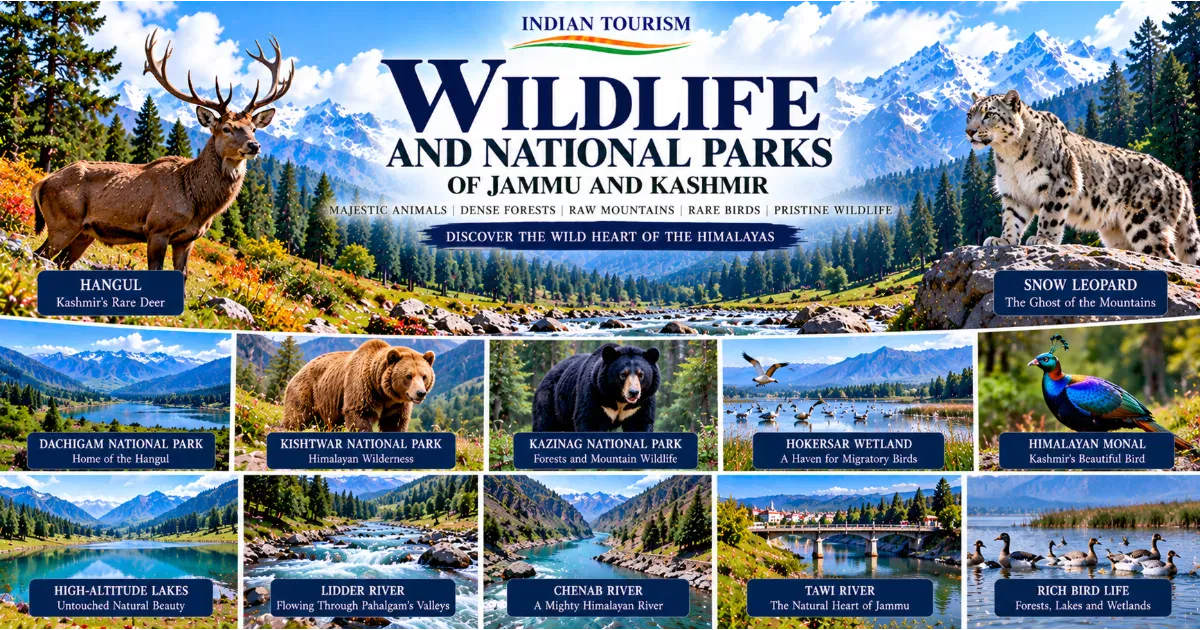
A Wilderness of Mountains, Forests and Rare Wildlife
Jammu and Kashmir is widely celebrated for its lakes, gardens, snow-covered mountains and beautiful valleys, but another side of the region deserves equal attention: its remarkable wildlife. From the alpine meadows of the Kashmir Valley to the dense forests of the Jammu region, this part of the Himalayas supports a rich variety of animals, birds and plant life. Its protected areas preserve fragile ecosystems and offer visitors an opportunity to understand the natural world beyond the familiar tourist destinations.
The wildlife of Jammu and Kashmir reflects the extraordinary variety of its landscapes. High mountain slopes provide habitats for animals adapted to cold conditions and steep terrain. Forests of pine, cedar and fir shelter mammals and birds, while wetlands attract waterbirds and support aquatic life. Alpine meadows become important feeding grounds during warmer months, and remote valleys provide refuge for species that depend on relatively undisturbed environments.
Among the region's most celebrated animals is the Hangul, also known as the Kashmir stag, a rare deer associated with the forests and meadows of the Kashmir Valley. The Himalayan black bear, Himalayan brown bear, leopard, musk deer and several mountain birds also form part of the region's wildlife story. The Himalayan monal and other high-altitude birds add colour and movement to the forests and mountain slopes.
Jammu and Kashmir is home to important protected landscapes, including Dachigam National Park, Kishtwar National Park, Kazinag National Park and several wildlife sanctuaries. Each has its own ecological character. Dachigam is especially associated with Hangul conservation, while Kishtwar preserves rugged Himalayan terrain and habitats for mountain wildlife. Wetlands such as Hokersar are important for migratory birds, demonstrating that the region's wildlife heritage extends well beyond forests and mountains.
Wildlife tourism requires a different approach from ordinary sightseeing. Animals are not attractions that appear on demand, and their natural behaviour should never be disturbed to obtain a photograph. Responsible visitors observe from suitable locations, follow local rules, use authorised guides and understand that sightings are never guaranteed.
This guide explores the wildlife, national parks, bird habitats and conservation challenges of Jammu and Kashmir. It also explains when to visit, how to plan a responsible wildlife trip and why protecting these ecosystems matters for the future of the region.
1. Dachigam National Park: The Home of the Hangul
Dachigam National Park is one of the most important protected areas in Jammu and Kashmir. Located near Srinagar, it is famous for its mountainous landscape, forest habitats and association with the Hangul, the Kashmir stag. Its proximity to the city makes it an important destination for understanding the region's wildlife, although access to different areas depends on conservation regulations and current permissions.
The name Dachigam is commonly associated with the historical relocation of ten villages during the creation of the protected landscape. The area was initially managed as a reserve and later became a national park. Its history reflects the changing relationship between conservation, land use and the protection of wildlife in the Kashmir Valley.
The park covers a wide range of elevations, creating different habitats within the same protected area. Lower sections include forests and streams, while higher areas contain alpine meadows and rugged mountain terrain. This variety supports different forms of vegetation and provides seasonal resources for wildlife.
The Hangul is the park's most famous animal. This rare deer is closely associated with Kashmir's natural heritage and has become an important symbol of wildlife conservation in the region. Its survival depends on suitable habitat, access to food and water, and protection from pressures such as habitat fragmentation and disturbance.
Dachigam is also associated with other mammals, including leopards, Himalayan black bears and musk deer. The presence of particular animals varies with habitat, season and local conditions. Visitors should not expect to see every species during a single visit, and some animals remain difficult to observe because they avoid people.
Birdlife adds another dimension to the park. Forests, streams and open slopes provide habitats for a variety of resident and seasonal birds. Birdwatchers may find opportunities to observe species in different habitats, provided they follow access rules and avoid disturbing wildlife.
The landscape itself is part of the experience. Mountain views, forested slopes and flowing streams create a striking natural environment close to Srinagar. For travellers accustomed to the city's lakes and gardens, Dachigam reveals a more rugged side of the Kashmir Valley.
Visitors should confirm current access arrangements before planning a trip. Some areas may require permissions or be subject to conservation restrictions. An authorised guide can help explain the park's ecology and identify suitable observation locations.
Dachigam is most rewarding when approached as a conservation landscape rather than a guaranteed wildlife-sighting destination. Its greatest importance lies in protecting a rare deer and the wider ecosystem on which many species depend.
2. The Hangul: Kashmir's Rare and Iconic Deer
The Hangul, or Kashmir stag, is one of the most distinctive animals associated with Jammu and Kashmir. It belongs to the deer family and is known for the impressive antlers developed by mature males. Its presence in the Kashmir Valley carries considerable cultural and conservation significance.
Historically, Hangul populations occupied a broader range of habitats across the region. Over time, changes in land use, disturbance, habitat fragmentation and other pressures contributed to a decline in their numbers. Today, conservation efforts focus strongly on protecting the remaining population and maintaining the habitats necessary for its survival.
Dachigam National Park is the best-known stronghold of the Hangul. The park's forests, meadows and seasonal feeding areas provide important resources for the species. The relationship between habitat and survival is especially important because deer require access to food, cover, water and areas where they can reproduce with limited disturbance.
Conserving the Hangul is not simply a matter of protecting individual animals. It also requires attention to the wider landscape. Forest quality, movement between suitable habitats, human activity and the availability of seasonal food all influence long-term survival.
The Hangul has become an important symbol of Kashmir's natural heritage. It demonstrates that a region known internationally for scenic beauty also has wildlife that requires dedicated scientific attention and sustained public support.
Visitors hoping to see the Hangul should understand that sightings cannot be promised. Animals may remain hidden in vegetation or use areas that are not open to visitors. Responsible wildlife tourism accepts these limits and places the animal's welfare above the desire for a close photograph.
Never attempt to approach, feed or chase deer. Sudden movement and human pressure can disturb their natural behaviour. Follow the guidance of park staff and keep a respectful distance whenever wildlife is encountered.
Conservation work may include habitat management, monitoring, research and community engagement. The effectiveness of these efforts depends on long-term cooperation among conservation authorities, scientists and local communities.
The Hangul's future is an important measure of the region's ability to protect its distinctive biodiversity. Preserving this rare deer also helps maintain the ecological integrity of the forests and meadows it depends on.
3. Kishtwar National Park: Wilderness in the High Himalayas
Kishtwar National Park protects a dramatic mountain landscape in the Kishtwar region of Jammu and Kashmir. Its steep valleys, forested slopes, high ridges and remote terrain make it one of the region's significant wilderness areas.
The park is associated with high-altitude ecosystems and wildlife adapted to difficult mountain conditions. Its varied elevations create differences in vegetation and habitat, from forested sections to alpine environments. These habitats support a range of mammals and birds, although sightings depend on season, access and local conditions.
The Himalayan brown bear, Himalayan black bear, musk deer and other mountain species are associated with the wider landscape. The snow leopard is also a species of conservation interest in the broader high Himalayan region, but its presence should never be assumed at a particular location without reliable evidence.
Kishtwar's geography gives the park a distinctive character. Deep valleys and rugged mountains create a sense of remoteness, while rivers and streams connect different parts of the landscape. The terrain also makes travel more challenging than visiting a garden or lakeside attraction in Srinagar.
For experienced nature travellers, the area offers an opportunity to learn about the relationship between mountain environments and wildlife. It is important, however, to distinguish ordinary sightseeing from travel in remote protected landscapes. Routes may be difficult, facilities may be limited and mobile connectivity may not be dependable.
Anyone planning to visit should seek current information about access, permits, local transport and safety. A knowledgeable local guide may be essential for certain routes, and travellers should not enter unfamiliar mountain terrain without appropriate preparation.
The park's conservation value extends beyond individual animal sightings. Its forests and mountain habitats help sustain biodiversity and protect landscapes that are sensitive to disturbance. Rivers, slopes and vegetation are connected parts of a larger ecosystem.
Visitors should stay on permitted routes, carry their waste back and avoid activities that could disturb wildlife. Loud noise, off-route travel and attempts to approach animals can undermine the purpose of a protected area.
Kishtwar National Park is best suited to travellers who appreciate wilderness and understand the responsibilities associated with exploring remote environments. It offers a reminder that the Himalayas are not merely a scenic backdrop but a living ecosystem that requires protection.
4. Kazinag National Park: Forests and Mountain Wildlife
Kazinag National Park lies in the Baramulla region of northern Kashmir and forms part of an important mountain landscape near the Line of Control. Its forests and rugged terrain support wildlife associated with the northwestern Himalayas.
The area is known for its forest ecosystems and conservation significance. The wider Kazinag landscape includes habitats for mammals and birds that depend on relatively undisturbed mountain environments. The exact species encountered in any location vary, and visitors should rely on current information from conservation authorities rather than assuming that a particular animal will be present.
Kazinag's forests are important because they provide cover, food and breeding habitat for wildlife. Forest structure also influences water movement, soil stability and the health of surrounding slopes. Protecting forest ecosystems therefore supports a range of environmental functions beyond the survival of individual species.
Mountain terrain can create natural barriers, but it can also make wildlife monitoring and habitat management challenging. Conservation authorities must consider access, disturbance, human activity and the condition of forest habitats when planning protection measures.
For travellers, Kazinag is not necessarily a conventional tourism destination with extensive visitor infrastructure. Access may be restricted or limited in particular areas, so it is essential to confirm whether visits are permitted before planning a journey.
The broader landscape can be attractive to nature enthusiasts interested in forest ecology and mountain biodiversity. However, visitors should not treat remote forest areas as places to explore independently without reliable guidance.
Kazinag also illustrates the connection between conservation and local communities. People living near forests may depend on surrounding natural resources, so successful conservation requires attention to local needs alongside the protection of wildlife.
Responsible tourism can contribute by encouraging awareness of biodiversity and supporting legitimate local services where available. It should never involve entering restricted areas or placing pressure on sensitive habitats.
The park's significance lies in protecting an important part of Kashmir's mountain environment. Its forests and wildlife are a valuable component of the region's natural heritage, even when they remain less familiar to visitors than Dal Lake or Gulmarg.
5. The Himalayan Black Bear: A Powerful Forest Resident
The Himalayan black bear is one of the notable mammals associated with the forests of Jammu and Kashmir. Recognisable by its dark coat and distinctive chest marking, it inhabits forested mountain landscapes where food, shelter and suitable seasonal conditions are available.
Black bears are adaptable animals, but they still depend on healthy habitats. Their diet can include plant material, fruit, insects and other available foods, with feeding patterns changing according to season and local conditions.
The presence of bears can sometimes create challenges where human settlements, orchards, waste sites and forest habitats overlap. Bears may be attracted to easily available food, increasing the likelihood of encounters with people. This makes responsible waste management and public awareness important elements of wildlife protection.
Visitors should never feed a bear or attempt to approach one for photographs. Feeding wildlife can change natural behaviour and increase the risk of dangerous encounters. Even an animal that appears calm should be treated with caution.
When travelling in forested areas, follow local guidance about wildlife activity. Do not leave food waste in open areas, and avoid entering closed or restricted forest zones. If a bear is encountered, remain calm, do not approach it and follow the advice of trained local authorities or guides.
The conservation of Himalayan black bears depends on habitat protection, responsible human behaviour and efforts to reduce conflict. Communities and visitors both have a role in avoiding situations that bring bears into close contact with people.
The bear's presence also highlights the importance of protecting entire ecosystems rather than focusing only on a few famous species. Healthy forests provide food and shelter for bears while supporting many other forms of life.
6. The Himalayan Brown Bear: Life in the High Mountains
The Himalayan brown bear is associated with high-altitude environments across parts of the Himalayan region. In Jammu and Kashmir, it is a species of conservation interest in mountain landscapes where open slopes, alpine meadows and suitable seasonal food sources occur.
Brown bears are large mammals whose behaviour and habitat requirements differ from those of smaller forest animals. They may use different elevations according to the season and availability of food. Mountain weather and changing vegetation influence where they can forage and find shelter.
Their presence in remote landscapes makes reliable observation difficult. Even in areas associated with the species, sightings are not guaranteed. Wildlife tourism should never encourage people to leave safe routes or approach animals in the hope of obtaining a photograph.
The protection of brown bears depends on maintaining suitable habitats and reducing disturbance. Roads, settlements, livestock activity and other human pressures can affect how animals use the landscape. The level of impact varies between locations, making local monitoring important.
Visitors exploring high mountain regions should understand that bear country requires care. Store food responsibly when camping where permitted, keep campsites clean and follow local instructions. Do not leave food or waste where it can attract wildlife.
If travelling through remote areas, use reliable local guidance and make sure someone knows your planned route. Conditions can change quickly, and assistance may be difficult to obtain in isolated mountain terrain.
The Himalayan brown bear is part of the wider story of mountain biodiversity in Jammu and Kashmir. Its conservation reminds visitors that some of the region's most important natural attractions are also places where wildlife needs space, quiet and protection.
7. The Snow Leopard and High-Altitude Wildlife
The snow leopard is one of the most famous animals of the high Himalayas. Its thick fur, powerful limbs and long tail help it survive in cold, rocky environments. It is a highly elusive predator, and its camouflage makes it difficult to observe even in landscapes where it is known to occur.
The snow leopard's wider Himalayan and trans-Himalayan range includes remote mountain environments, but its presence should be assessed carefully at the local level. Travellers should not assume that every high mountain area in Jammu and Kashmir is a reliable place to see one.
Snow leopards require suitable prey, extensive habitat and enough space to move across rugged terrain. Their conservation is connected with the health of mountain ecosystems and the protection of wild prey species.
Human-wildlife conflict can arise when predators come into contact with livestock. Losses can place pressure on pastoral communities, particularly where alternative protection measures or compensation systems are limited. Conservation programmes may therefore involve community engagement, livestock protection and monitoring.
A responsible wildlife experience focuses on learning about the animal and its habitat rather than promising a sighting. In many cases, tracks, camera-trap records and scientific monitoring provide more reliable evidence of presence than direct observation.
Other high-altitude wildlife includes mountain ungulates and birds adapted to thin air, cold temperatures and steep terrain. These animals form part of the ecological system that supports larger predators.
Visitors should respect protected-area restrictions and avoid off-road travel in sensitive habitats. Noise, litter and disturbance can affect wildlife even when no animals are visible.
The snow leopard represents the mystery and resilience of Himalayan wildlife. Protecting it requires cooperation across landscapes and communities, as well as an understanding that rare animals survive best when their habitats remain healthy and undisturbed.
8. Musk Deer: A Secretive Animal of the Mountain Forests
Musk deer are small, shy mammals associated with forested and mountainous habitats in parts of the Himalayan region. They differ from familiar deer species in appearance and biology, and they are known for their secretive behaviour.
Their habitat requirements vary with species and location, but suitable cover and access to food are important. Forest degradation, habitat fragmentation and illegal hunting have contributed to conservation concerns for musk deer in parts of their range.
Musk deer are particularly vulnerable to illegal hunting because of the historical demand for musk, a substance produced by males. Conservation measures and legal protections are important for reducing this pressure and supporting population recovery.
Because they are elusive, musk deer are rarely animals that visitors can expect to see during an ordinary sightseeing trip. Their presence is more often documented through research, monitoring and occasional field observations.
The protection of musk deer depends on healthy forest ecosystems, enforcement against illegal hunting and public awareness of the pressures facing the species. Local communities can play an important role when conservation efforts recognise their knowledge and needs.
Visitors should never purchase products claimed to contain animal-derived musk or other materials from protected wildlife. Choosing legal, responsibly sourced souvenirs helps avoid contributing to illegal wildlife trade.
Musk deer illustrate the importance of protecting less visible species. A landscape can appear quiet and undisturbed to a visitor while still supporting animals that are highly sensitive to changes in habitat.
Their survival is part of the wider conservation story of Jammu and Kashmir, where protecting forest ecosystems helps sustain a diverse range of wildlife.
9. Birdwatching in Jammu and Kashmir
Jammu and Kashmir is an attractive region for birdwatchers because it contains wetlands, forests, grasslands, rivers and high-altitude habitats. These different environments support a variety of resident birds and seasonal visitors.
The wetlands around Srinagar, including Hokersar, are especially important for migratory waterbirds. During suitable seasons, birds arrive from other regions to feed, rest and use wetland habitats. The species present and their numbers vary according to weather, migration patterns and habitat conditions.
Forest habitats support another group of birds. Woodpeckers, flycatchers, tits, warblers and other forest-associated species may be found in suitable locations, although identification often requires patience and a field guide.
Mountain habitats provide opportunities to learn about birds adapted to colder conditions and steep terrain. The Himalayan monal, known for its colourful plumage, is one of the region's best-known mountain birds. Other species may be associated with rocky slopes, alpine meadows and forest edges.
Birdwatching does not require visitors to disturb animals or travel deep into remote areas. Many observations can be made from appropriate public locations, provided access rules are followed and wildlife is given space.
Binoculars can improve the experience, while a field guide or reputable bird-identification application may help with identification. Beginners should focus on observing shape, movement, habitat and calls rather than trying to identify every bird immediately.
Birdwatchers should avoid playing loud recordings to attract birds, approaching nests or trampling vegetation. During breeding periods, disturbance can affect feeding and nesting behaviour.
Wetlands are especially sensitive to pollution and habitat loss. Keeping these areas clean and respecting restrictions helps protect birds and the wider ecosystem.
For visitors who enjoy nature, birdwatching offers a slower and more observant way to experience Jammu and Kashmir. It also reveals how important wetlands and forests are to wildlife that may otherwise go unnoticed.
10. Hokersar Wetland: A Haven for Migratory Birds
Hokersar Wetland, near Srinagar, is one of the important wetland habitats in the Kashmir Valley. It is widely recognised for its role in supporting migratory waterbirds and other wildlife associated with freshwater marshes.
Wetlands provide food, shelter and resting areas for birds during seasonal movements. Their shallow waters, vegetation and surrounding habitats create different feeding opportunities, making them valuable to species with different ecological requirements.
Hokersar is particularly relevant during the migration season, when birds arrive from other regions. The exact mix of species depends on environmental conditions and migration patterns, so birdwatchers should consult recent local information if they are hoping to observe particular species.
Wetlands also perform important environmental functions. They can store water, support aquatic vegetation and provide habitat for fish, invertebrates and other organisms. Their role in the wider water system makes their condition important beyond their value to birds.
Like many wetlands, Hokersar faces pressures that can include pollution, changes in land use, habitat disturbance and fluctuations in water conditions. Maintaining its ecological health requires careful management and cooperation among authorities and local communities.
Visitors should follow designated access arrangements and avoid entering sensitive areas. Birds may be feeding or resting, and disturbance can cause them to leave valuable habitat.
Birdwatching is best undertaken with patience. Early or quiet periods may provide useful opportunities, but wildlife sightings can never be guaranteed. A respectful observer can appreciate the landscape even when only a few birds are visible.
Hokersar demonstrates that Jammu and Kashmir's wildlife heritage is not limited to large mammals and mountain forests. Wetlands are equally important, connecting the region with wider migration routes and supporting life across seasons.
11. Dachigam's Forests and the Importance of Habitat Diversity
Dachigam is especially valuable because its different elevations create a range of habitats within one protected landscape. Lower forests, streams, slopes and higher meadows support different plants and animals, allowing ecological communities to change across the mountain.
This variety matters because wildlife species do not all require the same conditions. Some depend on forest cover, while others use open meadows or areas near water. Seasonal movement between habitats can also be important for finding food and shelter.
Forests influence more than wildlife. Tree cover can help stabilise soil, regulate water movement and maintain local environmental conditions. Streams and vegetation are connected parts of the ecosystem, and changes in one area can affect other parts.
Habitat diversity is particularly important for the Hangul and other mammals that rely on suitable feeding areas and cover. Conservation planning must consider not only where animals are seen but also how they use the landscape throughout the year.
Human activity can affect habitat through roads, settlement, grazing, waste and disturbance. The extent of these pressures varies by location, so effective management requires monitoring and local knowledge.
Visitors can support habitat protection by remaining within permitted areas and avoiding damage to vegetation. Even small disturbances can become significant when repeated by many people.
Dachigam's value is therefore broader than its reputation as a place associated with one rare deer. It protects a complex mountain ecosystem that supports many species and contributes to the environmental health of the surrounding region.
12. Wildlife Conservation Challenges in Jammu and Kashmir
Wildlife conservation in Jammu and Kashmir involves several connected challenges. Protecting animals requires suitable habitat, reliable monitoring, enforcement of wildlife laws and cooperation with communities living near forests and protected areas.
Habitat loss and fragmentation can reduce the space available to animals. When roads, buildings or other forms of development divide natural areas, wildlife may find it harder to move between feeding grounds, breeding sites and shelter.
Human-wildlife conflict is another concern. Animals may enter agricultural areas, approach settlements or come into contact with livestock. Such encounters can create genuine difficulties for residents, making it important to develop practical ways to reduce risk while protecting wildlife.
Illegal hunting and wildlife trade can also threaten vulnerable species. Enforcement, public awareness and community participation are all important in reducing these pressures.
Pollution affects wildlife in forests, rivers and wetlands. Plastic waste can harm animals, while contaminated water can affect aquatic organisms and the wider food chain. Responsible waste management is therefore an important part of conservation.
Climate change may influence snow cover, vegetation, water availability and seasonal patterns. The effects differ between habitats and species, making long-term monitoring essential.
Tourism can bring economic opportunities but also create pressure when visitor numbers exceed the capacity of a site. Noise, litter, off-route movement and attempts to approach wildlife can all affect animals.
Conservation programmes must balance ecological needs with local livelihoods. Communities are more likely to support long-term protection when their concerns are considered and they can participate meaningfully in decisions.
The future of wildlife in Jammu and Kashmir depends on sustained effort. Protecting a rare species is not a single event but a long-term process involving science, management, public understanding and respect for the natural environment.
13. Responsible Wildlife Tourism: How Visitors Can Help
Wildlife tourism can increase appreciation for nature and support local livelihoods, but it must be managed carefully. Visitors should remember that the animals they hope to see are wild creatures with their own needs and behaviours.
Never feed wild animals. Food provided by people can alter natural behaviour, create dependence and increase the likelihood of dangerous encounters. It can also expose animals to food that is unsuitable for them.
Maintain a safe distance. Do not approach animals to obtain a close photograph, and never attempt to touch or corner wildlife. If an animal changes its behaviour because of your presence, you may already be too close.
Avoid loud noise and sudden movements. Quiet observation is more respectful and often improves the chance of seeing natural behaviour without causing disturbance.
Follow the instructions of park staff and authorised guides. They can explain local rules, identify safe observation areas and help visitors understand the ecology of the site.
Do not leave rubbish behind. Plastic, food packaging and other waste can harm wildlife and damage habitats. Carry waste out and use appropriate disposal facilities.
Respect closures and restricted areas. These rules may protect breeding sites, sensitive habitats or locations where wildlife needs to remain undisturbed.
Choose responsible operators who follow conservation guidelines rather than promising guaranteed sightings. Be cautious of any activity that involves baiting, chasing, handling or otherwise disturbing wild animals.
Finally, understand that a wildlife trip can be successful even without a major sighting. Observing a forest, learning about conservation or watching common birds can provide a meaningful experience.
Responsible tourism places the welfare of wildlife above the demands of entertainment. This approach helps preserve the natural heritage that makes Jammu and Kashmir special.
14. Best Time to Explore Wildlife Areas
The best time to explore wildlife in Jammu and Kashmir depends on the destination, elevation and type of activity. Weather can change rapidly in the mountains, and some protected areas may have seasonal restrictions.
Spring
Spring brings fresh growth and changing conditions across forests and lower mountain slopes. It can be an appealing period for nature walks and birdwatching in suitable locations, although access to higher areas may remain limited by snow or weather.
Visitors should check local guidance before travelling to remote protected areas.
Summer
Summer often provides more accessible conditions for many mountain and forest destinations. Vegetation is active, and some higher areas become easier to reach as snow retreats.
However, wildlife may be dispersed across larger areas, and sightings remain uncertain. Travellers should not assume that warmer weather automatically means more animals will be visible.
Autumn
Autumn can offer comfortable conditions for some nature excursions, with changing colours in forests and cooler temperatures. It can also be a useful period for landscape photography.
Access depends on the location, and visitors should prepare for cooler evenings and changing weather.
Winter
Winter can bring snow, low temperatures and difficult travel conditions to many mountain areas. Some routes may be inaccessible or restricted, while other lower-elevation sites remain open.
Anyone planning a winter wildlife trip should seek current local advice and carry suitable equipment. Remote mountain travel should not be attempted without proper preparation.
Birdwatching seasons may differ from those for large mammals. Migratory birds are often associated with particular seasonal windows, but actual arrival and departure dates depend on weather and environmental conditions.
The most reliable approach is to check current information from the relevant protected-area authorities before departure.
15. What to Carry on a Wildlife Trip
Preparing properly can make a wildlife excursion safer and more comfortable. The equipment required depends on whether the trip involves a short visit to an accessible site or a demanding journey into remote mountain terrain.
For ordinary day trips, carry drinking water, weather-appropriate clothing, comfortable footwear, a charged phone and any personal essentials. A small bag for carrying rubbish back is also useful.
Binoculars can improve birdwatching and allow visitors to observe animals from a respectful distance. A camera with a suitable zoom lens can be helpful, but expensive equipment is not necessary to enjoy the experience.
For longer walks, travellers should consider snacks, a basic first-aid kit and additional layers. Mountain weather can change quickly, so waterproof clothing may be useful even when conditions appear favourable at the start.
Remote routes require more careful planning. Depending on the destination, visitors may need a guide, navigation equipment, emergency supplies and a clear understanding of the route. They should check whether permits are required and whether the journey is suitable for their level of fitness.
Do not rely entirely on mobile connectivity. Some forest and mountain areas may have limited signal, and travel plans should account for this.
Food and waste should be stored responsibly. Leaving scraps behind can attract animals and create conflict between wildlife and people.
Before leaving, tell someone about your planned destination and expected return time when travelling to isolated areas. Follow local safety instructions and turn back if conditions become unsafe.
Good preparation allows visitors to focus on observing nature rather than managing avoidable problems.
16. Photography and Observation Ethics
Wildlife photography can be rewarding, but it must never take priority over animal welfare. The most important rule is to observe from a safe and permitted distance.
Do not chase animals, block their movement or use bait to attract them. Such practices can create stress and may expose wildlife to additional danger. A photograph is not worth disturbing an animal's natural behaviour.
Avoid approaching nests, dens and breeding sites. Animals may become defensive when they feel threatened, and repeated disturbance can affect reproduction and survival.
Use binoculars or a camera zoom to observe wildlife without getting closer. If an animal looks directly at you, changes its movement or appears agitated, increase the distance and follow local guidance.
Stay on permitted paths. Walking through vegetation can damage habitat and may disturb animals that are difficult to see. In some environments, even a small change in movement can affect feeding or nesting behaviour.
When photographing birds, avoid loud playback recordings intended to attract them. Such recordings can interrupt natural activity and may cause birds to waste energy responding to perceived rivals or threats.
Share wildlife photographs responsibly. Avoid publishing precise locations of rare or vulnerable animals when that information could encourage disturbance or illegal activity.
Photography should be a way to document and appreciate nature, not a reason to control it. The best wildlife photographs often come from patience, careful observation and respect for the animal's space.
17. Supporting Local Communities Through Nature Tourism
Wildlife conservation and local livelihoods are closely connected. Communities living near forests, wetlands and protected areas may depend on surrounding natural resources for farming, livestock, transport and other activities.
Tourism can create opportunities for local guides, transport providers, accommodation businesses and other services. When managed responsibly, these opportunities can help people benefit from the natural heritage around them.
Visitors can contribute by choosing legitimate local services and treating residents with respect. Hiring a knowledgeable guide can also improve understanding of the landscape, local traditions and conservation challenges.
However, tourism should not be viewed as a replacement for every traditional livelihood. Conservation planning needs to consider local circumstances and provide realistic ways for communities to participate in decisions that affect their surroundings.
Human-wildlife conflict requires particular attention. Where animals damage crops or threaten livestock, communities need practical support and effective ways to report incidents. Conservation efforts are more sustainable when local concerns are taken seriously.
Visitors should avoid photographing people without permission or treating villages as if they exist solely for tourism. Local communities have their own priorities, routines and cultural practices.
Purchasing locally made products from responsible sellers can support small businesses, while choosing operators who respect wildlife rules helps encourage better tourism practices.
A meaningful wildlife journey should leave a positive impression on both the visitor and the place being visited. Supporting local livelihoods while respecting ecological limits helps make that possible.
Conclusion: Protect the Wild Heart of Jammu and Kashmir
The wildlife and protected landscapes of Jammu and Kashmir reveal a side of the region that cannot be understood through mountains, lakes and gardens alone. Dachigam National Park highlights the importance of the rare Hangul, while Kishtwar and Kazinag preserve mountain habitats that support a variety of wildlife. Wetlands such as Hokersar provide essential places for migratory birds, and the forests and alpine landscapes of the wider region shelter animals adapted to the Himalayan environment.
The Hangul, Himalayan black bear, Himalayan brown bear, musk deer and other wildlife species each depend on suitable habitats and protection from disturbance. Their survival is connected with forest health, water quality, human activity and the ability of communities and conservation authorities to work together.
Wildlife tourism offers a way to build appreciation for these natural treasures, but it must be approached with patience and responsibility. Sightings are never guaranteed, and rare animals should not be treated as attractions that visitors are entitled to see. The real value of a wildlife journey lies in understanding the ecosystem and respecting the animals that live within it.
Before travelling, check current access arrangements, weather conditions and safety advice. Use authorised guides where appropriate, remain on permitted routes and avoid entering sensitive habitats. Never feed or chase wildlife, and always carry rubbish back with you.
The future of Jammu and Kashmir's wildlife depends on long-term conservation, community participation and public awareness. Every visitor who follows responsible practices helps reduce pressure on fragile habitats and supports the idea that natural heritage deserves protection.
Whether you are learning about the Hangul at Dachigam, observing migratory birds at a wetland or appreciating the forests of the high Himalayas, remember that these landscapes are homes for countless forms of life.
Explore the wild heart of Jammu and Kashmir, discover the extraordinary wildlife of the Himalayas and help protect the natural heritage that belongs to future generations.
#IndianTourism #JammuAndKashmir #WildlifeOfKashmir #DachigamNationalPark #KishtwarNationalPark #KazinagNationalPark #Hangul #KashmirStag #HimalayanWildlife #HokersarWetland #Birdwatching #WildlifeConservation #NatureTourism #ExploreKashmir #ExploreIndia #ResponsibleTourism #Himalayas #WildlifePhotography #IndianWildlife

