
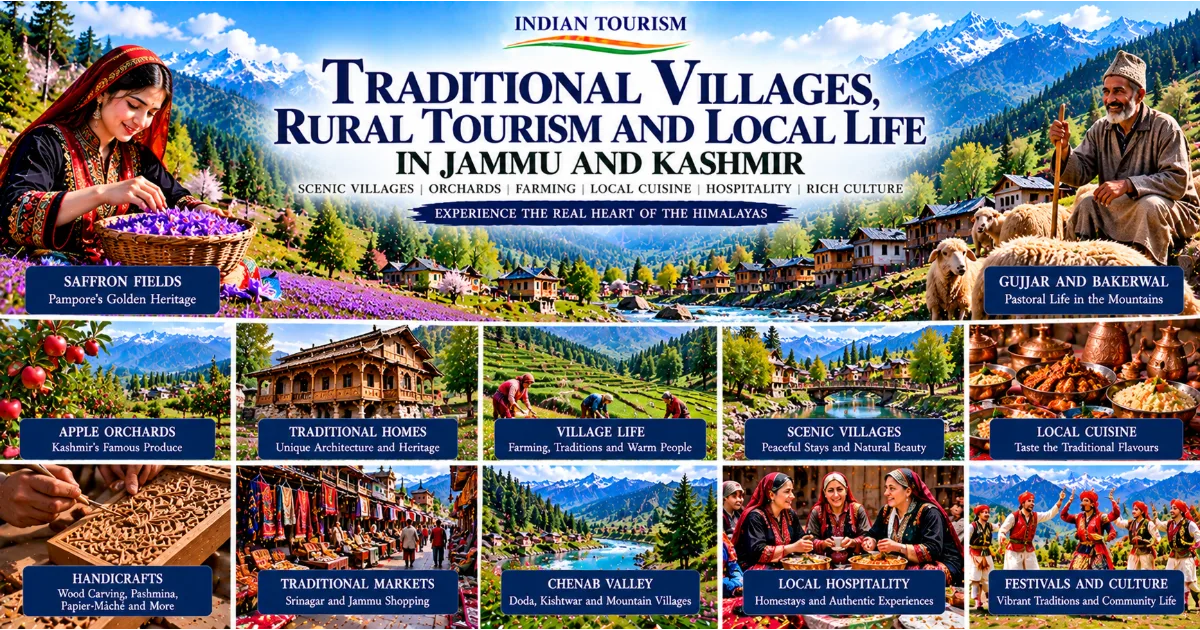
Beyond the Famous Tourist Destinations
Jammu and Kashmir is widely celebrated for its snow-covered mountains, beautiful lakes, Mughal gardens, houseboats, religious destinations and adventure activities. Srinagar, Gulmarg, Pahalgam, Sonamarg, Jammu and Vaishno Devi attract visitors from across India and around the world. Yet another side of the region waits beyond these familiar destinations. It can be discovered in its traditional villages, terraced fields, mountain settlements, orchards, shepherd communities and quiet rural landscapes, where everyday life remains closely connected to nature, local customs and generations of inherited knowledge.
Rural tourism offers travellers an opportunity to understand Jammu and Kashmir through the people who call it home. Instead of simply photographing a mountain or visiting a popular attraction, visitors can explore how families cultivate their land, prepare traditional meals, preserve their homes, celebrate festivals and adapt their lifestyles to the changing seasons. These experiences reveal a more personal and meaningful picture of the region.
The villages of Jammu and Kashmir are not all alike. The Kashmir Valley has settlements surrounded by rice fields, waterways, orchards and mountains. The Jammu region includes villages in the Shivalik hills, fertile plains and higher Himalayan areas. Ladakh, which became a separate Union Territory in 2019, has its own distinct cultural and geographical identity and is not part of the present Jammu and Kashmir destination guide. Within Jammu and Kashmir itself, differences in language, climate, architecture, agriculture and religious traditions create a rich variety of rural experiences.
For travellers seeking cultural understanding, slower journeys and genuine encounters with local communities, rural Jammu and Kashmir provides an opportunity to experience the region beyond conventional sightseeing. It invites visitors to slow down, observe carefully and appreciate the people, skills and traditions that sustain life in the mountains.
1. The Kashmir Valley: Villages Surrounded by Nature
The Kashmir Valley is home to numerous villages where the natural environment plays an important role in daily life. Mountains form the distant horizon, rivers and streams provide water, and agricultural land supports generations of farming families. Depending on the location, a village may be surrounded by rice paddies, apple orchards, walnut trees, vegetable gardens or meadows used for grazing animals.
The landscape changes dramatically with the seasons. Spring brings blossoming orchards and fresh greenery. Summer fills the fields with crops and activity. Autumn colours the trees in warm shades while families prepare for the colder months. Winter can bring snow, frost and a slower pace of outdoor work in higher or colder areas.
These seasonal changes influence local routines. Farming families plan their work around weather conditions, irrigation requirements and harvest periods. Household responsibilities often include food preparation, caring for livestock, maintaining homes and preserving produce. Visitors who spend time in a village can begin to understand how these activities are connected rather than viewing them as separate aspects of rural life.
Village walks are among the simplest ways to experience this environment. A local guide can explain traditional irrigation practices, identify common crops and describe how homes are adapted to the climate. Walking respectfully through established paths also allows travellers to appreciate the relationship between settlements and their surrounding agricultural land.
The most rewarding village experiences are often unhurried. A conversation with a resident, a view across a field after rainfall or the sound of water moving through a village channel can offer a stronger sense of place than a tightly packed sightseeing schedule.
2. Apple Orchards and the Agricultural Heritage of Kashmir
Apple cultivation is an important part of Kashmir's agricultural identity. The region is known for producing several varieties of apples, and orchards contribute to rural livelihoods, seasonal employment and local trade. For many visitors, the sight of fruit trees stretching across the foothills provides an introduction to the agricultural landscape behind Kashmir's reputation for natural beauty.
An orchard is more than a scenic location. Its care involves pruning, irrigation, pest management, seasonal maintenance, harvesting and the handling of fruit after it has been picked. Families and agricultural workers must coordinate these tasks according to weather and the needs of the trees. Harvest periods can bring increased activity to rural communities, with fruit collected, sorted, packed and transported for sale.
During a responsible orchard visit, travellers may learn how different apple varieties grow, why suitable weather matters and how growers manage their land. Some farms may offer opportunities to observe agricultural work or purchase produce directly, depending on the season and the owner's arrangements. Such experiences should always be organised with the permission of the orchard owner.
Visitors should remember that orchards are working agricultural spaces rather than public gardens. Trees, branches, irrigation systems and stored produce can be easily damaged by careless movement. Asking before picking fruit, entering planted rows or taking close-up photographs demonstrates respect for the people whose livelihoods depend on the land.
Apple orchards also provide an opportunity to understand the challenges facing rural producers. Weather variability, transportation costs, storage facilities, market prices and changing agricultural conditions can affect a family's income. Rural tourism cannot solve every agricultural challenge, but spending locally and learning directly from growers can help visitors recognise the economic realities behind the landscape.
3. Saffron Fields and the Countryside of Pampore
Pampore, in the Pulwama district, is closely associated with Kashmir's saffron cultivation. Saffron is valued for its colour, aroma and culinary uses, and its cultivation forms an important part of the area's agricultural heritage. The saffron fields offer a different rural experience from the apple orchards and rice-growing areas found elsewhere in the valley.
Saffron comes from the delicate stigmas of the saffron crocus flower. Cultivation requires specialised knowledge, careful seasonal management and labour-intensive harvesting. The flowering period is particularly important because the flowers must be collected and processed with care. The work illustrates how a small agricultural product can require considerable skill and attention before reaching a kitchen or marketplace.
A visit to Pampore is most meaningful when travellers understand the agricultural process rather than treating the fields as a decorative backdrop. Depending on the season and local arrangements, visitors may learn about cultivation, harvesting, drying and the differences between authentic saffron and misleading products sold in tourist markets.
The appearance of the fields varies throughout the year. During flowering, the landscape can become especially attractive, but the exact experience depends on weather and seasonal conditions. Travellers should check local guidance before planning a visit around the saffron harvest.
Purchasing saffron directly from a reputable producer or established seller can support local trade, provided the product is genuine and appropriately labelled. Buyers should be cautious of unusually low prices and exaggerated claims. The reputation of Kashmir's saffron makes authenticity an important consideration.
Pampore demonstrates how rural tourism can connect landscape, agriculture, craftsmanship and commerce. A traveller who learns about the effort involved in producing saffron gains a deeper appreciation for the people who maintain this specialised agricultural tradition.
4. Village Life Around Pahalgam and the Lidder Valley
Pahalgam is well known as a destination for mountain scenery, rivers, meadows and outdoor recreation. The surrounding area also contains rural settlements where agriculture, livestock and local services remain part of everyday life. Exploring these communities responsibly can help visitors look beyond the main tourist centre.
The Lidder River and its surrounding landscapes influence the character of the valley. Water, pastureland, forests and mountain slopes shape how people use the land. Depending on the settlement, residents may work in farming, animal husbandry, transport, hospitality, handicrafts or other local occupations. Tourism has created opportunities for many households, while also increasing pressure on infrastructure and natural resources in popular areas.
A rural visit near Pahalgam might include a guided walk along approved village routes, a conversation about local crops or an introduction to traditional food. In suitable locations, visitors may learn about the seasonal movement of livestock and the importance of pastureland. Any activity involving animals or private land should be arranged through the people responsible for it.
The countryside should not be viewed as an empty playground. Fields, grazing areas and forest edges support livelihoods and ecological processes. Travellers should stay on permitted paths, avoid disturbing livestock and follow local instructions around rivers and steep terrain.
Mountain villages also reveal how communities adapt to seasonal tourism. Some residents provide accommodation, meals, transport or guiding services. Others continue their agricultural activities while managing additional work during busier months. Supporting locally owned businesses can help tourism income reach households beyond large hotels and established commercial centres.
The best rural experiences near Pahalgam combine appreciation of the scenery with an understanding of the people who live and work there throughout the year.
5. Traditional Homes and the Architecture of Rural Kashmir
Traditional homes provide valuable insight into the climate, materials, skills and social customs of a region. In Kashmir, rural architecture has developed in response to cold winters, seasonal rainfall, available building materials and the practical requirements of family life.
Traditional houses may use timber, brick, stone, earth-based materials or combinations of these, depending on the locality and period of construction. Some older homes feature sloping roofs designed to manage precipitation, wooden balconies, carved details or enclosed courtyards. Their appearance varies considerably, and not every village house follows a single architectural style.
In colder areas, building design has historically reflected the need to manage indoor temperatures. Room arrangements, window sizes, roofing methods and the use of local materials all influence comfort. Modern homes increasingly incorporate contemporary construction techniques, while some families maintain older structures because of their cultural value or practical suitability.
The interior of a home can reveal another dimension of local life. Rooms may serve several purposes, with furniture, bedding and household objects arranged according to family needs. Carpets, embroidered textiles, copper vessels and wooden furnishings can combine functional use with local craftsmanship. The importance of particular objects varies between households and should not be generalised across the entire region.
Architecture is also connected to family history. A house may have been extended over several generations, repaired after difficult winters or adapted as family needs changed. What appears to a visitor as a simple building can hold memories of weddings, gatherings, seasonal work and everyday routines.
When visiting a traditional home, travellers should enter only with permission and follow the host's guidance about photography, footwear and access to private rooms. The purpose of such a visit should be learning and respectful exchange, not treating someone's home as an exhibit.
6. Gujjar and Bakerwal Communities: Pastoral Knowledge and Mountain Life
The Gujjar and Bakerwal communities are important parts of Jammu and Kashmir's cultural diversity. Many members of these communities have longstanding connections with livestock rearing and pastoral livelihoods, although their occupations and lifestyles vary considerably. Some families maintain mobile or seasonal patterns of movement, while others live in settled communities and participate in a wide range of economic activities.
Pastoral knowledge includes understanding animal health, pasture conditions, water sources, weather patterns and the practical challenges of moving livestock through mountainous terrain. Such knowledge is developed over time and passed between generations. It reflects a close relationship with the natural environment, although modern economic pressures and changing land-use conditions can affect traditional livelihoods.
The Bakerwal community is particularly associated with seasonal movement involving livestock and mountain pastures. The timing and routes of movement depend on local circumstances, weather, administrative requirements and access to grazing areas. These activities are not tourism performances. They are part of working lives and should be approached with care.
Travellers who want to learn about pastoral culture should seek experiences arranged through trusted local guides or community-led initiatives. A host may explain traditional animal care, seasonal routines, food practices or the challenges of maintaining a pastoral livelihood. Participation should always be voluntary, and visitors should never approach herds or camps without permission.
It is also important to avoid reducing communities to clothing, tents or picturesque mountain scenes. Gujjar and Bakerwal people have diverse experiences, aspirations and contemporary lives. Education, employment, mobility, access to services and cultural preservation may all be important issues for different families.
Respectful rural tourism recognises pastoral communities as knowledgeable hosts and equal participants in cultural exchange. It creates space for people to share their own perspectives rather than allowing outsiders to define their identity.
7. Doda, Kishtwar and the Mountain Villages of Chenab Valley
The Chenab Valley, encompassing areas associated with Doda, Kishtwar and Ramban, offers a rural landscape distinct from the familiar tourist image of Srinagar and the Kashmir Valley. Mountain roads wind through steep terrain, settlements occupy hillsides and valleys, and agricultural land is often shaped by the geography of the region.
Villages in these areas may be surrounded by terraced fields, forests, streams and high mountain ridges. Depending on altitude and local conditions, residents cultivate different crops, maintain livestock and participate in small-scale trade or public services. Travel between settlements can take longer than expected because of winding roads and changing terrain.
For visitors interested in rural tourism, the region offers opportunities to appreciate mountain architecture, local food, agricultural practices and the relationship between communities and their environment. A locally guided visit can explain how households manage water, transport produce and organise daily work when settlements are separated by considerable distances.
Kishtwar is also associated with distinctive mountain landscapes and agricultural products, including saffron cultivation in parts of the wider district. The wider Chenab region contains varied cultural traditions, languages and local histories. These should be explored on their own terms rather than treated as identical to the customs of the Kashmir Valley.
Planning is particularly important in mountainous areas. Road conditions, weather, landslides and limited transport options can affect travel. Visitors should verify current access information, allow extra time and avoid travelling into remote locations without appropriate preparation.
Rural tourism can help bring attention to destinations that receive less visibility than major tourist centres. However, new visitor activity should develop in ways that respect local priorities, protect fragile landscapes and avoid placing additional pressure on communities with limited infrastructure.
8. Rajouri and Poonch: Cultural Diversity in the Pir Panjal Region
Rajouri and Poonch, situated in the Pir Panjal region, have their own rural identities shaped by mountain geography, agricultural traditions, cultural exchange and diverse communities. Their villages offer a different perspective on Jammu and Kashmir, demonstrating why the region should not be understood through a single landscape or cultural narrative.
Rural settlements in this area may include terraced fields, orchards, livestock holdings, traditional homes and local marketplaces. Family life is connected to farming, trade, education, public services and seasonal changes. In some areas, mountain terrain influences road access and the way people transport goods between villages and towns.
The region's cultural diversity can be reflected in languages, food traditions, clothing, music and local celebrations. Customs may differ even between neighbouring communities, so visitors benefit from listening to residents rather than assuming that a tradition is shared everywhere.
A village visit can include learning about local agriculture, exploring a market with a guide or enjoying a meal prepared by a household that welcomes guests. These experiences work best when hosts are paid fairly for their time and visitors understand that cultural sharing is a choice, not an obligation.
Because some areas have security sensitivities or restricted access, travellers should consult current official travel advice and follow local administrative instructions. It is important not to enter restricted locations, photograph sensitive infrastructure or assume that every rural road is suitable for visitors.
Rajouri and Poonch remind travellers that rural tourism is not only about beautiful scenery. It is also about understanding regional variety, respecting local circumstances and recognising the people whose knowledge and daily work shape the landscape.
9. Traditional Food and the Hospitality of Village Households
Food is one of the most approachable ways to learn about a place. In rural Jammu and Kashmir, meals reflect local ingredients, family preferences, religious practices, seasonal availability and regional culinary traditions. A shared meal can reveal how households preserve food knowledge and maintain relationships with relatives, neighbours and guests.
In the Kashmir Valley, visitors may encounter rice-based meals, preparations involving vegetables, pulses, meat, dairy products and local spices. Popular regional dishes include haakh, a preparation of leafy greens, and a variety of meat dishes served on different occasions. Wazwan, the elaborate Kashmiri culinary tradition, is particularly associated with formal gatherings and celebrations, although its preparation and serving practices are not identical in every household.
In the Jammu region, food traditions vary between plains, foothills and mountain districts. Depending on the locality, visitors may encounter rajma, rice, breads, seasonal vegetables, dairy products and regional preparations using local ingredients. The food of a village should be understood within its own context rather than treated as a uniform regional menu.
Home dining can be especially memorable because it reveals the practical work behind a meal. Ingredients may be sourced from nearby markets or gardens, breads prepared by hand and recipes adjusted according to the season. Hosts may explain how certain dishes are associated with festivals, family occasions or winter routines.
Visitors should communicate dietary requirements in advance and respect household practices. Some families may not serve alcohol or particular foods, and meal times may differ from a visitor's usual schedule. Asking politely is better than making assumptions.
If a home meal is offered as part of a tourism experience, the payment arrangement should be clear. Fair compensation recognises the cost of ingredients, preparation time and hospitality. Travellers should also avoid expecting families to prepare elaborate meals without notice or payment.
A village meal is not simply an attraction to consume. It is an opportunity for cultural exchange built on mutual respect, gratitude and an appreciation of everyday life.
10. Markets, Weekly Trading and Local Rural Economies
Local markets play an important role in connecting villages with surrounding towns and agricultural centres. They provide places to purchase food, household supplies, clothing, farming materials and other everyday necessities. In some areas, market activity is closely linked to particular days, seasonal harvests or the movement of traders between settlements.
For visitors, these markets offer a practical way to observe local economic life. Stalls may display vegetables, fruit, grains, spices, dairy products, handmade items and goods brought from larger towns. The range of products depends on the location, season and size of the market.
Markets also reveal how rural and urban economies depend on one another. Farmers transport produce to buyers, shopkeepers supply village households and service providers support the movement of people and goods. Tourism can add another source of demand, particularly for food, handicrafts, accommodation and guiding services.
Travellers should approach market photography sensitively. People working at stalls are conducting business, not automatically participating in a tourist attraction. Ask before taking portraits, avoid blocking walkways and negotiate prices respectfully. If a seller explains the origin or production method of an item, listening carefully can help visitors make more informed purchases.
Buying directly from local producers can be beneficial, but travellers should not assume that every product is locally made simply because it is sold in a village. Asking about origin, materials and production methods is reasonable. For handmade goods, the price should reflect the skill and time involved rather than only the cost of raw materials.
Local markets are valuable because they show the everyday systems that sustain communities. Observing them with curiosity and respect offers a richer understanding of rural life than treating them only as places to buy souvenirs.
11. Farming, Kitchen Gardens and Seasonal Work
Agriculture in Jammu and Kashmir is shaped by altitude, water availability, soil conditions, local markets and seasonal weather. In rural areas, households may grow crops for sale, produce food for their own use or combine agriculture with other occupations. The balance differs from one village to another.
Rice cultivation is associated with many parts of the Kashmir Valley, while other areas support maize, wheat, pulses, vegetables and fruit. Orchards are important in suitable locations, and some communities cultivate specialised products such as saffron. In the Jammu region, the mix of crops changes according to geography and climate.
Kitchen gardens can be a useful part of household food production. Depending on the season, families may grow leafy vegetables, beans, herbs and other crops. These gardens provide fresh ingredients and can reduce dependence on purchased produce. They also offer a practical way for visitors to learn about seasonal eating and the use of available land.
Agricultural work requires planning and effort. Preparing soil, sowing, irrigating, weeding, protecting crops and harvesting may involve long hours, sometimes alongside other employment and household responsibilities. Visitors who observe farming should recognise this labour rather than assuming that agricultural activities are arranged for entertainment.
Where a farm welcomes visitors, hands-on activities may be possible with permission and appropriate supervision. Such experiences should be adapted to the work being done and should not interfere with essential tasks. Children should be kept away from machinery, chemicals, deep water and other hazards.
Climate variability, market access, labour availability and infrastructure can affect agricultural livelihoods. Rural tourism may create supplementary income through guided visits, meals or accommodation, but it should not be presented as a replacement for stable agricultural markets and public services.
Understanding seasonal work helps travellers see the countryside as a living and productive landscape. Fields and orchards are beautiful, but they are also places where families invest knowledge, time and resources.
12. Rural Homestays: Staying With Local Families
A homestay can offer a more personal experience than a conventional hotel, particularly for travellers who want to understand village life. Depending on the host and location, visitors may stay in a family home, a purpose-adapted section of a house or a locally managed guest accommodation designed around village hospitality.
The experience varies considerably. Some homestays offer private rooms and modern facilities, while others provide simpler accommodation with shared spaces. Heating, hot water, internet connectivity, transport access and meal arrangements should be checked before booking, especially in colder or remote locations.
The value of a homestay lies in the opportunity for genuine exchange. Hosts may introduce visitors to local food, explain seasonal routines or recommend walks and nearby cultural sites. Travellers can learn about a community through conversation while respecting that hosts may have work, family commitments and personal boundaries.
A good homestay should establish expectations clearly. Guests should understand meal times, house rules, cancellation policies, payment terms and any additional charges. Hosts should also be able to explain what services are included and what facilities are available.
Visitors should not expect every family to speak English fluently or to provide a curated cultural programme. Simple communication, patience and a willingness to learn are often more useful than a long list of expectations.
Before booking, look for reliable information about the operator, guest reviews where available, local registration requirements and transport arrangements. For remote stays, share the itinerary with someone you trust and confirm how emergency assistance can be reached.
Homestays can help tourism income remain within rural communities when they are locally owned and fairly managed. They can also encourage visitors to stay longer, purchase local products and develop a deeper understanding of the destination.
13. Handicrafts and Skills Preserved in Rural Communities
Jammu and Kashmir is known for a wide range of traditional crafts, including textile work, embroidery, weaving, wood carving, carpet making and decorative arts. The distribution of these skills varies, and not every craft is practised in every village. Nevertheless, rural and small-town craft traditions contribute to the wider cultural identity of the region.
Handicrafts are often connected to family knowledge, apprenticeship and long periods of practice. An embroidered textile may require detailed planning and patient needlework. A carved wooden object depends on material selection, tool control and an understanding of the design. Weaving requires coordination, pattern knowledge and familiarity with the behaviour of the fibres being used.
Visitors who want to learn about these crafts should seek out genuine workshops, artisan cooperatives or community-led demonstrations. A responsible visit allows artisans to explain their work in their own words and sets clear expectations about photography, purchasing and any demonstration fees.
Buying directly from a maker can help the artisan receive a fairer share of the sale, although the precise arrangement depends on the business. Travellers should ask reasonable questions about materials, production methods and origin, especially when purchasing items marketed as handmade or made from specialised fibres.
It is also important to recognise that artisans are professionals. They should not be expected to demonstrate complicated work without compensation, reveal commercial techniques they prefer to keep private or interrupt production simply to satisfy visitors.
Craft tourism can help preserve traditional skills by creating additional demand and encouraging younger people to see a future in skilled work. However, it should support the wishes and livelihoods of artisans rather than turning their workshops into stages for visitors.
A handmade item purchased with an understanding of its origin can become a meaningful reminder of the people and knowledge behind it.
14. Village Festivals, Weddings and Community Gatherings
Festivals and family celebrations offer important opportunities to understand social life in Jammu and Kashmir. Religious observances, seasonal events, weddings and community gatherings bring people together through food, music, prayer, clothing and shared responsibilities. Their forms differ across communities and localities.
In the Kashmir Valley, Eid celebrations, weddings and other community occasions may involve special meals, family visits and traditional clothing. In the Jammu region, festivals such as Lohri and Baisakhi are observed in different ways according to local customs, while religious and cultural celebrations reflect the diversity of the region. These examples are not exhaustive, and practices vary between families.
Weddings can be particularly significant social events involving extended families and community networks. Food preparation, clothing, music and hospitality may require considerable planning. However, weddings are private family occasions, not automatically public tourist events. Visitors should never assume that they can attend without a direct invitation.
Where communities organise public cultural events or tourism-friendly demonstrations, travellers can participate by following the hosts' guidance. Appropriate clothing, respectful behaviour and sensitivity around photography are important. Some religious or family settings may have restrictions on recording, and these should be followed without argument.
Community gatherings can also reveal how traditions change over time. Younger generations may combine inherited customs with modern music, clothing, technology and work patterns. Cultural continuity does not mean that every practice remains unchanged. Traditions often survive because people adapt them to new circumstances.
The most respectful approach is to observe without demanding access. A visitor who is welcomed into a celebration should express gratitude and avoid treating people as photographic subjects without permission.
15. Responsible Rural Tourism: Protecting People and Landscapes
Rural tourism can provide income, encourage cultural preservation and broaden the benefits of travel beyond established tourist centres. It can also create problems if visitor numbers grow faster than local infrastructure or if communities have little control over how their homes and traditions are presented.
Responsible tourism begins with local consent. Visitors should use approved routes, respect private property and avoid entering fields, houses, workshops or grazing areas without permission. Local residents should have the freedom to decide whether they want to participate in tourism and what experiences they are comfortable sharing.
Environmental care is equally important. Mountain streams, village paths, orchards and meadows can be affected by litter, wastewater, excessive noise and careless vehicle use. Travellers should carry reusable water bottles where practical, dispose of waste properly and avoid disturbing wildlife or damaging vegetation.
Water and energy may be limited in some locations, particularly during periods of extreme weather or in remote settlements. Visitors should use resources thoughtfully and understand that facilities may differ from those in large hotels. Hosts should communicate limitations clearly, and travellers should plan accordingly.
Economic fairness matters as well. Paying agreed prices, booking through local providers and purchasing genuine local products can help more tourism revenue reach the community. Visitors should be cautious of arrangements that promise community benefits without explaining how money is distributed.
Cultural respect includes recognising that rural communities are not frozen in the past. People use modern technology, pursue higher education, operate businesses and hold diverse opinions about their future. Their lives should not be judged against a romantic image of traditional village life.
Responsible tourism is most successful when it benefits both guests and hosts. The aim is not simply to visit a beautiful place, but to leave it with its dignity, resources and local priorities intact.
16. Best Time to Explore Rural Jammu and Kashmir
The best time for rural travel depends on the experience a visitor wants. Spring offers blossoming trees, fresh greenery and changing weather. Summer can be suitable for village walks and outdoor exploration in many locations, although conditions vary with altitude. Autumn is especially attractive in agricultural areas, where orchards and fields reflect the harvest season. Winter brings a quieter atmosphere in many places but may involve snow, cold temperatures and difficult road conditions.
For apple orchard experiences, travellers should confirm the expected harvest period with local growers because timing changes according to variety, altitude and weather. Saffron visits around Pampore are most relevant during the local flowering and harvest period, but exact conditions should be verified before travel.
Mountain villages may have very different conditions from settlements in the valley. A destination that is accessible in summer may become difficult to reach during heavy snowfall or prolonged rainfall. Road closures, landslides and other disruptions can occur, so a flexible itinerary is important.
Visitors should check current weather forecasts, transport information and official travel advisories before departure. For remote walks or overnight stays, it is wise to confirm the availability of guides, food, heating, communication and emergency assistance.
Travellers should also consider local agricultural schedules and community events. A visit during a busy harvest may offer valuable insight, but it should be arranged in a way that does not interfere with essential work.
The most suitable season is ultimately the one that matches the traveller's interests, physical preparation and willingness to adapt to local conditions.
17. Suggested Rural Tourism Itinerary
A short rural tourism itinerary can combine the cultural attractions of a major town with carefully arranged visits to nearby villages. The exact route should depend on current access, travel time, host availability and the interests of the group.
A three-day introduction could begin in Srinagar, where travellers explore a local market, learn about regional crafts and discuss village life with a knowledgeable guide. This provides background before moving into the surrounding countryside.
On the second day, visitors could arrange a guided trip to an agricultural area or orchard, depending on the season. The experience might include a walk through the landscape, an explanation of local farming practices and a meal at a participating local establishment. The visit should be booked in advance rather than assuming that private farms are open to tourists.
The third day could focus on handicrafts, food traditions or a locally managed homestay experience. Travellers might visit an artisan workshop, learn about the production of a traditional item or spend time in a village where hosts welcome guests. The itinerary should allow enough time for conversation and rest rather than rushing between multiple settlements.
A longer journey could include a carefully planned visit to the Pahalgam area, the Chenab Valley or parts of the Pir Panjal region. These areas should not be combined casually into a short trip because distances, road conditions and access requirements vary. Remote destinations deserve additional planning.
For families, older travellers and visitors with mobility needs, it is important to confirm walking distances, road surfaces, bathroom facilities and available transport. Rural accommodation may not provide the same accessibility features as purpose-built hotels.
The purpose of a rural itinerary is not to collect as many village names as possible. It is to spend enough time in each place to understand its landscape, listen to its residents and support the people who make the experience possible.
18. Practical Advice for Travellers
Preparation makes rural travel more enjoyable and reduces the risk of placing unexpected demands on local communities. Travellers should confirm accommodation, transport and guiding arrangements before reaching remote areas, particularly during winter or periods of unpredictable weather.
Carry suitable clothing for changing conditions. Even when daytime temperatures are comfortable, evenings in mountain areas can be cold. Walking shoes with a good grip are useful on uneven paths, while rain protection and warm layers may be necessary depending on the season.
Cash can be useful in smaller settlements where digital payment facilities or mobile connectivity may be unreliable. Visitors should keep emergency contact details available and tell someone their plans when travelling to remote areas. Mobile coverage should not be assumed everywhere.
Ask before photographing people, homes, livestock, religious places or private property. Respect restrictions around sensitive locations and follow local instructions. If a resident declines a photograph or conversation, accept the decision politely.
Language can also influence the experience. Kashmiri, Dogri, Gojri, Pahari and other languages are used across different communities, alongside Hindi, Urdu and English in varying contexts. Learning a few polite greetings or travelling with a trusted local guide can make communication easier.
Food preferences and dietary needs should be discussed before a homestay or village meal. Guests should be clear about allergies and other requirements rather than expecting hosts to guess. Similarly, travellers should explain any physical limitations before joining a walk or outdoor activity.
Finally, maintain realistic expectations. Rural accommodation may be simpler, journeys may take longer and services may be less predictable than in major tourist centres. Flexibility, patience and respect are essential parts of a successful rural trip.
Conclusion: Discovering the Human Side of Jammu and Kashmir
Traditional villages offer a different way to understand Jammu and Kashmir. They reveal how agriculture, architecture, food, crafts, pastoral knowledge and community relationships shape daily life across the region. From apple orchards and saffron fields to mountain settlements and village markets, the rural landscape tells stories that cannot be fully understood through photographs alone.
The people who live in these places are the keepers of practical knowledge and cultural traditions, but they are also individuals with changing aspirations and modern lives. Rural tourism becomes meaningful when it recognises both realities. It allows visitors to appreciate heritage without assuming that communities must preserve every practice for the benefit of outsiders.
For travellers, the experience can be deeply rewarding. A walk through an orchard, a conversation with a farmer, a meal shared with a welcoming host or an introduction to a traditional craft can create lasting memories. Such experiences encourage a slower style of travel in which learning and respectful exchange matter as much as sightseeing.
For local communities, well-managed tourism can create supplementary income, support artisans and farmers, and provide new opportunities for locally owned businesses. These benefits are most likely when residents have a genuine voice in tourism development and receive fair compensation for their time, work and knowledge.
Jammu and Kashmir's rural heritage deserves to be explored with curiosity, care and humility. Its villages are not merely destinations between famous attractions. They are living communities whose landscapes, skills and traditions form an essential part of the region's identity.
When travellers look beyond the familiar tourist routes, they discover a more personal side of Jammu and Kashmir: a place shaped not only by mountains and rivers, but also by the people who cultivate its fields, preserve its crafts, welcome guests and carry local traditions into the future.
Hashtags
#IndianTourism #JammuAndKashmir #RuralTourism #VillageTourism #ExploreKashmir #ExploreJammu #KashmirValley #ChenabValley #Pahalgam #Pampore #KashmirVillages #VillageLife #AppleOrchards #KashmirSaffron #GujjarCulture #BakerwalCulture #KashmiriCuisine #DograCulture #TraditionalHomes #CulturalTourism #ResponsibleTourism #SustainableTravel #HomestayExperience #LocalCommunities #IndianHeritage #ExploreIndia

