
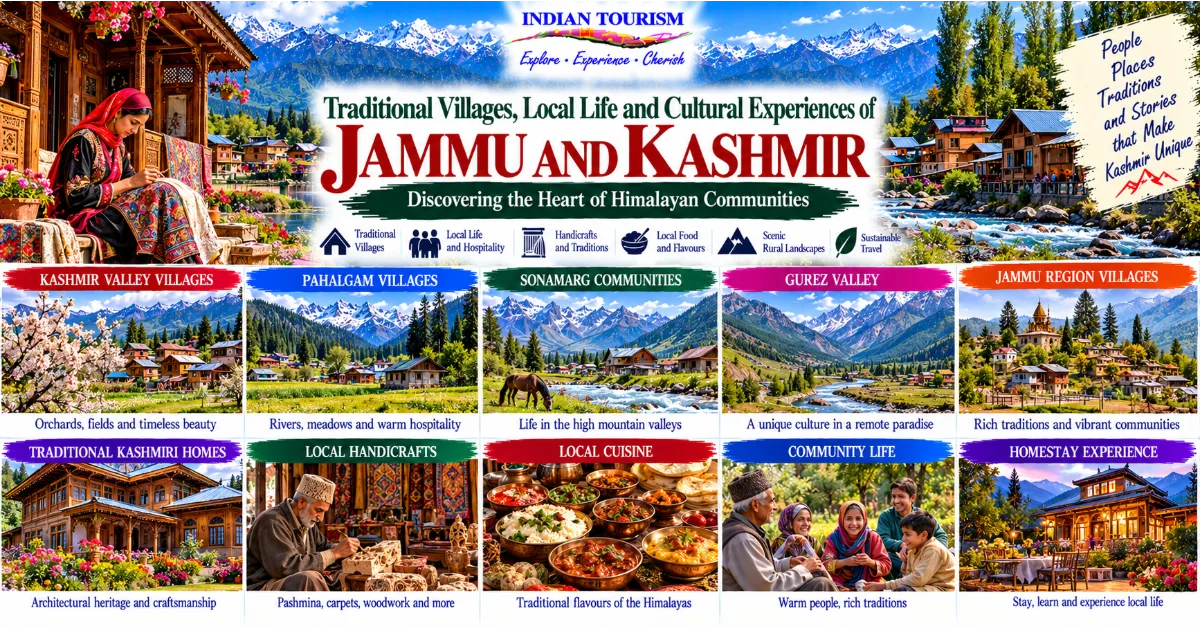
Beyond the Famous Tourist Destinations
Jammu and Kashmir is often introduced to travellers through its snow-covered mountains, beautiful lakes, historic gardens and famous pilgrimage destinations. Yet some of the most meaningful experiences in the region can be found beyond its popular tourist attractions, in traditional villages where daily life continues to follow rhythms shaped by the seasons, local landscapes and generations of cultural knowledge. Village journeys offer visitors an opportunity to understand the region through its people, homes, food, crafts, agriculture and community traditions.
The rural landscapes of Jammu and Kashmir are remarkably diverse. Villages in the Kashmir Valley are surrounded by paddy fields, orchards, waterways and mountain views, while settlements in the Jammu region reflect the varied environments of forested hills, river valleys and agricultural plains. Higher mountain communities experience colder climates and shorter growing seasons, influencing the kinds of homes, clothing, food and livelihoods found there. This geographical diversity has helped create distinct regional lifestyles within the wider cultural landscape of Jammu and Kashmir.
Traditional village life is closely connected with local resources. Agriculture remains important in many rural areas, with rice, maize, vegetables, fruit and other crops cultivated according to regional conditions. Apple orchards and other fruit-growing activities are especially visible in parts of Kashmir, while livestock rearing, handicrafts, weaving, woodwork and small local businesses contribute to household incomes in different communities.
Visitors can discover these traditions through village walks, local markets, traditional meals, craft workshops and community-led tourism experiences. Staying in a family-run homestay can provide a more personal understanding of the region than a brief sightseeing stop. However, rural communities are living places rather than outdoor museums, so meaningful cultural tourism depends on respect, consent and an understanding that local people have their own routines and priorities.
This guide explores the village landscapes, cultural practices, traditional homes, food, crafts and rural experiences that make Jammu and Kashmir distinctive. It also explains how travellers can plan responsible visits that support local livelihoods while protecting cultural heritage and the natural environment.
Traditional Villages of the Kashmir Valley
The Kashmir Valley contains numerous villages surrounded by fertile land, waterways, orchards and mountain scenery. These settlements reflect a long relationship between communities and the valley's natural resources. Their appearance varies according to location, elevation, economic activity and the history of individual settlements.
In agricultural areas, villages may be surrounded by paddy fields, vegetable plots and fruit orchards. During the growing season, fields create broad patches of green across the landscape, while autumn brings harvest activity and changing colours. The nearby mountains provide a dramatic background, but they also influence weather, water availability and the practical choices residents make in daily life.
Traditional village homes in Kashmir have often used locally available materials and construction techniques suited to the climate. Older houses may feature timber elements, carved balconies, sloping roofs and decorative details that reflect regional craftsmanship. Newer buildings increasingly use modern materials and designs, creating a varied architectural landscape in which traditional and contemporary homes exist side by side.
Village life is closely connected with family relationships and community networks. Neighbours may share knowledge about farming, local events, celebrations and seasonal work. Religious institutions, local shops and communal spaces can serve as important gathering points, although customs differ from one village to another.
Visitors who explore villages with a local guide can learn about the history of settlements, agricultural practices and changes in rural life. Walking through a village at a respectful pace allows travellers to notice details that are often missed from a vehicle, such as traditional water channels, small gardens, local workshops and the ways homes relate to the surrounding land.
Travellers should remember that villages are private residential environments. Photographing people, entering courtyards or approaching homes should always be done with permission. A friendly greeting and a willingness to listen can make a cultural encounter more rewarding than treating every building as a photographic attraction.
Village Life Around Pahalgam
Pahalgam is widely known for its river scenery, forests and mountain views, but the surrounding area also contains rural settlements where agriculture, livestock and local services contribute to everyday life. Exploring these areas can help visitors understand the human landscape behind one of Kashmir's best-known tourist destinations.
The countryside around Pahalgam includes meadows, cultivated fields, wooded slopes and settlements connected by local roads. Depending on the location and season, visitors may see agricultural activity, livestock grazing and small businesses serving residents and travellers. These activities form part of the wider rural economy and should not be confused with tourist attractions created specifically for visitors.
Village walks can provide opportunities to learn about traditional foods, household routines and local livelihoods. A knowledgeable local guide may explain how seasonal changes influence work, what crops are cultivated in the surrounding area and how tourism has affected employment and business opportunities.
Homestays can provide another way to experience rural life. Staying with a local family, where suitable accommodation is available, may introduce visitors to regional meals, household hospitality and the daily rhythms of a mountain community. The experience varies between households, so travellers should clarify accommodation facilities, meal arrangements, privacy and other expectations before booking.
Visitors should avoid assuming that all residents work in tourism or that every household is comfortable receiving guests. Some families may prefer to maintain their privacy, while others may operate businesses specifically designed for visitors. Respecting these differences is essential.
The rural landscape around Pahalgam can be particularly attractive during warmer months, when fields and meadows appear green and outdoor walking is more comfortable. Weather and road conditions should still be checked, especially when exploring areas away from the main town.
A village experience near Pahalgam can add depth to a conventional sightseeing trip by showing how rural livelihoods, mountain environments and tourism interact in everyday life.
The Traditional Settlements Around Sonamarg
Sonamarg is famous for its mountain scenery and access to high-altitude landscapes. The wider region also contains communities whose lifestyles are influenced by the demands of mountain geography, seasonal weather and the availability of grazing land.
Some communities in the Himalayan region have historically practised forms of seasonal movement associated with livestock and pastoral livelihoods. The Gujjar and Bakarwal communities are important examples of pastoral traditions in Jammu and Kashmir. Their histories, occupations and cultural practices are diverse, and they should not be treated as a single uniform group.
Seasonal movement may involve travelling between different elevations according to weather, pasture conditions and other practical requirements. Livestock can be central to household livelihoods, while family knowledge of routes, grazing areas and mountain conditions has developed through generations of experience.
Visitors may encounter pastoral communities in different parts of the region, but their presence should never be treated as an invitation to enter camps or photograph people without permission. Travellers interested in learning about these traditions should seek respectful opportunities through knowledgeable local guides or community-approved experiences.
Mountain communities face practical challenges that can include changing weather, difficult transport, access to healthcare and education, and pressures on traditional livelihoods. Tourism can create additional income opportunities, but it can also bring unwanted attention or disruption when visits are not managed carefully.
A responsible cultural visit begins by listening to local perspectives rather than making assumptions about how people live. Travellers should ask before taking photographs, respect private spaces and avoid interfering with livestock or work activities.
The area around Sonamarg demonstrates how human life in Jammu and Kashmir is shaped by elevation, climate and access to natural resources. Understanding these connections helps visitors appreciate the region as a living cultural landscape rather than simply a collection of mountain views.
Gurez Valley: Village Life in a Remote Himalayan Landscape
Gurez Valley, in northern Kashmir, is known for its dramatic mountain scenery, river landscapes and distinctive cultural heritage. Its villages offer a different experience from the more heavily visited areas around Srinagar, Pahalgam and Gulmarg.
The valley's geography has influenced settlement patterns, transport and everyday livelihoods. Mountain slopes, river corridors and seasonal weather affect access to neighbouring areas and shape the practical choices available to residents. Agriculture, livestock and local services contribute to rural life, although activities differ between settlements and households.
Gurez is also associated with the Dard-Shina cultural and linguistic heritage of the region. Local traditions reflect a distinctive history shaped by geography, cultural connections and the experiences of communities living in a relatively remote mountain valley. Travellers should approach this heritage with curiosity and avoid assuming that all residents share identical customs or identities.
A visit to Gurez can provide opportunities to learn about local food, architecture, agricultural practices and community traditions. Staying in locally operated accommodation, where available, may help visitors understand the area through the experiences of residents rather than viewing it only from the road.
The journey requires careful planning. Access may be affected by snow, weather, road conditions and official arrangements, so visitors should confirm current information before travelling. Accommodation and other services may be more limited than in larger tourist centres.
Visitors should also respect local privacy and any restrictions concerning photography or access. Remote settlements may contain sensitive locations, and travellers should follow local guidance rather than exploring unfamiliar areas independently.
Gurez offers a powerful reminder that rural tourism can be most meaningful when it creates opportunities for cultural exchange without placing pressure on local communities. Its landscapes are memorable, but the people, languages and traditions of the valley are equally important to its identity.
Traditional Kashmiri Homes and Architectural Craftsmanship
Traditional homes are an important part of the cultural landscape of Jammu and Kashmir. In the Kashmir Valley, older houses often reflect the use of timber and other locally available materials, with construction techniques developed in response to the climate, available resources and the practical needs of families.
Some traditional Kashmiri houses feature carved wooden balconies, projecting windows, decorative panels and sloping roofs. The details vary according to the building's age, location and the resources available to its owners. Timber craftsmanship can be particularly visible in older neighbourhoods, where skilled carpenters contributed to both structural elements and decorative finishes.
Traditional construction should not be understood as a single uniform style. Homes have changed over time, and modern materials are now widely used in many settlements. Older buildings may stand beside newer houses, creating a visual record of changing economic circumstances and architectural preferences.
In the Jammu region, traditional homes reflect different climatic conditions and local construction practices. Materials, roof forms and building layouts can vary between warmer lowland settlements and cooler mountain communities. The region's architectural diversity demonstrates how people have adapted their homes to different environments.
Visitors interested in traditional architecture can learn a great deal by observing buildings from public paths and listening to local explanations. A local guide may describe how homes are arranged, how families use different spaces and how construction materials respond to seasonal conditions.
However, a traditional house is first and foremost a private home. Visitors should not enter courtyards, look through windows or photograph interiors without explicit permission. Some homestays welcome guests into shared spaces, but the boundaries of the host family's private life should remain clear.
Preserving traditional architecture can be challenging because old buildings require maintenance and may not meet every modern household need. Sensitive conservation can help protect craftsmanship while allowing residents to live comfortably. Cultural tourism is most useful when it supports these goals rather than encouraging buildings to become decorative settings detached from the people who inhabit them.
The Art of Kashmiri Handicrafts in Rural Communities
Handicrafts are an important part of Jammu and Kashmir's cultural heritage. Skilled artisans produce textiles, embroidered fabrics, carpets, woodwork, papier-mache objects and other products that reflect regional techniques and artistic traditions.
The craft sector includes both rural and urban producers, and the exact nature of work varies between communities. Some artisans work from small workshops or family homes, while others participate in larger commercial networks. Production methods can involve several stages, with different people contributing to the preparation of materials, design, decoration and finishing.
Kashmiri embroidery is known for detailed patterns and careful stitching. Depending on the textile and technique, artisans may create floral designs, intricate borders and motifs influenced by local landscapes. Shawls and other embroidered products can require substantial time and specialised knowledge.
Carpet weaving is another significant craft tradition. Handmade carpets involve complex processes, including preparing yarn, tying knots, following patterns and finishing the surface. The quality and price of a carpet can depend on materials, craftsmanship, design and the amount of labour involved.
Papier-mache artisans create decorative objects through a process involving shaped paper material and painted or ornamented surfaces. Woodworkers produce carved objects and furniture, continuing traditions associated with the region's use of timber.
Visitors interested in handicrafts may be able to arrange a workshop visit or demonstration through a legitimate local business. It is important to distinguish between a genuine production workshop and a retail space presenting finished products. Both can be useful, but they offer different experiences.
Buying directly from artisans or trusted local businesses can help support livelihoods, provided prices and product descriptions are clear. Travellers should ask about materials, production methods and care requirements rather than assuming every item is handmade.
Craft traditions remain important because they preserve specialised knowledge and provide income to families. Respectful tourism can contribute to their continuity by recognising the skill and time involved in creating each product.
Pashmina and Wool: Traditions of Textile Production
Wool and fine animal fibres have played an important role in the textile traditions associated with Kashmir and the wider Himalayan region. Pashmina is especially well known for its softness and warmth, and authentic products are valued for the skill required to process and weave fine fibre.
The production of a traditional shawl may involve several stages, including obtaining and preparing the fibre, spinning, weaving, washing and finishing. Depending on the product, embroidery or other decorative work may be added. Different artisans may specialise in separate stages, creating a network of skills that supports the wider textile industry.
The term Pashmina is often used loosely in retail settings, so buyers should ask clear questions about fibre content, origin, production methods and available authenticity information. A high price alone does not prove that a product is genuine, and a low price does not necessarily reveal the complete nature of the material.
Woollen products also have an important place in everyday life across mountain communities. Warm garments, blankets and other textiles are practical responses to cold conditions, and their designs can reflect regional preferences and household needs.
A visit to a textile workshop can help travellers understand the labour involved in preparing and creating these products. Demonstrations should be arranged through businesses or artisans who welcome visitors, and photography should only take place with permission.
Visitors should avoid bargaining in a way that dismisses the value of skilled work. Negotiation may be common in some retail settings, but it should remain fair and respectful.
Textile traditions show how cultural knowledge, local resources and household economies are connected. Supporting responsible producers can help maintain these skills while giving travellers a more informed understanding of Kashmir's craft heritage.
Village Food and the Traditions of Kashmiri Hospitality
Food is one of the most accessible ways to learn about local culture. In Jammu and Kashmir, meals reflect regional ingredients, seasonal availability, family traditions and the influences of different communities.
In the Kashmir Valley, rice is an important staple, while vegetables, pulses, dairy products and a range of meat preparations feature in many households. The specific dishes served depend on family preferences, religious practices, local ingredients and the occasion.
Wazwan is one of Kashmir's best-known culinary traditions. It is associated with elaborate multi-dish meals, often served during weddings and other important gatherings. Preparing such a meal requires coordination, specialised cooking knowledge and considerable time. Although visitors may encounter Wazwan in restaurants or special dining arrangements, its deeper significance lies in the social and ceremonial contexts in which it is served.
Other foods may include rogan josh, yakhni, haak and various rice preparations, although recipes and ingredients differ between households. Traditional breads and tea are also part of everyday food culture in many settings.
The Jammu region has its own culinary traditions, influenced by local crops, climate and community practices. Travellers may encounter dishes prepared with maize, wheat, dairy products, lentils and regional spices. Food preferences vary considerably between districts and households, so a village visit can reveal more diversity than a single restaurant menu.
A homestay meal can provide an opportunity to learn how food is prepared and served in a particular household. Guests should communicate dietary requirements in advance and ask about ingredients when necessary.
Visitors should not assume that every family follows the same eating customs or that a meal will be prepared specifically for tourists. Showing appreciation, avoiding waste and respecting household routines are simple ways to be a considerate guest.
Local food is not merely a collection of famous dishes. It reflects the environment, household knowledge and social relationships that sustain communities across Jammu and Kashmir.
Agriculture, Orchards and the Seasonal Rhythm of Village Life
Agriculture remains important to many rural communities across Jammu and Kashmir. The crops grown and the work undertaken vary according to altitude, soil, water availability and local economic conditions.
In the Kashmir Valley, paddy cultivation is a familiar feature of the agricultural landscape. During the growing season, fields can create broad green patterns across the valley, while harvest periods bring changes in colour and activity. The exact timing of planting and harvesting depends on local conditions.
Apple orchards are especially significant in parts of Kashmir. Fruit cultivation supports farmers, seasonal labourers, transport businesses, traders and other parts of the supply chain. During the growing season, orchards develop through different stages, and harvest periods can bring substantial activity to rural areas.
Other fruits, vegetables and crops are also cultivated according to the conditions of individual districts. In parts of Jammu, maize, wheat, pulses and other agricultural products contribute to household livelihoods.
A rural visit during an agricultural season can help travellers understand the amount of work involved in food production. However, fields and orchards are working environments, not automatically public attractions. Visitors should seek permission before entering agricultural land, picking fruit or photographing workers closely.
Farm-based tourism can be valuable when arranged through participating households or businesses. Activities might include learning about crops, observing traditional practices or tasting locally produced food, depending on what the host is comfortable offering.
Agriculture is affected by weather, market prices, transport access and changing economic conditions. Tourism may create supplementary income, but it should not interfere with essential farming activities or create unrealistic expectations about rural life.
Understanding agriculture helps visitors appreciate how village communities maintain their livelihoods and how the region's celebrated landscapes are connected with everyday work.
Traditional Clothing, Weaving and Regional Identity
Clothing in Jammu and Kashmir reflects climate, local resources, cultural preferences and changing fashions. Traditional garments remain visible in everyday life, although their use varies according to age, occupation, occasion and personal preference.
In the Kashmir Valley, the pheran is a well-known loose garment traditionally worn for warmth during colder weather. It is associated with both practical needs and regional identity. Different styles, fabrics and decorative details may be used according to household preferences and the occasion.
Woollen shawls, scarves and other warm garments are also important in the region's clothing traditions. Their value can be practical as well as decorative, particularly in mountain environments where temperatures vary substantially between seasons.
The Jammu region contains a wider variety of clothing traditions shaped by its different communities and climates. Garments worn in warmer lowland areas may differ from those preferred in colder mountain settlements. Clothing can also vary during religious festivals, weddings and other important occasions.
Textile production and embroidery connect clothing with the wider craft economy. Some garments are produced for everyday use, while others involve specialised work and are worn for ceremonial or festive purposes.
Visitors should avoid treating traditional clothing as a costume or assuming that every resident wears the same garments. Contemporary clothing is also part of the region's identity, and local people make their own choices about what they wear.
Photography involving clothing should be respectful. Ask permission before taking portraits, particularly when photographing individuals in markets or residential areas.
Learning about traditional garments offers insight into how people respond to climate, express cultural identity and maintain craft knowledge across generations.
Community Celebrations, Music and Oral Traditions
Cultural life in Jammu and Kashmir includes festivals, family celebrations, folk music, storytelling and oral traditions. These practices help communities preserve memories, express shared values and mark important moments in the year.
Religious festivals are significant in many communities, but celebrations also include weddings, harvest-related gatherings and family occasions. The form of an event depends on local customs, religious traditions and the preferences of the people involved.
Music and storytelling can carry historical memories and local knowledge. Folk songs may reflect themes of love, work, separation, celebration or the natural landscape. Oral traditions can also communicate stories about places, respected figures and community experiences.
The region's cultural diversity means that traditions should not be reduced to a single description. Practices differ between Jammu and the Kashmir Valley, between rural and urban settings, and among individual communities. Even neighbouring villages may maintain different customs.
Visitors may encounter cultural performances at organised events, festivals or community gatherings. Participation should be guided by the host's invitation and the nature of the occasion. A private family celebration is not automatically a public tourist event.
If a cultural programme is organised for visitors, travellers can ask about its background and the role of local performers. Supporting genuine artists and community organisers can help ensure that cultural activities generate benefits for the people who maintain them.
Photography and recording should be undertaken only with permission. Some events may include sacred or private elements that are not appropriate for public recording.
Community traditions remain meaningful because people continue to practise and adapt them. Responsible tourism can help introduce visitors to this heritage without turning living culture into a performance that communities are expected to provide on demand.
Homestays and Rural Tourism: Experiencing Local Hospitality
Homestays can provide a valuable way to experience village life in Jammu and Kashmir. Unlike conventional hotels, a family-run homestay may allow visitors to learn about local food, household routines, regional architecture and the surrounding landscape through direct interaction with hosts.
The quality and style of a homestay vary. Some offer private rooms and modern facilities, while others provide a simpler experience closer to traditional household life. Travellers should confirm the available amenities, bathroom arrangements, meal options, heating, transport access and privacy before booking.
Rural accommodation can also help distribute tourism income beyond major destinations. Payments may support the host family and create demand for local food, transport, guides and small businesses. The benefits depend on how the accommodation is managed and how much of the income remains within the community.
A good homestay experience requires communication and respect. Guests should ask about household customs, meal timings and any rules concerning shared spaces. Hosts should also explain what services they provide and what visitors can reasonably expect.
Travellers should not assume that a host family is available for conversation at all times. Residents may have work, family responsibilities or other commitments. Cultural exchange works best when both hosts and guests have clear expectations and respect each other's privacy.
Before booking, travellers should look for transparent pricing, clear descriptions and credible reviews where available. For remote destinations, transport and emergency arrangements deserve particular attention.
Homestays are most rewarding when they provide genuine hospitality and fair economic benefits. They can create meaningful connections between visitors and residents while encouraging the preservation of local food, architecture and cultural knowledge.
Responsible Village Tourism and Respect for Local Communities
Responsible village tourism begins with recognising that rural settlements are homes, workplaces and community spaces. Visitors are guests, and their presence should not disrupt daily routines or place unnecessary pressure on local resources.
Photography is one of the most important areas requiring care. Always ask before taking close-up pictures of residents, children, homes or private activities. A beautiful setting does not remove a person's right to privacy, and permission should be respected even when a photograph would be useful for travel content.
Visitors should avoid entering fields, orchards, courtyards or workshops without permission. Agricultural land and craft spaces may contain equipment, livestock or materials that can be damaged by careless movement.
Buying local products and using legitimate local services can help support household incomes. However, purchases should be voluntary, prices should be clear and travellers should avoid making promises they cannot fulfil.
Waste management is especially important in villages where disposal facilities may be limited. Carry rubbish to appropriate collection points, reduce unnecessary packaging and avoid leaving plastic in fields, streams or roadside areas.
Water and energy resources should also be used thoughtfully. Rural communities may face seasonal shortages or have limited infrastructure, so visitors should avoid unnecessary consumption.
Cultural respect includes listening without making assumptions. Traditions differ, and not every resident will want to discuss personal beliefs, family history or community issues with visitors. A polite question is appropriate when the situation allows, but people should be free to decline.
Responsible tourism is not measured by the number of photographs taken or villages visited. Its value lies in creating positive exchanges, supporting local livelihoods and leaving communities and environments undisturbed.
Planning a Village and Cultural Journey Through Jammu and Kashmir
A village-focused journey is best planned around a manageable geographical area. Travellers staying in Srinagar can explore nearby rural settlements, craft businesses and agricultural landscapes before arranging longer journeys to destinations such as Gurez or other mountain regions where access is available.
Visitors travelling through the Jammu region can combine historic towns with rural landscapes and locally operated accommodation. The best itinerary depends on transport, available time, season and the type of cultural experience desired.
Road conditions and weather should be checked before travelling to remote areas. Mountain routes can be affected by snowfall, heavy rain, landslides and other disruptions. Access to some destinations may also be subject to official restrictions.
Spring and summer can be attractive for exploring green landscapes and agricultural activity, although conditions vary by location. Autumn offers opportunities to observe harvest-related activity and changing foliage. Winter may provide a different cultural experience, but cold weather can affect transport and accommodation in mountain areas.
Travellers should communicate with hosts in advance and confirm the details of any arranged activity. This is particularly important when a visit involves a workshop, farm, meal or cultural demonstration.
A local guide can help visitors understand the history of a settlement, explain customs and navigate respectfully. Choose someone who communicates clearly and understands the importance of community consent.
Finally, allow time for unplanned conversations and quiet observation. Village travel is often more rewarding when the schedule leaves room to appreciate ordinary details rather than attempting to cover as many places as possible.
Conclusion: Discovering the Human Side of Jammu and Kashmir
The traditional villages of Jammu and Kashmir reveal a side of the region that extends beyond its famous lakes, gardens, temples and mountain resorts. They show how people have adapted to different landscapes through agriculture, architecture, handicrafts, food traditions and community relationships.
The Kashmir Valley's agricultural settlements and traditional homes offer insight into rural life shaped by orchards, fields and waterways. The villages around Pahalgam and Sonamarg demonstrate the relationship between mountain environments and local livelihoods, while Gurez Valley provides an opportunity to understand the distinctive cultural heritage of a remote Himalayan landscape.
Traditional houses, textile production, embroidery, woodwork and regional foods preserve knowledge developed through generations of experience. Homestays and community-led experiences can introduce travellers to these traditions while creating income opportunities for local households.
However, rural tourism must remain respectful. Visitors should seek permission before taking photographs or entering private spaces, avoid disrupting agricultural work and support legitimate local businesses. Communities should be able to decide how they welcome visitors and how their traditions are shared.
A meaningful journey through Jammu and Kashmir involves more than admiring the scenery. It includes listening to local stories, learning about everyday work, understanding the value of traditional skills and recognising the diversity of communities across the region.
By approaching village tourism with curiosity, humility and care, travellers can gain a richer understanding of Jammu and Kashmir while helping protect the cultural heritage and rural livelihoods that make the region distinctive.
#IndianTourism #JammuAndKashmir #VillageTourism #RuralTourism #KashmirCulture #TraditionalVillages #GurezValley #KashmiriHandicrafts #KashmiriFood #Pashmina #KashmiriArchitecture #LocalCulture #HomestayExperience #HimalayanCommunities #ResponsibleTourism #CulturalHeritage #ExploreIndia
