
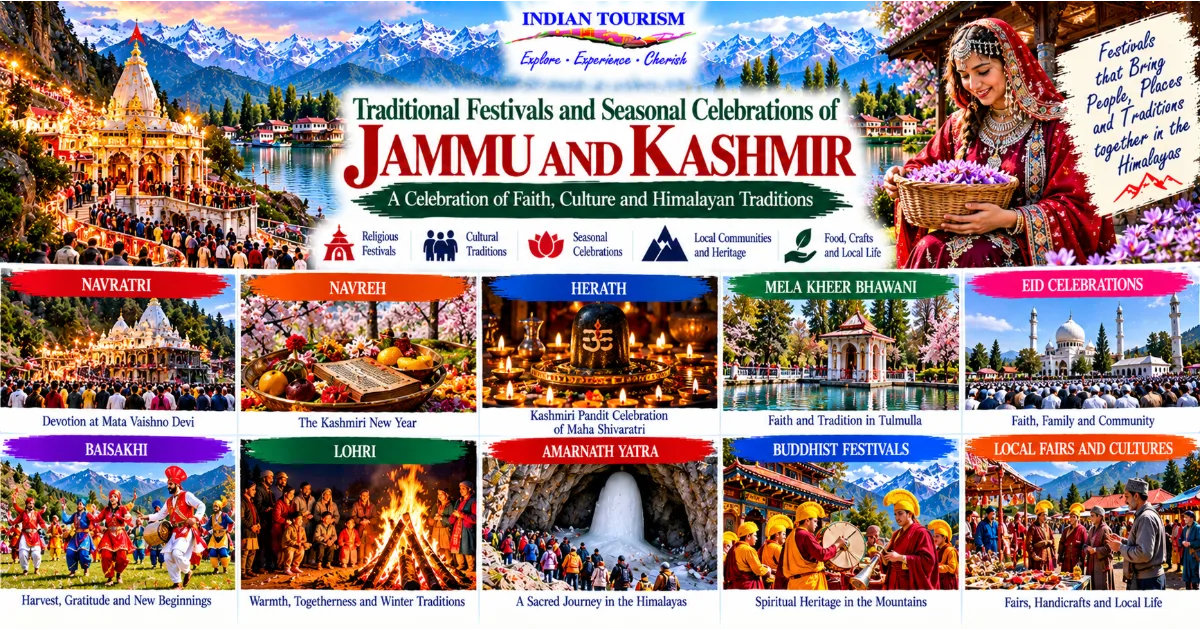
A Region Celebrated Through Its Traditions
Jammu and Kashmir is a region where festivals bring together faith, family, music, food, seasonal change and community traditions. Throughout the year, temples, mosques, shrines, villages and towns become centres of celebration as people mark religious occasions, welcome new seasons, honour historical traditions and gather with family members. These celebrations offer travellers an opportunity to understand the region beyond its famous mountains, lakes, gardens and pilgrimage routes.
The cultural calendar of Jammu and Kashmir reflects its geographical and social diversity. In the Kashmir Valley, festivals such as Navreh, Eid, Herath, Baisakhi and the annual Mela Kheer Bhawani are associated with distinctive religious and cultural traditions. In the Jammu region, Navratri, Lohri, Baisakhi and other seasonal observances bring communities together through prayer, food, fairs and family gatherings. Buddhist communities in parts of the wider Himalayan region also maintain celebrations connected with their religious traditions, while local fairs and seasonal events reflect the histories of individual towns and villages.
Festivals are not simply public spectacles. They carry memories, beliefs and practices passed from one generation to another. Families prepare special dishes, visit sacred places, exchange greetings, wear traditional clothing and participate in ceremonies that give meaning to particular dates in the year. The exact customs may differ between households, neighbourhoods and communities, so it is important to avoid assuming that everyone celebrates in the same way.
For travellers, a festival can provide a memorable cultural experience, but it also requires preparation. Accommodation may become more expensive or difficult to find, roads can be crowded, and religious sites may introduce special arrangements. Visitors should confirm dates and local requirements before planning a journey around a particular event.
This guide explores important festivals and seasonal celebrations across Jammu and Kashmir, explaining their cultural significance, regional variations and practical value for travellers. It also offers guidance on how to participate respectfully while supporting local communities and protecting the cultural environments that make these celebrations meaningful.
Navreh: The Kashmiri New Year
Navreh is the traditional New Year celebration observed by Kashmiri Pandits. It has deep cultural and religious significance and represents renewal, continuity and the beginning of a new annual cycle. For families connected with Kashmiri Hindu traditions, Navreh is an occasion to honour heritage, prepare for the year ahead and maintain customs passed down through generations.
The celebration is associated with the Kashmiri calendar and usually falls in spring. Families may prepare a traditional arrangement of items that carry symbolic meanings, such as food, rice, flowers, a mirror, written material and other objects associated with prosperity, knowledge and good fortune. The particular contents and practices can vary between households.
The ritual arrangement is not merely decorative. It connects everyday objects with ideas about learning, abundance, reflection and the hopes people carry into a new year. Family members may observe customary practices in the morning and spend time together, sharing greetings and discussing the year ahead.
Navreh also has a cultural significance beyond its religious observance. For Kashmiri Pandit families living in different parts of India and abroad, the celebration can serve as a link to ancestral homes, family memories and a shared cultural identity. Maintaining traditional foods, calendar practices and household rituals helps preserve that connection across generations.
For travellers interested in Kashmiri culture, Navreh offers an opportunity to learn about the region's calendar traditions and the ways families preserve their heritage. However, many of the most meaningful observances take place inside private homes. Visitors should not expect to witness household rituals unless they have been invited by a family or are attending an openly organised cultural event.
The timing of Navreh follows the traditional calendar, so visitors should confirm the date for the relevant year before making travel plans. Because the celebration is closely connected with family and religious life, the best way to understand it is through respectful conversation, cultural interpretation and a willingness to listen.
Navreh reminds visitors that the beginning of a new year does not have a single cultural form across India. Different communities mark renewal through their own calendars, rituals and stories, creating a rich diversity of seasonal traditions.
Herath: The Kashmiri Pandit Celebration of Maha Shivaratri
Herath is the name commonly used by Kashmiri Pandits for their observance of Maha Shivaratri. The festival is dedicated to Lord Shiva and holds a distinctive place in Kashmiri Hindu religious and cultural life. Its traditions include household worship, ritual preparations, family gatherings and the preparation of special foods.
Although Maha Shivaratri is observed in many parts of India, Herath has developed its own practices within the Kashmiri Pandit community. The festival is often associated with elaborate household arrangements and particular rituals that reflect the community's religious heritage. Details can differ between families, and individual households may preserve practices learned from parents and grandparents.
For many families, Herath is more than a single day of worship. Preparations may begin earlier, with household cleaning, the arrangement of ritual objects and the planning of meals. The observance can bring relatives together, reinforcing family relationships and a shared sense of cultural continuity.
Food has an important place in festival life. Families may prepare dishes associated with the occasion and share meals with relatives or guests. Recipes and customs vary, reflecting household preferences and regional traditions.
Herath also demonstrates how religious celebrations can preserve cultural identity during periods of migration and change. Kashmiri Pandit families living outside the Kashmir Valley may continue to observe the festival in their new homes, adapting practical details while retaining important elements of inherited tradition.
Visitors should approach Herath with an understanding that many rituals are private household observances. Public temples may have their own arrangements for Maha Shivaratri, but these should not be assumed to represent every aspect of Herath. Travellers interested in learning about the festival can seek cultural programmes or speak with community members who are comfortable sharing their experiences.
The date of the celebration follows the Hindu lunar calendar. Visitors should check the relevant year's calendar and confirm any public event arrangements before travelling.
Herath offers insight into the relationship between religious devotion, family life and Kashmiri cultural memory. Its significance lies not only in the rituals themselves but also in the care with which families maintain traditions across generations.
Mela Kheer Bhawani: A Major Gathering of Devotion
Mela Kheer Bhawani is one of the important annual religious gatherings associated with Kashmiri Pandit traditions. It takes place at the Kheer Bhawani Temple in Tulmulla, in the Ganderbal district, where devotees gather to honour Goddess Ragnya Devi.
The temple is associated with a sacred spring and with the offering of kheer, a preparation traditionally made with milk and rice. The religious practices surrounding the spring and the goddess form an important part of the site's identity. For devotees, the annual gathering offers an opportunity to pray, reconnect with community traditions and maintain a relationship with a sacred place.
The event can bring together people from different locations, including families who travel from outside the Kashmir Valley. Such gatherings demonstrate how pilgrimage can preserve cultural connections even when communities are geographically dispersed.
The atmosphere during the mela is shaped by prayer, offerings, family participation and the movement of pilgrims through the temple grounds. Visitors may encounter a wide range of people, from elderly devotees maintaining long-standing customs to younger family members learning about the tradition.
The festival is also important for understanding the cultural heritage of Kashmiri Pandits. The shrine remains a symbol of religious continuity and collective memory, making the annual gathering meaningful beyond its immediate ritual activities.
Travellers planning to attend should confirm the date and current access arrangements. Large gatherings can affect transport, parking and accommodation, so it is sensible to allow additional time and follow local instructions. Visitors should dress appropriately, avoid disrupting worship and ask permission before photographing individuals.
Mela Kheer Bhawani should not be treated simply as a colourful event for observation. It is a sacred occasion for devotees, and the needs of worshippers should remain central to the visitor's experience.
For travellers interested in religious and cultural heritage, the gathering provides an opportunity to understand the connection between sacred geography, family tradition and community identity in Jammu and Kashmir.
Navratri in Jammu: Nine Days of Devotion
Navratri is one of the most important Hindu festivals observed in the Jammu region. Dedicated to the worship of the Divine Mother in her various forms, the festival is marked by prayer, fasting, temple visits and community gatherings. Its significance is especially visible at important pilgrimage destinations, including the Shri Mata Vaishno Devi Shrine near Katra.
The festival is associated with nine nights of devotion, although the precise practices differ between households and communities. Some devotees observe fasts, while others participate in daily prayer, visit temples or attend religious programmes. Families may prepare special meals and gather for worship according to their traditions.
Jammu's association with Vaishno Devi makes Navratri a particularly important period for pilgrimage tourism. Many devotees travel to Katra during the festival, and the atmosphere around the pilgrimage route can become especially active. The shared journey, temple rituals and collective expressions of devotion are important aspects of the experience for many pilgrims.
Navratri also influences local businesses and services. Accommodation providers, transport operators, food businesses and shops may experience increased demand during the festival period. Travellers who are not visiting specifically for pilgrimage should take these changes into account when planning a broader tour.
The festival is also celebrated in homes and neighbourhoods, where family traditions remain central. Public religious programmes may be available in some locations, but not every household practice is open to visitors.
Those planning a Vaishno Devi pilgrimage during Navratri should check the latest registration procedures, route conditions, accommodation availability and official guidance. The route can be physically demanding, and visitors should prepare according to their fitness and health needs.
Navratri illustrates how religious celebrations can shape the rhythm of an entire destination. For visitors, it offers an opportunity to observe the importance of faith and community while remembering that pilgrimage sites are primarily places of worship rather than tourist attractions.
Eid Celebrations in Jammu and Kashmir
Eid is an important part of the religious and social calendar for Muslim communities throughout Jammu and Kashmir. The two major celebrations, Eid al-Fitr and Eid al-Adha, are marked through prayer, family gatherings, food, charity and visits to relatives and friends.
Eid al-Fitr marks the end of Ramadan, the month of fasting observed by Muslims. The celebration begins with special prayers and is followed by greetings, meals and social visits. Families may prepare traditional dishes, give gifts to children and share food with relatives or neighbours. Charitable giving is an important part of the religious observance, reflecting the emphasis on care for others.
Eid al-Adha is associated with the story of Prophet Ibrahim and the religious significance of sacrifice, obedience and generosity. Families observe the occasion according to their religious traditions, with charitable sharing and community support forming important elements of the celebration.
The atmosphere of Eid varies between towns, villages and households. Major mosques and religious sites may see large gatherings for prayer, while residential neighbourhoods become centres of family activity. Markets can be busy in the days leading up to the festivals as people purchase clothing, food and gifts.
For travellers, Eid can provide insight into the importance of family, hospitality and community life in Jammu and Kashmir. However, it is important to remember that religious observances may affect opening hours, transport schedules and the availability of some services.
Visitors should dress respectfully near religious sites and avoid interrupting prayers. Asking before photographing people is particularly important during family gatherings and religious activities. Travellers should also be mindful that not everyone wishes to participate in public celebration, and customs can differ between communities.
The dates of Eid follow the Islamic lunar calendar and depend on the relevant moon-sighting or official calendar arrangements. Anyone planning a trip around Eid should confirm the expected dates and check local travel conditions closer to departure.
Eid celebrations demonstrate how religious observance, generosity and family relationships remain closely connected in the cultural life of Jammu and Kashmir.
Baisakhi: Spring, Harvest and Community Gatherings
Baisakhi is celebrated in different parts of northern India and holds significance in Jammu and Kashmir as a seasonal and religious occasion. It is associated with the arrival of the spring harvest in some agricultural traditions and has particular importance for Sikh communities because of its connection with the formation of the Khalsa in 1699.
The festival generally falls in April. In agricultural areas, the season can coincide with important stages in the farming calendar, although actual harvest timing varies according to crop and local conditions. The association between Baisakhi and agricultural abundance makes it a meaningful occasion in communities where farming remains central to livelihoods.
For Sikh communities, Baisakhi is observed through visits to gurdwaras, prayer, devotional singing and community meals. The langar, a meal served to people without distinction, reflects the Sikh principles of service, equality and shared responsibility. Visitors attending a gurdwara should follow the site's rules, cover their heads where required, remove footwear in designated areas and respect the religious atmosphere.
In parts of Jammu and the surrounding region, Baisakhi may also be associated with fairs and community gatherings. The form and scale of these events vary by location and year, so travellers should check local announcements rather than assume a large public programme will take place everywhere.
Baisakhi can be a useful time to learn about the relationship between seasonal change, agricultural work and religious tradition. Visitors may observe how communities mark the season through worship, shared food and social gatherings.
Because the festival can coincide with increased activity at religious sites, travellers should allow additional time and check transport arrangements. Rural fairs may have different facilities from urban events, so visitors should plan accordingly.
Baisakhi illustrates the overlapping meanings that a festival can hold. For some, it is closely linked to harvest and seasonal renewal; for others, its religious significance is central. Both dimensions contribute to the cultural richness of Jammu and Kashmir.
Lohri: The Warmth of Winter Traditions in Jammu
Lohri is a winter festival celebrated in parts of northern India, including the Jammu region. It is associated with seasonal transition, community gatherings, traditional songs and foods connected with winter and the agricultural calendar.
The festival is generally observed in January. In some communities, families and neighbours gather around a bonfire, share greetings and enjoy seasonal foods such as sesame-based sweets, peanuts and other traditional snacks. The details of the celebration differ between households and localities.
Lohri is particularly associated with Punjabi cultural traditions and is observed by many families with connections to those traditions in Jammu. It can also be an occasion for celebrating family milestones, including the arrival of a new child or a marriage, depending on local custom.
The social atmosphere is an important part of the festival. People gather with relatives and neighbours, sing traditional songs and share food. In some places, community events may include music and dancing, while other celebrations remain focused on family gatherings.
For visitors, Lohri offers a glimpse into winter social life in the Jammu region. However, not every locality will organise a public event, and the scale of celebration varies. Travellers should seek reliable local information if they want to attend an organised gathering.
Safety is important around bonfires. Visitors should maintain a safe distance, follow instructions from event organisers and avoid contributing materials that may create smoke or fire hazards. Public spaces should be left clean after celebrations.
Lohri demonstrates how seasonal festivals can help communities gather during the colder part of the year. Food, fire, music and shared stories combine to create an occasion that connects present-day family life with inherited customs.
Shivratri Fairs and Religious Gatherings
Maha Shivaratri is observed by Hindu communities across Jammu and Kashmir, with temples dedicated to Lord Shiva becoming important centres of worship. In Jammu, temples such as Ranbireshwar attract devotees, while Shankaracharya Temple in Srinagar is another significant place associated with Shiva worship.
The festival is traditionally observed through prayer, fasting and night-time worship, although practices vary between households and religious institutions. Devotees may visit temples, offer prayers and participate in special ceremonies organised for the occasion.
The celebration demonstrates the importance of sacred places within the region's cultural geography. Temples are not simply historic structures; they remain active centres where religious traditions are maintained through regular worship and annual observances.
Some locations may host fairs or additional public programmes around important religious occasions. These events can include stalls, food vendors and gatherings of devotees, but arrangements vary by place and year.
Visitors planning to attend should confirm the temple's current programme and any entry requirements. Crowds can be larger than usual, and transport or parking may be affected. Modest clothing and respectful conduct are important throughout the visit.
Travellers should avoid assuming that every ritual is open for public observation. Some ceremonies may be reserved for worshippers or conducted in areas where visitors are not permitted.
Maha Shivaratri provides an opportunity to learn about the region's Hindu traditions while appreciating the continuing role of temples in community life. A respectful visit combines interest in architecture and history with an understanding of the site's religious purpose.
Amarnath Yatra: A Seasonal Pilgrimage in the High Himalayas
The Amarnath Yatra is one of the best-known seasonal pilgrimages associated with Jammu and Kashmir. Devotees travel to the Amarnath Cave in the Kashmir Himalayas, a sacred destination associated with Lord Shiva and a naturally formed ice structure that holds religious significance for worshippers.
The pilgrimage generally takes place during a designated period when access routes are considered suitable, but the exact dates and arrangements can vary from year to year. Weather, snow conditions, security requirements and administrative decisions influence whether the routes can operate safely.
The journey can be physically demanding because of the high altitude, mountain terrain and rapidly changing weather. It is not suitable for every traveller, and anyone considering the pilgrimage should carefully review official health guidance and assess their ability to complete the route.
Registration, medical requirements and other procedures may apply. Visitors should follow the latest official instructions and use authorised services. Travelling without proper preparation can create serious risks for both the pilgrim and the people responsible for managing the route.
The yatra has significance beyond the destination itself. For many devotees, the journey represents faith, perseverance and a deep connection with a sacred Himalayan landscape. The shared experience of travelling with other pilgrims forms part of its spiritual meaning.
The environmental sensitivity of the route is also important. High-altitude areas recover slowly from damage, and waste management can be difficult. Pilgrims should carry waste to designated collection points, remain on authorised paths and follow instructions intended to protect the landscape.
Visitors who are not undertaking the pilgrimage should be aware that the yatra can influence transport, accommodation and access arrangements in surrounding areas. Planning with current information helps avoid disruption.
The Amarnath Yatra illustrates the relationship between religious devotion, seasonal mountain access and the responsibilities involved in travelling through a fragile Himalayan environment.
Buddhist Festivals and Himalayan Cultural Traditions
Buddhist traditions are part of the wider cultural landscape of the Himalayan region, including communities and areas connected with the broader geography of Jammu and Kashmir. Buddhist celebrations vary according to religious tradition, local history and the calendar followed by the community.
Vesak, also known in some traditions as Buddha Purnima, commemorates important events in the life of Gautama Buddha. Depending on the tradition, observances may include prayer, offerings, meditation, teachings and acts of generosity. Other Buddhist communities mark important dates connected with their teachers, monasteries and local religious histories.
In the broader Himalayan cultural region, festivals can include ceremonial gatherings, traditional music, masked dances or religious performances, depending on the community and event. These forms should not be assumed to occur in every location, and travellers should confirm whether a particular celebration is taking place before planning a visit.
Buddhist cultural experiences can provide insight into the relationship between religious practice, community life and the mountain environment. Monasteries and other sacred spaces may serve as centres of learning, ritual and cultural preservation.
Visitors should approach religious institutions respectfully. Clothing should be appropriate, photography should be undertaken only where permitted and instructions from religious authorities should be followed. Some ceremonies may be open to visitors, while others may be intended primarily for members of the community.
Because the region contains different religious and cultural traditions, travellers should avoid presenting one festival as representative of every Himalayan community. Local histories and practices deserve individual attention.
For visitors interested in the wider cultural geography of the Himalayas, Buddhist festivals offer a reminder of the diversity of religious traditions that have developed across mountain regions. They also demonstrate how spiritual practices preserve artistic, musical and philosophical knowledge across generations.
Spring Festivals and the Arrival of a New Season
Spring is one of the most visually attractive periods in Jammu and Kashmir. Snow begins to retreat from lower elevations, trees develop fresh leaves, flowers appear in gardens and orchards, and agricultural activity increases in many parts of the region.
The arrival of spring is reflected in different cultural practices. Navreh marks the traditional New Year for Kashmiri Pandits, while the flowering of almond trees and other plants can become a seasonal attraction in Srinagar. The famous tulip display also draws visitors during its flowering period, although its timing depends on weather and horticultural conditions.
Spring is a time when the relationship between seasonal change and cultural life becomes especially visible. Families may prepare for festivals, farmers begin or continue agricultural work, and visitors arrive to see flowering gardens and the changing landscape.
The timing of seasonal events is not fixed to the same day every year. Flowering depends on temperature, rainfall and other conditions, while religious festivals follow their respective calendars. Travellers should therefore distinguish between calendar-based celebrations and natural seasonal displays.
Spring can also bring increased visitor numbers to Srinagar and other popular destinations. Accommodation and transport should be planned early if the trip coincides with a major flowering period or religious gathering.
Visitors can enjoy the season by combining garden visits with cultural sightseeing and local food experiences. However, public gardens and residential areas should be treated respectfully, and visitors should avoid damaging plants to obtain photographs.
Spring celebrations demonstrate that seasonal tourism can be cultural as well as scenic. By learning about the traditions associated with the changing year, travellers can gain a deeper understanding of how communities in Jammu and Kashmir connect nature, memory and everyday life.
Autumn Harvests and the Changing Colours of the Valley
Autumn is an important season in many parts of Jammu and Kashmir. The landscape changes as temperatures fall, leaves develop warmer colours and agricultural communities prepare for or complete important stages of the harvest.
In parts of the Kashmir Valley, autumn is associated with apple harvesting and other agricultural activity. Orchards become busy with picking, sorting and transporting fruit, creating a visible connection between the landscape and the rural economy. Rice cultivation and other crops also follow seasonal patterns, although the exact timing varies by district and local conditions.
Autumn is not defined by a single festival across the region. Instead, it brings together different seasonal activities, family routines and local events. The period can offer travellers a chance to understand how weather and agricultural cycles influence work and community life.
Visitors interested in rural experiences may be able to arrange an orchard visit through a participating farm or local business. Permission should always be obtained before entering agricultural land, and visitors should not pick fruit or interfere with work unless the host has explicitly invited them to do so.
The season can also be attractive for photography because the colours of trees and mountains change with the light. However, travellers should avoid blocking farm access or photographing workers closely without consent.
Autumn travel requires attention to changing weather. Temperatures can fall quickly in the evenings, and conditions differ between the valley floor and higher mountain destinations. Suitable clothing and a flexible itinerary help make the experience more comfortable.
The harvest season reveals the economic and cultural importance of agriculture in Jammu and Kashmir. It allows visitors to appreciate that the region's celebrated scenery is also a working landscape that supports families and local industries.
Local Fairs, Village Gatherings and Community Celebrations
Alongside major religious festivals, Jammu and Kashmir has a variety of local fairs and community gatherings. These events may be connected with temples, shrines, seasonal markets, regional histories or the traditions of particular villages.
A local fair can bring together food vendors, craft sellers, families and visitors. Depending on the event, people may attend for religious observance, social interaction, shopping or entertainment. The form and scale of these gatherings vary widely, so there is no single description that applies to every district.
Fairs can provide opportunities to discover local products and foods that may not be widely available in larger tourist centres. Visitors might encounter regional sweets, handmade goods, agricultural products or items produced by local artisans. Purchasing from legitimate local sellers can help support small businesses.
Community events also create spaces where traditional music, storytelling and social customs may be shared. However, not every event includes a formal performance, and visitors should avoid expecting residents to provide cultural entertainment simply because tourists are present.
Before attending a local fair, travellers should confirm the location, date, transport arrangements and any entry requirements. Smaller events may have limited parking or facilities, and visitors should plan accordingly.
Respectful behaviour remains important in crowded settings. Follow local instructions, dispose of rubbish properly and ask before photographing people, especially children or religious activities.
Local fairs reveal the diversity of community life across Jammu and Kashmir. They provide an opportunity to understand how traditions are maintained through regular social interaction rather than only through large events designed for visitors.
Festival Food and the Importance of Shared Meals
Food is one of the most important ways festivals express cultural identity. In Jammu and Kashmir, celebratory meals reflect regional ingredients, religious practices, family preferences and the social importance of gathering together.
In the Kashmir Valley, Wazwan is an important culinary tradition associated with weddings and major gatherings. The preparation of a traditional Wazwan can involve several dishes and requires considerable skill and coordination. Although it is widely known as a Kashmiri food experience, its deeper significance lies in the social and ceremonial setting in which it is served.
Other Kashmiri dishes may include rogan josh, yakhni, haak and rice preparations, while households may prepare particular foods for religious occasions. Recipes vary, and the same dish can be prepared differently by different families.
In Jammu, festive food traditions reflect the region's diverse communities and agricultural landscape. Families may prepare sweets, breads, rice dishes and other foods according to the occasion. Religious customs can influence ingredients and preparation methods.
Shared meals can express hospitality and strengthen relationships. Guests may be invited to eat with relatives or neighbours, while community kitchens and charitable meals can provide food to people without distinction during particular religious observances.
Visitors should be considerate of dietary customs and communicate any allergies or requirements clearly. It is also important not to waste food or assume that every household follows the same practices.
Food tourism can support local restaurants, home-based businesses and traditional cooks when it is organised fairly. Visitors should seek clear information about what is included in a meal and respect the host's time and effort.
Festival cuisine demonstrates that food is not merely an attraction to be photographed. It carries family memories, regional knowledge and the social values that make celebrations meaningful.
Practical Tips for Planning a Festival Trip
Planning a festival trip requires more attention than an ordinary sightseeing journey because dates, crowd levels and local arrangements can change. Travellers should first identify the festival's cultural or religious calendar and confirm the expected date for the relevant year.
Accommodation should be booked early when a major pilgrimage or popular public celebration is expected. Katra can become particularly busy during Navratri and other important periods associated with Vaishno Devi. Srinagar and nearby destinations may also experience higher demand during seasonal flowering events and major gatherings.
Transport planning is equally important. Roads near religious sites may be crowded, parking may be restricted and public transport schedules may change. Travellers should allow additional time rather than arranging a tightly packed itinerary.
Visitors should learn about the customs of the event before attending. This includes appropriate clothing, footwear rules, photography restrictions and any expectations concerning participation. At religious sites, the purpose of the celebration should take priority over sightseeing.
Weather should be considered carefully, especially for mountain pilgrimages and outdoor events. Warm clothing, comfortable footwear and sufficient drinking water can be important, depending on the destination and season.
Travellers should also remain flexible. A religious programme may change, a local event may be smaller than expected or weather may affect access. A good itinerary should include alternative activities that do not depend on a single event taking place.
Finally, remember that festivals belong first to the communities that celebrate them. Visitors can learn a great deal by observing respectfully, supporting local businesses and listening to local explanations without expecting unrestricted access to private or sacred activities.
Responsible Festival Tourism and Cultural Respect
Festival tourism can bring income to local businesses and create opportunities for cultural exchange. However, large crowds can also increase waste, traffic, pressure on water supplies and disruption to residents. Responsible planning helps reduce these effects.
Visitors should use waste facilities and avoid leaving plastic, food packaging or other rubbish at religious sites and public gathering places. Mountain pilgrimage routes require particular care because waste collection can be difficult and the environment is often fragile.
Respect for privacy is essential. Ask before taking photographs of individuals, family groups or ceremonies. Some religious activities may prohibit photography or restrict access to particular areas, and visitors should follow those rules without argument.
Local traditions should be described accurately and without stereotypes. Customs vary between families and communities, and one person's practice should not be treated as universal. Listening to local people is often the best way to understand the meaning of a celebration.
Supporting legitimate local businesses can help spread the economic benefits of tourism. Visitors may purchase local crafts, use authorised guides and choose accommodation that treats workers fairly. Spending should be voluntary, and bargaining should remain respectful.
Safety should also be taken seriously. Crowded routes, bonfires, mountain weather and long pilgrimages each involve different risks. Follow official guidance, avoid restricted areas and do not continue a physically demanding journey when it becomes unsafe.
Responsible festival tourism allows travellers to appreciate cultural traditions without placing unnecessary burdens on the communities that maintain them. It helps ensure that celebrations remain meaningful for local people while welcoming visitors who are genuinely interested in learning.
Conclusion: Experiencing the Cultural Calendar of Jammu and Kashmir
The festivals and seasonal celebrations of Jammu and Kashmir reveal the region's cultural richness through faith, family, food, agriculture and community life. Navreh and Herath preserve important Kashmiri Pandit traditions, while Mela Kheer Bhawani brings devotees together at a revered sacred site. Navratri is particularly significant in Jammu's pilgrimage calendar, and Eid celebrations reflect the importance of prayer, generosity and family relationships across Muslim communities.
Baisakhi and Lohri demonstrate the relationship between seasonal change, community gatherings and regional traditions. Maha Shivaratri and the Amarnath Yatra connect religious devotion with sacred places, while Buddhist observances in the wider Himalayan cultural landscape reveal additional dimensions of the region's spiritual diversity.
Spring and autumn offer opportunities to understand how natural cycles influence festivals, agriculture and everyday life. Local fairs and shared meals provide further insight into the ways communities maintain cultural traditions beyond the largest public events.
Every celebration has its own history, calendar and customs. Visitors should confirm dates and travel arrangements, respect religious practices and recognise that many important rituals take place in private family settings. The most rewarding cultural experiences are those approached with patience, curiosity and consideration.
Jammu and Kashmir's festivals are not simply events on a tourism calendar. They are expressions of living heritage that connect people with their beliefs, ancestors, communities and changing environment. By travelling responsibly, supporting local livelihoods and respecting the people who celebrate these traditions, visitors can gain a deeper understanding of the region while helping preserve its cultural diversity for future generations.
#IndianTourism #JammuAndKashmir #KashmirFestivals #JammuFestivals #Navreh #Herath #KheerBhawani #Navratri #Eid #Baisakhi #Lohri #MahaShivaratri #AmarnathYatra #KashmirCulture #IndianFestivals #SeasonalCelebrations #CulturalTourism #ResponsibleTourism #ExploreIndia
