
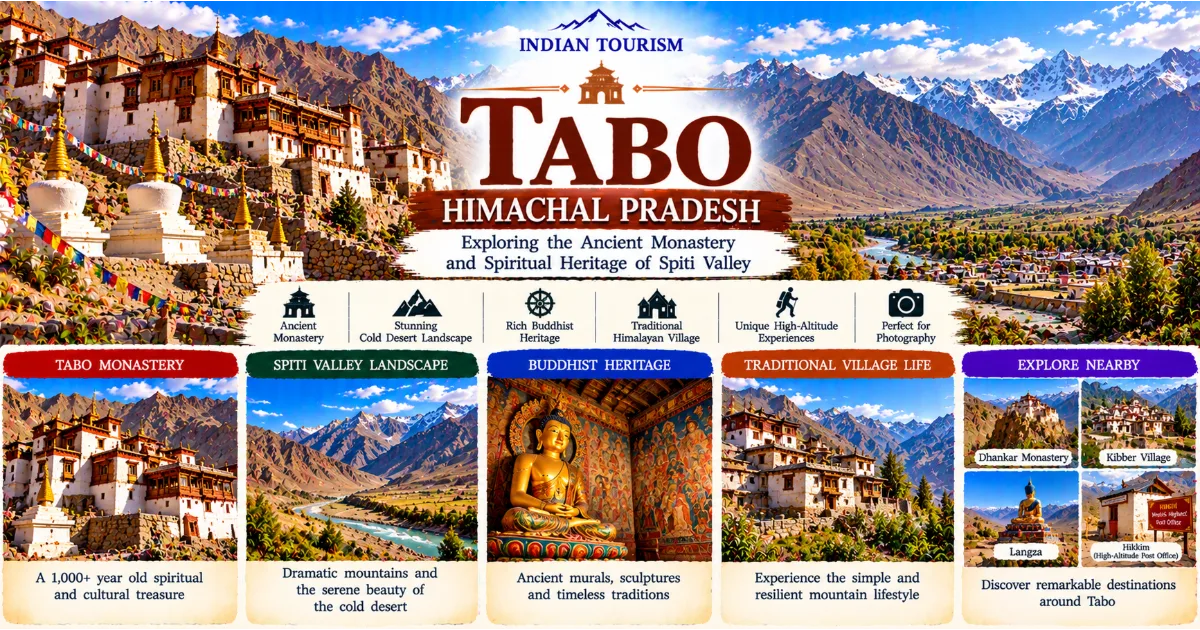
A Journey into the Spiritual Heart of the Himalayas
Himachal Pradesh is home to landscapes that range from lush green valleys and cedar forests to snow-covered mountains and high-altitude deserts. Among these diverse environments, Spiti Valley holds a special place because of its striking geography, distinctive culture and remarkable religious heritage. Within this rugged landscape lies Tabo, a small settlement renowned for its ancient Buddhist monastery, traditional village life and peaceful surroundings. For travellers interested in history, architecture, spirituality and Himalayan culture, Tabo offers an experience that goes far beyond conventional sightseeing.
Located in the Lahaul and Spiti district of Himachal Pradesh, Tabo is situated in a cold desert landscape where the mountains appear in shades of brown, grey and ochre. The sparse vegetation, wide skies and quiet surroundings create an atmosphere very different from the forested hill stations of the state. Yet the village is far from being culturally isolated. For centuries, it has been connected with the Buddhist traditions that spread across the western Himalayas, preserving religious art, teachings and architectural features that continue to attract scholars, pilgrims and visitors.
The most famous landmark in the settlement is Tabo Monastery, a historic Buddhist complex widely recognised for its antiquity and artistic significance. Often described as one of the most important surviving Buddhist monastic sites in the Himalayan region, the monastery preserves murals, sculptures and religious spaces that reflect the development of Tibetan Buddhist culture over many centuries. Its significance extends beyond the local community, making it an important destination for anyone interested in the history of Buddhism in the Himalayas.
However, Tabo should not be understood only through its monastery. The village and its surrounding landscape reveal how people have adapted to life in a high-altitude environment where water, agricultural land and transport are limited by geography. Traditional homes, cultivated fields, mountain paths and nearby settlements provide insight into the practical and cultural foundations of life in Spiti.
For travellers seeking a meaningful journey through Himachal Pradesh, Tabo offers a combination of heritage, natural beauty and quiet reflection. It rewards visitors who take time to understand the place rather than simply photographing its most famous monument. By exploring the monastery respectfully, learning about local traditions and appreciating the cold desert environment, travellers can discover one of the most significant cultural destinations in the Indian Himalayas.
Understanding Tabo and the Spiti Region
Where Is Tabo Located?
Tabo is situated in Spiti Valley in the Lahaul and Spiti district of Himachal Pradesh. The settlement lies along the Spiti River corridor, within a landscape characterised by rugged mountains, dry slopes and scattered villages. Its geographical position places it within one of the most distinctive cultural and environmental regions of the western Himalayas.
Spiti is known as a cold desert because it receives relatively little precipitation compared with many other parts of the state. The major Himalayan ranges intercept much of the moisture carried by monsoon winds, creating a dry environment with limited vegetation and extensive exposed rock. Although the landscape may appear harsh, it supports settlements that have developed around available water sources and cultivable land.
Tabo's location has helped shape its history. Mountain routes connected settlements across the region, allowing religious teachings, artistic traditions and cultural influences to travel between communities. The valley's relative isolation also contributed to the preservation of distinctive practices and architectural traditions.
Visitors travelling to Tabo should be prepared for the challenges associated with remote mountain destinations. Road conditions can change, services may be limited and weather can affect travel plans. Checking current road information and arranging accommodation before departure are important steps in planning a comfortable visit.
The Character of a Cold Desert Landscape
The scenery around Tabo differs sharply from the green landscapes that many visitors associate with Himachal Pradesh. Instead of dense forests, travellers encounter open slopes, rocky formations and broad mountain views. The colours of the terrain change with the light, creating dramatic contrasts between sunlit ridges and shadowed valleys.
The limited rainfall influences the appearance of the vegetation and the way settlements are organised. Agricultural activity is concentrated in areas where water can be accessed and managed. Fields may appear as patches of green within a landscape dominated by earth tones, demonstrating how communities have adapted to a demanding environment.
The cold desert also experiences considerable seasonal variation. Summers can offer relatively comfortable daytime conditions, while winter brings severe cold and the possibility of snow or road disruption. The difference between daytime and nighttime temperatures can be significant, so visitors should carry suitable clothing even when travelling during warmer months.
Understanding this environment adds depth to a visit to Tabo. The monastery, village homes and cultivated fields exist within a landscape that has influenced local life for generations. The setting is not merely a background for historical attractions. It is an essential part of the region's identity.
Tabo Monastery: A Treasure of Himalayan Buddhist Heritage
A Monastery Founded in the Tenth Century
Tabo Monastery is the defining landmark of the village and one of the most important Buddhist heritage sites in the western Himalayas. It is traditionally dated to 996 CE and is associated with the religious revival that helped strengthen Buddhist learning and artistic traditions across the Himalayan region.
The monastery was established during a period when Buddhist teachers, translators and patrons played an important role in transmitting religious knowledge across the Himalayan cultural world. Its historical setting connects the region with broader movements of Buddhist scholarship, artistic exchange and religious institution-building.
The antiquity of the complex makes it especially significant. Many historical religious structures have undergone extensive reconstruction or have disappeared over time, but Tabo preserves an important collection of historic buildings and artistic features. Although the site has experienced changes and conservation work across the centuries, its surviving heritage provides valuable insight into earlier periods of Himalayan Buddhism.
Visitors should remember that historical dating and architectural interpretation involve specialist research. The monastery is widely recognised as an ancient site, but individual buildings and artistic elements may reflect different phases of development. Understanding the complex as a historic institution that evolved over time provides a more accurate appreciation than assuming every part belongs to a single moment.
Why Tabo Monastery Is So Important
Tabo Monastery is significant because of its religious, historical and artistic value. It preserves murals, sculptures and other works that contribute to the understanding of Buddhist art in the Himalayan region. The complex also reflects the role monasteries played as centres of religious practice, learning and cultural preservation.
Religious institutions historically provided spaces for teaching, meditation, ritual and the transmission of texts. They also supported artistic activity through the creation of murals, sculptures and other objects used in religious settings. These activities connected local communities with wider networks of Buddhist scholarship.
Tabo's heritage demonstrates that the Himalayas were not isolated from wider cultural developments. Religious teachers, artists and patrons helped create connections across regions, allowing ideas and artistic styles to travel between communities.
For visitors, this history offers a reason to look carefully at the monastery's artistic and architectural features. Rather than treating the complex as a single photographic subject, travellers can appreciate how its buildings and artworks preserve different dimensions of Himalayan cultural history.
Architecture of the Monastery Complex
The monastery is known for its collection of structures, including temples and other religious buildings arranged within a relatively compact complex. The buildings reflect the requirements of religious practice and the architectural traditions that developed in the region.
The exterior appearance may seem modest compared with the grand monasteries found in some other parts of the Himalayas. Yet the significance of Tabo lies partly in the contrast between its simple external forms and the remarkable artistic heritage preserved within its historic spaces.
The complex includes structures associated with worship and religious instruction. Their arrangement reflects the way a monastery functions as a community rather than as a single monumental building. Each space contributes to a wider environment devoted to spiritual practice and the preservation of teachings.
Because the buildings are historic and some artistic elements are fragile, visitors should follow all conservation rules. Walls, paintings and sculptures must not be touched or disturbed. Photography may be restricted in certain areas, and local instructions should always take priority over personal preferences.
Murals, Sculptures and Sacred Art
One of the most remarkable aspects of Tabo Monastery is its collection of religious murals and sculptures. These works reflect the artistic traditions of Himalayan Buddhism and provide valuable evidence of the relationship between religious belief and visual expression.
Murals can communicate stories, spiritual concepts and symbolic relationships through carefully arranged figures, colours and compositions. Sculptures provide another form of religious representation, creating focal points for devotion and ritual. Together, these artworks help explain how religious teachings were expressed in visual forms that could be encountered within sacred spaces.
The preservation of historic art is especially challenging in a remote mountain environment. Temperature changes, moisture, dust and human activity can affect fragile surfaces. Conservation therefore requires care, specialist knowledge and respect from everyone who visits the site.
Visitors do not need advanced knowledge of Buddhist art to appreciate the monastery. Taking time to observe the details, learning about the general meaning of the artworks and respecting restrictions can make the experience more rewarding.
The Cultural Significance of Buddhism in Spiti
Tibetan Buddhist Traditions in the Valley
Buddhism has played a major role in shaping the cultural identity of Spiti. The region shares historical and cultural connections with Tibetan Buddhist communities across the wider Himalayan world. These connections are reflected in monasteries, religious festivals, traditional art, prayer practices and the everyday lives of many local residents.
Monasteries have historically served as places of worship, education and community gathering. They preserve religious texts and teachings while providing spaces for ceremonies, meditation and the training of monks. Their influence extends beyond the buildings themselves, shaping local traditions and the rhythm of community life.
Tabo Monastery is an important part of this cultural landscape. Its long history connects the village with broader developments in Buddhist learning and artistic expression. Visiting the monastery can help travellers understand how religious institutions contributed to the preservation of cultural knowledge across generations.
However, Buddhism in the Himalayas should not be treated as a uniform tradition. Practices and institutions differ between communities, and local customs may reflect distinctive historical experiences. Visitors should approach these differences with curiosity rather than assuming that all monasteries operate in exactly the same way.
Monasteries as Centres of Learning
Historically, monasteries were important centres for the study and transmission of Buddhist teachings. Monks and scholars learned religious texts, participated in rituals and preserved traditions through teaching and practice.
The transmission of knowledge depended on generations of teachers, students, translators and patrons. Manuscripts, paintings and sculptures helped preserve religious ideas, while oral instruction and ritual practice ensured that knowledge remained part of living communities.
Tabo's historical importance is connected with this broader role of monasteries. The site provides evidence of the intellectual and artistic traditions that flourished in the Himalayan region over many centuries.
Visitors interested in this aspect of the monastery may wish to learn more about the history of Buddhist translation, Himalayan art and the development of religious institutions. Even a basic understanding of these subjects can make a visit more meaningful.
Exploring Tabo Village
Traditional Homes and Settlement Patterns
Tabo village reflects the practical demands of living in a high-altitude cold desert. Traditional homes and other buildings are adapted to local materials, weather conditions and the availability of land. The settlement has developed around the resources and routes that support daily life in the region.
Architecture in Spiti often makes use of earth-based construction methods and other materials suited to the local environment. Building forms vary according to age, purpose and household needs, but many traditional structures reflect the importance of insulation and protection from cold conditions.
Walking through the village can provide a better understanding of how homes, agricultural spaces and community buildings relate to one another. The arrangement of houses and fields is influenced by the terrain and the need to use available land efficiently.
Visitors should remain respectful when exploring residential areas. Not every building is part of the monastery, and private homes should not be entered without permission. Quiet observation and courteous behaviour allow travellers to appreciate the settlement without disrupting local life.
Everyday Life in a Remote Mountain Community
Life in Tabo is shaped by the climate, geography and seasonal availability of resources. Agriculture, local services, religious institutions and tourism contribute to the life of the settlement, although their relative importance varies across households and seasons.
The short growing season requires careful planning. Water must be managed, crops must be suited to local conditions and agricultural activities must fit within the available period of favourable weather. Transport also plays an important role because many goods and services must travel through mountain roads that can be affected by weather.
Tourism brings opportunities for local businesses, accommodation providers and transport operators. At the same time, visitors should recognise that residents have everyday responsibilities that continue regardless of tourist expectations.
Respecting local routines, asking permission before taking photographs and purchasing goods or services thoughtfully can help create a positive relationship between visitors and the community.
Tabo's Natural Surroundings and Scenic Beauty
Mountain Views and Open Landscapes
The landscape surrounding Tabo offers the characteristic scenery of Spiti, with exposed mountain slopes, rocky formations and broad views across the valley. The absence of dense vegetation allows the contours of the terrain to remain visible, creating a sense of openness that differs from forested mountain regions.
The colours of the mountains change throughout the day. Morning sunlight may reveal warm tones on exposed slopes, while afternoon shadows create strong contrasts between ridges and valleys. In the evening, the landscape can take on muted colours as the light fades.
Photographers may find these changes particularly rewarding. Wide landscape images can communicate the scale of the valley, while closer compositions can reveal the textures of rock and the relationship between buildings and the surrounding terrain.
Weather conditions affect visibility, and clear views are never guaranteed. Travellers should avoid planning their entire visit around a single photograph. Allowing time to observe the landscape under different conditions often produces a more satisfying experience.
The Spiti River and the Importance of Water
The Spiti River is an important geographical feature of the wider region. Its course through the valley has influenced settlement patterns, agricultural activity and transport routes. Water from the river system supports life in an environment where rainfall is limited.
The relationship between water and settlement is particularly visible in Spiti. Villages and cultivated fields often occupy locations where water can be accessed and managed. Irrigation practices allow communities to grow crops during a relatively short agricultural season.
Visitors should treat the river and its surroundings with care. Riverbanks may be unstable, water temperatures can be extremely low and currents may be stronger than they appear. Avoid entering the water without appropriate knowledge and follow local advice about safe areas.
Water conservation is also important when staying in local accommodation. Using water thoughtfully helps reduce pressure on resources that may already be limited by the environment.
Nearby Destinations to Explore from Tabo
Dhankar Monastery and Village
Dhankar is one of the notable historical and cultural destinations in Spiti. The settlement and its monastery occupy a dramatic position within the mountain landscape, offering visitors another perspective on the region's religious heritage.
Dhankar Monastery is associated with the history of Buddhist practice in Spiti and is known for its striking setting. The village and surrounding slopes demonstrate how settlements and religious institutions developed in locations shaped by the terrain.
Visitors should check current access arrangements before travelling, particularly if planning to explore beyond the main settlement. Mountain roads and walking routes may be affected by weather or maintenance.
Dhankar can complement a visit to Tabo because the two destinations offer related but distinct experiences of Spiti's cultural landscape. Travellers interested in monastery architecture and regional history may find it worthwhile to compare their settings and traditions.
Pin Valley
Pin Valley is known for its dramatic scenery and distinctive environment within the wider Spiti region. The area includes rugged mountains, sparse vegetation and settlements adapted to the cold desert landscape.
The valley is also associated with the Pin Valley National Park, which protects important high-altitude habitats. Wildlife conservation is a significant part of the area's identity, and visitors should approach the environment with care.
Access and travel conditions depend on the season and current road status. Travellers should seek local guidance before making plans, especially when intending to explore remote locations or wildlife habitats.
Pin Valley can provide a valuable contrast with Tabo, allowing visitors to experience a different part of Spiti's geography and natural heritage. However, wildlife sightings should never be treated as guaranteed, and the welfare of animals should take priority over photography.
Dhankar Lake
Dhankar Lake is a high-altitude destination associated with the wider Dhankar area. It appeals to travellers interested in mountain scenery and walking routes, but reaching it can require physical effort and careful planning.
The route, conditions and suitability of a visit vary with the season. Visitors should confirm current information locally and avoid attempting the walk if weather, health or available daylight makes it unsafe.
High-altitude walking can be demanding even for people who are physically active at lower elevations. Travellers should allow time to acclimatise and avoid pushing beyond their abilities.
Anyone who chooses to visit should carry suitable clothing, water and essential supplies. The environment should be left undisturbed, and all rubbish should be carried back to an appropriate disposal point.
Kaza
Kaza is an important town and travel base in Spiti Valley. It provides access to services, accommodation and transport arrangements that may be more limited in smaller settlements.
A journey between Kaza and Tabo can form part of a wider Spiti itinerary, allowing travellers to explore different monasteries, villages and landscapes. The route offers opportunities to observe the changing terrain and the relationship between settlements and the valley.
Travellers should plan the journey according to road conditions and the time available. Avoid assuming that several distant destinations can be comfortably covered in a single day.
Kaza and Tabo offer different experiences. Kaza functions as a regional centre, while Tabo is especially known for its historic monastery and quieter village atmosphere. Including both can help visitors gain a broader understanding of Spiti.
Best Time to Visit Tabo
Summer: The Most Practical Season for Many Travellers
Summer is generally the most practical season for visiting Tabo and exploring the wider Spiti region. Conditions are usually more favourable for road travel than during the coldest months, although mountain weather can still change quickly.
During this period, visitors may find a wider range of accommodation and transport services. Longer daylight hours provide more flexibility for exploring the monastery, walking through the village and visiting nearby destinations.
Summer can also be a busy travel period, so advance accommodation planning is sensible. Travellers should carry warm clothing because temperatures may fall sharply after sunset, even when daytime conditions are comfortable.
The altitude remains an important consideration throughout the year. Visitors arriving from lower elevations should allow time to acclimatise and avoid strenuous activity immediately after arrival.
Autumn: Clear Skies and Cooler Conditions
Autumn can be rewarding for travellers interested in photography and cultural exploration. The air may be clear, and the exposed mountain landscape can appear especially dramatic under bright sunlight.
However, temperatures decline as winter approaches. Visitors should confirm that accommodation and transport services will be available for their intended dates.
Road conditions may become more difficult later in the season, particularly if snow or severe weather affects higher routes. A flexible itinerary is essential, and travellers should avoid depending on a single route without checking current information.
Winter: Severe Cold and Travel Restrictions
Winter in Spiti can bring extremely low temperatures, snow and difficult road conditions. Some routes may become inaccessible, and many tourist services may operate on a reduced basis.
Tabo remains part of a living region, but a winter visit requires much more preparation than a summer journey. Travellers must confirm accommodation, heating, food availability and transport arrangements before departure.
Anyone considering winter travel should seek current local advice and understand the risks associated with cold weather and remote mountain roads. It is not advisable to attempt an uncertain journey simply to follow an itinerary prepared for a different season.
Monsoon and Road Conditions
Spiti receives relatively little monsoon rainfall compared with many other parts of Himachal Pradesh because of its rain-shadow location. However, routes leading into the region can still experience heavy rain, landslides, rockfalls and road damage.
Travellers should check conditions across the entire route rather than relying only on the weather forecast for Tabo. Conditions can differ considerably between lower mountain roads and the cold desert valley.
If road authorities advise against travel, follow their guidance. Delaying a journey is preferable to taking unnecessary risks in difficult terrain.
How to Reach Tabo
By Road from Shimla and Kinnaur
One common approach to Tabo travels through Shimla and the Kinnaur region before continuing into Spiti Valley. This route passes through changing mountain landscapes, from forested slopes and river valleys to the drier terrain characteristic of Spiti.
The journey is long and requires careful planning. Road conditions, traffic, weather and maintenance work can affect travel time. Travellers should identify suitable overnight stops and avoid trying to cover excessive distances in one day.
Because the route includes narrow and sometimes exposed mountain roads, drivers should maintain safe speeds and avoid risky overtaking. Travellers who are unfamiliar with mountain driving may prefer an experienced local driver.
Checking current road conditions before departure is essential, particularly during the monsoon and colder months.
By Road from Manali
An alternative approach may be possible through Manali and the high mountain routes connecting the wider Lahaul and Spiti region. Availability depends on seasonal road conditions and the status of the relevant passes.
These routes are not open under the same conditions throughout the year. Snow, road maintenance, landslides and official restrictions may affect access, so travellers must obtain current information before planning the journey.
High-altitude travel requires careful attention to acclimatisation. Moving rapidly from lower elevations to a high pass can increase the risk of altitude-related illness.
Do not assume that a route is open simply because it appears in an older itinerary or online map. Current local guidance should determine the final travel plan.
Public Transport and Local Taxis
Travellers may investigate bus services connecting major settlements with parts of Spiti. Service frequency and availability vary by season, so schedules should be confirmed before making accommodation arrangements.
Local taxis may be available for travel between nearby destinations, although costs and availability depend on the route and current conditions. It is useful to agree on the destination, return arrangements and expected travel duration before departure.
Remote mountain travel benefits from flexibility. Visitors should allow extra time for delays and avoid depending on a late connection that may not operate in difficult weather.
Where to Stay in Tabo
Guesthouses and Homestays
Tabo offers accommodation options that may include guesthouses, homestays and small hotels. Facilities vary by property and season, so travellers should confirm details before booking.
Important considerations include room heating, hot water, meal availability, cleanliness and the property's ability to operate during colder periods. In a remote high-altitude environment, reliable basic facilities may matter more than luxury features.
Homestays can provide opportunities to learn about local food and household traditions. Guests should respect the routines of their hosts and understand that facilities may be simpler than those found in larger tourist centres.
During the main travel season, booking in advance is advisable. Travellers should also confirm cancellation policies in case road closures or weather conditions disrupt the journey.
Planning an Overnight Stay
An overnight stay allows visitors to explore the monastery and village without rushing. It can also provide flexibility if road conditions or weather affect the planned itinerary.
Travellers who arrive after a long road journey should prioritise rest and acclimatisation. Avoid planning strenuous walks immediately after arrival, especially if travelling from a much lower elevation.
Before booking, confirm the location of the property and the availability of food and transport. In smaller settlements, the distance between accommodation and services may be more significant than it appears on a map.
A well-planned stay helps visitors appreciate Tabo's heritage while maintaining a comfortable and safe travel schedule.
Local Food and Culinary Experiences
Food in Tabo reflects the wider culinary traditions of Spiti and the Himalayan region. Visitors may encounter familiar North Indian dishes alongside meals influenced by Tibetan and local mountain practices.
Depending on the establishment, meals may include thukpa, momos, noodles, rice, lentils and seasonal vegetables. The availability of particular dishes varies, especially outside the main travel season.
Food offers insight into how communities adapt their diets to the climate and availability of ingredients. Warm meals are particularly welcome after time spent exploring the cold desert landscape.
Travellers with dietary restrictions should ask about ingredients and preparation methods before ordering. In smaller settlements, choices may be limited, so carrying suitable snacks can be useful.
Visitors should also follow local guidance about drinking water and avoid wasting food. Supporting local eateries and accommodation providers can help ensure that tourism contributes to the regional economy.
Responsible Tourism at Tabo Monastery
Protecting Historic Art and Buildings
Tabo Monastery contains fragile historical and artistic features that require careful preservation. Visitors should never touch murals, scratch surfaces, move objects or attempt to remove material from the complex.
Follow all instructions from caretakers and respect areas that are closed to visitors. Photography may be restricted in certain rooms or around specific artworks, so ask before taking pictures.
Historic buildings can be damaged by repeated contact, changes in environmental conditions and careless visitor behaviour. Every visitor has a responsibility to minimise these risks.
A respectful visit does not require unrestricted access to every space. Observing the monastery within the boundaries established for conservation helps protect its heritage for future generations.
Respecting Religious Practice
The monastery is an active religious site, not simply a historical attraction. Visitors should dress appropriately, speak quietly and avoid interrupting prayer or other religious activities.
Ask before photographing monks or local worshippers. Do not assume that a religious ceremony is open to unrestricted observation or recording.
Visitors should follow local instructions regarding footwear, entry arrangements and access to sacred spaces. Customs may differ from those familiar to travellers, and observing them respectfully is part of the experience.
Approaching the monastery with patience and curiosity allows visitors to appreciate its spiritual importance alongside its artistic and historical value.
Protecting the Cold Desert Environment
The environment around Tabo is fragile because vegetation grows slowly and water resources are limited. Litter, careless driving and damage to natural features can have lasting effects.
Carry rubbish back to appropriate disposal points, avoid disturbing wildlife and stay on established paths where possible. Do not collect fossils, stones or other geological material from sensitive areas.
Use water thoughtfully and respect local efforts to manage waste and resources. Choosing local businesses and responsible accommodation can also help support the community.
Responsible tourism allows visitors to enjoy the landscape while reducing the impact of their presence.
A Suggested Three-Day Tabo Itinerary
Day One: Arrival and Village Exploration
Arrive in Tabo and settle into your accommodation. Keep the first day flexible because the road journey may take longer than expected.
After resting, explore the village at a comfortable pace. Observe the traditional settlement pattern, the surrounding mountains and the relationship between the village and the cold desert landscape.
Avoid strenuous activity if you have recently arrived from a lower elevation. Use the evening to confirm the monastery's visiting arrangements and plan the following day's exploration.
Day Two: Tabo Monastery and Cultural Heritage
Dedicate the main part of the day to Tabo Monastery. Allow time to appreciate the architecture, artistic features and religious significance of the complex.
Follow all visitor instructions, particularly those related to photography and conservation. If knowledgeable local interpretation is available, it may help deepen your understanding of the monastery's history and cultural role.
Later, spend time exploring accessible parts of the village and observing the surrounding landscape. Keep the schedule relaxed so that the experience remains focused on understanding the destination rather than rushing between attractions.
Day Three: Nearby Destinations and Departure
Depending on road conditions and the available time, consider a carefully planned excursion towards Dhankar or another nearby destination. Confirm access and transport arrangements locally before leaving.
If the road situation is uncertain, spend the morning exploring Tabo at a slower pace instead. A short village walk or additional time at a safe viewpoint may be more rewarding than attempting a difficult journey.
Before departure, check current road conditions and allow enough time for the onward journey. Travellers continuing through Spiti should make sure that the route and accommodation arrangements are suitable for the season.
Conclusion: Why Tabo Deserves a Place on Your Himachal Pradesh Travel List
Tabo is one of the most remarkable cultural destinations in Himachal Pradesh because it brings together ancient Buddhist heritage, distinctive architecture, traditional village life and the dramatic landscape of Spiti Valley. Its monastery preserves a significant record of Himalayan Buddhist art and religious history, while the surrounding settlement demonstrates how communities have adapted to a demanding cold desert environment.
A visit to Tabo offers more than an opportunity to see an old monument. It allows travellers to explore the relationship between faith, art, geography and everyday life in a region where cultural traditions have endured through centuries of change.
The monastery is the centrepiece of the experience, but the surrounding village and wider valley are equally important. Mountain views, traditional homes, agricultural fields and nearby settlements help visitors understand the environment in which the monastery developed and continues to function.
Tabo is particularly suited to travellers who appreciate history, architecture, spirituality and quieter journeys. Its remote location and high altitude require careful preparation, including checking road conditions, allowing time for acclimatisation and respecting local customs.
For anyone exploring the cultural heritage of Himachal Pradesh, Tabo offers a rewarding journey into one of the most significant Buddhist landscapes in the Indian Himalayas. It is a destination where the past remains visible in historic walls and sacred art, while living traditions continue to shape the identity of the community.
#IndianTourism #HimachalPradesh #Tabo #TaboMonastery #SpitiValley #BuddhistHeritage #HimalayanCulture #AncientMonasteries #LahaulAndSpiti #ExploreHimachal #CulturalTourism #HeritageTravel #MountainTravel #TravelIndia #ResponsibleTourism
