
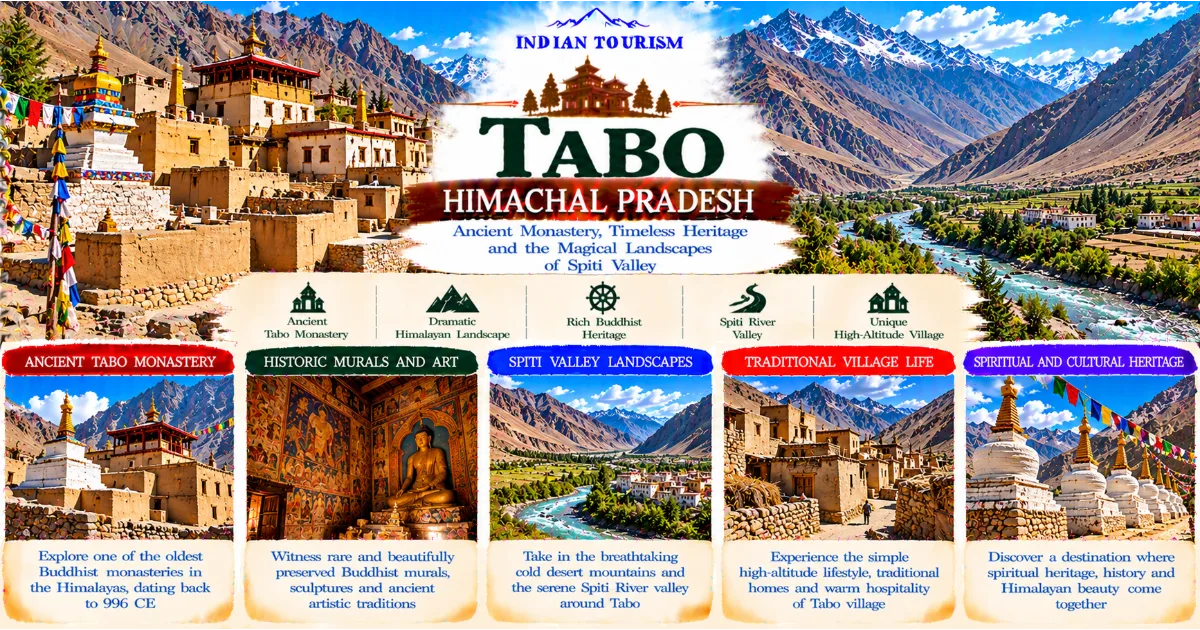
Discover the Spiritual Heart of Spiti Valley
High in the cold desert mountains of Himachal Pradesh, far from the crowded hill stations and busy tourist markets, lies Tabo, a remarkable village known for its ancient Buddhist monastery, traditional mud-brick architecture and dramatic Himalayan landscape. Located in the Spiti Valley, Tabo offers a different experience of mountain travel. Instead of dense forests and green valleys, visitors encounter barren mountains, deep blue skies, winding roads and settlements that have adapted to life in a high-altitude desert.
Tabo is one of the most historically significant destinations in the region. Its monastery, founded in 996 CE according to traditional historical accounts, is among the oldest continuously functioning Buddhist monastic establishments in the Himalayan world. The complex preserves murals, sculptures, religious spaces and artistic traditions that connect the village with centuries of Buddhist learning and cultural exchange.
The village is not only a destination for travellers interested in history and religion. It also appeals to photographers, architecture enthusiasts, cultural explorers and people seeking a quieter journey through the Himalayas. The surrounding landscape creates a powerful contrast with the monastery's richly decorated interiors. Outside, the mountains appear almost bare, shaped by wind, water and geological time. Inside the historic religious spaces, painted figures, sacred imagery and carefully preserved artistic details reveal a sophisticated cultural world.
Tabo is particularly rewarding for travellers who want to understand Spiti beyond its scenery. The region's identity has been shaped by Tibetan Buddhist traditions, local communities, ancient trade routes and the practical demands of living in a remote mountain environment. Exploring Tabo provides an opportunity to appreciate these connections rather than treating the village merely as a quick stop on a road trip.
A visit requires preparation. Tabo stands at high altitude, where cold temperatures, dry air, strong sunlight and long road journeys can affect travellers. Facilities are more limited than in large towns, and road access can change with weather and seasonal conditions. A thoughtful itinerary allows time for acclimatisation, cultural exploration and appreciation of the surrounding landscape.
For anyone planning a journey through Himachal Pradesh, Tabo deserves a place among the state's most distinctive heritage destinations.
Where Is Tabo Located?
Tabo is situated in the Spiti subdivision of the Lahaul and Spiti district in Himachal Pradesh, northern India. It lies along the Spiti River valley, surrounded by high mountains, rocky slopes and settlements adapted to the conditions of a cold desert.
The village occupies an important position on the route connecting parts of Spiti with the wider Himalayan region. Travellers commonly include Tabo in journeys involving Kaza, Dhankar, Nako and other destinations across the Spiti landscape.
Unlike destinations where the principal attraction is a forest, lake or snow-covered summit, Tabo's identity combines cultural heritage with its environment. The village's buildings, monastery and agricultural areas are closely connected with the limited resources available in this dry mountain region.
Water is especially important in Spiti. Communities depend on water sources and irrigation systems to sustain crops and household needs. The contrast between cultivated land near settlements and the surrounding barren slopes illustrates how people have adapted to an environment with limited rainfall and a short growing season.
The village's location also makes it a useful stop for travellers exploring the cultural geography of Spiti. It provides a chance to learn about Buddhist heritage before continuing towards other monasteries, villages and mountain landscapes.
Because Tabo lies at a substantial elevation, visitors should avoid treating the journey as an ordinary lowland road trip. Rest, hydration, gradual acclimatisation and awareness of altitude-related symptoms are important parts of responsible travel planning.
Tabo Monastery: A Living Monument of Himalayan Buddhism
The central attraction of Tabo is its historic Buddhist monastery, traditionally dated to 996 CE. The monastery is widely recognised for its cultural significance, religious continuity and artistic heritage.
Its foundation is associated with the spread and development of Buddhism across the western Himalayan region. Over centuries, religious teachers, artists, patrons and local communities contributed to the monastery's continued importance.
The complex contains a collection of religious buildings and sacred spaces. Its architecture reflects the materials and construction methods available in the high-altitude environment, while its artistic features reveal connections with wider Buddhist traditions.
Visitors often notice the contrast between the monastery's understated exterior and the rich visual world preserved within its historic structures. The surrounding landscape is defined by earth tones, rock and open sky, while the interiors contain religious paintings, sculptures and symbolic imagery.
The monastery remains an active religious site. It should therefore be approached as a place of worship and learning rather than simply as a museum. Visitors should follow the instructions of monastery staff, respect areas that are closed to the public and avoid interrupting prayers or religious activities.
Photography rules can vary between buildings and spaces. Always ask whether photography is permitted before taking pictures, particularly inside sacred rooms.
The monastery's long history makes conservation especially important. Its buildings and artworks have endured changing climatic conditions and the passage of centuries. Careful visitor behaviour helps protect this heritage for future generations.
The Ancient Murals and Religious Art of Tabo
One of Tabo Monastery's most remarkable features is its collection of historic murals. These paintings preserve religious themes, sacred figures and artistic traditions associated with Himalayan Buddhism.
The murals are important not only because of their age but also because they provide insight into the cultural connections that shaped the region. Himalayan monasteries historically formed part of networks through which religious ideas, artistic methods, manuscripts and teachers travelled.
The paintings may depict Buddhas, bodhisattvas, protective deities, mandalas and other figures from Buddhist religious traditions. Their arrangement and symbolism are connected with teachings and practices that can be difficult to interpret without specialist knowledge.
For visitors, observing the murals offers an opportunity to appreciate the skill required to create detailed religious art within a remote mountain setting. Colours, outlines, decorative patterns and the positioning of figures contribute to a visual language intended to support religious understanding and contemplation.
The murals should be viewed carefully. Flash photography, touching painted surfaces and ignoring instructions can contribute to damage or interfere with conservation efforts. Visitors should never assume that a sacred interior permits unrestricted photography.
The preservation of ancient murals is challenging because materials can be sensitive to changes in humidity, temperature, light and human activity. Conservation work may involve balancing public access with the need to protect fragile surfaces.
Even travellers without a background in Buddhist art can appreciate the murals by taking time to observe their detail and atmosphere. Reading interpretive information where available or learning from a knowledgeable guide can deepen the experience.
The Sculptures and Sacred Spaces of the Monastery
Tabo Monastery is also known for its sculptures and religious interiors. These works form part of a broader artistic tradition in which images are used to express Buddhist teachings and provide a focus for devotion.
Sacred sculptures can represent enlightened beings, teachers and other figures whose meanings are grounded in Buddhist philosophy and ritual practice. Their forms, gestures, ornaments and positions may carry specific symbolic significance.
The buildings within the complex serve different purposes. Some spaces are used for worship, while others may be associated with teaching, community activities or the preservation of religious heritage.
Visitors should remember that the meaning of a religious image is not always obvious from its appearance. A guide familiar with the monastery's history can explain the context of particular figures and architectural features.
The physical atmosphere of the monastery is an important part of the experience. Thick walls, small openings and enclosed rooms create an environment quite different from the bright, open landscape outside. This contrast reflects both the practical requirements of mountain construction and the spiritual functions of the buildings.
Respectful conduct is essential. Dress modestly, speak quietly and follow any directions about where visitors may walk or sit. Avoid touching sculptures, ritual objects or architectural details.
For travellers interested in cultural heritage, the monastery provides an opportunity to see how art, architecture and religious practice can remain connected within a living community.
Why Tabo Is Important in the History of Buddhism
Tabo's historical importance extends beyond the village itself. The monastery is associated with the development of Buddhist institutions and artistic traditions across the western Himalayas.
Spiti's location placed it within a wider cultural landscape linking Himalayan communities with Tibet and other parts of Asia. Mountain passes and trading routes allowed people, ideas and materials to move between regions, although travel was often difficult and seasonal.
Religious institutions played important roles in these networks. Monasteries preserved teachings, supported religious education and provided places where communities could gather for ceremonies and learning.
Tabo's artistic heritage reflects this broader history of exchange. Its murals and sculptures are evidence of the movement and adaptation of religious ideas across geographical and cultural boundaries.
The monastery's survival over many centuries also reflects the commitment of local communities and religious practitioners. Maintaining a religious institution in a remote environment requires resources, knowledge and ongoing care.
Visitors should avoid reducing this history to a simple story of one culture influencing another. Himalayan Buddhist traditions developed through complex relationships involving local communities, religious teachers, patrons and artistic workshops.
A visit to Tabo can therefore become an introduction to the cultural history of the western Himalayas. It encourages travellers to consider how remote mountain settlements have participated in wider networks of belief, learning and artistic creation.
Tabo Village: Life in the Cold Desert
Beyond the monastery, Tabo is a village shaped by the demands of high-altitude living. Traditional homes, agricultural plots and local pathways reflect the relationship between the community and its environment.
The climate is dry for much of the year, and the growing season is relatively short. Water management is important for agriculture, and cultivated areas are often concentrated where irrigation and soil conditions allow farming.
Traditional buildings commonly use earth-based construction materials, including mud and stone. Such materials are closely associated with local building practices and can help create substantial walls suited to the region's temperature variations.
Village life continues according to seasonal needs, work and community traditions. Visitors may see people tending fields, moving supplies, caring for livestock or carrying out household tasks.
Travellers should remember that Tabo is a living settlement rather than an open-air exhibition. Homes and courtyards are private spaces, and residents should not be photographed without permission.
Walking through publicly accessible parts of the village can help visitors appreciate the scale and character of the settlement. Observe how homes relate to the monastery, agricultural land and the surrounding terrain.
Small local businesses and accommodation providers may supply meals, rooms and travel assistance. Supporting these services helps tourism contribute to the local economy.
Tabo's village atmosphere is best experienced through respectful curiosity. Taking time to understand daily life can be as meaningful as visiting its famous monastery.
The Cold Desert Landscape Around Tabo
The landscape surrounding Tabo is one of the defining features of the Spiti region. Mountains rise in layers above the valley, their exposed surfaces displaying shades of brown, grey, ochre and muted red.
Unlike the forested landscapes associated with many other parts of Himachal Pradesh, the cold desert receives limited precipitation. Vegetation is concentrated in suitable locations, particularly near settlements and water sources.
The resulting scenery can appear stark, but it contains considerable geological variety. Erosion, wind and water have shaped ridges, gullies and slopes over long periods.
Light changes the appearance of the landscape throughout the day. Early morning may reveal cool colours and long shadows, while late afternoon can bring warmer tones to exposed rock and village buildings.
Photographers often find that the simplicity of the landscape creates strong compositions. A monastery building, a cluster of homes or a cultivated field can stand out against the broad mountain background.
Visitors should remain aware of the environment's limitations. Water can be scarce, shade may be limited and sunlight can be intense even when the air feels cold.
Avoid walking onto unstable slopes or entering narrow gullies without suitable knowledge of the terrain. Loose rock and sudden weather changes can create hazards.
The cold desert around Tabo is not empty wilderness. It is a landscape shaped by geological processes and human adaptation, and understanding that relationship adds depth to the travel experience.
Best Time to Visit Tabo
The most suitable time to visit Tabo depends on road access, weather conditions and personal preferences. Because the village lies in a high-altitude region, seasonal planning is especially important.
Spring: April to May
Spring marks a gradual transition from winter conditions. Temperatures begin to rise, although nights can remain very cold and some routes may still be affected by snow or ice.
Visitors travelling during this period should confirm road access and carry warm clothing. The landscape can remain dry and dramatic, making it suitable for photography when conditions are clear.
Summer: June to August
Summer is often a practical season for travelling through Spiti because many high-altitude routes are more accessible than during winter. Days can be sunny, but temperatures may fall sharply after sunset.
This period can be suitable for exploring the monastery, walking through the village and visiting nearby destinations. Travellers should still monitor weather forecasts, particularly if their route includes high mountain passes.
The monsoon affects different parts of Himachal Pradesh differently. Spiti is relatively dry compared with many southern and eastern parts of the state, but access routes can still experience landslides, flooding or road damage.
Autumn: September to October
Autumn can offer clear skies and attractive visibility, although temperatures decline as winter approaches. Visitors may enjoy the contrast between the village's cultivated areas and the surrounding dry mountains.
Accommodation and transport options may become less frequent later in the season, so advance planning is advisable.
Winter: November to March
Winter brings very cold temperatures and the possibility of snow or ice affecting travel. Some routes may become difficult or temporarily inaccessible, and local services can be limited.
Only travellers with appropriate preparation and reliable local information should consider winter journeys into remote parts of Spiti. Confirm road conditions, accommodation availability and emergency options before departure.
For many visitors, the summer and early autumn period offers the most practical combination of access and sightseeing opportunities. However, no season guarantees safe road conditions, and current local advice should always guide the final decision.
How to Reach Tabo
Reaching Tabo requires planning because the village is located in a remote mountain region. Road journeys can be long, and travel times depend on weather, road conditions and the route selected.
By Road Through Shimla and Kinnaur
One common approach to Spiti is through Shimla and the Kinnaur region. This route passes through mountain settlements before continuing towards the Spiti Valley.
Travellers should allow sufficient time for the journey and avoid trying to cover excessive distances in a single day. Road conditions can change quickly, especially after rainfall or snowfall.
By Road Through Manali and the High Mountain Route
Another approach may involve travelling through Manali and the high-altitude route towards Kaza, depending on seasonal access and current road conditions.
This route can involve substantial elevation changes and may be closed or restricted during parts of the year. It should never be assumed to be open simply because summer has arrived.
By Bus
Public transport options serving the wider Spiti region can vary by season and operating conditions. Confirm current schedules and the location of stops before travelling.
If your plan includes an overnight stay in Tabo, arrange onward transport and accommodation in advance.
By Train
Tabo has no railway station. Travellers arriving by train must continue by road from a suitable railhead as part of their wider Himachal Pradesh itinerary.
By Air
There is no airport in Tabo. Air travellers must arrange onward road transport from an airport appropriate to their route.
Local Transport
Local taxis and private vehicles may be available for travel between settlements, but availability can be limited. Agree on fares and return arrangements before beginning a journey.
Mountain travel is unpredictable. Keep extra time in your itinerary and avoid making critical connections immediately after a long road journey.
Where to Stay in Tabo
Accommodation in Tabo generally consists of guesthouses, homestays and small hotels rather than large resort properties. Facilities vary, so visitors should check the details of individual properties before booking.
Ask whether the room has reliable heating, hot water, meals and suitable access for your vehicle. These details matter because nights can be cold even during the warmer months.
Homestays can provide an opportunity to learn about local food, household traditions and village life. Visitors should communicate their requirements clearly and respect the household's routines.
Advance reservations are sensible during the main travel season. Travellers arriving late in the day should avoid assuming that a suitable room will be available without prior arrangements.
If you are travelling with older adults or people who have difficulty walking, ask about stairs, room access and the distance to the main road.
Visitors should also consider the altitude when selecting an itinerary. Spending time at a lower elevation before reaching Tabo may help some travellers acclimatise more comfortably.
Choosing locally operated accommodation can help support the community. Treat staff and hosts respectfully, use water carefully and follow any rules regarding waste and heating.
Food and Local Cuisine in Tabo
Food in Tabo reflects the practical realities and cultural influences of the Spiti region. Meals may include simple Indian dishes alongside foods associated with Tibetan and Himalayan traditions.
Depending on the establishment, visitors may find soups, noodles, rice, vegetables, bread and warming beverages. The exact menu varies with season, supply availability and the preferences of individual households or restaurants.
Traditional foods in the wider region can include thukpa, a warming noodle soup, and momos, which are dumplings served with various fillings. Butter tea is also associated with Tibetan cultural traditions, although availability and preparation vary.
Food supplies can be more limited than in larger towns, so travellers should not expect an extensive choice at every meal. If you have dietary restrictions or allergies, explain them clearly before ordering.
Carry suitable snacks for longer journeys, especially when travelling between remote settlements. Keep food waste and packaging with you until it can be disposed of appropriately.
Drinking enough safe water is important in the dry, high-altitude environment. Visitors should use safe drinking water sources and avoid assuming that untreated water is suitable for consumption.
Eating at local establishments can add a valuable cultural dimension to the trip. It also provides a way to support small businesses serving both residents and visitors.
A One-Day Itinerary for Tabo
A one-day visit can provide an introduction to Tabo, although travellers should avoid rushing the experience.
Begin the morning with a visit to Tabo Monastery, allowing enough time to observe the architecture and learn about its history. Follow local instructions about access, photography and behaviour inside religious buildings.
After visiting the monastery, explore publicly accessible parts of the village. Observe the traditional building styles, agricultural spaces and relationship between the settlement and the surrounding mountains.
Arrange lunch at a local restaurant or guesthouse. This is an opportunity to sample regional food and rest before continuing the day.
In the afternoon, explore a safe viewpoint or accessible area around the village. The surrounding landscape offers opportunities for photography, particularly when the light changes across the exposed mountain slopes.
Keep the schedule flexible and avoid setting out on a long walk late in the day. If you are travelling onwards, leave sufficient time for the road journey.
A one-day visit works best when the monastery and village are treated as places to understand rather than attractions to check off a list.
A Three-Day Tabo Itinerary
Three days allow a more relaxed visit and provide additional time to understand the area's cultural and natural setting.
On the first day, arrive in Tabo and rest. If you have travelled from a lower elevation, avoid strenuous activity and pay attention to how you feel.
On the second day, spend the morning exploring the monastery and learning about its historic murals and religious traditions. Continue with a walk through accessible village areas and a meal at a local establishment.
On the third day, consider a carefully planned excursion to another accessible destination in the wider Spiti region. Dhankar or Kaza may be relevant depending on your route, current road conditions and available time. Confirm travel times and access arrangements locally before departure.
This itinerary should be adapted to your acclimatisation needs and the weather. Travellers who experience symptoms of altitude illness should not continue to higher elevations or strenuous activities without appropriate medical guidance.
A Five-Day Spiti Journey Featuring Tabo
A five-day itinerary can place Tabo within a broader exploration of Spiti, provided the road conditions and travel distances are suitable.
Spend the first day travelling towards the region and staying at an appropriate intermediate destination if required. Avoid trying to complete a demanding journey without sufficient rest.
On the second day, continue towards Tabo, allowing time for road delays and stops. Rest after arrival and keep physical activity light.
Use the third day to explore Tabo Monastery and the village. Learn about the area's history, architecture and religious traditions, and support local businesses through meals or accommodation.
On the fourth day, consider visiting another accessible destination in Spiti, selected according to the direction of your journey. Confirm road status and avoid travelling to remote locations without suitable transport and current information.
On the fifth day, begin the next stage of your trip or return along your planned route. Build flexibility into the schedule because mountain roads can be affected by weather and maintenance work.
This itinerary is a framework rather than a fixed schedule. Actual travel times, acclimatisation needs and road access should determine the final plan.
Photography Tips for Tabo
Tabo offers a distinctive combination of ancient architecture, traditional village buildings and stark mountain scenery.
Early morning and late afternoon can provide attractive light for photographing the surrounding landscape. The angle of the sun changes the colours of the mountains and creates shadows that reveal the texture of the terrain.
When photographing the monastery, follow all rules concerning interior photography. Sacred paintings and objects may be subject to restrictions designed to protect them.
Use a lens or camera setting appropriate for the available light, and avoid using a flash where it is prohibited. Do not touch walls or paintings to position yourself for a photograph.
Landscape photographers should remain on safe ground and avoid standing on unstable slopes or close to unprotected edges. Never stop a vehicle in a dangerous position to capture a view.
Photograph village life respectfully. Ask permission before taking portraits and avoid treating private homes as public attractions.
Carry spare batteries and protect camera equipment from dust, cold and dry conditions. A simple protective case can help prevent damage during long road journeys.
The most meaningful photographs of Tabo often combine the monastery with the surrounding environment, showing how the historic settlement fits into the larger Himalayan landscape.
Responsible Tourism and Cultural Respect
Responsible tourism is essential in Tabo because its cultural heritage and natural environment are vulnerable to careless visitor behaviour.
The monastery should be treated as an active religious institution. Dress modestly, speak quietly and follow instructions from staff and religious practitioners. Ask before taking photographs, and do not enter areas marked as restricted.
Do not touch murals, sculptures or ritual objects. These works are part of a heritage that has survived for centuries and requires careful protection.
Respect residents' privacy when walking through the village. Ask permission before photographing people or entering private spaces.
Water conservation is important in a dry region. Use water carefully and avoid unnecessary waste, especially during periods when supplies are limited.
Carry rubbish back to appropriate disposal points. Do not leave plastic bottles, wrappers or other waste on mountain roads, in fields or near streams.
Choose local accommodation and services where possible. Tourism can provide economic opportunities, but its benefits are strongest when visitors respect the community and local environment.
Avoid loud music and disruptive behaviour near homes and religious spaces. Tabo's atmosphere is part of its appeal, and protecting that atmosphere benefits both residents and travellers.
High-Altitude Safety in Tabo
Tabo's elevation means that travellers should take altitude seriously. Some visitors may experience headaches, nausea, dizziness, fatigue or difficulty sleeping after gaining elevation.
A gradual ascent and adequate rest can reduce the risk of altitude-related illness. Avoid intense physical activity immediately after arrival, drink safe fluids regularly and do not ignore symptoms.
Severe or worsening symptoms, including breathlessness at rest, confusion or difficulty walking normally, require urgent medical attention and descent where appropriate. Do not attempt to push through serious symptoms to complete an itinerary.
Carry essential medication and make sure you know how to obtain help if needed. Medical facilities are more limited in remote areas than in major cities.
The climate is dry and sunlight can be intense. Wear suitable clothing, protect your skin and eyes, and carry enough safe drinking water.
Road safety is equally important. Mountain roads may be narrow, exposed or affected by loose rock and weather. Use experienced drivers when appropriate, wear seat belts and avoid unnecessary night driving.
Before travelling, check current road conditions, weather forecasts and any local advisories. Conditions can change after departure, so remain flexible.
What Makes Tabo Different from Other Himalayan Destinations?
Many Himalayan destinations attract visitors primarily through snow-covered peaks, forests, lakes or adventure sports. Tabo offers a different combination of cultural heritage and landscape.
Its monastery provides a direct connection with the history of Buddhist art and religious life in the western Himalayas. The surrounding village shows how communities have adapted to a cold desert environment where water and agricultural land are limited.
The scenery is also distinctive. Exposed mountains, dry slopes and compact settlements create a visual contrast with the greener valleys found elsewhere in Himachal Pradesh.
Tabo rewards visitors who are interested in history, architecture and local culture. It is not necessarily the ideal destination for travellers seeking nightlife, shopping centres or extensive luxury facilities.
Its quieter character can be a major attraction, but visitors should remember that remoteness also means fewer services and longer journeys. Preparation is essential.
For travellers exploring Spiti, Tabo adds a cultural dimension that complements the region's dramatic natural scenery. It encourages a deeper understanding of the people, traditions and historical connections that have shaped the valley.
Conclusion: Experience the Timeless Heritage of Tabo
Tabo is one of Himachal Pradesh's most distinctive destinations because it brings together ancient Buddhist heritage, traditional village life and the stark beauty of the Spiti Valley. Its historic monastery, murals and sculptures provide insight into centuries of religious and artistic development, while the surrounding mountains reveal the environmental challenges of life in a high-altitude desert.
The village is best explored patiently. Visitors who spend time understanding the monastery, observing the architecture and learning about local livelihoods will gain more from the journey than those who treat Tabo as a brief roadside stop.
Planning is essential because the altitude, weather and remote location influence every part of the experience. Travellers should check road conditions, arrange accommodation, acclimatise gradually and respect local rules.
Above all, Tabo is a reminder that the Himalayas are not only a landscape of mountains and adventure. They are also a place of living traditions, historical connections and communities whose knowledge has developed over generations.
For anyone planning an exploration of Himachal Pradesh, Tabo offers a meaningful journey into the cultural heart of Spiti Valley.
#IndianTourism #Tabo #TaboMonastery #SpitiValley #HimachalPradesh #HimalayanHeritage #BuddhistHeritage #HimalayanTravel #CulturalTourism #AncientMonasteries #ExploreSpiti #IncredibleIndia #ResponsibleTourism #MountainTravel
