
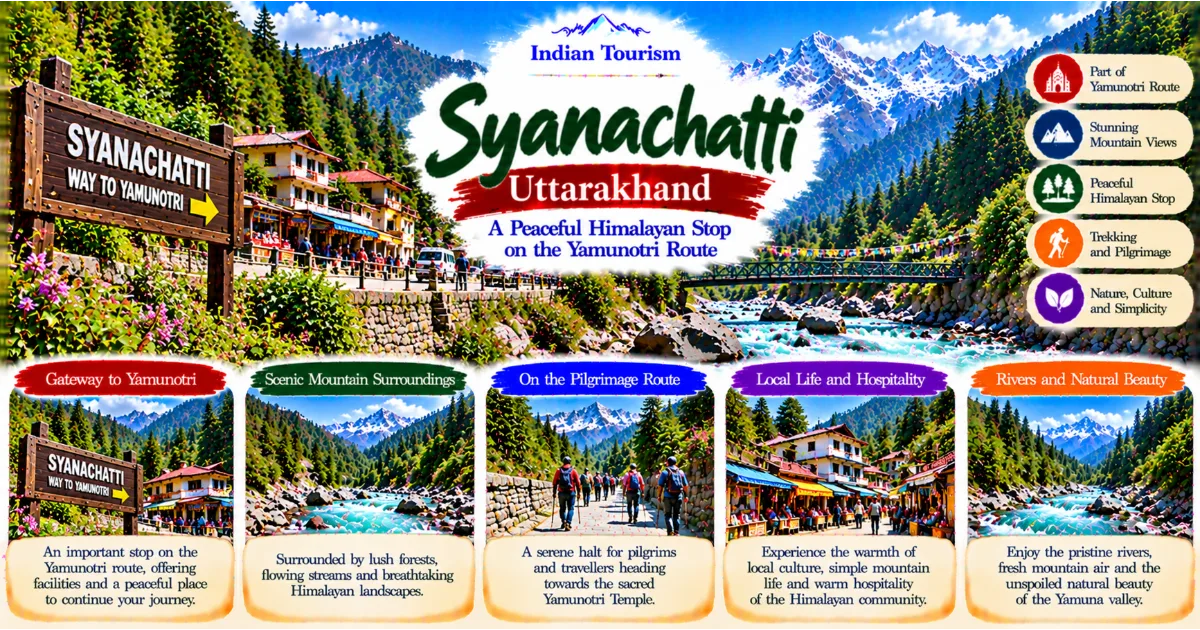
Discovering Syanachatti in the Garhwal Himalayas
Uttarakhand is a land where the mountains are not merely geographical formations but an inseparable part of everyday life, spirituality, culture, and tradition. Its winding roads connect remote settlements, sacred rivers flow through deep valleys, and small mountain villages welcome travellers journeying towards some of India's most revered pilgrimage destinations. Among these settlements, Syanachatti offers a glimpse of the quieter side of Himalayan travel. Situated along the route towards Yamunotri in the Uttarkashi district, it is associated with the journey through the upper Yamuna valley and the network of small settlements that support pilgrims and visitors heading into the mountains.
While famous destinations often attract attention because of their spectacular views, established tourist facilities, or religious importance, places such as Syanachatti are valuable for another reason. They reveal how travel unfolds beyond the major attractions. A mountain journey is made up of many small experiences, including watching the landscape change with elevation, observing village life, crossing streams, stopping beside a river, and discovering how people live in places where the terrain determines the rhythm of the day. Syanachatti belongs to this quieter travel experience.
For travellers exploring the Yamunotri region, Syanachatti can be considered as part of a broader journey through the Garhwal Himalayas. The area offers a setting shaped by mountain slopes, forested hills, the river valley, and roads that connect settlements across difficult terrain. Its importance to a visitor may depend on the purpose of travel. Pilgrims may encounter the settlement while proceeding towards Yamunotri, while road travellers may appreciate it as one of the smaller stops along the route. Those interested in regional geography and rural Himalayan life may find the surrounding landscape particularly meaningful.
It is important to approach Syanachatti with realistic expectations. It should not be confused with a large hill station or a major resort destination. The experience is more closely connected with the character of a mountain settlement and its place within the Yamunotri travel corridor. Facilities, accommodation availability, road conditions, and local services can vary by season. Travellers should confirm current arrangements before planning an overnight stay or treating the settlement as a fixed starting point for a particular excursion.
Where Is Syanachatti and What Makes Its Location Important?
Syanachatti is associated with the Yamunotri route in Uttarkashi district, Uttarakhand. The wider region lies within the Garhwal Himalayas, where settlements are often positioned along roads following river valleys and the natural contours of mountain slopes. Unlike plains destinations, where roads can follow relatively direct routes, Himalayan roads must respond to steep gradients, narrow valleys, unstable slopes, and the need to cross streams and rivers. As a result, distances that appear short on a map may take considerably longer to cover.
The Yamunotri region is known for its combination of pilgrimage traditions and dramatic mountain scenery. The journey towards the sacred Yamunotri Temple passes through a landscape of forested hills, settlements, river crossings, and changing elevations. Small roadside places play an important role in this journey because they connect larger settlements with the more remote parts of the valley. They provide opportunities for travellers to pause, arrange transport, obtain basic necessities where available, and observe the transition from everyday road travel to a journey deeper into the mountains.
Syanachatti's significance is therefore best understood in the context of the wider route rather than through expectations of a large collection of standalone attractions. The settlement forms part of the human geography of the region, where roads, rivers, villages, and pilgrimage routes are closely connected. The landscape is not simply a backdrop for sightseeing. It shapes where people live, how goods are transported, when visitors travel, and how seasonal activity changes throughout the year.
Because local place names and route descriptions may appear differently across travel listings, maps, and regional accounts, visitors should verify the exact location of Syanachatti and the current road arrangements before travelling. This is especially important when arranging accommodation, booking transport, or coordinating a journey during the busy pilgrimage season. Local confirmation can help prevent confusion between similarly named stops and nearby settlements.
The Landscape of the Yamuna Valley
One of the most appealing aspects of travelling through the Syanachatti area is the changing character of the Yamuna valley. Mountain landscapes are rarely static. Light moves across the slopes throughout the day, clouds gather around ridgelines, and the appearance of forests changes according to the season. Even during a relatively short road journey, visitors may notice a succession of views that make the route itself a memorable part of the trip.
The valley is shaped by the relationship between water and mountains. Rivers and streams descend from higher elevations, cutting through rocky terrain and collecting water from smaller channels along the way. Over long periods, flowing water has influenced the shape of the valley, the arrangement of riverbanks, and the location of settlements. Roads often follow these natural corridors because they offer some of the most practical routes through otherwise steep terrain.
The surrounding hills may display a mixture of forest cover, cultivated patches, rocky slopes, and clusters of buildings. The exact view changes depending on the position of the traveller, the weather, and the season. During clear conditions, mountain ridges may appear sharply defined against the sky. In cloudy weather, the same slopes can become partially hidden, giving the valley a more enclosed and atmospheric appearance.
Travellers should remember that mountain scenery is not always visible in the same way throughout the year. Monsoon clouds can obscure distant views, while winter conditions may bring cold temperatures and difficult road conditions. A clear morning may provide excellent opportunities for photography, but afternoon weather can change rapidly. Visitors who allow flexibility in their schedules are more likely to enjoy the landscape without feeling pressured to reach every destination at a predetermined time.
The Yamuna River and the Importance of Water
The Yamuna is one of the most culturally significant rivers in India. Its upper reaches in Uttarakhand are closely associated with the Himalayan landscape and the pilgrimage tradition surrounding Yamunotri. In the mountain region, the river and its tributaries are part of the physical environment that supports settlements, influences road construction, and gives the valley much of its visual character.
For travellers, the presence of flowing water often becomes one of the most memorable elements of the journey. The sound of a stream moving over stones, the changing colour of the water under different light, and the contrast between the river and the surrounding slopes can create a powerful sense of place. These experiences are often quieter than visiting a famous temple or viewpoint, but they help visitors appreciate the natural setting in which the pilgrimage route exists.
The river environment also deserves respect. Mountain streams can appear calm in one section and become fast-moving a short distance away. Their flow may increase suddenly after rainfall or during periods of snowmelt. Travellers should avoid entering unfamiliar water, standing on unstable rocks, or approaching the edge of a steep riverbank for photographs. A viewpoint that appears safe in dry weather may become slippery after rain.
Water is also central to the daily lives of Himalayan communities. Rivers and streams influence settlement patterns, agricultural activity, local infrastructure, and the availability of natural resources. Understanding this relationship helps visitors see the region as more than a scenic corridor. It is a living environment in which people must balance their needs with the challenges of mountain geography.
Syanachatti and the Yamunotri Pilgrimage Route
The Yamunotri pilgrimage is an important part of Uttarakhand's religious landscape. Yamunotri is traditionally regarded as the source region of the Yamuna and is one of the four destinations associated with the Char Dham pilgrimage of Uttarakhand. Every pilgrimage season, devotees travel through the Garhwal Himalayas to seek blessings, participate in religious traditions, and experience the sacred geography of the region.
The journey towards Yamunotri involves several stages. Travellers typically reach the broader region by road and continue through the mountain settlements towards Janki Chatti, from where the established final approach to the Yamunotri Temple begins. The exact route, road access, transport arrangements, and local restrictions should be checked before departure because conditions can change according to weather, maintenance work, and seasonal administration.
Syanachatti belongs to the network of places associated with travel through this wider corridor. For pilgrims, a small settlement along the route may serve as a place to pause, arrange supplies, or observe the landscape before continuing. For visitors who are not undertaking the pilgrimage, the same route provides an opportunity to learn about the relationship between religious travel and mountain life.
Pilgrimage journeys often encourage a different approach to time. Rather than treating every stop as an obstacle between the traveller and the final destination, visitors can use these pauses to appreciate the journey itself. A roadside tea break, a conversation with a local shopkeeper, or a short walk through a settlement can reveal details about the region that would otherwise be overlooked.
Travellers should not assume that every settlement along the route offers the same services. Accommodation, food, fuel, medical assistance, parking, and public transport may differ considerably between locations. Anyone planning to stay in or around Syanachatti should confirm the exact address of the property, its current operating status, road access, and the availability of essential facilities.
A Glimpse into Himalayan Village Life
One of the most rewarding aspects of visiting smaller mountain settlements is the opportunity to understand rural life beyond the familiar images of tourist brochures. Himalayan villages operate within a landscape that can be both beautiful and demanding. Steep slopes, limited flat land, seasonal weather, and long travel times influence everyday routines. Activities that seem simple in a city can require considerable planning when carried out in a remote mountain environment.
Settlements along pilgrimage routes may experience seasonal changes in activity. During periods of higher visitor movement, shops and service providers may see increased demand. Outside the busy season, the pace may become quieter, although local residents continue with their everyday responsibilities. This contrast illustrates how pilgrimage tourism can influence the economy of a mountain region while remaining only one part of local life.
Visitors may encounter small shops, roadside food stalls, transport services, local homes, and buildings adapted to the slope of the land. The appearance of these places depends on their location and the scale of the settlement. Travellers should avoid assuming that every village is organised primarily for tourism. Local people have their own work, schedules, social relationships, and concerns that continue regardless of the number of visitors passing through.
Respectful behaviour is essential. Ask permission before photographing people or entering private spaces. Follow local instructions, avoid blocking narrow roads, and dispose of waste responsibly. If you stop at a small shop or food stall, a polite conversation can provide useful local insight, but visitors should not treat residents as attractions or expect them to interrupt their work for photographs.
The most meaningful form of cultural tourism is one in which visitors remain curious without becoming intrusive. A little patience and respect can transform a brief stop into a valuable encounter with the everyday life of the Garhwal Himalayas.
Forests, Mountain Plants, and Seasonal Nature
The Himalayan landscape supports a variety of vegetation types, with plant communities changing according to altitude, rainfall, soil, sunlight, and local conditions. The wider Garhwal region contains forests, cultivated land, shrubs, grasses, and other forms of vegetation adapted to mountain environments. The exact species visible around a settlement such as Syanachatti depend on its elevation and the surrounding habitat.
Forests play several important roles in mountain ecosystems. They help stabilise slopes, support wildlife, regulate water movement, and contribute to the environmental conditions that sustain settlements downstream. Forested hills also shape the visual identity of many Himalayan valleys, creating a striking contrast with rocky ridges, rivers, and buildings.
The experience of the landscape changes through the year. Spring may bring fresh foliage and new growth, while summer offers relatively long daylight hours for road travel, subject to local weather and route conditions. The monsoon transforms the mountains with heavy rainfall and increased stream flow, but it can also increase the risks of landslides, road damage, and sudden travel delays. Autumn often brings clearer skies in many parts of the region, although conditions are never guaranteed. Winter can introduce freezing temperatures and restricted access in higher areas.
Nature observation does not require visitors to undertake a demanding trek. Even a short, careful walk in an accessible area can reveal changes in plant life, bird calls, light, and terrain. However, visitors should remain on established paths, avoid disturbing wildlife, and refrain from collecting plants or other natural materials.
The landscape should be treated as a shared resource rather than an unlimited attraction. Responsible tourism helps preserve the conditions that make mountain travel rewarding for future visitors and local communities alike.
Photography in and Around Syanachatti
The Yamuna valley offers opportunities for travel photography, particularly for people who enjoy natural landscapes and everyday mountain scenes. Instead of concentrating only on dramatic panoramas, visitors can look for smaller compositions that express the character of the region. A river moving beneath a bridge, a line of buildings following the road, forested slopes above a settlement, or changing light across the mountains can all become memorable subjects.
Early morning and late afternoon often provide softer light than the middle of the day. When the weather is clear, these periods can reveal the texture of the hills and the changing tones of the valley. Cloudy conditions can also produce attractive images, particularly when mist moves across the slopes. Rain, however, may reduce visibility and make walking surfaces slippery, so photographic opportunities should never take priority over personal safety.
Travellers should be cautious when taking photographs from roads. Mountain routes may be narrow, and vehicles often have limited room to pass. Never stand in the middle of the road or on an unstable shoulder for a better angle. Use only safe stopping places and follow instructions from drivers and local authorities.
When photographing people, shops, homes, or religious activities, ask for permission where appropriate. Respect restrictions around temples and sacred spaces. Drone use may be subject to local rules, security requirements, environmental restrictions, and permissions. Check the current regulations before bringing or operating a drone.
A thoughtful collection of photographs can tell a broader story of Syanachatti and its surroundings. Combining landscape images with details of local architecture, roadside life, and the river environment helps create a more balanced record of the journey.
Best Time to Visit Syanachatti
The best time to visit depends on the purpose of the journey, the prevailing weather, and the condition of the Yamunotri route. There is no single season that guarantees ideal conditions across the entire region. Visitors should consider both the attraction of the landscape and the practical requirements of mountain travel.
Spring: A Season of Fresh Growth
Spring can be an appealing time to travel through the lower and middle Himalayan valleys. Temperatures may become more comfortable than in winter, vegetation begins to develop, and the landscape can appear fresh after the colder months. Depending on the year and local conditions, spring may also coincide with preparations for the pilgrimage season.
Visitors should confirm when the Yamunotri route and relevant facilities are operating. The opening arrangements for the temple and access to different parts of the route follow official decisions and seasonal conditions. Travellers should not assume that all services are available simply because daytime temperatures are pleasant.
Summer: The Main Travel and Pilgrimage Period
Summer is a popular period for travelling through many parts of Uttarakhand, including the Yamunotri pilgrimage corridor. Longer daylight hours can make road journeys easier to schedule, while the higher mountain environment may offer relief from the heat experienced in the plains.
The same period can bring heavier visitor movement, particularly during holidays and busy pilgrimage dates. Accommodation may become more difficult to arrange at short notice, and roads may experience congestion. Advance planning is advisable for families, senior citizens, and travellers with fixed return schedules.
Monsoon: Beautiful but Unpredictable
The monsoon season brings rain that can transform the valley into a lush landscape. Forests and cultivated areas may appear vibrant, and streams may become more prominent. However, rainfall also creates some of the most important travel risks in the Himalayan region.
Landslides, falling rocks, damaged road sections, waterlogged paths, and temporary closures can affect travel. Even when conditions appear safe at the starting point, weather may be very different farther along the route. Visitors should check official road updates and weather advisories before travelling and should be willing to postpone their journey if conditions are unsafe.
Autumn: A Good Time for Landscape Appreciation
Autumn can offer clear views in many Himalayan areas after the monsoon has passed. For photographers and travellers who value mountain scenery, this period may be particularly rewarding. However, the actual conditions depend on rainfall patterns, local temperatures, and road maintenance.
Visitors should also confirm whether the services they need remain available. Some facilities may change their schedules as the pilgrimage season progresses. A quieter road does not necessarily mean every accommodation provider or transport service is operating.
Winter: Cold Weather and Access Considerations
Winter can bring low temperatures, frost, snowfall at higher elevations, and difficult road conditions in parts of the Himalayan region. Some facilities may close or reduce their operating schedules, and travel to higher areas may become restricted.
Anyone planning a winter visit should seek current local advice and confirm the status of the specific road sections they intend to use. Warm clothing, suitable footwear, flexible scheduling, and reliable transport arrangements are essential. Visitors should not attempt to push beyond safe limits simply to complete a planned itinerary.
How to Reach Syanachatti
Reaching Syanachatti generally involves travelling through the road network serving the Yamunotri region of Uttarakhand. The exact route depends on the starting city, current road conditions, transport availability, and the precise destination point within the settlement.
Travellers arriving from distant parts of India often plan their journey through major transport hubs before continuing by road into the Garhwal Himalayas. Dehradun and the wider network around Rishikesh and Haridwar are commonly used as gateways for journeys into Uttarakhand, although the most suitable connection depends on the traveller's origin and itinerary.
Road journeys through the region require more time than a simple distance calculation may suggest. Roads follow the contours of the valley, and progress can be affected by sharp bends, narrow sections, local traffic, weather, roadwork, and temporary restrictions. It is sensible to avoid building an itinerary around optimistic travel times.
Travelling by Road
Road travel is the most practical way to reach settlements along the Yamunotri corridor. Visitors may use private vehicles, hired taxis, or available public transport services, depending on the route and season. Before departure, confirm that the vehicle is suitable for mountain roads and that the driver is familiar with the route.
A private vehicle provides flexibility for stopping at viewpoints and roadside settlements, but parking may be limited. Public transport can be more economical, although schedules and service availability should be confirmed locally. Travellers who plan to continue towards Janki Chatti and the Yamunotri Temple should check the current transfer arrangements and understand where road travel ends and the walking route begins.
Travelling by Train
The nearest suitable railway connection depends on the broader itinerary and current transport arrangements. Many travellers use railway stations serving Dehradun, Haridwar, or Rishikesh before continuing by road. Train availability, travel duration, and onward connections should be checked when booking.
After reaching the railway station, allow sufficient time for the road journey. It is often more comfortable to avoid arriving late at night and immediately beginning a long mountain drive, particularly for visitors unfamiliar with the terrain.
Travelling by Air
Visitors arriving by air may consider the airport serving Dehradun, subject to current flight schedules and their point of origin. From there, onward road travel is required to reach the Yamunotri region. Flight availability and transfer time can vary, so travellers should coordinate arrival times with their road transport arrangements.
Regardless of the chosen mode, the final itinerary should be based on verified local information rather than assumptions about travel time or facility availability.
Accommodation and Food
Accommodation in smaller Himalayan settlements varies according to location, season, and local demand. Some places along pilgrimage routes have guesthouses, lodges, or basic accommodation facilities, while others may offer only limited services. It is important not to assume that Syanachatti has a particular type of hotel, resort, or restaurant without checking current listings and confirming the exact property.
Before booking, ask about room availability, heating arrangements, hot water, meal options, parking, electricity, mobile connectivity, and cancellation policies. These details can be particularly important during colder months or periods of heavy rainfall. Travellers with young children, older family members, or specific accessibility requirements should confirm that the accommodation meets their needs.
Food options along mountain routes may include simple meals, tea, snacks, and familiar North Indian dishes. Availability can change according to the season and visitor numbers. Travellers with dietary restrictions should communicate their needs clearly and carry suitable snacks for longer stretches of travel.
It is also wise to carry drinking water and essential personal supplies. Visitors should avoid leaving plastic bottles, food wrappers, or other waste behind. Where waste collection facilities are limited, carry rubbish until it can be disposed of responsibly.
Suggested Itinerary for Exploring the Yamunotri Corridor
Syanachatti is best considered within a broader itinerary through the Yamunotri region rather than as an isolated destination requiring several days of sightseeing. The duration of the trip should depend on road conditions, pilgrimage plans, available accommodation, and the amount of time travellers wish to spend enjoying the landscape.
Day One: Reach the Yamuna Valley
Begin by travelling towards the Yamunotri region from the selected transport gateway. Depending on the starting point and road conditions, the journey may take a substantial part of the day. Plan for rest stops, meals, and possible delays.
Rather than attempting to cover too much ground, focus on reaching confirmed accommodation safely. If conditions and daylight permit, enjoy a short walk in a suitable area and observe the surrounding valley. Keep the evening flexible, especially during the monsoon or periods of heavy visitor movement.
Day Two: Explore the Surrounding Settlements
Use the second day to explore accessible settlements and landscape viewpoints along the route. If Syanachatti fits the verified route and accommodation plan, allow time to appreciate the local setting rather than treating the stop as a brief photograph opportunity.
Visitors can look for safe riverside viewpoints, observe mountain architecture, and learn about the relationship between the settlement and the pilgrimage corridor. Any walking should remain within accessible areas, and travellers should ask locally before following unfamiliar paths.
If the primary purpose of the trip is pilgrimage, confirm the latest transport and access arrangements for continuing towards Janki Chatti and Yamunotri. The day's plan should be adjusted to account for the physical demands of the pilgrimage.
Day Three: Continue the Pilgrimage or Return
Depending on the itinerary, travellers may continue towards the Yamunotri Temple route or begin their return journey. The temple visit and associated walking route require preparation, suitable footwear, drinking water, and awareness of altitude, weather, and personal fitness.
Visitors should leave enough time for the return drive. Mountain journeys can take longer than expected, and it is safer to avoid rushing through unfamiliar roads after dark whenever possible.
This itinerary is a planning framework, not a guarantee of current road access or operating schedules. Confirm each stage before departure, especially if the trip falls during the monsoon, winter, or a busy pilgrimage period.
Responsible Tourism in the Himalayas
The natural beauty of the Yamuna valley depends on a delicate relationship between water, forests, slopes, wildlife, settlements, and human activity. Tourism can support local livelihoods, but it can also place pressure on waste collection, roads, water supplies, and fragile mountain environments. Responsible travel helps reduce these pressures.
The first principle is to leave the landscape as clean as it was found. Carry reusable water bottles where practical, avoid single-use plastics when alternatives are available, and never throw rubbish into rivers, streams, forests, or roadside drains. Even small items can accumulate when thousands of visitors pass through a region.
The second principle is to respect the natural environment. Do not damage vegetation, disturb wildlife, or leave established paths without understanding the terrain. Steep slopes and riverbanks can be unstable, and informal shortcuts may cause erosion or expose visitors to unnecessary risk.
The third principle is to support local businesses responsibly. Where suitable services are available, consider using locally operated accommodation, shops, transport providers, and food establishments. Fair spending can contribute to the livelihoods of residents whose work supports tourism throughout the region.
The fourth principle is cultural sensitivity. The Yamunotri corridor is not only a scenic destination but also a place of religious significance. Dress and behave respectfully around sacred places, follow local instructions, and ask permission before photographing religious activities or private property.
Finally, responsible tourism requires flexibility. If a road is closed, a river is swollen, or authorities advise against travel, change the plan. No viewpoint, photograph, or pilgrimage schedule is worth risking a life. Respect for the mountains includes accepting that access can be limited by natural conditions.
Travel Safety and Practical Advice
Mountain travel requires preparation because weather and road conditions can change quickly. Before leaving, check current forecasts, road status, and any official notices relating to the Yamunotri route. If travelling during the monsoon, pay particular attention to rainfall warnings and reports of landslides or road closures.
Carry clothing suitable for changing temperatures. Even when the lower valley feels warm, conditions may become cooler as the journey continues. Comfortable walking shoes with good grip are useful for uneven surfaces, while rain protection is valuable during periods of uncertain weather.
Keep essential medicines, identification, emergency contact information, a charged phone, and some cash accessible. Mobile coverage may be inconsistent in mountainous areas, and digital payment facilities may not always be available. Travellers should inform someone of their itinerary if they plan to visit less familiar areas.
Drivers should avoid rushing, particularly on narrow roads and blind bends. Use designated stopping places for photographs and never park where the vehicle could obstruct traffic or emergency access. If travelling with children or older relatives, allow additional rest time and consider their comfort when planning each stage.
Visitors should also be realistic about physical exertion. The journey towards Yamunotri involves a demanding mountain environment, and the final approach to the temple requires walking. Anyone with medical concerns should seek appropriate professional advice before undertaking strenuous activity and should follow official guidance during the pilgrimage.
Who Should Visit Syanachatti?
Syanachatti may appeal to travellers who want to understand the wider Yamunotri route and appreciate the smaller settlements that connect the region. It can be of interest to pilgrims, road-trip enthusiasts, photographers, nature lovers, and people who enjoy discovering places beyond the best-known tourist centres.
Pilgrims may appreciate the settlement as part of the journey through the Yamuna valley. Travellers who enjoy road trips may value the changing scenery and the experience of moving through a landscape shaped by rivers and steep mountain slopes. Photography enthusiasts may find opportunities to capture the contrast between natural scenery and everyday settlement life.
Visitors who prefer highly developed tourist facilities, extensive shopping, nightlife, or a large selection of organised activities may find that a small roadside settlement does not match their expectations. Its value lies more in its setting and its place within the wider route than in a large collection of attractions.
Families can include the area in a broader trip if the route, accommodation, and facilities suit their needs. However, they should verify essential services in advance and avoid assuming that every stop will provide medical assistance, specialised food, or convenient transport connections.
For travellers who appreciate the quieter details of Himalayan journeys, Syanachatti can be a reminder that a destination does not need to be famous to be meaningful. Sometimes the most rewarding part of a trip is the opportunity to slow down and notice how geography, culture, and travel come together.
Conclusion: Appreciating the Quieter Side of Uttarakhand
Syanachatti represents the kind of place that helps travellers understand the Yamunotri region as a connected landscape rather than a collection of separate attractions. Its relevance comes from its association with the mountain route, the surrounding river valley, and the settlements that support movement through the Garhwal Himalayas.
A visit should be planned with practical expectations. Confirm the exact location, current access, transport arrangements, and availability of accommodation before setting out. Weather, seasonal pilgrimage activity, and road conditions can influence what is possible on any given day.
Beyond these practical considerations, the wider experience of the region offers much to appreciate. The movement of the river, the slopes covered with vegetation, the rhythm of village life, and the gradual journey towards Yamunotri all contribute to the character of this part of Uttarakhand. Travellers who remain attentive to these details can discover value in places that are often treated merely as stops along the road.
Syanachatti is best approached with curiosity, patience, and respect for the environment and people who live there. By travelling responsibly and allowing enough time for the journey, visitors can appreciate a quieter side of the Himalayas while contributing to the preservation of the region for future generations.
#IndianTourism #UttarakhandTourism #Syanachatti #Yamunotri #Uttarkashi #GarhwalHimalayas #HimalayanTravel #MountainVillages #YamunaValley #PilgrimageTourism #ResponsibleTourism #ExploreUttarakhand #IncredibleIndia
