
A Journey Millions of Years into the Past
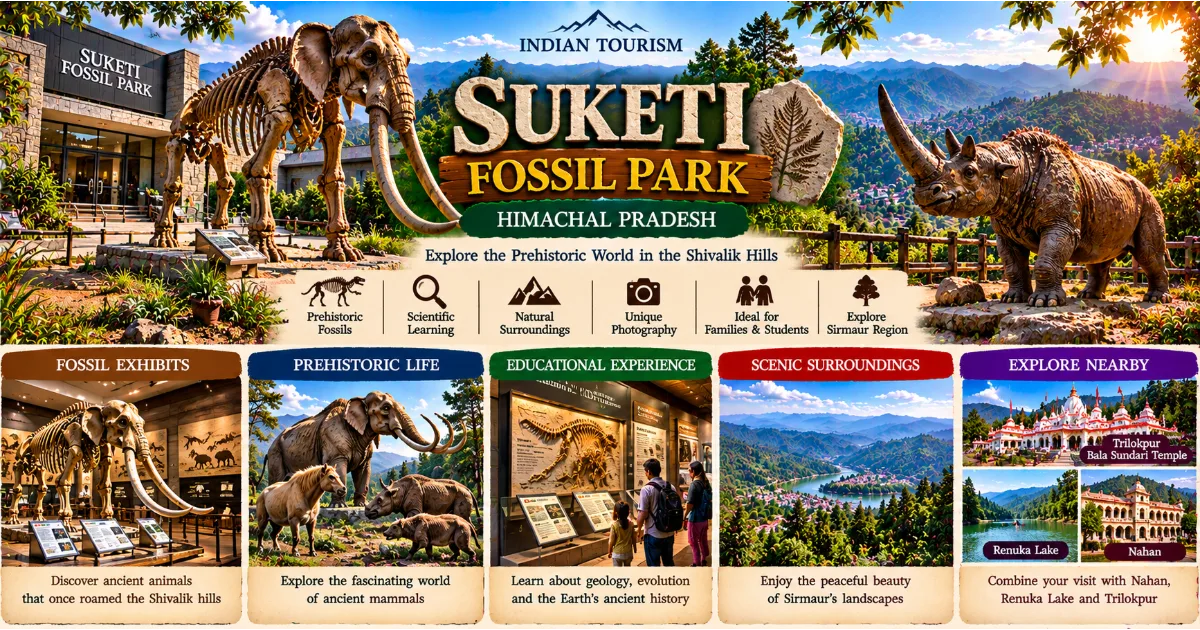
Himachal Pradesh is widely known for its snow-covered mountains, cedar forests, peaceful hill stations, ancient temples and winding roads that pass through some of the most beautiful landscapes in northern India. Yet, beyond its familiar mountain scenery lies another extraordinary attraction that offers a very different kind of travel experience. Suketi Fossil Park, located near Nahan in the Sirmaur district, invites visitors to explore a world that existed millions of years before modern human civilisation. Instead of focusing only on mountain views and traditional sightseeing, this remarkable destination introduces travellers to the prehistoric animals that once inhabited the region and the scientific discoveries that have helped researchers understand the distant past.
Officially associated with the discovery and preservation of prehistoric vertebrate fossils, Suketi Fossil Park is among India's important destinations for understanding palaeontology. The park is particularly notable for fossils of ancient mammals that lived during geological periods when the landscape and climate of the Indian subcontinent were very different from those of today. Reconstructions of extinct animals help visitors imagine the creatures that once moved across ancient river systems and forested environments in the region. For families, students, nature enthusiasts, history lovers and curious travellers, the park provides an opportunity to learn about the relationship between geology, evolution, climate and the changing environment of the Earth.
The experience of visiting Suketi Fossil Park is different from a conventional sightseeing trip. Here, the attraction is not a spectacular waterfall or a high mountain summit, but the evidence of life preserved in the ground over immense periods of geological time. The destination encourages visitors to think beyond familiar historical timelines and appreciate the vast age of the natural world. A visit can also be combined with a broader exploration of Nahan and the surrounding areas of Sirmaur, creating a journey that brings together science, culture, landscapes and local life.
Where Is Suketi Fossil Park Located?
Suketi Fossil Park is situated in the Sirmaur district of Himachal Pradesh, in the vicinity of Nahan. The surrounding region forms part of the Shivalik hills, a range of foothills lying along the southern edge of the greater Himalayan mountain system. These hills are especially significant to geological research because their sedimentary formations contain evidence of ancient environments and the organisms that lived in them.
The park is associated with the Suketi area, where important fossil discoveries brought scientific attention to the region. The geology of the surrounding landscape helps explain why fossil remains have been found here. Over millions of years, rivers transported sediments across ancient plains, burying animal remains beneath successive layers of sand, silt and other materials. Under suitable conditions, some of these remains were preserved and eventually became part of the geological record.
The setting makes the park a useful addition to a visit to Nahan. Travellers exploring the district can experience both its cultural attractions and its scientific significance. Nahan offers a different atmosphere from the busy tourist centres of Himachal Pradesh, with traditional neighbourhoods, historic sites, forested surroundings and access to several natural attractions. Suketi Fossil Park adds an educational dimension to this experience, making the region appealing to visitors who prefer destinations with a distinctive story.
Because the park lies away from the main tourist circuits of Shimla and Manali, it can be especially attractive to travellers seeking lesser-known destinations. Visitors should nevertheless plan their transport and confirm local access arrangements before travelling, as facilities and travel conditions may vary.
Understanding the Scientific Importance of the Park
What Is Palaeontology?
Palaeontology is the scientific study of ancient life through fossils. Fossils may include preserved bones, teeth, shells, footprints, plant impressions and other evidence of organisms that lived in the distant past. They help scientists reconstruct ancient ecosystems and understand how life has changed over millions of years.
A fossil is not simply an old bone. It represents a piece of evidence that has survived a complicated process involving burial, chemical changes, geological pressure and the passage of time. In many cases, the original biological material is gradually replaced by minerals. In other circumstances, the remains may be preserved in a different form. The precise process depends on the conditions in which the organism was buried and the geological history of the surrounding sediment.
Suketi Fossil Park offers visitors an introduction to this fascinating field. The fossil record of the Shivalik region has helped researchers investigate ancient mammals, environmental changes and the evolution of animal communities. Through fossil displays and reconstructed specimens, visitors can begin to understand how scientists use incomplete evidence to develop explanations about the past.
The study of fossils also demonstrates the importance of careful observation. A single tooth may reveal clues about an animal's diet, while the shape of a limb bone may provide information about how an animal moved. Comparing fossils from different geological layers can help scientists identify changes in species over time. When combined with geological evidence, these discoveries allow researchers to reconstruct environments that disappeared long before written records existed.
Why the Shivalik Hills Matter
The Shivalik hills are particularly important in the study of the geological history of northern India. Their sedimentary rocks preserve evidence of ancient rivers, floodplains and changing landscapes. Over long periods, erosion in the rising Himalayan region carried enormous quantities of sediment into lower areas. These deposits gradually accumulated and became rock formations containing fossils.
The fossil-bearing deposits of the Shivalik region have provided evidence of diverse prehistoric mammals. Researchers have studied remains associated with ancient elephants, relatives of modern horses, large herbivores, predators and other groups of animals. These discoveries have contributed to a better understanding of how mammals evolved and how ancient environments changed.
The geological history of the region is closely connected to the development of the Himalayas. As tectonic forces raised the mountain system, the surrounding landscape changed, river networks shifted and sedimentation continued across the foothills. Fossils preserved within these deposits offer a record of life during these changing conditions.
For visitors, this connection between mountains and prehistoric life adds an unexpected dimension to the landscape. The hills are not only scenic formations to be admired from a viewpoint. They also preserve clues about a much older world, making the region valuable for both tourism and scientific research.
The Prehistoric Animals That Capture Visitors' Attention
Ancient Elephants and Their Relatives
Among the most fascinating groups represented in the fossil record of the Shivalik region are prehistoric proboscideans, the broader group that includes modern elephants and their extinct relatives. The history of this group is more complex than many visitors realise. Different species lived in different environments, possessed different teeth and tusks, and adapted to changing food sources over millions of years.
Some prehistoric relatives of elephants differed considerably from the animals familiar to us today. Their body proportions, skull structures and feeding adaptations reflected the environments in which they lived. Fossil teeth can be particularly informative because their size, shape and wear patterns may provide clues about diet.
Reconstructions of ancient elephants and related animals help visitors imagine how large mammals once moved across the landscapes of the Indian subcontinent. They also encourage questions about extinction, adaptation and the changing availability of food and habitat.
Modern elephants are highly intelligent animals that play important ecological roles in the environments they inhabit. Their prehistoric relatives, however, lived in ecosystems that no longer exist in their original form. Studying these extinct animals helps scientists understand the long history of mammalian evolution and the environmental changes that shaped it.
Prehistoric Horses and Other Hoofed Mammals
The fossil record of the Shivalik region also includes evidence of ancient hoofed mammals. Some belonged to evolutionary groups related to animals that survive today, while others represented branches of the mammalian family tree that eventually disappeared.
The evolutionary history of horses provides a useful example of how animals can change over long periods. Modern horses belong to a lineage that experienced changes in body size, limb structure, teeth and feeding adaptations. These changes were influenced by ecological conditions, including shifts in vegetation and habitat.
Fossils allow scientists to compare the anatomy of ancient species with that of modern animals. The structure of teeth can suggest whether an animal consumed soft vegetation or tougher grasses. The shape and proportions of limb bones can offer information about movement and body weight. Such clues help researchers develop a more detailed picture of prehistoric ecosystems.
The fossil displays at a destination such as Suketi can make these scientific ideas easier to understand. Instead of reading about evolution only in textbooks, visitors can encounter physical evidence and reconstructed forms that bring the subject closer to everyday experience.
Large Herbivores and Ancient Predators
Ancient ecosystems depended on relationships between plants, herbivores and predators. Fossil evidence from the wider Shivalik region has helped researchers investigate the variety of mammals that lived in these environments and the ecological roles they may have occupied.
Large herbivores depended on vegetation and access to water. Predators, in turn, depended on prey populations and suitable hunting habitats. Changes in rainfall, temperature, river systems and vegetation could influence the distribution of these animals. Over time, some species adapted to changing conditions, while others became extinct.
It is important to understand that a fossil park is not simply a collection of impressive prehistoric creatures. Its scientific value lies in the relationships between the specimens and the geological evidence surrounding them. Fossils can help explain how ecosystems functioned, how species responded to environmental changes and why the composition of animal communities changed over time.
For young visitors, these subjects can create an engaging introduction to ecology and evolutionary biology. For adults, they offer an opportunity to appreciate how much information can be recovered from remains that have survived for millions of years.
How Fossils Are Formed
From Living Animal to Geological Evidence
The formation of a fossil begins when an organism dies, but preservation is far from guaranteed. Most dead animals decompose, and their remains are destroyed by scavengers, weather and microorganisms. Fossilisation requires special circumstances that protect at least part of the remains from complete destruction.
Rapid burial by sediment can improve the chances of preservation. An animal that dies near a river may become covered by sand or silt during a flood. If the remains remain undisturbed, mineral-rich groundwater can move through the surrounding sediment. Over time, chemical processes may preserve or replace parts of the original material.
The buried remains may remain hidden for millions of years as additional sediment accumulates above them. Geological processes gradually transform the sediment into rock. Much later, erosion may expose the fossil-bearing layers at the surface, allowing researchers to discover them.
This process explains why fossils are rare and why particular geological environments are especially important. The presence of ancient life alone does not guarantee that fossils will form. Burial conditions, sediment chemistry and later geological changes all influence whether remains survive.
How Scientists Study Fossils
Once a fossil is discovered, scientists must document its location and geological context carefully. The precise position of a specimen within a rock formation can be as important as the specimen itself. Without reliable information about its origin, researchers may lose valuable evidence about its age and environment.
Specialists examine the shape, size and internal structure of fossils. They compare these features with known specimens to identify similarities and differences. In some cases, laboratory imaging and other analytical methods provide additional information that cannot be obtained through ordinary visual inspection.
Scientists also study the rock surrounding a fossil. Sediment type, mineral composition and the position of geological layers can help establish the environmental conditions under which the remains were preserved. When multiple discoveries are considered together, researchers can develop broader explanations about ancient habitats and evolutionary changes.
Visitors should remember that scientific interpretations may change as new evidence becomes available. Palaeontology is an active field of research, and discoveries from one region can influence how scientists understand specimens found elsewhere. This ongoing process makes fossil studies both challenging and exciting.
What Visitors Can Experience at Suketi Fossil Park
Fossil Displays and Prehistoric Reconstructions
One of the main attractions of Suketi Fossil Park is its focus on prehistoric animals and the fossil heritage of the Shivalik region. Displays and reconstructions help visitors visualise creatures that lived long before the emergence of modern human societies.
The reconstructed animals can be particularly engaging because fossils themselves are often incomplete. A visitor looking at a fragment of a skull or a fossilised tooth may find it difficult to imagine the original animal. A carefully prepared reconstruction offers a visual interpretation of what the creature may have looked like, based on available scientific evidence.
These representations should be understood as educational aids rather than photographs of the prehistoric world. Researchers use fossil anatomy and comparisons with related animals to develop reconstructions, but certain details may remain uncertain. This distinction provides an excellent opportunity to discuss how science separates evidence from interpretation.
Visitors should take time to read available descriptions and interpretive information instead of moving quickly through the exhibits. Understanding the relationship between the specimens, the geological layers and the ancient environment makes the experience more rewarding.
An Educational Visit for Families
Suketi Fossil Park can be a useful destination for families who want to combine a day out with learning. Children often find prehistoric animals fascinating, and the park can provide a starting point for discussions about fossils, extinction and the history of life.
Parents can encourage children to observe the differences between reconstructed animals. How might the shape of a tooth relate to diet? Why would an animal need long legs? What evidence would scientists use to determine whether a creature ate plants or meat? Questions such as these help children connect visual displays with scientific reasoning.
The visit can also encourage an interest in geology. Children can learn that mountains, valleys and rock formations have histories that extend far beyond human memory. They can begin to understand that the natural world is constantly changing, even when those changes occur over periods too long for people to observe directly.
For school groups, the park can complement lessons in biology, geography, environmental studies and Earth science. Teachers can prepare students by introducing basic concepts about fossil formation and then encourage them to reflect on what they observed during the visit.
A Destination for Curious Adult Travellers
Suketi Fossil Park is not limited to children or school groups. Adult travellers with interests in science, natural history, geology and the evolution of life may find it especially rewarding.
The destination offers an alternative to the usual hill station itinerary. Instead of spending the entire day visiting viewpoints and markets, travellers can explore a subject that connects the local landscape with global scientific questions. The park can also encourage visitors to look at the surrounding hills differently, recognising that the rocks beneath their feet preserve a record of ancient environments.
For photographers, the experience may be more focused on exhibits, reconstructions and the atmosphere of the site than on expansive mountain scenery. Visitors should follow the park's rules regarding photography and avoid touching or handling scientific specimens unless explicitly permitted.
Best Time to Visit Suketi Fossil Park
Spring and Early Summer
Spring is generally a pleasant season for exploring the Nahan region. Temperatures become more comfortable after the cooler winter months, and the surrounding hills may display fresh greenery. The period can be suitable for combining the fossil park with local sightseeing.
Early summer can also work well, particularly for visitors planning to explore several nearby attractions in one trip. However, daytime temperatures can rise, so carrying drinking water, wearing comfortable clothing and avoiding unnecessary exposure to the midday sun are sensible precautions.
The best experience depends on current local conditions and the park's operating arrangements. Travellers should confirm opening hours and accessibility before setting out, particularly if they are making a special journey primarily to visit the fossil park.
Monsoon Season
The monsoon brings rainfall to the region, transforming the landscape with greener vegetation and fuller streams. The hills can look especially attractive during this period, but travel requires additional care.
Heavy rain can affect road conditions, increase the risk of landslides in hilly areas and cause delays. Visitors travelling during the monsoon should check weather and road updates, allow extra time for their journey and avoid unnecessary travel during severe conditions.
A visit during the rainy season may be rewarding when conditions are stable, but flexibility is important. If the weather becomes unsuitable, travellers can adjust their plans and explore indoor attractions or postpone the trip.
Autumn and Winter
Autumn often provides comfortable conditions for sightseeing around Nahan, with clearer days and pleasant temperatures. It can be a good season for visitors who wish to explore the fossil park and nearby cultural attractions without the intensity of summer heat.
Winter can bring cooler mornings and evenings. The climate around Nahan is generally different from the colder high-altitude destinations of Himachal Pradesh, but travellers should still carry suitable layers and check forecasts before departure.
For most visitors, the most practical approach is to select a season that offers comfortable travel conditions and then verify the park's current schedule. Since access arrangements may change, planning around confirmed information is more reliable than assuming the site will always operate in the same way.
How to Reach Suketi Fossil Park
By Road
Road travel is a practical way to reach the Nahan area from other parts of Himachal Pradesh and neighbouring states. Visitors can travel towards Nahan and arrange local transport for the onward journey to Suketi Fossil Park.
The route and journey time will depend on the starting point, traffic and road conditions. Travellers arriving from major cities should account for the winding roads and slower speeds that are common in hilly areas. A private vehicle offers flexibility, while a taxi can be convenient for visitors unfamiliar with the region.
Before departure, confirm the precise location of the park and whether local transport can reach the entrance directly. This is particularly important for visitors travelling with children, older family members or anyone who may have difficulty walking longer distances.
By Rail
Travellers using the railway network can plan their journey through a suitable railhead serving the wider region and then continue towards Nahan by road. The most appropriate station depends on the origin of the journey and the available train services.
Rail travel can be useful for visitors coming from distant cities because it reduces the need for a long drive. However, the final road connection should be planned in advance, especially if arrival occurs late in the day.
By Air
For travellers coming from distant parts of India, the nearest practical airport will depend on flight availability and the road journey required to reach Nahan. After landing, visitors can continue by taxi or another suitable road connection.
Flight schedules, airport services and road travel times can change. It is best to compare the full journey rather than choosing an airport solely on the basis of distance. A convenient flight combined with a manageable road transfer can make the trip significantly easier.
Local Transport and Planning
The last part of the journey deserves special attention. Visitors should confirm the park's exact location, local road access, operating hours and any entry requirements before travelling. If public transport is limited, arranging a taxi in advance can prevent delays.
A useful approach is to visit the park during daylight hours and leave enough time to return to Nahan. Travellers unfamiliar with the area should avoid building an itinerary that depends on reaching several distant attractions in a single afternoon.
Places to Explore Around Suketi Fossil Park
Nahan
Nahan is a natural base for exploring Suketi Fossil Park. The town has a distinctive character shaped by its history, local traditions and position among the lower hills of Sirmaur. Compared with some of Himachal Pradesh's busiest tourist centres, Nahan can offer a calmer experience.
Visitors can explore the town's streets, observe local life and learn about the history of the former princely state of Sirmaur. The surrounding landscape provides opportunities for relaxed drives and short excursions. Spending time in Nahan also allows travellers to experience regional food and hospitality rather than treating the area merely as a stop between destinations.
A visit to the fossil park can be combined with a broader day of sightseeing, provided the operating hours and travel distances are checked in advance. Travellers who enjoy slower journeys may prefer to spend a night in the town rather than rushing back immediately.
Renuka Lake
Renuka Lake is one of the notable natural and cultural attractions in the Sirmaur region. Surrounded by hills and vegetation, it offers a peaceful setting that contrasts with the scientific focus of Suketi Fossil Park.
The lake is associated with religious traditions and local stories, making it an interesting destination for travellers who appreciate the relationship between nature and cultural heritage. Visitors can enjoy the landscape, spend time near the water where access is permitted and learn about the area's significance.
Combining the lake with the fossil park creates a varied itinerary. One destination focuses on prehistoric life and geology, while the other introduces visitors to a landscape valued for its natural beauty and cultural associations. Travellers should allow adequate road time between attractions and confirm local conditions before setting out.
Trilokpur Temple
Trilokpur is known for the Mata Bala Sundari Temple, an important religious destination in the Sirmaur region. The temple attracts devotees throughout the year, with particularly significant activity during major religious occasions.
For visitors interested in regional culture, a temple visit offers insight into the traditions that shape community life in Himachal Pradesh. The atmosphere can be especially lively during festivals, although crowds and traffic may increase during these periods.
Travellers should dress respectfully, follow local customs and check whether any restrictions apply to photography or movement within the temple complex. When planning a combined visit with Suketi Fossil Park, allow enough time for both the journey and the religious site.
Local Markets and Regional Life
Exploring local markets can add a human dimension to a trip centred on science and natural history. Markets reveal the everyday rhythms of the region through food, household goods, traditional products and conversations with local residents.
Visitors may find seasonal produce, regional snacks and small items suitable as souvenirs. Shopping locally can also support small businesses and help travellers engage more meaningfully with the destination.
As in any travel setting, it is important to ask before photographing individuals or private spaces, respect local customs and avoid bargaining in a manner that disregards the work of local sellers. Responsible tourism is not limited to protecting landscapes. It also involves treating the communities that welcome visitors with consideration.
A Suggested One-Day Itinerary
Travellers staying in Nahan can organise a practical day around Suketi Fossil Park without attempting to cover every attraction in the district. Begin with breakfast and check the day's weather, transport arrangements and the park's opening schedule. Depart early enough to reach the site comfortably and spend sufficient time exploring the displays.
During the visit, focus on the prehistoric animals, the fossil record of the Shivalik hills and the scientific methods used to study ancient life. If travelling with children, encourage them to identify details in the reconstructions and explain what they think those details might reveal about the animals.
After the park visit, return towards Nahan for lunch and a relaxed exploration of the town. Depending on the time available, visitors may choose to see a nearby cultural attraction or simply spend the afternoon enjoying the town's atmosphere.
Renuka Lake or Trilokpur Temple may be better suited to a longer itinerary because road travel and time spent at each location can add up. Travellers who wish to include either destination should check the route carefully and avoid rushing through the experience.
For those with two days available, the first day can focus on Suketi Fossil Park and Nahan, while the second can be reserved for Renuka Lake, Trilokpur or another nearby attraction. This slower approach allows visitors to appreciate the region rather than spending most of the trip travelling between stops.
Responsible Tourism and Fossil Conservation
Why Fossils Must Be Protected
Fossils are irreplaceable records of the history of life. Once a fossil has been damaged or removed from its original geological context, valuable scientific information may be lost. Even when the physical specimen survives, researchers may no longer be able to determine exactly where it came from or how it relates to nearby fossils and rock layers.
Visitors should never remove fossils, stones or other natural objects from protected areas without permission. Collecting specimens without authorisation can damage scientific heritage and may violate local rules. The correct response to an interesting discovery is to inform the relevant authorities or park staff rather than attempting to take it home.
The preservation of fossil sites also depends on public awareness. When visitors understand why a location matters, they are more likely to respect its boundaries and support conservation efforts. Educational tourism can therefore play a role in protecting the natural heritage that makes a destination valuable.
How Visitors Can Help
Visitors can contribute by following posted instructions, avoiding contact with specimens and keeping the site clean. Litter should be disposed of appropriately, and food should be consumed only in permitted areas. Children should be supervised, particularly around exhibits or uneven ground.
Photography should be carried out according to the park's rules. Flash photography, tripods or other equipment may be restricted in certain areas, so visitors should ask before using them. Staff instructions should always take priority over personal preferences.
Responsible tourism also includes supporting the surrounding community. Choosing local transport where practical, purchasing goods from legitimate local sellers and using nearby accommodation can help spread the economic benefits of tourism. Respectful behaviour, careful planning and a willingness to learn make the visit better for both travellers and the people who maintain the destination.
Practical Travel Tips for Visitors
Before visiting Suketi Fossil Park, confirm its current operating hours, entry arrangements and accessibility. Information found in older travel descriptions may not reflect present conditions, so direct confirmation is especially useful when the park is the main purpose of the trip.
Wear comfortable clothing and footwear suitable for walking around exhibits and outdoor areas. Carry drinking water, sun protection and any personal essentials required for the day. During the monsoon, a rain jacket and attention to road conditions can be important.
Visitors travelling with children should plan a pace that leaves time for questions and observation. A fossil park can be more rewarding when children are encouraged to explore ideas rather than simply move from one display to the next. Adults with an interest in geology or natural history may wish to read introductory material before the visit to make the exhibits easier to interpret.
Keep some flexibility in the itinerary. Transport delays, weather changes or variations in opening hours may require adjustments. If the park cannot be visited as planned, Nahan and the surrounding Sirmaur region offer other cultural and natural attractions that may still make the journey worthwhile.
Who Should Visit Suketi Fossil Park?
Suketi Fossil Park is particularly suitable for travellers who want to discover a different side of Himachal Pradesh. Students of biology, geology and environmental science may find the fossil heritage especially interesting, while families can use the displays as a starting point for conversations about evolution and Earth's history.
The destination also appeals to travellers who have already visited popular hill stations and want a more specialised experience. Rather than offering the familiar combination of shopping streets, viewpoints and cafés, the park focuses on the scientific story of ancient life. That distinctive character makes it a useful addition to a broader Sirmaur itinerary.
However, visitors should set realistic expectations. This is primarily an educational and heritage destination, not a large amusement attraction or a dramatic mountain viewpoint. The quality of the experience depends on curiosity, the condition of the exhibits and the information available during the visit. Travellers who enjoy learning about the natural world are likely to appreciate it most.
Why Suketi Fossil Park Deserves More Attention
Himachal Pradesh's tourism identity is often associated with snow, forests, temples and mountain adventures. Suketi Fossil Park expands that identity by revealing a much older chapter of the region's history. It reminds visitors that the landscape has changed repeatedly and that the hills preserve evidence of environments that vanished long before human settlements appeared.
The park also illustrates how local discoveries can contribute to scientific understanding on a much wider scale. Fossils from the Shivalik region have helped researchers investigate mammalian evolution, ancient ecosystems and the geological development of northern India. The significance of these discoveries reaches beyond tourism because they form part of the evidence scientists use to understand the history of life on Earth.
For travellers, the greatest reward may be a new way of looking at the natural world. After learning about ancient animals and the sediments that preserved their remains, the surrounding hills no longer appear to be merely scenic terrain. They become part of a long and continuing geological story.
Conclusion: Discover the Ancient World of Sirmaur
Suketi Fossil Park offers an unusual and meaningful travel experience in Himachal Pradesh. Located near Nahan in the Sirmaur district, it introduces visitors to the prehistoric animals and geological history of the Shivalik hills. Through fossil displays and reconstructions, the park helps make the distant past easier to imagine and demonstrates how scientific discoveries can transform our understanding of a landscape.
The destination is especially rewarding for families, students, science enthusiasts and travellers seeking experiences beyond conventional hill station tourism. Its proximity to Nahan and other attractions in Sirmaur makes it possible to build a varied itinerary that combines natural history, local culture and scenic surroundings.
A visit is best approached with curiosity, patience and respect for the scientific heritage on display. Confirming local arrangements in advance, travelling responsibly and allowing sufficient time for the experience will help make the journey more enjoyable.
For anyone exploring the lesser-known destinations of Himachal Pradesh, Suketi Fossil Park offers a reminder that some of the most fascinating stories are not found only in monuments or written records. They are preserved in the rocks beneath our feet, waiting to reveal the extraordinary history of life on Earth.
#IndianTourism #HimachalPradesh #SuketiFossilPark #Sirmaur #Nahan #ShivalikHills #FossilPark #PrehistoricAnimals #Palaeontology #GeologicalHeritage #NatureEducation #FamilyTravel #EducationalTourism #ExploreHimachal #DiscoverIndia
