
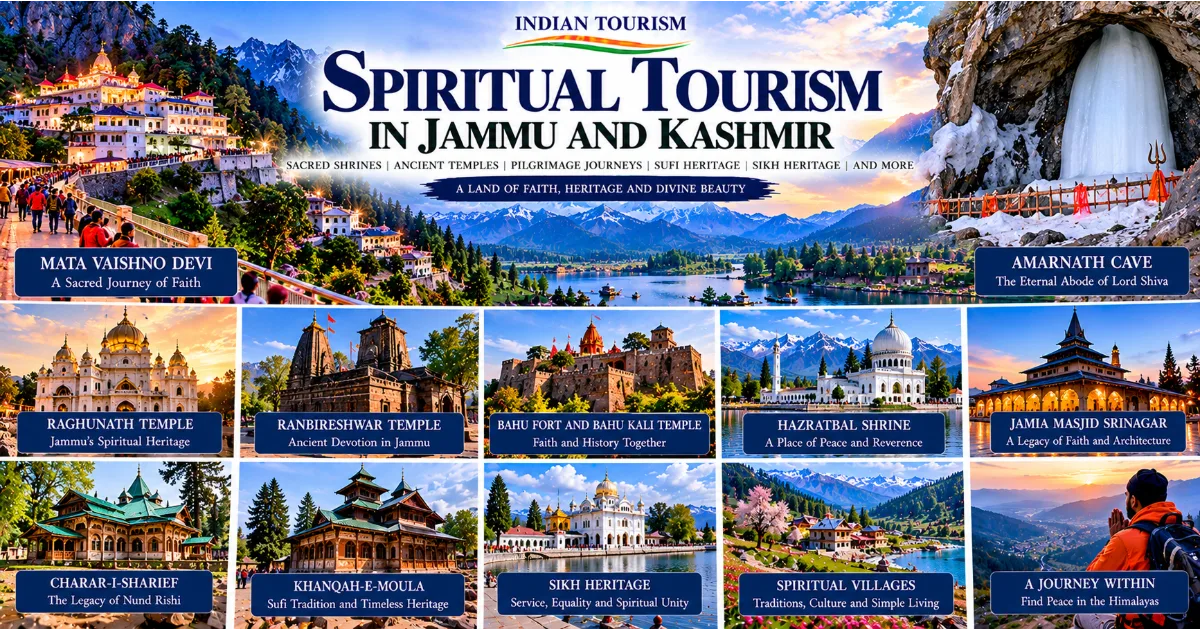
A Land of Faith, Heritage and Spiritual Discovery
Jammu and Kashmir is a region where spirituality and natural beauty come together in remarkable ways. Surrounded by the Himalayas, enriched by centuries of cultural exchange and home to sacred destinations belonging to different religious traditions, the region has long attracted pilgrims, seekers and travellers interested in its spiritual heritage. Ancient temples, revered shrines, historic mosques, Sufi centres and sacred landscapes reveal a history in which faith has influenced architecture, art, music, community life and the movement of people across mountains and valleys.
For many visitors, spiritual tourism begins with a pilgrimage to Mata Vaishno Devi, one of India's most widely visited Hindu religious destinations. Others travel to the ancient Raghunath Temple in Jammu, the Amarnath Cave during the pilgrimage season, the revered Hazratbal Shrine in Srinagar or the Charar-i-Sharief shrine associated with Kashmir's Sufi heritage. These places differ in their religious significance, architectural character and visitor experience, yet each reflects the deep relationship between faith and place.
Spiritual tourism, however, extends beyond visiting famous religious sites. It also includes learning about local traditions, understanding the history of sacred architecture, observing religious festivals respectfully and discovering how communities preserve their spiritual heritage. A temple courtyard, a shrine beside a river, an old mosque in a historic neighbourhood or a pilgrimage path through the mountains can offer insight into the beliefs and experiences of generations.
Jammu and Kashmir's spiritual landscape is diverse. Hindu traditions are represented through major pilgrimage centres and ancient temples. Islam has shaped the region's religious life through mosques, shrines and Sufi traditions. Sikh heritage is reflected in historic gurdwaras connected with the journeys and teachings of Sikh Gurus. Buddhist history is also visible in the wider cultural landscape of the former princely state, although many of its best-known Buddhist destinations are now in the separate Union Territory of Ladakh.
Visitors should approach this diversity with curiosity and respect. Religious places are living centres of worship, not simply tourist attractions. Their importance comes from the faith, memories and practices of the people who visit them. By understanding the meaning of these destinations and observing local customs, travellers can experience Jammu and Kashmir's spiritual heritage in a thoughtful and rewarding way.
1. Shri Mata Vaishno Devi: The Sacred Journey to the Holy Cave
The Shri Mata Vaishno Devi shrine, situated in the Trikuta hills near Katra in Jammu, is one of the most important pilgrimage destinations in India. Devotees travel from different parts of the country to seek the blessings of Mata Vaishno Devi, making the pilgrimage a defining spiritual experience for millions of people.
The journey traditionally begins in Katra, a town that serves as the principal base for pilgrims. From there, visitors follow the established route towards the holy cave. The climb, the mountain surroundings and the shared determination of pilgrims create an atmosphere that many devotees describe as deeply meaningful. For some, the pilgrimage is an expression of gratitude; for others, it is connected with prayers, family traditions or important moments in life.
The route includes facilities developed to support pilgrims, although conditions and services can vary according to season, crowd levels and weather. Visitors should consult the official shrine authorities for current registration procedures, route information, available facilities and any restrictions. Rules concerning entry, transport, security and medical assistance should be followed carefully.
The physical effort involved can be significant, particularly for older visitors, children and people with mobility limitations. Travellers should choose a pace suitable for their fitness, wear comfortable footwear and carry appropriate clothing. Weather can change in the hills, so preparation is important even when the journey begins under clear skies.
The town of Katra has developed a substantial hospitality and service economy around the pilgrimage. Accommodation, food, transport and other services support visitors throughout the year, with demand often increasing during major pilgrimage periods. Travellers can contribute to the local economy by using legitimate providers and treating service workers respectfully.
For many devotees, the pilgrimage is not simply about reaching a destination. It is about the experience of walking with others, maintaining faith through physical effort and participating in a tradition that connects families across generations.
2. Bhairon Temple and the Wider Pilgrimage Experience
The spiritual journey associated with Mata Vaishno Devi also includes Bhairon Temple, situated higher in the Trikuta hills. Many pilgrims include this shrine as part of their broader visit, following the established access arrangements and guidance provided by the shrine authorities.
The surrounding mountain landscape contributes to the atmosphere of the pilgrimage. Views of hills and valleys remind visitors that the sacred route is also a journey through a distinctive Himalayan environment. The physical setting can encourage reflection, especially for those who travel slowly and pay attention to the experience rather than concentrating only on reaching the next stop.
Visitors should remember that mountain routes require sensible preparation. Weather, crowd density, walking ability and the availability of transport can affect the journey. Those travelling with elderly relatives or young children should check current facilities and plan suitable rest periods.
The religious meaning of Bhairon Temple belongs to the wider traditions associated with the pilgrimage. Travellers unfamiliar with these traditions can learn about them through official information and local guidance, while recognising that different devotees may express their faith in different ways.
Photography, food and other visitor activities should follow the rules in place at each sacred location. Some areas may have restrictions designed to protect religious practices, manage crowds or maintain security. Following these instructions helps preserve the experience for everyone.
For travellers interested in pilgrimage culture, the wider route demonstrates how religious journeys can combine physical movement, communal participation and personal reflection. The significance of the destination lies not only in its location but also in the stories, rituals and beliefs that give the journey meaning.
3. Amarnath Cave: A High-Altitude Pilgrimage in the Himalayas
The Amarnath Cave is among the most renowned Hindu pilgrimage destinations in Jammu and Kashmir. Located in the Himalayas at a high altitude, the cave is associated with Lord Shiva and attracts devotees during the designated annual pilgrimage period. Its remote mountain setting makes it very different from pilgrimage sites located in towns and cities.
The journey to Amarnath requires careful planning because of the altitude, weather and challenging terrain. Pilgrimage arrangements are managed through designated authorities, and registration, medical requirements, route permissions and other procedures may apply. Travellers must consult current official guidance rather than relying on information from previous years.
The environment can be demanding even for physically active visitors. Cold temperatures, changing weather, steep paths and reduced oxygen availability at altitude can create significant risks. Participants should follow medical advice, respect health screening requirements and avoid treating the pilgrimage as an ordinary sightseeing trek.
The religious importance of the cave is central to the experience. Devotees undertake the journey for spiritual reasons, and the effort required can form an important part of their personal understanding of pilgrimage. The surrounding mountains add to the sense of remoteness, but visitors should not allow the scenery to distract them from safety instructions.
The pilgrimage also requires careful environmental management. Large numbers of visitors travelling through sensitive mountain landscapes can create pressure on waste systems, water sources and local ecosystems. Travellers should follow all waste-disposal rules, avoid damaging vegetation and respect the instructions of the authorities responsible for the route.
Amarnath illustrates the relationship between devotion, physical endurance and the natural environment. It is a powerful destination for those who are eligible and prepared to undertake the journey, but it is not suitable for every traveller. People seeking a spiritual experience without high-altitude physical demands can explore other sacred destinations across Jammu and Kashmir.
4. Raghunath Temple: A Major Centre of Hindu Heritage in Jammu
Raghunath Temple, situated in Jammu city, is one of the region's prominent Hindu religious landmarks. The temple complex is associated with Lord Rama and forms an important part of Jammu's spiritual and cultural identity.
Unlike mountain pilgrimage destinations that require long journeys on foot, Raghunath Temple can be incorporated into a city-based cultural itinerary. Its location makes it accessible to travellers exploring Jammu's historic sites, markets and other religious landmarks.
The temple is associated with the Dogra period and reflects the importance of religious patronage in the region's historical development. Its architectural and devotional character makes it relevant to visitors interested in the relationship between political history, religious institutions and urban life.
A visit provides an opportunity to observe how a major place of worship functions within a modern city. Devotees arrive for prayer and religious observances, while visitors interested in history may wish to understand the temple's background and place within the wider heritage of Jammu.
Travellers should dress appropriately, observe the rules governing entry and follow instructions concerning footwear, photography and security. During busy periods, patience is important because the temple serves worshippers whose primary purpose is religious rather than recreational.
Raghunath Temple can be visited alongside other destinations in Jammu, including nearby historic neighbourhoods and cultural landmarks. However, visitors should allow enough time to experience the temple respectfully instead of treating it as one item on a rushed checklist.
The temple demonstrates that spiritual tourism does not always require remote mountain travel. Urban sacred spaces can provide equally meaningful opportunities to explore faith, architecture and cultural history.
5. Ranbireshwar Temple: Devotion and Sacred Architecture
Ranbireshwar Temple is another significant religious destination in Jammu city. Dedicated to Lord Shiva, it attracts devotees and contributes to the city's long-standing tradition of Hindu worship.
The temple is especially relevant to travellers interested in the religious history of Jammu. It provides a contrasting experience to the large pilgrimage routes of the mountains, offering an opportunity to observe worship within an established urban setting.
Religious architecture often expresses beliefs through its layout, sacred objects, spaces for prayer and the organisation of worship. Visitors who take time to learn about these features can better appreciate how a temple serves its community. The meaning of particular practices should be understood through reliable local explanations rather than assumptions based on appearances.
The atmosphere of a temple can vary according to the time of day, religious calendar and number of visitors. During important observances, crowds may increase and access arrangements may change. Travellers should check local information before planning a visit around a festival or special occasion.
Respectful behaviour is essential. Visitors should avoid disrupting prayers, keep pathways clear and refrain from photographing worshippers without permission. Quiet observation is often the best way to understand the rhythm of a sacred space.
Ranbireshwar Temple can be combined with Raghunath Temple and other heritage sites during a day in Jammu. Such an itinerary offers a useful introduction to the city's religious identity and helps visitors understand why Jammu is often associated with its temples and pilgrimage traditions.
6. Bahu Fort and the Ancient Bahu Kali Temple
Bahu Fort stands among Jammu's notable historic landmarks, overlooking the Tawi River and connecting the city's urban landscape with its historical and religious heritage. Within the fort complex is the Bahu Kali Temple, an important place of worship associated with the region's devotional traditions.
The combination of fort and temple illustrates how religious institutions and historic structures can occupy the same landscape. The fort recalls the political and defensive history of Jammu, while the temple remains a place of spiritual significance for devotees.
Visitors can explore the setting to understand how geography influenced the development of the city. Elevated ground and the nearby river shaped the strategic value of the location, while the religious site contributed to its continuing cultural importance.
The temple is especially busy during certain religious occasions, and visitors should be prepared for changes in crowd levels. Travellers who want a quieter experience may prefer to check local timings and plan accordingly.
As with other religious destinations, the temple should be approached primarily as a place of worship. Visitors should observe local customs and respect any restrictions on photography or movement within the complex.
Bahu Fort and the Bahu Kali Temple can form part of a wider Jammu heritage tour. Their shared location allows travellers to explore several aspects of the city's history while appreciating the continuing role of religious places in everyday life.
7. Hazratbal Shrine: A Revered Spiritual Landmark on Dal Lake
The Hazratbal Shrine, located on the western shore of Dal Lake in Srinagar, is one of the most revered Muslim religious sites in Jammu and Kashmir. Its location beside the lake gives it a distinctive setting, while its religious significance draws worshippers and visitors interested in the spiritual heritage of Kashmir.
The shrine is associated with a sacred relic believed by devotees to be connected with the Prophet Muhammad. This association gives the site particular importance within the region's Muslim community. Visitors should learn about the shrine's significance through reliable sources and recognise that the beliefs surrounding sacred relics are an important part of religious devotion.
The white architecture of Hazratbal stands out against the waters of Dal Lake and the mountains beyond. The surrounding area offers a chance to observe the relationship between Srinagar's religious landmarks and its natural environment. Yet the beauty of the setting should not overshadow the fact that the shrine remains an active centre of worship.
Visitors should dress modestly, follow the guidance of shrine authorities and respect the practices of worshippers. Entry arrangements, access to particular areas and photography rules may vary. Travellers should not assume that every part of a religious complex is open to general visitors.
The area around the shrine can be explored as part of a broader Srinagar itinerary, but time should be allowed for the visit itself. Observing the setting quietly, learning about its history and understanding its place in local religious life can be more rewarding than rushing through for photographs.
Hazratbal demonstrates the importance of Muslim spiritual heritage in Kashmir and offers visitors an opportunity to understand a sacred place that is deeply meaningful to the community it serves.
8. Jamia Masjid Srinagar: Faith and Architecture in the Old City
Jamia Masjid, situated in Srinagar's historic Nowhatta area, is one of the city's most important mosques. Its courtyard, wooden architectural features and traditional design distinguish it from many other religious buildings in the region.
The mosque is not only a place of prayer but also a significant part of Srinagar's historical urban landscape. Its setting in the old city connects religious life with neighbourhood markets, traditional streets and long-established patterns of community activity.
Architectural details can help visitors appreciate how local materials and building traditions have influenced sacred spaces. Wooden pillars, open courtyards and the organisation of the mosque's interior contribute to its distinctive character. The present structure reflects a history of construction, repair and renewal, rather than a single unchanged moment in the past.
Visitors should understand that a mosque is an active religious space. Prayer times, Friday congregational worship and religious events can affect access and visitor movement. Modest clothing, appropriate conduct and attention to local instructions are essential.
The surrounding neighbourhood can be explored on foot when conditions permit. Historic markets and streets offer further insight into Srinagar's cultural life, although travellers should be mindful of traffic, crowded lanes and local sensitivities.
Jamia Masjid is particularly rewarding for visitors interested in the relationship between architecture, faith and city history. It reveals how religious institutions remain connected to the daily life of the surrounding community.
9. Charar-i-Sharief: The Legacy of Sheikh Noor-ud-din Noorani
Charar-i-Sharief, located in the Budgam district, is one of Kashmir's important Sufi destinations. It is closely associated with Sheikh Noor-ud-din Noorani, also known as Nund Rishi, a revered figure in the region's Rishi tradition.
The Rishi tradition has played an influential role in Kashmir's spiritual history. It is associated with values such as simplicity, devotion, ethical conduct and reflection. Sheikh Noor-ud-din Noorani's teachings and legacy remain significant in the cultural memory of many people across the region.
The shrine at Charar-i-Sharief offers an opportunity to learn about this tradition and its place in Kashmiri spiritual life. The site should not be understood solely through its physical structure. Its importance also comes from the teachings, stories and devotional practices associated with the revered figure.
Travellers can approach the visit by learning about the historical background, observing the atmosphere respectfully and listening to local explanations. As with any active religious site, visitor access and local arrangements should be confirmed before travelling.
The journey to Charar-i-Sharief also offers views of the countryside around Budgam, although conditions vary with season and route. Visitors should plan transport in advance and allow time for the journey rather than treating the shrine as a quick detour.
Charar-i-Sharief demonstrates the importance of Sufi and Rishi traditions in Kashmir's cultural heritage. It is a meaningful destination for travellers who wish to explore the region's spiritual history beyond its best-known temples and mosques.
10. Khanqah-e-Moula: Sufi Heritage Along the Jhelum River
Khanqah-e-Moula, also known as the Shah-e-Hamdan Mosque, is an important religious and historical landmark in Srinagar. Situated near the Jhelum River, it is associated with Mir Sayyid Muhammad Hamadani, a Sufi figure whose legacy is closely connected with the development of Islam in Kashmir.
The building is notable for its traditional Kashmiri architectural character. Woodwork, decorative details and the structure's relationship with the surrounding historic neighbourhood distinguish it from many other religious sites. Its design reflects a regional architectural tradition in which local materials and craftsmanship played an important role.
Khanqah-e-Moula is also significant for understanding the role of Sufi teachers and institutions in the region's religious history. Sufi traditions have influenced spiritual practices, devotional literature and cultural expression in Kashmir over many generations.
Visitors interested in the site's history should distinguish between documented architectural history and religious traditions associated with the shrine. Both are important to understanding its place in the community, but they may be supported by different kinds of evidence.
The surrounding area can be explored as part of a walking tour of historic Srinagar. Travellers should pay attention to local access rules, avoid disrupting worship and ask before photographing people or religious activities.
Khanqah-e-Moula is a reminder that spiritual heritage includes more than large pilgrimage destinations. Historic shrines can preserve knowledge about architecture, literature, religious teaching and the social life of earlier periods.
11. Ziyarat Naqshband Sahib and Srinagar's Sacred Neighbourhoods
Srinagar contains several important shrines associated with Sufi traditions and the city's religious history. Ziyarat Naqshband Sahib is one such site, situated in the old city and connected with the Naqshbandi Sufi tradition.
The shrine forms part of a wider landscape of religious institutions, historic neighbourhoods and traditional markets. Visiting these places can help travellers understand how spiritual life has shaped the organisation and character of Srinagar over time.
Sacred neighbourhoods are living environments. Residents travel through them for work, shopping, education and worship, while visitors may arrive to explore the area's history. Travellers should avoid blocking narrow lanes, entering private spaces or treating the neighbourhood as a staged attraction.
Learning about the Naqshbandi tradition provides context for the shrine's significance. Sufi orders have different histories, teachings and devotional practices, and visitors should avoid assuming that all Sufi shrines share identical customs.
The experience can be combined with a broader exploration of Srinagar's old city, including historic buildings and local markets where access is appropriate. A knowledgeable local guide can explain the relationship between the shrine, the surrounding community and the city's religious history.
Visitors should check current conditions and local advice before planning an old-city walking route. Access, traffic and security arrangements may change, and certain areas may require additional care.
The shrine is a useful destination for travellers seeking to understand the variety of spiritual traditions that have contributed to Kashmir's cultural identity.
12. Sikh Heritage: Gurdwaras and the Legacy of the Gurus
Sikh heritage is another important part of Jammu and Kashmir's spiritual landscape. Historic gurdwaras in the region commemorate connections with Sikh Gurus and preserve traditions of prayer, community service and collective worship.
Gurdwaras serve as places where Sikh communities gather for religious observances and community activities. The practice of langar, a communal meal offered without discrimination among those who attend, reflects the Sikh emphasis on service, equality and shared humanity. Visitors should learn about these practices through respectful observation and local explanations.
Sikh religious heritage in Jammu and Kashmir is connected to wider historical journeys, regional communities and the development of religious institutions. Individual gurdwaras may have distinct histories, so travellers should consult reliable local information before attributing specific events or traditions to a particular site.
When visiting a gurdwara, guests are generally expected to cover their heads, remove their shoes where required and dress respectfully. Visitors should follow the instructions of the people responsible for the premises and ask before taking photographs.
Those invited to share langar should approach the meal with gratitude and respect. It is a community practice rooted in religious values, not simply a tourist food experience. If visitors are uncertain about the appropriate conduct, a polite question to a volunteer is usually the best approach.
Including Sikh heritage in a Jammu and Kashmir itinerary offers a broader understanding of the region's religious diversity. It also highlights how places of worship can serve as centres of service, hospitality and community support.
13. Sacred Landscapes and the Spiritual Meaning of Mountains
The mountains of Jammu and Kashmir are central to many pilgrimage experiences. Their height, changing weather, forests, rivers and remote valleys create settings that many travellers experience as inspiring or conducive to reflection. For religious pilgrims, these landscapes can hold specific spiritual meanings linked to sacred stories, places and traditions.
The significance of a mountain landscape depends on the beliefs and experiences of the people who visit it. Some undertake demanding journeys as an expression of devotion, while others seek quiet contemplation or an opportunity to disconnect from everyday routines. Spiritual tourism can accommodate these different motivations, provided visitors respect the traditions of each site.
The natural environment also imposes practical limits. Mountain paths can be steep, weather can change quickly and access may be restricted during certain periods. A landscape that appears peaceful in photographs may involve considerable physical effort or safety concerns.
Travellers should distinguish between established pilgrimage routes and informal mountain excursions. Routes connected with organised religious journeys may have specific requirements, while other locations may need specialist guiding or permits. Current local guidance should always take priority over assumptions based on online images.
Protecting the environment is part of responsible travel. Visitors should avoid leaving litter, damaging plants, disturbing animals or contaminating water sources. Quiet conduct may also be important near places where people pray or meditate.
The spiritual value of a landscape does not depend on how far a traveller walks or how remote a destination is. Sometimes a quiet moment in a temple courtyard or beside a river can be just as meaningful as a long journey into the mountains.
14. Religious Festivals and Pilgrimage Seasons
Religious festivals and pilgrimage seasons influence travel across Jammu and Kashmir. They bring communities together, shape local calendars and create periods when sacred destinations receive increased numbers of visitors.
The annual Amarnath pilgrimage is one of the region's most prominent examples of a seasonal religious journey. Mata Vaishno Devi also attracts pilgrims throughout the year, with visitor numbers changing according to religious occasions, holidays and travel conditions. Major Hindu festivals, Islamic observances and Sikh religious events contribute to the wider spiritual calendar.
Festival dates may follow lunar or other religious calendars and can vary from year to year. Travellers planning a visit around a particular observance should confirm the current date and local arrangements rather than relying on an old schedule.
Visiting during a festival can provide insight into religious practices, community organisation and devotional life. It can also involve larger crowds, longer waiting periods, changes to traffic and restrictions on movement. Accommodation may become more expensive or harder to secure during busy periods.
Visitors should not assume that every ritual is open to observation. Some ceremonies or spaces may be reserved for worshippers, and photography may be restricted. Following local guidance is more important than attempting to capture every moment.
Travellers who prefer quieter visits may choose dates outside major festival periods, although individual preferences and site conditions differ. Those who want to experience a festival should plan well in advance and remain flexible.
Religious festivals reveal the living nature of spiritual heritage. They are not merely annual attractions but occasions through which communities renew relationships, express faith and maintain traditions across generations.
15. Spiritual Tourism and Responsible Cultural Understanding
Spiritual tourism can encourage cultural understanding when it is approached thoughtfully. Visiting sacred places offers opportunities to learn about different religious traditions, but genuine understanding requires more than entering a building or reading a signboard.
Travellers should learn the basic history and significance of a destination before arriving. Reliable information helps prevent misunderstandings and allows visitors to recognise why particular customs, objects or spaces matter to worshippers.
Respectful clothing and conduct are important at religious sites. Visitors should follow instructions about footwear, head coverings, entry restrictions and photography. If a custom is unfamiliar, asking politely is preferable to ignoring it or assuming that the same rules apply everywhere.
It is also important to avoid treating religious communities as uniform. People within the same tradition may have different interpretations, practices and personal relationships with faith. A short visit cannot represent every aspect of a religion or community.
Photography deserves special attention. A temple, mosque, gurdwara or shrine may be visually impressive, but people who are praying or participating in ceremonies should not be photographed without appropriate permission. Images of children, private rituals and restricted areas require particular care.
Local guides can provide useful historical and cultural context, especially in complex heritage sites. Visitors should choose knowledgeable and responsible guides, agree on fees in advance and remain open to explanations that challenge their assumptions.
Responsible spiritual tourism also includes practical support for local communities. Using legitimate accommodation, purchasing local products where appropriate and treating workers fairly can help distribute tourism benefits more widely.
The goal is not to compare religions or decide which tradition is more important. It is to appreciate how different communities express faith and how sacred places contribute to the region's cultural life.
16. Planning a Spiritual Journey Across Jammu and Kashmir
A spiritual journey through Jammu and Kashmir can be organised around a particular pilgrimage, a city-based heritage itinerary or a wider exploration of religious traditions. The best plan depends on available time, mobility, interests and current travel conditions.
A short visit to Jammu could include Raghunath Temple, Ranbireshwar Temple and Bahu Fort with its associated temple. These destinations offer an introduction to Jammu's religious history and can be combined with other city attractions. Travellers should check opening hours, local restrictions and transport arrangements before departure.
A visit to Srinagar could include Hazratbal Shrine, Jamia Masjid and selected Sufi heritage sites in the old city. Because some locations are close to busy neighbourhoods, it is sensible to plan the route carefully and allow enough time for walking, observation and local guidance.
Pilgrimages to Mata Vaishno Devi and Amarnath require separate planning. Their routes, registration arrangements, health considerations and seasonal conditions differ significantly. They should not be treated as interchangeable day trips, and visitors should consult the relevant official authorities before making bookings.
Travellers interested in a broader regional itinerary should account for the distances between Jammu, Srinagar and other districts. Road conditions, weather, security requirements and seasonal access can affect journey times. It is better to visit fewer places with sufficient time than to attempt an unrealistic schedule.
Accommodation should be selected according to the purpose of the journey. Pilgrims may prioritise proximity to a shrine and access to transport, while cultural travellers may prefer a base that allows walking tours and visits to historic neighbourhoods.
Before travelling, confirm identification requirements, transport, accommodation, medical needs and any permits or registrations that apply. Keep essential documents secure and follow current official advice.
A well-planned spiritual journey balances religious interests, cultural learning, practical preparation and respect for the communities that maintain these sacred places.
Conclusion: Discovering the Spiritual Heritage of Jammu and Kashmir
Jammu and Kashmir's spiritual heritage is expressed through mountain pilgrimages, ancient temples, revered shrines, historic mosques, Sufi traditions and Sikh religious institutions. Each destination has its own history and meaning, shaped by the people who visit, maintain and preserve it.
From the journey to Mata Vaishno Devi and the high-altitude pilgrimage to Amarnath to the urban temples of Jammu and the sacred sites of Srinagar, the region offers many ways to explore faith and cultural history. These experiences demonstrate that spiritual tourism is not limited to one religious tradition or one type of landscape.
For visitors, the most rewarding journeys combine preparation with an open mind. Learning about a site's history, following local customs, respecting worshippers and allowing time for reflection can transform a brief visit into a meaningful cultural experience.
For local communities, sacred destinations are living places whose significance extends beyond tourism. Their preservation depends on responsible visitor behaviour, sensitive management and respect for religious practices. Tourism should support these places without disrupting the communities that give them life.
Jammu and Kashmir invites travellers to discover its spiritual identity through its sacred architecture, pilgrimage routes, traditions of devotion and diverse communities. Approached with care, a spiritual journey through the region can deepen cultural understanding and create lasting memories grounded in respect.
The true value of spiritual tourism lies not in the number of shrines visited, but in the willingness to understand what makes each place meaningful to the people who call it sacred.
Hashtags
#IndianTourism #JammuAndKashmir #SpiritualTourism #PilgrimageTourism #VaishnoDevi #AmarnathYatra #RaghunathTemple #RanbireshwarTemple #BahuFort #HazratbalShrine #JamiaMasjid #ChararSharief #KhanqahEMoula #SufiHeritage #SikhHeritage #ReligiousTourism #SacredPlaces #TempleTourism #KashmirHeritage #JammuTourism #ExploreKashmir #ExploreJammu #CulturalHeritage #ResponsibleTourism #ExploreIndia

