
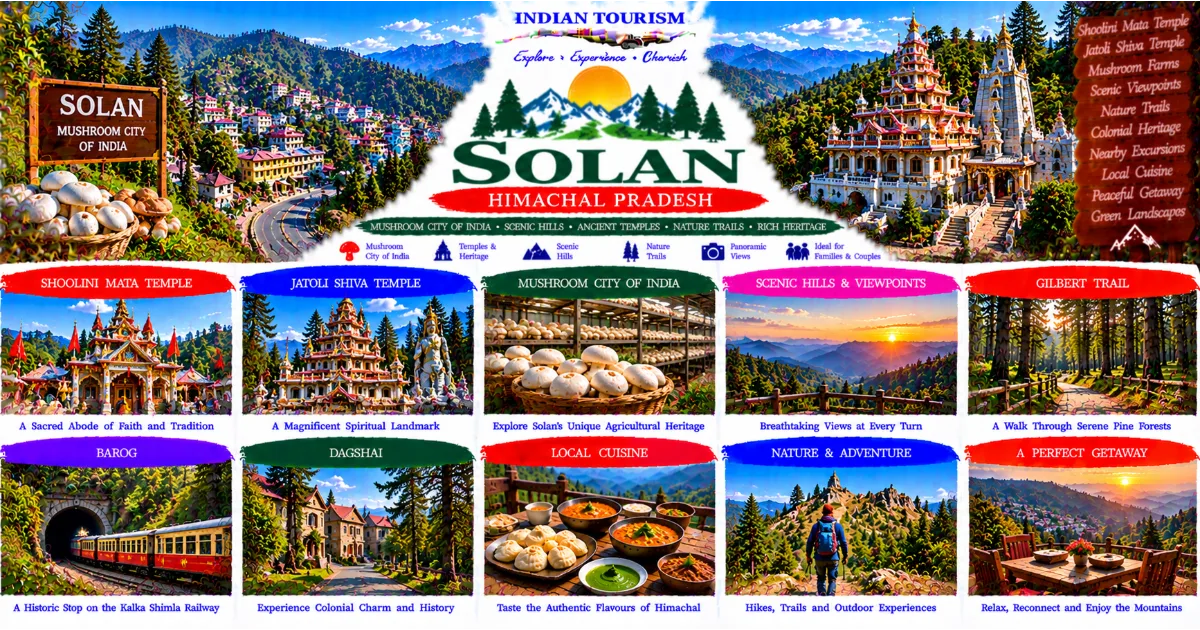
Explore the Diverse Charm of Solan
Himachal Pradesh is home to many destinations that combine mountain scenery, cultural heritage, agriculture and peaceful countryside. While Shimla attracts visitors with its colonial architecture, Kasauli is known for its pine forests and historic charm, and Narkanda offers apple orchards and elevated Himalayan views, Solan presents a different side of the state. Often associated with mushroom cultivation and tomato production, Solan is a growing town surrounded by green hills, religious landmarks, educational institutions and agricultural landscapes. Its location between Chandigarh and Shimla makes it an accessible destination for travellers who want to explore the lower Himalayan region while discovering a place with its own character and history.
Situated in the Solan district of Himachal Pradesh, the town lies along an important road corridor connecting the plains with the higher hill stations. Its surroundings include forested slopes, cultivated fields, small settlements and mountain ridges. Unlike destinations that depend primarily on seasonal snow or dramatic high-altitude scenery, Solan offers a combination of everyday town life, agricultural activity, heritage attractions and opportunities for excursions into the surrounding hills.
Solan is particularly interesting for travellers who enjoy understanding the economic and cultural life of a region. Its association with mushroom farming reflects the importance of horticulture and agricultural innovation in Himachal Pradesh. The town is also known for its connection with the historic Shoolini Mata Temple, which plays an important role in local religious traditions. Nearby attractions such as the Jatoli Shiva Temple, the surrounding countryside and the elevated landscapes around Karol Tibba provide additional reasons to explore the area.
The town can serve as a convenient base for visitors who want to discover several destinations in the region. Kasauli, Chail, Barog and other places around the Shimla hills can be incorporated into a broader itinerary, depending on the available time and road conditions. This makes Solan suitable for families, couples, history enthusiasts, religious travellers and visitors interested in rural tourism.
Solan's appeal is not limited to sightseeing. Local markets, regional food, educational institutions and agricultural traditions provide insight into how the town functions beyond the tourism season. Travellers who take time to explore these everyday aspects can develop a more complete understanding of the region.
This guide explores Solan's history, major attractions, temples, nature experiences, local food, seasonal travel, accommodation and transport. It also explains how to plan a comfortable visit while respecting local traditions and the natural environment.
Understanding Solan and Its Historical Background
Solan is an important town in Himachal Pradesh and serves as the administrative centre of Solan district. Its location along the route between Chandigarh and Shimla has contributed to its growth as a commercial and transport centre. The town connects surrounding villages and agricultural areas with larger markets, making it significant to the wider regional economy.
The area's history reflects the broader development of the hill region, where local kingdoms, religious institutions, colonial administration and modern economic activity have influenced settlement patterns. The establishment of roads and transport connections helped link mountain communities with the plains, encouraging trade, tourism and the movement of agricultural produce.
Solan's development has also been shaped by its educational and institutional presence. The region is associated with agricultural research and horticultural activity, while the wider district includes settlements with their own religious and cultural identities. This mixture of agriculture, education, commerce and tourism distinguishes Solan from hill stations that are primarily designed around holiday travel.
The town's name is commonly connected with the local tradition associated with Shoolini Mata, a revered deity in the region. The Shoolini Mata Temple remains an important religious landmark, and the annual Shoolini fair brings together devotees and visitors for celebrations and community activities.
Solan's surroundings also contain historical and religious sites that can be explored as part of a wider itinerary. Some attractions are located outside the main town and require road travel or walking, so visitors should plan according to their available time and fitness.
For travellers interested in history, Solan provides a useful starting point for understanding the relationship between religious traditions, agriculture, transport and modern development in Himachal Pradesh. Its character is defined by several influences rather than one single historical monument.
Shoolini Mata Temple: The Spiritual Heart of Solan
Shoolini Mata Temple is one of the most important religious landmarks in Solan. The temple is associated with Goddess Shoolini, who holds a special place in the religious traditions of the region. For local residents, the temple represents faith, community identity and continuity with traditions that have been observed across generations.
Visitors who explore the temple can experience an important aspect of Solan's cultural life. The atmosphere may be particularly lively during religious festivals, when devotees gather for worship and community celebrations. Outside major events, the temple can provide a quieter opportunity for prayer and reflection.
The annual Shoolini fair is one of the best-known cultural events associated with Solan. The celebrations traditionally bring together religious observances, local participation and public festivities. The exact programme and arrangements may vary from year to year, so travellers who want to attend should confirm the current dates and schedule before planning their visit.
The temple is not simply a sightseeing attraction. It remains a place of worship, and visitors should approach it respectfully. Appropriate clothing, consideration for worshippers and compliance with local rules help preserve the character of the site. Photography should follow any restrictions, particularly during ceremonies or crowded periods.
The temple's central location also makes it a practical stop during a visit to the town. Travellers can combine a visit with time exploring nearby markets and local eateries, allowing them to experience both the religious and everyday dimensions of Solan.
For visitors interested in cultural tourism, Shoolini Mata Temple provides a meaningful introduction to the region. It demonstrates how religious traditions continue to influence the identity of a modern Himalayan town.
Jatoli Shiva Temple: A Distinctive Religious Landmark
Jatoli Shiva Temple is a prominent religious attraction near Solan, known for its striking architecture and association with Lord Shiva. Located in the Jatoli area, the temple attracts devotees and visitors interested in religious heritage, architectural details and the wider cultural landscape of Himachal Pradesh.
The temple complex is notable for its tall structure and decorative features. Its design distinguishes it from smaller village shrines and gives it a strong visual presence within the surrounding landscape. Visitors interested in architecture can appreciate the scale of the building, the details of its exterior and the way the complex has developed as a place of worship.
The temple's religious significance is central to the visitor experience. People come to pray, participate in rituals and seek a quiet moment away from everyday pressures. Travellers who are not visiting for religious reasons can still appreciate the site by observing its architecture and understanding its place in local traditions.
Visitors should dress respectfully and follow the temple's rules. During religious festivals or busy periods, additional time may be needed for parking and movement around the complex. It is sensible to check locally for current access arrangements and any restrictions.
The temple can be included in a half-day exploration of Solan and its surrounding attractions. Travellers can combine it with a visit to Shoolini Mata Temple and other suitable locations, depending on transport and available time.
Jatoli Shiva Temple is particularly rewarding for visitors who enjoy destinations where architecture and faith come together. Its distinctive appearance makes it a memorable stop within the broader Solan tourism experience.
The Mushroom City of India: Understanding Solan's Agricultural Identity
Solan is often associated with mushroom cultivation, earning recognition as the Mushroom City of India. The title reflects the importance of mushroom production and related agricultural activity in the region. This connection gives the town an identity beyond its temples and mountain scenery.
Mushroom cultivation demonstrates how agricultural communities can adapt production methods to local conditions and market demand. Unlike crops that require extensive outdoor fields, mushrooms can be grown under controlled environmental conditions when suitable facilities and technical knowledge are available. Their cultivation involves careful attention to temperature, humidity, growing materials, hygiene and harvesting practices.
Solan's association with mushroom farming also reflects the wider role of agricultural research and education in Himachal Pradesh. The region has a history of horticultural development, and the broader agricultural sector contributes to livelihoods, local trade and the movement of produce to markets beyond the immediate area.
Visitors interested in agriculture can use Solan as an opportunity to learn about the relationship between scientific knowledge and rural livelihoods. However, commercial growing facilities are not automatically open to tourists. Anyone hoping to visit a farm, training centre or production unit should seek permission and confirm whether visitor access is available.
The town is also associated with tomato cultivation, which contributes to its reputation as an agricultural centre. Seasonal produce and local markets provide a glimpse into the importance of farming in the surrounding district.
For families and students, the agricultural identity of Solan can make the visit educational. It introduces the idea that tourism destinations are not defined only by scenery or monuments. Their economic activities, agricultural traditions and institutional development are also part of what makes them distinctive.
Karol Tibba: A Mountain Experience Near Solan
Karol Tibba is associated with the higher terrain around Solan and appeals to visitors who enjoy nature, walking and elevated landscapes. The surrounding area provides a contrast to the town's roads and markets, offering a more outdoor-oriented experience.
The journey towards the Karol Tibba area involves mountain terrain and routes that may require careful planning. Visitors should confirm the current trail conditions, access arrangements and suitability of the route before setting out. Walking time depends on the chosen starting point, fitness and weather.
Travellers who enjoy hiking should approach the experience realistically. Mountain routes can be uneven, steep or difficult to follow, and weather may change quickly. Suitable footwear, drinking water, weather-appropriate clothing and enough daylight are essential. Visitors unfamiliar with the area should seek local guidance rather than relying solely on an online route description.
The surrounding forest and hills can provide opportunities for nature observation and photography. The experience is especially rewarding for travellers who prefer walking through natural landscapes rather than spending the entire holiday in vehicles.
Visitors should remain on suitable routes, avoid disturbing wildlife and carry their rubbish back. Forest areas should be treated carefully, particularly during dry periods when fires can spread rapidly. Local restrictions and advice should always take priority.
Karol Tibba is best approached as an outdoor excursion rather than a casual roadside stop. With appropriate preparation and suitable conditions, it can add a nature-focused dimension to a visit to Solan.
Barog: A Scenic Excursion from Solan
Barog is a well-known destination in the wider Solan region, associated with mountain scenery, a historic railway setting and a peaceful atmosphere. Its location along the Kalka to Shimla railway route makes it interesting to visitors who appreciate transport history and scenic travel.
The Kalka to Shimla railway is recognised for its winding mountain route and engineering features. The journey passes through tunnels, bridges and hill settlements, offering a distinctive way to experience the landscape. Barog is one of the places associated with this historic railway corridor.
Visitors can explore the general area, enjoy the surrounding scenery and learn about the railway's role in the development of hill travel. Travellers interested in riding the railway should check current train schedules, ticket availability and service conditions before planning their journey.
Barog can also provide a relaxed break from the busier parts of Solan. The surrounding landscape is suitable for photography and quiet observation, especially when weather conditions allow clear views across the hills.
As with other mountain destinations, road and railway conditions may be affected by weather or maintenance. Visitors should allow enough time for transport and avoid assuming that every service will operate exactly as expected.
Barog is a useful addition to a Solan itinerary for travellers interested in heritage, engineering and scenic mountain experiences. It offers a different perspective on the region from its temples and agricultural attractions.
Dagshai: Explore a Historic Cantonment Town
Dagshai is a historic cantonment town in the Solan district, known for its colonial-era associations and quiet mountain setting. It offers a different type of heritage experience from the temples and markets of Solan, allowing visitors to explore aspects of the region's administrative and military history.
The town developed as part of the British-era cantonment system, and its historical identity is reflected in the older built environment and institutional landscape. Visitors interested in history can learn about the role such settlements played during the colonial period and how they influenced the development of hill regions.
Dagshai is also associated with a historic prison and museum, although access arrangements and opening hours should be confirmed before a visit. Travellers should not assume that every historic building or institutional property is open to the public.
The town's elevated setting and quieter atmosphere can make it appealing to visitors who enjoy exploring places away from major commercial centres. The surrounding landscape offers opportunities for photography and observation, while the heritage sites provide context for understanding the area's past.
Visitors should respect local rules and recognise that cantonment areas may have restrictions on movement and photography. Checking access conditions in advance is particularly important where security requirements apply.
Dagshai can be included in a broader exploration of Solan district, especially for travellers interested in history, architecture and the evolution of hill settlements.
Nature Walks and Green Landscapes Around Solan
The Solan region contains a mixture of forested slopes, cultivated land and mountain roads that offer opportunities for outdoor exploration. Visitors who want to experience the natural side of the district can choose suitable walking routes, scenic drives and short excursions into the countryside.
Nature walks provide a chance to observe the landscape at a slower pace. Visitors may notice changes in vegetation, birdsong, cultivated fields and the relationship between settlements and the surrounding terrain. A short walk on a suitable public path can be rewarding even for travellers who do not want to undertake a strenuous hike.
The suitability of a route depends on weather, fitness and local access conditions. Not every visible path is a formal tourist trail, and some may be used by farmers, residents or forestry workers. Visitors should ask locally about safe walking areas and avoid entering unfamiliar terrain without guidance.
Comfortable footwear is important because mountain paths may include uneven surfaces, loose stones and muddy sections after rain. During the monsoon, some routes can become slippery, while winter mornings may bring colder conditions.
Responsible nature tourism requires care for the environment. Visitors should carry rubbish back, avoid disturbing wildlife and never light fires in unauthorised areas. Plants should not be removed, and noise should be kept to a reasonable level.
The natural landscape around Solan offers a welcome contrast to its commercial and institutional areas. Travellers who allow time for a walk or a scenic drive can experience a broader picture of the district.
The Best Time to Visit Solan
Solan can be visited throughout the year, but the most suitable season depends on the type of experience travellers want. The region's lower elevation compared with some higher Himalayan destinations influences its weather, although conditions can still vary considerably.
Spring: March to April
Spring is a pleasant time to explore Solan and its surroundings. Temperatures often become comfortable for sightseeing, and the landscape begins to show fresh seasonal growth. Visitors can explore temples, heritage areas and nearby towns without the extreme cold that may affect higher destinations during winter.
This season is also suitable for short nature walks and scenic drives. Travellers should carry a light jacket for cooler mornings and evenings and check the forecast before planning longer outdoor activities.
Summer: May to June
Summer is a popular travel period because visitors from the plains seek cooler conditions in the hills. Solan offers a convenient base for exploring the district and travelling towards Shimla, Kasauli and other nearby destinations.
The season is suitable for families and first-time visitors who want to combine sightseeing with relaxed outdoor experiences. However, busy weekends and school holidays can increase demand for accommodation.
Travellers should book ahead where possible, carry water and use sun protection during outdoor activities. Warm afternoons may make early morning or late afternoon the most comfortable times for walking.
Monsoon: July to September
The monsoon can make the surrounding hills appear especially green. The landscape may be attractive for photography, and visitors can enjoy the fresh atmosphere when conditions are suitable.
Heavy rainfall can also cause landslides, slippery roads and travel delays. Visitors should check local forecasts and road conditions before setting out for nearby attractions. Hiking routes may become unsafe, and outdoor plans should remain flexible.
Travellers should avoid driving through areas affected by heavy rain or following routes where local authorities have advised against travel.
Autumn: October to November
Autumn can provide comfortable conditions for sightseeing and exploring the wider district. As the monsoon retreats, visibility may improve and the air becomes cooler.
This season is suitable for travellers who prefer outdoor exploration without the challenges of heavy rainfall. Layered clothing is useful because temperatures can fall during the evening.
Winter: December to February
Winter brings colder weather, especially during mornings and evenings. Visitors can still explore Solan's town attractions and nearby heritage sites, although higher routes may experience more challenging conditions.
Travellers should carry warm clothing and check road access before visiting elevated locations. Accommodation heating arrangements should be confirmed if the visit falls during a cold spell.
For most visitors, spring, summer and autumn offer practical conditions for exploring Solan. Monsoon and winter trips can also be rewarding when travellers prepare for changing weather and adjust their plans accordingly.
Food and Local Culinary Experiences in Solan
Food is an important part of exploring Solan and the wider Himachal Pradesh region. Visitors can enjoy familiar North Indian meals alongside traditional Himachali dishes, seasonal vegetables and local agricultural produce. The exact selection depends on the restaurant, season and accommodation.
Himachali cuisine includes preparations based on lentils, beans, rice, yoghurt and regional spices. Madra is a well-known dish that appears in different forms across the state. Rajma preparations, seasonal vegetable dishes and traditional breads may also be available in local eateries.
Dham is a traditional festive meal associated with Himachal Pradesh. Its composition varies across regions and occasions, and it is often served during celebrations and community gatherings. Visitors interested in regional cuisine can ask local restaurants whether traditional preparations are available.
Solan's association with mushroom cultivation creates an additional connection with food and agriculture. Mushrooms may appear in restaurant dishes and local markets, although availability and preparation styles vary. Travellers can ask about the source of ingredients and whether a dish reflects local agricultural produce.
Tomatoes and other seasonal vegetables are also important in the wider agricultural landscape. Visitors may find fresh produce at local markets and roadside sellers, depending on the season.
For a satisfying culinary experience, try a combination of local dishes and everyday meals. Hot tea, coffee and freshly prepared food can be welcome after sightseeing, especially during cooler weather.
Visitors with food allergies or dietary restrictions should communicate their needs clearly and ask about ingredients. Exploring local food becomes more rewarding when travellers take time to learn about the ingredients and traditions behind each dish.
Where to Stay in Solan
Solan offers a range of accommodation options, including hotels, guesthouses and properties suited to different budgets. Its position along an important transport route makes it a practical base for visitors who want to explore nearby destinations without changing accommodation every day.
Staying Near the Main Town
Accommodation near the main town can be convenient for travellers who want access to markets, restaurants and transport. This option is suitable for short visits, families and visitors planning to explore the main religious and commercial attractions.
Before booking, check the distance to the road, parking arrangements, meal availability and room facilities. If arriving late, confirm the check-in arrangements in advance.
Scenic Stays Around Solan
Some travellers may prefer accommodation outside the busiest part of town, where the surroundings can feel quieter and more connected with the landscape. These properties can appeal to couples and visitors who want to relax after sightseeing.
A scenic location may require additional transport, so check whether taxis or other services are available. Travellers should also ask about road access during heavy rain or winter weather.
Budget Guesthouses
Budget-conscious visitors can compare smaller hotels and guesthouses. It is useful to consider the total cost of the stay, including food and transport, rather than focusing only on the room price.
Check recent feedback, cleanliness, hot water, parking and cancellation terms. Visitors travelling with families should confirm room arrangements and access requirements.
Accommodation for Longer Stays
Solan can serve as a base for exploring several destinations across the district. Travellers planning a longer stay may prefer accommodation with reliable meals, convenient transport connections and enough space to relax between excursions.
Before choosing a property, identify the attractions you intend to visit and consider the travel time required for each journey. A central location may be more practical than a remote property if the itinerary involves frequent road trips.
Solan for Couples and Honeymoon Travellers
Solan can be a suitable destination for couples who want a relaxed holiday combining local culture, mountain scenery and short excursions. Although it does not have the same atmosphere as a secluded high-altitude retreat, its location makes it a convenient base for exploring the wider region.
Couples can begin the day with a leisurely breakfast before visiting Shoolini Mata Temple or Jatoli Shiva Temple. The afternoon can be spent exploring a nearby heritage location, enjoying local food or taking a scenic drive through the surrounding countryside.
Visitors interested in quieter experiences may choose accommodation outside the busiest part of town. A comfortable room, convenient transport and good food can make the stay more enjoyable.
Solan can also be combined with Kasauli or Chail for a longer couple's holiday. Kasauli offers colonial charm and pine forests, while Chail provides a quieter setting associated with royal history. The choice depends on the couple's interests and available time.
The destination is especially suitable for travellers who appreciate culture and exploration rather than a holiday centred entirely on luxury resorts or nightlife. A relaxed itinerary allows couples to enjoy the region without unnecessary pressure.
Solan for Families with Children
Families can enjoy Solan because the town offers a mixture of religious heritage, agricultural identity and nearby nature experiences. Children may find the mushroom-growing tradition interesting, while temples and historic locations provide opportunities to learn about local culture.
Parents should plan activities according to children's ages and interests. Short visits, regular breaks and convenient meals can make sightseeing more comfortable.
When visiting temples, families should explain the importance of respectful behaviour and follow local rules. Children should remain under supervision around road traffic, uneven paths and elevated viewpoints.
Families interested in agriculture should seek permission before visiting farms or production facilities. A visit arranged through an authorised provider may offer a useful educational experience, but commercial sites are not automatically open to tourists.
Accommodation should be selected according to family requirements, including room size, meal options, parking and access to essential services. Travellers with young children may also want to confirm heating and hot water during colder months.
A family trip can combine the main attractions with a relaxed excursion into the countryside. Allowing time to enjoy the journey rather than rushing between locations often produces a more satisfying holiday.
Responsible Tourism in Solan
Responsible tourism helps protect Solan's natural environment, historical sites and local communities. As the town grows and attracts more visitors, considerate behaviour becomes increasingly important for maintaining its character.
Visitors should dispose of rubbish properly and avoid leaving plastic waste along roads, trails or religious sites. Reusable water bottles and bags can help reduce unnecessary packaging.
Religious sites should be treated respectfully. Travellers should follow instructions about clothing, entry, photography and behaviour. During festivals, visitors should be mindful of crowds and avoid obstructing processions or community activities.
Forest areas and walking routes require care. Visitors should remain on suitable paths, avoid disturbing wildlife and never light fires in unauthorised locations. Local environmental restrictions should always be followed.
Tourism can benefit local residents when travellers use local shops, restaurants, guides and legitimate producers. Buying local products and learning about regional food traditions can help connect tourism spending with the wider economy.
Visitors interested in agriculture should respect private property and seek permission before entering farms. They should avoid damaging crops or interfering with commercial activity.
Responsible travel is not only about protecting the environment. It also involves recognising that Solan is a working town where residents live, study, trade and worship. Respect for everyday life helps create a positive experience for both visitors and the local community.
Practical Travel Tips for Visiting Solan
A little preparation can make a visit to Solan more comfortable. Travellers should check weather forecasts and road conditions before departure, especially during the monsoon and winter.
Comfortable footwear is useful for walking around town and visiting nearby attractions. Visitors should carry a light jacket for cooler mornings and evenings, with warmer clothing during winter.
If planning an excursion to Karol Tibba or another elevated area, check the current route conditions and choose a walk appropriate for your fitness. Carry drinking water and allow enough time to return before dark.
Accommodation should be booked in advance during busy holidays and long weekends. Confirm parking, meal availability, room facilities and cancellation conditions before finalising the booking.
Visitors planning to attend the Shoolini fair should verify the current dates and arrangements. Similarly, those interested in historic museums, religious sites or agricultural visits should check access conditions rather than assuming that every attraction is open at all times.
Mobile connectivity and digital payment options may vary in the surrounding countryside. Keeping essential booking information available offline and carrying some cash can be helpful.
Finally, allow flexibility in the itinerary. Weather, traffic and local conditions can affect travel times. A relaxed schedule makes it easier to enjoy the destination without rushing.
Suggested Two-Day Itinerary for Solan
A two-day visit provides a practical introduction to Solan's main attractions and the surrounding countryside.
On the first day, arrive and settle into your accommodation before exploring the town. Visit Shoolini Mata Temple and learn about its religious significance. Spend time exploring nearby streets and markets, then enjoy a meal at a local restaurant. If time permits, include a visit to another suitable attraction within the town.
On the second day, explore Jatoli Shiva Temple and consider an excursion to Barog or Dagshai, depending on your interests and the current access arrangements. Travellers who prefer nature may choose a suitable countryside walk or scenic drive instead.
This itinerary should remain flexible. A longer visit to a religious site or a transport delay may affect the schedule, and travellers should not attempt to fit too many distant locations into a single afternoon.
Visitors interested in Karol Tibba should allocate sufficient time and confirm the current route conditions. The excursion may require more preparation than a casual town visit.
A three-day stay allows additional time to explore nearby destinations such as Kasauli or Chail. It can also provide opportunities to learn more about Solan's agricultural identity and enjoy the region at a slower pace.
Nearby Destinations to Combine with Solan
Solan is well positioned for travellers exploring the lower Himalayan region of Himachal Pradesh. Its road connections make it possible to combine the town with several destinations, provided the itinerary allows enough time for mountain travel.
Kasauli is an appealing option for visitors who enjoy colonial architecture, pine forests and scenic viewpoints. Chail offers royal heritage and forest surroundings, while Barog provides a connection with the historic Kalka to Shimla railway route.
Shimla is suitable for travellers interested in a larger hill station with historic buildings, markets and cultural attractions. Combining Solan with Shimla provides a broader picture of the region's history and tourism landscape.
Narkanda and Theog offer opportunities to explore apple-growing countryside and rural mountain communities. These destinations generally require more travel time, so they are better included in a longer itinerary rather than rushed into a short visit.
The best combination depends on the starting point, total duration and current road conditions. Travellers should avoid relying solely on straight-line distances when planning journeys through mountainous terrain.
A thoughtfully arranged itinerary can include a mixture of heritage, nature, agriculture and scenic drives, allowing visitors to experience the diversity of Himachal Pradesh without excessive travel.
Is Solan Worth Visiting?
Solan is worth considering for travellers who want to explore a town that combines religious heritage, agricultural activity and access to the surrounding hills. Its identity differs from that of a conventional holiday hill station because it is also an important commercial and administrative centre.
The town is particularly suitable for visitors interested in temples, local culture, agricultural traditions and short excursions. Shoolini Mata Temple and Jatoli Shiva Temple provide important religious experiences, while the association with mushroom cultivation offers an educational perspective on the region's economy.
Nearby destinations such as Barog, Dagshai and Kasauli provide additional reasons to use Solan as a base. Nature enthusiasts can also explore suitable routes in the surrounding countryside, provided conditions and access arrangements allow.
Solan may be less appealing to travellers who expect extensive nightlife or a resort-focused holiday. Its strength lies in its combination of everyday town life, cultural landmarks and convenient access to the wider region.
For visitors exploring Himachal Pradesh destination by destination, Solan offers a useful reminder that the state's appeal extends beyond famous hill stations. Agricultural innovation, local markets, religious traditions and historic settlements are all part of its tourism identity.
Conclusion: Discover the Many Sides of Solan
Solan offers a distinctive experience within Himachal Pradesh, combining religious heritage, agricultural traditions, historic settlements and access to the surrounding mountains. Its association with mushroom cultivation and tomato production gives it a recognisable agricultural identity, while its temples and nearby heritage locations provide cultural depth.
From the spiritual atmosphere of Shoolini Mata Temple to the distinctive architecture of Jatoli Shiva Temple, from the historic railway setting of Barog to the colonial associations of Dagshai, the region offers several ways to explore its past and present. The surrounding countryside adds opportunities for scenic drives and gentle outdoor experiences.
A rewarding visit depends on thoughtful planning. Travellers should check access arrangements, choose activities appropriate to the season and allow sufficient time for road journeys. Respect for religious customs, local communities and the environment helps preserve the qualities that make the region worth exploring.
For anyone discovering Himachal Pradesh one destination at a time, Solan deserves consideration as more than a transit stop. It is a town where agriculture, faith, history and modern life intersect, providing a broader understanding of the people and landscapes of the Himalayan foothills.
#IndianTourism #Solan #SolanTourism #HimachalPradesh #HimachalTourism #MushroomCityOfIndia #ShooliniMataTemple #JatoliShivaTemple #Barog #Dagshai #HimalayanTravel #CulturalTourism #AgriculturalTourism #NatureTravel #TravelIndia #IncredibleIndia
