
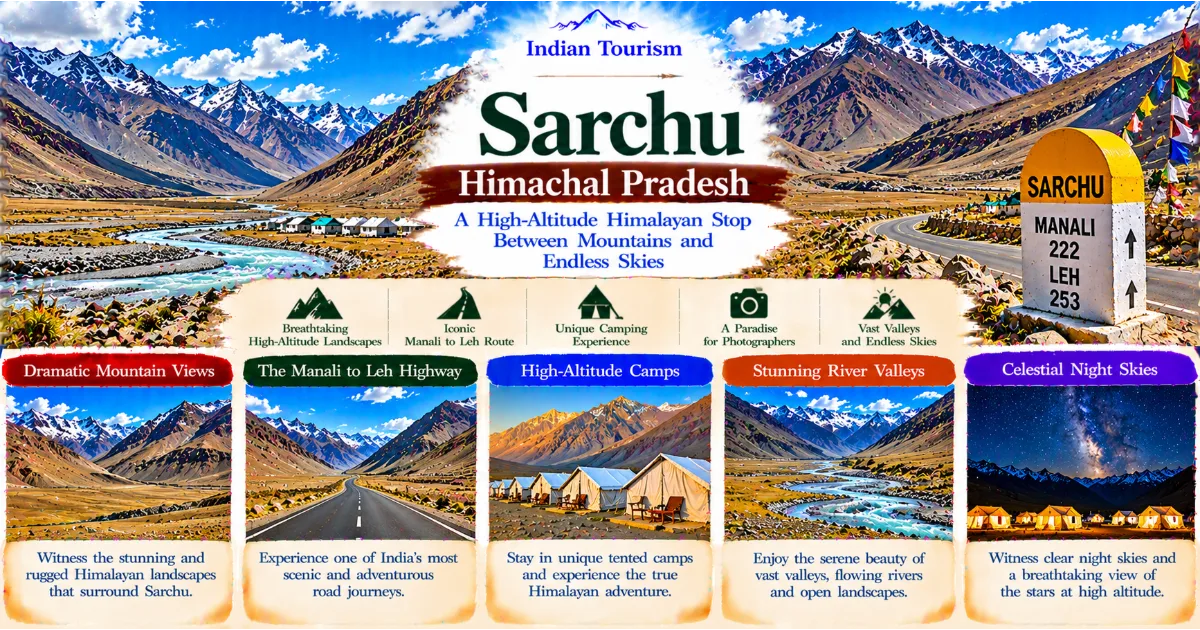
Discovering the Remote Beauty of Sarchu
Himachal Pradesh offers travellers an extraordinary range of landscapes, from green valleys and cedar forests to snow-covered peaks, ancient settlements and vast high-altitude deserts. Beyond its familiar hill stations lies another world where the mountains become more rugged, vegetation becomes sparse and the landscape opens into enormous stretches of rocky terrain. Sarchu, situated along the Manali to Leh highway near the boundary between Himachal Pradesh and Ladakh, represents this dramatic side of Himalayan travel. It is a remote high-altitude destination known for its open valleys, rugged mountains, tented accommodation during the travel season and its importance as a stopping point on one of India's most memorable road journeys.
Unlike destinations where travellers arrive primarily to explore markets, monuments or entertainment centres, Sarchu is closely connected with the journey itself. Visitors come here to experience the scale of the Himalayas, pause during a demanding road trip and observe a landscape that feels very different from the greener parts of Himachal Pradesh. The wide surroundings, winding roads, distant mountain ridges and clear skies create a sense of isolation that many travellers find fascinating.
Sarchu is particularly associated with journeys between Manali and Leh. For motorcyclists, road-trip enthusiasts, photographers and adventure travellers, it can become one of the most memorable sections of the route. The terrain changes dramatically as the road climbs through mountain passes and high-altitude valleys. Travellers gradually leave behind forested areas and enter a drier landscape where exposed rock, gravel plains and distant peaks dominate the scenery.
However, Sarchu should not be treated as an ordinary roadside stop. Its high elevation can affect the body, weather conditions can change rapidly and services are limited compared with larger towns. A successful visit requires preparation, respect for altitude and a willingness to adjust plans according to local conditions.
For travellers who appreciate remote landscapes and the experience of crossing the Himalayas, Sarchu offers something distinctive. It is a place where the journey becomes the attraction, where the road stretches into the mountains and where the immense scale of the natural environment becomes impossible to ignore.
Understanding Sarchu and Its Geographical Setting
Sarchu lies on the Manali to Leh highway in a remote high-altitude region near the boundary between Himachal Pradesh and Ladakh. Its surroundings are characterised by broad mountain valleys, barren slopes, rocky ground and long stretches of road passing through exposed terrain. The landscape differs considerably from the forested hills and agricultural valleys commonly associated with Himachal Pradesh.
The region's geographical character is shaped by its elevation, mountain barriers and relatively dry conditions. Vegetation is sparse across much of the surrounding terrain, and many slopes display exposed rock rather than thick forests. The landscape can appear almost desert-like, yet it is unmistakably Himalayan because of the immense mountain ranges and the high passes that form part of the wider route.
The road passing through Sarchu gives the settlement its importance. It connects travellers moving between Manali and Leh, making the area a practical stopping point on a journey that involves long distances and considerable changes in altitude. During the main travel season, temporary accommodation and basic services may operate to support road users. These facilities are often seasonal because winter conditions make the region difficult to access.
The surrounding mountains create a constantly changing visual environment. Some slopes appear smooth and rounded, while others display sharp ridges, loose rock and deeply cut channels. The colours vary with the light, ranging from pale grey and brown to golden tones under the afternoon sun. Clouds and shadows can transform the landscape within a short period, giving photographers a variety of compositions even when the terrain appears simple at first glance.
Sarchu's location also means that it is exposed to the challenges of high-altitude travel. Cold nights, strong winds, sudden weather changes and limited emergency services must all be considered. A route that looks straightforward on a map may involve long driving periods and difficult conditions in reality.
Understanding this geographical setting helps visitors appreciate both the beauty and the limitations of Sarchu. It is not a conventional holiday resort, but a remote Himalayan location whose attraction comes from its landscape, isolation and role in a remarkable mountain journey.
Why Sarchu Deserves a Place on Your Himachal Pradesh Travel List
Sarchu is best understood as a destination for travellers who want to experience the wider Himalayan landscape rather than spend their holiday in a single developed town. Its appeal lies in the feeling of remoteness, the scale of the mountains and the opportunity to witness a striking transition between different geographical environments.
One of the strongest reasons to visit Sarchu is its dramatic scenery. The open terrain offers expansive views of mountain slopes and high-altitude valleys. There are few urban distractions, and the natural environment remains the dominant feature. For visitors accustomed to busy roads, crowded markets and densely developed tourist areas, the openness can feel refreshing.
Another reason is the experience of travelling along the Manali to Leh highway. The route passes through changing landscapes, with steep climbs, mountain passes and wide valleys creating a journey that is as important as the destination. Sarchu provides an opportunity to pause, appreciate the scenery and reflect on the distance already covered.
The area also attracts photographers because of its distinctive light and terrain. The absence of dense vegetation makes the shape of the mountains especially visible, while the broad sky creates opportunities for dramatic landscape images. Travellers may find that the simplest compositions, such as a road crossing an empty valley or a line of mountains beneath changing clouds, communicate the character of the region effectively.
Sarchu can also appeal to motorcyclists and road-trip enthusiasts who enjoy the challenge of long mountain journeys. It is often associated with overnight breaks along the route, allowing travellers to divide a demanding journey into more manageable stages. However, the altitude means that an overnight stop should be planned carefully rather than chosen only for convenience.
The destination is not suitable for every traveller. Those who require extensive facilities, warm resort-style accommodation, nightlife or a wide range of restaurants may find the options limited. Visitors who understand these limitations and prepare accordingly are more likely to enjoy Sarchu.
For the right traveller, Sarchu provides an opportunity to experience the Himalayas in a more remote and elemental form. Its value comes not from the number of attractions within the settlement but from the surrounding landscape and the memorable journey required to reach it.
The Landscape of Sarchu: Mountains, Valleys and Open Horizons
The landscape surrounding Sarchu is one of its defining attractions. Unlike the greener valleys of lower Himachal Pradesh, the terrain here is dominated by exposed rock, gravel, dry slopes and distant mountain ridges. The lack of dense vegetation allows the underlying shape of the land to become the main visual feature.
The mountains rise above broad valleys and create a sense of enormous scale. From certain viewpoints, the road appears as a narrow line crossing a vast landscape. Vehicles become small against the surrounding slopes, helping visitors understand the distance and isolation of the region.
The colours of the terrain depend heavily on sunlight and weather. During clear mornings, the mountains may appear in cool grey and blue tones. As the sun rises higher, warmer browns and golden shades become more prominent. Late afternoon can produce long shadows across the slopes, revealing textures that are less obvious in direct sunlight.
Clouds add another dimension to the landscape. Moving shadows may travel across distant ridges, while changing visibility can make nearby mountains appear sharply defined and distant peaks seem almost invisible. This constant variation makes the region attractive to photographers who enjoy observing natural changes rather than relying on a single viewpoint.
The terrain also demonstrates the geological forces that shape the Himalayas. Folded rock layers, eroded slopes and channels created by flowing water reveal a landscape that has developed through immense geological processes. Visitors do not need specialised equipment to appreciate these features. Simply observing the contrast between different mountain faces can provide a sense of the region's complexity.
Despite its apparent emptiness, the landscape is not lifeless. Small plants adapted to harsh conditions may grow in suitable places, and wildlife can exist across the wider region. Visitors should avoid disturbing animals or collecting plants and stones as souvenirs. The fragile environment requires care, particularly because vegetation grows slowly at high altitude.
The most rewarding way to appreciate Sarchu is to allow time for observation. Rather than rushing to the next destination, travellers can stop at safe designated locations, study the changing mountain colours and appreciate the extraordinary openness of the terrain.
The Manali to Leh Highway: The Journey That Defines Sarchu
Sarchu is closely connected with the Manali to Leh highway, one of India's best-known high-altitude road journeys. The route links the Kullu region with Lahaul and continues towards the high mountain landscapes of Ladakh. Travellers experience a dramatic transition from greener valleys to exposed slopes, broad plateaus and remote mountain passes.
The journey is not simply a means of reaching another town. For many visitors, it is the central experience of the trip. The road passes through changing elevations and landscapes, creating a sense of progression from one geographical environment to another. Forests gradually become less common, slopes become more exposed and the surrounding terrain takes on a drier appearance.
Sarchu offers an important pause along this route. Travellers often use it to rest during a multi-day journey, especially when moving between the Manali side and Leh. The availability of seasonal accommodation can make an overnight stay practical, but visitors should confirm current services before travelling.
Road conditions vary with the season and can change rapidly. Snow, rain, landslides, roadwork and other disruptions may affect access. Travellers should check official road advisories and local information before setting out rather than relying exclusively on older travel reports or mapping applications.
Drivers should also recognise that long-distance mountain travel places demands on concentration and vehicle performance. Narrow roads, steep gradients, sharp bends and changing visibility require careful driving. Fuel planning, vehicle checks and realistic travel schedules are essential.
For motorcyclists, the highway can be particularly memorable because of the direct experience of changing weather and terrain. However, riders need appropriate protective clothing, a suitable motorcycle, emergency supplies and experience with mountain roads. The desire to complete the route should never take priority over safety.
Sarchu's significance comes from this relationship between the road and the landscape. It is a place where travellers can pause, recover from the journey and appreciate the remarkable geographical transition unfolding around them.
High-Altitude Travel and Understanding the Environment
One of the most important aspects of visiting Sarchu is understanding the effect of altitude. The area lies at a high elevation, and the reduced availability of oxygen can affect visitors who arrive from lower regions. People respond differently to altitude, and physical fitness alone does not guarantee protection against altitude-related illness.
Travellers may experience headache, nausea, dizziness, unusual tiredness or reduced appetite when adjusting to high altitude. Symptoms should never be ignored simply because the destination is remote or the itinerary is tightly planned. Severe or worsening symptoms, confusion, difficulty walking normally or breathlessness at rest require urgent medical attention and prompt descent where appropriate.
It is important to avoid treating Sarchu as a place where the body will automatically adjust after a single night's rest. The safest itinerary depends on the overall route, previous acclimatisation, health status and the elevation of the places visited before arrival. Travellers should consult appropriate medical professionals if they have concerns about high-altitude travel.
Weather presents another challenge. Temperatures can fall sharply after sunset, and strong winds can make conditions feel considerably colder. Even during the main road-travel season, warm layers and weather protection remain necessary.
The exposed terrain offers limited shelter in many places. Visitors should avoid wandering far from established areas without reliable local guidance and should not attempt difficult walks immediately after arriving at high altitude. Rest and gradual adjustment are more important than strenuous sightseeing.
Travellers should also understand that emergency services may be limited. Mobile connectivity can be unreliable, and distances between settlements can be substantial. Carrying essential medication, warm clothing, drinking water and a reliable communication plan is sensible.
The high-altitude environment is part of what makes Sarchu visually extraordinary, but it also requires respect. Visitors who understand the risks can make better decisions and enjoy the journey without unnecessary exposure to danger.
Best Time to Visit Sarchu
The most suitable time to visit Sarchu depends on road access, weather conditions and the wider Manali to Leh itinerary. Because the region is exposed to severe winter conditions, travel opportunities are seasonal and should be planned around confirmed access rather than assumptions about fixed dates.
Summer: The Main Travel Season
Summer is generally the most practical period for road travel through Sarchu. Snow clearance and improving weather conditions can make sections of the Manali to Leh route accessible, although the timing varies each year. Official road information should be checked before departure.
During this period, the surrounding landscape becomes more accessible to road travellers. Longer daylight hours provide additional time for photography and rest stops, while seasonal accommodation may be available in the area. This is also when many motorcyclists and road-trip enthusiasts plan journeys through the high Himalayas.
Despite the more favourable access, summer does not guarantee comfortable conditions. Nights can be cold, winds may be strong and weather can change quickly. Travellers should carry suitable clothing and avoid assuming that a clear afternoon forecast means the entire route will remain safe.
Early Autumn: Clear Skies and Cooler Conditions
Early autumn can offer excellent views when road access remains open and the weather is stable. The atmosphere may feel crisp, and clear conditions can make distant mountain ridges especially visible.
However, temperatures generally become more challenging as the season progresses. The risk of snowfall and road disruption increases, and temporary accommodation services may begin to close. Travellers should confirm the availability of facilities before planning an overnight stay.
Winter: Extreme Conditions and Restricted Access
Winter brings severe cold, snowfall and difficult access to much of the high-altitude route. Sarchu should not be approached as a casual winter destination. Ordinary tourist services may be unavailable, and road access may be closed or severely restricted.
Visitors who have specialised experience in winter mountain travel should still rely on official information and appropriate local support. Independent travellers should not attempt to reach the area merely to experience a snowy landscape.
Spring: A Period of Uncertainty
Spring is a transition period in which snow clearance and road conditions can vary considerably. Some sections may be accessible while others remain closed. Weather can change rapidly, and services may not yet be operating consistently.
For most travellers, the safest strategy is to wait until road access and accommodation availability are confirmed. The best travel date is not necessarily the earliest possible date, but the one that offers suitable conditions for the entire journey.
How to Reach Sarchu
Sarchu is primarily reached by road as part of a journey between Manali and Leh. Because of the high altitude and seasonal nature of the route, reaching the area requires more planning than travelling to a conventional hill station.
Reaching Sarchu from Manali
Manali is a common starting point for travellers approaching Sarchu from Himachal Pradesh. The journey passes through Lahaul and continues into increasingly rugged high-altitude terrain. Depending on the route, traffic restrictions and current conditions, travellers may pass through the Atal Tunnel before continuing towards the higher mountain sections.
The journey should be divided into realistic stages. Drivers need to allow time for road conditions, rest breaks and possible delays. Attempting to cover the entire distance without adequate rest can increase the risk of fatigue and poor decision-making.
Travellers should confirm fuel availability, vehicle condition and accommodation plans before leaving. Fuel stations and services become less frequent along remote sections of the route, so relying on the next convenient stop can be unwise.
Reaching Sarchu from Leh
Travellers moving from Leh towards Manali may also stop at Sarchu during their journey. The route involves long distances and several high mountain sections. Because elevation and weather can affect both driving and physical comfort, an overnight stop should be part of a carefully planned itinerary.
Road conditions may differ between sections, and delays can occur even when the weather initially appears favourable. Travellers should check current conditions before departure and remain prepared to change plans.
Reaching by Motorcycle
Motorcycle journeys through Sarchu are popular among experienced riders who want to explore the high Himalayas. The changing landscape and open road create a memorable riding experience, but the route requires preparation and sound judgement.
Riders should check their motorcycles thoroughly, carry suitable protective equipment and plan fuel stops carefully. Warm gloves, weatherproof clothing, tools and essential repair supplies can be valuable. Riding in poor visibility or severe weather should be avoided.
Public Transport and Organised Tours
Public transport availability can vary by season and route. Some travellers choose shared vehicles or organised road trips because these options reduce the need to manage every driving detail independently. However, schedules and services should be confirmed before travelling.
Organised tours can be useful for visitors who are unfamiliar with high-altitude roads, but the itinerary should allow adequate rest and provide clear information about accommodation, transport arrangements and emergency procedures.
There is no major commercial airport or railway station in Sarchu itself. Travellers generally combine air or rail transport to a larger town with a road journey into the mountains.
Places and Landscapes to Explore Around Sarchu
Sarchu can be included in a wider journey through Lahaul and Ladakh. The most appropriate nearby stops depend on the direction of travel, road access and the time available.
Baralacha La
Baralacha La is a high mountain pass on the Manali to Leh route. The surrounding landscape illustrates the dramatic terrain of the greater Himalayas, with rugged slopes, snow-covered sections during suitable seasons and broad views across the high-altitude environment.
The pass is a major part of the road journey and should be approached with caution. Weather can change quickly, and snow or other conditions may affect access. Visitors should follow local instructions and avoid stopping in unsafe locations.
Deepak Tal
Deepak Tal is a small high-altitude lake along the route on the Lahaul side. When conditions are favourable, the lake can create attractive reflections of the surrounding mountains and sky. Its setting offers a quieter photographic stop for travellers moving through the region.
The lake's appearance varies with the season and weather. Visitors should avoid damaging the surrounding ground or leaving litter, and should remain aware of the cold conditions and limited services.
Suraj Tal
Suraj Tal is a high-altitude lake associated with the Baralacha La region. It is known for its mountain setting and the striking contrast between water, rocky slopes and snow in suitable conditions. The lake is particularly appealing to photographers and travellers interested in high-altitude landscapes.
Because the area is exposed and access depends on road and weather conditions, visits should be planned carefully. Travellers should not assume that every section will be accessible throughout the season.
Keylong
Keylong is an important settlement in Lahaul and offers more facilities than many remote stops along the highway. Travellers may find accommodation, food and practical services that are less readily available in higher-altitude areas.
A stop in Keylong can be useful before or after travelling through Sarchu. It also provides an opportunity to experience the settlement patterns and everyday life of the wider Lahaul region.
Jispa
Jispa is a settlement beside the Bhaga River and a popular stopping point for travellers moving through Lahaul. Its river valley, mountain scenery and relatively peaceful atmosphere provide a contrast with the more exposed terrain around Sarchu.
A journey that includes both Jispa and Sarchu offers a broader view of the region. Jispa provides a river-focused landscape, while Sarchu is associated with high-altitude openness and the road crossing towards Ladakh.
Pang
Pang is a high-altitude stopping point on the route between Sarchu and Leh. The surrounding terrain is marked by broad mountain landscapes and exposed slopes. Travellers often encounter Pang as part of a long road journey rather than as a destination for an extended stay.
As with other remote stops, the availability of accommodation and services can vary. Visitors should confirm current conditions and avoid planning an itinerary that depends on unverified facilities.
Experiences Worth Enjoying in Sarchu
Observing the Vast Mountain Landscape
One of the most rewarding experiences in Sarchu is simply observing the surrounding mountains. The open terrain creates a feeling of distance and scale that is difficult to experience in more developed tourist areas.
Visitors can appreciate how the landscape changes under different lighting conditions. Morning light may emphasise cool tones, while afternoon sunshine reveals warmer colours and stronger shadows. Safe roadside viewpoints can provide opportunities to pause and take photographs without leaving established routes.
Landscape Photography
Sarchu offers a range of photographic subjects, including mountain ridges, empty roads, gravel plains and dramatic skies. Wide-angle compositions can communicate the scale of the landscape, while narrower frames can highlight the texture of individual slopes.
Photographers should pay attention to weather and visibility. Dust, wind and sudden changes in temperature can affect equipment. A protective camera bag and spare batteries are useful for travellers who plan to photograph the region extensively.
Safety should remain a priority. Do not stand in traffic lanes, cross unstable ground or climb exposed slopes simply to improve a photograph. The most effective images often come from safe, accessible viewpoints.
Experiencing a High-Altitude Road Journey
For many visitors, travelling through Sarchu is itself the main activity. The road reveals a sequence of changing landscapes, from steep mountain sections to wide valleys and exposed high-altitude terrain.
Travellers should allow time to enjoy the journey without creating pressure to reach the next destination too quickly. Scheduled rest breaks, realistic driving distances and attention to weather make the experience safer and more comfortable.
Spending a Quiet Evening
When seasonal accommodation is operating, an overnight stay can provide an opportunity to experience the stillness of the surrounding mountains after the road becomes quieter. The landscape may feel especially expansive as the light fades and the temperature drops.
Evenings can be very cold, and accommodation conditions may be basic. Visitors should confirm heating, bedding, meal arrangements and access to essential services before booking.
Stargazing When Conditions Permit
Clear skies and limited artificial lighting can create opportunities to observe stars in remote mountain areas. The quality of the experience depends on cloud cover, moonlight, weather and the precise location.
Visitors should remain near safe, familiar areas after dark and dress appropriately for the cold. It is not advisable to walk across unfamiliar terrain or approach road edges in darkness.
Accommodation and Food in Sarchu
Accommodation in Sarchu is limited and strongly seasonal. During the main road-travel period, visitors may find tented camps or other temporary accommodation intended for travellers moving between Manali and Leh. The availability and quality of these facilities can vary from year to year.
Travellers should confirm accommodation before setting out, especially when planning to stay overnight. It is important to ask about bedding, insulation, sanitation, meals, electricity and heating arrangements. Visitors should not assume that facilities will match those available in a large tourist town.
Because of the altitude and exposure, a suitable place to rest is particularly important. Even if accommodation is simple, it should provide adequate protection from cold and wind. Travellers should bring personal warm clothing and any essential medication rather than relying entirely on the facilities available at the stop.
Food options may be basic and dependent on seasonal operations. Visitors may find simple meals and hot beverages where camps or food services are functioning, but the range can be limited. Those with dietary requirements should confirm arrangements in advance and carry appropriate backup supplies.
Water availability and sanitation also deserve attention. Travellers should follow the instructions of accommodation providers and use safe drinking water. Avoid wasting water or leaving packaging and food waste behind.
Sarchu is not the ideal destination for visitors who expect a wide choice of luxury hotels, restaurants and shopping facilities. Its accommodation serves a practical purpose within a remote road journey. Understanding this reality helps visitors prepare properly and appreciate the landscape without unrealistic expectations.
A Suggested Two-Day Itinerary for Sarchu
Day One: Travel Through Lahaul and Reach Sarchu
Begin from Manali or another suitable point with a realistic driving schedule. Check the road situation before departure and make sure the vehicle is prepared for a high-altitude journey. Carry drinking water, food, warm clothing and essential supplies.
During the journey, stop at safe viewpoints where road conditions permit. Avoid turning every scenic stop into a long detour because the distance and elevation changes can make travel more demanding than expected.
If travelling from the Manali side, consider the broader Lahaul route and the conditions at the mountain passes. The journey should be planned according to current official information rather than relying on fixed assumptions about travel time.
On reaching Sarchu, check into confirmed accommodation if an overnight stay is planned. Rest, eat a suitable meal and avoid strenuous activity while adjusting to the elevation. Pay attention to any unusual symptoms and seek help if necessary.
Spend the remaining daylight observing the surrounding landscape from safe areas. Photography and quiet observation are suitable activities, provided weather and physical comfort permit.
In the evening, prepare warm clothing for the night and confirm the next day's route. Check weather information and road updates before resting.
Day Two: Continue the Journey or Explore Accessible Viewpoints
Begin the day by checking road conditions and assessing how you feel after the night at high altitude. If you have developed symptoms that could indicate altitude illness, do not ignore them or continue simply because the itinerary requires it. Seek appropriate assistance and follow medical guidance.
If conditions are suitable, spend a short period appreciating the morning landscape before continuing towards Leh or returning towards Lahaul and Manali, depending on your route.
Travellers with additional time may plan stops at accessible locations such as Deepak Tal, Suraj Tal or other established viewpoints, subject to road conditions. These stops should be incorporated into a realistic travel schedule that allows adequate rest.
Avoid attempting to cover too many high-altitude destinations in one day. The combination of long driving distances, cold conditions and reduced oxygen availability can be physically demanding.
This itinerary treats Sarchu as both a landscape destination and a practical overnight stop. It leaves room for observation while prioritising safe travel and adequate rest.
Sarchu for Different Types of Travellers
For Road-Trip Enthusiasts
Sarchu is especially appealing to travellers who enjoy long mountain journeys. Its position on the Manali to Leh highway makes it an important part of a broader road-trip experience. The surrounding terrain provides a striking contrast with the greener landscapes of lower Himachal Pradesh.
Road-trip enthusiasts should prepare carefully, maintain their vehicles and avoid setting unrealistic daily distances. The objective should be to enjoy the route safely rather than complete it as quickly as possible.
For Motorcycle Riders
Experienced motorcycle riders may find Sarchu memorable because of its remote setting and connection with high mountain passes. The journey offers changing scenery and the experience of riding through a demanding landscape.
However, the altitude, cold, wind and road surface require appropriate preparation. Riders should carry protective equipment, warm layers and essential repair supplies. Anyone experiencing altitude-related symptoms should stop and seek appropriate help rather than continuing the ride.
For Photographers
Sarchu is well suited to photographers interested in landscapes, mountain roads and open skies. The broad terrain provides opportunities for images that emphasise scale and isolation.
Photographers should plan around the light and weather while keeping equipment protected. A safe viewpoint is preferable to a dangerous position reached by leaving established routes.
For Solo Travellers
Solo travellers may enjoy the quiet atmosphere, but remote travel requires careful planning. Limited connectivity and long distances between services can make unexpected problems more difficult to manage.
Share your itinerary with someone trusted, confirm accommodation and transport, and carry essential supplies. Solo travellers should also be particularly cautious about altitude symptoms and should not attempt strenuous excursions without appropriate preparation.
For Families
Sarchu requires careful consideration for family travel because of its high elevation, cold conditions and limited services. Families should assess the needs of children and older travellers before including it in an itinerary.
A brief stop during a road journey may be more suitable than an extended stay for some families. Children should be kept warm, monitored for unusual symptoms and protected from exposed terrain and moving traffic.
Families travelling with people who have medical concerns should seek professional advice before planning a high-altitude journey.
Responsible Tourism in the High Himalayas
The high-altitude environment around Sarchu is fragile. Vegetation grows slowly, waste disposal can be difficult and the remoteness of the area makes environmental damage harder to address. Responsible tourism is therefore essential.
Visitors should carry their rubbish until it can be disposed of appropriately. Plastic packaging, bottles and food waste should never be left along the road, near camps or across open ground. Even small amounts of litter can accumulate when many travellers pass through the same location.
Water should be used carefully, and travellers should follow local guidance about sanitation. Avoid washing vehicles or equipment in natural water sources and do not leave chemicals or waste where they can enter the environment.
Stay on established routes and avoid driving across fragile ground. Do not disturb wildlife, remove plants or collect natural materials as souvenirs. The landscape may look empty, but it supports ecological processes that are vulnerable to careless activity.
Support responsible accommodation and tour operators where possible. Ask about waste management and follow local rules. Visitors should also respect the people who work in seasonal camps and transport services, recognising that conditions can be demanding for residents as well as travellers.
Responsible tourism means understanding that access to a beautiful place carries obligations. By reducing waste, conserving resources and respecting local instructions, travellers can help protect the high Himalayas for future visitors.
High-Altitude Safety and Practical Travel Advice
Safety should be the foundation of any trip to Sarchu. The elevation can affect breathing and physical performance, while cold weather and long driving distances add further challenges.
Travellers should plan a route that allows gradual acclimatisation where possible. Avoid strenuous activity immediately after arriving at high altitude and pay attention to symptoms such as headache, nausea, dizziness and unusual fatigue. Severe or worsening symptoms require urgent medical attention. Confusion, difficulty walking normally or breathlessness at rest are warning signs that must not be ignored.
Carry warm layers, thermal clothing, gloves, a cap and weatherproof outerwear. Temperatures can drop rapidly after sunset, and strong winds may increase heat loss. Sun protection is also important because high-altitude sunlight can be intense even when the air feels cold.
Before travelling, check the condition of the vehicle, fuel availability and current road advisories. Carry essential medication, a first-aid kit, water, food, a torch and a way to contact help where possible. Mobile coverage may be inconsistent, so do not depend entirely on a phone connection.
Avoid unnecessary night driving on unfamiliar mountain roads. Visibility may be limited, road edges can be difficult to judge and temporary obstacles may be harder to see. Stop only in safe locations and follow official instructions at checkpoints or road closures.
Visitors should not attempt to cross flooded sections, drive through unstable debris or continue during severe weather simply to stay on schedule. A delayed journey is preferable to an avoidable accident.
Those with relevant medical conditions should consult a qualified healthcare professional before planning high-altitude travel. Preparation, caution and flexibility are the most important tools for enjoying Sarchu safely.
What to Pack for a Trip to Sarchu
Packing for Sarchu requires more attention to weather and practical needs than a typical short holiday. Even during the main travel season, cold nights and sudden weather changes are possible.
Carry thermal layers, a warm fleece or insulated jacket, a windproof outer layer and waterproof protection. Gloves, a warm cap and socks suitable for cold conditions can make a significant difference. Comfortable shoes with good grip are useful for walking around safe viewpoints and accommodation areas.
Sun protection should include sunglasses, sunscreen and a hat. The combination of altitude, sunlight and exposed terrain can increase discomfort during extended outdoor periods.
Carry personal medication, a basic first-aid kit and any supplies recommended by your healthcare professional. A reusable water bottle, snacks and drinking water are useful during long stretches of driving. A torch or headlamp can help when moving around accommodation after dark.
Drivers and motorcyclists should carry essential vehicle or motorcycle supplies suited to their route. Protective riding gear, tools, puncture-repair equipment and weatherproof storage can be particularly important for riders.
A power bank, spare charging cables and offline copies of important travel information may be helpful where connectivity is unreliable. Keep identification and emergency contact details accessible.
Finally, carry sufficient cash for situations in which digital payments or banking services are unavailable. Confirm accommodation and transport arrangements before departure, and keep a reserve for unexpected delays or overnight stays.
Budget Planning for Sarchu
The cost of visiting Sarchu depends on transport, the season, accommodation availability, group size and the wider route. Travellers who arrive in a private car will have different expenses from those travelling by motorcycle or joining an organised tour.
Accommodation may consist of seasonal camps or basic facilities rather than conventional hotels. Prices and availability can vary considerably, so travellers should confirm arrangements directly before departure. The cost of an overnight stay should be considered alongside food, transport and any additional services.
Transport is often the largest part of the budget because the journey involves long distances and high-altitude roads. Private vehicles provide flexibility but require fuel, maintenance and suitable equipment. Motorcycle travellers may need to account for repairs, protective gear and emergency supplies.
Food options can be limited, particularly outside the main travel period. Carrying appropriate snacks and backup supplies can help reduce dependence on uncertain services, but travellers should not compromise on safe drinking water or essential provisions.
A contingency fund is particularly important for remote travel. Road closures, bad weather or altitude-related problems can require additional accommodation or changes to the route. A flexible budget makes it easier to choose safety over an attempt to preserve the original schedule.
The best approach is to plan conservatively, confirm major costs before leaving and allow enough money for unexpected changes. In a remote mountain environment, preparation can be more valuable than attempting to travel on the smallest possible budget.
Common Mistakes to Avoid When Visiting Sarchu
One of the most common mistakes is underestimating the effect of altitude. Travellers may feel healthy at lower elevations and assume that they can immediately continue at the same pace. However, altitude affects people differently, and symptoms should never be ignored.
Another mistake is treating Sarchu as a conventional tourist destination with guaranteed accommodation, restaurants and reliable connectivity. Seasonal services can vary, and visitors should confirm what is operating before arriving.
Some travellers also plan unrealistic driving distances. Mountain roads can be slow, and weather or roadwork can add significant delays. A flexible itinerary with adequate rest is safer and usually more enjoyable.
Packing insufficient warm clothing is another avoidable problem. Even when daytime temperatures appear comfortable, evenings can become very cold. Layered clothing and weather protection are essential.
Visitors should also avoid leaving litter behind or walking onto fragile terrain for photographs. The environment is sensitive, and the remoteness of the area makes waste management difficult.
Finally, travellers should not continue towards higher destinations when experiencing serious symptoms of altitude illness. The desire to complete a road trip must never take priority over health and safety.
Avoiding these mistakes helps ensure that the visit remains memorable for the right reasons. Sarchu rewards preparation, patience and respect for the realities of high-altitude travel.
Is Sarchu Worth Visiting?
Sarchu is worth visiting for travellers who enjoy remote Himalayan landscapes and understand the demands of high-altitude road travel. Its broad valleys, rugged mountains and open skies create an environment that differs sharply from the forests and green hills found elsewhere in Himachal Pradesh.
The destination is particularly suited to experienced road-trip enthusiasts, motorcyclists, photographers and travellers moving between Manali and Leh. It can provide a practical place to pause during a long journey while offering opportunities to observe the surrounding landscape.
However, Sarchu is not ideal for every kind of holiday. Its facilities are limited, accommodation can be basic and weather conditions can be challenging. Travellers seeking luxury, extensive sightseeing infrastructure or easy access to medical services may prefer to spend more time in better-equipped settlements.
The best way to experience Sarchu is to approach it as part of a carefully planned mountain journey. Allow adequate time, prepare for the altitude, confirm road conditions and remain flexible if the weather changes.
For travellers who appreciate the scale and solitude of the high Himalayas, Sarchu can become one of the most memorable parts of a journey through northern India. Its beauty is found in the landscape itself and in the experience of travelling through one of the country's most dramatic mountain regions.
Conclusion: Experiencing the High Himalayas at Sarchu
Sarchu represents a distinctive side of Himachal Pradesh, where rugged mountains, open valleys and exposed high-altitude terrain replace the forests and crowded streets of familiar hill stations. Its importance as a stopping point on the Manali to Leh highway makes it part of a remarkable road journey, but the landscape deserves attention in its own right.
Visitors can appreciate the vast mountain views, photograph the changing light, observe the terrain and experience the feeling of travelling through a remote Himalayan region. An overnight stay, when seasonal accommodation is available, can provide a welcome pause during a demanding journey.
Preparation is essential. High altitude, cold temperatures, limited services and changing road conditions require travellers to plan carefully and prioritise safety. Checking official information, carrying suitable equipment and allowing time for rest can make a substantial difference.
Sarchu is not defined by luxury facilities or a long list of organised attractions. It is defined by the scale of its surroundings and its place within one of India's most extraordinary mountain routes. For travellers willing to prepare and adapt, it offers a memorable encounter with the open landscapes of the high Himalayas.
#IndianTourism #HimachalPradesh #Sarchu #ManaliToLeh #HimalayanRoadTrip #HighAltitudeTravel #ExploreHimachal #HimalayanLandscapes #AdventureTravelIndia #MountainPhotography #ResponsibleTourism #ExploreIndia
