
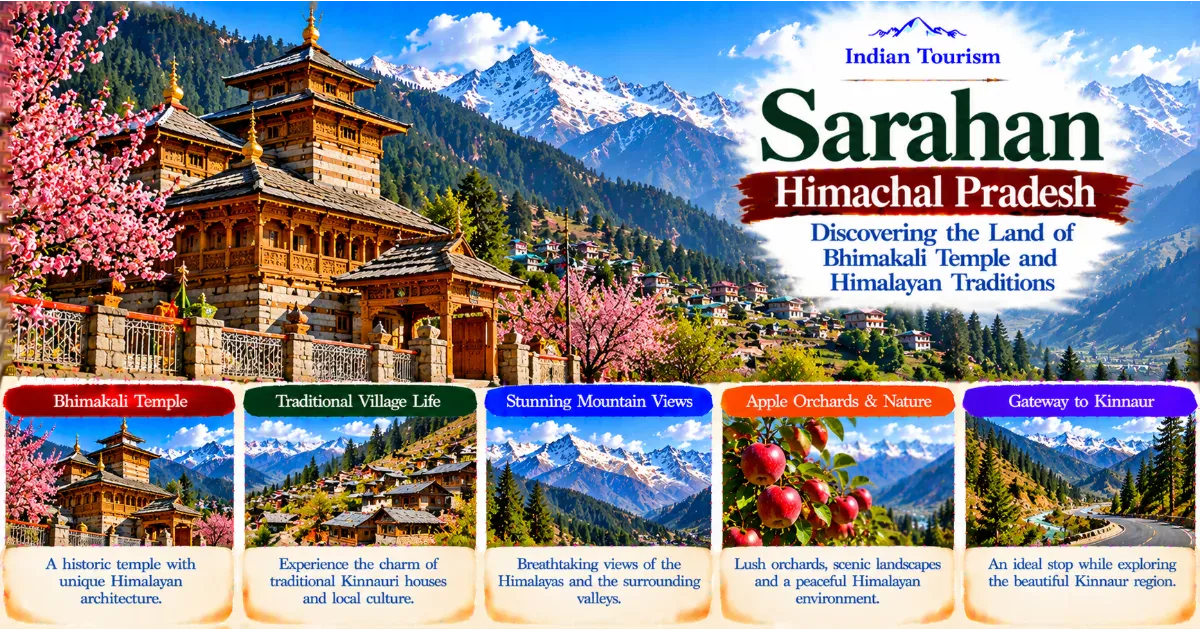
A Himalayan Village Where Heritage Meets Mountain Beauty
Himachal Pradesh is home to destinations that combine spectacular mountain scenery with centuries of religious traditions, distinctive architecture and deeply rooted local cultures. While many travellers are familiar with Shimla, Manali and Dharamshala, the state also contains smaller settlements where the relationship between people, faith and the natural environment remains central to everyday life. Sarahan, situated in the Shimla district near the Kinnaur region, is one such destination. Known for the historic Bhimakali Temple, traditional Himalayan architecture and panoramic views of the surrounding mountains, Sarahan offers a rewarding experience for travellers interested in culture, history and nature.
The village occupies an important position along the traditional route connecting the lower Himalayan regions with Kinnaur. Its location makes it a useful stopping point for travellers heading towards the Sutlej valley, while its religious heritage gives it an identity of its own. Sarahan is particularly associated with Bhimakali Temple, a significant Hindu religious complex recognised for its distinctive architecture and spiritual importance.
The experience of visiting Sarahan differs from a conventional holiday focused on shopping, entertainment and crowded attractions. Here, the most memorable experiences often involve walking through the village, observing traditional buildings, learning about local customs, enjoying mountain views and understanding the importance of the temple to the surrounding community.
Sarahan is also a destination where history and geography come together. The village's position in the western Himalayas has influenced its architecture, agriculture, transport connections and religious traditions. Its surroundings provide a transition between the greener lower mountain landscapes and the increasingly rugged terrain encountered farther towards Kinnaur.
For travellers exploring Himachal Pradesh, Sarahan can be included in a broader itinerary through Shimla, Rampur, the Sutlej valley and Kinnaur. It can also be a destination in its own right for visitors who prefer quieter settlements and cultural exploration.
A journey to Sarahan offers an opportunity to appreciate a less hurried side of the Himalayas, where historic religious institutions, mountain landscapes and village life form a connected experience.
Where Is Sarahan Located?
Sarahan is a mountain settlement in the Shimla district of Himachal Pradesh. It lies along the broader route towards Kinnaur and is associated with the historic landscape of the former Bushahr region.
Its location provides access to the Sutlej valley and makes it a useful destination for travellers moving between the lower mountain districts and the higher regions of Kinnaur. The surrounding terrain consists of forested slopes, agricultural land, mountain ridges and settlements connected by winding roads.
The village is known for its elevated setting and views of the surrounding Himalayan landscape. The scenery changes according to the season, with greener conditions during warmer months and the possibility of snow in colder periods.
Sarahan's geographical position has also influenced its cultural history. Routes through the region have connected communities, facilitated trade and contributed to the movement of religious and architectural traditions across the western Himalayas.
The village is not as large as major tourist centres, and its facilities reflect its character as a smaller mountain settlement. Travellers should plan accommodation, transport and sightseeing according to their needs, particularly if visiting during a holiday period.
Sarahan can be reached by road from Shimla and other settlements in Himachal Pradesh. The journey involves mountain roads, so travel times depend on traffic, weather and road conditions.
Visitors travelling onward to Kinnaur may find Sarahan a useful place to pause, explore its heritage and break up a longer journey. Those visiting specifically for the temple and surrounding scenery can also plan an overnight stay to experience the village at a slower pace.
Bhimakali Temple: The Spiritual Heart of Sarahan
Bhimakali Temple is the principal landmark of Sarahan and one of the most important reasons travellers visit the village. The temple complex is associated with the worship of Goddess Bhimakali and occupies a significant place in the religious traditions of the region.
The temple is notable for its distinctive architecture, which combines features associated with the western Himalayas. Its layered structures, timber elements and traditional design distinguish it from many other Hindu temple complexes found elsewhere in India.
The architectural character reflects the historical building traditions of the region, where wood and stone have long been used to construct structures suited to mountain conditions. The result is a complex that appears closely connected with its surroundings rather than separate from the village landscape.
For devotees, the temple is a place of worship and spiritual significance. For visitors interested in architecture and history, it offers an opportunity to understand how religious institutions have developed within Himalayan communities.
The temple should be approached respectfully. Visitors must follow the rules provided by temple authorities, including any instructions concerning footwear, photography, restricted areas and appropriate behaviour.
Religious spaces are living institutions, not simply tourist attractions. Worshippers may be attending prayers or carrying out rituals, and visitors should avoid interrupting these activities.
It is also important to recognise that temple traditions may include practices that are unfamiliar to some visitors. The appropriate response is to observe respectfully rather than judge or interfere.
A visit to Bhimakali Temple provides more than an opportunity to see a historic building. It offers insight into the relationship between faith, regional identity and community life in the western Himalayas.
The Architecture of Bhimakali Temple
The architecture of Bhimakali Temple is one of its most distinctive features. The complex reflects traditional Himalayan construction practices, combining materials and design elements that developed in response to the region's climate, available resources and cultural influences.
Timber and stone are important components of the temple's architectural character. In mountain regions, these materials have historically been used to create buildings that are practical as well as visually distinctive.
The temple's multi-level appearance and carefully arranged structural elements create a strong vertical presence. Decorative wooden features add detail, while the overall design reflects regional craftsmanship.
Traditional Himalayan architecture often demonstrates a close relationship between engineering and local knowledge. Builders worked with the materials available to them and developed methods suited to steep terrain, changing temperatures and seasonal weather.
The appearance of Bhimakali Temple also reflects the historical significance of religious institutions in regional society. Temples were not only places of worship but also centres around which community identity and local traditions developed.
Visitors interested in architecture should take time to observe the building's details without touching or disturbing fragile surfaces. Historic structures require careful maintenance, and even seemingly minor damage can affect their preservation.
The temple is especially valuable because it demonstrates that Himalayan architecture cannot be understood as a single uniform style. Different valleys and communities have developed distinctive forms shaped by their own histories and environmental conditions.
Bhimakali Temple is therefore both a religious landmark and an important example of the architectural heritage of Himachal Pradesh.
Sarahan and the Historical Legacy of Bushahr
Sarahan is associated with the historical Bushahr region, which played an important role in the political and cultural history of parts of present-day Himachal Pradesh.
The former Bushahr kingdom had connections with settlements and trade routes across the western Himalayas. Its history developed through relationships among mountain communities, religious institutions, agricultural settlements and routes connecting different valleys.
The location of Sarahan made it significant within this broader regional landscape. Mountain routes provided links between communities, while religious centres helped maintain cultural and spiritual connections.
Historical traditions associated with the region continue to influence how local places are understood today. Temples, settlements and traditional buildings provide visible reminders of the past.
However, local history is complex, and not every historical account should be treated as a fully documented record. Visitors interested in the region's past can benefit from consulting knowledgeable local guides and reliable historical material.
The importance of Sarahan lies partly in the way history remains present in its architecture and religious life. Rather than existing only in museums or written records, the region's heritage continues through places that people visit, maintain and use.
Exploring Sarahan with an interest in history can therefore deepen a traveller's understanding of the wider Shimla and Kinnaur regions.
The Natural Landscape Around Sarahan
Sarahan is surrounded by the varied mountain scenery that makes Himachal Pradesh attractive to nature lovers. Forested slopes, ridgelines, cultivated areas and distant peaks form a landscape that changes considerably throughout the year.
The village's elevated setting creates opportunities to observe the structure of the surrounding mountains. On clear days, views may extend across ridges and valleys, while clouds and changing light can transform the scenery within a short period.
Vegetation varies according to elevation and local conditions. Forests and cultivated land occupy suitable areas, while steeper slopes remain less accessible.
The landscape is especially appealing to travellers who enjoy quiet observation rather than intensive outdoor activities. Walking through suitable village routes and nearby viewpoints can provide opportunities to appreciate the scenery without undertaking demanding treks.
Weather conditions should always guide outdoor plans. Mountain environments can experience sudden changes, and visitors should avoid exposed locations during poor weather.
The natural surroundings also support local livelihoods. Forest resources, agricultural land and water influence the daily lives of residents, making environmental protection an important part of responsible tourism.
Visitors should avoid littering, damaging vegetation or entering private fields without permission. Respect for the landscape helps preserve the qualities that make Sarahan attractive.
Birdwatching and Nature Observation
The wider mountain environment around Sarahan offers opportunities for observing birds and other elements of Himalayan biodiversity. The species encountered depend on elevation, habitat, season and weather.
Forest edges, cultivated areas and open mountain slopes provide different environments for birds. Visitors who move quietly and take time to observe may notice more wildlife than those who rush between viewpoints.
Birdwatching does not require expensive equipment. A pair of binoculars, a field guide and patience can improve the experience, although photography may also be useful for identifying species later.
Visitors should avoid playing recorded bird calls at high volume or approaching nests. Such practices can disturb breeding behaviour and create unnecessary stress for wildlife.
Nature observation should also include attention to the wider environment. Trees, flowers, insects and changing weather patterns all contribute to the ecological character of the region.
The purpose of responsible nature tourism is not simply to collect photographs or sightings. It is to appreciate the complexity of the environment while minimising disturbance.
Sarahan can provide a useful opportunity to include gentle nature observation alongside cultural sightseeing, particularly for travellers who prefer a balanced itinerary.
Village Life and Local Traditions
Sarahan's identity is shaped by more than its temple and mountain views. Everyday village life reflects the agricultural practices, family relationships and cultural traditions that have developed in the region over generations.
The settlement includes homes, small businesses and spaces connected with local religious and community activities. These places provide a glimpse of how mountain communities organise daily life.
Agriculture remains important in many parts of the surrounding region. The type of cultivation varies according to local conditions, but household gardens, fields and orchards contribute to the landscape.
Seasonal work influences the rhythm of village life. Planting, tending crops and harvesting require attention to weather and water availability, while winter conditions may change the range of outdoor activities.
Visitors should remember that the village is a home for its residents. Walking through public areas can be an enjoyable way to explore, but private courtyards, homes and working spaces should not be entered without permission.
Photographing people should always be done respectfully. Ask before taking close portraits, especially when children or private family activities are involved.
Learning about local traditions is most rewarding when conversations are natural and respectful. A local guide or host may be able to explain the significance of particular customs, buildings or community events.
Sarahan's village life adds depth to a visit because it reveals the human relationships that connect the settlement with its landscape and religious heritage.
Festivals and Religious Celebrations
Religious celebrations are important parts of community life in many Himalayan settlements, including areas associated with Sarahan. The temple's traditions contribute to the village's cultural identity and attract devotees from different places.
Festivals may involve prayers, gatherings, music, processions or other community activities, depending on the event and local custom. The timing and format of celebrations can vary, so visitors should seek current information before planning a trip around a particular occasion.
Attending a public religious celebration can provide insight into local traditions, but visitors should remember that the event is primarily meaningful to the community rather than organised for tourists.
Follow instructions from temple authorities and organisers. Avoid blocking processions, interrupting rituals or taking photographs where permission has not been granted.
Crowds may increase during important events, affecting accommodation availability and transport. Travellers should make arrangements in advance if they intend to visit during a major celebration.
It is also important to recognise that some ceremonies or spaces may be restricted to particular participants. Visitors should not assume that every activity is open to public observation.
When approached respectfully, religious celebrations can help travellers understand the continuing importance of faith, tradition and collective identity in the Himalayan region.
Best Time to Visit Sarahan
Sarahan can be visited during different seasons, but the best period depends on the weather, road conditions and the type of experience you want.
Spring: A Season of Renewal
Spring brings a gradual transition from winter conditions towards warmer weather. Vegetation begins to renew itself, and the surrounding landscape may appear increasingly fresh.
This season can suit visitors interested in cultural sightseeing and quieter travel. However, weather conditions can remain unpredictable, particularly at higher elevations.
Travellers should confirm road conditions and carry warm clothing.
Summer: A Comfortable Period for Exploration
Summer is generally a practical period for visiting Sarahan. Daytime temperatures are often more suitable for walking around the village, exploring the temple complex and enjoying nearby viewpoints.
The season can also be convenient for travellers combining Sarahan with a longer journey through Kinnaur.
Because summer is a popular travel period, accommodation should be booked in advance when possible. Weather and road conditions should still be checked before departure.
Autumn: Clear Views and Changing Colours
Autumn can offer attractive mountain views and comfortable conditions for cultural exploration. The changing appearance of vegetation adds variety to the landscape.
Temperatures begin to fall as winter approaches, particularly during the evening and early morning.
Travellers should confirm the availability of transport and accommodation, especially if planning to continue into higher mountain areas.
Winter: Snow and Cold Conditions
Winter can bring severe cold and snowfall to the surrounding mountains. The village may offer a different atmosphere during this period, but road conditions can become challenging.
Visitors considering winter travel should check current weather and access information, carry suitable clothing and remain flexible about their plans.
For many travellers, the warmer months provide the most practical combination of accessibility and comfortable sightseeing. Regardless of the season, local conditions should determine the final travel plan.
How to Reach Sarahan
Sarahan is accessible by road from several destinations in Himachal Pradesh. The route involves mountain roads, so travellers should allow sufficient time and check conditions before setting out.
From Shimla
Shimla is a common starting point for journeys to Sarahan. The route continues through the mountain landscape towards the Sutlej valley and the wider Bushahr region.
The journey may take several hours, depending on traffic, road conditions and stops. Travellers should avoid planning a tightly timed arrival.
From Rampur
Rampur can serve as an intermediate stop for travellers approaching Sarahan through the Sutlej valley. The onward journey involves mountain roads and changing terrain.
A stopover may make the trip more comfortable, particularly for visitors who prefer not to complete a long mountain journey in one day.
From Kinnaur
Travellers already exploring Kinnaur may be able to include Sarahan as part of a wider itinerary, depending on their route and available time.
Check current road conditions before travelling between destinations. Roadwork, landslides and weather can affect journey times.
By Private Vehicle
A private vehicle provides flexibility for stopping at suitable viewpoints and exploring the surrounding area. Drivers should be experienced with mountain roads and should avoid unnecessary night driving.
By Taxi
A locally arranged taxi can be a practical option for visitors who do not wish to drive. Confirm the route, expected duration, waiting arrangements and return journey before departure.
By Public Transport
Public transport may be available through larger settlements, but schedules and onward connections can vary. Confirm current services rather than relying on old timetables.
Because the journey takes place in a mountain environment, travellers should keep some flexibility in their itinerary and avoid assuming that road conditions will remain unchanged.
Accommodation and Facilities
Sarahan offers accommodation options that may include hotels, guesthouses and other locally operated stays. The range of facilities depends on the property and season.
Visitors should choose accommodation according to their transport arrangements, budget and comfort requirements. Confirm room availability, heating, meals, hot water and cancellation conditions before booking.
Travellers visiting during festivals or popular holiday periods should arrange accommodation early when possible.
Those continuing towards Kinnaur should consider whether Sarahan is best used as an overnight stop or as a destination for a longer stay. The decision depends on the wider itinerary and the time available for sightseeing.
Mobile connectivity and internet access may vary. Download important maps, keep essential contact details accessible and inform someone about your travel plans.
Visitors should also consider access to medical services, fuel and basic supplies. A remote mountain trip is more comfortable when essential needs are planned in advance.
Using legitimate local accommodation providers can support the regional economy and create opportunities to learn more about the area's culture and history.
Local Food and Culinary Experiences
Food is an important part of discovering Sarahan and the surrounding region. Local meals reflect the agricultural resources, climate and culinary traditions of Himachal Pradesh.
Depending on the establishment, visitors may find familiar North Indian dishes alongside regional preparations. Simple meals based on grains, vegetables, lentils and dairy products are common across many mountain communities.
The precise menu varies according to the season, location and type of accommodation. Smaller establishments may offer fewer choices than restaurants in larger towns.
Visitors staying in locally operated accommodation can ask whether regional dishes are available. Such meals may provide insight into the ingredients and cooking practices used in the area.
Travellers with dietary restrictions should communicate their requirements in advance and carry suitable alternatives when necessary.
Food should be approached as part of a wider cultural experience. The ingredients available to mountain households, the seasonal timing of agricultural work and the practical challenges of transporting supplies all influence local eating habits.
Purchasing food from legitimate local businesses can also help support the community.
Photography Opportunities in Sarahan
Sarahan provides opportunities for photographing architecture, village life and mountain scenery. The Bhimakali Temple is a prominent subject, although visitors must follow all photography rules established by temple authorities.
The surrounding mountains offer a changing background throughout the day. Early morning and late afternoon may provide attractive light, while clouds can create dramatic variations in the landscape.
Village lanes, traditional houses and cultivated areas provide additional subjects. Visitors should ask permission before taking close photographs of residents or private property.
Photographers should avoid standing in roadways, blocking access or entering restricted areas for a better view.
Weather conditions can change quickly, so equipment should be protected from cold, moisture and dust.
The most meaningful travel photographs often communicate the relationship between people and place. Images of the temple, surrounding mountains and everyday village life can together provide a fuller impression of Sarahan than a collection of isolated scenic views.
Responsible photography protects the dignity of local residents and helps preserve the atmosphere of the destination.
A Suggested Two-Day Itinerary for Sarahan
Day One: Arrival and Cultural Exploration
Arrive in Sarahan after checking road conditions and transport arrangements. Settle into your accommodation and allow time to rest after the mountain journey.
Visit Bhimakali Temple if it is open to visitors, following the instructions provided by temple authorities. Take time to appreciate the architecture and learn about the temple's religious significance.
Explore suitable public areas of the village and observe traditional buildings and local activity. Ask permission before photographing residents or entering private spaces.
Spend the evening enjoying the mountain scenery and preparing for the following day.
Day Two: Nature and Regional History
Begin the day with a relaxed walk through appropriate village routes or a visit to a safe viewpoint, depending on weather conditions.
If time and transport permit, explore additional nearby settlements or viewpoints after confirming access with local sources.
Visitors interested in regional history can ask a knowledgeable local guide about Sarahan's connection with the former Bushahr region and the wider Kinnaur area.
Return according to your planned transport arrangements, leaving enough time for mountain-road delays.
This itinerary is a flexible suggestion rather than a fixed schedule. Travellers should adjust it according to the season, road conditions and the amount of time available.
Responsible Tourism in Sarahan
Responsible tourism helps protect Sarahan's cultural heritage and natural environment while supporting local livelihoods.
Visitors should dispose of rubbish responsibly and avoid leaving waste near temples, roads, forests or viewpoints.
Water should be used carefully, and visitors should never pollute local streams or other water sources.
Religious spaces deserve particular respect. Follow instructions about footwear, photography, access and appropriate behaviour.
Ask permission before photographing residents, entering private property or visiting working agricultural spaces.
Support local businesses where possible, including legitimate accommodation providers, shops and transport operators.
Visitors should also respect the limits of the environment. Avoid damaging vegetation, disturbing wildlife or creating informal paths across fragile slopes.
Travel plans should remain flexible because mountain weather and road conditions can change. If conditions make an activity unsafe, choose an alternative rather than taking unnecessary risks.
The goal of responsible tourism is to ensure that the village's heritage and natural surroundings remain valued by both residents and future visitors.
Common Travel Mistakes to Avoid
One common mistake is underestimating mountain travel times. Roads can be winding, and unexpected delays may affect the schedule.
Another mistake is treating Bhimakali Temple as merely a photographic attraction. The temple is a living religious institution, and visitors should respect the people who worship there.
Travellers should not assume that every facility remains open throughout the year. Confirm accommodation, transport and meal arrangements before departure.
Overloading the itinerary can also reduce the quality of the visit. Sarahan is best explored at a pace that allows time for its cultural and natural features.
Visitors should avoid entering private courtyards or agricultural areas without permission. Respecting local boundaries helps maintain positive relationships between travellers and residents.
Finally, check current weather and road conditions before travelling. Older information may not reflect temporary closures or changing access arrangements.
Is Sarahan Worth Visiting?
Sarahan is a rewarding destination for travellers interested in Himalayan architecture, religious heritage, mountain scenery and traditional village life. Its association with Bhimakali Temple gives it a distinctive cultural identity, while its location provides a useful connection between the Shimla region and Kinnaur.
The village is particularly suitable for visitors who appreciate quieter destinations and prefer to understand a place rather than simply pass through it. A visit can combine temple exploration, historical learning, photography and gentle walks around the settlement.
Sarahan may be less suitable for travellers seeking extensive nightlife, large shopping areas or a wide range of entertainment facilities. Its appeal lies in heritage, landscape and cultural atmosphere.
With suitable planning, it can also become an effective stop on a longer journey through the western Himalayas. Travellers can use the village to break up a mountain drive while gaining a deeper appreciation of the region's history and traditions.
Visitors should confirm road conditions, arrange accommodation in advance when necessary and follow local instructions at religious sites.
Conclusion: Experiencing the Heritage and Beauty of Sarahan
Sarahan offers a distinctive combination of cultural heritage, religious significance and Himalayan scenery. Its historic Bhimakali Temple, traditional architecture and connection with the former Bushahr region make it an important destination for travellers interested in the history of Himachal Pradesh.
The surrounding mountains and village landscape provide opportunities for photography, quiet walks and an appreciation of mountain life. These experiences become more meaningful when visitors take time to understand the relationship between local communities, religious traditions and the natural environment.
A visit to Sarahan requires sensible preparation, especially when travelling by road through the mountains. Checking current conditions, arranging suitable accommodation and allowing flexibility in the itinerary can help make the journey more comfortable.
Responsible behaviour is equally important. Respect religious customs, ask permission before photographing residents, avoid littering and support local businesses where possible.
For travellers exploring the western Himalayas, Sarahan is more than a stop along the way. It is a destination where history remains visible in architecture, faith continues to shape community life and the surrounding landscape provides a powerful sense of place.
Adding Sarahan to a Himachal Pradesh itinerary offers an opportunity to experience a quieter and culturally rich side of the state, making it a worthwhile destination for anyone seeking a deeper connection with the Himalayas.
#IndianTourism #HimachalPradesh #Sarahan #BhimakaliTemple #ShimlaDistrict #Kinnaur #HimalayanHeritage #HimachalTravel #TempleArchitecture #MountainDestinations #ExploreIndia #ResponsibleTourism
