
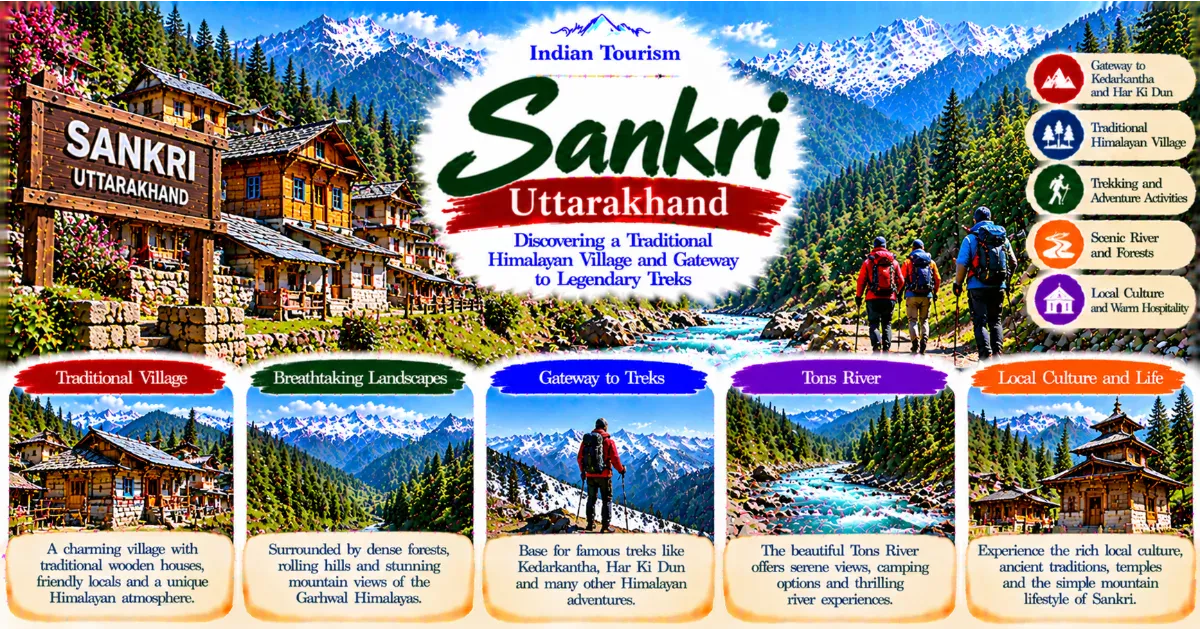
A Himalayan Village Where Adventure Begins
Uttarakhand is home to some of India's most remarkable mountain landscapes, from sacred Himalayan shrines and forested valleys to high-altitude lakes, alpine meadows, and snow-covered summits. While many travellers associate the state with popular destinations such as Mussoorie, Nainital, Auli, and Rishikesh, its deeper character can often be discovered in smaller settlements where mountain traditions remain closely connected to everyday life. Sankri, a village in Uttarkashi district, is one of those places.
Located in the western Garhwal Himalayas, Sankri is widely recognised as a starting point for several celebrated trekking routes. Travellers heading towards Kedarkantha, Har Ki Dun, and other mountain trails frequently pass through the village before continuing into the higher reaches of the region. Yet Sankri is more than a convenient stop before a trek. Its traditional houses, surrounding forests, mountain scenery, and relationship with nearby villages make it a worthwhile destination in its own right.
The atmosphere here differs from that of a large hill station. Instead of extensive shopping streets and a crowded tourist promenade, visitors encounter a smaller mountain settlement whose daily life revolves around local needs, seasonal travel, agriculture, and the movement of trekkers. The surrounding landscape changes dramatically with the seasons, creating different experiences for those who visit in spring, summer, autumn, or winter.
Sankri attracts several kinds of travellers. Adventure enthusiasts come to begin mountain journeys, photographers seek the contrast between traditional architecture and forested slopes, and nature lovers appreciate the quiet surroundings. Cultural travellers can also use the village as an introduction to the traditions of the western Himalayan region.
The most rewarding visit combines these different aspects. Spend time exploring the village, learn about the routes that begin nearby, appreciate the surrounding countryside, and understand how tourism fits into the lives of local residents. Sankri offers an opportunity to experience the Himalayas not only as a landscape of peaks and trails, but also as a living region shaped by communities, history, and changing seasons.
Where Is Sankri Located?
Sankri is situated in the Mori area of Uttarkashi district in Uttarakhand. It lies within the western Garhwal Himalayas, a region characterised by forested mountains, river valleys, rural settlements, and routes leading towards high-altitude trekking destinations.
The village occupies an important position in the local travel network because several trekking journeys begin here or use it as an overnight base. Among the best-known routes are those leading towards Kedarkantha and Har Ki Dun. Other longer and more demanding journeys in the wider region include routes associated with Ruinsara Tal, Bali Pass, and Rupin Pass. Each route has different requirements, and travellers should research their chosen trek separately rather than assuming that all trails offer a similar level of difficulty.
Reaching Sankri usually involves a substantial road journey from Dehradun. The route passes through the mountainous countryside of Uttarakhand, with changing scenery along the way. Depending on the chosen route and current road conditions, travellers may pass through areas around Mussoorie, Naugaon, Purola, and Mori before reaching the village.
The journey itself is part of the attraction. Mountain roads follow the contours of hills and valleys, while the surrounding landscape gradually becomes more rural and remote. Visitors may see agricultural fields, small settlements, forested slopes, and sections of river valley along the way.
However, mountain travel requires realistic planning. A distance that appears manageable on a map can take several hours because of winding roads, narrow stretches, traffic, road maintenance, or weather conditions. Travellers should confirm current route information before departure and allow enough time to reach their accommodation during daylight.
Sankri is best understood as both a destination and a gateway. It offers a place to rest and explore before entering the mountains, while also providing access to a wider landscape of villages, forests, meadows, and trekking routes. Even travellers who do not intend to undertake a long trek can enjoy its village atmosphere and surrounding scenery.
The Traditional Character of Sankri Village
One of Sankri's most appealing qualities is its traditional Himalayan character. The village is known for its wooden architecture and its relationship with the surrounding mountain landscape. Although tourism has brought changes and new facilities, the settlement continues to reflect the practical needs and cultural traditions of a Himalayan community.
Traditional houses in this part of Uttarakhand often demonstrate an understanding of local materials, weather, and terrain. Wood has played an important role in regional building practices, and older structures may include carved details and construction techniques associated with the western Himalayan region. The exact appearance of buildings varies, and visitors should avoid assuming that every house follows the same design.
Walking through the village provides an opportunity to observe how homes, paths, small businesses, and community spaces fit into the landscape. The arrangement of buildings reflects the available ground and the needs of daily life rather than a plan designed exclusively for visitors.
The village is particularly interesting when travellers look beyond its most photographed houses. A local shop, a narrow lane, a courtyard, or a view of the surrounding hills can reveal how residents use the spaces around them. These everyday details help create a more complete understanding of Sankri.
It is important to remember that traditional houses are private homes, not open-air museum exhibits. Visitors should not enter courtyards or buildings without permission, and photography should be approached respectfully. Asking before taking close-up photographs of residents is equally important.
Modern development is also part of the village's story. Guesthouses, trekking services, shops, and newer buildings reflect changing needs and the growing importance of tourism. These developments should not automatically be regarded as a loss of authenticity. Local residents need reliable facilities, education, healthcare, transport, and economic opportunities just as people elsewhere do.
Sankri's character emerges from the coexistence of older traditions and contemporary life. Observing both allows travellers to appreciate the village as a living settlement rather than simply a picturesque backdrop for adventure.
Sankri as the Gateway to Kedarkantha
Kedarkantha is among the best-known trekking destinations associated with Sankri. The route attracts walkers who want to experience Himalayan forests, mountain camps, snowy landscapes during winter, and the challenge of reaching a summit.
The trek typically begins with preparations in Sankri, where trekkers arrange accommodation, confirm their equipment, and coordinate with guides or trekking operators. Depending on the itinerary, the route may include forest trails, campsites, clearings, and higher ground that offers increasingly expansive mountain views.
Kedarkantha is often marketed as an accessible summit trek, but its difficulty depends on the season, weather, route conditions, and the fitness of the individual. Winter snow can make the trail more challenging, while cold temperatures increase the importance of suitable clothing and equipment. Even during warmer months, steep sections and altitude can place demands on the body.
Travellers should not underestimate the importance of preparation. Appropriate footwear, layered clothing, rain protection, a reliable daypack, and sufficient drinking water are basic considerations. Depending on the season and itinerary, additional equipment may be required.
Choosing a responsible trekking operator can help visitors understand the route and prepare for its challenges. Before booking, ask about the guide's experience, the group size, the daily walking schedule, emergency arrangements, equipment, accommodation, and the procedures followed if weather conditions deteriorate.
The mountain environment can change quickly, and summit plans should remain flexible. If conditions are unsafe, turning back is a sensible decision. Reaching the top is never more important than returning safely.
For travellers who do not want to complete the full trek, Sankri can still provide an introduction to the mountain landscape. Village walks, shorter excursions on suitable paths, and views of the surrounding hills can be enjoyable alternatives, provided that local access and conditions are checked.
Kedarkantha contributes significantly to Sankri's identity, but the village should not be reduced to a starting point for one summit. It is part of a wider Himalayan region with many different landscapes and cultural experiences.
Har Ki Dun: A Journey into the Valley of Gods
Another major trekking route associated with Sankri leads towards Har Ki Dun, a mountain valley celebrated for its scenery, forests, traditional settlements, and high Himalayan surroundings. The journey offers a different experience from the more summit-focused Kedarkantha route.
Har Ki Dun is known for its broad valley landscape and its relationship with the surrounding mountain peaks. Depending on the season, visitors may encounter green slopes, forested sections, streams, flowering vegetation, and snow on higher ground. The scenery changes throughout the journey, making the trek rewarding for people who enjoy observing gradual changes in the landscape.
The route commonly involves road travel from Sankri towards Taluka or another designated starting point, followed by trekking through the valley. Depending on the operator and itinerary, overnight stops may be arranged in villages, guesthouses, or camps. The exact route and accommodation plan should be confirmed before departure.
Har Ki Dun is also associated with local stories and religious traditions. The wider region contains settlements whose architecture, customs, and relationship with the mountains reflect a long history of living in this environment. Travellers interested in culture should pay attention to the villages along the route rather than treating them only as places to rest.
Although Har Ki Dun is sometimes promoted as a relatively approachable Himalayan trek, it still requires preparation. Daily walking distances, altitude, changing weather, and the availability of services can make the journey demanding for some visitors. Travellers should choose an itinerary that matches their fitness and experience.
The best approach is to plan the trek with a reliable operator or experienced local guide, follow the established route, and avoid making independent changes without understanding the consequences. Weather forecasts, trail conditions, and local instructions should guide decisions throughout the journey.
For those willing to travel slowly and prepare carefully, Har Ki Dun can provide a deep introduction to the natural and cultural landscape of the western Garhwal Himalayas. Sankri serves as the important first step in that experience.
Forests, Mountain Trails and Natural Scenery
The countryside around Sankri is characterised by forests, mountain slopes, clearings, and roads that connect settlements scattered across the region. The changing elevation and seasonal weather give the landscape a variety of appearances throughout the year.
Forested sections can provide welcome shade during warmer months and create a different atmosphere when mist settles between the trees. In winter, snow may transform parts of the landscape, although the extent and duration of snow cover vary with weather and elevation.
Walking through the surrounding countryside allows visitors to notice details that can be missed during a vehicle journey. The sound of birds, the movement of clouds across a ridge, the shape of tree branches, and the changing light on distant slopes all contribute to the experience.
Not every forest path is a marked tourist trail. Some routes serve local residents, agricultural areas, or trekking journeys, while others may be difficult to follow without guidance. Travellers should ask locally about suitable walks and avoid entering unfamiliar forest areas without preparation.
Nature observation can be rewarding even without a long hike. A short walk along an appropriate path, time spent looking across a valley, or a quiet period near the village can provide opportunities to appreciate the region's natural environment.
The area is also connected with the wider Govind Pashu Vihar National Park and Wildlife Sanctuary landscape. This protected region is known for its forests, alpine meadows, wildlife habitats, and trekking routes. Visitors planning to enter protected areas should check current rules, registration requirements, permitted routes, and any restrictions that apply to their intended journey.
Wildlife should always be observed from a respectful distance. Feeding animals, disturbing nests, collecting plants, and leaving rubbish can damage the environment. Travellers should keep noise low and follow guidance from local authorities and guides.
Sankri's natural appeal comes from the larger landscape surrounding it. A thoughtful visit recognises that forests and mountain trails are not simply recreational spaces, but ecological environments that need protection.
Local Culture and the Heritage of the Western Himalayas
Sankri belongs to a region with rich cultural traditions shaped by geography, community life, religious beliefs, and the practical demands of living in the mountains. The cultural identity of the western Garhwal Himalayas is expressed through architecture, food, language, festivals, music, and relationships between neighbouring settlements.
The village provides a starting point for learning about these traditions. Visitors may notice the use of wood in traditional buildings, the arrangement of houses along sloping terrain, and the importance of community spaces. Local customs are also reflected in the way residents interact, celebrate important occasions, and maintain religious practices.
The region's folk music and dances are important expressions of cultural identity. Such traditions may be experienced during particular festivals or community events, but travellers should not assume that performances will be available whenever they arrive. If a cultural event is taking place, visitors should follow local guidance and avoid interrupting preparations or ceremonies.
Religious sites in and around the wider region can also help visitors understand the relationship between belief and place. Temples and local shrines may have stories associated with particular deities, ancestors, or regional traditions. These narratives form part of living community heritage and should be approached with respect.
Food is another way to understand local culture. The broader Garhwali culinary tradition includes preparations based on grains, lentils, legumes, seasonal vegetables, and locally available ingredients. What is served in Sankri depends on the establishment, season, and availability of supplies, so travellers should ask about local dishes rather than expecting every regional speciality to be offered.
Language can also create opportunities for cultural exchange. A polite greeting, a willingness to listen, and patience when communication is difficult can help visitors interact more positively with residents.
Cultural tourism is most meaningful when it benefits the people whose traditions are being explored. Supporting local accommodation, purchasing goods from village businesses, and using responsible local guides can contribute to the local economy. At the same time, visitors should avoid treating residents as attractions or assuming that private life is open to observation.
Sankri offers a valuable reminder that Himalayan heritage is not confined to ancient monuments. It continues through the everyday lives of the people who inhabit the mountains.
The Seasonal Beauty of Sankri
Sankri changes considerably throughout the year, and each season offers a different combination of scenery, weather, and outdoor opportunities. The most suitable time to visit depends on whether the priority is trekking, snow, photography, village exploration, or a quiet mountain break.
Spring brings gradual changes to the forests and countryside. Temperatures begin to rise, and lower areas may show fresh greenery as winter recedes. This season can suit travellers who want to explore the village and undertake suitable outdoor activities without the deepest winter conditions. Higher trails can still be cold, and snow may remain in some areas.
Summer often provides opportunities for trekking and exploring the surrounding landscape. Daytime conditions can be relatively comfortable, but weather changes remain possible. Visitors should carry suitable layers and confirm the condition of the specific trail they intend to follow.
The monsoon season requires caution. Rain can make paths slippery, increase the risk of landslides, and affect mountain roads. Streams may rise rapidly, and access to remote areas can become difficult. Travellers should check official advisories and local information before departure and be prepared to change plans.
Autumn can be an appealing period for mountain journeys when the weather is stable. Clearer skies may provide better views of distant peaks, while cooler temperatures make appropriate clothing essential, particularly during the morning and evening.
Winter gives Sankri a distinctive character, especially when snowfall affects the village and nearby forests. Snow-covered scenery can be beautiful, but it also introduces additional challenges. Roads may be affected, temperatures can fall sharply, and trekking routes may require specialised equipment and experienced guides.
Visitors should not assume that a winter trek is safe simply because an operator advertises it. Ask about recent conditions, emergency procedures, clothing requirements, and the experience needed for the chosen route.
There is no universally perfect season for every traveller. The best time to visit is the period that suits the planned activity while allowing for the realities of Himalayan weather. Flexibility is essential, and safety should always take precedence over completing a fixed itinerary.
Photography in Sankri and the Surrounding Mountains
Sankri provides a variety of subjects for photography, from traditional wooden houses and narrow village paths to forested slopes, distant mountain ridges, and seasonal snow. The diversity of the landscape makes it possible to build a travel story without relying on a single famous viewpoint.
Village photography can focus on architectural details, textures of timber, rooflines, pathways, and the relationship between homes and the surrounding hills. Early morning may provide softer light and quieter streets, while changing weather can create dramatic conditions across the mountain landscape.
Landscape photographers can experiment with wide views that include the village and its surroundings. During clear weather, distant ridges may appear sharply defined. Mist and clouds can create layered compositions, while fresh snowfall may simplify the scene and emphasise the shapes of trees and rooftops.
Travellers should also consider documenting the journey itself. Mountain roads, forest sections, trail signs, and the preparations made before a trek can help communicate the experience of reaching Sankri. Such details often provide more context than a series of summit photographs alone.
Respect is essential when photographing people. Ask before taking portraits, particularly of children, workers, or residents engaged in private activities. A person's presence in a public area does not automatically mean that they wish to be photographed.
Weather protection is important for cameras and mobile phones. Rain, snow, and cold temperatures can affect equipment and battery life. Carry suitable protection and avoid exposing expensive devices to unnecessary risks.
Photographers should never stand in the path of vehicles, step onto unstable slopes, or leave established paths for an unsafe angle. In the mountains, a good photograph should never come at the expense of personal safety or the environment.
The most memorable images of Sankri may combine the dramatic and the ordinary: a traditional house against a mountain backdrop, a village lane after snowfall, a quiet forest path, or the changing light over the surrounding hills.
Best Time to Visit Sankri
The best time to visit Sankri depends on the intended experience, but spring, summer, autumn, and winter each offer distinct possibilities.
For Kedarkantha and other trekking routes, travellers should consult current guidance about the recommended season for the specific trail. Kedarkantha is popular in winter for snow-covered landscapes, but winter trekking requires appropriate clothing, equipment, preparation, and experienced guidance. Spring and autumn can offer different conditions and may suit travellers who prefer less severe cold.
Har Ki Dun and other valley routes are generally planned around suitable trekking seasons, when trail conditions, daylight, and weather make the journey more manageable. Exact conditions vary each year, so dates published in a general travel guide should not be treated as a guarantee of access.
Summer can be a good time for village exploration, shorter walks, and journeys into the surrounding countryside. Even then, visitors should carry layers and rain protection because mountain weather can change quickly.
Monsoon travel demands particular care. Heavy rainfall can disrupt roads and trails, so it may be necessary to postpone a trip or choose a different destination. Travellers should never continue into a risky area merely to preserve a booking.
Autumn can offer clear views and comfortable conditions for many outdoor activities, although mornings and evenings may be cold. Winter brings the possibility of snow and a more dramatic mountain atmosphere, but it also increases the need for careful preparation.
Before finalising travel dates, confirm road access, accommodation availability, trekking permits or registration requirements, and local weather information. Travellers should also check whether their chosen trek has restrictions related to protected areas or seasonal conditions.
A well-planned visit allows enough flexibility to adapt. In the Himalayas, the weather and condition of the route are part of the journey, not details that can safely be ignored.
How to Reach Sankri
Sankri is reached primarily by road, and the journey usually begins from Dehradun or another major town in Uttarakhand. The road route passes through the western Garhwal region and continues towards Mori and the surrounding mountain settlements.
Travellers arriving by air commonly use Jolly Grant Airport near Dehradun before continuing by road. Those travelling by train may use Dehradun railway station and arrange onward transport. The remaining journey is substantial and should be planned with sufficient time.
Private vehicles offer flexibility, but mountain driving requires experience and patience. Roads can be narrow, bends may limit visibility, and weather or roadwork can affect travel times. Drivers should avoid unnecessary overtaking, stop only in safe locations, and aim to reach their accommodation before dark.
Public transport may be available through a combination of buses and shared vehicles serving the wider region. However, services can be limited compared with major tourist destinations. Confirm current schedules and onward connections locally, particularly if travelling outside the busiest periods.
If the purpose of the visit is trekking, travellers should coordinate their arrival with their guide or operator. Arriving late may affect equipment checks, briefings, or the planned departure time for the trail.
Carry sufficient water and essential supplies for the road journey. Mobile network coverage may vary, so keep accommodation details, transport information, and emergency contacts accessible offline. Travellers should also carry some cash because digital payment facilities may not be available everywhere.
The journey to Sankri should not be treated as a race. Allowing time for traffic, road conditions, and rest stops makes the experience safer and more comfortable.
Accommodation and Facilities in Sankri
Sankri has developed as a base for trekkers, and visitors may find guesthouses, small hotels, homestays, and trekking-related accommodation depending on the season. The range of facilities is different from that of a large hill station, so travellers should confirm their requirements before arriving.
When booking accommodation, ask about room facilities, hot water, heating arrangements, meals, parking, payment methods, and check-in times. Winter visitors should pay particular attention to heating and warm bedding. Those travelling with children or older family members should check the accessibility of rooms and the condition of paths around the property.
Trekkers may choose accommodation that includes meals, equipment storage, or assistance with local transport. Before booking a trekking package, confirm exactly what is included, whether guides and permits are covered, how meals are arranged, and what happens if weather prevents the trek from proceeding.
Homestays can offer an opportunity to learn more about local life, but guests should respect household routines and understand that the experience may be simpler than a conventional hotel stay. Ask before using private spaces for photography and follow the host's guidance about meals and facilities.
Visitors should not assume that every service will be available throughout the year. Demand varies by season, and some facilities may operate differently during periods of heavy snowfall or poor road access. Advance confirmation is particularly useful during popular trekking periods.
Sankri is best approached with practical expectations. The main purpose of many facilities is to provide a comfortable base for exploring the village and surrounding mountains. Travellers who plan accordingly can enjoy the destination without expecting the extensive amenities of a major resort.
Responsible Tourism and Mountain Safety
Sankri's natural and cultural environment deserves careful treatment. The forests, trails, traditional houses, and nearby settlements form part of a living landscape that supports both residents and visitors.
Waste management is one of the simplest ways to travel responsibly. Carry reusable water bottles where appropriate, avoid unnecessary single-use packaging, and take rubbish back to designated disposal points. Never leave plastic, food wrappers, or other waste along trails or at campsites.
Trekking requires particular attention to safety. Travellers should remain on established routes, follow their guide's instructions, carry suitable clothing, and avoid pushing ahead when tired or unwell. Altitude can affect people differently, and symptoms that may seem minor should not be ignored during a high-altitude journey.
Weather should guide decisions. Snow, rain, strong winds, and poor visibility can change the difficulty of a trail. If a guide or local authority advises against continuing, respect that decision. A summit or campsite is never worth risking a serious accident.
Visitors should also avoid disturbing wildlife, damaging vegetation, or lighting fires where they are not permitted. Camping should take place only in authorised or otherwise appropriate locations, with attention to sanitation, fire safety, and waste disposal.
Cultural respect is equally important. Do not enter private homes, courtyards, or agricultural land without permission. Ask before photographing residents, and follow local rules at religious sites.
Supporting local businesses can help tourism contribute to the local economy. Choosing locally operated accommodation, buying supplies from village shops, and hiring qualified local guides where appropriate can create benefits beyond the trekking industry.
Responsible tourism means recognising that Sankri is not merely a place for visitors to enjoy. It is home to a community whose well-being and environment should remain central to the way tourism develops.
A Suggested Three-Day Visit to Sankri
A three-day visit can provide a useful introduction to Sankri and its surroundings for travellers who do not plan to complete a longer trek. The itinerary should remain flexible and should be adjusted according to weather, road access, and available local activities.
On the first day, travel to Sankri and arrive with enough daylight to settle into your accommodation. After a long mountain journey, keep the evening relaxed. Explore accessible parts of the village, observe its traditional architecture, and ask locally about suitable places to eat. Use the evening to learn about the surrounding area and plan the following day's activities.
On the second day, spend time exploring the village and its immediate surroundings. A guided walk on a suitable route can provide a closer look at the landscape and local settlement patterns. Travellers interested in photography can focus on traditional houses, forested hills, and changing light. If you intend to undertake a short hike, confirm the route's difficulty and conditions before setting out.
The third day can be devoted to a short excursion or to preparing for an onward journey. Visitors interested in trekking may use the time to coordinate with an operator and begin a planned trek if the itinerary and conditions permit. Those who prefer a slower holiday can enjoy another walk, speak with local hosts about the region, or simply appreciate the mountain scenery before departure.
This plan is intentionally flexible. It does not assume that every activity will be available or that every visitor will have the same level of fitness. Travellers planning Kedarkantha, Har Ki Dun, or a more demanding route should follow a separate itinerary appropriate to that trek.
The objective is to allow enough time for Sankri itself rather than treating the village as a place to sleep before leaving at dawn. Even a short stay can be rewarding when it includes time to appreciate the settlement, landscape, and local culture.
Who Should Visit Sankri?
Sankri is particularly appealing to travellers who enjoy mountain landscapes, traditional villages, and outdoor exploration. It is a natural choice for trekkers preparing to visit Kedarkantha or Har Ki Dun, but it can also interest photographers, cultural travellers, and people seeking a quieter Himalayan experience.
Adventure enthusiasts may appreciate the range of trekking routes associated with the region. Nature lovers can explore suitable walking paths and observe the changing forest landscape. Travellers interested in local architecture and culture may find the village rewarding even without undertaking a demanding physical activity.
Families can consider visiting Sankri if the travel arrangements suit their needs. However, mountain roads, cold weather, and trekking conditions should be assessed carefully, especially when travelling with young children or older relatives. A village stay and a short walk may be more suitable than a high-altitude trek for some visitors.
Sankri may not be ideal for those who expect extensive nightlife, large shopping centres, or a wide range of resort-style entertainment. Its appeal lies in the mountains, the village environment, and access to outdoor experiences.
It is also important to distinguish between enjoying the village and undertaking a serious trek. Visitors can appreciate Sankri without attempting a summit, while anyone planning a high-altitude route should prepare according to the demands of the trail.
The most suitable visitors are those who arrive with curiosity, patience, and respect for the environment. They understand that the value of a mountain destination is not measured only by the height of a summit or the number of photographs taken.
Final Thoughts: More Than a Starting Point for Treks
Sankri occupies a special place in the travel landscape of Uttarakhand. It is widely known as a starting point for journeys towards Kedarkantha, Har Ki Dun, and other mountain destinations, but its appeal extends beyond trekking logistics.
The village offers an opportunity to experience traditional Himalayan architecture, observe local life, appreciate forested hills, and understand the relationship between a mountain community and the surrounding landscape. Its changing seasonal character provides different experiences throughout the year, from greener countryside in warmer months to snow-covered scenery during suitable winter conditions.
For trekkers, Sankri is a practical base where preparation and local guidance can make a significant difference to the journey ahead. For other travellers, it offers a quieter introduction to the western Garhwal Himalayas. A walk through the village, a conversation with a local host, or a view across the surrounding hills can become meaningful parts of a visit.
The most important principle is to travel responsibly. Mountain conditions can change quickly, and the environment should be treated with care. Visitors who prepare well, follow local guidance, and respect residents are more likely to have a safe and rewarding experience.
As part of the Indian Tourism series, Sankri represents the side of Uttarakhand where adventure, cultural heritage, and village life come together. It reminds travellers that the Himalayas are not only a collection of peaks and trekking routes. They are also places where communities preserve traditions, adapt to changing conditions, and welcome visitors into a landscape that deserves both admiration and respect.
#IndianTourism #Sankri #SankriVillage #UttarakhandTourism #Uttarkashi #GarhwalHimalayas #KedarkanthaTrek #HarKiDun #HimalayanTrekking #MountainVillages #ExploreUttarakhand #AdventureTravel #ResponsibleTourism #TravelIndia
