
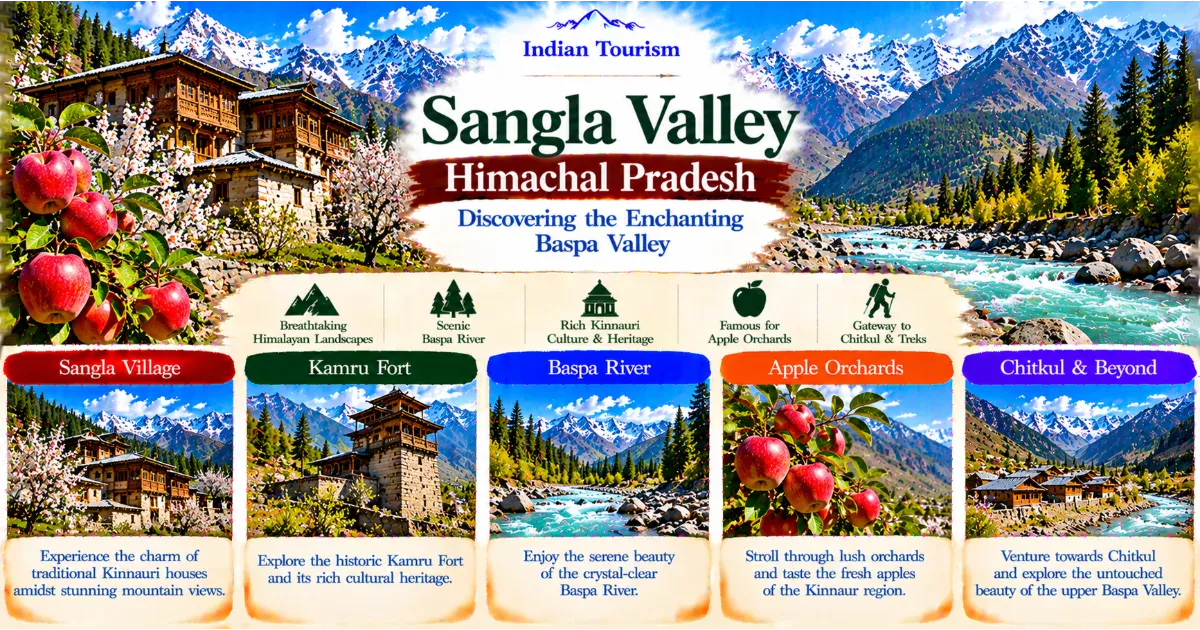
A Himalayan Valley Where Nature and Tradition Meet
Himachal Pradesh is home to some of India's most captivating mountain landscapes, where snow-covered peaks, flowing rivers, dense forests and traditional villages create a remarkable diversity of experiences. Among its many destinations, Sangla Valley stands out for its dramatic scenery, distinctive Kinnauri culture, apple orchards and peaceful mountain settlements. Located in the Kinnaur district, this beautiful valley follows the Baspa River through a landscape of forested slopes, terraced fields and towering Himalayan mountains.
Often described as one of the most scenic valleys in Himachal Pradesh, Sangla offers a different atmosphere from the busy tourist centres of Shimla and Manali. Its appeal lies in the combination of natural beauty and everyday mountain life. Wooden houses, traditional temples, small farms and orchards reflect the cultural identity of the region, while the surrounding mountains provide opportunities for photography, walking, village exploration and nature-based travel.
Sangla Valley is also an important destination for travellers who want to understand the diversity of Himachal Pradesh. The state is not defined by a single mountain landscape or cultural tradition. Different valleys have developed their own architectural styles, agricultural practices, religious customs and relationships with the natural environment. In Kinnaur, these features are particularly visible in the settlements along the Baspa River.
A journey to Sangla can include riverside scenery, visits to traditional villages, exploration of local markets, excursions towards Chitkul and opportunities to learn about Kinnauri traditions. The experience changes with the seasons. Spring brings renewed growth to orchards and fields, summer offers relatively comfortable conditions for exploration, autumn creates colourful landscapes, and winter transforms the valley with snow and cold weather.
Sangla is not merely a place to photograph mountains. It is a living Himalayan landscape where tourism, agriculture, culture and environmental conservation intersect. Visitors who take time to explore respectfully can discover a destination that offers both visual beauty and a deeper understanding of mountain life.
Where Is Sangla Valley Located?
Sangla Valley is situated in the Kinnaur district of Himachal Pradesh, in the western Himalayas. The valley follows the Baspa River, which flows through a series of mountain settlements before joining the Sutlej River in the broader Kinnaur region.
The valley is surrounded by steep mountain slopes, forested areas and high peaks. Its geography creates a distinct landscape in which cultivated fields and settlements occupy suitable stretches of land near the river, while rocky slopes and forests rise above them.
Sangla village is one of the principal settlements in the valley and serves as a convenient base for exploring nearby attractions. The wider area includes villages with traditional architecture, agricultural land and religious sites that reflect the cultural heritage of Kinnaur.
The valley is also connected with Chitkul, a well-known high-altitude village farther along the Baspa River. Travellers frequently combine Sangla and Chitkul in the same itinerary because each destination offers a different experience of the valley.
The journey to Sangla generally involves travelling through the mountain roads of Himachal Pradesh and entering Kinnaur through the wider Sutlej valley. Road conditions, journey times and access can vary considerably according to the season.
Because the region is mountainous, visitors should allow sufficient time for travel rather than planning their journey around the distances shown on a map alone. Narrow roads, construction work, landslides and weather conditions can affect progress.
Sangla's location gives it a special character. It is accessible enough for a carefully planned holiday, yet its mountain setting and traditional settlements allow visitors to experience a landscape that remains closely connected with local livelihoods and natural conditions.
The Natural Beauty of Sangla Valley
The scenery of Sangla Valley is defined by the relationship between the Baspa River, cultivated land, forests and surrounding mountains. These elements combine to create a landscape that changes noticeably over the course of the day and throughout the year.
The river provides a visual and geographical centre for the valley. In places, its waters flow between rocky banks, while nearby stretches of land support vegetation and cultivation. The sound of flowing water adds to the atmosphere, especially in quieter areas away from busy roads.
Above the river, the valley rises into forests and steep mountain slopes. Depending on the location and season, visitors may see coniferous trees, grassy clearings, rocky outcrops and snow-covered peaks.
The contrast between green vegetation and rugged mountain terrain is one of Sangla's defining features. In summer, cultivated fields and orchards add colour to the landscape. During autumn, changing foliage and harvest activity create a different atmosphere. Winter can bring snow and a more austere mountain environment.
Light also influences the appearance of the valley. Early mornings often provide clear views before clouds develop, while late afternoon sunlight can highlight the contours of the mountains and the textures of traditional buildings.
Travellers who enjoy photography should avoid concentrating exclusively on famous viewpoints. Smaller paths, village lanes and riverbank settings may offer equally rewarding perspectives.
The natural beauty of Sangla is closely linked to its ecological balance. Forests, rivers and agricultural land support both wildlife and human communities. Visitors should therefore avoid littering, disturbing vegetation or entering fragile areas without permission.
The Baspa River: The Lifeline of Sangla Valley
The Baspa River is central to the geography and daily life of Sangla Valley. Its presence influences the location of settlements, the availability of water and the development of agricultural activities.
The river flows through a mountain environment where water is particularly valuable. Communities depend on reliable water sources for household needs and cultivation, while the river and its surrounding habitats contribute to the ecological character of the valley.
The river's appearance changes with the season. Snowmelt, rainfall and other environmental conditions influence its flow, and water levels may vary significantly during the year.
Although riverside locations can be attractive places for photography and quiet observation, visitors should exercise caution. Mountain rivers may have strong currents, slippery banks and rapidly changing conditions. A stretch of water that appears calm from the road may still be dangerous.
Swimming or entering the river without understanding the local conditions is not advisable. Visitors should follow local guidance and avoid approaching unstable banks or attempting crossings.
The Baspa River also provides a setting for understanding the relationship between natural resources and mountain communities. Agriculture, settlement patterns and transport routes have developed in response to the geography of the valley.
Responsible visitors should never dispose of rubbish, food waste or other materials in or near the river. Protecting water quality is essential for local communities and the wider environment.
For many travellers, the Baspa River is one of the most memorable features of Sangla. Its significance extends beyond scenery because it helps sustain the landscape and the communities that make the valley a living destination.
Sangla Village: The Cultural Heart of the Valley
Sangla village offers an introduction to the traditional architecture and everyday life of the Baspa Valley. The settlement reflects the practical and cultural adaptations that have developed in Kinnaur's mountain environment.
Traditional houses often incorporate locally available materials and building techniques suited to cold conditions. Wood and stone are important elements of the region's architectural heritage, although modern construction is also visible.
Walking through village lanes can reveal details that are easily missed from a vehicle. Wooden balconies, carved architectural elements, household courtyards and small cultivated plots help communicate how residents organise their living spaces.
The village is also a place to observe the relationship between agriculture and settlement. Orchards, fields and household gardens contribute to the local economy and influence the seasonal rhythm of daily life.
Visitors should remember that Sangla is a working community rather than a tourist attraction designed exclusively for visitors. Residents may be engaged in farming, household responsibilities, religious activities or other work.
Ask permission before photographing people, private homes or activities taking place within household spaces. Respecting privacy creates a more positive relationship between travellers and residents.
Small local businesses and accommodation providers can help visitors understand the area through food, local recommendations and practical guidance.
A meaningful visit to Sangla village involves more than walking through its streets. It means appreciating the architectural traditions, agricultural practices and community relationships that give the settlement its distinctive character.
Kamru Fort: Exploring Kinnaur's Historic Heritage
Kamru Fort is one of the most recognisable historic landmarks in the Sangla area. Associated with the history of the former Bushahr kingdom and the wider Kinnaur region, the fort provides a connection with the political and cultural past of the western Himalayas.
The fort's elevated setting and traditional architectural features distinguish it from modern buildings. Its design reflects regional construction traditions and the practical requirements of mountain settlements.
The surrounding village also contributes to the experience. The approach allows visitors to observe traditional houses, narrow lanes and the relationship between the settlement and the surrounding mountains.
Kamru Fort is associated with local religious traditions, and parts of the complex may have specific rules concerning entry, footwear, photography and behaviour. Visitors should follow the instructions provided by local caretakers.
It is important not to treat historic structures as unrestricted photographic locations. Avoid touching fragile architectural elements, climbing on restricted sections or leaving rubbish behind.
The fort's significance lies not only in its appearance but also in the stories, traditions and memories associated with the region. Local accounts can provide valuable context that is difficult to understand from photographs alone.
Visitors interested in history should allow enough time to explore the wider settlement rather than making a brief stop solely to photograph the fort.
Kamru offers a useful perspective on how political authority, religious practice and architecture have shaped Kinnaur's cultural landscape.
Chitkul: Exploring the Upper Baspa Valley
Chitkul is one of the best-known destinations in the wider Sangla Valley region. Situated farther along the Baspa River, it is recognised for its mountain scenery, traditional settlement and high-altitude environment.
The journey towards Chitkul provides changing views of the valley. Forested slopes, rocky mountains, river scenery and cultivated areas appear along the route, creating a journey that is as important as the destination.
Chitkul's traditional houses and village setting offer opportunities to explore Kinnauri architecture and everyday life. The surrounding mountains also attract visitors interested in landscape photography and short walks.
The village experiences substantial seasonal changes. Summer is generally more practical for general sightseeing, while winter can bring severe cold, snowfall and travel restrictions.
Visitors should confirm road conditions before planning the journey. Mountain access can change rapidly, and services may be limited during periods of harsh weather.
The village should be approached respectfully. Local residents continue to work and live in the area, and tourism should not interfere with their privacy or daily activities.
Chitkul and Sangla are complementary destinations. Sangla provides a convenient base for exploring the valley's cultural and natural attractions, while Chitkul offers a deeper journey into the upper Baspa landscape.
Travellers should avoid trying to cover the entire region in a hurry. Allowing time to appreciate the journey, stop safely for photographs and learn about the local environment can make the experience more rewarding.
Rakchham: A Peaceful Village Along the Baspa River
Rakchham is another notable settlement in the Sangla Valley region. Its location between Sangla and Chitkul makes it an attractive stop for travellers exploring the upper Baspa Valley.
The village is known for its mountain setting, traditional character and proximity to the river. Surrounding forests, open slopes and cultivated areas contribute to its scenic appeal.
Rakchham offers a quieter experience for visitors who want to spend time observing the landscape rather than moving rapidly between major tourist sites. Walking through appropriate village routes can provide opportunities to appreciate the architecture and local environment.
The surrounding landscape changes according to altitude and season. Vegetation may be more noticeable in warmer months, while winter brings colder conditions and possible snow.
Travellers should remain on suitable paths and avoid entering private fields without permission. Agricultural land is an important part of local livelihoods and should not be treated as open recreational space.
Facilities may be limited compared with larger destinations, so visitors should confirm accommodation, meals and transport arrangements in advance.
Rakchham demonstrates that the appeal of Sangla Valley is not limited to a few famous viewpoints. Smaller settlements also provide valuable opportunities to understand Kinnaur's cultural traditions and relationship with the mountains.
Kinnauri Culture and Traditions
Kinnaur has a distinctive cultural identity shaped by its geography, historical connections and religious traditions. The region's communities have developed practices that reflect both the challenges of mountain life and long-standing connections with neighbouring Himalayan areas.
Architecture is one visible expression of this identity. Traditional houses use materials and designs suited to local conditions, while carved wooden details and distinctive building forms reflect regional craftsmanship.
Clothing, food, festivals and community gatherings also contribute to Kinnaur's cultural character. Traditions vary between settlements and families, so visitors should avoid assuming that every village follows identical practices.
Religious life includes Buddhist traditions and other regional beliefs that have developed over time. Temples, monasteries and sacred spaces are important parts of the cultural landscape.
Visitors can learn about these traditions through respectful conversations, guided visits and participation in public cultural events where visitors are welcome.
It is important to ask permission before photographing religious ceremonies or private gatherings. Some spaces may restrict photography or require visitors to follow particular customs.
Cultural tourism is most valuable when it creates opportunities for exchange without turning local traditions into performances for visitors. Travellers should remain curious while respecting the right of communities to determine how their culture is shared.
Understanding Kinnauri culture adds depth to a visit to Sangla Valley. It helps explain why the valley is more than a scenic destination and why its communities remain central to its identity.
Agriculture and Apple Orchards in Sangla Valley
Agriculture is an important part of life in Sangla Valley. The region's cultivated land reflects generations of adaptation to mountain conditions, seasonal water availability and limited growing periods.
Apple orchards are a familiar feature of the wider Kinnaur landscape. The climate and elevation in suitable areas support fruit cultivation, which contributes to household incomes and the regional economy.
The appearance of orchards changes throughout the year. Spring brings flowering, summer supports fruit development, and autumn is associated with harvesting in many growing areas. The precise timing varies according to elevation, weather and local conditions.
Cultivation is closely connected with water management. Irrigation systems and careful use of available water help sustain crops in a mountainous environment.
Visitors should remember that orchards are productive agricultural spaces. Entering private land, picking fruit without permission or damaging branches can create real costs for local families.
Travellers interested in local produce may ask accommodation providers or shopkeepers about seasonal fruit and regional products. Purchasing from legitimate local businesses can help support the community.
Agriculture also provides insight into the relationship between people and the environment. The cultivation of crops depends on temperature, water, soil and seasonal timing, all of which are influenced by the valley's geography.
Sangla's orchards are therefore more than attractive photographic subjects. They are an essential part of the local economy and cultural landscape.
Forests, Mountains and Biodiversity
The Sangla Valley landscape includes forests, river corridors, cultivated areas and rugged mountain terrain. These environments support different forms of plant and animal life and create a varied ecological setting.
Forest vegetation is particularly important because it contributes to soil stability, provides habitat and influences the movement of water through the landscape. In mountain regions, vegetation can help reduce erosion on suitable slopes.
The river corridor supports a different set of ecological conditions from the surrounding mountains. Water availability allows vegetation to grow in places where the broader environment is relatively dry.
Wildlife presence varies according to season, habitat and human activity. Visitors may encounter birds or signs of animal movement, but sightings are never guaranteed.
Responsible exploration requires avoiding disturbance to animals and plants. Visitors should not feed wildlife, remove natural materials or leave rubbish in forests and river areas.
Noise should be kept to a reasonable level, especially in quieter natural settings. Travellers should also avoid creating informal trails that damage vegetation or destabilise soil.
The ecological value of Sangla Valley depends on the health of its interconnected environments. Forests, water, agricultural land and mountain habitats influence one another, making conservation a shared responsibility.
Visitors who appreciate the landscape without disturbing it help protect the qualities that make the valley special.
Trekking and Walking Around Sangla Valley
Sangla Valley offers opportunities for walking and exploring the surrounding mountain environment. Activities range from relaxed village walks to more demanding routes that require suitable equipment, experience and local guidance.
Village walks are a practical way to learn about local architecture, agricultural practices and daily life. Visitors can take time to observe orchards, traditional houses and the changing views of the Baspa River.
Longer walks may lead towards forested slopes or viewpoints, but the suitability of any route depends on its condition, elevation and current access restrictions.
Travellers should not assume that a visible path is safe simply because it appears close to a village. Mountain trails may include steep sections, loose rocks, narrow passages or areas exposed to changing weather.
Before undertaking a longer walk, ask local guides or accommodation providers about current conditions. Use suitable footwear, carry water and warm clothing, and allow enough time to return before darkness.
Visitors unfamiliar with mountain environments should avoid attempting demanding routes alone. A knowledgeable local guide can provide practical information about terrain, weather and community access.
Trekking should not involve disturbing wildlife or entering restricted areas. Campers must also follow local rules concerning fires, waste and overnight stays.
For many visitors, the most rewarding walks are not necessarily the longest. A carefully chosen route that offers time to observe the landscape and understand local life can provide a deeper experience than a strenuous journey undertaken without preparation.
Photography in Sangla Valley
Sangla Valley is an appealing destination for photographers because its landscapes combine rivers, forests, orchards, villages and dramatic mountain scenery.
Early morning often provides attractive light across the valley, while late afternoon can highlight the textures of the surrounding slopes. Cloud conditions and seasonal changes create different photographic opportunities throughout the year.
Traditional houses and village lanes provide subjects for architectural photography. Visitors should ask permission before taking close photographs of residents or entering private spaces.
The Baspa River offers opportunities for landscape compositions, but photographers must remain cautious around slippery banks and fast-flowing water.
Apple orchards can be particularly attractive during flowering and harvest periods. Visitors should avoid stepping into cultivated areas without permission or disturbing crops to create a photograph.
Travellers should never stop vehicles in unsafe locations to capture a view. Use designated or otherwise safe stopping places and remain aware of traffic on narrow mountain roads.
Photography equipment should be protected from dust, moisture and cold. A spare battery can be useful during colder conditions.
Responsible photography means considering not only the image but also its effect on the environment and people being photographed. The best travel photographs preserve the character of a place without compromising its safety or dignity.
Local Food and Culinary Experiences
Food is an important part of discovering Sangla Valley and the wider Kinnaur region. Local meals reflect the climate, agricultural resources and cultural connections of the western Himalayas.
Traditional diets in mountain communities have often relied on grains, seasonal vegetables, dairy products and ingredients that can be stored through colder months. The exact dishes served vary between households and establishments.
Visitors may find familiar Himalayan dishes alongside regional preparations. Thukpa, momos and simple vegetable meals are available in some places, while local households may prepare foods that are less common in commercial restaurants.
Availability depends on the village, season and size of the establishment. Travellers should not assume that every destination offers a wide menu or that restaurants remain open throughout the year.
Homestays can provide opportunities to experience home-style cooking, where available. Visitors should communicate dietary requirements in advance and remain respectful of the time and resources required to prepare meals.
Local produce, including seasonal fruit, can also contribute to the culinary experience. Purchasing produce from local sellers helps support small businesses.
Food offers a useful perspective on mountain life because it reveals how communities adapt to local conditions. Meals are connected with agriculture, seasonal routines and the practical realities of living in a high-altitude region.
Best Time to Visit Sangla Valley
The best time to visit Sangla Valley depends on the type of experience you want, your tolerance for cold weather and the condition of the mountain roads.
Spring: Orchards and Renewed Landscapes
Spring brings a transition from winter conditions towards warmer weather. Orchards and cultivated areas begin their seasonal cycle, and the valley gradually becomes more suitable for general exploration.
Weather can remain unpredictable, particularly at higher elevations. Travellers should confirm road access and carry warm clothing.
Summer: A Practical Season for Sightseeing
Summer is generally a popular period for exploring Sangla Valley. Daytime conditions may be suitable for village walks, sightseeing and excursions towards Rakchham and Chitkul.
This is also a useful period for travellers who want to combine the valley with other destinations in Kinnaur.
Even during summer, evenings can be cold, and mountain weather can change quickly. Accommodation should be booked according to the travel dates and expected facilities.
Autumn: Clear Views and Harvest Activity
Autumn can offer excellent landscape photography opportunities. Clear weather may reveal mountain details, while agricultural activity adds interest to the valley.
Temperatures fall as winter approaches, so travellers should confirm transport and accommodation arrangements.
Winter: Snow and Severe Cold
Winter transforms the valley, but travel can become more challenging. Snowfall, icy roads and low temperatures may affect access to villages and services.
Visitors considering winter travel should check current conditions and use suitable transport and clothing. It is important not to assume that all roads or accommodation options remain available.
For many first-time visitors, the warmer months provide a practical balance between accessibility and opportunities for exploration. Regardless of the season, local information should guide final travel decisions.
How to Reach Sangla Valley
Sangla Valley can be reached by road from other parts of Himachal Pradesh, but the journey requires careful planning because of the mountainous terrain.
From Shimla
Shimla is a common starting point for travellers heading towards Kinnaur. The route continues through the mountain landscape towards the Sutlej valley and then towards Sangla.
The journey can take much of the day, depending on traffic, road conditions and stops. Travellers should avoid planning a tightly timed arrival.
From Rampur and the Sutlej Valley
Rampur and other settlements along the Sutlej corridor may serve as intermediate points on the journey. The route passes through mountain terrain where road conditions can change.
A stopover can make the trip more comfortable and reduce the pressure of covering a long distance in a single day.
From Kalpa
Travellers already exploring Kinnaur may combine Kalpa and Sangla in one itinerary. The journey requires checking the current road conditions and allowing sufficient time.
By Private Vehicle
A private vehicle offers flexibility for stopping at viewpoints and visiting nearby settlements. Drivers should be experienced with mountain roads and familiar with the limitations of narrow or uneven sections.
By Taxi
Locally arranged taxis can be convenient for visitors who do not want to drive. Confirm the destination, expected duration, waiting arrangements and return journey before setting out.
By Public Transport
Public transport options may be available through larger settlements, but schedules and onward connections can vary. Check current services before relying on them for a remote-area itinerary.
Because road conditions can change, travellers should confirm current access shortly before departure. Allow extra time for delays and avoid driving unfamiliar mountain roads after dark whenever possible.
Accommodation and Facilities
Sangla Valley offers a range of accommodation options that may include guesthouses, hotels and homestays. Availability, facilities and prices vary according to location and season.
Staying in Sangla village can provide a practical base for exploring the surrounding valley. Travellers may also find accommodation in nearby settlements, depending on their itinerary.
Before booking, ask about heating, hot water, meals, transport access and cancellation arrangements. Cold nights are possible even during the warmer months.
Visitors planning to travel towards Chitkul or other remote locations should confirm whether accommodation will be available on their chosen dates. Facilities may be limited during winter or periods of difficult weather.
Connectivity can be inconsistent in mountain areas. Download offline maps, keep essential contact details available and inform someone about your itinerary.
Travellers should also consider access to medical services, fuel and basic supplies. A well-planned trip includes contingency time and money for unexpected changes.
Using legitimate local accommodation providers can support the regional economy and provide opportunities to learn about the area from residents.
Responsible Tourism in Sangla Valley
Responsible tourism helps protect the natural environment and maintain positive relationships between visitors and local communities.
The first principle is to carry waste away from natural areas and dispose of it responsibly. Plastic packaging, bottles and food waste should never be left along the river, trails or village roads.
Water should be used carefully, particularly in areas where households and agriculture depend on limited supplies. Avoid polluting streams and irrigation channels.
Visitors should respect private property and agricultural land. Orchards and fields are sources of livelihood, not public recreation areas.
Photography should be undertaken with consideration for residents. Ask permission before taking close photographs of people or entering private courtyards.
Religious sites should be approached respectfully. Follow instructions regarding footwear, photography and access to sacred spaces.
Wildlife should never be fed or deliberately disturbed. Visitors should stay on suitable paths and avoid creating new trails that damage vegetation.
Supporting local businesses can help ensure that tourism benefits the community. Consider locally operated accommodation, guides and transport services where available.
Responsible travel also means being flexible. If weather or road conditions make an activity unsafe, change the plan rather than taking unnecessary risks.
A Suggested Three-Day Itinerary for Sangla Valley
Day One: Arrive and Explore Sangla
Arrive in Sangla after checking the road conditions and your transport arrangements. Keep the first day relatively relaxed, especially after a long mountain journey.
Explore suitable village lanes, observe traditional architecture and spend time appreciating the surrounding landscape. If you arrive early enough, visit a nearby viewpoint that can be reached safely.
Arrange the next day's transport and ask local residents or accommodation providers about current conditions.
Day Two: Kamru Fort and Rakchham
Begin with a visit to Kamru Fort, following local instructions and respecting any access restrictions.
Continue towards Rakchham if road conditions and timing permit. Enjoy the river scenery and explore suitable areas around the village without entering private land.
Return to Sangla with sufficient daylight and time for unexpected delays.
Day Three: Excursion Towards Chitkul
If road access is suitable, travel towards Chitkul. Enjoy the changing scenery along the Baspa River and allow time to explore the village respectfully.
Check weather and road conditions before departing, particularly during periods of snowfall or heavy rain.
Return according to your planned transport arrangements, leaving sufficient time to complete the journey safely.
This itinerary is a flexible framework rather than a fixed schedule. The best plan depends on the season, road access and the time available.
Is Sangla Valley Suitable for Families and First-Time Visitors?
Sangla Valley can be suitable for families and first-time visitors who prepare for the realities of mountain travel. Its combination of scenic landscapes, village experiences and cultural attractions makes it appealing to a range of travellers.
Families should consider the age and health of their children, the length of the journey and the availability of suitable accommodation. Long drives and winding roads can be tiring, so regular breaks are important.
Older travellers and people with medical conditions should consider the elevation, road conditions and availability of healthcare before planning the trip. A qualified healthcare professional can provide advice where needed.
Visitors unfamiliar with the Himalayas should avoid overloading their itinerary. Spending more time in a small number of destinations can be more enjoyable than rushing between multiple villages.
Suitable footwear, warm clothing, sun protection and drinking water are essential. Travellers should also remain alert around rivers and steep terrain.
For first-time visitors, a locally arranged taxi or experienced driver can reduce the stress of navigating unfamiliar mountain roads.
With realistic expectations and thoughtful planning, Sangla Valley can provide an accessible introduction to the landscapes and cultural traditions of Kinnaur.
Common Travel Mistakes to Avoid
One common mistake is underestimating travel time. Mountain roads can make relatively short distances take much longer than expected.
Another is assuming that weather conditions will remain stable. Rain, snow, roadwork and landslides can disrupt travel, so itineraries should allow flexibility.
Visitors sometimes focus only on famous locations and overlook the villages and agricultural landscapes that give Sangla its character. Allowing time for slower exploration often creates a more meaningful experience.
Entering private orchards without permission is another mistake. Agricultural land supports local livelihoods and must be treated respectfully.
Travellers should not assume that every village offers extensive accommodation or dining options. Confirm essential arrangements in advance.
Finally, avoid leaving waste behind or disturbing the river environment. The valley's appeal depends partly on the quality of its natural surroundings, and every visitor has a role in protecting them.
Conclusion: Experiencing the Enduring Charm of Sangla Valley
Sangla Valley is one of Himachal Pradesh's most rewarding destinations for travellers who appreciate mountain scenery, cultural traditions and the quieter rhythms of Himalayan life. The Baspa River, traditional villages, orchards and surrounding peaks combine to create a landscape that changes beautifully with the seasons.
The valley's appeal extends beyond its natural scenery. Kamru Fort offers a connection with regional history, Rakchham provides a quieter village experience, and Chitkul reveals the dramatic character of the upper Baspa Valley. Together, these places help visitors understand the geographical and cultural diversity of Kinnaur.
A successful visit requires preparation. Travellers should confirm road conditions, arrange suitable accommodation, allow enough time for mountain journeys and respect local customs. Responsible behaviour helps protect the environment and ensures that tourism remains compatible with the needs of local communities.
Whether you are planning a photography trip, a family holiday, a cultural journey or a broader exploration of Himachal Pradesh, Sangla Valley offers a memorable combination of scenery and tradition. Its greatest attraction lies in the relationship between the mountains, the river and the communities that call this landscape home.
For anyone exploring the western Himalayas, Sangla deserves consideration as a destination where natural beauty and cultural heritage can be experienced together.
#IndianTourism #HimachalPradesh #SanglaValley #Kinnaur #BaspaValley #Chitkul #Rakchham #KamruFort #HimalayanTravel #ExploreIndia #MountainDestinations #ResponsibleTourism
