
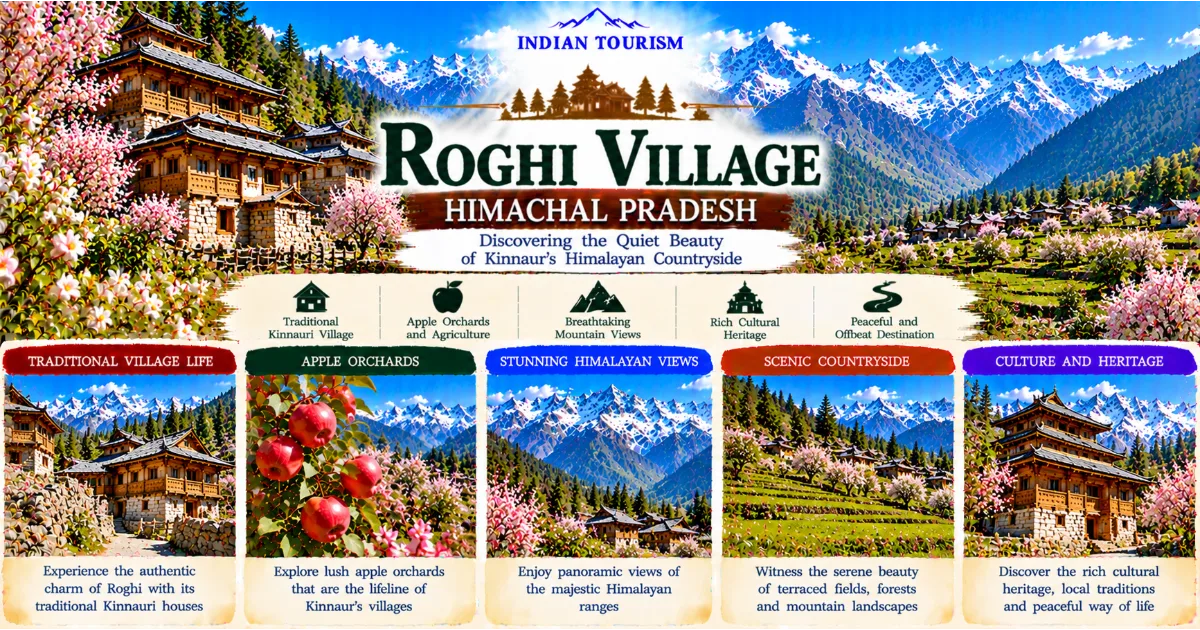
A Village Above the Ordinary
Himachal Pradesh is home to many destinations celebrated for their snow-covered mountains, apple orchards, winding roads, ancient temples and traditional Himalayan settlements. While places such as Shimla, Manali, Kalpa and Chitkul attract visitors from across India, the state also contains quieter villages where the beauty of the mountains can be experienced at a slower pace. Roghi Village, located in the Kinnaur district near Kalpa, is one such destination. Surrounded by dramatic mountain landscapes and traditional settlements, Roghi offers a glimpse into the distinctive lifestyle, architecture and natural environment of the eastern Himalayan region.
Roghi is particularly appealing to travellers who want to understand the countryside beyond the familiar tourist viewpoints. Its narrow village lanes, traditional houses, cultivated terraces, fruit orchards and views of the surrounding mountains create an atmosphere that feels deeply connected to the land. The village is not designed around large hotels, entertainment complexes or extensive commercial tourism. Instead, its appeal lies in its everyday surroundings, local culture and proximity to the landscapes that make Kinnaur so memorable.
The village is often explored as part of a visit to Kalpa and the wider Kinnaur region. Its location makes it possible to combine mountain sightseeing with a closer look at village life. Travellers can spend time observing the construction of traditional homes, noticing the changing patterns of agricultural land and appreciating how settlements adapt to steep terrain and a demanding climate. These details offer a different kind of travel experience, one that encourages observation rather than rushing from one attraction to another.
Roghi is also a destination where responsible tourism matters. The village is a living community, not simply a scenic backdrop. Residents maintain their homes, work in orchards, care for livestock, follow local customs and manage the practical challenges of mountain life. Visitors who approach the village with respect can gain a richer understanding of Kinnaur while helping ensure that tourism remains compatible with the community's daily needs.
Where Is Roghi Village Located?
Roghi Village is situated in Kinnaur district in the eastern part of Himachal Pradesh. It lies near Kalpa, a well-known Himalayan destination associated with mountain scenery, traditional settlements and views of the Kinnaur Kailash range. The wider region is characterised by deep valleys, steep slopes, high mountain ridges, terraced fields and settlements positioned according to the geography of the land.
Kinnaur occupies an important geographical position between the greener middle Himalayas and the drier landscapes that become increasingly prominent towards the higher reaches of the region. This transition can be seen in the changing vegetation, patterns of cultivation and appearance of the mountains. Depending on the season and altitude, visitors may encounter orchards, pine-covered slopes, rocky terrain, snow-covered peaks and exposed mountain faces within a relatively short journey.
Roghi's surroundings are closely connected to the Sutlej River system and the wider network of valleys and mountain roads that link settlements throughout Kinnaur. The terrain makes road travel an important part of reaching the village. Distances that appear short on a map may take longer to cover because roads follow mountain contours, pass through narrow sections and negotiate steep slopes.
The village's proximity to Kalpa makes it suitable for travellers who prefer to stay in an established tourist area while exploring smaller settlements nearby. Kalpa provides a useful base for discovering the wider region, while a visit to Roghi adds a more village-focused experience to the itinerary.
Travellers should confirm current road conditions and local access arrangements before departure. Mountain roads can be affected by snowfall, landslides, heavy rain, construction and seasonal maintenance. A route that is accessible during one part of the year may require additional planning during another.
The Landscape of Roghi: Mountains, Terraces and Orchards
The landscape around Roghi reflects the distinctive character of Kinnaur. Unlike lowland destinations where villages spread across broad plains, Himalayan settlements often occupy narrow terraces and sloping areas between mountains. Homes, agricultural plots and pathways are arranged according to the available land, and the surrounding slopes influence how people travel, cultivate crops and organise their daily activities.
One of the most noticeable features of the region is the relationship between settlement and mountain terrain. Houses appear along the contours of the hillside, while fields occupy flatter sections wherever the landscape permits. Roads and paths connect different levels of the settlement, sometimes offering changing perspectives of rooftops, orchards and distant mountain ridges. The resulting landscape is not simply natural or built. It is a combination of geography shaped by generations of human adaptation.
Apple orchards are an important feature of the wider Kinnaur region. The district is well known for apple cultivation, and orchards contribute significantly to local livelihoods. During the growing season, trees provide greenery and shade, while flowering and fruiting periods bring visible changes to the countryside. The appearance of the orchards varies according to the season, altitude and agricultural practices followed by individual growers.
Terraced fields also contribute to the area's visual character. On steep slopes, level sections of land help make cultivation possible. These terraces demonstrate the practical knowledge that mountain communities have developed over time. They represent an adjustment to limited agricultural space, uneven terrain and local weather conditions.
The surrounding mountains create a constantly changing backdrop. Morning light may reveal details on distant slopes, while clouds can soften the outlines of ridges during the afternoon. Clear days often provide expansive views, but mountain weather is unpredictable, and visibility can change quickly. Visitors should therefore avoid planning their entire experience around a single expected viewpoint or a particular weather condition.
Roghi's landscape rewards patient observation. Rather than looking only for a dramatic panorama, travellers can notice how houses, trees, cultivated land and mountain slopes fit together. These smaller details help explain why Himalayan villages have developed in their particular forms and why their landscapes remain closely tied to local livelihoods.
Traditional Architecture and the Character of Kinnauri Homes
Traditional architecture is an important part of the cultural identity of Kinnaur. In villages such as Roghi, buildings reflect a long process of adaptation to mountain weather, available construction materials and the practical requirements of everyday life. Local architecture also expresses cultural preferences and inherited building knowledge.
Traditional Kinnauri buildings may combine stone, timber and other locally suitable materials. The precise form of a house depends on its age, location, maintenance history and the resources available to its owners. Older structures can feature timber frameworks and stone walls, while newer buildings may incorporate concrete, metal roofing and contemporary construction methods. As a result, visitors may see different architectural periods within the same settlement.
The use of timber and stone in traditional buildings reflects the need to work with materials that were historically available in the region. Timber can contribute structural flexibility and warmth, while stone provides mass and durability. The arrangement of windows, doors, balconies and upper floors also responds to local weather, sunlight and the shape of the land.
Architecture in a mountain village should not be treated merely as a decorative attraction. A house is first a place where a family lives, stores belongings, prepares food and manages the demands of daily life. Some traditional homes have been modified to accommodate modern heating, sanitation, electricity and other facilities. Such changes are part of the continuing evolution of village architecture rather than a loss of cultural identity.
Visitors should admire buildings from public paths and avoid entering private courtyards without permission. If a resident invites a traveller inside, it is appropriate to follow the household's instructions and ask before photographing interiors. Respectful behaviour helps preserve the trust that makes meaningful cultural encounters possible.
The Culture and Traditions of Kinnaur
Kinnaur has a distinctive cultural identity shaped by its Himalayan geography, historical connections and diverse religious traditions. The region's customs cannot be reduced to a single uniform pattern because practices vary between villages, families and local communities. Nevertheless, shared traditions, community gatherings, local architecture and religious observances contribute to a strong sense of place.
Religious life in Kinnaur includes Hindu traditions and Buddhist influences, with local practices reflecting centuries of cultural exchange across the Himalayan region. Temples, monasteries and village shrines occupy important positions in many settlements. These places can serve as centres of worship, community activity and cultural continuity.
Roghi's cultural environment is best understood through attentive observation rather than assumptions. Travellers may notice prayer flags, shrines, traditional decorative features or community spaces in the wider area, but individual sites have their own significance. Visitors should ask locally before assuming that a building is open to tourists or that a particular ritual can be photographed.
Festivals are important occasions in many Kinnauri communities. Celebrations can include traditional music, dancing, ceremonial gatherings and communal participation. Their timing and form vary, so visitors should consult local information if they hope to experience a festival during their stay. A festival should be approached as a meaningful community event, not as a performance arranged solely for tourists.
Traditional dress, ornaments, music and dance can also form part of the region's cultural expression. However, everyday clothing changes with occupation, weather and personal preference. Travellers should avoid treating traditional clothing as a costume or expecting residents to perform cultural practices on demand.
Language is another important part of local identity. People in Kinnaur use regional languages and dialects alongside Hindi and other languages depending on the setting. A simple greeting, a polite request and a willingness to listen can help visitors establish friendly interactions. Learning a few commonly used Hindi phrases is useful, although travellers should follow the language preferred by the person they are speaking with.
The most rewarding cultural experiences often arise from small interactions. A conversation with a shopkeeper, a question about local farming or an explanation of a traditional building can reveal details that are absent from conventional sightseeing itineraries. These encounters should remain voluntary and respectful, allowing residents to decide how much they wish to share.
Apple Orchards and the Agricultural Life of Roghi
Agriculture is closely connected to the economy and seasonal rhythm of the wider Kinnaur region. Apple cultivation has become especially significant in many parts of the district, supporting growers, seasonal workers, transport services, traders and businesses that supply agricultural materials. The orchards are therefore both a defining landscape feature and an important source of livelihood.
The agricultural year follows a sequence of tasks shaped by temperature, altitude and weather. Orchard work can include pruning, soil management, irrigation, flowering-season care, pest management, fruit thinning, harvesting and packing. The timing of these activities differs according to location and growing conditions. Visitors who arrive at different times of the year may see very different aspects of the same countryside.
Spring can bring renewed growth and blossoms in suitable areas. The flowering period is especially attractive because the orchards take on a delicate appearance against the mountains. However, blossom timing varies, and cold spells or unusual weather can affect flowering. Travellers should not assume that every orchard will be in bloom during a fixed calendar week.
Summer brings greener vegetation and continued orchard care. Depending on the local altitude and weather, this can be a pleasant time for exploring village roads and observing agricultural activity. Harvesting typically occurs later in the growing season, with exact dates varying according to variety, elevation and local conditions. During busy periods, orchards become workplaces where careful coordination is necessary.
Visitors should never enter an orchard or pick fruit without permission. Trees represent an investment of time and resources, and fruit is an important commercial product for many households. Even an apparently empty orchard may be privately owned or awaiting agricultural work.
A responsible visitor can support local livelihoods by buying produce from legitimate local sellers, eating at village businesses and choosing locally operated accommodation where available. These decisions help tourism contribute to the local economy without interfering with farming activities.
Best Time to Visit Roghi Village
Roghi can be visited during different seasons, but the best time depends on the type of experience a traveller wants. Weather, road access, visibility and agricultural activity all influence the character of the visit. Because Kinnaur is a mountain region, seasonal conditions can vary significantly between lower settlements and higher elevations.
Spring: Fresh Landscapes and Orchard Blossoms
Spring can be an appealing period for travellers who enjoy changing vegetation and the possibility of orchard blossoms. As temperatures gradually rise, the landscape begins to emerge from winter conditions. Clear intervals may provide excellent views of the surrounding mountains, while the countryside can feel fresh and quiet.
The exact flowering period depends on local conditions, so visitors hoping to see blossoms should check current information before travelling. Late snow, cold weather and variations in altitude can influence the appearance of orchards. Spring visitors should also be prepared for cool mornings and evenings.
Summer: Comfortable Exploration and Village Walks
Summer is often suitable for exploring Kinnaur because daytime conditions can be more comfortable than during winter. Travellers can combine Roghi with nearby destinations, enjoy village walks and spend time observing the landscape without necessarily facing the coldest conditions of the year.
Even during summer, temperatures can fall after sunset, particularly when skies clear. Carrying a warm layer is sensible. Visitors should also remain alert to changing weather and road conditions, especially during periods of heavy rain in the wider Himalayan region.
Monsoon: A Season for Careful Planning
The monsoon period requires particular attention to weather forecasts and road conditions. Rainfall can increase the risk of landslides, falling rocks and road closures in mountainous areas. Conditions vary across Himachal Pradesh, and the impact of rain is not identical in every valley, but travellers should never assume that a road is safe simply because it was open the previous day.
Anyone planning a monsoon visit should confirm local transport conditions, keep their schedule flexible and avoid travelling through visibly unstable areas. If authorities or local residents advise against a route, their guidance should take priority over a sightseeing plan.
Autumn: Clear Views and Harvest Activity
Autumn can be rewarding for travellers interested in orchard landscapes and changing agricultural activity. Depending on the elevation and crop variety, this season may coincide with apple harvesting and the movement of produce from farms to collection and packing facilities.
The air can feel crisp, and clear days may provide attractive mountain views. However, evenings become colder as the season advances, so visitors should prepare for a wider difference between daytime and nighttime temperatures.
Winter: Quiet Surroundings and Cold Weather
Winter brings a different character to the region. Temperatures can fall considerably, and snowfall may affect higher routes and nearby areas. The village environment may feel quieter, but travel requires more preparation and flexibility.
Winter visitors should confirm accommodation availability, road access, heating arrangements and local weather conditions. Suitable footwear, insulated clothing and a plan for possible delays are important. Travellers should avoid driving into snowy or icy conditions without the necessary vehicle equipment and experience.
For many first-time visitors, the warmer months and early autumn provide a practical balance between sightseeing and travel flexibility. Nevertheless, no season guarantees clear skies or uninterrupted road access in the Himalayas.
How to Reach Roghi Village
Reaching Roghi generally involves travelling through the road network of Kinnaur and continuing towards the Kalpa area. The precise route depends on the traveller's starting point, current road conditions and transport arrangements.
By Road
Road travel is the principal way to reach the village. Travellers coming from Shimla and other parts of Himachal Pradesh generally follow routes leading towards the Kinnaur district. The journey passes through mountain terrain, where bends, steep gradients, narrow sections and changing road surfaces are common.
Driving distances alone do not provide a reliable estimate of travel time. A short stretch of mountain road can take considerably longer than an equivalent distance on a highway. Weather, road maintenance, traffic, construction and landslides can also affect the journey.
Drivers should travel during daylight whenever possible, particularly if they are unfamiliar with Himalayan roads. It is important to maintain a safe speed, avoid overtaking where visibility is limited and follow instructions from local authorities. Travellers should not stop at unsafe road edges merely to take photographs.
By Bus
Public buses and other shared transport services connect important towns and settlements in Himachal Pradesh, including areas of Kinnaur. However, services to a smaller village may be limited or may require a connection through a larger settlement. Availability can change by season and operating conditions.
Travellers using public transport should confirm the latest schedules locally and ask about the most practical drop-off point. They should also allow time for the final portion of the journey, which may require a taxi, local vehicle or a walk depending on the route and current arrangements.
By Train
There is no railway station in Roghi itself. Travellers arriving by train must continue by road from a suitable railway station in the broader region. The most practical connection depends on the origin city, train schedules and the onward transport plan.
By Air
There is no airport in Roghi. Visitors arriving by air must arrange road transport from an airport serving the broader region. Mountain travel can require several additional hours, and flight schedules may not align conveniently with onward journeys. It is advisable to avoid planning a tight connection between a flight and a long mountain drive.
Local Transport and Final Approach
Before setting out from Kalpa or another nearby settlement, travellers should confirm the exact route, road access and any local restrictions. A local driver may be helpful for visitors unfamiliar with the area. Where the final approach involves narrow roads or limited parking, visitors should follow local instructions rather than attempting to force a vehicle into a restricted space.
Places to Explore Near Roghi Village
Roghi is best approached as part of a wider Kinnaur itinerary. The surrounding region contains mountain viewpoints, traditional settlements, orchards and cultural sites that can be explored according to available time and road conditions.
Kalpa
Kalpa is a natural companion to a visit to Roghi. It is known for its Himalayan scenery, traditional settlement character and views of the Kinnaur Kailash region. Travellers can spend time walking through the village, observing its architecture and enjoying the changing appearance of the surrounding mountains.
Kalpa also offers a practical base for accommodation and local travel arrangements. Visitors who stay there can explore Roghi without needing to relocate their luggage or organise a new overnight stop. The two places provide different perspectives on the same broader landscape, with Kalpa offering a more established visitor environment and Roghi providing an opportunity to focus on village surroundings.
Reckong Peo
Reckong Peo is an important administrative and commercial centre in Kinnaur. It is useful for travellers who need transport information, supplies or access to local services. The settlement also offers a view of how contemporary town life functions in a remote mountain district.
A stop in Reckong Peo can help visitors understand the practical connections between smaller villages and the wider regional economy. Shops, transport services and other facilities are important to residents who live in more isolated settlements.
Kothi Village
Kothi is another settlement in the Kalpa area known for its mountain setting and cultural character. A visit can provide additional insight into village architecture and the relationship between religious sites, homes and the surrounding landscape.
As with Roghi, visitors should approach local religious places respectfully and confirm whether particular areas are open to the public. The most valuable experience may come from noticing how each village has adapted to its specific location rather than treating every settlement as identical.
Sangla Valley
Sangla Valley lies farther along the Kinnaur region and offers a different collection of landscapes and settlements. Its scenery includes mountain slopes, cultivated land, riverside areas and villages connected to the Baspa River valley.
Including Sangla in the same trip can be worthwhile for travellers with enough time, but it should not be treated as a quick detour without considering the road journey. Mountain travel requires realistic scheduling, particularly when visitors intend to explore several settlements along the way.
Chitkul
Chitkul is a well-known destination in the Baspa Valley, recognised for its high-altitude setting and distinctive mountain environment. It is generally best planned as part of a separate excursion within a broader Kinnaur itinerary rather than squeezed into a rushed day.
Travellers should check seasonal road conditions and local guidance before proceeding to higher areas. The combination of altitude, changing weather and long road journeys means that preparation is more important than simply trying to cover as many destinations as possible.
Things to Do in Roghi Village
The main activities in Roghi revolve around observing the village, appreciating the landscape and learning about the everyday life of the region. Visitors who expect large entertainment attractions may find the village quiet, but those who enjoy slower travel can discover many rewarding details.
Walk Through the Village
A walk through public lanes is one of the simplest ways to experience Roghi. The route can reveal traditional houses, cultivated plots, orchard boundaries and changing views of the surrounding mountains. The walking experience is shaped by the terrain, so some paths may be steep, uneven or narrow.
Comfortable footwear is essential. Visitors should avoid entering private property, blocking doorways or walking through cultivated land without permission. Where a lane appears to serve a household or agricultural area, it is important to keep the route clear and follow local advice.
Observe Traditional Architecture
Travellers interested in heritage can pay attention to construction materials, roof forms, balconies, wooden details and the arrangement of buildings along the hillside. Comparing older and newer structures can help explain how village architecture responds to changing needs.
Photography should be considerate. A building may be visually interesting, but the people who live inside have a right to privacy. Ask permission before taking close photographs of residents or looking into private courtyards.
Enjoy the Mountain Views
The village surroundings offer opportunities to appreciate the scale and complexity of the Himalayas. On clear days, the combination of nearby slopes and distant ridges can be especially striking. Cloud cover may obscure some peaks, but it can also create a different atmosphere across the landscape.
Visitors should choose safe stopping points and avoid standing near unstable edges. Mountain viewpoints can be deceptive because a seemingly accessible slope may contain loose stones or a sudden drop.
Learn About Local Agriculture
If residents are willing to talk, travellers can ask about apple cultivation, seasonal work and the challenges of farming in mountain terrain. These conversations can provide a deeper understanding of the region's economy than a brief sightseeing stop.
Visitors should remember that agricultural work takes time and concentration. It is better to ask questions politely when people are not occupied with urgent tasks, and to accept a refusal without insisting.
Photograph the Countryside
Roghi can appeal to photographers interested in rural architecture, orchard patterns and mountain landscapes. Early morning and late afternoon may offer changing light, although weather and cloud cover influence the results.
A good photograph does not require entering a restricted area or placing anyone in an uncomfortable situation. Respect for residents and attention to road safety should always take precedence over obtaining a particular image.
Food and Local Culinary Experiences
Food in Kinnaur reflects the region's climate, agricultural practices, cultural influences and connections with the wider Himalayan area. Everyday meals may include grains, vegetables, pulses, dairy products and seasonal ingredients, while particular dishes vary between households and communities.
Visitors should avoid assuming that every village restaurant serves the same menu. Food options in a small settlement may be limited, and opening hours can depend on season, demand and local circumstances. Travellers who have dietary requirements should communicate them clearly before ordering.
The broader Kinnaur region is known for its apple production, and locally grown fruit can be an enjoyable part of the experience when available. Other agricultural products may also appear in local markets depending on the season. Buying from local sellers is a straightforward way to support the regional economy.
For travellers staying in Kalpa or another nearby settlement, it may be easier to find a wider selection of meals and supplies. Carrying drinking water and a few suitable snacks can also be helpful during a day of village exploration, particularly if the itinerary includes several stops.
Food should be treated as part of the cultural experience rather than an attraction that can be separated from local life. A meal prepared in a small family-run establishment may offer a more personal experience than a highly standardised tourist menu, provided that the establishment is open and comfortable serving visitors.
Accommodation Options Around Roghi
Accommodation planning for Roghi should be based on current availability rather than an assumption that every small village has a wide range of hotels. Travellers often find it practical to stay in nearby Kalpa or another established settlement in Kinnaur and visit Roghi during the day.
The broader region offers different kinds of accommodation, including guesthouses, homestays and hotels. Availability, facilities and standards vary. Some properties provide basic rooms and home-style meals, while others offer more contemporary amenities. Travellers should confirm heating arrangements, hot water, meal availability, parking and cancellation policies before making a booking.
Homestays can be particularly useful for visitors who want to learn about local routines and experience a more personal style of hospitality. A homestay is still someone's home, however, and guests should respect household rules, meal schedules and expectations around shared spaces.
Visitors travelling during busy holiday periods should book accommodation in advance. Those visiting in winter should pay particular attention to heating, road access and the availability of food and essential services. It is also sensible to keep the itinerary flexible in case weather disrupts travel.
Camping should not be undertaken on private land or in a restricted area without permission. Travellers should use designated sites where available and avoid lighting fires in unsafe locations. Waste must be carried out rather than left in orchards, fields or along mountain paths.
A Suggested One-Day Itinerary for Roghi and Kalpa
A day trip combining Roghi and Kalpa can provide a balanced introduction to the area without requiring an overly demanding schedule. The exact order depends on where the traveller is staying, current road conditions and available daylight.
Begin the day with an early breakfast in Kalpa or another nearby settlement. Before leaving, confirm that the intended route is open and ask locally about any restrictions or conditions that could affect the visit. Carry drinking water, a warm layer, comfortable walking shoes and essential personal items.
Travel towards Roghi when conditions are suitable. Once there, spend time exploring accessible village lanes and observing the surrounding architecture. Rather than trying to cover every corner of the settlement, focus on a few areas where public access is clear and where walking can be done without disturbing residents.
Set aside time for photography and quiet observation. Notice the relationship between houses and cultivated land, the arrangement of paths and the changing mountain views. If residents are available and comfortable speaking with visitors, ask a few polite questions about the village or local agriculture.
Return towards Kalpa for lunch or a break, depending on available food options and the day's schedule. The afternoon can be spent exploring Kalpa itself, visiting accessible local cultural sites and enjoying the surrounding scenery. Avoid leaving the return journey until the last moment, especially if the weather begins to change.
End the day with enough time to return to the accommodation before dark. This itinerary is intentionally flexible because mountain travel benefits from allowing extra time. Visitors should not attempt to include distant destinations simply to make the day appear more extensive.
A Two-Day Kinnaur Itinerary Including Roghi
Travellers with two days available can explore the area at a more relaxed pace. The aim should be to understand the landscape and culture rather than cover every well-known location in a short period.
On the first day, focus on reaching the Kalpa area and allowing time for rest after the mountain journey. Depending on arrival time, visitors can explore the accessible parts of Kalpa, enjoy local food and become familiar with the surroundings. Keeping the first day relatively light helps reduce fatigue after a long drive.
On the second day, visit Roghi and spend several hours exploring the village at a comfortable pace. Return to Kalpa or Reckong Peo for additional sightseeing, shopping or a meal, depending on the route and the time available. If conditions permit and the traveller has sufficient daylight, a nearby settlement such as Kothi may be considered.
Travellers who want to include Sangla Valley or Chitkul should allow additional time rather than forcing those destinations into the same schedule. Road distances, altitude changes and possible delays can make a packed itinerary stressful and less safe.
An itinerary with fewer stops can often produce a more meaningful experience. It allows time to appreciate the village, talk to local people when appropriate and respond to the natural rhythm of the mountains.
Responsible Tourism in Roghi Village
Responsible tourism is especially important in small Himalayan settlements, where roads, water supplies, waste management and public spaces may have limited capacity. A visitor's actions can directly affect residents, agricultural work and the local environment.
The first principle is to respect private property. Orchards, fields, homes and courtyards should not be entered without permission. A path that looks attractive may belong to a household or lead through cultivated land. If uncertain, ask before proceeding.
The second principle is to manage waste carefully. Carry reusable water bottles where practical and take packaging, tissues and other rubbish back to an appropriate disposal point. Do not leave waste beside roads, in streams or among trees. Burning plastic or abandoning rubbish creates environmental and health problems for the community.
Water should also be used thoughtfully. Mountain villages depend on local water systems that may be affected by seasonal changes and demand. Visitors should avoid unnecessary waste and follow any instructions provided by their accommodation or local hosts.
Noise is another consideration. Loud music, shouting and intrusive photography can disturb residents and wildlife. A village is a place where people live and work, so travellers should keep their behaviour appropriate to a residential environment.
Photography requires particular sensitivity. Ask permission before taking close-up photographs of residents, children or private activities. Religious sites may have restrictions on photography, footwear or behaviour, and these should be followed even when they are not prominently displayed.
Supporting local businesses can help tourism deliver tangible benefits. Travellers can buy legitimate local products, eat at local establishments and choose locally operated accommodation when suitable. Payment should be fair, and visitors should avoid bargaining aggressively over small amounts when the price is reasonable.
Finally, travellers should respect local advice about roads, weather and access. Residents understand the immediate environment and may know about hazards that are not obvious to visitors. Responsible travel begins with recognising that local knowledge is valuable.
Practical Travel Tips for Roghi Village
Preparation can make a visit to Roghi more comfortable. Mountain conditions are different from those in large cities, and travellers should be ready for changes in temperature, road access and available services.
Carry clothing that can be layered. Even when daytime temperatures feel pleasant, shade and evening conditions may be cold. A warm jacket, comfortable walking shoes and rain protection are useful additions to a day bag.
Bring essential medicines and personal supplies. A small village may not have a pharmacy or medical facility nearby, so travellers should plan ahead for regular medication and basic needs. Those with health concerns should seek appropriate medical advice before undertaking strenuous walking or travelling to higher elevations.
Mobile connectivity can vary in mountain areas. Do not rely entirely on a continuous data connection for navigation or communication. Download necessary maps in advance, inform someone of the day's plan and keep important contact details accessible.
Carry sufficient cash for small purchases where digital payment facilities may be unreliable. At the same time, avoid carrying more cash than necessary and keep valuables secure.
Check weather and road information before leaving and again when appropriate during the journey. If the forecast indicates dangerous conditions, change the plan rather than treating the itinerary as fixed. Travellers should also avoid driving when tired, particularly on narrow mountain roads.
Be mindful of altitude and physical effort. Most visitors can explore a village at a gentle pace, but the elevation and uneven terrain may affect people differently. Take breaks, drink water and avoid pushing beyond personal limits.
Above all, leave room for flexibility. The strongest memories of a mountain village may come from an unexpected conversation, a change in light across the orchards or a quiet walk along a village lane. These experiences cannot always be scheduled in advance.
Who Should Visit Roghi Village?
Roghi is well suited to travellers who appreciate rural landscapes, traditional architecture, quiet surroundings and cultural observation. It can be particularly rewarding for photographers, nature lovers, couples seeking a peaceful excursion and visitors interested in understanding the everyday character of Kinnaur.
Families can also enjoy a visit if they plan for the terrain and keep children away from steep edges, traffic and agricultural equipment. Parents should remember that village lanes are not necessarily designed for strollers or extensive walking, and some areas may be uneven.
Travellers interested in heritage can observe the relationship between architecture, agriculture and local geography. Those who enjoy slow travel may appreciate spending time in the village without a long list of attractions to complete.
Roghi may be less suitable for visitors who expect extensive nightlife, large shopping areas, luxury entertainment facilities or a highly developed tourist infrastructure directly within the village. Its appeal is quieter and more dependent on the surrounding landscape and community character.
The village can also be valuable for travellers who have already visited major destinations in Himachal Pradesh and want to explore a more local side of the state. However, visitors should not arrive expecting residents to provide an organised cultural programme. The experience depends on respectful observation and the facilities available at the time.
Conclusion: Experiencing the Quiet Side of Kinnaur
Roghi Village offers a different perspective on Himachal Pradesh, one shaped by mountain geography, orchard cultivation, traditional architecture and the everyday routines of a Himalayan community. Its location near Kalpa makes it a practical addition to a Kinnaur itinerary, while its village character provides a welcome contrast to destinations where tourism is the primary focus.
The experience is not defined by a single monument or a long list of attractions. It emerges from the details of the landscape, the arrangement of houses along the hillside, the presence of orchards and terraces, and the way local life continues within a dramatic natural setting. Travellers who take time to observe these details can develop a stronger appreciation of the relationship between people and their environment.
A visit to Roghi is most rewarding when planned with realistic expectations. Road conditions should be checked, weather changes should be taken seriously and enough time should be allowed for travel. Respect for private property, local customs and agricultural work is essential. By choosing local services where appropriate and leaving the village clean, visitors can help ensure that tourism remains beneficial to the community.
For anyone exploring Kinnaur, Roghi is a reminder that the character of the Himalayas cannot be understood through famous viewpoints alone. The region's smaller settlements reveal how people have adapted to steep terrain, changing seasons and a landscape that is both beautiful and demanding. A thoughtful visit offers more than photographs. It provides an opportunity to appreciate the quiet resilience, cultural richness and natural beauty of life in the mountains.
#IndianTourism #HimachalPradesh #RoghiVillage #Kinnaur #Kalpa #HimalayanVillages #ExploreHimachal #HimachalTravel #MountainTourism #ResponsibleTourism #IncredibleIndia #TravelIndia
