
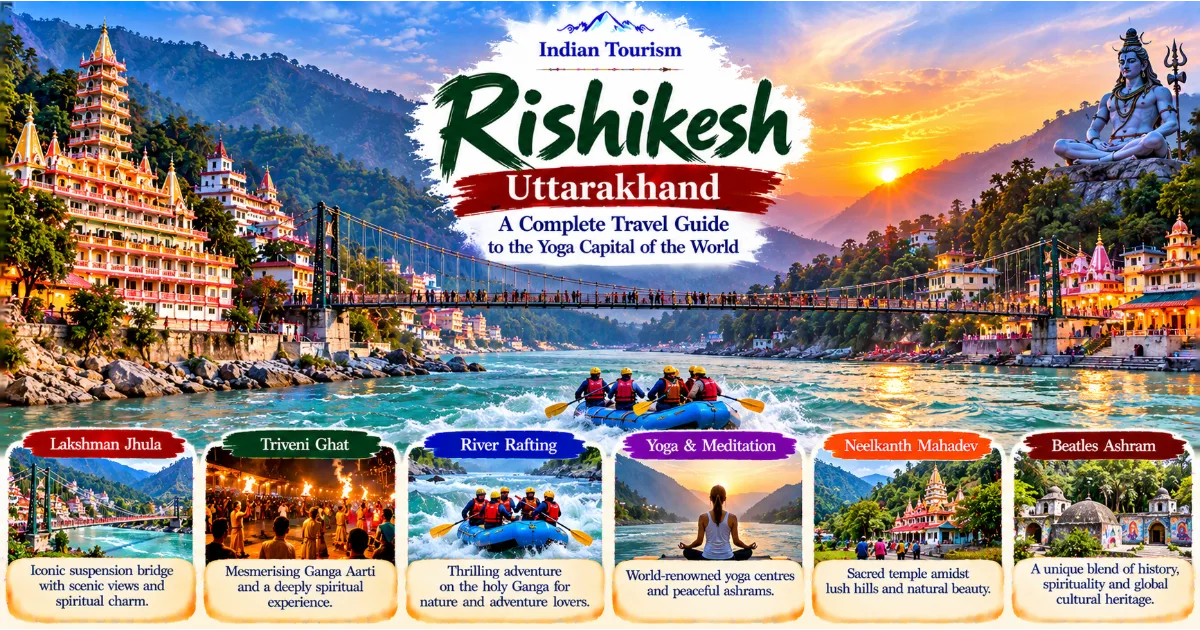
Introduction to Rishikesh
Rishikesh, situated in the foothills of the Himalayas in Uttarakhand, is one of India's most distinctive travel destinations. Known internationally as the Yoga Capital of the World, the city attracts spiritual seekers, adventure enthusiasts, nature lovers, families, solo travellers and visitors searching for a peaceful break beside the Ganga. Its identity brings together ancient religious traditions, riverside life, yoga and meditation, forested hills, suspension bridges, ashrams, bustling markets and outdoor adventures. Few places offer such a varied travel experience within a relatively compact area.
The sacred River Ganga is central to Rishikesh's character. Emerging from the Himalayan region and flowing through the foothills, the river passes through the city before continuing towards the plains. Its clear stretches, rocky banks and surrounding green hills create a dramatic natural setting. Pilgrims visit to pray, take ritual baths at designated ghats and participate in evening ceremonies, while travellers come to enjoy the scenery, explore riverside cafés or experience rafting during suitable seasons and conditions.
Rishikesh is not simply a religious destination or an adventure hub. It is a place where different ways of travelling coexist. One visitor may spend the morning meditating in an ashram, another may be preparing for a rafting trip, and another may be walking across a suspension bridge to visit a temple. In the evening, many gather near the river to watch lamps illuminate the water during the Ganga Aarti. This combination of spirituality, outdoor recreation and everyday local culture makes Rishikesh a rewarding destination for travellers with different interests.
The history and spiritual significance of Rishikesh
Rishikesh has deep roots in Hindu religious tradition. The surrounding Himalayan landscape has long been associated with sages, meditation, pilgrimage and spiritual learning. Religious stories connect the region with ancient ascetics who sought solitude near the Ganga and practised meditation in forests and caves. Although individual legends belong to the realm of faith and traditional accounts, they help explain why the city continues to hold such importance for Hindu pilgrims.
The name Rishikesh is commonly associated with Lord Vishnu in Hindu tradition. The region contains temples and sacred places linked with different forms of Hindu worship. For centuries, the wider area has served as a gateway for pilgrims travelling towards Himalayan shrines and holy sites. Its location between the plains and the mountains made it a natural place for travellers to rest, worship and prepare for journeys into higher elevations.
Rishikesh gradually developed beyond its traditional pilgrimage role. Ashrams and spiritual institutions established teaching programmes for yoga, meditation, philosophy and religious study. During the twentieth century, international visitors became increasingly interested in Indian spiritual traditions, and Rishikesh gained global recognition as a destination for yoga and meditation. Its reputation expanded further as international yoga schools, wellness centres and retreat programmes welcomed students from many countries.
Today, Rishikesh preserves this spiritual identity while adapting to modern tourism. Some institutions remain dedicated to traditional study and disciplined spiritual practice, while others offer short introductory courses for visitors. Travellers should remember that an ashram is not simply a hotel with a spiritual theme. Many operate according to particular rules concerning dress, meals, silence, participation in activities and daily schedules. Understanding these expectations helps visitors choose an experience suited to their needs.
Best time to visit Rishikesh
The best time to visit Rishikesh depends on whether the primary interest is sightseeing, yoga, rafting, trekking or attending religious festivals. The city experiences hot summers, a monsoon season with heavy rainfall and cooler winters. Each season offers a different atmosphere, but river activities and mountain travel require particular attention to weather and safety conditions.
Spring from March to April
Spring is one of the most popular periods for visiting Rishikesh. Temperatures are generally more comfortable than during the peak summer months, and the surrounding hills can look fresh and green after winter. This season is suitable for sightseeing, temple visits, yoga retreats, nature walks and outdoor activities when local operators confirm that conditions are safe.
Rafting demand often increases during this period, especially around weekends and holidays. Travellers should reserve accommodation in advance if visiting during a busy period. Those interested in yoga or meditation may also find a broad range of workshops and short courses available.
Summer from May to June
Summer brings warmer weather, particularly during the afternoon. Early mornings and evenings are generally more pleasant for walks along the river, temple visits and outdoor photography. Visitors should carry drinking water, wear light clothing and plan physically demanding activities for cooler parts of the day.
Rishikesh can become crowded during school holidays, and accommodation prices may rise in popular areas. The river and forested surroundings offer a welcome contrast to the heat of the plains, but high temperatures should not be ignored. Travellers should avoid prolonged exposure to direct sunlight and follow instructions from rafting operators and local authorities.
Monsoon from July to September
The monsoon transforms the surrounding landscape, bringing greenery and a stronger flow to the Ganga and its tributaries. However, heavy rainfall can increase the risk of flooding, landslides, slippery trails and sudden changes in river conditions. Rafting and other water-based activities may be suspended or restricted during unsafe periods.
Travellers visiting during the monsoon should remain flexible with their itineraries. Outdoor excursions should be undertaken only when conditions are suitable and local authorities permit them. It is sensible to choose accommodation with reliable access and to avoid walking close to swollen riverbanks. The monsoon can be beautiful, but safety must take priority over scenic plans.
Autumn from October to November
Autumn is an excellent season for sightseeing, outdoor exploration and spiritual travel. The monsoon usually recedes, and clearer skies can improve views of the surrounding hills. The weather often supports walking tours, visits to temples and ashrams, and carefully organised adventure activities.
The period can be particularly attractive for photographers and travellers seeking a balance between comfortable weather and natural scenery. Major holidays and festivals can bring larger crowds, so accommodation should be booked early when travel dates coincide with popular celebrations.
Winter from December to February
Winter brings cooler mornings and evenings. Daytime conditions can be comfortable for exploring the city, although visitors should pack warm layers for early morning yoga, riverside ceremonies and outdoor walks. Some days are bright and pleasant, while others may be foggy or cold.
Winter is particularly suitable for travellers interested in meditation, spiritual study and quieter sightseeing. Those planning outdoor activities should confirm seasonal operating schedules rather than assuming that every adventure service remains available throughout the year.
Lakshman Jhula and the historic suspension bridges
Lakshman Jhula has long been one of the most recognisable landmarks associated with Rishikesh. The suspension bridge and its surrounding neighbourhood connect the city's spiritual heritage with daily riverside life. The area contains temples, small shops, cafés, guesthouses and narrow lanes that attract pilgrims and travellers throughout the year.
According to Hindu tradition, Lakshman, the younger brother of Lord Rama, crossed the Ganga at this location using a jute rope. The present-day bridge became a prominent symbol of the area and an important point for visitors exploring the eastern side of Rishikesh. The historic bridge has been closed to regular pedestrian use because of safety concerns, so visitors must check current local access rules and should not assume that it is open for crossing.
The surrounding neighbourhood remains worth exploring even when the bridge itself is inaccessible. Travellers can walk through the nearby streets, visit permitted viewpoints, explore temples and enjoy the distinctive atmosphere created by the river, hills and local businesses. The area's small cafés and shops also provide opportunities to pause between sightseeing stops.
Ram Jhula is another important suspension bridge and a major crossing point near several ashrams and spiritual institutions. It is associated with a lively riverside neighbourhood where visitors can find religious centres, bookshops, food stalls and places offering yoga classes. Walking across the bridge, when open and safe, provides views of the Ganga and the surrounding hills.
Both areas are popular with photographers, but visitors should remain aware of pedestrians, traffic restrictions and local instructions. Bridges can become crowded during holidays and religious events. Photography should never obstruct people who are crossing for everyday purposes or travelling to places of worship.
Triveni Ghat and the Ganga Aarti
Triveni Ghat is one of the most important bathing and worship areas in Rishikesh. Pilgrims gather here to pray, perform rituals and participate in ceremonies dedicated to the Ganga. The name Triveni is traditionally associated with the confluence of three sacred rivers, although the religious understanding of this association should be distinguished from the physical geography of the visible river.
The ghat becomes especially atmospheric in the evening, when devotees gather for the Ganga Aarti. Priests perform coordinated rituals with lamps, bells, chants and devotional songs. The reflections of the lamps on the water create a memorable scene, and the collective participation gives the ceremony a strong sense of community.
Visitors who attend the Aarti should treat it as a religious ceremony rather than merely a performance. Arriving early helps secure a suitable place without pushing through the crowd. Modest clothing, respectful behaviour and attention to instructions from organisers are appropriate. People wishing to photograph the ceremony should avoid obstructing worshippers or using equipment in ways that disturb the gathering.
The experience can be meaningful even for visitors who do not follow Hindu religious practices. Observing the ceremony offers an opportunity to understand the importance of the river in local life and the way faith, music and community come together in a shared public space.
Triveni Ghat is also worth visiting during the day. The riverfront offers a different atmosphere in daylight, when people come for prayers, quiet reflection and daily activities. Visitors should use designated steps and bathing areas, pay attention to river conditions and avoid entering the water where currents are strong or access is restricted.
Parmarth Niketan and the ashram experience
Parmarth Niketan is one of the best-known spiritual institutions in Rishikesh. Located beside the Ganga, it welcomes visitors interested in yoga, meditation, spiritual learning and religious ceremonies. Its riverside setting and organised programmes make it a significant destination for people seeking a structured introduction to the spiritual life of the city.
The institution is widely associated with its evening Ganga Aarti, which attracts residents, pilgrims and international visitors. The ceremony combines devotional music, chanting and the use of lamps, creating an experience that reflects the religious traditions of the region. Visitors should check current schedules and participation arrangements before planning their evening around a particular programme.
Ashram life differs from a conventional holiday. Some programmes may include early rising, vegetarian meals, meditation, yoga practice, lectures or periods of silence. Rules vary by institution, so travellers should understand the expectations before booking a course or accommodation. Those seeking a retreat should consider the length of the programme, teaching style, daily schedule and level of physical activity.
A visit to an ashram can also help travellers appreciate that yoga is more than a series of physical postures. Depending on the institution, classes may explore breathing practices, concentration, ethical principles, meditation and philosophical ideas. The depth of study varies considerably, and visitors should select a programme that matches their goals and experience.
Rishikesh contains many other spiritual centres, each with its own character. Some focus on traditional religious education, while others offer courses for beginners or visitors who have limited time. Travellers should ask clear questions about instructors, fees, accommodation, meals and programme requirements before making a commitment.
The Beatles Ashram and its artistic legacy
The Beatles Ashram, commonly associated with the Chaurasi Kutia area, is one of Rishikesh's most distinctive cultural attractions. The site became internationally famous after members of the British music group The Beatles visited Rishikesh in 1968 to study meditation under Maharishi Mahesh Yogi. Their visit helped bring global attention to Indian meditation practices and strengthened the city's reputation among international spiritual travellers.
The site contains structures associated with the former meditation centre, including unusual dome-shaped buildings and spaces that have attracted artists and photographers. Vegetation has reclaimed parts of the complex, creating a distinctive combination of architecture, forest and artistic expression. Murals and other visual works have also contributed to its reputation as a place where music history and contemporary creativity meet.
Visitors should check current entry arrangements and opening hours before planning a trip. Access conditions may change, and the site is not simply an unrestricted public park. The walk through the grounds can involve uneven surfaces, steps and areas affected by weather, so comfortable footwear is advisable.
The Beatles connection is an important part of the site's modern history, but the wider story of meditation in Rishikesh extends far beyond one musical group. The region had an established spiritual identity before the visit, and its teachers and institutions continued to develop programmes long afterwards. Understanding both elements gives the site a richer meaning than treating it only as a celebrity attraction.
Travellers interested in music, photography, architecture or the international history of yoga may find the visit particularly rewarding. It can also be combined with nearby ashrams, riverside walks and other attractions in the same part of the city.
Neelkanth Mahadev Temple
Neelkanth Mahadev Temple is an important pilgrimage destination located in the forested hills near Rishikesh. Dedicated to Lord Shiva, it is associated with the Hindu story of Samudra Manthan, the churning of the cosmic ocean. According to the traditional account, Shiva consumed the poison that emerged during the churning to protect the universe, and the poison caused his throat to turn blue. The name Neelkanth is commonly understood as referring to the blue-throated form of Shiva.
The temple's setting among hills and forest adds to its appeal. The journey from Rishikesh offers views of the surrounding landscape, although road conditions and travel times vary with traffic, weather and seasonal conditions. Visitors should plan the excursion as a separate part of their itinerary rather than attempting to squeeze it into a rushed schedule.
The temple attracts especially large numbers of devotees during religious occasions associated with Shiva. Such periods can bring heavy traffic, long queues and crowded access routes. Travellers who prefer a quieter visit may choose a less busy day, while those attending a festival should prepare for delays and follow local crowd-management instructions.
Dress modestly and respect the customs of the temple. Photography restrictions, offerings and entry arrangements can vary, so visitors should follow posted rules and guidance from temple staff. The religious significance of the site is central to the experience, and the surrounding natural scenery should be enjoyed without disturbing local wildlife or leaving litter behind.
Vashishta Gufa and riverside contemplation
Vashishta Gufa, often called Vashishta Cave, is a spiritual site associated with the sage Vashishta in Hindu tradition. It lies outside the busiest parts of Rishikesh and offers a quieter atmosphere for visitors interested in meditation, religious history and the natural environment.
The cave and its surroundings provide a contrast to the busy streets, shops and cafés of central Rishikesh. Visitors may come to sit quietly, reflect or explore the riverfront. The natural setting can be especially appealing to people seeking a slower pace, but the site should be approached with respect because it has religious significance.
Travel arrangements should be checked before visiting, particularly for travellers relying on public transport. Depending on the route and season, visitors may need to arrange a taxi or other local transport. It is advisable to allow enough time for the journey and to avoid returning after dark if unfamiliar with the area.
The cave is not an entertainment attraction, and visitors should keep noise to a minimum. Those interested in meditation can use the visit as an opportunity to experience a quieter side of the Rishikesh region without expecting a formal retreat programme.
Yoga and meditation in Rishikesh
Yoga is one of the strongest reasons travellers from around the world visit Rishikesh. The city offers everything from introductory classes for holidaymakers to longer teacher-training programmes and intensive retreats. Its reputation is supported by a long history of spiritual learning, although the quality, teaching methods and standards of individual institutions vary.
Beginners can start with a single class or a short programme to understand the basic principles of posture, breathing and relaxation. Those planning a longer course should research the institution carefully and ask about instructor qualifications, class size, the curriculum, assessment methods and any certification offered. A recognised certificate is not automatically a guarantee of teaching quality, so prospective students should look beyond marketing claims.
Meditation programmes also differ. Some focus on breath awareness and concentration, while others include chanting, philosophical study or guided relaxation. Visitors should choose a format that feels appropriate to their experience and expectations. People with physical limitations should inform instructors before participating in movement-based classes.
A longer stay allows travellers to establish a daily routine rather than treating yoga as a one-time activity. Early morning practice, a simple breakfast, study, walking and quiet evenings can create a more balanced experience. However, visitors should avoid assuming that every retreat is suitable for every person. A programme's intensity, accommodation conditions and teaching philosophy should be considered before booking.
Rishikesh is also a useful place to learn about the broader cultural context of yoga. Visitors can explore the relationship between physical practice, breath control, meditation and philosophical traditions. Approaching these subjects with curiosity and respect helps avoid reducing a complex tradition to a fitness trend.
River rafting and adventure activities
Rishikesh is widely known for white-water rafting on the Ganga and nearby stretches of the river system. The activity attracts visitors who want to experience the Himalayan foothills from the water. Rafting routes differ in length and difficulty, and the appropriate option depends on river conditions, operator arrangements and the participant's experience.
Safety should be the main consideration when selecting a rafting trip. Use an established operator that provides suitable life jackets, helmets, trained guides and a clear safety briefing. Participants should follow instructions carefully and disclose relevant physical limitations. Do not enter the river independently in areas where currents are strong, and never assume that a calm-looking stretch is safe for swimming.
Rafting availability is seasonal and can change according to rainfall, water levels and official restrictions. Heavy monsoon conditions may lead to closures or limitations. Even outside the monsoon, operators should assess conditions before each trip. Travellers should be prepared for cancellation if safety conditions are unsuitable.
Other outdoor activities may include guided nature walks, trekking, camping in permitted areas and selected adventure sports offered by local providers. The exact range depends on current regulations and operating conditions. Before paying for an activity, confirm what is included, whether equipment is supplied, what safety measures are in place and how weather-related cancellations are handled.
Camping deserves particular care because riverbanks can be affected by sudden changes in water levels. Visitors should use authorised campsites and follow local restrictions rather than setting up tents wherever the scenery looks attractive. Responsible adventure tourism protects both visitors and the fragile riverside environment.
Exploring the cafés, markets and local food
Rishikesh has a distinctive food culture shaped by pilgrimage, wellness tourism and its international visitor community. Many parts of the city have a strong vegetarian food tradition, and visitors can find Indian meals, simple snacks, bakery products, fruit, tea and a variety of café dishes. The choices vary by neighbourhood and establishment.
Traditional Indian food is widely available. Travellers can try regional thalis, lentils, rice, seasonal vegetables, parathas, pakoras and sweets. Chai is a familiar part of everyday life, especially in small tea shops where visitors can pause between sightseeing stops. Food preferences and preparation styles differ, so people with dietary requirements should ask about ingredients before ordering.
The café culture around the river and popular traveller neighbourhoods offers another side of Rishikesh. Some cafés provide views of the hills or water, while others focus on quiet interiors, reading spaces and international menus. These places can be convenient for solo travellers and visitors staying for yoga courses.
Travellers should remember that local businesses may follow religious or regional practices regarding food and alcohol. It is important to respect the character of each neighbourhood and the rules of individual establishments. Visitors should also avoid assuming that every café offers the same dietary choices.
Food safety matters, particularly during hot weather. Choose places that appear clean and handle food properly, drink safe water and be cautious with uncooked items if their preparation is uncertain. Carrying a reusable bottle that can be refilled safely can reduce plastic waste during the trip.
The local markets offer opportunities to buy clothing, religious items, books, handicrafts, yoga accessories and souvenirs. Bargaining may be acceptable in some shops, but it should remain polite. Purchasing from local businesses can help support the people who make Rishikesh a living destination rather than merely a tourist backdrop.
Nearby places worth exploring
Rishikesh is a useful base for exploring other destinations in Uttarakhand, although travel times depend on traffic, road conditions and the season. Visitors who have more than two or three days can consider extending their trip beyond the central attractions.
Haridwar
Haridwar is one of the major pilgrimage cities of northern India and lies a manageable distance from Rishikesh by road or rail. It is known for Har Ki Pauri, religious ceremonies, temple visits and its long association with the Ganga. The city's atmosphere differs from Rishikesh, with a strong emphasis on pilgrimage and large public gatherings.
A combined visit allows travellers to experience two important centres of religious life in Uttarakhand. Haridwar can be visited as a day trip, but festival periods may involve significant crowds and transport delays.
Rajaji National Park
Rajaji National Park protects forests and wildlife across parts of Uttarakhand. The region is associated with elephants, deer, birds and other wildlife species. Safari access depends on authorised routes, season, permits and current park arrangements.
Visitors should book through legitimate channels and follow the instructions of guides and park staff. Wildlife sightings are never guaranteed, and responsible visitors should not feed animals, make excessive noise or attempt to leave designated routes.
Shivpuri
Shivpuri, near Rishikesh, is associated with rafting and riverside outdoor recreation. It attracts visitors seeking adventure activities and access to natural surroundings. As with rafting elsewhere in the region, conditions, availability and safety requirements should be checked before booking.
Travellers interested in spending more time outdoors may use Shivpuri as part of a broader itinerary, but should choose authorised facilities and respect rules governing river access and camping.
Devprayag
Devprayag is a significant religious and geographical destination in Uttarakhand. It is traditionally recognised as the confluence where the Alaknanda and Bhagirathi rivers meet to form the Ganga. The town has a distinctive riverside setting and a strong pilgrimage identity.
The journey involves mountain roads, so travellers should allow sufficient time and check conditions before departing. Visitors should be careful around the water, particularly near steep banks and strong currents.
How to reach Rishikesh
Rishikesh is accessible by road, rail and air connections through the wider Dehradun region. The most suitable route depends on the traveller's starting point, budget and preferred mode of transport.
By air
The nearest major airport is Jolly Grant Airport near Dehradun. From the airport, travellers can continue to Rishikesh by taxi or other available road transport. Travel time varies with traffic and the exact destination within the city.
Visitors arriving by air should confirm transport arrangements before landing, particularly if arriving late in the evening or travelling during a busy holiday period. Some accommodation providers may be able to recommend local transport options.
By train
Rishikesh has rail connectivity, while Haridwar is also an important rail gateway for visitors travelling to the region. Depending on the origin and available train services, travellers may find it convenient to arrive at Haridwar and continue by road.
Train schedules and connections change, so tickets should be checked before departure. During major holidays and pilgrimage periods, advance booking is advisable.
By road
Rishikesh is connected to nearby cities by road. Travellers commonly arrive from Dehradun, Haridwar and Delhi, although journey times vary significantly with traffic and weather. The route can become congested during weekends, long holidays and major religious events.
Private taxis offer flexibility, while buses and other shared transport options may be more economical. Visitors should choose transport appropriate to their arrival time, luggage and accommodation location.
Getting around the city
Rishikesh contains several distinct areas, and travelling between them can take longer than expected during busy periods. The central pilgrimage areas, ashram neighbourhoods, market streets and outlying adventure locations do not all sit within one compact walking zone.
Walking is often the best way to explore nearby temples, cafés and markets. However, some streets are steep, crowded or uneven, so comfortable footwear is important. Visitors should take care when walking beside roads and remain alert to local traffic.
Auto-rickshaws, taxis and other local transport services may be useful for longer journeys. Travellers should confirm the fare or booking terms before setting off. For places outside the central city, it can be helpful to arrange a return journey in advance rather than assuming transport will always be readily available.
Visitors with mobility limitations should check the terrain and access arrangements of each attraction. Steps, steep paths, crowded bridges and uneven riverfront areas can make some locations challenging. Selecting accommodation close to the main activities can reduce the need for repeated travel.
Where to stay in Rishikesh
Rishikesh offers a wide range of accommodation, from simple guesthouses and ashram rooms to family hotels, boutique properties and riverside retreats. The best area depends on the purpose of the trip.
Travellers focused on spiritual activities may prefer accommodation near established ashrams and temples. Those who enjoy cafés and international traveller culture may choose a property in one of the popular riverside neighbourhoods. Families may prioritise convenient road access, quieter surroundings and comfortable facilities, while adventure travellers may prefer a base that simplifies transport to authorised activity locations.
Ashram accommodation can provide a distinctive experience, but rules and facilities vary. Visitors should check meal arrangements, room types, curfews, participation requirements and whether the stay includes scheduled activities. It is important to understand the conditions before booking.
Hotels and guesthouses should be evaluated according to cleanliness, safety, location, reviews and transparent pricing. During high season, festivals and long weekends, suitable rooms may become limited. Booking ahead can help travellers avoid last-minute compromises.
A riverside view may be attractive, but safety and accessibility should come first. Visitors should avoid properties that encourage unsafe access to the river or fail to provide clear information about facilities. The cheapest option is not always the best value if transport, meals and basic comfort become difficult.
Suggested three-day itinerary
A three-day visit provides enough time to explore Rishikesh's major attractions without rushing through every experience. The following plan can be adjusted according to weather, religious events and personal interests.
Day one: Discover the spiritual heart of Rishikesh
Begin the morning with a walk near the Ganga and a visit to the temples and markets in the central area. If interested, attend a yoga class or meditation session at a reputable institution. Spend the afternoon exploring the neighbourhood around Ram Jhula, subject to current access conditions, and visit an ashram that welcomes visitors.
In the evening, attend the Ganga Aarti at Triveni Ghat or another suitable authorised location. Arrive early, follow instructions and allow time to return to the accommodation without rushing through crowded streets.
Day two: Explore the river and the surrounding hills
Dedicate the second day to outdoor activities. If rafting is operating safely and you meet the requirements, book a guided trip with a reputable operator. If rafting is unavailable or not of interest, consider a nature walk, a visit to the Beatles Ashram or a trip to a permitted viewpoint.
After returning to the city, spend time in the local markets or cafés. Keep the evening flexible, especially if the day's activities involve physical exertion.
Day three: Visit a temple or take a day trip
Use the final day for a longer excursion. Neelkanth Mahadev Temple is a suitable choice for travellers interested in religious heritage and forested hill scenery. Alternatively, visit Vashishta Gufa for a quieter experience, explore Haridwar or arrange a trip to Devprayag if road conditions and time permit.
Return with enough time to pack and prepare for departure. Mountain journeys can be affected by weather and traffic, so it is unwise to schedule a long excursion immediately before a tightly timed onward connection.
A five-day itinerary for a deeper experience
Travellers with five days can experience Rishikesh at a slower pace and include both spiritual and outdoor activities. The additional time allows for a more balanced schedule, especially for those who want to try yoga or meditation without turning the entire trip into a formal retreat.
On the first day, arrive, settle into the accommodation and explore the nearby riverfront. Keep the schedule light to allow time for travel fatigue. On the second day, visit Ram Jhula and the surrounding ashrams, attend a class or talk where available, and enjoy the evening atmosphere beside the river.
The third day can be devoted to adventure or nature. Choose rafting only if it is operating under suitable conditions, or select a guided walk or other authorised outdoor activity. The fourth day can focus on Neelkanth Mahadev Temple, the Beatles Ashram or another nearby site, depending on personal interests and current access arrangements.
On the fifth day, enjoy a morning yoga session, revisit a favourite riverside location or explore a local market before departure. Visitors following a retreat programme should adapt this itinerary to the institution's schedule rather than trying to fit in every tourist attraction.
A slower itinerary gives travellers time to appreciate the daily rhythm of Rishikesh. The city is not only a collection of landmarks. Its appeal also lies in quiet mornings, the sound of the river, shared meals, conversations with local people and the contrast between busy streets and peaceful spiritual spaces.
Estimated travel budget
The cost of a Rishikesh trip varies according to the season, accommodation category, transport arrangements, meals and activities. A simple trip using guesthouses, local food and public transport can cost substantially less than a holiday involving premium hotels, private taxis, guided excursions and multiple adventure activities.
Budget travellers should plan for accommodation, meals, local transport, entry charges where applicable and a reserve for unexpected expenses. Visitors staying in an ashram should confirm whether the fee includes meals and scheduled programmes. Some courses have separate charges for accommodation, tuition or activities.
Mid-range travellers may prefer a comfortable hotel, a mix of local restaurants and cafés, and selected guided excursions. Families should account for room size, transport, meals, children's needs and the additional cost of booking activities through suitable operators.
Travellers choosing premium accommodation should consider whether the location offers convenient access to the activities they want to experience. A beautiful property far from the central area may require more transport spending than expected.
Because prices change frequently, it is best to check current rates close to the travel date. Weekends, holidays, festivals and peak seasons can bring substantial increases. A realistic budget should include a contingency rather than allocating every rupee to planned activities.
Shopping in Rishikesh
Shopping in Rishikesh is closely connected with its spiritual identity and its role as a destination for yoga students and international travellers. Markets and small shops offer religious books, prayer beads, incense, clothing, handicrafts, yoga accessories, notebooks and souvenirs.
Visitors interested in yoga may find mats, comfortable clothing and other practice-related items. Product quality varies, so people planning to use equipment regularly should inspect it carefully rather than choosing solely on appearance or price. Books and locally produced crafts can make more meaningful souvenirs than mass-produced objects.
Religious items should be purchased and handled respectfully. Travellers should avoid buying products made from protected wildlife materials or items whose origin is unclear. Supporting legitimate local businesses and artisans can contribute to the local economy.
Bargaining may be common in some markets, but it should be polite and proportionate. Visitors should also keep their belongings secure in crowded areas and avoid carrying unnecessary valuables.
Responsible tourism and environmental protection
Rishikesh's natural beauty and spiritual significance depend on the health of the Ganga, surrounding forests and local communities. Increasing visitor numbers create opportunities for local businesses but also place pressure on waste management, water resources, roads and public spaces.
Travellers can make a positive difference through small decisions. Carry reusable water bottles where safe refilling is available, avoid unnecessary single-use plastics and dispose of rubbish in designated bins. Never throw packaging, food waste or other objects into the river.
Respect religious spaces and local customs. Dress appropriately when visiting temples and ashrams, keep noise low during ceremonies and ask permission before photographing people in personal or devotional settings. Not every person wants to appear in a travel photograph, particularly during prayer.
Water safety is essential. The Ganga can have strong currents, submerged rocks and sudden changes in depth. Visitors should use designated areas and follow local warnings. Do not enter restricted stretches of the river, swim alone in unfamiliar locations or ignore instructions from authorities.
Responsible adventure tourism means choosing operators who provide appropriate equipment, qualified guides and clear safety briefings. If weather conditions are poor or an activity is suspended, do not seek an informal alternative that bypasses safety restrictions.
Visitors should also consider the effect of noise, traffic and construction on the local environment. Choose accommodation and businesses that demonstrate reasonable waste-management practices, and avoid activities that disturb wildlife. Respecting the destination helps ensure that future visitors and residents can continue to benefit from its natural and cultural heritage.
Practical travel tips for first-time visitors
First-time visitors should remember that Rishikesh combines a busy tourist economy with active religious life. A little preparation can make the experience more comfortable and respectful.
Carry comfortable walking shoes, modest clothing for religious sites, sun protection and a light layer for cooler mornings or evenings. During the monsoon, suitable rain protection is essential, while winter visitors should pack warm clothing. A small day bag is useful for carrying water, personal medication and necessary items during excursions.
Check opening arrangements and access restrictions before visiting major attractions. Some bridges, temples, forest areas and adventure locations may have changing rules. Do not rely solely on old travel photographs or outdated descriptions when planning a route.
Keep extra time in the schedule for traffic and crowds. Rishikesh can become especially busy during weekends, festivals and holiday periods. Booking accommodation and important activities in advance can reduce stress.
Use reputable providers for yoga courses, rafting and transport. Ask questions about pricing, safety measures, cancellation policies and what is included. Avoid anyone who pressures you into paying immediately without explaining the service.
Solo travellers should share their general plans with someone they trust, choose well-reviewed accommodation and avoid isolated routes after dark. Families should supervise children closely around the river, bridges and crowded market areas.
Finally, approach Rishikesh with realistic expectations. It is a living city, not a perfectly quiet retreat. Traffic, construction, crowds and commercial activity are part of modern life here. The most rewarding visit comes from balancing the famous attractions with quieter moments and remaining open to the city's many different sides.
Is Rishikesh worth visiting?
Rishikesh is worth visiting because it offers an unusually broad range of experiences within one destination. It is a place of pilgrimage and meditation, but it is also a centre for outdoor recreation, cultural exploration, food, shopping and everyday life beside the Ganga. Travellers can spend their days attending yoga classes, visiting temples, exploring forested surroundings or taking part in supervised adventure activities.
The city appeals to visitors who want a spiritual experience as well as those who simply appreciate mountain scenery and riverside landscapes. Families can focus on sightseeing and cultural activities, solo travellers can explore the cafés and ashrams, and adventure enthusiasts can arrange suitable outdoor experiences according to the season.
Its greatest appeal may lie in the contrast between movement and stillness. Crowded market lanes and suspension bridges stand alongside places of quiet reflection. Energetic river activities coexist with devotional ceremonies and meditation sessions. This variety allows visitors to shape a trip around their own interests.
A thoughtful visit also requires respect for the river, religious traditions and local communities. Travellers who take safety seriously, support responsible businesses and avoid treating sacred places as mere backdrops will gain a deeper understanding of Rishikesh.
For anyone exploring Uttarakhand, Rishikesh is a destination that deserves more than a quick stop. Given sufficient time, it reveals itself as a place where Himalayan nature, spiritual heritage and contemporary travel culture meet.
Conclusion
Rishikesh stands among Uttarakhand's most memorable destinations because it brings together the sacred Ganga, centuries of spiritual tradition, internationally recognised yoga institutions, historic religious sites and a thriving outdoor adventure scene. From the evening Aarti at Triveni Ghat to the peaceful atmosphere of an ashram, from the forested approach to Neelkanth Mahadev Temple to the excitement of a supervised rafting trip, the city offers many ways to connect with its surroundings.
The best itinerary depends on the traveller. Some will prefer a short cultural visit, while others may spend a week studying yoga or exploring the nearby hills. Planning around the season, checking current activity conditions and allowing time for unhurried exploration can make the journey safer and more rewarding.
Rishikesh is not defined by a single landmark. It is defined by the relationship between river, mountains, faith, learning and community. For travellers seeking a deeper experience of Uttarakhand, it offers a powerful introduction to the region's natural beauty and cultural richness.
#IndianTourism #Rishikesh #UttarakhandTourism #YogaCapitalOfTheWorld #TravelIndia #ExploreUttarakhand #GangaAarti #IndianCulture #SpiritualTravel #AdventureTravel #YogaInIndia #ResponsibleTourism
