
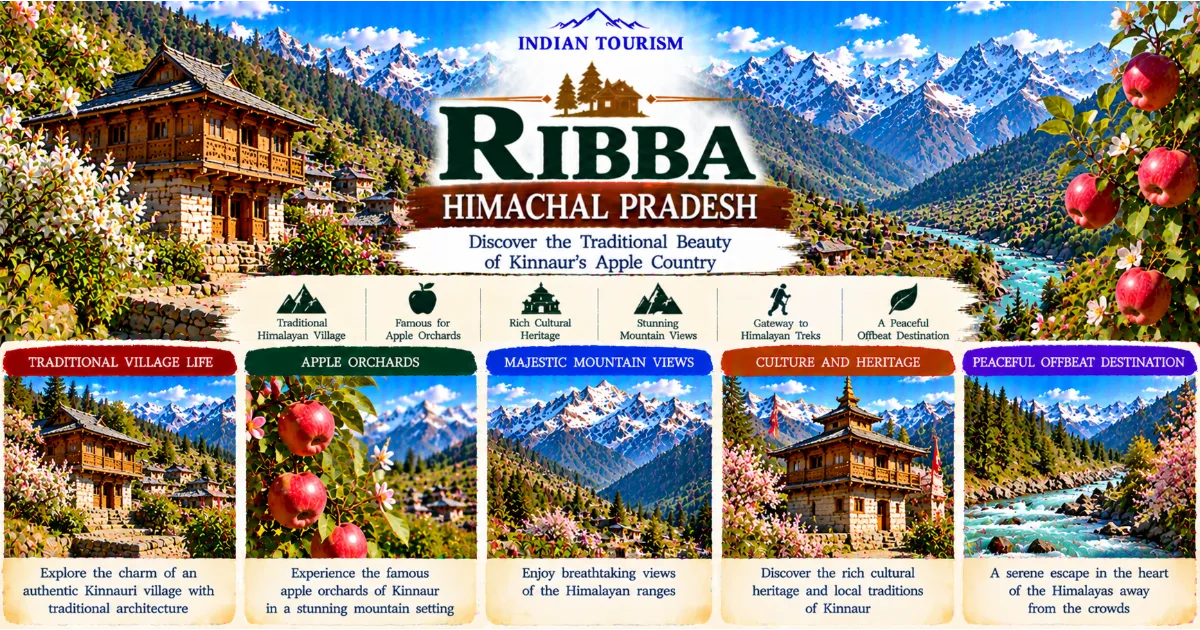
A Peaceful Himalayan Village Beyond the Usual Tourist Trail
Himachal Pradesh is a land of extraordinary geographical and cultural diversity, where green valleys, snow-covered mountains, ancient temples, and traditional settlements come together to create some of India's most memorable travel experiences. While Shimla, Manali, and Spiti are familiar names among travellers, the Kinnaur district offers a different kind of journey. Here, mountain communities preserve distinctive traditions, apple orchards cover cultivated slopes, and narrow roads lead towards villages that remain closely connected to their natural surroundings. Ribba, a traditional settlement in Kinnaur, is one of the places that introduces visitors to this quieter side of the Himalayas.
Ribba is situated in the Kinnaur region of Himachal Pradesh, an area known for its mountainous terrain, orchards, distinctive architecture, and rich cultural heritage. The village is associated with the broader landscape around the Sutlej Valley and the traditional settlements that developed along mountain routes connecting different parts of the western Himalayas. Travellers who venture into this part of Kinnaur can experience a landscape shaped by agriculture, seasonal weather, local customs, and generations of adaptation to mountain life.
Unlike large hill stations built around commercial tourism, Ribba is best understood as a living village rather than a conventional holiday resort. Its attraction lies in the surroundings, the agricultural landscape, the architecture, and the opportunity to understand the everyday character of Kinnaur. Visitors may find orchards, terraced fields, mountain views, and quiet village lanes more memorable than a crowded list of formal attractions.
The village is particularly interesting for travellers who want to explore the relationship between people and the Himalayan environment. Agriculture is important across much of Kinnaur, and fruit cultivation has transformed the economy of many settlements. Apple orchards, carefully maintained fields, and houses adapted to local conditions reveal how communities have developed livelihoods in a region where steep slopes, cold winters, and limited cultivable land shape daily life.
Ribba is also a suitable destination for slow travel. Instead of rushing through the village on the way to another place, visitors can spend time observing the landscape, learning about regional traditions, and appreciating the pace of life in a mountain settlement. With careful planning, respect for local residents, and realistic expectations about facilities, Ribba can become a meaningful stop on a wider journey through Kinnaur.
Where Is Ribba Located?
Ribba is a village in Kinnaur district, Himachal Pradesh, in the western Himalayas of northern India. The district stretches across a varied landscape that includes deep river valleys, steep mountain slopes, agricultural settlements, forests, and high-altitude terrain. Its geography creates substantial differences between villages in terms of climate, vegetation, accessibility, and traditional livelihoods.
Kinnaur is often associated with the Sutlej River corridor, which has historically influenced settlement patterns, transport routes, and economic activity. Mountain roads connect communities that are separated by steep slopes and long distances, making travel through the district an experience in itself. Visitors approaching Ribba should expect a journey that requires attention to road conditions and enough time for delays.
The region is also known for its changing landscape. Lower and more sheltered areas may support extensive cultivation and orchards, while higher slopes become increasingly exposed and rugged. Snowfall, rainfall, temperature, and water availability affect the appearance of the countryside throughout the year.
Ribba's appeal is closely connected with this broader Kinnauri setting. The village offers an opportunity to appreciate a traditional settlement within a landscape where agriculture, mountain architecture, and regional culture remain closely linked. Travellers should confirm the most suitable approach route, current road conditions, and local accommodation options before departure, as services and access can vary by season.
The Natural Beauty of Ribba
Mountain Slopes and Expansive Views
The mountains surrounding Kinnaur create a dramatic setting for village life. Slopes rise above cultivated land, ridges form layered horizons, and narrow valleys reveal how closely settlements are connected with the shape of the terrain. Depending on the season, the landscape may appear green and cultivated, dry and rugged, or dusted with snow at higher elevations.
For visitors, the beauty of Ribba is not necessarily concentrated in a single viewpoint. It emerges through the combination of houses, fields, orchards, trees, and mountain backdrops. Walking along an accessible village lane can reveal different perspectives of the surrounding terrain, particularly when changing light brings out the contours of distant slopes.
The mountain environment also influences how the village functions. Buildings must respond to cold weather and seasonal changes, agricultural activity follows local growing conditions, and roads must negotiate steep terrain. These practical relationships help explain why settlements in Kinnaur often appear integrated into the landscape rather than spread across broad, level ground.
Visitors should remain aware that mountain viewpoints can be exposed and that loose stones, steep drops, and narrow paths may present risks. Photography should always be secondary to personal safety. Travellers should use established access routes and avoid entering private property or cultivated areas without permission.
The Changing Colours of the Landscape
One of the pleasures of exploring Kinnaur is watching the landscape change through the seasons. Spring brings renewed growth to many cultivated areas, while summer supports agricultural activity and greener surroundings where water and elevation allow. Autumn is often associated with harvest activity and changing orchard colours. Winter introduces colder conditions and may bring snow to parts of the region.
These seasonal changes influence the experience of visiting Ribba. A traveller interested in agriculture may prefer a period when orchards are active, while a photographer may value clear weather and distinctive light. Visitors seeking snow should understand that conditions vary with elevation and year, and snowfall cannot be guaranteed at a particular time.
The landscape is also affected by the balance between sunlight and shadow. Mountain slopes can receive very different amounts of sunlight depending on their orientation and surrounding ridges. As the day progresses, the appearance of fields, trees, and buildings can change significantly.
Travellers who slow down enough to notice these details gain a deeper appreciation of the region. Rather than measuring a visit by the number of places covered, they can experience the atmosphere of the village through its changing light, weather, and agricultural rhythms.
Ribba and the Apple Orchards of Kinnaur
Understanding the Importance of Fruit Cultivation
Kinnaur is widely associated with apple cultivation, and fruit orchards have become an important feature of the district's rural economy. The region's altitude, climate, and local growing conditions support horticulture in many settlements, although the suitability of particular crops varies with location and elevation.
Apple cultivation has influenced more than agriculture alone. It has affected household income, seasonal employment, transport requirements, and the movement of produce to markets. Orchard work can involve pruning, irrigation, pest management, seasonal maintenance, harvesting, sorting, packing, and transporting fruit along mountain roads.
For visitors, orchards offer a way to understand the connection between geography and livelihood. The presence of fruit trees reflects years of local knowledge about growing conditions, water availability, and the management of cultivated land. It also demonstrates how communities have adapted their economic activities to the opportunities and limitations of mountain environments.
Travellers should remember that orchards are working properties. Trees, irrigation systems, equipment, and harvested produce are valuable resources. Visitors should never pick fruit, enter a fenced orchard, or photograph workers at close range without permission. A respectful conversation with an orchard owner or local guide, when welcomed, can provide more insight than simply walking through the fields.
When Can Travellers Experience Orchard Seasons?
The appearance of orchards changes throughout the year. During spring, trees may develop new leaves and blossoms, creating an attractive setting in suitable locations. Summer is generally associated with active growth and orchard maintenance. As the harvest season approaches, fruit develops and workers prepare for picking and transport.
The exact timing of flowering and harvesting depends on altitude, weather, variety, and local conditions. Visitors should not assume that every orchard in Kinnaur follows the same calendar. A local host or grower can provide the most relevant information about what is happening during a planned visit.
Autumn can be especially interesting for travellers who want to understand the practical side of fruit production. Harvesting and packing may involve considerable work, and the movement of produce can make roads and village areas busier. Visitors should avoid obstructing vehicles or interfering with operations.
Even outside the most visually striking periods, orchards remain important parts of the landscape. Their rows of trees, surrounding walls, irrigation channels, and relation to mountain slopes reveal how agricultural land is managed in a challenging environment.
Traditional Architecture and Village Design
Houses Adapted to Mountain Conditions
Traditional settlements in Kinnaur reflect the practical demands of mountain living. Buildings must respond to cold winters, seasonal precipitation, steep terrain, and the availability of construction materials. Stone and wood have historically played important roles in regional architecture, although designs differ across villages and have evolved over time.
In Ribba, the built environment can be appreciated as part of the broader cultural landscape of Kinnaur. The arrangement of houses, paths, fields, and open spaces reflects the way residents use the land available to them. The village should not be treated as a collection of decorative structures. It is a functioning community in which buildings support family life, work, storage, and social activity.
Travellers interested in architecture can observe roof forms, construction materials, entrances, balconies, and the relationship between buildings and the surrounding terrain. However, they should avoid making assumptions about the age or cultural meaning of a particular structure without reliable local information.
Modern construction has also influenced Himalayan villages. Concrete buildings, updated materials, and new facilities may exist alongside older forms. This mixture is part of the continuing evolution of rural life rather than evidence that a village has lost its identity.
Respecting Private and Community Spaces
Village exploration is most rewarding when visitors understand the difference between public routes and private spaces. A narrow lane may pass close to homes, courtyards, storage areas, or agricultural workspaces. Residents may be going about their daily responsibilities, and the presence of visitors should not interfere with those activities.
Ask before photographing people or private buildings. Do not enter homes, courtyards, temples, or enclosed spaces unless invited or clearly permitted. If a community space has posted rules, follow them. Modest clothing and respectful conduct are appropriate when visiting religious or culturally significant places.
Visitors should also keep noise to a minimum, particularly early in the morning and later in the evening. Playing loud music, flying drones without permission, or organising photography sessions that obstruct paths can create unnecessary disturbance.
A considerate approach allows travellers to appreciate the character of Ribba while respecting the privacy and dignity of its residents.
Kinnauri Culture and Local Traditions
A Region With a Distinct Cultural Identity
Kinnaur has a distinctive cultural history shaped by geography, trade, religion, agriculture, and interactions between neighbouring Himalayan regions. Its traditions vary between localities, and the district should not be understood as culturally uniform. Language, clothing, architecture, food, and religious practices can differ across communities.
Traditional festivals and community gatherings play important roles in many settlements. They may be connected with agricultural seasons, religious observances, local deities, and shared social responsibilities. Such events are part of community life rather than performances arranged primarily for tourists.
Visitors who want to learn about Kinnauri culture should approach local traditions with curiosity and humility. Reading about the region before travelling can provide useful background, but direct explanations from residents are often more meaningful when people are willing to share them.
It is important not to assume that every local custom is open to public observation. Some ceremonies, sacred spaces, and rituals may have specific restrictions. Travellers should follow local guidance and avoid taking photographs where photography is unwelcome.
Festivals and Community Life
Festivals across Kinnaur can involve music, dance, traditional clothing, religious observances, and gatherings that strengthen community relationships. The timing and form of celebrations differ from one locality to another. Visitors planning a journey around a festival should confirm the date and nature of the event locally rather than relying on general descriptions of the district.
Attending a community celebration can be a memorable cultural experience, but it should be approached as an invitation to observe respectfully. Travellers should not assume that they may enter restricted areas, interrupt ceremonies, or photograph participants without permission.
When visitors are welcomed, they can learn about the significance of local music, food, clothing, and ritual practices. The most rewarding cultural exchanges occur when travellers listen carefully and recognise that the people they meet are sharing their living traditions, not simply presenting attractions.
If no festival is taking place during a visit, ordinary village life still offers valuable insight. Agricultural work, family activities, local markets, and conversations about the landscape can reveal how culture continues through everyday routines.
Temples and Spiritual Traditions in Kinnaur
Religious traditions are an important part of the cultural landscape across Kinnaur. Temples and other sacred places often serve as centres of worship, community gatherings, and local identity. Their importance may extend beyond the physical structures to include the traditions, stories, and relationships associated with them.
Visitors exploring Ribba and nearby settlements may encounter religious buildings or community spaces that hold particular significance for residents. Travellers should seek reliable local information before assigning historical claims or religious meanings to a site. The presence of a distinctive architectural feature does not by itself establish its age or origin.
When visiting a temple, follow local customs regarding footwear, clothing, photography, and access. Some areas may be restricted to certain participants or may have rules that differ from those at major tourist temples. Respecting these practices is part of responsible travel.
Religious spaces should not be treated merely as photographic backgrounds. Visitors can appreciate their architecture and setting while recognising their continuing spiritual role in the community. Quiet behaviour and a willingness to follow local guidance help preserve a respectful atmosphere.
Best Time to Visit Ribba
Spring: New Growth and Orchard Landscapes
Spring can be an appealing time to explore the lower and middle elevations of Kinnaur. As temperatures begin to rise, vegetation changes and agricultural activity increases. In suitable locations, fruit trees may blossom, adding seasonal colour to the landscape.
The timing of spring conditions varies from year to year. Cold weather may continue in mountain areas, and higher roads can remain affected by snow or other seasonal conditions. Visitors should confirm access and accommodation arrangements before departure.
Spring suits travellers who enjoy village walks, photography, and observing the transition from winter to the growing season. It is also a useful period for learning about orchard maintenance and agricultural preparation, provided local residents have time to discuss their work.
Summer: A Practical Season for Village Exploration
Summer is often a practical season for exploring many parts of Kinnaur because roads and services may be more accessible than during periods of heavy snow. Daytime conditions can be comfortable for walking and sightseeing, although temperatures still vary considerably with elevation and weather.
Visitors interested in orchard landscapes, regional culture, and longer road journeys may find summer convenient. However, summer travel should not be planned without checking weather forecasts and road conditions. Mountain roads can be affected by construction, rockfall, landslides, and temporary restrictions.
The season can also be busy on popular routes through Kinnaur. Booking accommodation ahead of time and leaving sufficient time for travel can reduce stress.
Monsoon: Careful Planning Is Essential
Monsoon conditions can make travel through parts of Himachal Pradesh unpredictable. Heavy rainfall may cause landslides, road damage, falling rocks, and delays. The intensity of rainfall varies by location, and the condition of a road can change quickly.
Travellers visiting Ribba during the monsoon should monitor official advisories and local updates. Avoid driving through flooded sections, approaching unstable slopes, or continuing along roads that local authorities have closed. Flexible travel dates are valuable during this season.
The monsoon may bring greener scenery to some areas, but the potential for disruption should be considered before booking. Safety and road access should take priority over photography or a fixed sightseeing schedule.
Autumn: Clearer Skies and Harvest Activity
Autumn can be a rewarding period for visitors interested in mountain views and agricultural life. Weather may provide clear periods suitable for photography, while orchard activity can make the countryside particularly interesting.
Temperatures become cooler as the season progresses, especially in the evening and at night. Warm clothing is essential, and travellers should confirm that accommodation remains available for their dates.
Visitors should also be mindful that harvest work can make village roads busier. Avoid blocking vehicles or entering orchards without permission. Observing the harvest respectfully can offer an informative perspective on the work behind the region's agricultural economy.
Winter: Cold Weather and Possible Travel Disruptions
Winter conditions in Kinnaur can be severe, particularly at higher elevations. Snowfall, ice, low temperatures, and road restrictions may affect access. Some accommodation providers and transport services may operate on a reduced schedule or close temporarily.
Travellers planning a winter visit should obtain current local advice and avoid assuming that a route is safe because it was open during a previous season. Appropriate winter clothing, reliable transport arrangements, and a flexible itinerary are essential.
Winter may appeal to experienced travellers who are prepared for cold conditions, but it is not the easiest season for a spontaneous visit. Anyone unfamiliar with mountain winter travel should consider a more accessible period.
How to Reach Ribba
Travelling by Road
Road travel is the principal way visitors reach villages across Kinnaur. Travellers generally plan a route through the wider district and then continue towards Ribba using the appropriate local road connections. The exact approach should be confirmed before departure, as road conditions and access can change with weather and maintenance work.
Mountain driving requires patience and attention. Roads may be narrow, winding, or exposed to steep slopes. Travellers should avoid unnecessary night driving in unfamiliar areas and should not stop at blind bends or unsafe roadside locations for photographs.
A private vehicle offers flexibility, but the driver should be comfortable with mountain roads. Shared taxis and local transport may be options on some routes, although schedules and availability should be checked locally. Public transport services can be less frequent than those in major tourist centres.
Travelling by Bus or Shared Taxi
Visitors using public transport can investigate connections to larger towns and settlements in Kinnaur before arranging onward travel to Ribba. Services vary by season, route, and local conditions. A connection that is available on one day may not operate at the same time on another.
Travellers should confirm departure points, arrival locations, luggage arrangements, and onward transport before beginning the journey. If reaching Ribba depends on a particular connection, an additional overnight stop may be more sensible than relying on a tight schedule.
Shared taxis can be useful where available, but passengers should agree on the destination and fare in advance. Visitors carrying trekking equipment or substantial luggage should confirm that the vehicle can accommodate it.
Planning the Journey From Outside Himachal Pradesh
Travellers arriving from distant cities may combine air or rail travel with a long road journey into the mountains. There is no major airport or railway station within Ribba itself. The most suitable gateway depends on the overall route, transport connections, and current conditions.
It is important to consider the complete journey rather than only the distance from a transport hub to Kinnaur. Mountain roads can make travel times much longer than a map might suggest. An overnight stop can reduce fatigue and make the trip more comfortable.
Before leaving, share your itinerary with someone you trust and keep important contact details accessible offline. Mobile coverage can vary across mountain routes, and travellers should not depend entirely on continuous internet access.
Places and Experiences to Explore Around Ribba
Village Walks and Local Observation
One of the simplest ways to appreciate Ribba is to explore accessible village lanes at a relaxed pace. Walking allows visitors to notice the relationship between houses, cultivated land, orchards, and mountain slopes. It also provides opportunities to observe ordinary routines without needing a tightly packed sightseeing schedule.
Choose routes that are clearly accessible and avoid entering private land. If a path becomes unfamiliar, steep, or unsafe, turn back rather than continuing without guidance. Local residents may be able to explain which routes are suitable for a short walk, but visitors should not assume that everyone is available to act as a guide.
Orchard Landscapes
The agricultural landscape is an important part of Kinnaur's identity. Visitors may be able to observe orchard areas from public roads or with permission from landowners. The appearance of the trees changes throughout the year, making the landscape interesting in different seasons.
If an orchard owner agrees to a visit, follow their instructions carefully. Do not touch equipment, disturb irrigation systems, or pick fruit without permission. During harvesting, keep clear of vehicles and work areas.
A respectful orchard visit can help travellers understand the work involved in growing and transporting fruit in mountainous terrain. It can also highlight the importance of seasonal labour and road access to local livelihoods.
Photography of the Mountains and Village
Photography is a natural activity in a landscape as varied as Kinnaur. Travellers can capture the relationship between village architecture, orchards, cultivated fields, and distant mountains. Early and late daylight may create attractive shadows, although the best conditions depend on weather and the orientation of the landscape.
Use established viewpoints and avoid standing on unstable edges or narrow road shoulders. Never obstruct traffic for a photograph. Drones should only be used where permitted and with any required approvals, and they should not disturb residents, wildlife, or religious activities.
A thoughtful photograph often communicates more than a collection of hurried images. Spend time observing the composition and understanding what makes the landscape distinctive.
Exploring the Wider Kinnaur Region
Ribba can be considered as part of a broader Kinnaur itinerary rather than an isolated destination. The district contains a variety of settlements, landscapes, cultural sites, and mountain routes. Travellers may combine village exploration with other destinations according to their available time and the current condition of the roads.
The itinerary should be designed around geography rather than a simple checklist. Distances between mountain settlements can take longer to cover than expected, and unexpected delays are common enough to justify a flexible schedule.
Visitors should avoid trying to see every major attraction in a short trip. Allowing more time in fewer places can create a richer experience and reduce pressure on transport, accommodation, and local services.
Local Food and Dining Expectations
Food is an important part of travel because it connects visitors with the practical and cultural realities of a place. In rural Kinnaur, food availability may be more limited than in larger tourist towns. Travellers should expect that meals and provisions will depend on the accommodation provider, season, and local supply arrangements.
Simple home-style meals may be available through local accommodation, while the range of restaurant choices can be limited. Visitors with dietary restrictions should communicate their needs before arrival. Anyone with a serious food allergy should carry appropriate medication and confirm ingredients rather than relying on assumptions.
Travellers should also plan drinking water carefully. Clear water from a stream or mountain source is not automatically safe to drink. Use reliable treatment methods or properly supplied drinking water, especially when walking or travelling away from established settlements.
Carrying a small supply of snacks can be helpful during long road journeys, but packaging should be managed responsibly. All wrappers, bottles, and other waste should be carried until they can be disposed of appropriately.
Accommodation in and Around Ribba
Accommodation in smaller Kinnauri villages may consist of homestays, guesthouses, or properties in nearby settlements. Availability and facilities can vary, so travellers should confirm arrangements before arrival rather than assuming that rooms will be available on demand.
When making a booking, ask about meals, hot water, heating, electricity, sanitation, vehicle access, and payment arrangements. Travellers who require reliable internet or specific amenities should confirm them explicitly. Facilities may be basic, particularly outside peak travel periods.
Staying with local hosts can provide a more personal understanding of village life, but visitors should respect household routines. Ask about meal times, footwear, photography, and the use of shared spaces. Keep noise low and avoid wasting water or electricity.
Travellers should also maintain realistic expectations about service standards. A homestay in a remote mountain village may not offer the same facilities as a hotel in a major town. Flexibility and preparation can make the experience more comfortable for both guests and hosts.
Responsible Tourism in Ribba
Protecting Orchards, Fields, and Natural Areas
Agricultural land is a valuable resource in mountain communities. Visitors should remain on public routes unless they have permission to enter private fields or orchards. Walking through crops can damage plants, compact soil, and interfere with irrigation.
Mountain slopes can also be vulnerable to erosion. Avoid creating shortcuts across steep ground, disturbing vegetation, or leaving litter along trails. Small actions can have lasting consequences where soil develops slowly and access for waste removal is limited.
Visitors should not collect plants, disturb wildlife, or remove objects from the landscape. The goal of responsible travel is to appreciate the area without reducing its natural or cultural value.
Supporting the Local Economy
Using locally available accommodation, guides, transport, and products can help tourism provide benefits to the community. Fair prices and clear agreements make transactions more comfortable for both visitors and service providers.
Travellers should not bargain aggressively for essential services or expect local residents to provide unpaid assistance. At the same time, visitors should confirm costs and arrangements in advance to avoid misunderstandings.
Purchasing locally produced goods, where available, can support small businesses and encourage visitors to learn about regional livelihoods. The value of these interactions extends beyond spending money. Respectful conversations and responsible behaviour help establish positive relationships between guests and hosts.
Reducing Waste and Resource Use
Waste management can be challenging in remote mountain settlements. Visitors should minimise single-use packaging, carry reusable water bottles, and take their rubbish back to places with suitable disposal facilities. Burning plastic or leaving rubbish in secluded areas is harmful and unacceptable.
Water and electricity may also be limited. Use only what is necessary and follow local guidance about water sources, sanitation, and waste disposal. Visitors should avoid washing directly in streams with soap or disposing of food waste near water.
Responsible tourism is not limited to major decisions. It is reflected in everyday actions, including where visitors walk, how they photograph people, what they purchase, and whether they leave a place clean.
Safety Advice for Travelling to Ribba
Mountain travel requires preparation because weather, road conditions, and access can change quickly. Check current forecasts and local road information before leaving and continue monitoring conditions during the journey. If authorities close a road or local professionals advise against travel, do not attempt to bypass the restriction.
Wear footwear suitable for uneven surfaces and carry warm layers even when the weather is pleasant at lower elevations. Temperatures can fall quickly after sunset, and changing weather may bring rain, wind, or snow depending on the season.
Avoid walking close to steep drops, unstable slopes, and riverbanks. Do not enter fast-flowing water, and never attempt to cross a stream when its depth or current is uncertain. Mountain rivers can rise quickly following rainfall or snowmelt.
Mobile connectivity may be inconsistent. Keep essential information available offline and tell someone about your planned route and return time. Travellers undertaking longer walks should carry water, food, a basic first-aid kit, a charged phone, and appropriate navigation tools.
If you experience symptoms that could indicate altitude-related illness, do not ignore them. Headache, nausea, dizziness, unusual fatigue, and breathing difficulties can require medical assessment, particularly if symptoms worsen with ascent. Serious symptoms should prompt immediate action and descent where appropriate.
A Suggested Two-Day Itinerary for Ribba
Day One: Arrival and Village Exploration
Begin the journey early enough to reach the area during daylight, allowing for possible delays on mountain roads. Once you arrive, settle into your accommodation and confirm local conditions with your host. Avoid scheduling an ambitious walk immediately after a long journey.
Spend the remaining daylight exploring accessible village lanes and observing the surrounding landscape. Look at how orchards, houses, and cultivated plots fit into the mountain environment. If local residents are willing to speak with you, ask respectful questions about the area and its agricultural life.
Keep the evening relaxed. Enjoy a meal arranged through your accommodation, prepare for the following day, and check the weather forecast before sleeping.
Day Two: Orchards, Photography, and a Slow Departure
Begin the morning with a short walk along an established route or a visit to an accessible viewpoint recommended locally. Use the opportunity to observe the landscape in the softer morning light and photograph the village without disturbing residents.
If an orchard owner has agreed to a visit, learn about seasonal work and local growing conditions. Otherwise, enjoy the orchards from public areas without entering private property. A relaxed morning is preferable to attempting to cover too much ground.
After lunch, begin the return journey with enough time to manage traffic, roadwork, or weather-related delays. If you plan to continue to another Kinnaur destination, ensure that the next stop is realistic and that accommodation has been confirmed.
This two-day plan is deliberately flexible. Travellers with more time can explore the wider region, while those planning a trekking expedition will need a substantially different itinerary designed around the route and current conditions.
Who Should Visit Ribba?
Ribba is well suited to travellers who appreciate mountain landscapes, rural culture, agriculture, and quiet village experiences. It may appeal to photographers, slow travellers, cultural explorers, and visitors interested in understanding how Himalayan communities adapt to their environment.
It can also be a rewarding destination for people who have already visited the major tourist centres of Himachal Pradesh and want to discover a less commercialised setting. The experience encourages observation rather than constant activity, making it particularly suitable for travellers who enjoy spending time in one place.
However, Ribba may not be the best choice for visitors who expect extensive nightlife, large shopping areas, luxury resort facilities, or a packed programme of organised attractions. Facilities can be limited, and transport may require advance planning.
Families and older travellers should assess road conditions, walking requirements, accommodation facilities, and access to medical assistance before travelling. Anyone with specific accessibility needs should confirm the practical arrangements directly with the accommodation provider.
The most rewarding visit is one that matches the destination's character. Travellers who arrive prepared and remain flexible are more likely to appreciate the quiet beauty of the village.
Why Ribba Deserves a Place on Your Kinnaur Travel List
Ribba represents an aspect of Himachal Pradesh that can be missed when travel focuses only on famous hill stations and established tourist attractions. Its value lies in the combination of mountain scenery, agricultural life, traditional settlement patterns, and the wider cultural identity of Kinnaur.
The village provides an opportunity to understand the importance of orchards and cultivated land in a mountainous economy. It also encourages visitors to look beyond dramatic landscapes and recognise the human effort required to maintain homes, fields, and livelihoods in challenging terrain.
A visit can be simple and still be memorable. A morning walk, a respectful conversation with a resident, an observation of orchard work, or a quiet view of the mountains can provide a stronger sense of place than a hurried journey through numerous attractions.
Planning remains important. Visitors should confirm road access, accommodation, and seasonal conditions, while avoiding assumptions about local facilities. They should also remember that the village is first and foremost a home for its residents.
When approached with respect and curiosity, Ribba can become a valuable part of a wider journey through Kinnaur, offering a closer understanding of the relationship between Himalayan communities and their surroundings.
Conclusion
Ribba is a traditional village in the Kinnaur district of Himachal Pradesh that offers travellers a quieter perspective on the western Himalayas. Its surroundings reflect the region's combination of mountain slopes, cultivated land, orchards, and distinctive rural culture. Rather than relying on large commercial attractions, the village invites visitors to appreciate everyday life and the landscape that sustains it.
The experience is best enjoyed through slow travel, careful planning, and respect for local customs. Visitors should confirm transport and accommodation, prepare for changing mountain weather, and remain flexible when road conditions affect the journey.
For those who want to discover the agricultural and cultural character of Kinnaur, Ribba offers an opportunity to travel beyond the familiar tourist circuit. Its quiet lanes and mountain setting encourage a more thoughtful style of exploration, one that values local life as much as scenic beauty.
#IndianTourism #HimachalPradesh #Ribba #Kinnaur #KinnaurValley #HimachalTravel #HimalayanVillages #AppleOrchards #MountainTravel #VillageTourism #ResponsibleTourism #ExploreHimachal #HimalayanCulture #SlowTravel
