
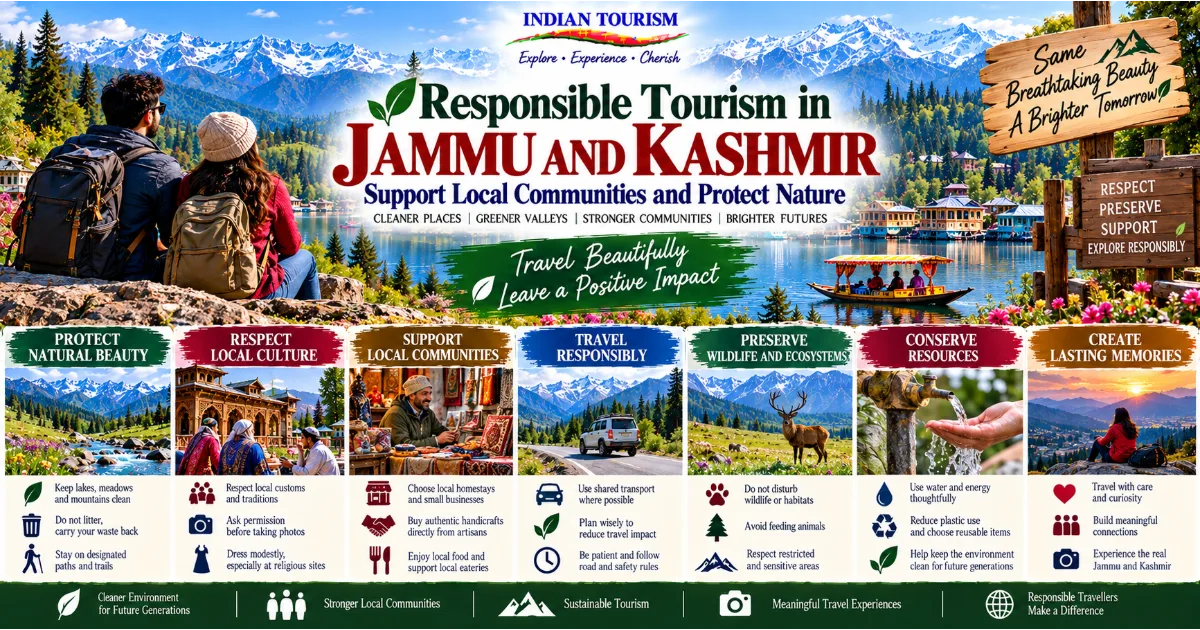
Travel Beautifully, Leave a Positive Impact
Jammu and Kashmir is one of India's most remarkable travel destinations, known for its snow-covered Himalayan peaks, tranquil lakes, green valleys, traditional villages, historic monuments and rich cultural heritage. From the houseboats of Srinagar and the meadows of Pahalgam to the mountain landscapes of Gulmarg, the countryside around Jammu and the quieter settlements of remote valleys, the region offers experiences that attract travellers throughout the year.
Yet the natural beauty and cultural richness that make Jammu and Kashmir special also create a responsibility for everyone who visits. Tourism can provide employment, support small businesses and introduce visitors to local traditions. At the same time, poorly managed tourism can increase waste, place pressure on water resources, disturb wildlife, damage sensitive landscapes and put additional demands on communities that may have limited infrastructure.
Responsible tourism offers a way to enjoy the region while reducing these negative effects. It encourages travellers to make informed decisions about transportation, accommodation, food, shopping, waste management and interactions with local residents. It also recognises that tourism should benefit the people who live in a destination rather than treating their homes and surroundings simply as attractions.
A responsible holiday does not mean giving up comfort or avoiding popular destinations. It means considering how travel choices affect the environment and the local economy. Staying in a locally operated homestay, hiring a knowledgeable local guide, respecting photography boundaries, carrying reusable items and following official instructions in sensitive areas are practical steps that can make a difference.
Responsible tourism is particularly important in mountainous regions because ecosystems, roads, water supplies and waste-management systems can be vulnerable to pressure. Weather, altitude and seasonal access also influence how visitors should plan their journeys. Travellers need to understand that the region's natural landscapes are not unlimited resources and that local communities should have a meaningful role in deciding how tourism develops.
This guide explains how to practise responsible tourism in Jammu and Kashmir, protect its natural environment, support local livelihoods, respect cultural traditions and plan a holiday that creates positive memories without leaving unnecessary damage behind.
1. Understanding Responsible Tourism
Responsible tourism means making travel decisions that consider environmental protection, cultural respect, community well-being and economic fairness. It is not limited to choosing an environmentally friendly hotel or carrying a reusable water bottle. It involves a broader understanding of how tourism affects a destination.
In Jammu and Kashmir, responsible tourism includes respecting mountain ecosystems, reducing litter in popular valleys, conserving water, following instructions in protected areas, supporting legitimate local businesses and understanding the customs of the communities that welcome visitors.
It also means being realistic about the limits of a destination. A small mountain village may not have the same waste collection, healthcare facilities or transport network as a large city. A popular lake may experience pressure during peak tourist periods. A narrow mountain road may not be suitable for heavy traffic during adverse weather.
Travellers can respond to these conditions by planning carefully, following local guidance and avoiding behaviour that increases unnecessary pressure.
Responsible tourism also recognises that every destination has its own needs. Measures that work in Srinagar may not be sufficient for a remote settlement in a high-altitude valley. Environmental challenges, infrastructure and community priorities differ across the region, so visitors should pay attention to local circumstances rather than applying a single approach everywhere.
The goal is not to make tourism disappear. Tourism can support livelihoods, encourage cultural exchange and provide reasons to preserve important landscapes. The objective is to make tourism more thoughtful, fair and sustainable over time.
2. Why Responsible Tourism Matters in Jammu and Kashmir
Protecting fragile mountain ecosystems
Mountain environments contain a range of habitats shaped by altitude, temperature, rainfall and seasonal snow. Changes in vegetation, soil and water conditions can influence the plants and animals that depend on these landscapes.
Popular meadows, riverbanks, forests and high-altitude routes can experience pressure when large numbers of visitors use the same areas without adequate management. Litter, off-trail walking, vehicle movement and careless disposal of waste can damage the environment.
Travellers can help by remaining on permitted paths, avoiding sensitive habitats, carrying their waste back and following the instructions of local authorities or site managers.
Supporting local communities
Tourism can create employment for drivers, guides, artisans, cooks, accommodation providers, shopkeepers and many other workers. When visitors purchase services from locally owned businesses, some of the economic benefits can remain within the destination.
However, tourism income does not automatically reach every household. The distribution of benefits depends on business ownership, employment practices, community participation and the way tourism is organised.
Travellers can make more informed choices by asking who operates a property, purchasing directly from local producers where practical and paying fair prices for services.
Preserving cultural heritage
Jammu and Kashmir has diverse cultural traditions reflected in its food, crafts, architecture, languages, music, festivals and everyday practices. These traditions are maintained by communities, families and skilled practitioners.
Responsible tourism allows visitors to learn about this heritage without demanding that local people perform their traditions for entertainment. It also encourages respect for religious sites, historic buildings and private spaces.
Improving the quality of the travel experience
Responsible travel can create more meaningful holidays. Instead of rushing between famous viewpoints, visitors can spend time learning about a village, exploring a local market, discovering regional food or understanding the history of a place.
A slower and more considerate approach often creates stronger connections with a destination. It also helps travellers appreciate the people and everyday activities that exist beyond the main tourist attractions.
3. Protecting the Natural Beauty of Kashmir's Lakes
Lakes are among the most recognisable features of the Kashmir Valley. Dal Lake and other water bodies attract visitors because of their scenery, houseboats, traditional boats and surrounding landscapes.
These environments are also important to the people who live and work around them. Lakes support local livelihoods and form part of the wider ecological system. Their long-term health depends on factors such as water quality, waste management, drainage, land use and the activities that take place around them.
Avoid littering near lakes and waterways
Even small pieces of plastic, food packaging and other waste can accumulate when many visitors use the same area. Wind and rain can move litter from paths and roads into nearby water.
Carry a small bag for waste and use appropriate disposal facilities. If bins are unavailable or overflowing, keep your waste with you until you can dispose of it properly.
Do not throw food scraps, plastic bottles, wrappers or cigarette ends into the water. Organic waste should not automatically be treated as harmless because it can still affect the environment and attract animals to unsuitable places.
Choose water-based activities responsibly
Visitors may enjoy boat rides, sightseeing and other activities around lakes. Select legitimate operators and follow their safety instructions.
Avoid throwing food or other materials into the water. Respect any restrictions on boating, movement or access that are in place to protect sensitive areas.
If you are staying on a houseboat, ask the operator about waste disposal and water use. Choose businesses that demonstrate responsible practices rather than assuming that every property manages its environmental impact in the same way.
Understand that lake conservation requires collective action
Travellers can reduce their own impact, but the long-term health of lakes also depends on public infrastructure, wastewater management, planning, enforcement and community participation.
Responsible visitors should avoid making exaggerated claims about the condition of a lake based on a single visit. Instead, they can support appropriate conservation efforts, follow official instructions and encourage good practices through their own behaviour.
4. Keeping Mountain Meadows and Valleys Clean
Jammu and Kashmir's meadows, forests and mountain valleys are major attractions for nature lovers. Areas around Gulmarg, Pahalgam, Sonamarg, Doodhpathri and other destinations can offer spectacular views and opportunities to spend time outdoors.
These landscapes can also be vulnerable to careless visitor behaviour. Repeated trampling may damage vegetation, while litter and poorly managed vehicle activity can affect the appearance and ecological quality of popular sites.
Stay on permitted paths
Walking on designated paths helps reduce unnecessary damage to vegetation and soil. Avoid creating new shortcuts across meadows or steep slopes, particularly where plants are recovering or the ground is unstable.
If a route is restricted, respect the restriction. A scenic viewpoint is not worth entering a hazardous or protected area without permission.
Do not leave waste behind
Carry reusable water bottles, food containers and bags where practical. Take all non-biodegradable waste back to an appropriate disposal point.
Do not bury plastic or leave it hidden under stones, vegetation or snow. Waste that appears out of sight can remain in the environment for a long time and may be exposed again when conditions change.
Avoid disturbing grazing animals
Livestock may be an important part of rural livelihoods. Keep a respectful distance from animals, do not feed them without the owner's permission and avoid blocking their movement.
Dogs and other domestic animals may also be present around villages and trails. Do not assume that every animal is comfortable with unfamiliar people.
Be considerate when using vehicles
Vehicle traffic can contribute to congestion, noise, dust and pressure on narrow roads. Where safe and practical, travellers can organise shared transport or combine nearby visits rather than making unnecessary repeated journeys.
Never park on vegetation, block access routes or ignore restrictions placed by local authorities. Follow designated parking arrangements and avoid driving onto meadows or other sensitive land.
5. Responsible Tourism in Gulmarg
Gulmarg is known for its mountain scenery, winter activities, meadows and access to high-altitude landscapes. Its popularity creates opportunities for local businesses while making careful visitor management important.
During busy periods, accommodation, transport, parking and outdoor facilities may experience high demand. Travellers should plan ahead and follow current instructions concerning weather, access, activities and safety.
Respect seasonal conditions
Winter can bring snow, low temperatures and changing visibility. Summer conditions can also change rapidly at higher elevations. Visitors should check current weather and activity information rather than assuming that conditions will remain suitable throughout the day.
Use appropriate clothing and equipment, follow the instructions of qualified activity providers and avoid attempting routes beyond your experience.
Support legitimate local services
Gulmarg provides work for many people involved in accommodation, transport, guiding and outdoor activities. Travellers should agree on prices and services before booking and choose providers who explain safety requirements clearly.
Do not hire an unqualified person for an activity that requires specialist training. A low price is not a substitute for safety, suitable equipment or reliable guidance.
Protect the landscape
Avoid littering, disturbing animals and entering restricted areas for photographs. Popular destinations can remain attractive only when visitors and operators take care of the places they use.
6. Responsible Tourism in Pahalgam
Pahalgam is known for its river scenery, surrounding mountains, forests and access to outdoor experiences. It is also a useful starting point for travellers interested in local villages and the wider landscape.
Responsible travel in Pahalgam requires attention to the river environment, mountain paths, traffic and the livelihoods of residents.
Protect rivers and streams
Do not throw waste into rivers or streams, and avoid washing with soaps or detergents in natural water bodies. Even products marketed as environmentally friendly may be unsuitable for direct use in a sensitive ecosystem.
Stay away from dangerous riverbanks, particularly when water levels are high or conditions are changing. Follow local warnings and do not attempt to cross a stream simply because it appears shallow.
Respect access arrangements
Some routes and activities may be managed through local permissions, transport arrangements or seasonal restrictions. Confirm the current rules before travelling.
Do not assume that a vehicle, guide or accommodation booking automatically grants access to every nearby attraction. Follow official instructions and avoid pressuring local workers to bypass restrictions.
Choose local experiences thoughtfully
A guided walk, a meal prepared by a local household or a visit to a legitimate artisan business can provide a meaningful way to understand the area.
Ask before entering private land or photographing residents. Remember that villages are living communities with their own routines, not simply scenic extensions of a tourist resort.
7. Supporting Local Businesses and Rural Livelihoods
One of the most practical ways to contribute to responsible tourism is to think about where your travel spending goes.
A holiday may involve accommodation, transport, food, souvenirs, outdoor activities and guided experiences. Each purchase can create an opportunity to support local workers and businesses.
Choose locally operated accommodation where suitable
Family-run guesthouses and homestays can provide income to residents and offer visitors an opportunity to learn about regional life. However, travellers should verify the property, its facilities and the legitimacy of the booking arrangement.
Local ownership alone does not guarantee good service or responsible management. Look for clear communication, fair working practices, cleanliness and respect for the surrounding community.
Hire local guides
Local guides may have knowledge of routes, weather patterns, community history and cultural practices that visitors would otherwise miss. Their expertise can also help travellers avoid unsuitable paths and understand local rules.
Before hiring a guide, clarify the route, duration, total price and services included. For demanding activities, confirm that the guide has the appropriate training and experience.
Purchase directly from artisans
Jammu and Kashmir is known for crafts that include textiles, embroidery, carpets, woodwork and other traditional products. Buying directly from a reputable artisan or a clearly identified local producer can help support skilled work.
Ask about the material, production process and origin of the item. Not every product described as traditional is made locally, and travellers should not assume that all goods sold in a tourist market have the same provenance.
Pay fair prices and avoid bargaining in a way that disregards the labour involved. A purchase can be both a meaningful souvenir and a contribution to local livelihoods.
Eat at local establishments
Traditional bakeries, family-run restaurants and local eateries can offer insight into regional food culture. They can also provide income for cooks, shopkeepers and food suppliers.
Choose establishments that appear clean and handle food safely. Ask about ingredients and preparation methods when you have dietary requirements.
8. Respecting Kashmiri and Dogra Cultural Traditions
Jammu and Kashmir has a diverse cultural landscape. Traditions differ between the Kashmir Valley, Jammu region, mountain districts and individual communities. Responsible tourism begins with recognising these differences rather than treating the region as culturally uniform.
Dress respectfully
When visiting religious sites, traditional neighbourhoods or family homes, ask about appropriate clothing. Requirements differ by location, so follow the guidance of the people responsible for the site.
Comfortable clothing is important for outdoor travel, but visitors should also consider local expectations and the nature of the place they are entering.
Follow rules at religious sites
Religious sites are places of worship and community life. Visitors should follow instructions concerning footwear, photography, entry areas and behaviour.
Avoid interrupting prayers or ceremonies to take photographs. If access is restricted to certain areas, respect those boundaries.
Ask before photographing people
A person standing in a public place has not automatically agreed to be photographed. Ask permission before taking close-up portraits, entering private courtyards or recording family activities.
Exercise particular care when photographing children. Do not publish identifiable images of people or private spaces without appropriate permission.
Learn a few local expressions
A simple greeting or a polite expression of thanks can help create a friendly interaction. Language use varies across the region, and visitors should avoid assuming that everyone speaks the same language.
If you are unsure how to pronounce a word, ask politely. Showing an interest in local language and customs is often more valuable than attempting to demonstrate knowledge you do not have.
9. Preserving Traditional Food and Culinary Heritage
Food is an important part of the cultural identity of Jammu and Kashmir. Kashmiri cuisine, Dogra food traditions, traditional breads, local beverages and seasonal home cooking all reflect the region's history and environment.
Responsible food tourism encourages visitors to explore these traditions while supporting the people who maintain them.
Discover regional food beyond famous dishes
Visitors may be familiar with Rogan Josh, Wazwan, Kahwa, Rajma Chawal and Kaladi Kulcha. Yet the region's culinary diversity extends beyond these well-known names.
Ask local hosts about seasonal vegetables, traditional breads and home-cooked dishes that are commonly eaten in their area. Food differs across households and communities, so a single restaurant menu cannot represent the entire region.
Avoid wasting food
Traditional meals can be generous, especially during celebrations or formal gatherings. Order portions that suit your appetite and ask whether smaller servings are available.
If you are staying in a homestay, communicate your preferences and dietary requirements in advance. This helps the host plan ingredients and reduces the risk of preparing food that will not be eaten.
Support responsible food producers
Purchase regional products from sellers who can explain their origin and handling. Avoid buying food items that appear poorly stored or are packaged in a way that makes safe transport difficult.
If you plan to carry food products home, check the relevant transport and customs rules. Some items may have restrictions or require particular packaging.
10. Reducing Plastic Waste During Your Holiday
Plastic waste is a concern in many tourist destinations, particularly where waste collection and disposal facilities face pressure during busy periods. Mountain locations can be especially difficult to clean because waste may be scattered across large or hard-to-reach areas.
Travellers can reduce avoidable plastic use through simple preparation.
Carry reusable essentials
A reusable water bottle, shopping bag and suitable food container can reduce the number of disposable items used during a trip. Choose items that are practical to clean and carry.
Where reliable refill facilities are available, use them. If safe drinking water is uncertain, prioritise water safety rather than refilling from an unverified source.
Avoid unnecessary packaging
Buy snacks and supplies thoughtfully, choosing options with less packaging where practical. Avoid accepting disposable cutlery, bags and cups when you do not need them.
However, do not purchase products in unsafe or unhygienic packaging merely to avoid plastic. Responsible travel requires balancing waste reduction with food safety.
Take waste back from remote locations
Do not assume that a remote meadow or mountain trail has a waste collection system. Carry rubbish until you reach a suitable disposal point.
Do not burn plastic or bury it in the ground. Burning waste can release harmful pollutants, while buried waste can remain in the environment.
Do not rely on clean-up activities alone
Participating in an organised clean-up can be useful when it is properly planned and safe. However, prevention is equally important. Avoiding litter in the first place reduces the burden on local workers and community volunteers.
11. Water Conservation in Tourist Accommodation
Water is essential for households, farms, businesses and ecosystems. In some destinations, tourism can increase demand for water, particularly during busy periods.
The availability of water varies across Jammu and Kashmir. Travellers should avoid assuming that every accommodation has the same supply conditions.
Use water thoughtfully
Turn off taps when they are not needed and avoid unnecessarily long showers. Report leaks to the accommodation provider instead of ignoring them.
These actions may seem small, but they are practical habits that can reduce avoidable waste across many rooms and properties.
Ask accommodation providers about their practices
When choosing a property, look for reasonable water-management measures and clear waste-disposal arrangements. Travellers should not expect every small homestay to have advanced infrastructure, but basic care and transparency are useful indicators.
Avoid polluting natural water sources
Do not wash clothes, use detergents or dispose of waste directly in streams and lakes. Natural water bodies may be used by people, wildlife and surrounding ecosystems.
If you are camping or trekking, follow the guidance of local authorities or qualified guides concerning sanitation and water use.
12. Wildlife Protection and Responsible Nature Experiences
Jammu and Kashmir contains varied habitats that support wildlife and plant life. Forests, wetlands, meadows and mountain environments have ecological value beyond their appeal to visitors.
Responsible wildlife tourism focuses on observation without unnecessary disturbance.
Keep a respectful distance
Do not chase, surround, touch or feed wild animals. Feeding can alter natural behaviour and may create risks for both wildlife and people.
If you encounter an animal on a trail or near accommodation, remain calm, maintain distance and follow local guidance.
Avoid disturbing habitats
Stay on permitted trails and do not remove plants, flowers, eggs, feathers or other natural materials. Certain locations may have specific restrictions to protect sensitive species or habitats.
Never enter a restricted area to obtain a better photograph. A picture is not worth damaging an ecosystem or placing yourself in danger.
Choose responsible wildlife operators
If an activity involves wildlife observation, ask how the operator manages distance, noise, group size and habitat protection.
Avoid activities that depend on harassing animals, offering food to attract them or forcing them into close contact with visitors.
Respect seasonal restrictions
Some areas may have restrictions during breeding seasons, periods of high fire risk or other environmentally sensitive times. Follow current instructions rather than relying on information from an old travel account.
13. Responsible Trekking and Mountain Activities
Trekking and outdoor activities can provide some of the most memorable experiences in Jammu and Kashmir. They also require preparation, respect for the environment and awareness of personal limits.
Choose routes according to your ability
Select a route that matches your fitness, experience and available time. A trail that appears manageable on a map may involve steep climbs, loose surfaces, altitude changes or unpredictable weather.
For unfamiliar or demanding routes, consider a qualified local guide. Confirm that the route is permitted and that the guide has appropriate experience.
Check weather and access conditions
Mountain weather can change quickly. Rain, snow, strong winds, low visibility and falling temperatures can make an otherwise manageable route hazardous.
Check current local conditions before leaving and be prepared to postpone the activity. Follow any closures or warnings issued by the relevant authorities.
Carry suitable equipment
Footwear, warm layers, rain protection, water, food and basic emergency supplies should match the route and season. More demanding activities may require specialised equipment and training.
Do not assume that equipment can always be rented at the starting point. Confirm availability before travelling.
Leave no trace
Carry all waste back with you and avoid damaging vegetation. Do not carve names into trees, disturb rocks or create unnecessary campsites.
If camping is permitted, use designated areas where available and follow local rules for fires, sanitation and waste. Never light a fire in a prohibited or unsafe location.
14. Responsible Winter Tourism
Winter can transform parts of Jammu and Kashmir into landscapes of snow, ice and dramatic mountain scenery. Visitors may travel for snow experiences, winter sports and seasonal photography.
Responsible winter tourism requires special attention to safety, weather and environmental pressure.
Prepare for cold conditions
Choose clothing suitable for expected temperatures and wind. Confirm the heating arrangements at your accommodation and whether essential services will remain available during your stay.
Do not assume that every rural property has central heating or uninterrupted electricity. Ask specific questions before booking.
Follow qualified activity providers
For skiing, snowboarding and other specialist activities, use reputable providers and appropriate equipment. Beginners should receive suitable instruction rather than attempting difficult terrain independently.
Follow restrictions concerning slopes, lifts, routes and weather conditions. Do not enter closed areas to obtain photographs.
Avoid unsafe roadside stops
Snow-covered roads and reduced visibility can create risks for drivers and pedestrians. Stop only where parking is permitted and safe.
Never block emergency access or stand in a dangerous position on a narrow road for a photograph. Allow sufficient time for journeys and avoid pressuring drivers to continue in unsafe conditions.
15. Responsible Summer Tourism and High-Season Travel
Summer is a popular period for many destinations in Jammu and Kashmir. More visitors can bring increased business for accommodation providers, restaurants, transport operators and local shops.
At the same time, peak periods may create congestion, higher demand for water and accommodation, and pressure on popular viewpoints and walking routes.
Book ahead and plan realistically
Reserve accommodation and necessary transport in advance where possible. Confirm the location, cancellation policy and facilities rather than relying only on promotional photographs.
Avoid building an itinerary that requires rushing between multiple distant destinations every day. A more manageable schedule can reduce unnecessary vehicle journeys and allow more time to appreciate each place.
Be patient in crowded areas
Follow parking instructions, queue where required and respect barriers. Do not push into restricted viewpoints or enter private property to avoid crowds.
If a destination is particularly busy, consider visiting at a quieter time or selecting another suitable attraction. The aim is to enjoy the region without adding to avoidable congestion.
Choose activities with care
Outdoor activities should be selected according to weather, fitness and available safety arrangements. Do not assume that a popular destination is automatically safe for every activity.
Ask local operators about conditions and follow official guidance.
16. Choosing Responsible Accommodation
Accommodation is an important part of a traveler's environmental and social impact. Hotels, guesthouses, houseboats and homestays differ in how they use resources, manage waste and interact with their surrounding communities.
Look beyond promotional claims
Terms such as green, eco-friendly and sustainable can be used broadly. Rather than relying only on labels, look for practical information about waste disposal, water use, energy management and local employment.
A small property may use simple but sensible measures, while a larger hotel may have more developed systems. The relevant question is whether the business manages its impact responsibly and communicates honestly.
Respect the host's property
In a homestay, guests are sharing a living environment with a family or staying in accommodation closely connected to the household. Respect privacy, follow agreed rules and avoid wasting food, water or electricity.
Ask before entering areas that are not part of the guest accommodation. Do not assume that access to a garden, kitchen or private courtyard is automatically included.
Confirm essential facilities
Responsible travel does not require sacrificing personal safety or basic comfort. Confirm heating, bathroom arrangements, accessibility, meal options and transport before booking.
For remote stays, ask about emergency arrangements and the availability of essential services. Choose accommodation that meets your needs rather than selecting a property solely because it uses environmentally friendly language.
17. Responsible Shopping and Traditional Handicrafts
Traditional crafts are an important part of the cultural and economic life of Jammu and Kashmir. Visitors may encounter textiles, embroidery, carpets, woodwork, decorative objects and other products associated with regional craftsmanship.
Buying these products can support artisans, but responsible shopping requires attention to origin, quality and fair pricing.
Ask about the product
Ask the seller what material is used, how the item is made and where it comes from. Some products may be handmade locally, while others may be manufactured elsewhere or produced using different techniques.
A seller who can explain the product clearly can help you make a more informed purchase, although a detailed explanation alone does not guarantee authenticity.
Pay fair prices
Handmade products can involve considerable labour and skill. Bargaining is common in some markets, but it should not become an attempt to obtain skilled work at an unreasonable price.
If you are uncertain about value, compare products from several reputable sellers and ask questions before making a decision.
Avoid illegal or environmentally harmful souvenirs
Do not purchase products made from protected wildlife, illegal natural materials or other restricted items. If you are uncertain about a product's origin or legality, choose a safer alternative.
Consider buying smaller items that are easy to transport and likely to be used rather than purchasing souvenirs that may be discarded after the holiday.
18. Understanding the Role of Local Communities
Responsible tourism works best when local communities have a meaningful voice in decisions about tourism development. Residents understand the practical challenges of their surroundings and may have valuable knowledge about environmental conditions, local history and cultural priorities.
Visitors can support community participation by choosing local services, respecting community rules and listening to local guidance.
However, one should not assume that every resident has the same opinion about tourism. Some households may depend heavily on visitor spending, while others may experience noise, congestion or pressure on resources without receiving direct economic benefits.
The effects of tourism can also change over time. A business that benefits from additional visitors may face new costs when roads become congested or waste management becomes more difficult.
Travellers should therefore avoid simplistic assumptions that tourism is always beneficial or always harmful. Its effects depend on how it is planned, managed and shared.
Supporting responsible businesses, respecting local concerns and following rules are practical ways for visitors to contribute positively. Tourism development should be evaluated not only by visitor numbers but also by its effects on livelihoods, cultural continuity, environmental health and quality of life.
19. Responsible Photography and Social Media Sharing
Photographs help travellers remember their experiences and introduce others to Jammu and Kashmir. However, sharing images responsibly requires attention to privacy, safety and the effect of publicity on sensitive places.
Ask permission before taking portraits
Respect people's decisions about photography. Ask before taking close-up portraits or recording residents in their homes, workplaces or places of worship.
Do not photograph children without appropriate permission from their parent or guardian. Avoid sharing private family details alongside images.
Avoid revealing sensitive locations
Not every location needs to be promoted widely. If a place is ecologically fragile, privately owned or subject to access restrictions, consider whether sharing its precise location could encourage harmful visitor pressure.
Follow the guidance of local authorities and site managers concerning photography and location sharing.
Represent places honestly
Avoid presenting a carefully selected photograph as proof that an entire destination is untouched, empty or free from environmental problems. A single image rarely captures the full complexity of a place.
When sharing an experience, provide context and avoid making unsupported claims about local culture or environmental conditions. Respectful storytelling can encourage interest in the region without misrepresenting its people.
Do not risk safety for a photograph
Avoid standing near unstable edges, entering rivers, climbing restricted structures or stopping in dangerous road locations for photographs.
If weather or local instructions make photography unsafe, put the camera away. A memorable image is never worth a serious injury.
20. Transportation Choices and Reducing Travel Impact
Transportation is an important part of a holiday's environmental footprint. In a mountainous region, vehicle use also affects congestion, road safety, noise and the experience of people living along busy routes.
Travellers can reduce unnecessary travel by planning a practical itinerary and choosing suitable transport options.
Combine nearby activities
Rather than making separate journeys for attractions that are close together, group visits by area where practical. This can save time, reduce fuel use and leave more time for the destination itself.
A sensible itinerary should still account for road conditions, opening schedules and the needs of the people travelling with you.
Consider shared transport
Where reliable and safe services are available, shared transport can reduce the number of individual vehicles required for a journey. Public transport may also be suitable for some routes, depending on schedules and accessibility.
For remote destinations, private transport may be necessary. In such cases, plan journeys efficiently and use legitimate operators.
Avoid pressuring drivers
Mountain driving can be demanding, especially during rain, snow, darkness or congestion. Do not ask a driver to speed, overtake dangerously or continue when conditions are unsafe.
Allow enough time for transfers and keep important appointments flexible where possible. Safety should take priority over a tightly packed sightseeing schedule.
21. Responsible Tourism for Families
Families can introduce children to responsible travel through simple habits and practical examples. A holiday can become an opportunity to learn about nature, cultural diversity and the importance of respecting other people.
Teach children to protect nature
Encourage children to carry their waste, remain on permitted paths and avoid disturbing plants and animals. Explain why littering is harmful rather than treating these rules as arbitrary restrictions.
Encourage cultural curiosity
Children can learn about regional food, architecture, crafts and local languages through respectful conversations and age-appropriate activities.
Remind them to ask before taking photographs and to respect private spaces. Cultural curiosity should never become an excuse to disturb residents.
Plan for comfort and safety
Choose activities that match children's ages and abilities. Confirm accommodation facilities, meal options, transport arrangements and access to medical services where necessary.
Mountain weather can change quickly, so carry appropriate clothing and avoid routes that exceed the family's experience.
22. Responsible Tourism for Solo Travellers and Couples
Solo travellers and couples can also make a positive contribution through careful planning and respectful choices.
Solo travellers
Solo visitors should confirm accommodation and transport, share their itinerary with a trusted person and follow current local safety advice. For remote walks or unfamiliar mountain routes, a suitable local guide may provide valuable assistance.
Respect local customs and avoid assuming that a destination is safe simply because other travellers have visited it. Conditions and access arrangements can change.
Couples
Couples may choose a combination of hotels, homestays and rural accommodation. Before booking, confirm privacy, facilities and the expectations of the host.
Responsible travel includes respecting the household and community, particularly when staying in a traditional village. Ask about local customs rather than assuming that practices are identical across the region.
Both groups
Whether travelling alone or with a partner, avoid wasteful spending, support local businesses where practical and follow environmental instructions.
A responsible journey is not defined by the number of activities completed. It is defined partly by how thoughtfully those activities are chosen and how visitors behave while enjoying them.
23. A Seven-Day Responsible Tourism Itinerary for Jammu and Kashmir
A week can provide an introduction to responsible travel in the region, although it is not enough to explore every destination. The following example focuses on a manageable pace and a combination of cultural, natural and community-based experiences.
Day One: Arrive in Srinagar
Arrive in Srinagar and settle into verified accommodation. Spend the day exploring suitable local attractions and learning about the city's cultural heritage.
Choose a locally operated restaurant where possible, avoid unnecessary disposable items and confirm transport arrangements for the following days.
Day Two: Explore the Lake and Local Markets
Explore the lake area using legitimate operators and follow all boating and safety instructions. Avoid throwing waste into the water and respect any restrictions on access.
Visit a local market or traditional bakery, asking permission before photographing people or working areas. Purchase products thoughtfully and avoid items whose origin or legality is uncertain.
Day Three: Discover Regional Food and Culture
Spend time learning about Kashmiri cuisine, traditional breads and beverages. If a suitable local cooking experience is available, arrange it through a reputable host.
Use the day to understand the difference between everyday home cooking and ceremonial food traditions. Avoid wasting food and communicate dietary requirements clearly.
Day Four: Travel to Pahalgam or Another Suitable Destination
Travel to a suitable destination after checking current road conditions and local guidance. Choose accommodation that meets your needs and provides clear information about facilities.
Spend the afternoon enjoying permitted outdoor areas, respecting the landscape and carrying waste back with you.
Day Five: Explore the Countryside Responsibly
Arrange a guided walk or another appropriate local experience. Ask permission before entering private land, and avoid disturbing animals or vegetation.
Consider a meal at a locally operated establishment and learn about regional food or village traditions through respectful conversation.
Day Six: Return to Srinagar or Explore a Nearby Area
Keep the itinerary flexible according to weather, transport and your interests. Rather than adding a long and unnecessary journey, consider a nearby attraction or a slower day.
Use the opportunity to purchase authentic local crafts from reputable sellers and support small businesses through fair transactions.
Day Seven: Departure
Allow sufficient time to reach your departure point. Dispose of waste responsibly, leave accommodation in good condition and thank local hosts and service providers.
The itinerary can be adapted for families, couples, solo travellers and nature enthusiasts. Its main principle is to travel at a manageable pace, follow local guidance and leave the places visited in good condition.
24. A Practical Responsible Traveller's Checklist
Before travelling, confirm accommodation, transport, current weather information and any relevant access requirements. Research the facilities available at remote destinations and avoid assuming that every location has the same services.
During the trip, carry reusable essentials, minimise unnecessary packaging, conserve water and follow local instructions. Ask permission before photographing residents or entering private property, and treat local workers fairly.
When exploring nature, remain on permitted paths, avoid disturbing wildlife and take all waste to an appropriate disposal point. Do not enter restricted areas or continue an activity when conditions are unsafe.
When shopping, ask about product origins, support reputable local businesses and avoid goods made from protected wildlife or restricted materials.
After the holiday, reflect on what worked well and share useful information responsibly. If you recommend a destination, encourage visitors to follow local rules and respect the communities that live there.
These habits do not require a perfect traveller. They require awareness, preparation and a willingness to make better choices whenever practical.
Conclusion: Leave Jammu and Kashmir Better Respected, Not More Burdened
Responsible tourism in Jammu and Kashmir is about understanding the relationship between travel, nature, culture and local livelihoods. The region's lakes, meadows, rivers, forests, villages and historic places are valuable not only because visitors enjoy them, but also because they are part of the environment and daily life of the people who live there.
Every traveller can contribute through practical decisions. Carrying waste instead of littering, conserving water, choosing suitable local services, respecting cultural boundaries and following official safety instructions are small actions that can collectively improve the quality of tourism.
Supporting local businesses also matters. Fair payment for accommodation, transport, guiding, food and handicrafts can help tourism benefits reach more people. At the same time, visitors should recognise that local communities have different needs and that tourism should respect their right to privacy, cultural continuity and a healthy environment.
Responsible tourism is not a demand for a flawless holiday. It is an approach based on care, fairness and informed choices. Sometimes it means taking a shared vehicle. Sometimes it means postponing a mountain excursion because the weather is unsafe. Sometimes it means choosing a local homestay, asking permission before taking a photograph or simply carrying a piece of waste back from a beautiful meadow.
The best travel memories are those that combine enjoyment with respect. When visitors appreciate local traditions, protect natural surroundings and treat residents as partners rather than attractions, their journey becomes more meaningful.
Jammu and Kashmir deserves to be explored with curiosity and care. Its landscapes and cultural traditions can continue to inspire future generations when tourism is managed responsibly and visitors understand their role in protecting what makes the region special.
Travel to discover, travel to learn and travel in a way that gives something back. Let every journey through Jammu and Kashmir be an opportunity to appreciate its beauty while helping preserve its natural and cultural heritage for the people who call it home and the travellers who will arrive in the years ahead.
#IndianTourism #JammuAndKashmir #ResponsibleTourism #SustainableTravel #EcoTourism #KashmirTravel #JammuTravel #ProtectNature #SupportLocalCommunities #ResponsibleTravel #CulturalHeritage #MountainTourism #LeaveNoTrace #ExploreIndia
