
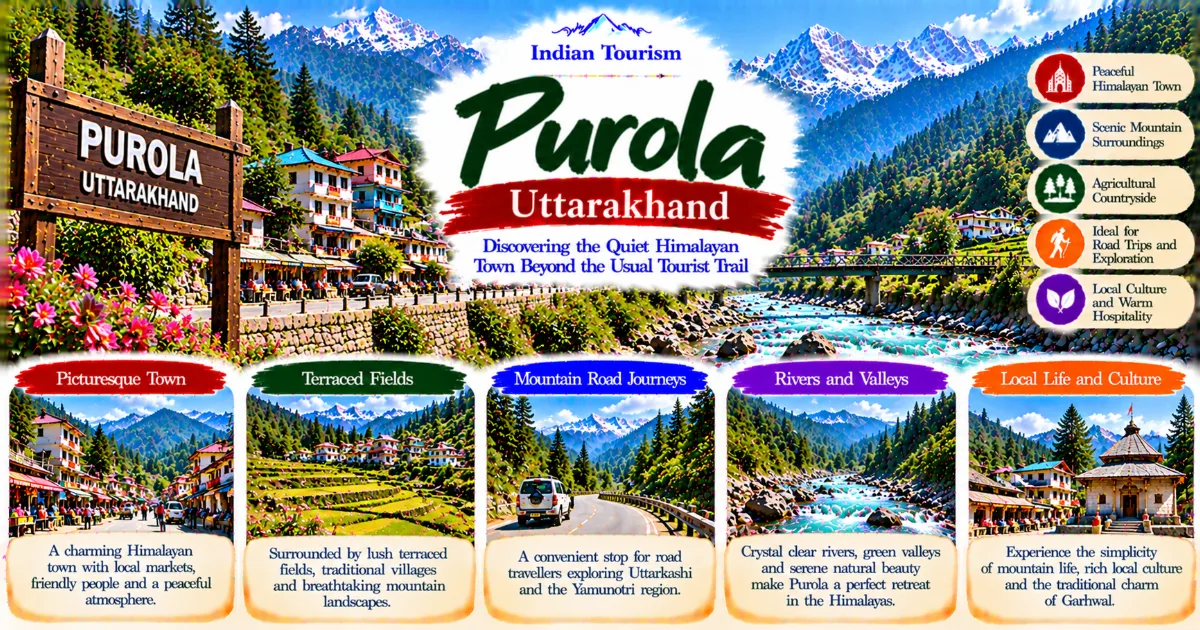
A Different Side of Uttarakhand
Uttarakhand is often associated with famous destinations such as Mussoorie, Nainital, Auli, Rishikesh, and the sacred Char Dham pilgrimage sites. These places attract travellers for their dramatic mountain views, religious significance, adventure activities, and established tourism facilities. Yet, beyond the best-known destinations lies another side of the state, where everyday Himalayan life continues at a gentler pace. Small towns, agricultural settlements, forested slopes, and winding mountain roads reveal a quieter landscape that many visitors pass without fully exploring.
Purola, located in the Uttarkashi district of Uttarakhand, offers an opportunity to experience this less familiar side of the Garhwal Himalayas. Rather than presenting itself as a conventional holiday resort, Purola is a regional town connected with the surrounding countryside. Its appeal lies in the relationship between settlement, agriculture, mountain scenery, local markets, and the everyday routines of people living in the upper Yamuna region.
For travellers exploring the western Garhwal Himalayas, Purola can be considered a destination for understanding the region beyond its famous pilgrimage routes. It is particularly suitable for people who enjoy road journeys, rural landscapes, local food, photography, and observing the cultural character of smaller Himalayan settlements. A visit here does not need to be filled with a long checklist of attractions. The experience can instead be built around discovering the town, travelling through the countryside, appreciating the surrounding mountains, and taking time to understand the local environment.
Purola is not a substitute for a high-altitude trekking destination or a developed hill station. Its value is different. It offers a glimpse of the lived-in Himalayas, where roads serve local communities, fields remain part of the landscape, and the rhythm of the day is influenced by weather, farming, transport, and the changing seasons.
Where Is Purola Located?
Purola is a town in Uttarkashi district in the Garhwal region of Uttarakhand. The district includes several well-known destinations associated with Himalayan pilgrimage, mountain scenery, trekking, and traditional settlements. Purola belongs to the wider western Garhwal landscape, an area shaped by mountain valleys, forested hillsides, agricultural land, and rivers that flow through the Himalayan terrain.
The town is connected by road with other settlements in the region and serves local residents travelling for markets, education, services, and transport. This practical role is important to understanding its character. Purola is not simply a scenic location created for visitors. It is a functioning town whose importance comes from its relationship with the surrounding villages and countryside.
The journey towards Purola introduces travellers to the changing geography of the region. Depending on the route, the landscape may include steep hillsides, cultivated slopes, roadside settlements, forest patches, and distant mountain ridges. The road itself becomes part of the travel experience, especially for people who enjoy watching the scenery change gradually rather than reaching a destination through a short transfer.
Because the terrain is mountainous, travel times can vary considerably. Road conditions, weather, landslides, traffic, and seasonal maintenance can influence a journey. Visitors should therefore plan their route using current local information instead of relying only on estimated distances or old travel schedules.
Purola is best approached as a regional base for exploring its surroundings rather than as a place where every attraction is concentrated within a compact tourist centre. Travellers who appreciate this distinction will be better prepared to enjoy the town without expecting the infrastructure or entertainment options of a major holiday destination.
The Landscape Around Purola
The natural appeal of Purola comes from its setting within the mountainous terrain of Uttarkashi district. The surrounding region includes slopes, valleys, forested areas, cultivated land, and settlements that follow the shape of the landscape. These elements create a visual environment that changes with the season and the weather.
Unlike a destination defined by a single famous viewpoint, the countryside around Purola can be appreciated through movement and observation. A drive along a mountain road may reveal terraced fields, houses set along slopes, narrow streams, trees growing around agricultural plots, and ridges appearing through the morning mist. The scenery can be especially attractive when clouds move across the hills and sunlight falls unevenly on different sections of the valley.
The mountains also influence how settlements are built. Roads follow available contours, houses occupy relatively suitable ground, and agricultural plots are shaped by the slope. The resulting landscape is not entirely wild or entirely developed. It is a combination of natural terrain and generations of human adaptation.
For photographers, this mixture can be more interesting than a single dramatic panorama. A photograph of cultivated fields beside a mountain road, a small market opening in the morning, or a village house against a forested slope may communicate more about the region than a wide landscape photograph alone.
Visitors should remember that the appearance of the mountains varies with visibility. On clear days, distant ridges may be sharply defined. During cloudy weather, the same hills can become layered silhouettes, while mist may partially conceal the surrounding landscape. These changing conditions are part of the Himalayan experience and should not automatically be regarded as a disappointment.
The most rewarding approach is to allow time for the surroundings rather than trying to find a spectacular viewpoint at every turn. In places like Purola, the landscape often reveals its character through smaller details.
A Town Connected to the Surrounding Villages
One of the most useful ways to understand Purola is to observe its relationship with the villages around it. Small Himalayan towns frequently function as service and trading centres for nearby rural settlements. Residents may visit the town to purchase household necessities, access services, meet relatives, attend appointments, or continue their journeys to other parts of the district.
This connection between town and countryside gives Purola a character that differs from that of a destination built mainly around hotels and sightseeing. Its streets and markets are part of everyday life. Shops serve residents as well as visitors, vehicles transport people and goods, and public spaces are shaped by practical needs.
Travellers can learn a great deal simply by spending some time in the local market. The arrangement of shops, the movement of people, and the kinds of goods available offer clues about the economy of the surrounding region. Agricultural produce, groceries, clothing, household supplies, and other everyday items may be more representative of the town than souvenir shops or tourist attractions.
Visitors should approach these spaces respectfully. A local market is not a performance arranged for outsiders. People are working, shopping, travelling, and managing their daily responsibilities. Asking permission before photographing individuals, keeping entrances clear, and avoiding intrusive behaviour are simple ways to show consideration.
The relationship between Purola and its surrounding settlements also makes it useful for travellers interested in rural tourism. Rather than limiting a visit to the main town, they can explore nearby areas where roads, fields, homes, and natural features reveal different aspects of mountain life. Such excursions should be planned with attention to road conditions and local access, especially where smaller roads lead into villages.
Agriculture and the Himalayan Countryside
Agriculture remains an important part of life in many Himalayan settlements, and the countryside around Purola provides an opportunity to appreciate how farming fits into a mountainous environment. The amount of level land available for cultivation is often limited, so fields may be arranged along slopes or in stepped patterns where the terrain permits.
Terraced agriculture is one of the most recognisable features of many Himalayan landscapes. By creating relatively level surfaces on hillsides, farmers can cultivate land that would otherwise be difficult to use. The appearance of these fields changes throughout the year, depending on planting, growth, harvesting, rainfall, and the crops being cultivated.
For visitors, the agricultural landscape can be especially rewarding during periods when the fields are green and the surrounding hills are clearly visible. Other seasons reveal different colours and textures. Recently cultivated land may appear brown and earthy, while harvested fields can expose the structure of the terraces and the paths connecting them.
The countryside is also a reminder that beautiful rural landscapes require work. Maintaining fields, managing water, transporting produce, and looking after livestock can demand considerable effort in mountainous conditions. Roads and weather influence how easily goods reach markets, while the steep terrain can make even short distances physically demanding.
Travellers should avoid walking through cultivated plots without permission or treating private agricultural land as an unrestricted sightseeing area. Paths that appear open may serve as access routes for residents or farmers. If visitors wish to learn more about farming practices, a respectful conversation with local residents, when they have time to talk, is more appropriate than assuming access to private property.
A visit to Purola can therefore become more meaningful when agriculture is viewed not merely as scenery but as part of the region's economy, culture, and relationship with the land.
Experiencing Local Culture and Everyday Life
The cultural character of Purola is best approached through its everyday routines rather than through expectations of staged tourist activities. The town and surrounding countryside belong to the wider Garhwali cultural region, where language, food, family traditions, religious practices, seasonal work, and relationships with neighbouring settlements all contribute to local identity.
The experience of a smaller Himalayan town often comes from observing ordinary details. A morning walk may reveal shopkeepers preparing for the day, residents collecting supplies, vehicles arriving from nearby settlements, and people meeting acquaintances in familiar places. These scenes are not necessarily listed in travel guides, but they provide an authentic sense of how a town functions.
Food can also offer an introduction to regional culture. Uttarakhand has a varied culinary tradition shaped by local ingredients, agricultural conditions, climate, and household practices. Travellers may encounter simple meals prepared for residents and people passing through the area. Availability will vary, so visitors should ask locally about suitable places to eat rather than expecting a fixed list of tourist restaurants.
Regional dishes across Uttarakhand can include preparations made with lentils, seasonal vegetables, grains, and local herbs. However, a visitor should not assume that every traditional dish is available in every town or at every time of year. Asking what is freshly prepared can be a practical way to discover local food.
Respect for local customs is equally important. Clothing should be appropriate for the setting, religious spaces should be approached with consideration, and photography should be guided by consent. Visitors who take an interest in local life without demanding special treatment are more likely to have positive interactions.
The purpose of cultural exploration is not to collect photographs of people or reduce a place to a handful of stereotypes. It is to recognise that each settlement has its own routines, priorities, and history. Purola offers an opportunity to practise this slower and more attentive style of travel.
Purola for Road Trip Enthusiasts
For travellers who enjoy road journeys, Purola can form part of an exploration of the western Garhwal region. Mountain roads offer a constantly changing view of the terrain, from built-up stretches near towns to quieter sections surrounded by slopes and vegetation.
The pleasure of such a journey is often found in the transitions between places. A road may pass through a busy settlement, follow a hillside, open briefly to a valley view, and then enter another cluster of houses. These changes help visitors understand the relationship between geography and settlement patterns.
Road trips in the Himalayas require a different approach from journeys across flat plains. Distances alone do not provide a reliable measure of travel time. Sharp bends, narrow stretches, roadworks, weather, and traffic can slow progress. Drivers should avoid rushing to meet unrealistic schedules and should stop only where parking is safe and permitted.
Before leaving, travellers should check the condition of their intended route, fuel availability, local transport options, and accommodation arrangements. Mobile connectivity can vary in mountainous areas, so downloading essential maps and keeping important information available offline can be useful. Carrying drinking water, suitable clothing, basic medicines, and some cash can also make a journey more comfortable.
The best road-trip itinerary leaves room for unexpected delays and unplanned stops. A viewpoint may be hidden by clouds, a road section may take longer than expected, or a village market may offer an interesting opportunity to pause. Flexible planning makes it easier to enjoy the journey without turning every delay into a problem.
Purola is particularly suitable for travellers who value the road itself as part of the holiday. The destination can be appreciated through the surrounding countryside, the pace of the journey, and the chance to observe the region beyond its most famous landmarks.
Photography Around Purola
Photography in and around Purola does not need to depend on dramatic peaks or famous monuments. The region offers a range of subjects for travellers interested in landscapes, rural life, architecture, and travel documentation.
Wide landscape photographs can capture the relationship between the town, the surrounding slopes, and the distant hills when visibility is good. A longer lens can help isolate details such as terraced fields, houses along a hillside, or layers of mountain ridges. During misty conditions, photographers may prefer softer compositions that emphasise depth and atmosphere.
Village and market photography requires more sensitivity. Buildings, shopfronts, roads, and everyday objects can be photographed where permitted, but people should not be treated as automatic subjects. Ask before taking close-up portraits, particularly of children, workers, or anyone engaged in a private activity.
The changing light throughout the day creates different opportunities. Early morning may provide quiet streets and softer light, while later daylight can reveal more detail in the landscape. Clouds and rain can alter colours quickly, so protecting camera equipment and mobile phones from moisture is important.
Travellers should also consider the practical safety of taking photographs beside mountain roads. Stopping on blind bends, standing close to moving traffic, or stepping onto unstable ground for a better angle can create unnecessary risks. A photograph is never worth compromising personal safety or inconveniencing local residents.
For a meaningful travel collection, combine broad scenery with small details. A road curving through the hills, a field bordered by stonework, a local shop, or a view from a quiet roadside stop can help tell the story of Purola more effectively than a collection of similar mountain panoramas.
Best Time to Visit Purola
The best time to visit Purola depends on the type of experience a traveller wants and the prevailing road and weather conditions. In the Himalayan region, seasons can differ significantly from one valley to another, so visitors should confirm local conditions before departure.
Spring can bring fresh greenery and a gradual change in the landscape after winter. Temperatures vary with elevation and weather, but this period may suit travellers who enjoy countryside scenery and relatively mild conditions. It is sensible to carry layers because mornings and evenings can feel cooler than the middle of the day.
Summer is often a practical period for exploring many lower and middle Himalayan settlements. The weather can be pleasant compared with the heat of the plains, although rain and local road conditions still need attention. This season can also coincide with increased movement on pilgrimage routes across Uttarakhand, which may affect traffic and accommodation availability in some areas.
The monsoon season requires additional caution. Heavy rainfall can cause landslides, road damage, falling rocks, and interruptions to transport in mountainous terrain. Travellers should check official advisories and local reports before setting out. If conditions are unsafe, changing the itinerary or postponing the journey is the sensible choice.
Autumn can offer clear skies and attractive mountain views when the weather is favourable. It may be a good time for road journeys and landscape photography, although temperatures can fall noticeably after sunset as winter approaches.
Winter brings colder conditions, and the experience depends on local elevation, weather, and road accessibility. Visitors should not assume that every route remains easy to travel throughout the season. Warm clothing, flexible schedules, and current local information are essential.
There is no single perfect month for every visitor. Those who prioritise comfortable road travel may choose a period with more stable conditions, while photographers may prefer the seasonal changes in greenery, cloud formations, and mountain visibility. Safety and access should always take priority over a preferred travel date.
How to Reach Purola
Purola can be reached by road from other parts of Uttarakhand, but the most suitable route depends on the traveller's starting point and current road conditions. People arriving from Dehradun, Rishikesh, or other towns should plan the journey around the mountain roads and allow sufficient time for stops and unexpected delays.
Travellers using public transport should confirm current bus and shared-taxi services locally. Schedules in smaller Himalayan towns may be less frequent than services on major routes, and availability can change according to season and demand. It is wise to establish the return journey or onward connection before relying on a particular service.
Visitors travelling by private vehicle should check the route in advance and avoid driving unfamiliar mountain roads after a long day of travel. Daylight driving is generally preferable because visibility is better and road features are easier to assess. Drivers should use lower speeds on bends, avoid overtaking where sightlines are limited, and be prepared to yield on narrow sections.
If travelling during the monsoon or after heavy rain, check for road closures and weather warnings before leaving. Conditions can change quickly, and a route that was open earlier may become difficult or unsafe later in the day.
Air travellers will generally need to combine a flight to an airport serving the region with onward road transport. Rail travellers will similarly need to continue by road from an appropriate railway station. Exact travel times and connections should be checked against current schedules rather than treated as fixed.
Because Purola is a functioning regional town, it is sensible to plan accommodation and transport according to the needs of the entire journey. Visitors should not assume that every service will be available late at night or that onward vehicles can always be arranged at short notice.
Where to Stay and What to Expect
Accommodation planning for Purola should be based on the type of journey being undertaken. Travellers may use the town as an overnight stop, a base for exploring nearby countryside, or part of a longer road trip through Uttarkashi district. The most suitable choice will depend on availability, budget, transport access, and desired comfort.
Visitors should check current accommodation options before arriving, particularly during busy travel periods. It is useful to confirm the room arrangement, hot water availability, meal options, parking, check-in time, and payment methods directly with the property. Smaller towns may have fewer choices than major tourist centres, so advance planning can prevent unnecessary inconvenience.
Travellers seeking luxury resorts, extensive nightlife, or a large range of organised tourist activities may find Purola less suited to their expectations. Its appeal is more closely connected with regional travel, everyday town life, and access to the surrounding landscape.
A practical packing list should include clothing suitable for changing temperatures, comfortable walking shoes, a light rain layer when appropriate, personal medicines, and a torch or charged phone for use in the evening. Travellers should also carry enough essential supplies for the day's journey, especially if they plan to explore roads beyond the main town.
It is worth asking accommodation providers about local road conditions and the most practical places to visit nearby. Residents often have more recent information than general travel descriptions, especially after rain or during seasonal changes.
A comfortable stay in Purola does not require an elaborate itinerary. A clean room, a reliable meal, a safe place to park, and enough time to explore the surrounding region may be all that is needed for a rewarding visit.
Responsible Tourism in the Himalayan Region
Responsible tourism is particularly important in mountain destinations, where ecosystems can be sensitive and local infrastructure may have limited capacity. Travellers visiting Purola and its surroundings should try to minimise their environmental impact and respect the needs of the communities that live there.
Waste management is a practical starting point. Carry reusable water bottles where safe drinking water is available, avoid leaving packaging behind, and take rubbish back to places where it can be disposed of properly. Roadsides, streams, fields, and forest edges should never be treated as convenient dumping grounds.
Water should also be used thoughtfully. Mountain settlements depend on local water systems, and availability can vary by season. Visitors should avoid unnecessary wastage and follow any local guidance about drinking water and sanitation.
Respect for private land matters just as much as environmental care. Fields, orchards, homes, and village paths may look picturesque, but they serve real purposes. Ask permission before entering private property, avoid damaging crops, and do not remove plants or other natural materials as souvenirs.
Supporting local businesses can help keep the benefits of tourism within the region. Purchasing supplies from local shops, using legitimate local accommodation, and choosing local services where suitable are simple ways to contribute to the local economy. Travellers should still compare services fairly and make choices that suit their needs.
Responsible travel also means being realistic about risk. Do not enter closed roads, cross swollen streams, or continue towards an exposed viewpoint during dangerous weather. Follow instructions from local authorities and emergency personnel.
The most meaningful way to visit a place like Purola is to leave it as undisturbed as possible. Tourism should allow visitors to appreciate the region without making daily life more difficult for the people who call it home.
A Suggested Two-Day Purola Itinerary
A two-day visit can provide a gentle introduction to Purola and the surrounding countryside, provided that road access and local conditions are suitable.
On the first day, arrive with enough daylight remaining to settle into your accommodation and explore the town at an unhurried pace. Walk through accessible market areas, observe the daily rhythm of the settlement, and identify places where you can eat or purchase essential supplies. Rather than searching immediately for a major attraction, allow the town itself to introduce the character of the region. In the evening, keep the schedule simple and prepare for the following day's excursion.
On the second day, set aside time for a road journey through the nearby countryside. The exact route should be selected with local advice, taking account of road quality, weather, travel time, and permission to access any village areas. Stop at safe and permitted locations to appreciate the landscape, photograph the hills, or learn about the agricultural surroundings. If a local market or community event is taking place, observe respectfully and avoid interfering with residents' activities.
Return to Purola with sufficient time before dark, particularly if the route includes narrow or unfamiliar mountain roads. Use the remainder of the day for a meal, a final walk through accessible parts of town, and preparation for the onward journey.
This itinerary is intentionally flexible. It does not depend on a long list of attractions or assume that every nearby location is accessible. The aim is to experience the town and its countryside without rushing or creating unnecessary pressure on local infrastructure.
Travellers with additional time can extend the journey into a broader exploration of Uttarkashi district, but they should research each proposed destination separately and avoid treating all mountain roads as interchangeable.
Who Should Visit Purola?
Purola is likely to appeal most to travellers who value quiet exploration over a highly structured holiday. People interested in road trips, rural landscapes, local markets, photography, and the everyday culture of Himalayan settlements may find it rewarding.
It can also suit travellers who want to understand Uttarakhand beyond its most widely advertised destinations. A small town provides a different perspective from a pilgrimage centre or a purpose-built hill station. It shows how people live and work in a mountainous environment, how rural settlements connect with regional services, and how the landscape influences ordinary routines.
Photographers may appreciate the variety of subjects available across the town and countryside. Slow travellers can enjoy spending time in one place instead of changing hotels every night. Families who are comfortable with mountain road travel may also find the area interesting, provided they plan around the needs of all travellers and confirm suitable accommodation.
Purola may be less appropriate for visitors who require a wide range of entertainment facilities, extensive shopping options, or guaranteed access to major sightseeing attractions. It is also important to distinguish between a peaceful setting and a risk-free one. Mountain roads and changing weather require attention regardless of whether a destination is busy or quiet.
Ultimately, the best visitors are those who arrive with curiosity and realistic expectations. They do not need every hour to be filled with organised activities. They are willing to observe, learn, and appreciate the ordinary details that make a Himalayan town distinctive.
Final Thoughts: Finding Meaning in the Less-Travelled Himalayas
Purola offers a reminder that the beauty of Uttarakhand is not limited to its most famous mountains, temples, lakes, and adventure destinations. The state also contains towns whose importance comes from the lives they support and the countryside they connect.
A journey to Purola can be an opportunity to slow down, watch the changing landscape, explore a local market, appreciate agricultural patterns, and learn how the surrounding communities relate to their environment. The experience may not deliver a single iconic attraction, but it can provide a more grounded understanding of the western Garhwal Himalayas.
The most rewarding travel experiences are not always defined by how many places are visited. Sometimes they come from noticing the curve of a mountain road, the changing colour of a hillside, the activity of a morning market, or the quiet relationship between fields and settlements. These details create a richer sense of place than a rushed checklist of attractions.
For travellers planning a broader Uttarakhand journey, Purola can be considered as part of an itinerary focused on the countryside and smaller settlements of Uttarkashi district. The trip should be planned around current road conditions, suitable accommodation, and respect for local communities.
Purola is best explored with patience, flexibility, and a willingness to appreciate the less familiar side of Himalayan travel. It is a destination for those who understand that discovering a region means more than reaching a famous viewpoint. It also means recognising the people, landscapes, and everyday routines that give the mountains their enduring character.
#IndianTourism #Purola #UttarakhandTourism #Uttarkashi #GarhwalHimalayas #ExploreUttarakhand #HimalayanTravel #RuralTourism #MountainRoadTrips #ResponsibleTourism #HiddenPlacesOfIndia #TravelIndia
