
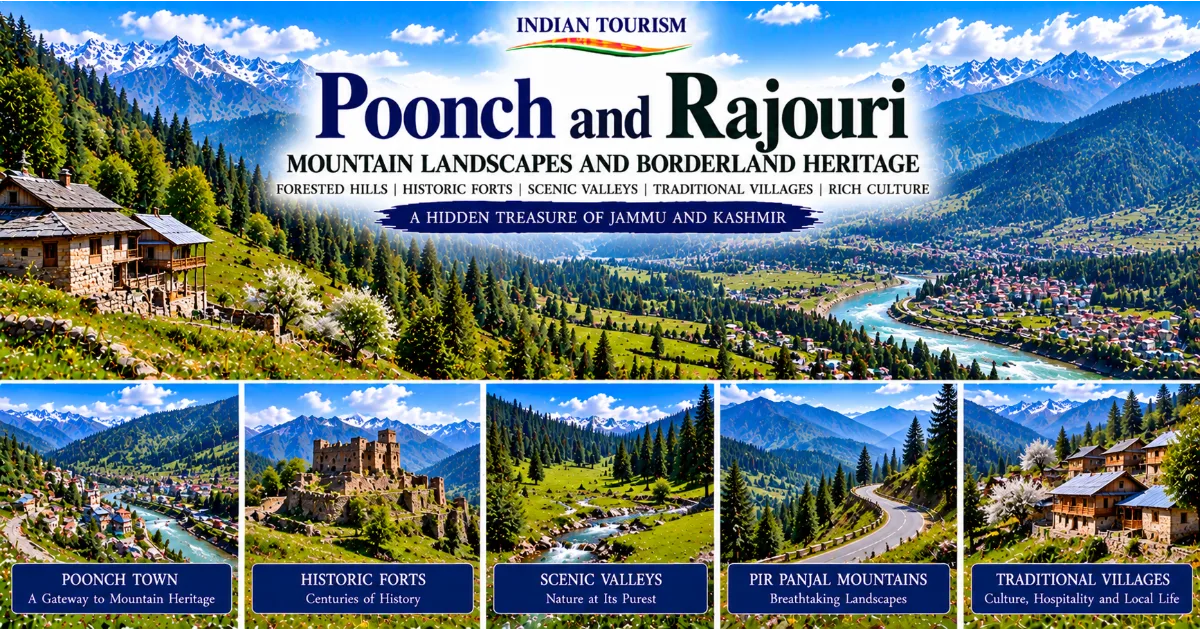
Discovering Forested Hills, Historic Forts, Mountain Passes, Traditional Villages and the Cultural Richness of Jammu
Two Mountain Districts with Stories to Tell
The Jammu region of Jammu and Kashmir is known for its varied landscapes, ranging from the plains around Jammu city to forested hills, river valleys and high mountain passes. Beyond the destinations that dominate popular travel itineraries, Poonch and Rajouri offer a distinctive combination of natural beauty, historical significance and cultural diversity. Located in the western part of the Jammu region, these neighbouring districts lie within a mountainous landscape strongly influenced by the Pir Panjal range.
Poonch is known for its mountain scenery, historic associations, traditional settlements and routes connecting different parts of the region. Rajouri is equally interesting for its forests, valleys, heritage sites and location along historic routes that linked communities across the mountains. Together, the two districts provide an opportunity to understand the wider geography and history of Jammu and Kashmir beyond its better-known tourist centres.
Their landscapes change with elevation and season. Lower slopes may remain green for much of the year, while higher areas experience colder conditions and occasional snowfall. Forests, agricultural terraces, streams and mountain roads create a varied setting for travellers who appreciate nature and regional culture.
Poonch and Rajouri also occupy an important place in the historical geography of the subcontinent. Their mountain corridors have connected settlements, supported movement and trade, and witnessed political changes across different periods. Their heritage is reflected in forts, religious places, old routes, oral traditions and the cultural practices of local communities.
Travel in these districts requires a thoughtful approach. Their proximity to the Line of Control, the international security situation and the mountainous terrain mean that visitors must pay attention to current official travel advisories, local restrictions and road conditions. Some locations may be restricted or unsuitable for tourism at particular times. A responsible itinerary focuses on permitted destinations, local guidance and respect for the communities who call these mountains home.
1. Understanding the Geography of Poonch and Rajouri
Poonch and Rajouri are situated in the western Himalayan foothills and the broader Pir Panjal landscape. Their terrain includes ridges, forested slopes, valleys, streams and cultivated areas. The relationship between mountains and settlements is central to understanding both districts.
The Pir Panjal range forms a significant geographical feature of the region. Its mountains influence rainfall, vegetation, seasonal temperatures and the movement of people between different valleys. Mountain passes have historically provided routes through terrain that would otherwise have been difficult to cross.
Poonch district is centred around Poonch town, which serves as an administrative and commercial hub for surrounding settlements. The district's landscape includes mountain villages, forested areas and agricultural communities. Its position gives it a distinctive relationship with the wider western Himalayan region.
Rajouri district contains a variety of landscapes, including hills, valleys, cultivated slopes and forested terrain. Rajouri town functions as an important centre for surrounding communities and provides a practical starting point for exploring permitted local attractions.
The natural environment differs according to elevation, exposure and seasonal weather. Some areas are characterised by dense vegetation, while others have open slopes and cultivated terraces. Watercourses support local agriculture and contribute to the visual character of the landscape.
For travellers, this variety makes the journey between settlements as interesting as the destinations themselves. Mountain roads pass through changing terrain, and the views can shift from wooded ridges to open valleys and clusters of houses. However, these roads also demand caution, especially during heavy rain, snowfall or periods of poor visibility.
2. Poonch Town: A Gateway to Mountain Heritage
Poonch town is an important starting point for exploring the district. It combines the functions of an administrative centre, a local marketplace and a connection point for surrounding villages. Visitors can experience a different side of the region by spending time in the town rather than immediately travelling towards distant scenic locations.
The everyday rhythm of Poonch is shaped by local trade, education, public services and movement between town and countryside. Market areas provide access to groceries, clothing, household goods and regional food. They also offer a glimpse into how mountain communities obtain supplies and maintain connections with nearby settlements.
Poonch's historical identity is closely connected to its location along routes through the western Himalayan region. Its position has given it importance in different political and cultural periods. The surrounding terrain has influenced where settlements developed, how people travelled and how communities interacted with neighbouring areas.
Visitors interested in history should explore the town with an appreciation of its layered past. Historical narratives in borderland regions can be complex, and the experiences of different communities may not always be represented by a single account. Speaking with knowledgeable local residents, consulting credible historical material and visiting permitted heritage sites can provide a fuller understanding.
Poonch town is also a practical place to arrange transport, check current local conditions and seek advice about permitted excursions. Travellers should confirm opening arrangements for individual attractions rather than assuming that every site is accessible throughout the year.
An unhurried visit can be rewarding. A walk through appropriate public areas, a meal at a local establishment and conversations with shopkeepers or hosts can introduce visitors to the district's contemporary life.
3. Rajouri Town: History, Markets and Mountain Surroundings
Rajouri town is another important centre for exploring the region. Located amid the hills of the Jammu area, it serves surrounding villages and provides access to several parts of the district. Its setting makes it a useful base for travellers interested in regional culture, history and landscapes.
The town's markets and streets reflect the practical character of a mountain settlement. Local businesses supply everyday necessities, while transport services connect the town with nearby communities. Visitors can use these public spaces to understand how the district functions beyond its reputation as a scenic destination.
Rajouri's historical significance is associated with its position along routes linking the Jammu region with areas towards the Pir Panjal mountains. Such routes enabled movement between settlements and helped shape trade, cultural exchange and political relationships. The terrain that makes the district attractive today also influenced the development of historic routes and defensive positions.
The town and surrounding area contain cultural and religious places that may be of interest to visitors. Access conditions can differ, so travellers should seek local guidance before planning visits to individual sites. Where places of worship are open to visitors, respectful clothing, quiet behaviour and attention to local customs are essential.
Rajouri can also serve as a starting point for exploring the district's rural surroundings. Depending on current conditions, travellers may arrange permitted drives to scenic areas, villages or heritage locations. The route should be planned according to weather, road quality and any restrictions in force.
A visit to Rajouri becomes more meaningful when the town is treated as a living community rather than simply a stop between attractions. Local food, markets and conversations can reveal details about the region's traditions and contemporary challenges.
4. The Pir Panjal Mountains: The Natural Backbone of the Region
The Pir Panjal range is one of the defining geographical features of the wider Jammu and Kashmir landscape. Its mountains influence the appearance of Poonch and Rajouri and have shaped the movement of people through the region for generations.
The range includes ridges, forested slopes, valleys and high passes. Elevation creates changes in temperature and vegetation, while rainfall and snowfall influence water availability and seasonal access. These conditions support a range of ecological environments within relatively short distances.
Forested hills are among the region's most attractive natural features. Trees cover many slopes, creating changing patterns of light and shade as the sun moves across the mountains. During the warmer months, vegetation can give the landscape a rich green appearance, while colder periods may bring snow to higher elevations.
The Pir Panjal region is also important because it connects different parts of Jammu and Kashmir. Routes through and around the mountains have helped people travel between settlements, access markets and maintain social relationships across difficult terrain. These connections have contributed to the cultural diversity of the wider region.
For nature lovers, the mountains offer opportunities to appreciate scenery, observe vegetation and enjoy permitted outdoor excursions. However, travellers should remember that mountain environments are dynamic. Rain can make paths slippery, snowfall can affect access and fog can reduce visibility.
Visitors should avoid treating remote mountain roads as casual sightseeing routes without preparation. Before leaving a town or accommodation, confirm the intended route, check current weather conditions and identify a realistic return time.
5. Forests and Green Valleys of Rajouri
Rajouri's forested landscapes are an important part of its natural appeal. The district contains a variety of wooded slopes and valleys where vegetation responds to differences in elevation, rainfall and local conditions.
Forests are valuable for much more than scenery. They provide habitat for wildlife, help protect soil and influence how water moves through mountain catchments. Healthy forest ecosystems contribute to the long-term stability of the landscapes on which local communities depend.
The changing appearance of the forests creates seasonal opportunities for visitors. In spring and summer, many slopes become greener and the countryside can feel especially fresh after rainfall. Autumn may bring changes in the colours of some vegetation, while winter introduces colder conditions and can affect access to higher areas.
Travellers can appreciate these landscapes through permitted scenic drives and short walks in suitable locations. The best experiences are often those that allow time to observe the surroundings rather than rush between stops.
Forest areas should be approached carefully. Visitors should not light fires in unsafe locations, leave waste behind or disturb wildlife. They should also follow local instructions about access and avoid entering areas that are closed or restricted.
A responsible visit recognises that forests are working ecological systems and, in many places, part of the daily lives of local communities. Protecting them helps preserve the natural beauty that makes Rajouri an appealing destination.
6. Poonch's Mountain Villages and Rural Landscapes
The rural areas around Poonch reveal a quieter side of the district. Villages are distributed across valleys, slopes and cultivated terraces, with their locations influenced by water availability, access routes and the practical needs of mountain agriculture.
Traditional settlements often reflect an intimate understanding of local terrain. Houses, fields and paths are arranged according to the shape of the land, while daily routines respond to weather, seasons and agricultural requirements.
For travellers, village visits can provide insight into life beyond the main towns. A short journey into the countryside may reveal cultivated plots, livestock, local shops and community spaces. The landscape is not simply picturesque. It is also a place where people work, raise families and maintain longstanding social relationships.
Visitors should approach rural tourism with respect. Not every village is organised to receive tourists, and not every home or field is a public attraction. Ask permission before photographing residents or private property, avoid obstructing roads and paths, and follow local advice about where to go.
Purchasing locally made goods or eating at a local establishment can help support rural livelihoods. However, visitors should not expect every community to provide commercial services or organised activities.
The most rewarding village experiences often come from curiosity and patience. Learning about seasonal work, local food or the history of a settlement can offer a more meaningful understanding of the district than simply taking photographs from a roadside viewpoint.
7. Historic Forts and Defensive Heritage
The historical geography of Poonch and Rajouri has encouraged the development of defensive structures and strategically located settlements. Mountain routes, ridges and valley approaches have long influenced how rulers and communities protected important locations.
Forts and historic defensive sites in the wider region reflect the political realities of different periods. Their locations may have provided views over routes, controlled access to settlements or served as centres of local authority. The surviving remains, where accessible, can help visitors understand how geography and security shaped historical architecture.
The region's heritage should be explored with care because the condition and accessibility of individual structures vary. Some sites may be maintained, while others may have deteriorated over time. Visitors should avoid climbing unstable walls, removing stones or damaging historical remains.
It is also important to distinguish documented history from popular stories. Local traditions can preserve valuable memories, but specific dates, rulers and events should be checked against reliable historical sources when accuracy matters.
A heritage-focused visit can combine an exploration of permitted historic sites with a broader appreciation of the landscape. Understanding why a fort or settlement occupied a particular position can make the surrounding terrain more meaningful.
Poonch and Rajouri demonstrate that heritage is not limited to monumental buildings. Old routes, place names, religious sites and patterns of settlement also preserve traces of the past. These features contribute to a broader historical picture of life in the western Himalayan mountains.
8. Mughal Routes and the Historic Movement Across the Mountains
Mountain routes have played a major role in the history of Jammu and Kashmir. The wider Pir Panjal region contains corridors that connected different settlements and provided passage between the Kashmir Valley and the southern side of the mountains.
One of the best-known historical connections is associated with the Mughal Road, which links the Poonch and Rajouri side of the mountains with the Kashmir region through the Pir Panjal landscape. The route has historical associations with travel across the mountains and reflects the long-standing importance of mountain corridors.
The movement of people along such routes was influenced by weather, terrain and political circumstances. Travellers, traders, officials and other groups depended on knowledge of the landscape and on places where they could rest or obtain supplies. The routes also facilitated cultural contact between communities living on different sides of the mountains.
The Mughal Road is significant today for both its historical associations and its mountain scenery. However, travellers must check current road access, official advisories and seasonal conditions before planning a journey. It should not be assumed that the route is always open or suitable for every vehicle.
The history of mountain travel is a reminder that infrastructure and geography are closely connected. A route that appears straightforward on a map may involve difficult gradients, changing weather and long stretches between services.
For visitors interested in history, understanding the role of these routes adds depth to a trip through Poonch and Rajouri. The mountains are not simply barriers. They have also served as pathways that connected people, goods and ideas across generations.
9. Cultural Diversity and Community Traditions
Poonch and Rajouri are culturally diverse districts whose communities have developed traditions shaped by geography, history, language, religion and contact with neighbouring regions.
This diversity can be seen in everyday life, including food, clothing, festivals, family practices, local speech and community gatherings. Traditions may vary between settlements, and the same festival or custom can be observed differently by different families.
Religious places are important parts of community life. Temples, mosques, shrines and other places of worship can serve as centres of gathering, reflection and social connection. Visitors should respect the rules of each site, ask before taking photographs and avoid interrupting religious activities.
Festivals provide another window into regional culture. They may bring families and neighbours together for prayer, meals, music or other communal activities. Travellers who happen to visit during a celebration should observe respectfully and participate only when welcomed.
Cultural tourism works best when it is based on mutual respect rather than assumptions. Visitors should avoid treating a community as a single cultural group or expecting residents to explain every aspect of their identity. Asking thoughtful questions and listening carefully can lead to a richer understanding.
The region's diversity is one of its strengths. It reflects generations of interaction, adaptation and continuity within a mountainous environment. Exploring this human dimension can make a visit to Poonch and Rajouri more memorable than a journey focused exclusively on landscapes.
10. Local Food: Discovering the Flavours of the Jammu Mountains
Food offers a practical and enjoyable way to understand the culture of Poonch and Rajouri. Local meals reflect household traditions, seasonal ingredients, agricultural practices and culinary influences shared across the wider Jammu region.
Travellers may encounter rice, breads, lentils, vegetables, dairy products and dishes prepared with regional spices. Menus vary by establishment and season, so visitors should ask what is freshly prepared and what local specialities are available.
The wider Jammu region is associated with a number of traditional dishes, but travellers should not assume that every preparation is specific to Poonch or Rajouri. It is useful to ask local hosts about the origins of a dish and how it is usually served.
Small eateries can provide a simple introduction to regional food. A meal in a local establishment may also create an opportunity to ask about the surrounding area, transport or seasonal travel conditions. Visitors should remain mindful of hygiene and choose places where food is handled appropriately.
Food traditions are also linked to the seasons. The availability of certain ingredients may change throughout the year, and household recipes can vary between communities. This diversity makes local dining an experience worth approaching with curiosity.
Buying food and other products from local businesses can help support the economy. Travellers should pay fair prices, respect the customs of the establishment and communicate dietary requirements clearly before ordering.
11. Best Time to Visit Poonch and Rajouri
The best time to visit depends on the areas travellers wish to explore and the kind of experience they prefer. Weather conditions vary across the districts because of differences in elevation and exposure.
Spring: Fresh Landscapes and Comfortable Exploration
Spring brings a gradual change in temperature and vegetation. Many lower and middle-elevation areas begin to look greener, and the countryside can be attractive for scenic drives and visits to towns and villages.
Conditions at higher elevations may remain cold, and some routes can still be affected by snow or weather-related disruption. Travellers should confirm local access before planning excursions into the mountains.
Spring is a good option for people who prefer a balance between outdoor exploration and comfortable sightseeing. Layered clothing is useful because daytime temperatures and evening conditions may differ.
Summer: A Popular Season for Mountain Travel
Summer can be suitable for exploring the green landscapes, towns and permitted mountain routes of Poonch and Rajouri. Longer daylight hours make it easier to plan scenic drives and village visits.
However, rainfall can affect road conditions, and travel times may be longer than expected. Visitors should check weather forecasts and local advisories before beginning longer journeys.
Accommodation and transport should be arranged in advance during busy holiday periods. Travellers should also avoid assuming that every mountain road or viewpoint is accessible simply because the weather is warm in town.
Autumn: A Quieter Time for Cultural Exploration
Autumn can provide opportunities for relaxed sightseeing, visits to local markets and exploration of accessible rural areas. Some parts of the landscape may display seasonal changes in vegetation, while the gradual cooling of temperatures creates a different atmosphere from summer.
Visitors should prepare for colder evenings and check the operating arrangements of accommodation and transport providers. A flexible schedule is useful because mountain weather can change.
Winter: Cold Conditions and Possible Snowfall
Winter brings colder weather, and higher elevations may experience snowfall. Some roads can become difficult or temporarily inaccessible, while fog and reduced daylight may affect travel.
Winter trips should be planned with particular care. Confirm road conditions, follow official instructions and carry suitable clothing. Travellers should never enter a closed or restricted area in pursuit of snow or mountain views.
Across all seasons, current official guidance should take priority over general travel advice. Conditions in these districts can change for reasons beyond weather alone.
12. How to Reach Poonch and Rajouri
Poonch and Rajouri can be reached through the road network of the Jammu region. Travellers generally combine rail or air travel to a larger transport centre with onward road journeys, depending on their starting point and itinerary.
By Road
Road travel is the principal way to reach many locations within the two districts. Mountain routes can be scenic, but they require attention to road conditions, travel time and weather.
Before departure, check the route with reliable local sources and confirm whether any restrictions or closures are in force. Avoid relying entirely on a navigation application, particularly for remote destinations or roads that may be affected by seasonal conditions.
Travellers unfamiliar with mountain driving may prefer an experienced local driver. Vehicles should be in good condition, and journeys should be planned with enough time for breaks and delays.
By Train
Travellers from other parts of India may consider rail services to Jammu before continuing by road. Train availability, journey duration and onward transport should be checked for the intended travel dates.
Rail travel can reduce the need to cover the entire distance by car, but the remaining road journey should be included realistically in the itinerary.
By Air
Visitors may investigate flights to Jammu and then arrange onward road transport. The overall journey time depends on flight schedules, airport transfers, traffic and mountain road conditions.
Travellers should compare the complete travel plan rather than looking only at the duration of the flight. Delays or changes in road access may require additional time.
Local Transport
Taxis and other local transport services may be available in the towns and for selected excursions. Availability can vary by season and destination. Before arranging a long drive, confirm the route, return plan and any applicable local restrictions.
13. Accommodation and Planning Your Stay
Poonch and Rajouri towns can serve as bases for exploring the surrounding areas. Accommodation choices may include hotels, guesthouses and other locally operated properties, depending on availability and the season.
Staying in a town can make it easier to access food, transport and everyday services. It is often a practical choice for first-time visitors who want to explore permitted nearby attractions without changing accommodation each day.
Travellers interested in village life may investigate suitable homestays or rural accommodation where these are available. Such stays can provide a closer connection to local culture, but facilities and access may differ from those in larger towns.
Before booking, confirm the location, room facilities, heating arrangements during colder periods, parking and meal availability. Ask about cancellation terms and whether the property is operating during your intended dates.
Families should prioritise suitable room arrangements and convenient access to transport. Budget travellers can compare basic guesthouses and local properties, while visitors planning longer excursions should consider how far their accommodation is from the routes they intend to use.
A good itinerary should avoid excessive driving every day. Spending adequate time in one base can reduce fatigue and allow visitors to explore the area at a more relaxed pace.
14. A Suggested Five-Day Poonch and Rajouri Itinerary
A five-day trip can provide an introduction to the towns, landscapes and permitted heritage attractions of the region. The following outline should be adjusted according to current security guidance, road conditions and travel time.
Day One: Arrive in Rajouri
Arrive in Rajouri and settle into your accommodation. Use the remaining time to explore suitable public areas, visit local markets and enjoy a meal at a local establishment.
Keep the first day relaxed, especially if the journey has been long. Ask local contacts about current conditions and confirm which attractions are appropriate to visit.
Day Two: Explore Rajouri and Nearby Permitted Sites
Spend the second day exploring Rajouri town and accessible cultural or historical attractions. Confirm opening hours and local access arrangements before setting out.
Allow time for the town itself rather than treating it only as a transport stop. Markets and everyday public spaces can provide insight into regional life.
Day Three: Travel Towards Poonch
Plan the road journey towards Poonch only after checking the current route and official advisories. Allow sufficient time for the drive and avoid adding remote detours without local confirmation.
After arrival, explore suitable public areas in Poonch town and prepare for the following day's activities.
Day Four: Explore Poonch's Local Heritage and Surroundings
Use the day for permitted cultural sites, town exploration or a locally recommended scenic excursion. The choice should be based on current access conditions and the time required for safe travel.
Visitors interested in heritage can focus on local history, architecture and community traditions. Nature lovers can choose an accessible landscape route if conditions are favourable.
Day Five: Relaxed Exploration and Departure
Use the final day for a short walk, a local meal or any nearby activity that fits comfortably within the departure schedule. Avoid beginning a long excursion immediately before a train, flight or onward road journey.
This itinerary is a planning framework rather than a guarantee that every route or site will be available. Local conditions should determine the final plan.
15. Responsible Travel Near Sensitive Border Areas
Poonch and Rajouri require special care in travel planning because of their geographical position and security context. Some areas may be subject to restrictions, and conditions can change in response to official decisions or developments.
Travellers should check current government advisories and follow instructions issued by local authorities. They should not attempt to enter restricted areas, bypass checkpoints or use unofficial routes to reach places that are closed to visitors.
Photography also requires judgement. Avoid photographing military installations, security personnel, checkpoints or other sensitive locations. Where there is uncertainty, ask for guidance and follow instructions immediately.
Visitors should carry appropriate identification when travelling and allow additional time for checks where required. They should remain courteous and patient with officials and avoid sharing unverified information about local security conditions.
These precautions do not diminish the value of visiting the region. They are part of travelling responsibly in a place where the needs of residents, public safety and tourism must be considered together.
A well-planned trip focuses on destinations that are officially accessible and on experiences that respect local conditions. Visitors should never place themselves or others at risk for the sake of a photograph or an unplanned detour.
16. Responsible Tourism and Environmental Protection
The forests, mountains and valleys of Poonch and Rajouri are important environmental resources. Their long-term protection depends on responsible decisions by residents, authorities, businesses and visitors.
Travellers should carry their waste back to appropriate disposal points and avoid leaving plastic packaging, bottles or food containers along roads and in natural areas. Waste should never be thrown into streams or other water sources.
Water conservation is important in mountain communities, where local sources support household needs, agriculture and livestock. Visitors should use water carefully and follow local guidance about sanitation.
Forest fires can cause serious damage, so visitors should avoid unsafe fires and follow all restrictions. They should not disturb wildlife, remove plants or damage trees. Staying on established paths reduces harm to vegetation and helps prevent accidents.
Tourism can also contribute to local livelihoods when visitors use locally operated accommodation, eat at local businesses and purchase legitimate regional products. Spending locally can help distribute some of the economic benefits of tourism beyond larger commercial centres.
Respect for cultural sites and communities is equally important. Visitors should ask before taking photographs of individuals, follow rules at religious places and avoid treating private homes or working farms as public attractions.
Responsible tourism is a practical way to help ensure that future visitors can enjoy the same landscapes and learn from the same cultural traditions.
17. Photography and the Best Ways to Experience the Landscape
Poonch and Rajouri offer many opportunities for landscape photography, particularly where forested ridges, open valleys and mountain roads create contrasting views.
Morning and late afternoon can provide attractive light, but the best conditions depend on cloud cover, season and elevation. Travellers should allow time to observe the landscape rather than expect every location to produce the same view on every visit.
Photography should always be secondary to safety. Do not stop on narrow roads, stand near unstable edges or enter restricted areas for a better angle. Use designated stopping places and follow local instructions.
Photographers interested in cultural subjects should seek permission before photographing people, homes or private activities. A respectful approach often leads to better interactions and a more authentic understanding of the place.
Visitors should also avoid exaggerating or misrepresenting what they see. Travel photographs can inspire interest in lesser-known destinations, but accurate descriptions and responsible captions help audiences understand the real conditions of a location.
For many travellers, the most memorable images may be simple ones: a village set against a mountain slope, sunlight filtering through trees or a quiet road winding between green hills. These scenes capture the character of the region without requiring risky or intrusive behaviour.
18. Why Poonch and Rajouri Deserve More Attention
Poonch and Rajouri demonstrate that the appeal of Jammu and Kashmir extends far beyond a small number of famous destinations. Their landscapes combine mountain scenery with cultural richness and a historical geography that has connected communities across generations.
The districts offer an opportunity to appreciate the Pir Panjal region as both a natural environment and a lived landscape. Forests, fields, towns and villages are interconnected, and each contributes to the identity of the region.
For travellers interested in history, the districts provide a setting in which to explore old routes, defensive heritage and the influence of geography on settlement. For nature lovers, the mountains and forests offer opportunities to enjoy scenery through permitted excursions. For culturally curious visitors, local markets, food and community traditions can reveal details that are not always visible in conventional travel photography.
Their location also makes responsible planning essential. Tourism should be developed in ways that respect the security context, protect the environment and benefit local communities. A destination becomes more rewarding when visitors understand its circumstances rather than treating it as a collection of scenic viewpoints.
Poonch and Rajouri are not places that need to imitate another destination to be worth visiting. Their identity comes from their own landscapes, traditions and history. With careful planning and respectful travel, they can offer a distinctive experience of the Jammu region.
Conclusion: Discover the Mountains and Heritage of Poonch and Rajouri
Poonch and Rajouri are two remarkable districts of Jammu and Kashmir, where the Pir Panjal mountains create a landscape of forested slopes, green valleys, traditional villages and historic routes. Their towns provide access to regional culture and everyday life, while the surrounding countryside reveals the close relationship between geography, settlement and tradition.
A visit can include local markets, cultural sites, scenic drives and permitted excursions into the mountains. The experience is enriched by learning about the region's diverse communities, tasting local food and understanding the history of routes that once connected different parts of the Himalayan landscape.
The most important part of planning is to remain informed and flexible. Check official advisories, confirm road access and follow local instructions, particularly because some areas are sensitive or restricted. Responsible travel protects visitors while respecting the people who live in the region.
For anyone interested in discovering a less familiar side of Jammu and Kashmir, Poonch and Rajouri offer an opportunity to explore mountains, heritage and culture together. Their value lies not only in their scenery but also in the stories, traditions and communities that give these landscapes meaning.
#IndianTourism #Poonch #Rajouri #JammuAndKashmir #PirPanjal #JammuTourism #MountainTravel #CulturalHeritage #HistoricRoutes #NatureTourism #HimalayanLandscapes #ResponsibleTourism #ExploreIndia #HiddenDestinationsOfIndia

