
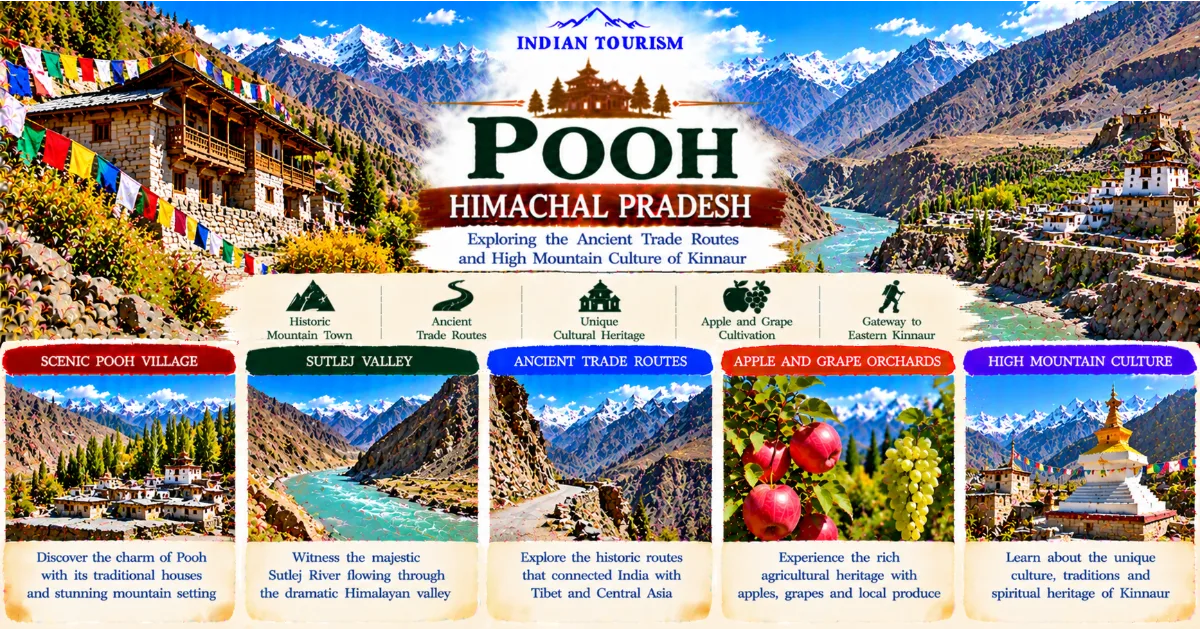
Discovering the Historic Mountain Town of Pooh
Himachal Pradesh is a state of remarkable geographical and cultural diversity. Its landscapes extend from forested hills and fertile valleys to high-altitude deserts, while its communities preserve traditions shaped by centuries of mountain life. In the eastern part of the state, Kinnaur offers a distinctive combination of dramatic scenery, agricultural settlements, historic routes and cultural connections across the Himalayas. Among its lesser-known destinations, Pooh stands out as a place where geography, history and everyday life come together.
Pooh, also known as Poo, is a small town in Kinnaur district situated along the historic route through the Sutlej Valley towards the higher Himalayan regions. Its setting reflects the transition from the more vegetated parts of Kinnaur to increasingly dry and rugged terrain. The surrounding mountains, cultivated patches, traditional homes and distant ridges create a landscape that feels different from the greener hill stations of Himachal Pradesh.
The town is particularly interesting for travellers who want to understand Kinnaur beyond its famous viewpoints. Its location along an important mountain corridor gives it historical significance, while its agricultural activities and local religious traditions offer insight into the everyday lives of residents. Pooh is not a destination built around large entertainment complexes or extensive commercial attractions. Instead, its appeal lies in its setting, cultural background and role within the wider region.
Travelling through Pooh can also help visitors understand how mountain geography influences human settlement. The availability of water, the shape of the valley, the difficulty of crossing high passes and the movement of people and goods have all contributed to the development of communities across Kinnaur. The roads that connect these settlements continue to shape the region's economy and travel patterns.
A visit to Pooh is best approached with realistic expectations and careful planning. Facilities may be more limited than in larger tourist centres, and road conditions can change because of weather, landslides or maintenance work. Travellers should confirm local arrangements before departure, respect private property and follow all instructions concerning access to sensitive border areas.
For those interested in history, culture and the landscapes of the eastern Himalayas, Pooh offers an opportunity to explore a quieter and less familiar part of Himachal Pradesh.
Where Is Pooh Located?
Pooh is situated in Kinnaur district in the eastern part of Himachal Pradesh. The town lies along the Sutlej Valley road corridor, which connects settlements in the district and provides access towards higher mountain regions. Its geographical position has influenced its historical role as a place along routes linking different parts of the western Himalayas.
Kinnaur contains several distinct landscapes. The lower sections of the district include river valleys and cultivated settlements, while higher areas become increasingly rugged and dry. The terrain is shaped by steep mountain slopes, narrow river corridors and areas where agriculture depends on carefully managed land and water resources.
Pooh reflects the changing environment of the Sutlej Valley. The surroundings are generally more arid than the forested landscapes associated with many well-known hill stations. Rocky slopes, sparse vegetation and cultivated patches create a striking contrast, especially for travellers arriving from greener parts of Himachal Pradesh.
The town's position along a major mountain road makes it accessible as part of a wider journey through Kinnaur. However, mountain travel times can vary significantly. Road construction, weather, traffic and landslides may affect the journey, so travellers should allow extra time and avoid scheduling tight connections.
Visitors should also recognise that the region includes sensitive border areas. Not every road or settlement near the international boundary is open for unrestricted civilian travel. Current official guidance must determine where visitors may proceed.
Pooh is most rewarding when included in a broader exploration of Kinnaur's geography and culture. Its significance becomes clearer when viewed in relation to the Sutlej Valley, nearby settlements and the historic routes that have connected communities across the mountains.
The Sutlej Valley and Its Influence on Settlement
The Sutlej Valley is one of the defining geographical features of Kinnaur. The river cuts through mountainous terrain, creating a corridor that supports roads, settlements and agricultural activity. Although the landscape can appear harsh in places, the valley has long provided a route through an otherwise difficult region.
Mountain rivers shape their surroundings over long periods. Flowing water erodes rock, carries sediment and contributes to the formation of deep valleys. The resulting terrain often contains steep slopes and narrow sections where construction is difficult. Roads must follow the contours of the land, and settlements develop where suitable ground and resources are available.
The Sutlej Valley has helped connect communities that might otherwise be separated by formidable mountain barriers. Its routes have supported the movement of people, agricultural produce, livestock and other goods. The development of modern roads has changed travel, but the basic geographical importance of the valley remains.
Pooh's position within this corridor helps explain its historical and practical significance. Its surroundings reflect the challenges of living in a mountainous environment, where water availability, transport and access to markets influence daily life.
The river and its tributaries also affect the wider ecological system. Water supports vegetation and agriculture, while the surrounding terrain provides habitats that differ according to altitude and exposure. However, river conditions can change with rainfall, snowmelt and other seasonal factors.
Travellers should appreciate the Sutlej Valley from safe locations. Do not approach unstable riverbanks, cross fast-moving water or stop in narrow road sections to take photographs. Mountain roads and river corridors require particular care because space can be limited and conditions can change quickly.
Understanding the Sutlej Valley provides a foundation for appreciating Pooh. The town's position is not accidental. It reflects the importance of the natural corridor through which people have travelled and settled for generations.
Pooh and the History of Himalayan Trade
The history of Kinnaur is closely connected with mountain trade and the movement of people between different regions of the Himalayas. Before modern transport networks developed, communities relied on established routes that crossed valleys, passes and difficult terrain. These routes connected agricultural settlements with markets and linked Himalayan communities with regions beyond the mountains.
Pooh's location along the Sutlej Valley corridor placed it within this wider historical geography. The town and surrounding region formed part of a landscape through which travellers and traders could move between different settlements. Goods, ideas, religious practices and cultural influences travelled alongside the people who carried them.
Mountain trade required extensive local knowledge. Travellers needed to understand seasonal weather, river conditions, the availability of water and the challenges of crossing high terrain. Routes could become difficult or inaccessible during particular seasons, so movement often depended on careful planning.
Trade also involved relationships between communities. Merchants, farmers, livestock owners and local authorities all played roles in maintaining the networks through which goods moved. These connections helped create cultural exchange across regions that might appear isolated when viewed only from a modern map.
It is important to distinguish this broad regional history from specific claims about individual buildings or events in Pooh. Not every historic route has a complete written record, and some aspects of local history may survive through oral tradition. Visitors interested in the town's past should consult reliable local historical information rather than assume that every travel account provides a fully documented narrative.
The wider history of Himalayan trade helps explain why settlements along major valleys developed importance beyond their size. Pooh's location demonstrates how geography could create opportunities for interaction between communities separated by difficult terrain.
The Cultural Landscape of Kinnaur
Kinnaur has a distinctive cultural identity shaped by its geographical position, historical connections and religious traditions. Hindu practices, Buddhist influences and local forms of worship contribute to the region's cultural diversity. Traditions vary between settlements, and each community should be understood within its own context.
Religious sites, traditional homes and community spaces form part of the cultural landscape. They may preserve architectural features, local beliefs and customs passed through generations. Their significance often extends beyond their physical appearance because they are connected with community identity and shared memory.
The cultural environment of Pooh reflects the wider history of Kinnaur. Its location along a major valley corridor has created opportunities for contact between communities, while the demands of mountain life have encouraged the continuation of local traditions.
Festivals and religious gatherings can be important occasions for community life. Depending on local customs, events may include ceremonies, music, dancing and shared meals. Their timing and form can vary, so visitors should seek current local information rather than assume that a particular event will take place during their visit.
Language is another part of cultural identity. Residents may use regional languages and dialects alongside Hindi and other languages depending on the situation. Travellers who greet people politely and show an interest in local traditions can often make their interactions more meaningful.
Visitors should approach cultural practices with respect. Religious ceremonies are not performances organised for tourists, and some spaces may be private or restricted. Ask before taking photographs, follow instructions from caretakers and avoid interrupting worship.
Pooh's cultural interest lies partly in its everyday character. The town is a living community where work, family life, religious practices and travel intersect. Observing these relationships can provide a deeper understanding of Kinnaur than a hurried stop focused only on scenery.
Traditional Architecture and Mountain Settlements
Architecture across Kinnaur reflects the practical demands of building in a mountainous environment. Local materials, available land, seasonal weather and inherited construction knowledge have influenced the design of homes and community structures.
Traditional Himalayan buildings often use stone and timber, although construction methods differ according to location and period. Stone can provide durable walls and foundations, while timber can contribute structural support and flexibility. The exact combination depends on local craftsmanship and the resources available when a building was constructed.
The climate influences building design. Homes must cope with cold weather, temperature changes and precipitation, while their position must take account of steep slopes and access routes. The arrangement of houses often reflects the availability of suitable ground and the practical needs of residents.
Pooh's built environment should be understood as part of a living settlement rather than a preserved heritage display. Older buildings may retain traditional details, while newer structures use modern materials and facilities. These changes reflect the continuing evolution of the town.
Visitors interested in architecture should observe buildings from public paths and avoid entering private properties without permission. Residential courtyards, storage areas and working spaces are part of everyday life, and they should not be treated as unrestricted tourist attractions.
The relationship between buildings and terrain is especially important in mountain settlements. Roads, houses and cultivated plots occupy limited spaces within the valley, requiring practical decisions about movement, access and land use.
By observing these details, travellers can gain insight into how communities adapt to the Himalayan environment. Architecture becomes a record of both practical experience and cultural continuity.
Agriculture and Local Livelihoods
Agriculture remains important across Kinnaur, although the crops and farming practices vary with altitude, climate and access to water. The district is widely associated with fruit cultivation, particularly apples in suitable areas, while other crops and livestock-related activities also contribute to rural livelihoods.
In the more arid parts of the Sutlej Valley, water management is especially important. Cultivation depends on suitable land and reliable access to water, and agricultural plots are often located where the terrain allows farming. These conditions require detailed knowledge of the local environment.
The agricultural year involves different tasks according to the crop and season. Farmers may need to maintain fields, manage irrigation, protect crops against weather and organise the movement of produce. The timing of these activities can vary considerably across the district because elevation and exposure affect growing conditions.
Agriculture is connected with the wider economy through roads and markets. Produce must be transported from mountain settlements to places where it can be sold, making dependable transport an important factor in local livelihoods.
Tourism can create additional opportunities for some households through accommodation, meals and transport services. However, agriculture remains an important part of the regional landscape and should not be overlooked when visitors explore the area.
Travellers should respect cultivated land and avoid entering fields without permission. If local products are available for sale, purchasing them from legitimate sellers can support the community. Visitors should also recognise that farming activities are work, not demonstrations organised for tourists.
Understanding agriculture helps reveal how communities have adapted to the demands of mountain geography. It also shows that the landscapes admired by visitors are often the result of careful management and generations of labour.
The Mountain Climate Around Pooh
The climate around Pooh reflects the geography of the eastern Himalayas and the influence of elevation, slope orientation and seasonal weather. Compared with wetter and more forested parts of Himachal Pradesh, sections of the Sutlej Valley can appear relatively dry and exposed.
Mountain climates can change significantly over short distances. A location exposed to strong sunlight may feel very different from a shaded slope, while temperatures can fall sharply after sunset. Wind, cloud cover and precipitation can also change conditions quickly.
Winter may bring severe cold and snowfall to surrounding higher areas, while lower sections of the valley may experience different conditions. Summer can provide more comfortable daytime temperatures, but travellers should still prepare for cool mornings and evenings.
Rainfall can create challenges for road travel. Landslides, falling rocks and damaged road surfaces may disrupt journeys, particularly during periods of heavy precipitation. Even when the weather is clear in Pooh, conditions elsewhere along the route may be different.
Travellers should check current weather and road information before departure. Warm clothing, suitable footwear and a flexible itinerary are useful in every season. Visitors should not rely solely on photographs or descriptions from previous years because mountain conditions can change.
The climate also influences local livelihoods. Agricultural activity, water management and transport all depend on seasonal conditions. Understanding this relationship helps visitors appreciate why communities in Kinnaur adapt their routines to the environment.
Best Time to Visit Pooh
The best time to visit Pooh depends on the weather, road conditions and the type of experience a traveller wants. Conditions vary from year to year, so local information should guide the final decision.
Spring: A Gradual Seasonal Transition
Spring brings a gradual transition from winter conditions. Temperatures begin to rise, and vegetation responds to the changing weather. The surrounding landscape may show a mixture of dry mountain slopes, cultivated patches and snow on higher terrain.
This season can appeal to travellers interested in cultural exploration and quieter roads, although cold mornings and evenings remain possible. Visitors should confirm access conditions before departure, especially if winter weather has affected the region.
Summer: A Practical Season for Exploration
Summer is often a convenient period for exploring Kinnaur. Daytime conditions may be more comfortable for walking and sightseeing, and road travel can be easier than during periods of heavy snowfall.
However, the weather can still change quickly, and some routes may be affected by rain or road maintenance. Travellers should allow enough time for the journey and carry warm clothing.
Monsoon: Careful Road Planning
Rain can affect mountain roads through landslides, falling rocks and temporary closures. The degree of risk varies according to the route and local weather.
Check road conditions before travelling and follow local advice. Avoid stopping beneath unstable slopes and do not attempt to drive through areas where authorities have advised against travel.
Autumn: Clear Mountain Air
Autumn can offer attractive conditions for exploring the Sutlej Valley. Clear days may provide good visibility, while cooler temperatures create a crisp atmosphere.
Travellers should carry warm clothing, especially for early mornings and evenings. It is also sensible to check road conditions before setting out because weather can change quickly as the season advances.
Winter: Cold and Potentially Difficult Travel
Winter can bring severe cold, snow and ice to parts of Kinnaur. Roads may become difficult to use, and some services can operate with limited availability.
Visitors planning a winter trip should confirm road access, accommodation and local conditions. A flexible itinerary is essential.
For many travellers, summer and early autumn provide a practical balance between accessibility and comfortable exploration. The final choice should always depend on current weather and road information.
How to Reach Pooh
Pooh is reached by road through Kinnaur. The journey is part of the experience, but mountain travel requires careful planning and attention to current conditions.
By Road
Travellers coming from Shimla and other parts of Himachal Pradesh generally follow the road network through Kinnaur and along the Sutlej Valley. The route includes winding mountain sections, steep gradients and stretches where road conditions can change because of weather or maintenance work.
Travel time depends on the starting point, traffic and road conditions. Visitors should allow extra time for delays and avoid relying entirely on map estimates.
Drivers should maintain safe speeds, avoid risky overtaking and follow instructions from local authorities. If weather or road conditions become unsafe, postponing the journey is the sensible choice.
By Bus
Public transport connects important settlements along the Kinnaur route. Travellers should confirm current services, stopping points and onward connections before departure because schedules may change.
If local transport is needed for the final section of a journey, arrange it in advance where possible. Allow enough time for connections and avoid scheduling tight onward travel.
By Train
Pooh does not have a railway station. Travellers arriving by train must continue by road from a suitable station serving their broader itinerary.
By Air
There is no airport in Pooh. Visitors arriving by air need to arrange onward road transport. Since mountain journeys can take a substantial part of the day, a generous time allowance is advisable.
Local Transport
Local taxis may be useful for travellers who do not wish to drive mountain roads themselves. Confirm the route, expected travel time and current conditions with the driver before setting out.
Roadside stopping space can be limited. Avoid parking in narrow sections or blocking access for residents and other vehicles.
Places to Explore Near Pooh
Pooh can be included in a broader journey through Kinnaur. The best destinations to combine with it depend on available time, road conditions and the direction of travel.
Nako Village and Lake
Nako is a high-altitude village in the wider Kinnaur region, known for its traditional settlement character and small lake. Its landscape differs from the greener valleys farther west, offering an introduction to the more arid environments of the eastern Himalayas.
Visitors should confirm road conditions and accommodation availability before travelling. The village's elevation makes suitable clothing and gradual adjustment to altitude important considerations.
Kalpa
Kalpa is one of Kinnaur's best-known destinations, associated with traditional architecture, orchards and views towards the high mountains. It provides a practical base for exploring nearby settlements and offers access to accommodation and food services.
A visit to Kalpa can complement Pooh by providing a different perspective on the cultural and agricultural landscape of Kinnaur.
Reckong Peo
Reckong Peo is an important administrative and commercial centre of Kinnaur. It offers access to shops, transport arrangements and other practical services. Travellers may use the town to purchase supplies or organise the next stage of their journey.
Ribba
Ribba is associated with the agricultural landscape of Kinnaur, particularly fruit cultivation. It provides an opportunity to explore another village setting and understand the role of farming in the district's economy.
Visitors should respect private orchards and fields and purchase local produce only from legitimate sellers.
Nako's Wider Mountain Landscape
The area around Nako provides opportunities to observe the transition towards higher, drier Himalayan terrain. Travellers interested in geology, village architecture and high-altitude environments may find the contrast with the lower Sutlej Valley particularly interesting.
Because access conditions can vary, visitors should confirm local information before planning additional stops.
Things to Do in Pooh
Pooh is best suited to travellers who enjoy observing landscapes, learning about regional history and exploring places beyond major tourist centres. The town does not require a crowded schedule to provide a meaningful experience.
Observe the Valley Landscape
The surrounding terrain provides opportunities to appreciate the relationship between the Sutlej Valley, rocky slopes and cultivated land. Changing light can alter the appearance of the mountains throughout the day.
Choose safe public viewing areas and avoid stopping in narrow road sections. Mountain terrain can be unstable, particularly after rain or snowfall.
Learn About the Historic Route
Pooh's location along the Sutlej Valley corridor makes it a useful place to reflect on the history of movement through the Himalayas. Travellers can learn about the importance of roads and passes in connecting communities across difficult terrain.
Specific historical claims should be checked against reliable local information, especially when discussing individual buildings or events.
Explore Accessible Village Areas
Walking through suitable public areas can provide insight into local architecture and everyday life. Observe the arrangement of buildings and the relationship between homes, roads and the surrounding landscape.
Respect private property and avoid entering courtyards or buildings without permission.
Appreciate Local Agricultural Practices
Where agriculture is visible from public routes, visitors can observe how cultivated plots fit into the mountain environment. Do not enter fields or disturb farming activities without permission.
If local produce is available for sale, purchasing it from legitimate sellers can support the community.
Experience Local Hospitality
A meal or stay at a locally operated establishment can provide a more personal introduction to the region. Travellers may learn about food, daily life and local conditions through ordinary conversations.
Be polite, respect people's time and ask before photographing residents at close range.
Food and Local Culinary Experiences
Food in Kinnaur reflects the region's climate, agricultural traditions and cultural connections with neighbouring Himalayan communities. Meals may include grains, vegetables, pulses and seasonal ingredients, although dishes vary between households and establishments.
Food options in smaller towns may be more limited than in larger tourist centres. Travellers should confirm meal availability before departure, particularly when travelling outside the main tourist season. Carrying suitable snacks and drinking water can be useful for longer journeys.
Locally operated establishments can offer an opportunity to experience regional hospitality. Visitors with dietary requirements should communicate their needs clearly and confirm ingredients when necessary.
The wider Kinnaur region is known for fruit cultivation, although availability varies by location and season. Buying local produce from legitimate sellers can support farmers and provide a connection to the area's agricultural economy.
Visitors should dispose of food packaging responsibly and avoid leaving waste along roads, in fields or near rivers. Keeping the landscape clean is an important part of responsible travel.
Accommodation and Travel Planning
Pooh is a smaller destination, so travellers should confirm accommodation availability before making it an overnight stop. Depending on the itinerary, nearby settlements or larger centres in Kinnaur may provide a wider choice of places to stay.
Accommodation options in the wider region can include guesthouses, hotels and homestays. Facilities vary, especially during colder months, when heating and water availability may require additional planning.
Before booking, confirm the availability of meals, hot water, heating, parking and road access. Travellers visiting in winter should also check whether the property is open and whether essential services are operating.
A homestay can provide a more personal experience of local hospitality. Guests should respect household rules, meal arrangements and privacy, and should ask before photographing interiors or entering private spaces.
During popular travel periods, advance booking can reduce uncertainty. It is also useful to keep some flexibility in the itinerary in case weather or road conditions change.
Camping should only take place where it is permitted and with any required approval. Avoid lighting fires in unsafe areas, damaging vegetation or leaving waste behind.
Responsible Tourism in Pooh
Responsible tourism is important in small Himalayan communities where roads, water resources and waste-management systems may have limited capacity. Visitors can help protect the region by travelling carefully and respecting local routines.
Carry rubbish out and dispose of it appropriately. Avoid leaving plastic, cans, food packaging or other waste along roads, in fields or beside watercourses.
Respect private property and agricultural land. Do not enter homes, courtyards or cultivated plots without permission, and avoid interfering with local work.
Keep noise at a reasonable level, particularly near residential areas and religious sites. The town is a living community, not simply a tourist attraction.
Follow local instructions about road access and sensitive border areas. Do not attempt to bypass checkpoints or enter restricted locations. Visitors should also follow applicable rules concerning photography near sensitive infrastructure.
Support local businesses where possible. Choosing local accommodation, eating at local establishments and purchasing legitimate local products can help tourism benefit residents.
Responsible travel also means remaining flexible when conditions change. If weather or road disruptions make a journey unsafe, revising the plan is better than taking unnecessary risks.
A Suggested One-Day Itinerary
A one-day visit to Pooh can be part of a broader journey through Kinnaur. The schedule should depend on the starting point and current road conditions.
Begin with breakfast at your accommodation and check the weather and road information before departure. Carry water, snacks, warm clothing and any essential personal supplies.
Travel to Pooh and spend time appreciating the valley landscape and accessible parts of the town. Observe the relationship between the road, settlement and surrounding terrain. If reliable local historical information is available, use the visit to learn more about the region's role along the Sutlej Valley corridor.
Take a break for lunch or refreshments at a suitable local establishment. If time and road conditions permit, continue towards another destination along your route, but avoid trying to cover too many distant places in one day.
Allow enough time for the return journey or onward travel. Mountain roads can involve unexpected delays, and a flexible schedule makes the trip safer and more enjoyable.
A Two-Day Itinerary for Eastern Kinnaur
Travellers with two days available can explore Pooh and the wider region at a more relaxed pace.
On the first day, travel through Kinnaur and settle into accommodation at a suitable base. Depending on arrival time, explore accessible local areas and enjoy the surrounding mountain scenery.
On the second day, visit Pooh and spend time learning about the town's setting and regional history. If road conditions permit and sufficient time is available, include another destination along the route, such as a nearby village or a cultural stop.
Travellers planning to visit Nako should consider the distance, elevation and road conditions carefully. A separate overnight stay may be more practical than attempting to combine too many destinations in one day.
A slower itinerary gives visitors more time to appreciate the landscape and adapt to changing weather. It also reduces the pressure to rush through places that are best experienced through careful observation.
Practical Travel Tips
Carry layered clothing because temperatures can change quickly in the mountains. Mornings and evenings may be cold even during warmer months, and comfortable footwear is important for walking on uneven surfaces.
Bring essential medication and personal supplies. Do not assume that a smaller settlement will have every service readily available.
Mobile connectivity can be inconsistent in mountainous areas. Download maps in advance and keep important travel information accessible without an internet connection.
Carry some cash for small purchases where digital payment facilities may be unreliable. Keep valuables secure and avoid carrying unnecessary amounts of money.
Check weather and road conditions before departure and remain flexible. If rain, snowfall or road disruption affects the journey, revise the plan.
Respect local customs and privacy. Ask permission before photographing residents or entering private spaces, and follow instructions at religious sites.
If travelling towards sensitive border areas, follow current official restrictions. Never assume that a road is open simply because it appears on a map or is described in an older travel account.
Conclusion: Discovering the Historic and Cultural Landscape of Pooh
Pooh offers a distinctive perspective on Himachal Pradesh and the wider region of Kinnaur. Its location along the Sutlej Valley corridor connects it with the geographical and historical patterns that have shaped mountain settlement, transport and trade.
The town's appeal lies in its relationship with the surrounding landscape and its position within a region of cultural diversity. The rugged terrain, agricultural activity and traditional settlement patterns reveal how communities have adapted to the demands of mountain life.
A visit to Pooh can complement a broader exploration of Kinnaur, including destinations such as Kalpa, Reckong Peo and Nako. Careful planning is important because road conditions, weather and access restrictions can affect travel. Visitors should allow enough time, confirm local arrangements and avoid trying to cover too many places in one day.
Responsible tourism helps protect the region's natural and cultural environment. By respecting private property, supporting local businesses, managing waste and following official guidance, travellers can contribute positively to the communities they visit.
For anyone interested in exploring the less familiar destinations of Himachal Pradesh, Pooh provides an opportunity to understand the Himalayas through more than their scenery. Its story is also connected with the roads, settlements, livelihoods and cultural traditions that have linked mountain communities for generations.
#IndianTourism #HimachalPradesh #Pooh #Kinnaur #SutlejValley #HimalayanHistory #MountainCulture #RuralTourism #ExploreHimachal #ResponsibleTourism #IncredibleIndia #TravelIndia
