
Discovering the Spiritual Heart of Jammu and Kashmir
Jammu and Kashmir is widely celebrated for its snow-covered mountains, beautiful valleys, alpine lakes, lush meadows and charming villages. Yet beyond its natural beauty lies another dimension that has shaped the region for centuries: its spiritual heritage. The land is home to sacred temples, revered shrines, ancient religious traditions and pilgrimage routes that attract millions of devotees and travellers. For many visitors, a journey through Jammu and Kashmir is not simply a holiday. It is an opportunity to seek blessings, experience faith, understand local traditions and discover the deep relationship between spirituality and the Himalayan landscape.
Pilgrimage tourism in Jammu and Kashmir brings together religious devotion, cultural heritage, architecture, local hospitality and mountain travel. The region has important destinations associated with Hindu traditions, Islam, Sikhism and other spiritual communities. Some pilgrimage sites are located in busy towns and established tourist centres, while others require travellers to journey through mountain roads, forested paths or high-altitude terrain. Each destination has its own history, atmosphere and customs, offering visitors a different understanding of the region.
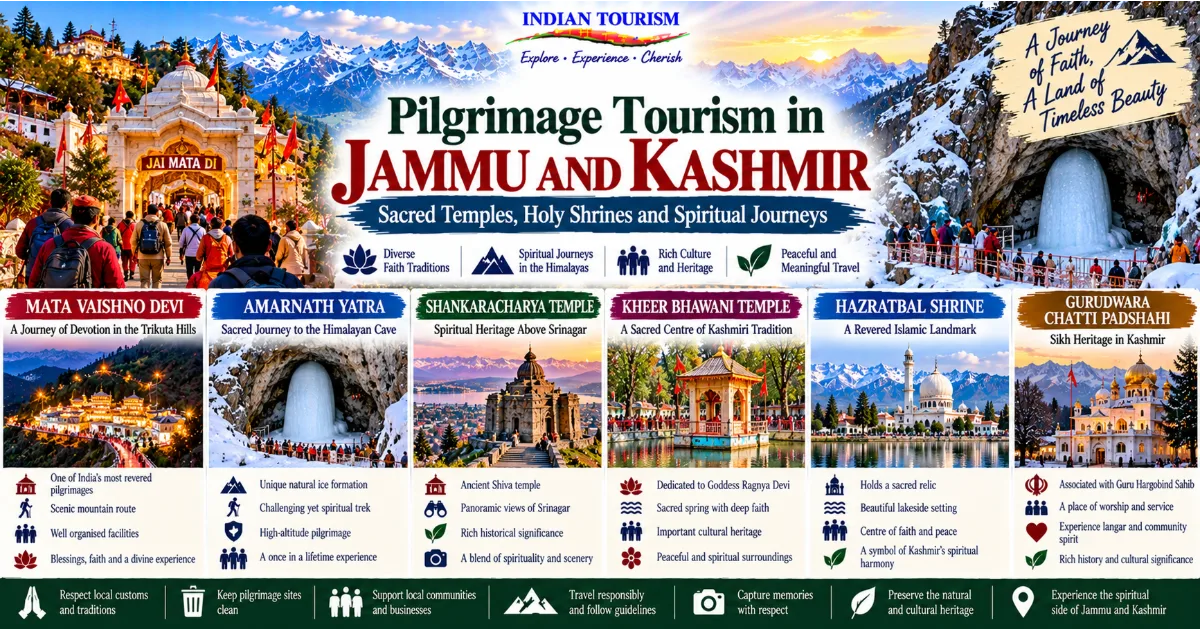
The sacred journey to Mata Vaishno Devi in the Trikuta Hills is among India's best-known pilgrimages. The annual Amarnath Yatra takes devotees towards a naturally formed ice formation inside a Himalayan cave. Shankaracharya Temple overlooks Srinagar, while Kheer Bhawani Temple is associated with an important Kashmiri Hindu tradition. Hazratbal Shrine, located beside Dal Lake, is one of Kashmir's most revered Muslim religious sites. Gurudwara Chatti Padshahi connects Sikh heritage with the region's historical landscape.
These destinations demonstrate that the spiritual identity of Jammu and Kashmir cannot be understood through one religious tradition alone. Its sacred places reflect centuries of cultural exchange, devotion, migration, scholarship and community life. Responsible pilgrimage tourism can help preserve this heritage while supporting local businesses and encouraging visitors to approach religious spaces with respect.
Mata Vaishno Devi: A Journey of Faith in the Trikuta Hills
Mata Vaishno Devi, located near Katra in the Reasi district of Jammu and Kashmir, is one of the most important pilgrimage destinations in India. The shrine is dedicated to Mata Vaishno Devi, widely worshipped by devotees who believe that a visit to the holy cave brings spiritual fulfilment and blessings. The pilgrimage attracts visitors throughout the year, with particularly heavy crowds during major Hindu festivals and holiday periods.
The journey traditionally begins in Katra, a town that has developed into a major centre for pilgrimage services. Visitors register for the pilgrimage according to the current procedures established by the Shri Mata Vaishno Devi Shrine Board. From there, pilgrims travel towards the Bhawan, where the sacred cave shrine is located. The established route passes through mountainous terrain and includes rest points, food facilities, medical assistance and other services intended to support pilgrims.
For many devotees, the walk itself is an essential part of the experience. Families, elderly pilgrims, young travellers and groups of friends undertake the journey with a shared sense of purpose. Chants, devotional songs and conversations accompany the ascent, creating an atmosphere that is distinct from ordinary mountain tourism. Some visitors complete the route on foot, while authorised transport and assistance options may be available according to current regulations and individual needs.
The surrounding landscape adds to the experience. The Trikuta Hills rise above the plains, and changing weather can transform the appearance of the route. During cooler months, the journey may feel comfortable for walking, although winter conditions can create challenges. Summer can bring heat and fatigue, especially during exposed sections of the route. Travellers should choose their departure time carefully, carry appropriate clothing and drinking water, and follow official advice.
Katra also offers opportunities to understand the relationship between pilgrimage and the local economy. Hotels, guesthouses, restaurants, shops, transport providers and small businesses serve the needs of visitors. Purchasing locally made products, using legitimate transport services and respecting public spaces can help make tourism beneficial to the surrounding community.
Pilgrims should remember that the route is not simply a recreational hiking trail. It is a sacred journey shared by people with different physical abilities and levels of experience. Keeping pathways clear, following instructions, avoiding litter and showing patience during crowded periods contribute to a safer and more meaningful pilgrimage.
Amarnath Cave: A Sacred Himalayan Pilgrimage
The Amarnath Cave, situated in the Himalayan region of Kashmir, is one of the most significant pilgrimage destinations associated with Lord Shiva. The shrine is particularly known for a naturally formed ice formation inside the cave, which devotees worship as a representation of Shiva. The annual Amarnath Yatra attracts pilgrims from different parts of India and is generally conducted during a limited period in summer, subject to official arrangements and weather conditions.
Unlike a pilgrimage that takes place entirely within an urban centre, the Amarnath Yatra involves travel through challenging mountain terrain. The traditional routes include the Pahalgam route and the Baltal route, each with different distances, terrain characteristics and logistical considerations. Route access, registration procedures, medical requirements and travel arrangements can change from year to year. Pilgrims must therefore consult current official information before making plans.
The Pahalgam route passes through a celebrated Himalayan landscape, with mountain valleys, rivers, forests and high-altitude camps along the way. It is generally associated with a longer journey that many pilgrims undertake in stages. The Baltal route is comparatively shorter in distance to the cave but involves a demanding ascent and can be physically strenuous. Neither route should be treated casually, and the appropriate choice depends on health, fitness, available time and official guidance.
High-altitude conditions are among the most important factors to consider. Thin air, sudden weather changes, cold temperatures, rain, snow and difficult walking surfaces can affect even experienced travellers. Pilgrims should not assume that ordinary fitness is sufficient for every stage of the journey. Medical screening, acclimatisation where advised, suitable footwear, warm layers and adherence to authorised travel arrangements are essential.
The spiritual importance of Amarnath is inseparable from the extraordinary setting in which the pilgrimage takes place. The journey invites reflection on faith, endurance and the relationship between human beings and the natural world. However, the beauty of the landscape should not distract visitors from the seriousness of the environmental and safety challenges involved.
The annual pilgrimage also requires careful coordination among authorities, medical teams, transport services, volunteers and local communities. Visitors can support these efforts by following instructions, avoiding unauthorised routes, carrying back waste and respecting restrictions designed to protect both pilgrims and the mountain environment.
Anyone considering the Amarnath Yatra should prioritise safety over completing the journey at any cost. If authorities restrict access or weather conditions become dangerous, changing plans is the responsible decision. A meaningful pilgrimage does not require ignoring medical advice or taking unnecessary risks.
Shankaracharya Temple: Spiritual Heritage Above Srinagar
Shankaracharya Temple stands on a hill overlooking Srinagar and offers a different kind of pilgrimage experience. Associated with Lord Shiva, the temple occupies a prominent position above the Kashmir Valley and is an important destination for devotees and visitors interested in the region's religious and historical heritage.
The hill is commonly known as Shankaracharya Hill, while the temple is also associated with the name Takht-e-Sulaiman in local historical usage. Its elevated location creates a striking relationship between sacred architecture and the surrounding landscape. From suitable viewpoints, visitors can appreciate the wider setting of Srinagar, including parts of Dal Lake and the urban landscape below.
The temple is reached by a road followed by steps, with access conditions and security arrangements subject to prevailing rules. Visitors should check current access requirements before travelling, as restrictions can apply to vehicles, belongings, photography and movement around the site. Respecting these instructions is especially important at a religious destination with both spiritual and historical significance.
For devotees, the temple provides a place for prayer and contemplation. For cultural travellers, it offers an opportunity to consider the long history of Hindu worship in Kashmir and the region's place in broader Indian religious traditions. Its position above the city also demonstrates how sacred places were often associated with prominent natural features such as hills, rivers and mountain viewpoints.
A visit can be combined with a wider exploration of Srinagar, provided travellers allow enough time for security checks, road conditions and other practical requirements. The temple should not be treated merely as a viewpoint. Visitors can enjoy the scenery while remaining mindful that it is an active place of worship.
Kheer Bhawani Temple: A Sacred Centre of Kashmiri Hindu Tradition
Kheer Bhawani Temple, located at Tulmulla in the Ganderbal district, is a highly significant religious site for Kashmiri Hindus. The temple is dedicated to Goddess Ragnya Devi, also known as Kheer Bhawani, and is associated with traditions that have been preserved across generations.
The temple complex is known for its sacred spring, which occupies an important place in local religious belief. Devotees visit to offer prayers, seek blessings and participate in observances connected with the goddess. The setting offers a quieter spiritual experience compared with the large crowds commonly associated with some of India's biggest pilgrimage destinations.
The annual observance of Kheer Bhawani Mela is particularly important. Devotees gather for worship and community participation, maintaining a tradition that connects religious faith with cultural identity. The occasion is also meaningful for many families whose connections to Kashmir extend across different places of residence.
The temple's significance goes beyond its physical structure. It represents the continuity of Kashmiri Hindu religious traditions and the importance of sacred landscapes in the region's cultural memory. For visitors interested in heritage tourism, learning about the temple can provide a deeper understanding of Kashmir's religious history and the communities that have maintained its practices.
Visitors should approach the sacred spring and temple grounds with care. Religious observances may involve particular customs concerning offerings, behaviour and access to different areas. Asking local authorities or temple staff about appropriate conduct is preferable to making assumptions.
The area can be included in a broader journey through central Kashmir, depending on road conditions, current access arrangements and the travel schedule. Visitors should leave sufficient time for prayer and quiet observation rather than attempting to rush through the site as one stop among many.
Hazratbal Shrine: A Revered Islamic Landmark Beside Dal Lake
Hazratbal Shrine, situated on the western shore of Dal Lake in Srinagar, is one of the most revered Islamic religious sites in Jammu and Kashmir. The shrine is associated with a sacred relic believed by devotees to be connected with Prophet Muhammad. Its spiritual importance attracts worshippers from across Kashmir and beyond.
The shrine's setting gives it a distinctive character. The white structure stands beside the lake, with the waters and surrounding mountains forming a memorable backdrop. The combination of religious architecture and natural scenery makes Hazratbal an important part of Srinagar's cultural landscape, but its primary significance remains religious rather than purely scenic.
For Muslim visitors, the shrine offers a place for prayer, reflection and community participation. Religious observances and gatherings may bring large numbers of people to the complex, especially on significant occasions in the Islamic calendar. During such periods, movement around the shrine and nearby roads may become busy, so visitors should plan their journeys with flexibility.
The architectural appearance of the shrine reflects a distinctive style that differs from many other religious buildings in the region. Its presence also illustrates the historical importance of Islamic institutions in Kashmir's cultural and social life. The shrine is part of a wider network of mosques, khanqahs, educational traditions and spiritual centres that have shaped the region over many centuries.
Non-Muslim visitors who wish to see the shrine should behave respectfully and follow the instructions of staff and worshippers. Appropriate clothing, quiet conduct and sensitivity around prayer are important. Visitors should ask before photographing people and should never interrupt religious observances for a picture.
Hazratbal can be visited as part of a cultural itinerary through Srinagar, alongside other heritage locations and lakeside areas. However, visitors should allow the shrine to be experienced on its own terms, recognising that it is a living religious centre rather than a monument existing only for tourism.
Gurudwara Chatti Padshahi: Sikh Heritage in Kashmir
Gurudwara Chatti Padshahi, located in Srinagar, is an important Sikh religious site associated with Guru Hargobind Sahib, the sixth Sikh Guru. Sikh historical tradition connects the site with the Guru's travels in Kashmir. The gurudwara represents the long-standing presence of Sikh religious heritage in the region and offers visitors an opportunity to learn about a community whose history is woven into Kashmir's wider cultural story.
A visit to a gurudwara is often defined by a sense of openness, prayer and community service. Visitors may observe worship, listen to devotional singing when services are taking place and learn about Sikh traditions. Depending on local arrangements, visitors may also encounter the practice of langar, the community meal served without distinctions of social background.
Those unfamiliar with Sikh customs should follow the established practices of the gurudwara. Visitors are generally expected to cover their heads, remove their footwear before entering designated prayer areas and maintain respectful behaviour. Local volunteers can provide guidance when needed.
The importance of Chatti Padshahi lies not only in its connection to Sikh history but also in its place within the shared heritage of Kashmir. Religious sites can help visitors understand how communities have travelled, worshipped and maintained cultural connections across the Himalayan region.
Including the gurudwara in a Srinagar itinerary offers a more complete view of the area's spiritual diversity. Travellers should avoid reducing religious sites to a checklist. Spending time learning about the history and traditions associated with a place makes the visit more meaningful.
Ancient Temples of Kashmir: Preserving a Layered Past
Kashmir contains a rich collection of historical temple sites that reflect the region's earlier religious, artistic and architectural traditions. Some survive as active places of worship, while others remain as archaeological remains or historical landmarks. These places are important for understanding the development of religious life in Kashmir and its connections with wider Himalayan and Indian cultural networks.
Martand Sun Temple, near Anantnag, is among the most prominent historical temple complexes in the region. Its remains provide evidence of a major architectural tradition and offer insight into the artistic ambitions of earlier Kashmir. Although it is not a conventional functioning pilgrimage destination in the same way as Mata Vaishno Devi, it holds considerable significance for heritage travellers interested in the history of sacred architecture.
The remains of ancient temples can be especially valuable for understanding the relationship between religion, political authority, craftsmanship and landscape. Their locations often reflect the importance of open views, elevated ground or connections with established settlements. Stonework, structural layouts and surviving decorative elements help historians investigate the cultural world in which these places were built.
Visitors should remember that archaeological sites require a different approach from active temples. Some areas may have restrictions intended to protect fragile remains. Climbing on ancient walls, removing stones, carving names or leaving waste can cause lasting damage. Travellers should remain on permitted paths and respect any instructions provided by site authorities.
Historical religious sites also require careful interpretation. The surviving structure may not tell the whole story, and local legends, historical records and archaeological evidence can offer different kinds of information. Visitors can gain a more balanced understanding by distinguishing documented history from religious tradition without dismissing the importance either holds for local communities.
For those interested in pilgrimage tourism, these historical sites broaden the meaning of a spiritual journey. They demonstrate that the sacred landscape of Jammu and Kashmir includes not only active shrines but also places that preserve memories of earlier religious life.
Temples and Spiritual Destinations in the Jammu Region
The Jammu region contains numerous temples and religious destinations that complement the major pilgrimages of Vaishno Devi and Amarnath. Exploring these places allows visitors to understand the diversity of religious traditions across the wider territory of Jammu and Kashmir.
Bahu Fort and the nearby Bawey Wali Mata Temple are important landmarks in Jammu city. The temple is associated with the worship of Goddess Kali and attracts devotees throughout the year. Its location near the historic fort connects religious practice with the city's wider historical landscape.
Raghunath Temple in Jammu is another significant destination. The temple complex is associated with Lord Rama and forms an important part of the city's religious identity. Its location in an established urban setting makes it accessible to travellers who wish to combine pilgrimage with local markets, heritage exploration and regional cuisine.
Shiv Khori, situated in the Reasi district, is a revered cave shrine dedicated to Lord Shiva. The journey to the shrine involves travel through a landscape of hills and rural settlements. Visitors should check current route conditions and available facilities before travelling, particularly during busy pilgrimage periods or adverse weather.
These destinations show that pilgrimage tourism in Jammu is not limited to one famous shrine. The region offers a variety of religious experiences, from major organised yatras to temple visits within towns and journeys to cave shrines surrounded by hills.
Travellers can plan a multi-day itinerary that includes Jammu city, Katra and other established pilgrimage centres. However, journey times should be calculated realistically. Mountain roads, traffic, festival crowds and weather can make travel slower than expected, and a schedule that leaves no room for delays can turn a peaceful pilgrimage into a stressful experience.
Best Time to Visit Pilgrimage Destinations in Jammu and Kashmir
The best time for pilgrimage tourism depends on the destination, the type of journey and the traveller's priorities. Some shrines remain accessible throughout much of the year, while high-altitude pilgrimages operate within specific seasonal windows.
Spring and autumn can be pleasant periods for visiting many locations in the Jammu region and Srinagar, although weather conditions vary. Spring brings fresh vegetation and moderate temperatures in many areas. Autumn often offers clear views and changing colours across the landscape. These seasons can be suitable for visitors who want to combine religious sites with cultural exploration.
Summer is particularly important for the Amarnath Yatra because the pilgrimage is normally conducted during a designated period. The exact dates and arrangements are announced by the relevant authorities. Visitors must not assume that the route will be open simply because it is summer. Registration, medical requirements, weather conditions and official restrictions determine whether and how the journey can take place.
Mata Vaishno Devi receives pilgrims throughout the year. Festival periods can be especially busy, and accommodation may become more expensive or difficult to secure. Travellers who prefer a quieter experience may consider dates outside the busiest periods, while remaining prepared for cold weather during winter.
Winter can bring snow, icy conditions and road disruptions in some parts of Jammu and Kashmir. Lower-altitude temples and shrines may remain accessible, but access to mountain destinations can be affected. Travellers should verify conditions close to departure and avoid relying on old travel reports.
The most useful principle is to plan according to the requirements of the specific shrine rather than selecting dates only for the scenery. Religious calendars, official opening schedules, weather forecasts and transport availability should all inform the decision.
How to Plan a Safe and Meaningful Pilgrimage
Good preparation can make a pilgrimage more comfortable and help visitors respect the places they visit. The first step is to identify the destination and understand its current entry procedures. Some sites require registration or permits, while others have specific security rules or restrictions on belongings and photography.
For the Vaishno Devi pilgrimage, travellers should confirm the current registration process, approved routes and available assistance services. For Amarnath, they should review the latest official announcements regarding registration, medical certification, route access, transport and weather-related restrictions. These requirements may change, so information from previous years should not be treated as current guidance.
Accommodation should be booked through legitimate providers, particularly during major religious festivals. Katra and Srinagar offer a range of accommodation options, while smaller pilgrimage centres may have fewer choices. Travellers should confirm the location, facilities and cancellation conditions before making payment.
Physical preparation is important for journeys involving long walks or steep climbs. Visitors with health concerns should seek appropriate medical advice before undertaking strenuous travel, especially at high altitude. Carrying necessary medicines, dressing in layers, wearing comfortable footwear and drinking water regularly can improve comfort. Travellers should not ignore symptoms such as severe breathlessness, confusion, fainting or unusual weakness during demanding journeys. Promptly seeking assistance is safer than attempting to continue.
Respectful clothing and behaviour are also important. Rules vary by religious site, so visitors should follow posted instructions and local guidance. Some places require head coverings or the removal of footwear. Others restrict photography or access to particular areas. Visitors should never assume that the same customs apply everywhere.
Families travelling with children or older adults should choose an itinerary that reflects everyone's needs. Frequent breaks, accessible accommodation, shorter travel days and realistic walking expectations can help ensure that the pilgrimage remains manageable. For some travellers, visiting a lower-altitude shrine may be more appropriate than attempting a difficult mountain route.
Local Food, Accommodation and Community Experiences
Pilgrimage travel also creates opportunities to experience the hospitality and food traditions of Jammu and Kashmir. Katra, Jammu city and Srinagar offer a wide range of meals and accommodation, from simple guesthouses to established hotels and restaurants. In smaller communities, the available facilities may be more limited, so visitors should plan accordingly.
The Jammu region is known for dishes such as rajma with rice, traditional breads and preparations associated with Dogra food culture. Kashmir has a distinct culinary heritage that includes rice-based meals, breads, seasonal vegetables and regional preparations influenced by its history and climate. Travellers can explore these traditions through reputable local eateries while respecting their own dietary needs and religious practices.
Pilgrimage centres also support numerous small businesses. Shopkeepers, transport providers, guides, cooks, accommodation operators and artisans contribute to the visitor experience. Choosing legitimate local services and paying fair prices helps ensure that tourism benefits the people who live in these destinations.
Visitors should be cautious about unverified offers, especially during busy periods. They should confirm transport fares in advance, use authorised service providers and avoid anyone who pressures them into unsafe or unauthorised arrangements.
Community interaction can be one of the most rewarding parts of a pilgrimage. Conversations with local residents, learning about regional customs and understanding how religious festivals shape everyday life can provide insights that are not available through sightseeing alone. Such interactions should be approached with courtesy, and visitors should avoid intrusive questions or photography without permission.
Responsible Pilgrimage Tourism and Environmental Protection
The natural landscapes that surround many sacred sites are vulnerable to pollution, overcrowding and poorly managed development. Pilgrimage tourism can place pressure on water supplies, waste systems, forests, roads and local services, especially during large gatherings.
Every traveller can help reduce this impact. Carrying reusable water bottles where practical, disposing of waste properly, avoiding single-use plastics where possible and never throwing rubbish into rivers or mountain valleys are simple but valuable measures. Visitors should follow official waste-management arrangements and carry their rubbish until a suitable disposal point is available.
Wildlife and vegetation should also be respected. Travellers must not feed wild animals, damage plants or leave food waste in natural areas. In mountain environments, seemingly small actions can have consequences because waste collection and transport are difficult.
Responsible behaviour includes respecting residents and other pilgrims. Loud music, blocking pathways, disregarding queues and entering restricted spaces can make religious sites less welcoming and create safety problems. Visitors should cooperate with volunteers and authorities, particularly when crowd management measures are in place.
Photography deserves special consideration. Religious ceremonies and moments of prayer are personal and meaningful experiences. Asking permission before photographing individuals and complying with restrictions shows respect. Visitors should not interrupt worship to obtain photographs or videos.
Sustainable pilgrimage tourism is not only about protecting the environment. It also involves preserving cultural practices, maintaining historical structures and ensuring that tourism does not overwhelm the communities that sustain these places. A respectful visitor helps protect the destination for future generations.
Suggested Pilgrimage Itineraries
Travellers with limited time can focus on one area rather than attempting to cover the entire region in a single trip. A two or three-day visit to Jammu and Katra can include the Raghunath Temple, Bahu Wali Mata Temple and the Mata Vaishno Devi pilgrimage, depending on arrival time, physical ability and current travel arrangements.
Visitors spending several days in Srinagar can explore Shankaracharya Temple, Hazratbal Shrine, Gurudwara Chatti Padshahi and other cultural landmarks. Kheer Bhawani Temple may be included in a wider journey through the Ganderbal area, subject to road conditions and the time required at each location.
Travellers planning the Amarnath Yatra should organise a separate itinerary based on the official pilgrimage schedule. The demanding nature of the journey means that it should not be squeezed between unrelated sightseeing activities. Time for registration, medical requirements, acclimatisation where advised, travel delays and recovery should be included.
A longer journey can combine the Jammu region with selected destinations in Kashmir, but distances and mountain-road conditions must be considered carefully. Travelling between regions may take substantial time, and the most efficient itinerary will depend on the arrival airport or railway station, season and transport availability.
Pilgrims should also leave time for unplanned delays. Weather, traffic, religious gatherings and security arrangements may affect schedules. Flexibility is especially valuable when travelling with family members or undertaking a physically demanding route.
Conclusion: A Journey Through Faith, History and Himalayan Culture
Pilgrimage tourism in Jammu and Kashmir offers a rich and varied way to understand the region. Mata Vaishno Devi represents one of India's most important journeys of devotion, while Amarnath brings pilgrims into a dramatic high-altitude environment associated with Lord Shiva. Shankaracharya Temple and Kheer Bhawani preserve important aspects of Kashmiri Hindu religious tradition. Hazratbal Shrine reflects the spiritual significance of Islam in Kashmir, while Gurudwara Chatti Padshahi highlights the region's Sikh heritage. Ancient temple remains and the religious destinations of Jammu further demonstrate the depth of its cultural history.
These sacred places are connected by more than geography. They reflect the beliefs, memories, artistic traditions and community practices of generations of people. Their significance cannot be measured only by visitor numbers or scenic beauty. Each destination has its own customs, history and atmosphere, and each deserves to be approached with curiosity and respect.
For travellers, the most rewarding pilgrimage is one that combines careful preparation with an open mind. Understanding local customs, checking official travel requirements, respecting the environment and supporting legitimate local businesses can make the experience safer and more meaningful. It is equally important to recognise personal limits and follow medical and official guidance, especially when travelling through high-altitude terrain.
Jammu and Kashmir welcomes visitors through a remarkable variety of spiritual destinations. Whether a traveller seeks prayer, historical understanding, cultural discovery or a deeper appreciation of the Himalayan landscape, these sacred places offer opportunities to learn and reflect. Approached responsibly, pilgrimage tourism can strengthen cultural preservation, support local livelihoods and help ensure that the spiritual heritage of Jammu and Kashmir remains alive for future generations.
#IndianTourism #JammuAndKashmir #PilgrimageTourism #VaishnoDevi #AmarnathYatra #KashmirTourism #SpiritualTravel #IndianTemples #HazratbalShrine #SikhHeritage #CulturalTourism #ExploreIndia #IncredibleIndia
