
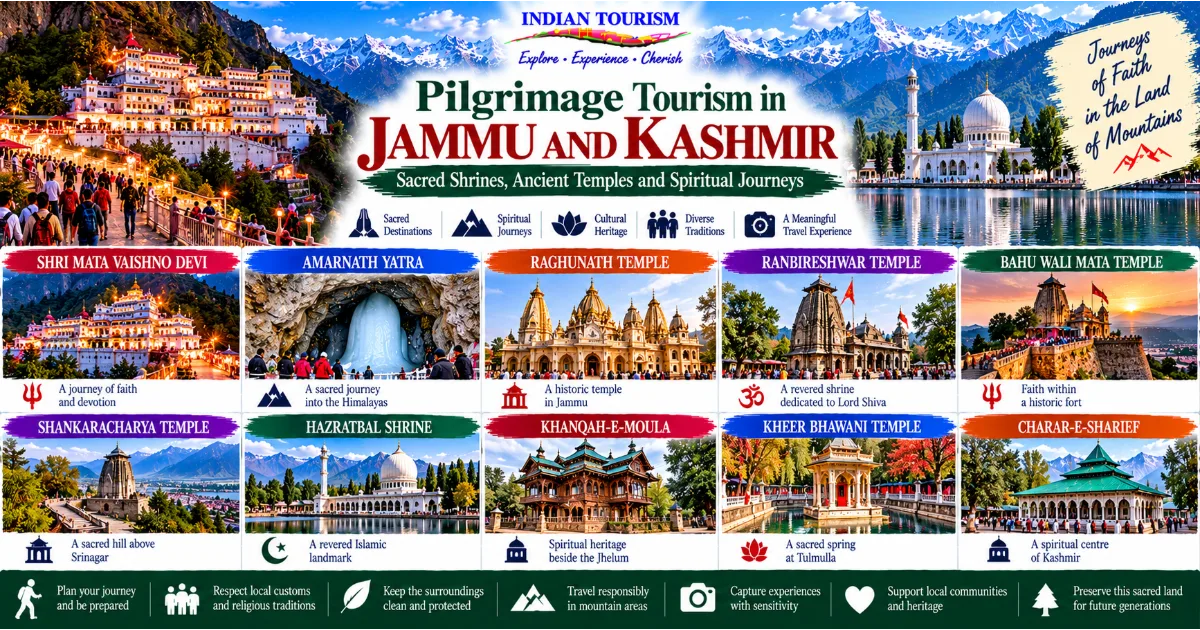
Discovering the Spiritual Heritage of the Himalayas
Jammu and Kashmir is celebrated for its mountains, lakes, gardens and historic architecture, but the region also holds a special place in India's spiritual landscape. For centuries, pilgrims have travelled through its valleys, climbed its hills and crossed mountain routes to visit temples, shrines, monasteries and sacred natural sites. These journeys reflect the region's religious diversity, historical traditions and enduring relationship between faith and the Himalayan environment.
Pilgrimage tourism offers a different way to experience Jammu and Kashmir. Instead of focusing only on scenic viewpoints and sightseeing, visitors explore places that carry religious significance for communities across generations. The journey may involve walking along a mountain path, offering prayers at an ancient temple, visiting a revered shrine or learning about the traditions associated with a sacred landscape. For many pilgrims, the destination is important, but the journey itself is also a meaningful part of the experience.
Jammu is particularly well known for the Shri Mata Vaishno Devi pilgrimage, which attracts devotees from across India. The region also contains historic temples, including Raghunath Temple and Ranbireshwar Temple, along with sacred sites associated with local religious traditions. In the Kashmir Valley, the Shankaracharya Temple, Hazratbal Shrine and other religious landmarks represent different aspects of the region's spiritual heritage. The Amarnath Cave pilgrimage is one of the best-known high-altitude religious journeys in the Himalayas.
These destinations differ greatly in accessibility, physical demands, facilities and religious practices. Some are located within cities and can be visited during an ordinary sightseeing trip, while others require registration, careful preparation or travel through challenging mountain terrain. Understanding these differences is essential for planning a safe and respectful pilgrimage.
This guide explores major pilgrimage destinations in Jammu and Kashmir, their cultural significance, practical travel considerations and the importance of responsible conduct at sacred places.
Shri Mata Vaishno Devi Shrine: One of India's Major Pilgrimage Destinations
The Shri Mata Vaishno Devi Shrine, situated in the Trikuta Hills near Katra in Jammu, is one of the most important pilgrimage destinations in India. Devotees visit to seek the blessings of Mata Vaishno Devi, who is worshipped as a manifestation of the Divine Mother. The shrine attracts pilgrims from different states and communities throughout the year.
The pilgrimage traditionally begins in Katra, a town that serves as the principal base for the journey. From there, registered pilgrims follow the designated route towards the shrine. The journey involves an uphill walk through the mountains, although authorised transport and assistance options may be available under current arrangements for eligible visitors.
For many devotees, undertaking the journey on foot is an important part of their spiritual experience. The route includes resting places, facilities and checkpoints designed to support pilgrims. The atmosphere can become particularly devotional during busy periods, when people travel together while chanting prayers and encouraging one another along the way.
The pilgrimage requires preparation even though the route is supported by organised facilities. Visitors should wear comfortable footwear, carry suitable clothing and drinking water, and allow enough time for the ascent and return. People with health conditions or limited mobility should review the physical demands and available assistance before making the journey.
Registration and identity requirements must be followed according to the current official procedures. Travellers should verify the latest arrangements before departure, particularly during Navratri and other periods when the number of pilgrims may rise substantially.
Katra itself has developed around the needs of pilgrims. Accommodation, restaurants, shops and transport services support visitors before and after the journey. Travellers can also explore nearby Jammu attractions if their schedule allows.
The shrine is a religious destination rather than simply a mountain viewpoint. Visitors should follow the rules established by the shrine authorities, respect fellow pilgrims and maintain cleanliness along the route. A well-planned visit can combine spiritual reflection with an appreciation of the region's mountain environment and community hospitality.
The Amarnath Cave: A Sacred Journey into the Kashmir Himalayas
The Amarnath Cave is one of the most revered Hindu pilgrimage destinations in Jammu and Kashmir. Located in the high Himalayas, the cave is associated with Lord Shiva and is traditionally visited during the annual Amarnath Yatra. Devotees regard the naturally formed ice lingam inside the cave as a sacred manifestation of Shiva.
The pilgrimage is distinctive because it combines religious devotion with travel through a demanding mountain environment. Unlike urban temples that can be reached by ordinary road journeys, the Amarnath pilgrimage requires careful planning, attention to altitude and preparation for changing weather. Snow, rainfall, cold temperatures and difficult terrain can affect the journey.
The official pilgrimage period and permitted routes are determined according to arrangements for each year. Registration, medical fitness requirements and other rules may apply. Travellers should consult current official information before making plans rather than relying on details from previous seasons.
The journey offers striking views of mountain valleys, rocky slopes and high-altitude landscapes. However, these surroundings should not distract from the physical demands of the pilgrimage. Visitors need appropriate clothing, sturdy footwear and sufficient preparation for prolonged walking at elevation. People with medical conditions should seek professional medical advice before undertaking strenuous high-altitude travel.
Facilities and transport arrangements may vary according to the route and prevailing conditions. Pilgrims should follow the instructions of authorised personnel and avoid attempting shortcuts or entering restricted areas. Weather-related delays are possible, so keeping a flexible schedule is essential.
The Amarnath Yatra also illustrates the importance of coordination between local communities, pilgrimage authorities, medical services and transport providers. Managing large numbers of pilgrims in a fragile mountain environment requires attention to safety, sanitation and environmental protection.
For travellers interested in religious heritage, the pilgrimage provides insight into the enduring relationship between faith and the Himalayas. It should be approached with respect, preparation and an understanding that the journey is a sacred undertaking for the devotees who participate.
Raghunath Temple: A Major Religious Landmark in Jammu
Raghunath Temple is one of Jammu city's most prominent Hindu religious landmarks. Dedicated primarily to Lord Rama, the temple complex is associated with the Dogra rulers and the development of Jammu as an important religious and administrative centre.
The temple's history is closely linked with Maharaja Gulab Singh and the royal patronage of the nineteenth century. Its development reflects the role of rulers in supporting religious institutions, which often served as places of worship, community gathering and the preservation of traditional knowledge.
The complex contains multiple shrines, creating a broader religious environment rather than a single place of worship. Devotees visit to offer prayers and participate in religious observances throughout the year. During major festivals, the atmosphere can become especially active as families and pilgrims gather.
The temple's central location makes it convenient for visitors exploring Jammu's markets and historical attractions. A visit can be combined with other heritage sites, allowing travellers to understand how religious institutions have influenced the city's development.
As an active place of worship, Raghunath Temple has rules that visitors must follow. Security procedures, restrictions on belongings and photography arrangements may change. Travellers should confirm current instructions before visiting and respect the guidance of temple staff.
The surrounding streets provide additional insight into the relationship between religious life and commerce. Shops, local businesses and everyday urban activity continue around the temple, demonstrating how pilgrimage destinations can remain integral to the life of a city.
Raghunath Temple is particularly rewarding for travellers interested in religious architecture and the history of Jammu. Its significance lies in its continuing role in devotional life as well as its association with the region's historical development.
Ranbireshwar Temple: The Shiva Tradition of Jammu
Ranbireshwar Temple is another important religious destination in Jammu. Dedicated to Lord Shiva, it is associated with Maharaja Ranbir Singh and reflects the importance of religious patronage during the Dogra period.
The temple is known for its Shiva lingams, which form a central part of its religious identity. Devotees visit to offer prayers, seek blessings and observe important occasions in the Hindu religious calendar. Maha Shivaratri is particularly significant for worshippers of Shiva, although the scale and arrangements of celebrations can vary.
The temple provides an opportunity to understand how religious architecture supports ritual practice. The arrangement of sacred objects, worship areas and spaces for devotees reflects the needs of an active place of worship rather than simply a historical monument.
Visitors who are exploring Jammu's religious heritage can combine Ranbireshwar Temple with Raghunath Temple and Bahu Fort. Together, these sites reveal different aspects of the city's spiritual traditions and historical identity.
Travellers should dress respectfully, follow the temple's entry procedures and avoid interrupting worship. Photography may be restricted in particular areas, so visitors should ask or check posted rules before using a camera.
The temple also demonstrates the continuing importance of sacred spaces in urban life. Although Jammu has developed into a modern city, its religious institutions remain places where families maintain traditions, celebrate festivals and pass cultural knowledge to younger generations.
For visitors, the most rewarding approach is to appreciate both the building and the living religious practices that give it meaning.
Bahu Wali Mata Temple: Faith Within a Historic Fort
Bahu Wali Mata Temple, situated within Bahu Fort in Jammu, is an important religious destination associated with the worship of the Divine Mother. Its location within a historic fort makes it distinctive among the city's pilgrimage sites.
Bahu Fort stands on elevated ground overlooking the Tawi River. The setting provides a connection between the region's historical landscape and its religious traditions. The fort is associated with local history, while the temple continues to attract devotees who come to offer prayers.
The temple is especially busy during important religious occasions, including Navratri. During these periods, pilgrims may gather in large numbers, and the surrounding area can become crowded. Visitors should allow additional time for transport and entry procedures.
A visit to Bahu Wali Mata Temple can be combined with an exploration of the fort and the surrounding area. However, travellers should remember that the temple is an active place of worship and that devotional activity takes priority over sightseeing.
The location also illustrates how religious sites can become part of a destination's broader identity. The fort, the temple and the surrounding urban landscape are connected through history, local memory and continued public use.
Visitors should follow the instructions of temple authorities, avoid littering and respect the privacy of worshippers. During major gatherings, it is particularly important to remain patient and follow crowd-management arrangements.
For travellers interested in Jammu's religious and historical heritage, Bahu Wali Mata Temple provides a meaningful opportunity to explore a place where sacred tradition and regional history meet.
Shankaracharya Temple: A Sacred Hill Above Srinagar
Shankaracharya Temple is one of the most recognisable religious landmarks in Srinagar. Dedicated to Lord Shiva, it stands on an elevated hill overlooking parts of the city and Dal Lake. Its position gives it both spiritual importance and a distinctive place within Srinagar's landscape.
The temple is associated with long-standing religious traditions, although interpretations of its earliest history and development should be considered alongside historical evidence and local accounts. Its importance today is connected with its continuing religious role and its position as a landmark of Kashmir's cultural heritage.
Reaching the temple involves travelling up the hill and climbing steps. The physical effort required depends on access arrangements and the visitor's ability. Travellers should wear comfortable footwear, allow sufficient time and consider the climb carefully if they have mobility limitations.
The elevated location offers views of the city, lake and surrounding hills. These views are attractive, but visitors should remain mindful that the temple is an active sacred site. Religious observance and site rules should take priority over photography or sightseeing.
Security arrangements and restrictions concerning belongings, vehicles and cameras may apply. These rules can change, so visitors should confirm the current instructions before travelling.
Shankaracharya Temple can be included in a wider Srinagar itinerary alongside the Mughal gardens, Dal Lake and other heritage attractions. Allowing time for a calm visit can make the experience more meaningful than treating the temple as a brief stop on a busy sightseeing schedule.
The temple illustrates how sacred places in Kashmir are often connected with the surrounding natural landscape. Hills, lakes and mountain views form part of the setting through which visitors experience the region's spiritual heritage.
Hazratbal Shrine: A Revered Islamic Landmark
Hazratbal Shrine, located on the western shore of Dal Lake in Srinagar, is one of the most important Islamic religious sites in Kashmir. It is revered for a sacred relic believed by devotees to be associated with Prophet Muhammad.
The shrine's white architecture and lakeside setting make it a prominent feature of Srinagar's cultural landscape. However, its primary importance is religious, and visitors should understand that the site serves a living community of worshippers.
The shrine attracts devotees throughout the year, with especially significant gatherings during important religious occasions. These gatherings demonstrate its place in the spiritual life of Kashmir and its importance to families and communities across the region.
A visit can be combined with a journey around Dal Lake or an exploration of other religious and historical landmarks in Srinagar. The surrounding area also provides insight into the relationship between sacred spaces and the everyday life of local neighbourhoods.
Visitors should dress modestly, follow entry instructions and behave respectfully. Photography rules may vary according to the area and occasion. Travellers should ask before photographing people and should never interrupt worship to obtain a picture.
Hazratbal also illustrates the diversity of Kashmir's religious heritage. Its architecture, traditions and continuing importance provide a different perspective from the region's Hindu temples and ancient archaeological sites.
For visitors interested in cultural tourism, the shrine offers an opportunity to understand the relationship between faith, community identity and the historic landscape of Srinagar.
Khanqah-e-Moula: Spiritual Heritage Beside the Jhelum
Khanqah-e-Moula, also known as Shah-e-Hamadan Mosque, is a major religious landmark in the old city of Srinagar. Situated near the Jhelum River, it is associated with Mir Sayyid Ali Hamadani, a prominent Persian scholar and spiritual figure whose influence is remembered in Kashmir's Islamic history.
The building is known for its traditional wooden architecture and decorative details. Its form reflects regional craftsmanship and demonstrates how local materials and construction traditions were used to create distinctive religious buildings.
The khanqah is important not only as a place of worship but also as a symbol of the historical development of spiritual and scholarly traditions in Kashmir. Religious institutions have played significant roles in community life, education, cultural exchange and the preservation of spiritual knowledge.
The surrounding old city contributes to the experience. Traditional houses, narrow streets, markets and the riverfront reveal how Srinagar developed around its waterways and neighbourhood networks.
Visitors should explore the area with sensitivity because it remains a living urban environment. Residents use the streets for daily activities, and the religious site continues to serve worshippers. Photography should not intrude on private life or interrupt religious practices.
A knowledgeable local guide can help explain the building's architectural features and the historical importance of the surrounding neighbourhood. Travellers should follow current access arrangements and respect any restrictions established by the site authorities.
Khanqah-e-Moula is especially valuable for visitors who want to understand the Islamic cultural heritage of Kashmir beyond its most familiar tourist attractions.
Charar-e-Sharief: A Sacred Town of Spiritual Significance
Charar-e-Sharief is a historic town in the Kashmir Valley associated with Sheikh Noor-ud-Din Noorani, widely revered in Kashmir's spiritual traditions. He is also known as Nund Rishi and is an important figure in the region's Rishi tradition, which has influenced its religious and cultural identity.
The shrine associated with the saint attracts visitors seeking spiritual reflection and an understanding of Kashmir's religious history. The town's significance extends beyond a single building because it is connected with a broader tradition of spirituality, ethical teaching and community memory.
Sheikh Noor-ud-Din Noorani is remembered for teachings that emphasised moral conduct, simplicity and spiritual awareness. His legacy is significant in Kashmiri cultural history, and his poetry and teachings have contributed to the region's religious imagination.
A visit to Charar-e-Sharief can provide insight into the way spiritual figures become part of a community's identity. Shrines may serve as places of prayer, remembrance and gathering, while the surrounding town continues its everyday life.
Travellers should verify current access conditions and local guidance before visiting. As with any active religious site, respectful clothing, quiet behaviour and sensitivity towards worshippers are important.
The town can be included in a wider cultural journey through the Kashmir Valley, depending on road conditions and the time available. Visitors should allow enough time to explore without rushing through the religious and historical context.
Charar-e-Sharief is a reminder that the spiritual heritage of Kashmir includes traditions of reflection, poetry and ethical teaching as well as formal religious institutions.
Kheer Bhawani Temple: A Sacred Destination at Tulmulla
Kheer Bhawani Temple, located at Tulmulla in the Ganderbal district, is an important Hindu pilgrimage site associated with the worship of Goddess Ragnya Devi. It holds particular significance for Kashmiri Pandits and is known for its sacred spring and distinctive religious setting.
The temple is traditionally associated with the offering of kheer, a milk-based preparation, which contributes to the site's name and devotional practices. Ritual customs may vary, and visitors should follow the guidance of temple authorities rather than assume that all practices are identical across families.
The sacred spring forms an important part of the temple's identity. Its surroundings create a setting in which natural features and religious tradition are closely connected. Visitors may observe worshippers offering prayers and participating in rituals associated with the goddess.
The annual festival associated with Kheer Bhawani attracts devotees, particularly during the period linked with Jyeshtha Ashtami. The gathering has religious and cultural importance, bringing people together through prayer and shared traditions.
The temple's significance also extends to the cultural memory of Kashmiri Pandit families, including those living outside the Valley. Visits can reinforce connections with ancestral traditions and places associated with family history.
Travellers should check the calendar and current arrangements before planning a visit around the annual gathering. Crowds, transport and access arrangements may differ from ordinary days.
Kheer Bhawani Temple can be a meaningful destination for visitors interested in the religious heritage of Kashmir. It should be approached with respect for the people who regard it as a sacred place and for the traditions that continue there.
Aharbal and Other Sacred Landscapes: Understanding Nature and Faith
Some pilgrimage journeys in Jammu and Kashmir are closely connected with natural landscapes, including mountains, springs, rivers and remote valleys. These places may carry religious meaning through local traditions, stories and practices that have developed over generations.
The region's geography has influenced the location of sacred places. Hills can provide sites for temples and shrines, while springs and rivers may become associated with particular traditions. In some cases, the natural setting is an essential part of the experience rather than simply a backdrop.
Aharbal is best known for its waterfall and surrounding landscape, but it also demonstrates the broader appeal of destinations where nature and local cultural life meet. Visitors should distinguish between places that are primarily established tourist attractions and those with specific religious significance, rather than assuming that every scenic location is a formal pilgrimage destination.
When exploring rural or remote areas, travellers should seek reliable local information about access, safety and cultural expectations. Some routes may be affected by weather, while others may require additional preparation or local guidance.
Respect for the environment is particularly important around springs, rivers and forested landscapes. Visitors should avoid leaving waste, disturbing wildlife or damaging vegetation. If a location is regarded as sacred by local communities, travellers should follow the customs associated with it.
These landscapes reveal that spiritual heritage is not confined to large temples or well-known shrines. Local traditions can also give meaning to particular places in the natural environment, creating a relationship between faith, geography and community memory.
Best Time to Visit Pilgrimage Destinations
The best time for pilgrimage tourism depends on the destination, religious calendar, weather and physical demands of the journey.
Spring is suitable for exploring many temples and shrines in Jammu and the Kashmir Valley. Temperatures generally become more comfortable for walking, and the surrounding landscapes begin to show fresh growth. However, weather can still change, and visitors should carry appropriate clothing.
Summer is important for high-altitude pilgrimage routes, including the Amarnath Yatra, which operates during a limited period according to official arrangements. Travellers should not assume that the route is accessible throughout the summer or that the same rules apply every year.
Navratri can bring large numbers of devotees to the Shri Mata Vaishno Devi Shrine and other religious sites. The atmosphere may be particularly devotional, but accommodation and transport can become busy. Advance planning is advisable.
Religious observances such as Eid follow the Islamic lunar calendar, so their dates change relative to the Gregorian calendar. Visitors should check locally confirmed dates and be aware that business hours and transport schedules may be affected.
Winter can be suitable for visiting many urban temples and shrines, although cold weather, snow and road conditions may influence travel. High-altitude routes can be inaccessible or unsafe during this season.
The most appropriate travel period is the one that combines the visitor's religious interests with realistic expectations about access, weather and physical ability. Current official information should always take priority over old itineraries.
Practical Tips for Planning a Pilgrimage
Planning is essential for a safe and respectful pilgrimage. Before travelling, visitors should confirm opening hours, registration requirements, entry procedures and any restrictions on personal belongings. These details are particularly important for major shrines and high-altitude routes.
Travellers undertaking strenuous journeys should assess their fitness and carry suitable footwear, clothing, water and essential medication. High-altitude pilgrimages require additional care because reduced oxygen levels, cold temperatures and physical exertion can create health risks.
Accommodation should be booked in advance during major religious festivals. Katra and other pilgrimage centres can become crowded, while remote destinations may have limited facilities. Visitors should confirm transport arrangements and avoid relying on unverified last-minute offers.
Religious sites require appropriate behaviour. Dress modestly, remove footwear where instructed and follow the rules established by temple, mosque or shrine authorities. Photography should only take place where permitted.
Families travelling with children or older relatives should consider walking distances, available rest areas and accessibility. Not every site is suitable for visitors with limited mobility, and some mountain routes can be demanding.
Travellers should also keep a flexible schedule. Weather, crowd management and official decisions can affect access, particularly for major pilgrimages. Allowing additional time can reduce stress and improve safety.
Finally, visitors should remember that pilgrimage sites serve local worshippers throughout the year. Patience, respect and consideration for other people are essential parts of a meaningful visit.
Responsible Pilgrimage Tourism and Environmental Protection
Pilgrimage tourism can support local livelihoods through accommodation, food services, transport, guiding and small businesses. However, large gatherings can also place pressure on water supplies, waste management, roads and fragile natural environments.
Visitors can reduce their impact by using designated waste facilities, carrying reusable water bottles where practical and avoiding litter along walking routes. Plastic packaging and discarded food can create problems in mountain areas where waste collection is difficult.
At high-altitude sites, travellers should follow established paths and avoid disturbing vegetation or wildlife. Campsites and resting areas should be used only where permitted, and waste should be managed according to local requirements.
Respect for religious spaces is equally important. Visitors should not disturb ceremonies, enter restricted areas or photograph worshippers without appropriate permission. Cultural sensitivity helps preserve the dignity of sacred places and the communities that maintain them.
Supporting legitimate local businesses can help ensure that pilgrimage tourism contributes to the regional economy. Travellers should confirm prices, use authorised transport and avoid services that ignore safety rules.
Responsible pilgrimage tourism also means understanding the physical limits of the destination. A mountain route cannot safely accommodate unlimited visitors under every weather condition, and official restrictions may be necessary to protect pilgrims.
By following local guidance and behaving responsibly, visitors can help ensure that sacred destinations remain accessible, meaningful and environmentally sustainable for future generations.
Conclusion: A Spiritual Journey Through Jammu and Kashmir
Pilgrimage tourism in Jammu and Kashmir reveals a rich spiritual landscape shaped by centuries of faith, tradition and cultural exchange. The Shri Mata Vaishno Devi Shrine and the Amarnath Cave represent major Hindu pilgrimage journeys, while Raghunath Temple, Ranbireshwar Temple and Bahu Wali Mata Temple preserve important religious traditions in Jammu.
In the Kashmir Valley, Shankaracharya Temple, Hazratbal Shrine, Khanqah-e-Moula, Charar-e-Sharief and Kheer Bhawani Temple demonstrate the diversity of the region's spiritual heritage. Each destination has its own history, customs and continuing significance for the communities that visit it.
These sacred places also reveal the close relationship between religion and geography. Hills, lakes, rivers and mountain valleys shape the experience of pilgrimage, creating journeys that combine devotion with an appreciation of the Himalayan environment.
For travellers, a meaningful pilgrimage requires more than reaching a destination. It involves preparation, respect for religious practices, awareness of physical demands and consideration for local communities. Checking current access rules, planning around religious calendars and protecting the environment are essential parts of responsible travel.
Jammu and Kashmir's spiritual heritage deserves to be explored with the same care given to its natural beauty and historic architecture. By approaching its temples, shrines and pilgrimage routes with understanding and respect, visitors can gain a deeper appreciation of the traditions that continue to shape the region.
#IndianTourism #JammuAndKashmir #PilgrimageTourism #VaishnoDevi #AmarnathYatra #RaghunathTemple #RanbireshwarTemple #ShankaracharyaTemple #HazratbalShrine #KheerBhawani #ChararESharief #SpiritualTravel #ReligiousTourism #KashmirHeritage #JammuHeritage #ResponsibleTourism #ExploreIndia
