
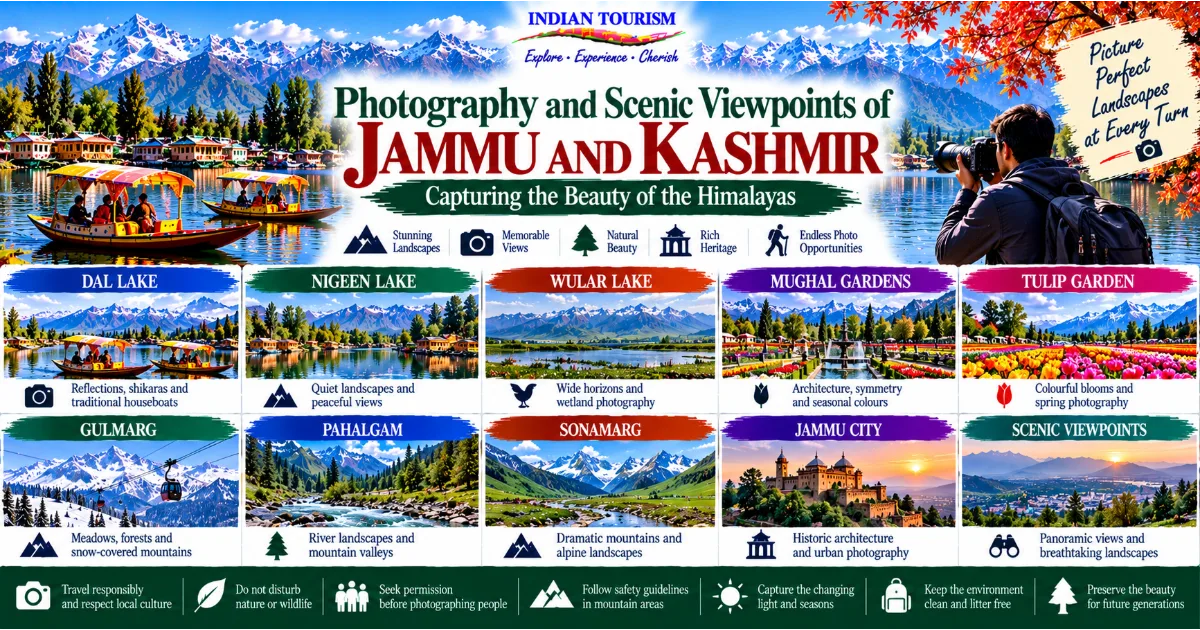
A Photographer's Journey Through Jammu and Kashmir
Jammu and Kashmir offers extraordinary opportunities for photography, from snow-covered Himalayan peaks and peaceful lakes to flower-filled gardens, traditional wooden houses, historic temples and vibrant local markets. Every season transforms the landscape, creating new possibilities for travellers who want to capture the region's natural beauty and cultural richness. Whether someone enjoys landscape photography, wildlife observation, travel portraits, architectural details or simple photographs of memorable experiences, Jammu and Kashmir provides a remarkable variety of subjects.
The region's visual appeal comes from the relationship between its natural surroundings and the communities that live among them. The reflections of mountains in Dal Lake, the terraced gardens of Srinagar, the winding roads of mountain valleys and the historic architecture of Jammu all tell different stories. A photograph can preserve a beautiful view, but it can also reveal the connection between geography, history, livelihood and culture.
Srinagar is an excellent starting point for photography because its lakes, gardens, old neighbourhoods and surrounding hills offer a variety of subjects within a relatively compact area. Pahalgam provides opportunities to photograph rivers, forests and mountain scenery, while Gulmarg is known for expansive meadows and winter landscapes. Sonamarg offers dramatic mountain views and access to highland scenery, subject to seasonal conditions. Jammu presents a different visual character through its historic monuments, religious landmarks, river landscapes and urban life.
Photography in Jammu and Kashmir requires some planning. Light changes rapidly in mountain environments, weather can affect visibility, and certain locations have security or photography restrictions. Travellers should also understand that not every person, religious ceremony or private property is available for photography. Respectful behaviour is essential, particularly in places of worship and residential neighbourhoods.
This guide explores the most rewarding photography destinations in Jammu and Kashmir, explains how different seasons affect the landscape and offers practical suggestions for capturing memorable images while travelling responsibly.
Dal Lake: Reflections, Shikaras and Traditional Houseboats
Dal Lake is one of the most recognisable photography destinations in Kashmir. Its combination of water, mountain scenery, traditional houseboats and colourful shikaras creates a landscape that changes throughout the day. The lake offers opportunities for wide scenic photographs as well as detailed images of boats, floating gardens and everyday life along the water.
Early morning is particularly attractive for photography. When the water is calm, the surrounding mountains and buildings may appear as reflections on the lake. Soft light can bring out the colours of the sky without producing the strong contrast often associated with midday sunlight. Early hours may also reveal the quieter rhythms of local life, including boats moving across the water and vendors beginning their daily activities.
Shikara rides provide another perspective. Photographing from a boat allows travellers to capture the changing relationship between water, buildings and mountains. A wide-angle view can show the scale of the lake, while a longer focal length can isolate a boat, distant shoreline or architectural detail. Travellers should secure their equipment and avoid leaning dangerously over the side while taking photographs.
Houseboats add a distinctive architectural element. Their wooden balconies, carved details and traditional forms can be attractive subjects, especially when reflected in the water. Visitors should obtain permission before photographing private houseboats or their occupants at close range.
The surrounding hills and changing skies create opportunities throughout the day. Late afternoon can produce warm light across the water, while cloudy conditions may create dramatic reflections and softer colours. During winter, the lake can have a quieter atmosphere, although cold weather and changing conditions may limit boating opportunities.
A successful Dal Lake photography session does not require expensive equipment. A smartphone can capture excellent images when the photographer pays attention to composition, light and timing. Keeping the horizon level, avoiding unnecessary digital zoom and waiting for a natural moment can often produce a stronger image than taking many photographs without planning.
Nigeen Lake: Quiet Landscapes and Peaceful Reflections
Nigeen Lake offers a more restrained visual atmosphere than some of the busiest parts of Dal Lake. Its water, tree-lined edges, houseboats and surrounding hills create opportunities for peaceful landscape photography.
The lake can be particularly appealing to photographers who prefer quieter compositions. Instead of filling the frame with crowds and numerous boats, a photograph can focus on a single shikara, a reflection or the relationship between a houseboat and the surrounding landscape.
Early morning and late afternoon are useful times to explore the shoreline. Soft light can reveal details in wooden structures and trees while maintaining a natural balance between bright skies and darker foregrounds. Reflections may be especially attractive when the water is calm, although wind can change the surface within minutes.
Photographers should pay attention to the background. A visually interesting subject can become less effective if buildings, wires or unrelated objects appear in distracting positions. Moving a few steps to one side or waiting for a boat to change position can create a more balanced composition.
Nigeen is also suitable for environmental photography. Images of boats, aquatic vegetation and the surrounding settlement can help tell a story about the relationship between local communities and the lake. However, the environment should not be disturbed to obtain a photograph. Visitors should avoid entering restricted areas or disturbing birds and plants.
Travellers staying in the area should ask before photographing the interiors of houseboats or the private activities of residents. A quiet landscape can be photographed without turning the lives of local people into unwanted subjects.
Nigeen Lake is best appreciated at a relaxed pace. Spending time observing the changing light often produces more meaningful photographs than moving quickly between several locations.
Wular Lake: Wide Horizons and Wetland Photography
Wular Lake provides a different photographic experience because of its large scale and ecological importance. Its open water, surrounding settlements and broad horizons contrast with the more enclosed setting of Srinagar's urban lakes.
Landscape photographers can use Wular's expansive views to create images that emphasise space. A wide composition can include the lake, the sky and the distant hills, while a more focused photograph can highlight the texture of the water or a boat moving across it.
Weather has a major influence on the lake's appearance. Clear conditions may reveal distant mountains and create a bright, open landscape. Overcast skies can produce softer tones and a more subdued atmosphere. Morning mist, when it occurs, can introduce depth and a sense of distance, although visibility and travel conditions should always be considered.
Wular is also relevant to birdwatching and wetland photography. Visitors may encounter birds and other wildlife, depending on the season and location. Wildlife should be photographed from a suitable distance, using optical zoom or a longer lens rather than approaching animals closely.
The lake supports fishing communities and other local livelihoods. Photographs that document these activities can help communicate the relationship between people and the environment, but consent is important when individuals are identifiable. Visitors should ask before making close-up portraits or documenting private work.
Because Wular is an important wetland, photographers should avoid disturbing sensitive habitats. They should remain in permitted areas, avoid entering reed beds or nesting zones and follow local guidance about access.
The best photographs of Wular often come from patience. Waiting for a boat to cross the frame or for the light to change can create a more compelling image than trying to include every feature in a single photograph.
Mughal Gardens: Architecture, Symmetry and Seasonal Colours
The Mughal gardens of Srinagar are rewarding destinations for photographers interested in landscape design and architectural composition. Shalimar Bagh, Nishat Bagh and Chashme Shahi combine terraces, water channels, fountains, trees and views of the surrounding mountains.
These gardens offer strong opportunities for symmetrical compositions. A central water channel can guide the viewer's eye towards a distant pavilion, while the repeating pattern of terraces creates visual rhythm. Photographers can use the arrangement of pathways, walls and planted areas to create a sense of depth.
Nishat Bagh is especially attractive for photographs that combine garden terraces with the setting of Dal Lake. Its elevated arrangement provides changing viewpoints, allowing visitors to photograph the garden itself as well as the landscape beyond it.
Shalimar Bagh offers architectural details and formal garden layouts that reflect the Mughal tradition of landscape design. Photographers can focus on the relationship between water and architecture, the textures of stone and wood, or the way trees frame a particular view.
Chashme Shahi provides a smaller and more compact setting where the relationship between water and terraces can become the main subject. Its scale makes it suitable for detail photography as well as wider landscape compositions.
Seasonal timing makes a significant difference. Spring brings fresh growth and flowering plants, summer produces lush greenery, and autumn can create warm colours in trees and surrounding hills. The appearance of the gardens depends on weather and maintenance, so travellers should not expect identical conditions each year.
Visitors should avoid stepping into flower beds, climbing restricted structures or obstructing pathways while setting up photographs. Tripods and other equipment may be subject to site rules. Checking the current photography policy before visiting is a sensible precaution.
Indira Gandhi Memorial Tulip Garden: Colour and Spring Photography
The Indira Gandhi Memorial Tulip Garden is one of the most visually striking seasonal attractions in Srinagar. Situated on the slopes of the Zabarwan Range, it offers colourful flower displays with views towards Dal Lake and the surrounding mountains.
The annual flowering period creates opportunities for photography that combines foreground colour with a broad Himalayan setting. Rows of tulips can provide strong leading lines, while individual flowers can become the main subject in close-up images.
A wide-angle composition can show the scale of the garden and its mountain backdrop. A closer composition can emphasise colour, texture and the arrangement of petals. Photographers should consider the background before taking close-ups, because distracting shapes or overly bright areas can draw attention away from the flower.
Morning and late afternoon often provide softer light than the middle of the day. However, the best time depends on the weather and the direction of the sun. Cloudy conditions can reduce harsh shadows and create even lighting across the flower beds.
The timing of the Tulip Festival varies according to the flowering cycle and weather. Travellers planning a dedicated photography trip should check recent announcements and bloom conditions before booking. Arriving too early or too late may mean that the displays differ from expectations.
The garden can be crowded during popular periods. Photographers should be patient, avoid blocking narrow paths and wait for clear moments rather than pushing into busy areas. Flowers should never be picked or damaged to improve a composition.
Tulip photography is a useful reminder that strong travel images do not always require dramatic scenery. Attention to colour, pattern, light and perspective can turn a simple flower into a memorable photograph.
Gulmarg: Meadows, Forests and Snow-Covered Mountains
Gulmarg is one of the most popular mountain destinations for landscape photography in Jammu and Kashmir. Its open meadows, coniferous forests, mountain views and seasonal snow create a range of photographic opportunities.
During warmer months, the landscape can feature green slopes, wildflowers and open views across the surrounding mountains. Photographers can capture broad scenes that show the relationship between the meadow and the surrounding forest, or focus on smaller details such as flowers, grass and changing light.
Winter transforms Gulmarg into a destination for snow photography. Snow-covered trees, open white slopes and distant mountain ridges create opportunities for minimalist compositions. A single line of trees or a person walking across a snowy landscape can provide a sense of scale.
Snow can be challenging to photograph because cameras sometimes render bright scenes darker than expected. Photographers should review their images and adjust exposure where necessary to preserve the brightness of the snow without losing important details. Smartphone users can tap on the bright area of the scene and make a small exposure adjustment if their camera provides that control.
Weather can change quickly in the mountains. Cloud, snowfall, wind and low visibility may alter the landscape within a short period. Visitors should check local forecasts and avoid leaving safe routes to obtain a photograph.
The Gulmarg Gondola is a major attraction, but access and operating conditions depend on weather, maintenance and official arrangements. Travellers should confirm current operating information before planning a photography session around the ride.
Photographers should also respect local restrictions and avoid photographing sensitive infrastructure or restricted areas. Winter landscapes can be beautiful, but personal safety must take priority over obtaining a particular image.
Pahalgam: River Landscapes, Forests and Mountain Valleys
Pahalgam offers a diverse range of photographic subjects, including the Lidder River, forested slopes, mountain meadows and traditional settlements. Its landscape changes significantly according to the season, making it suitable for photographers interested in nature and rural travel.
The Lidder River is one of the area's most recognisable subjects. Its flowing water, rocky banks and surrounding vegetation create opportunities for photographs that communicate movement and atmosphere. A fast shutter speed can freeze individual splashes, while a slower shutter speed, when safely supported and conditions permit, can produce a smoother appearance of flowing water.
Photographers should never stand in unsafe positions near the river to obtain a better angle. Slippery rocks, cold water and changing currents can create serious hazards. Safe viewpoints and established paths should always take priority.
The surrounding meadows and forests provide opportunities for wide landscape compositions. Including a tree, rock or person in the foreground can help communicate the scale of the mountains. During clear conditions, distant peaks may become prominent subjects, while mist and cloud can create a softer, more atmospheric image.
Pahalgam is also a useful place for documenting rural life, local architecture and seasonal tourism. Visitors should ask permission before photographing people, private homes or activities that may be sensitive.
Some areas around Pahalgam have seasonal access restrictions or require authorised transport arrangements. Travellers should confirm current rules before visiting particular valleys or viewpoints.
The strongest photographs often combine several elements of the landscape rather than focusing only on the mountains. A river leading towards a distant peak, a path crossing a meadow or a traditional structure surrounded by trees can communicate the character of Pahalgam more effectively than an isolated mountain image.
Sonamarg: Dramatic Mountains and Alpine Landscapes
Sonamarg, often associated with the name meaning Meadow of Gold, offers dramatic mountain scenery and access to highland landscapes. Its open valleys, river views and surrounding peaks make it a rewarding destination for photographers who enjoy expansive natural environments.
The visual character of Sonamarg depends heavily on the season. During warmer months, green meadows and flowing water contrast with the surrounding mountains. Snow may remain visible at higher elevations, creating layered compositions of different textures and colours. In colder periods, access can be affected by snow and road conditions.
A wide landscape photograph can emphasise the scale of the valley, while a narrower composition can isolate a mountain ridge or river bend. Including a foreground element helps create depth and gives the viewer a reference point for the size of the landscape.
Clouds can add drama to mountain photography. Moving cloud shadows may change the appearance of slopes, while low cloud can partially conceal peaks and create a sense of mystery. Photographers should remain flexible because the best view may appear only briefly.
Sonamarg is also a gateway to high-altitude routes and glacier-associated landscapes. These areas require careful planning, and visitors should not assume that every viewpoint or trail is accessible throughout the year. Current conditions, local guidance and any applicable restrictions should be checked before departure.
Travellers should be particularly cautious around rivers, unstable slopes and areas affected by snow or ice. It is not worth risking personal safety for a photograph.
Sonamarg rewards photographers who allow time for changing conditions. Instead of taking a single photograph from a roadside stop, consider how the landscape looks from several safe viewpoints and how the light changes throughout the visit.
Jammu City: Historic Architecture and Urban Photography
Jammu offers a photographic experience that differs from the lakes and mountain meadows of the Kashmir Valley. Its forts, temples, palaces, markets and river landscapes create opportunities to document the region's history and urban character.
Bahu Fort is a particularly recognisable landmark. Its elevated position above the Tawi River creates opportunities for photographs that combine architecture and landscape. The surrounding area can also provide views of the river and parts of the city.
Mubarak Mandi Palace offers architectural details associated with the former royal establishment. Photographers interested in heritage can focus on courtyards, arches, balconies and surviving decorative features, subject to current access and photography rules.
Amar Mahal Palace provides another architectural perspective, with its distinctive design and elevated setting. Visitors should check the rules for photographing interiors and museum collections before taking pictures.
Raghunath Temple and Ranbireshwar Temple are important religious landmarks. Their architecture and surroundings may be photographed only in accordance with the current rules of each site. Active religious spaces require particular sensitivity, and visitors should not interrupt worship or ignore restrictions.
Jammu's markets provide opportunities for street photography, including textiles, food stalls and everyday commercial life. However, photographing people at close range should involve permission where appropriate. Some vendors may welcome photographs, while others may prefer not to be photographed.
The city is often warmer than the Kashmir Valley, particularly in summer. Photographers should plan outdoor sessions for comfortable parts of the day and carry drinking water. Early mornings can provide softer light and less crowded streets.
Urban photography becomes more meaningful when it captures the relationship between people, architecture and everyday life rather than treating a city as a collection of monuments.
Scenic Viewpoints Around Srinagar
Srinagar's location beside Dal Lake and beneath the Zabarwan hills creates numerous opportunities for panoramic photography. Elevated viewpoints allow visitors to appreciate the relationship between the city, the lake and the surrounding mountains.
Shankaracharya Hill is a well-known location for views across parts of Srinagar and Dal Lake. The temple at the top is an active religious site, so visitors should follow security requirements and photography restrictions. Travellers should not assume that photography is permitted everywhere on the hill or inside the temple.
Pari Mahal offers another elevated perspective. Its terraced structures create foreground elements that can frame the landscape, while the views across Dal Lake and the city provide opportunities for wide compositions.
The Mughal gardens also provide scenic viewpoints. Nishat Bagh is particularly known for its relationship with Dal Lake, while Shalimar Bagh offers a different combination of terraces, water and planting.
A good viewpoint does not always need to be high above the city. Lakeside paths, bridges and open public spaces can also provide attractive perspectives, especially when reflections or foreground details are present.
Photographers should confirm access arrangements and opening times before travelling to a viewpoint. Some sites have security checks or restrictions that affect the use of equipment. Travellers should avoid using drones unless they have confirmed that the activity is legally permitted and all necessary permissions have been obtained.
The best viewpoint is one that allows a safe, respectful and unhurried experience. A clear photograph from a permitted public area is preferable to an image obtained by entering a restricted location.
Best Seasons for Photography in Jammu and Kashmir
Spring is particularly rewarding for flower photography and fresh landscapes. The Tulip Garden and Badamwari Garden can provide colourful seasonal subjects, while the Mughal gardens begin to show renewed growth. The exact timing of flowers varies according to weather, so visitors should check current conditions.
Summer is suitable for many mountain landscapes, river scenes and outdoor travel experiences. Green meadows, flowing rivers and accessible routes create a wide range of subjects. Popular destinations can be crowded, and photographers may benefit from starting early.
Autumn is attractive for warm foliage colours and softer light. Chinar trees, gardens and mountain landscapes can take on rich tones, making this a good season for photography that emphasises colour and atmosphere.
Winter creates opportunities for snow photography, particularly in destinations such as Gulmarg and higher parts of the Kashmir Valley. Cold weather, reduced daylight and changing road conditions require additional preparation.
High-altitude areas may have very different conditions from Srinagar or Jammu. A location that is accessible in summer may be difficult or unsafe in winter. Visitors should always check current forecasts and local travel guidance before planning a photography trip.
The best season also depends on the subject. A traveller interested in tulips should prioritise the flowering period, while someone seeking snow-covered landscapes should focus on the winter season and confirm access conditions.
Practical Photography Tips for Travellers
Good travel photography begins with observation. Before taking a picture, consider the main subject, the direction of the light and the elements that will appear around it. A simple composition with a clear subject often communicates more effectively than a crowded frame.
The rule of thirds can be a useful starting point. Placing the horizon or main subject away from the exact centre may create a more balanced image, although centred compositions can work particularly well for reflections and symmetrical gardens.
Wide-angle views are useful for mountains, valleys and large gardens, while a moderate zoom can isolate architectural details, boats or distant subjects. Travellers do not need a large collection of equipment. A smartphone or a single versatile camera lens can be enough for most sightseeing situations.
Keep camera equipment protected from rain, snow, dust and sudden temperature changes. Cold weather can reduce battery performance, so carrying a charged spare battery or a power bank may be useful. Allow equipment to adjust gradually when moving between very cold outdoor conditions and warm indoor spaces to reduce condensation.
Photographers should avoid standing in roads, leaning over riverbanks or moving into unstable terrain for a better angle. Tripods should be used only where permitted and where they do not obstruct other visitors.
Before travelling, back up important images when possible. A lost or damaged device should not mean losing every photograph from the trip.
Most importantly, take time to enjoy the destination without viewing every moment through a camera. Some of the most memorable experiences are those that remain personal rather than being recorded.
Respectful Photography and Local Culture
Photography is a powerful way to document the culture of Jammu and Kashmir, but it comes with responsibilities. People should not be treated as props in a travel image, and private moments should not be photographed without consideration.
Before taking close-up photographs of shopkeepers, artisans, children or local residents, ask permission when appropriate. A friendly explanation of how the photograph will be used can help people make an informed decision.
Religious sites require particular care. Photography may be restricted in temples, mosques, shrines and other sacred spaces. Even when cameras are permitted, visitors should avoid photographing worshippers in a way that interrupts prayer or violates their privacy.
Military installations, security facilities, checkpoints and other sensitive locations may have strict photography restrictions. Travellers should follow posted instructions and directions from authorised personnel. If uncertain, it is safer to put the camera away and ask for clarification.
Commercial photography, drone use and the use of specialised equipment may require permission. Rules can differ between sites and authorities, so visitors should not assume that permission granted at one location applies everywhere.
Responsible photography also includes protecting the environment. Do not damage flowers, disturb wildlife, leave the path to reach fragile habitats or litter while looking for a scenic location.
A respectful photograph should preserve the dignity of its subject and the integrity of the place. This approach leads to more meaningful travel experiences and helps ensure that photography benefits rather than burdens the communities being documented.
Conclusion: Capture the Beauty of Jammu and Kashmir Responsibly
Jammu and Kashmir offers a remarkable range of photographic experiences. Dal Lake and Nigeen Lake reveal the beauty of water, traditional boats and lakeside life. The Mughal gardens and Tulip Garden showcase the relationship between horticulture, architecture and seasonal colour. Gulmarg, Pahalgam and Sonamarg provide dramatic mountain landscapes, while Wular Lake offers a broader view of the region's wetlands and rural surroundings.
Jammu adds another dimension through its historic forts, palaces, temples, markets and river landscapes. These destinations demonstrate that the region's photographic appeal extends beyond mountains and lakes to include architecture, culture and everyday community life.
The most rewarding photographs come from understanding the place, observing the light and taking time to compose an image. Seasonal planning can improve the experience, but weather and access conditions should always be checked before travelling. Safety, respect for local communities and protection of the environment must remain priorities.
Travellers do not need expensive equipment to create meaningful photographs. Patience, careful observation and thoughtful composition are often more valuable than advanced technology. A simple image of a shikara on calm water, a flower in a spring garden or a historic building framed by mountains can preserve the spirit of a journey.
Ultimately, photography should deepen the connection between a traveller and a destination. By capturing Jammu and Kashmir with care and respect, visitors can create lasting memories while helping preserve the dignity, natural beauty and cultural heritage of this extraordinary Himalayan region.
#IndianTourism #JammuAndKashmir #KashmirPhotography #TravelPhotography #DalLake #Gulmarg #Pahalgam #Sonamarg #Srinagar #MughalGardens #TulipGarden #HimalayanLandscapes #NaturePhotography #HeritagePhotography #ResponsibleTourism #ExploreIndia
