
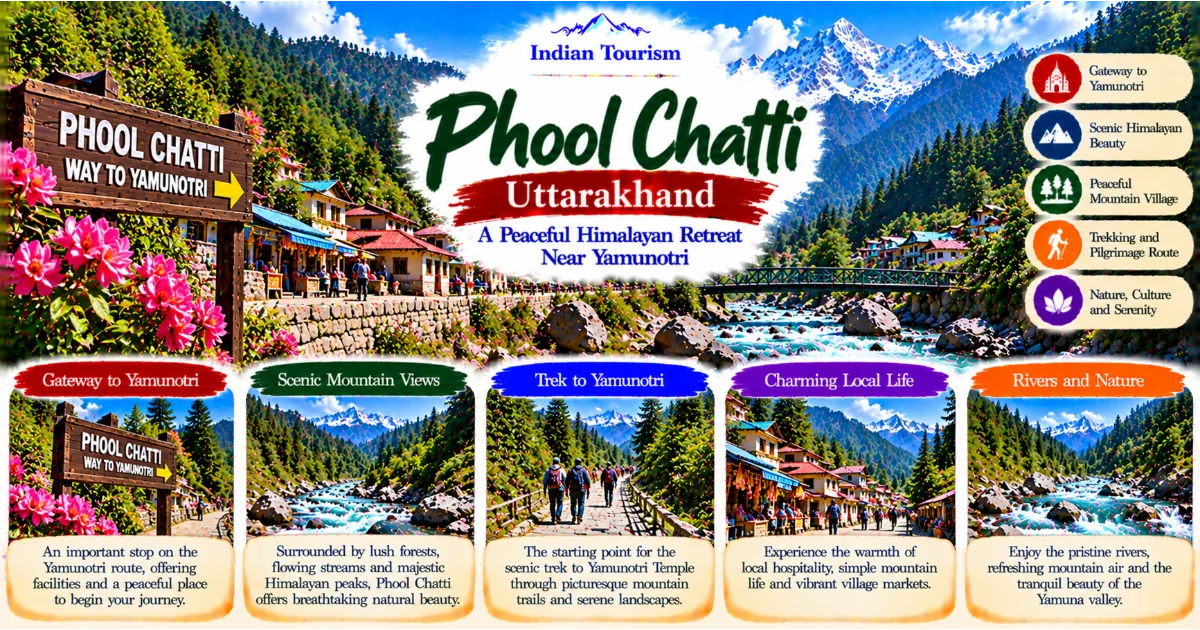
Discovering Phool Chatti in the Garhwal Himalayas
The Garhwal Himalayas of Uttarakhand are home to countless destinations where mountain scenery, spiritual traditions, village life, and natural beauty come together. While famous pilgrimage centres attract thousands of visitors every year, smaller settlements along their routes often remain less familiar to travellers. Phool Chatti is one such destination associated with the wider Yamunotri region, offering an opportunity to explore the quieter character of Himalayan travel beyond the best-known temples and crowded pilgrimage stops.
The name Phool Chatti evokes the image of flowers and mountain rest stops, reflecting the charm often associated with Himalayan settlements surrounded by vegetation and sloping terrain. Travellers exploring the Yamuna valley may encounter the name while learning about the local geography, religious routes, and places associated with traditional mountain travel. The area belongs to a landscape where streams descend through narrow valleys, roads follow steep mountain contours, and communities have adapted their lives to the challenges of altitude and seasonal weather.
Phool Chatti is best approached as part of a wider journey through the Yamunotri region rather than as a large, independently developed tourist centre. Its appeal lies in the opportunity to understand the connections between smaller Himalayan settlements, pilgrimage movement, natural surroundings, and the cultural traditions of Uttarakhand. Travellers who enjoy slow journeys and meaningful exploration may find this approach more rewarding than attempting to visit every location as quickly as possible.
The Yamunotri region is especially significant because of its association with Goddess Yamuna and the sacred geography of the upper Yamuna valley. Pilgrims travel through mountain settlements on their way to the Yamunotri Temple, and these communities help support the journey through transport, accommodation, food, and other services where available. The settlements themselves form part of the wider travel experience, revealing how mountain tourism and religious traditions interact.
For visitors planning a trip through Uttarakhand, Phool Chatti can be considered alongside destinations such as Barkot, Hanuman Chatti, Janki Chatti, Kharsali, and Yamunotri. Each place has its own geographical position and cultural identity. Exploring them with an understanding of their individual roles helps create a more thoughtful itinerary and a deeper appreciation of the region.
Understanding the Location and Landscape of Phool Chatti
Phool Chatti is associated with the Yamunotri travel corridor in the Garhwal Himalayas. This broader region is characterised by steep slopes, narrow valleys, mountain streams, forested areas, and settlements connected by winding roads. The geography has a strong influence on transport, construction, agriculture, and the way people organise their everyday lives.
Mountain destinations can sometimes be difficult to understand from maps alone. Two places that appear close together may require a substantial amount of travel because roads must follow the contours of the terrain. Travel times can also change according to road conditions, rainfall, traffic, landslides, and seasonal restrictions. Visitors should therefore confirm the precise location of Phool Chatti and the current access arrangements before planning a dedicated visit.
The surrounding Yamuna valley forms part of a larger Himalayan environment in which rivers and streams have shaped the landscape over long periods. Water flows down from higher elevations, cutting through rock and carrying sediment into lower areas. The resulting valleys provide routes for roads and settlements, although the steep terrain limits the availability of flat land.
Vegetation changes according to altitude, sunlight, soil, and moisture. Sheltered slopes may support thicker growth, while exposed areas can appear rocky and sparsely vegetated. During the warmer months, the landscape often becomes greener, while winter brings colder temperatures and changes in the appearance of the surrounding hills.
The natural setting is one of the region's main attractions, but it should never be treated as a completely predictable environment. Rain can make paths slippery, river levels may rise quickly, and mountain roads can become unsafe during severe weather. Responsible travel begins with understanding these conditions and planning accordingly.
For visitors interested in the geography of Uttarakhand, the wider Yamunotri region offers an opportunity to observe how settlements have developed in response to mountainous terrain. Roads, houses, agricultural plots, and religious structures occupy the available land while adapting to local environmental conditions.
The Cultural Landscape of the Yamuna Valley
The cultural identity of the Yamuna valley is closely connected with the river, its surrounding mountains, and the religious traditions that have developed across the region. For generations, the upper Himalayan landscape has been associated with pilgrimage, seasonal movement, local worship, and the relationship between communities and their natural environment.
The Yamuna is revered in Hindu traditions as a sacred river and a divine presence. Its cultural importance extends far beyond the upper valley, reaching towns and cities across northern India. The Himalayan region associated with Yamunotri holds a special place within this broader religious geography because of its connection with the upper reaches of the river and the pilgrimage dedicated to Goddess Yamuna.
Settlements along the route are part of the living cultural landscape. They provide places where travellers rest, obtain supplies, arrange transport, and prepare for the next stage of their journey. Local religious traditions, festivals, and community practices help maintain a sense of continuity between generations.
The importance of smaller settlements should not be measured only by the number of monuments or commercial attractions they contain. Their value can also lie in the way they support the wider pilgrimage network and preserve local knowledge about mountain travel, seasonal conditions, and community life.
Visitors exploring Phool Chatti and the surrounding area can gain a better understanding of this cultural landscape by observing the relationship between settlements and their surroundings. The positioning of buildings, the routes used by residents, and the location of religious structures all reflect the practical and cultural considerations that shape mountain life.
Respectful travel is particularly important in places associated with religious traditions. Visitors should follow local instructions, avoid disrupting ceremonies, and ask permission before photographing residents or private property. A genuine interest in local culture is most valuable when it is accompanied by consideration for the people who maintain it.
The Importance of Pilgrimage Travel in the Region
The Yamunotri pilgrimage is one of the defining features of tourism in this part of Uttarakhand. Yamunotri forms part of the Char Dham pilgrimage circuit, along with Gangotri, Kedarnath, and Badrinath. These destinations hold considerable importance for Hindu devotees and attract visitors from many parts of India.
The pilgrimage journey involves more than reaching the final temple. Travellers move through a network of towns, villages, roadheads, and mountain paths. Each location plays a different role in the journey, whether by providing accommodation, offering supplies, supporting transport, or serving as a place of worship.
Smaller settlements associated with the wider route form part of this support system. Their services may be modest, and availability can change throughout the year, but they contribute to the overall experience of travelling through the Himalayas.
Pilgrimage tourism also creates seasonal economic opportunities. Local businesses may receive visitors who need meals, rooms, transport, or basic travel supplies. The resulting activity can provide income for households and help sustain services in areas where other economic opportunities may be limited.
At the same time, a concentration of visitors can place pressure on roads, water supplies, waste-management systems, and local infrastructure. Sustainable tourism requires careful planning, cooperation between authorities and businesses, and consideration for residents who live in the area throughout the year.
Travellers should approach the Yamunotri region with realistic expectations. Conditions may differ from those in a major city, and facilities can be limited during quieter periods. Flexibility is essential, particularly when weather or road conditions change.
Understanding pilgrimage travel as a network of communities and landscapes makes the journey more meaningful. It encourages visitors to look beyond the final destination and appreciate the people and places that help make the pilgrimage possible.
Natural Beauty and Mountain Scenery
The natural environment of the Yamunotri region is one of the most compelling reasons to explore the area. Mountain slopes, streams, forests, and changing weather create a landscape that can look dramatically different from one season to another.
In the warmer months, vegetation may become dense and the hills can appear richly green. The monsoon brings rainfall that refreshes the landscape but can also create serious travel challenges. Autumn often provides clearer conditions, while winter brings colder weather and may affect access to higher areas.
Clouds frequently move across mountain valleys, changing the quality of light and visibility. A landscape that appears open and bright in the morning may become misty later in the day. These changes are part of the character of Himalayan travel and provide opportunities for photography when conditions are safe.
Mountain streams contribute to the region's atmosphere. Their movement through rocky channels reflects the natural processes that shape Himalayan valleys. However, streams and rivers should be approached cautiously. Water levels can rise after rainfall, and rocks near the water may be slippery.
The surrounding vegetation also deserves attention. Forests and shrubs provide habitat for wildlife, help protect soil, and contribute to the ecological health of the mountains. Visitors should avoid damaging plants, disturbing animals, or leaving waste in natural areas.
Phool Chatti can be appreciated as part of this broader environmental setting. Travellers who take time to observe the relationship between the landscape and the settlements may develop a deeper understanding of how people live in the Himalayas.
Rather than searching constantly for dramatic viewpoints, visitors can enjoy smaller details: the changing colour of the hills, the sound of flowing water, the arrangement of houses along a slope, and the way weather transforms the valley. These experiences often provide a more lasting impression than a hurried checklist of attractions.
Village Life in the Garhwal Himalayas
Mountain village life in Garhwal reflects a long history of adapting to terrain, climate, and available resources. Although modern infrastructure has changed many aspects of daily life, geography continues to influence how settlements function.
Agriculture has traditionally played an important role in the livelihoods of many Himalayan communities. The availability of cultivable land varies considerably, and fields are often shaped by the natural contours of the slopes. Families may combine agricultural activities with other forms of employment, including tourism-related services and work outside the village.
Transport is another defining factor. Narrow roads and steep terrain can make the movement of goods and people more difficult than in the plains. Weather conditions may affect access, while the cost of construction and maintenance can be higher in remote mountain areas.
Religious traditions and community institutions provide another dimension of village life. Temples and local places of worship may serve as centres for ceremonies, gatherings, and the continuation of cultural practices. Festivals and seasonal observances help strengthen relationships among residents.
Tourism can create opportunities for small businesses, but it also changes the rhythm of village life. During busy periods, residents may experience increased traffic, noise, waste, and demand for local resources. Responsible visitors should recognise that the area is first and foremost a place where people live and work.
Travellers can show respect by keeping noise levels reasonable, asking before taking photographs, and avoiding entry into private spaces without permission. Supporting local businesses where appropriate can help ensure that tourism provides benefits to the community.
A visit to a smaller Himalayan settlement is most rewarding when it is approached as an opportunity to learn rather than simply to consume a scenic experience. Observing the relationship between people, landscape, and tradition can reveal much about the character of Uttarakhand.
Exploring the Wider Yamunotri Region
Phool Chatti can be considered within a broader itinerary through the Yamunotri region. Because mountain travel takes time, visitors should group destinations according to their actual location and the road conditions rather than assuming that every place can be visited in a single day.
Barkot
Barkot is an important town for travellers preparing to explore the Yamunotri area. It offers a practical base for arranging transport, accommodation, and supplies before continuing into the mountain region.
Visitors can use Barkot as an overnight stop, particularly when arriving from a distant city. Staying here can reduce the pressure of attempting a long drive and a demanding mountain journey on the same day.
Hanuman Chatti
Hanuman Chatti is associated with the wider Yamunotri travel corridor and the network of mountain settlements serving pilgrims. Its location and local character provide additional context for understanding the route.
Travellers should check current road arrangements and local access information before adding it to an itinerary. Mountain roads and transport services may change according to seasonal conditions.
Janki Chatti
Janki Chatti is widely recognised as the principal roadhead for the final trek to Yamunotri under the usual pilgrimage arrangements. It is an important place for visitors to prepare for the uphill walk and confirm the current conditions along the route.
The trek requires appropriate footwear, suitable clothing, water, and sufficient time. Travellers should assess their physical ability and follow official guidance before starting.
Kharsali
Kharsali is known for its religious and architectural heritage, including its association with the winter worship of Goddess Yamuna. Its traditional buildings and local customs provide a different perspective on the cultural landscape surrounding Yamunotri.
Visitors interested in religious history and Himalayan architecture may find Kharsali a valuable addition to their journey.
Yamunotri
Yamunotri is the principal pilgrimage destination associated with the Yamuna River and Goddess Yamuna. The temple is situated in a high-altitude mountain environment, and the journey requires preparation for changing weather and physical exertion.
The temple's operating season follows the religious calendar and current administrative arrangements. Travellers should verify opening dates, access conditions, and local instructions before planning their visit.
Best Time to Explore Phool Chatti and Its Surroundings
The best time to explore the wider Yamunotri region depends on the purpose of the trip, the current condition of the roads, and the seasonal availability of services.
Spring
Spring brings a gradual transition from winter towards warmer weather. The landscape begins to change as vegetation responds to rising temperatures, although mornings and evenings can remain cold.
Visitors planning a spring journey should check whether the relevant pilgrimage routes and services are operating. Higher areas may continue to experience winter conditions even when lower settlements become more comfortable.
Summer
The warmer months are generally important for pilgrimage travel in the region. Longer daylight hours can make it easier to organise road journeys and walking activities, although visitor numbers may increase considerably.
Travellers should book accommodation where necessary and allow additional time for traffic and delays. Mountain weather can remain unpredictable, so warm and waterproof clothing is still useful.
Monsoon
The monsoon brings heavy rainfall to Uttarakhand. Although the landscape can become greener and more dramatic, rainfall also increases the risk of landslides, falling rocks, road closures, and slippery paths.
Travellers should monitor weather forecasts and local road advisories. If conditions become unsafe, changing the itinerary is the responsible choice.
Autumn
Autumn can offer clear mountain views and cooler temperatures. It is often a pleasant period for travellers interested in landscape photography and cultural exploration.
However, visitors should check the pilgrimage calendar because the Yamunotri Temple generally closes for winter according to established religious traditions. Services in the surrounding region may also change as the season progresses.
Winter
Winter brings colder conditions and may affect road access, accommodation, and transport in the upper valley. Travellers should not assume that all facilities remain open throughout the year.
Anyone planning a winter visit should confirm local conditions before departure and prepare for low temperatures, shorter daylight hours, and possible travel disruptions.
How to Reach the Yamunotri Region
Because Phool Chatti is associated with the wider Yamunotri area, visitors should confirm its exact access arrangements and the current route before travelling specifically to the settlement.
By Road
Road travel is the principal means of reaching the Yamunotri region. Travellers commonly approach through Dehradun or other accessible towns in Uttarakhand before continuing towards Barkot and the upper Yamuna valley.
The journey includes winding mountain roads, changing elevations, and sections where traffic may move slowly. Heavy rainfall, landslides, road maintenance, and pilgrimage traffic can affect travel time.
Visitors should use experienced drivers familiar with mountain conditions and avoid unnecessary night driving on unfamiliar roads.
By Train
There is no railway station serving the immediate Yamunotri area. Travellers arriving by train can use an accessible railway hub such as Dehradun, depending on their route and available services.
The remainder of the journey must be completed by road. It is sensible to allow sufficient time between train arrival and onward transport.
By Air
Jolly Grant Airport near Dehradun is a commonly used air gateway for visitors travelling towards the Yamunotri region. From the airport, the journey continues by road.
Because the mountain drive can take several hours, travellers should avoid planning a demanding trek immediately after arriving from a long flight and road journey.
Local Transport
Taxis and other locally operated vehicles may be available along the route, depending on the season. Confirm fares, luggage arrangements, route access, and expected journey times before departure.
For any visit that includes Yamunotri, check the current roadhead and trekking arrangements with local authorities or authorised service providers. Access rules and transport facilities can change.
Accommodation and Food Planning
Accommodation options in the wider Yamunotri region vary by settlement and season. Larger towns and established pilgrimage stops may offer more choices than small villages, where services can be limited.
Travellers should confirm accommodation before arriving, particularly during the main pilgrimage season. Ask about heating, hot water, bathroom facilities, electricity, room capacity, and any arrangements relevant to older travellers or families.
Outside the busiest months, some guesthouses and food establishments may operate on reduced schedules or close temporarily. A confirmed reservation and a flexible itinerary can help avoid unnecessary difficulties.
Food options often include simple Indian meals, snacks, tea, and refreshments. Travellers with specific dietary requirements should confirm availability in advance and carry suitable supplies when necessary.
Drinking water should be obtained from a reliable source. Clear mountain water is not automatically safe to drink without treatment. Visitors should also avoid leaving food packaging and other waste behind.
Supporting local accommodation providers and small eateries can help sustain services in the region. At the same time, visitors should recognise that a remote Himalayan destination may not offer the same range of facilities as a major city or developed resort.
Responsible Tourism in the Himalayan Environment
The natural environment of Uttarakhand is beautiful but sensitive to poorly managed tourism. Mountain slopes can be vulnerable to erosion, while streams and rivers support communities and ecosystems downstream.
Visitors should carry their waste until it can be disposed of properly. Plastic wrappers, bottles, disposable utensils, and food packaging should never be left beside roads, trails, streams, or religious sites.
Respect local residents and private property. Ask permission before photographing people, avoid entering homes or fields without an invitation, and follow local guidance around religious buildings.
Use established paths and avoid taking shortcuts across steep slopes. Unmarked routes may be unsafe and can contribute to erosion or damage vegetation.
Tourism can create valuable opportunities for local businesses, but its long-term benefits depend on responsible management. Travellers can contribute by using local services where appropriate, respecting cultural traditions, and avoiding unnecessary consumption of local resources.
Visitors should also remember that the Himalayan environment is affected by seasonal hazards. Heavy rain, landslides, falling rocks, and sudden changes in weather can make travel dangerous. Following local instructions and postponing a journey when conditions are unsafe are essential parts of responsible tourism.
Who Should Explore Phool Chatti?
Phool Chatti and the wider Yamunotri region may appeal to travellers who enjoy cultural exploration, mountain landscapes, religious history, and less hurried forms of travel.
Pilgrims can use the region to understand the communities and settlements that support the Yamunotri journey. Nature lovers may appreciate the surrounding mountain environment, while photographers can explore the changing light and seasonal appearance of the valley.
Travellers interested in rural culture may find value in observing how village life responds to geography, climate, and seasonal tourism. Those who enjoy slow travel can combine visits to suitable nearby destinations without attempting to cover too much ground in a single day.
Families can explore the region if they plan carefully and consider the needs of all members. Visitors with mobility limitations or medical conditions should verify accessibility and seek appropriate advice before undertaking demanding walks.
Phool Chatti may be less suitable for people seeking extensive shopping, nightlife, luxury resorts, or a large range of organised recreational activities. Its appeal is connected more closely with the wider cultural landscape and the experience of travelling through the Himalayas.
Because the exact facilities and visitor arrangements associated with smaller settlements can vary, travellers should verify what is available before treating Phool Chatti as an independent overnight destination.
Final Thoughts: Discovering the Quiet Character of the Yamunotri Region
Phool Chatti can be approached as part of a broader exploration of the Yamunotri region, where Himalayan landscapes, religious traditions, and mountain communities come together. Its value for travellers lies in understanding the wider environment surrounding one of Uttarakhand's most important pilgrimage destinations.
The region reveals how geography shapes daily life and travel. Roads follow the contours of the mountains, settlements depend on seasonal access, and local businesses adapt to the movement of pilgrims. Religious traditions provide continuity, while the surrounding landscape remains central to the experience of travelling through the valley.
Visitors who explore the area with patience can appreciate more than scenic views. They can learn about the role of smaller settlements, the challenges of mountain travel, and the importance of preserving cultural and natural heritage.
Planning is essential. Travellers should verify the precise location of Phool Chatti, current road access, accommodation availability, and the operating arrangements for any nearby pilgrimage sites. Seasonal weather can affect travel, particularly during the monsoon and winter.
Responsible behaviour is equally important. Respect local customs, protect water sources, avoid littering, and support community businesses where appropriate. These simple actions help preserve the character of the region for residents and future visitors.
For those exploring Uttarakhand, the Yamunotri valley offers a journey through a landscape where nature, culture, and devotion are closely connected. Phool Chatti can be considered within that journey as part of a broader effort to discover the quieter settlements and traditions that contribute to the identity of the Garhwal Himalayas.
#PhoolChatti #UttarakhandTourism #IndianTourism #Yamunotri #YamunaValley #GarhwalHimalayas #Uttarkashi #HimalayanTravel #CulturalTourism #MountainVillages #ExploreUttarakhand #ResponsibleTourism #TravelIndia #HimalayanHeritage #NatureTravel
