
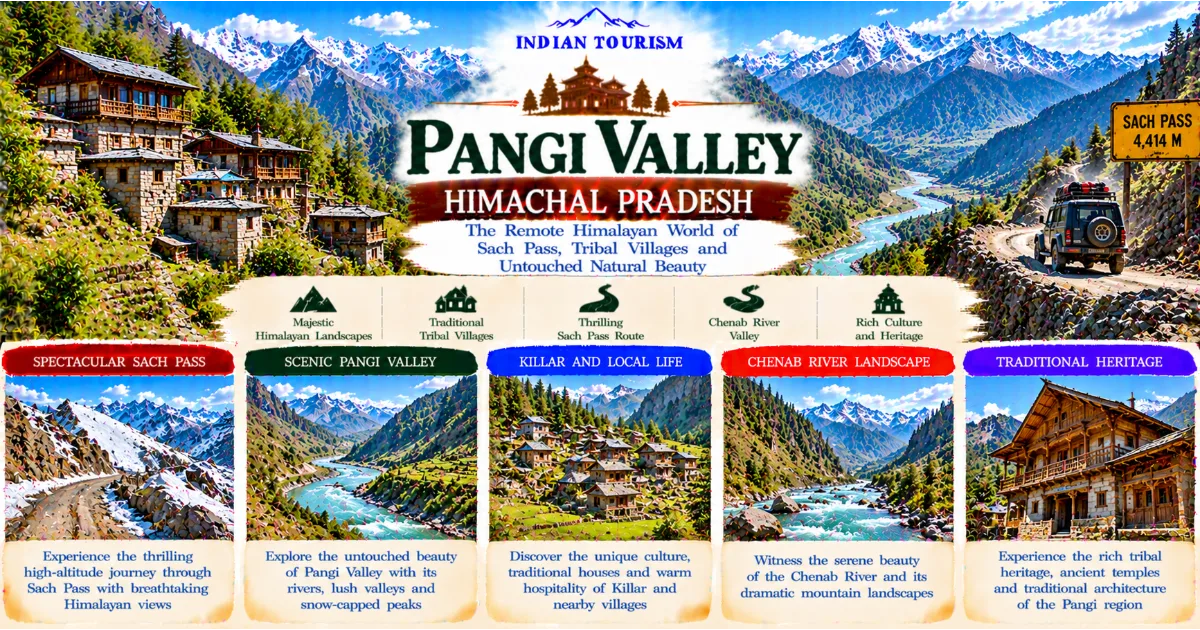
Pangi Valley, One of Himachal Pradesh's Most Remote Himalayan Regions
Pangi Valley is one of the most remarkable destinations in Himachal Pradesh for travellers who want to explore the remote, rugged and culturally distinctive side of the Himalayas. Located in the northern part of Chamba district, Pangi is known for its dramatic mountain scenery, deep river valleys, high-altitude villages, traditional lifestyles and challenging mountain roads. Unlike popular destinations where tourism infrastructure shapes much of the visitor experience, Pangi retains a strong sense of remoteness. Reaching the valley can be an adventure in itself, and exploring it offers a glimpse into communities that have adapted to demanding geographical and climatic conditions over generations.
The valley lies in a mountainous region where steep slopes rise above rivers, settlements occupy narrow terraces and roads follow difficult contours across the landscape. Snow-covered peaks dominate the horizon in colder months, while summer brings changing shades of green to lower slopes and cultivated areas. Small villages are scattered across the valley, and their traditional buildings, fields and local customs reveal the relationship between people and the mountain environment.
Pangi is particularly associated with Sach Pass, a high mountain route that connects the Chamba side with the Pangi region and onward routes towards the Lahaul area. The pass is famous among experienced road travellers and motorcyclists for its rugged terrain, sharp bends, exposed sections and spectacular views. However, the road is highly seasonal, and travel depends on snow clearance, weather and official road conditions. It should never be treated as an ordinary scenic drive.
The valley is also culturally important. Its communities maintain distinctive local traditions, languages, clothing practices, agricultural knowledge and forms of architecture. These traditions have developed within a landscape where isolation, climate and geography have influenced everyday life. Visitors who take time to understand the region will discover that Pangi is much more than a destination for dramatic photographs.
Pangi Valley rewards travellers who arrive with patience and realistic expectations. Accommodation and transport options may be limited, mobile connectivity can be inconsistent and journeys can take longer than expected. Yet these challenges are part of what makes the region distinctive. For those willing to travel responsibly and respect local communities, Pangi offers an unforgettable experience of the western Himalayas.
Where Is Pangi Valley Located?
Pangi Valley lies in the northern part of Chamba district in Himachal Pradesh, close to the high mountain ranges that separate it from neighbouring Himalayan regions. The valley is associated with the Chenab River system and includes several settlements spread across a rugged landscape.
Its location makes Pangi geographically different from many of Himachal Pradesh's better-known destinations. Reaching it often involves long journeys through mountain roads, high passes and isolated stretches where services are limited. The terrain has historically influenced communication with other parts of the state, particularly during winter when snowfall can restrict access.
The wider Pangi region contains several villages and smaller settlements, each with its own local character. The town of Killar serves as an important administrative and service centre for the valley. Travellers may use Killar as a base for arranging accommodation, food, transport and excursions to nearby villages.
The valley's geographical setting also creates considerable variation in climate. Lower areas may experience relatively mild conditions during summer, while higher slopes and mountain passes can remain cold or snow-covered. Travellers should not assume that weather in one settlement accurately represents conditions throughout the region.
Pangi can be approached through different routes depending on the season and current road conditions. The route via Sach Pass is particularly well known, but it is not always accessible. Other approaches may involve different mountain corridors and substantial travel time. Visitors should verify the latest information with local authorities and reliable transport providers before finalising their plans.
Understanding Pangi's location is essential for planning a safe visit. It is not a destination where a traveller should rely entirely on spontaneous arrangements. The remoteness is part of its appeal, but it also makes preparation particularly important.
The Geography of Pangi: A Valley Shaped by Mountains and Rivers
Pangi's landscape is defined by steep mountains, deep valleys, narrow terraces and rivers that have carved routes through the terrain over long periods. The geography determines where villages can be built, where agriculture is possible and how people travel between settlements.
The valley includes a range of elevations, creating differences in vegetation, temperature and seasonal accessibility. Lower slopes may support cultivated land and trees, while higher elevations transition into alpine terrain, rocky slopes and snow-covered landscapes. The changes can be striking during a journey through the region.
The Chenab River system is an important geographical feature of the wider area. Watercourses influence settlement patterns and form part of the ecological network that sustains plants, animals and human communities. River valleys also provide natural corridors through terrain that would otherwise be extremely difficult to cross.
Mountain slopes are vulnerable to erosion, landslides and rockfall. Heavy rainfall, snowmelt and freeze-thaw cycles can destabilise roads and paths. These natural processes explain why travel routes may require repairs or temporary closures.
The landscape also influences local architecture. Buildings must withstand cold winters, snowfall in some areas and changing weather. Traditional construction practices reflect knowledge of local materials and environmental conditions, although modern building methods are increasingly common.
For visitors, the geography creates opportunities for photography, nature observation and cultural exploration. It also requires a careful approach. Steep slopes and fast-flowing rivers can be dangerous, and an attractive viewpoint may not be safe to reach without local guidance.
Pangi's natural beauty is inseparable from the physical challenges of mountain life. Understanding this relationship makes the valley more meaningful than a destination viewed only through its scenery.
Killar: The Main Settlement and Gateway to Pangi
Killar is the principal administrative and service centre of Pangi Valley. It is an important stop for travellers who need accommodation, meals, transport arrangements and information about the surrounding region.
The settlement occupies a mountainous landscape where roads, buildings and cultivated areas follow the contours of the valley. It offers a different atmosphere from major tourist towns, with a stronger connection to local administrative functions and everyday community life.
Killar is often used as a starting point for exploring nearby villages and viewpoints. However, the distances between settlements can be deceptive. Mountain roads may be narrow and winding, and journeys that appear short on a map can require considerable time.
Visitors should use Killar to confirm current road conditions, particularly if they intend to travel towards remote villages or high-altitude routes. Local drivers and accommodation hosts may have useful information about weather, road repairs and transport availability.
The settlement can also provide insight into the challenges of providing services in remote mountain regions. Access to supplies, healthcare, education and transport is influenced by terrain and seasonal weather. These realities are an important part of understanding life in Pangi.
Travellers should not expect the same range of hotels, restaurants and shops available in larger destinations. It is sensible to confirm accommodation and meal arrangements in advance, particularly outside the main travel season.
Killar may not have the polished appearance of a commercial hill station, but its importance lies in its role as a working centre for the valley. Spending time here can help visitors understand the practical realities of life in a remote Himalayan region.
Sach Pass: The Dramatic Mountain Gateway to Pangi
Sach Pass is one of the most famous geographical features associated with Pangi Valley. Situated at a high elevation in the Pir Panjal mountain region, the pass connects the Chamba side with Pangi and forms part of a challenging mountain road network.
The route is known for its steep gradients, narrow sections, sharp turns and exposed terrain. In suitable weather, the journey can offer extraordinary views of rugged peaks, deep valleys, streams and snowfields. These features have made Sach Pass popular among experienced road travellers and motorcyclists seeking demanding Himalayan routes.
However, Sach Pass is not a road to approach casually. Snowfall can block access for extended periods, while rain, landslides and rockfall can create serious hazards. Even after a road has been opened, conditions may change rapidly.
Travellers should confirm that the route is officially open before setting out. They should also ask about current road conditions, vehicle suitability, fuel availability and the location of the nearest services. A road being open does not necessarily mean that every section is easy or safe.
Motorcyclists should be experienced in mountain riding and should carry appropriate protective equipment. Drivers should avoid attempting the pass in poor visibility, during severe rainfall or when local authorities advise against travel.
Fuel planning is important because services can be limited along remote stretches. Vehicles should be mechanically sound, and travellers should carry essential supplies in case of delays.
Sach Pass offers a powerful encounter with the scale of the Himalayas, but its real value lies in experiencing the mountains with respect rather than treating the route as a challenge to conquer. Safety and local advice must always take priority over completing the journey.
The Chenab River and the Life of the Valley
The Chenab River system plays a significant role in the wider geography of Pangi. Watercourses shape the valley floor, influence agricultural opportunities and create natural corridors through the mountains.
The river landscape can be visually dramatic, with water moving through narrow channels beneath steep slopes. Seasonal changes affect water levels, colour and flow. Snowmelt and rainfall influence the river's behaviour, making its appearance different at various times of the year.
For local communities, water is an essential resource. It supports household needs, agriculture and the broader ecological systems of the valley. The availability and management of water are especially important in mountain environments where terrain limits the amount of easily cultivated land.
Visitors should observe rivers from safe locations. Fast currents, cold water, unstable banks and sudden changes in flow can create serious hazards. Swimming or crossing the river without suitable local guidance and appropriate arrangements is not advisable.
Riverbanks should be kept clean. Plastic waste, food packaging and other rubbish can harm the environment and degrade the landscape. Visitors should carry their waste back to suitable disposal points.
The river also offers opportunities for photography and quiet observation. From safe viewpoints, travellers can appreciate the relationship between water, rock formations, vegetation and the settlements that occupy the surrounding slopes.
Understanding the river helps explain why Pangi's communities developed where they did. The valley's watercourses are not simply scenic features. They are part of the natural foundation of local life.
The Villages of Pangi: Living Traditions in the Mountains
Pangi Valley contains a number of villages scattered across its rugged terrain. These settlements offer insight into the everyday lives of communities that have adapted to steep slopes, cold winters and sometimes difficult access to services.
Village locations reflect practical considerations. Homes may be grouped near cultivated land, water sources or routes connecting neighbouring settlements. The arrangement of buildings and fields demonstrates how communities make use of limited flat ground.
Traditional architecture varies according to local conditions and available materials. Stone and timber have been used in many Himalayan settlements, while contemporary buildings increasingly incorporate modern construction techniques. Roof design, wall thickness and the arrangement of rooms can reflect the need to manage cold temperatures and seasonal weather.
Agriculture remains an important part of rural life in many mountain communities. Crops, livestock and household gardens vary with elevation and local conditions. The agricultural calendar is shaped by temperature, rainfall, access to land and the length of the growing season.
Visitors walking through villages may encounter people engaged in farming, household tasks or the movement of livestock. These are everyday activities rather than staged attractions, and travellers should observe them respectfully.
Ask permission before photographing residents or entering private courtyards. Avoid walking across cultivated fields without consent, and do not assume that an empty building is abandoned or open to visitors.
Supporting local accommodation, food services and transport can help tourism contribute to village livelihoods. Travellers should also understand that remote communities may have different expectations about privacy, noise and visitor behaviour.
The villages of Pangi are among the most meaningful parts of the region because they reveal how people live within a demanding mountain environment. Their traditions deserve attention beyond the scenery that surrounds them.
Pangi's Cultural Identity and Tribal Heritage
Pangi has a distinctive cultural identity shaped by geography, historical connections and the traditions of its communities. The valley's relative isolation helped preserve local customs and forms of social organisation, although contemporary life continues to change through education, transport, migration and contact with other regions.
Local languages and dialects reflect the cultural diversity of the western Himalayas. Language is an important part of identity because it carries family histories, oral traditions, local knowledge and ways of describing the surrounding landscape.
Clothing, food, architecture and festivals also reflect the region's heritage. Traditional garments have historically been influenced by the need for warmth, the availability of materials and local aesthetic preferences. Contemporary clothing varies according to age, occupation and personal choice.
Religious practices and community celebrations provide additional insight into local life. Their forms may differ between settlements, and visitors should avoid assuming that every village follows identical customs.
Cultural heritage is not static. Younger generations may combine traditional practices with modern education, employment and communication technologies. Some customs continue strongly, while others adapt to changing circumstances.
Visitors can support cultural continuity by approaching the region with curiosity and respect. Ask questions politely, purchase local products where appropriate and listen to residents who choose to share their experiences.
It is important not to reduce Pangi's communities to romantic images of an untouched past. The valley is home to people with contemporary ambitions, practical concerns and varied perspectives. Respectful tourism recognises both cultural continuity and change.
Traditional Architecture and Mountain Homes
Architecture in Pangi reflects the practical demands of a cold, mountainous environment. Buildings must respond to limited construction space, available materials, winter temperatures and the challenges of transporting supplies through remote terrain.
Traditional homes in Himalayan regions may combine stone, timber and other locally available materials. Construction techniques vary according to settlement, resources and historical influences. The design of roofs, windows and interior spaces often reflects an understanding of local weather conditions.
In areas that experience substantial snowfall, roof design and structural strength are particularly important. Homes may also be arranged to make efficient use of sunlight and to provide shelter from wind.
Village architecture can reveal how households organise daily activities. Storage areas, animal shelters, cooking spaces and living rooms may be arranged according to family needs and seasonal routines.
Modern materials and construction practices have become more common as roads and markets have improved access to supplies. This creates changes in village appearance, but it does not necessarily mean that traditional knowledge has disappeared.
Visitors should observe buildings from public paths and avoid entering private properties without permission. Some structures may be old, fragile or used for purposes that are not immediately obvious.
Traditional architecture is best understood as an expression of adaptation. It demonstrates how people have used local knowledge to build homes suited to the realities of Himalayan life.
Agriculture, Livestock and Seasonal Life
Agriculture and livestock have long influenced the economy and everyday routines of mountain communities. In Pangi, the availability of cultivable land varies considerably because steep slopes and rugged terrain limit where crops can be grown.
Cultivated areas may occupy terraces or relatively level patches close to settlements. The crops grown in a particular village depend on elevation, soil, temperature, water availability and the length of the growing season.
Livestock can provide food, income and other resources for households. The movement and care of animals follow seasonal patterns, while access to pasture depends on weather and the condition of mountain routes.
These activities require detailed knowledge of local conditions. Farmers must work within a short growing season in colder areas and respond to weather that can change quickly. Household practices often reflect generations of experience with the surrounding environment.
Visitors may observe agricultural work during their journey, but they should not interfere with farming activities. Avoid stepping on crops, opening gates or approaching livestock without permission.
Buying locally produced goods can support households, although availability may be limited and seasonal. Travellers should ask about products rather than assuming that every village has a regular market.
Agriculture and livestock help explain the rhythm of life in Pangi. The valley's culture is connected not only with festivals and architecture but also with the practical work required to sustain households in a remote mountain landscape.
Wildlife and the Natural Environment of Pangi
Pangi's mountainous landscape contains a variety of habitats, from forested slopes to alpine terrain. Differences in elevation, temperature and vegetation create conditions that support different plant and animal communities.
Forests provide shelter and food for wildlife, while higher elevations support species adapted to colder environments. The precise animals encountered depend on the location, season and ecological conditions.
Wildlife observation requires patience and restraint. Animals may avoid people, and sightings are never guaranteed. Visitors should not approach, feed or attempt to photograph wild animals at close range.
Mountain ecosystems can be sensitive to disturbance. Litter, uncontrolled fires, noise and damage to vegetation can affect wildlife and habitat quality. Travellers should remain on suitable paths and follow local guidance about access.
The region's environment is also influenced by broader pressures, including changing weather patterns, infrastructure development and the growing movement of people through mountain areas. Responsible tourism can reduce some local impacts by keeping waste under control and avoiding unnecessary disturbance.
Visitors interested in nature should use reliable local information to understand the habitats and species associated with particular areas. It is better to appreciate the ecological diversity of the valley than to travel with unrealistic expectations of seeing specific animals.
Pangi's natural environment is one of its greatest assets. Protecting it requires recognising that forests, rivers and wildlife have importance beyond their value as attractions.
Trekking and Walking in Pangi Valley
Pangi offers opportunities for walking and mountain exploration, but the suitability of individual routes depends on terrain, elevation, weather and access. Some walks may be relatively short, while others can involve steep climbs, remote areas and demanding conditions.
Visitors should obtain current route information before setting out. A path that appears straightforward on a map may be difficult to follow, particularly where trails are unmarked or affected by seasonal weather.
Local guides can provide valuable assistance by identifying suitable routes, explaining the terrain and helping travellers understand local conditions. Their knowledge is especially important when exploring areas far from settlements.
Preparation should include appropriate footwear, layered clothing, drinking water, food, a first-aid kit and a charged phone. Mobile connectivity may be unreliable, so travellers should not depend entirely on digital navigation.
For longer walks, inform someone about the intended route and expected return time. Avoid travelling alone into unfamiliar terrain, particularly during poor weather or when there is limited daylight.
High-altitude walking can be physically demanding. Visitors should consider their fitness, allow time to adjust to elevation and avoid continuing if they feel unwell.
Walking in Pangi is most rewarding when the route matches the traveller's ability and current conditions. There is no need to attempt a difficult trek simply to experience the valley. Shorter walks through accessible areas can also provide meaningful encounters with the landscape.
Photography in Pangi: Capturing a Remote Himalayan Landscape
Pangi provides striking opportunities for landscape photography. Deep valleys, rugged peaks, village settlements, winding roads and changing weather create a wide variety of subjects.
The light changes quickly in mountain environments. Early morning may bring mist across the slopes, while clear afternoons can reveal more detail in the surrounding terrain. Clouds can add drama to the landscape, but they may also reduce visibility and make travel more difficult.
Village photography can be especially rewarding because buildings, fields and daily activities reveal how communities live within the mountains. However, visitors should ask permission before photographing residents or entering private areas.
Road photography requires particular care. Do not stop in the middle of a narrow road or at blind bends. Choose safe stopping places and avoid standing close to unstable edges.
Photographers should also respect religious sites and local customs. Some ceremonies or private gatherings may not be appropriate to photograph without permission.
Weather protection is important for cameras and phones. Rain, dust, cold temperatures and condensation can affect equipment, so carry suitable protection and keep batteries warm where possible.
The best photographs often emerge from patient observation rather than rushing between viewpoints. Pangi's atmosphere, changing light and everyday life offer many opportunities for thoughtful photography when visitors take time to look carefully.
Best Time to Visit Pangi Valley
The most suitable time to visit Pangi depends on road access, weather and the activities planned. Because the valley is remote and surrounded by high mountains, seasonal differences can have a major impact on travel.
Spring: March to April
Spring is a period of transition, but conditions can remain cold, particularly at higher elevations. Snow may still affect some routes, and the opening of mountain roads depends on local conditions.
Travellers considering an early-season visit should confirm access before making reservations or committing to a fixed itinerary.
Summer: May to June
Summer can provide suitable conditions for exploring lower settlements and enjoying the mountain landscape. However, high passes may not be fully accessible throughout this period, depending on snowfall and road clearance.
Visitors should check current road conditions rather than relying on average seasonal expectations.
Monsoon: July to September
The monsoon can make mountain travel more difficult because of heavy rain, landslides, rockfall and road damage. Conditions may change quickly, and a route that was passable earlier can become unsafe.
Travellers should avoid unnecessary journeys during severe weather and follow local authority guidance.
Autumn: October to November
Autumn can bring clear periods and impressive mountain views, but temperatures fall rapidly as winter approaches. Some routes may become increasingly difficult as snow and ice develop at higher elevations.
Visitors should not assume that a pass will remain open simply because it was accessible earlier in the season.
Winter: December to February
Winter can bring severe cold and extensive snowfall, particularly along high routes. Access may become restricted, and services in remote settlements may be limited.
Winter travel requires careful planning and reliable local information. Visitors should not attempt closed or unsafe roads.
For many travellers, the summer period is the most practical time to consider a visit, provided road access has been confirmed. The exact travel window varies from year to year, so current conditions are more important than the calendar alone.
How to Reach Pangi Valley
Reaching Pangi requires planning because the valley is remote and access depends on the mountain route selected.
By Road via Sach Pass
The route via Sach Pass is famous for its dramatic scenery and challenging terrain. It is highly seasonal and may remain closed during periods of snow or adverse weather.
Before choosing this route, confirm official opening information, road conditions, vehicle suitability and fuel availability. Do not begin the journey based only on reports from previous years.
By Other Mountain Routes
Depending on the season and starting point, travellers may be able to reach Pangi through other mountain corridors. These routes can involve substantial driving time and their own seasonal limitations.
Ask local authorities or reliable transport providers which route is currently appropriate. Do not assume that an alternative route will be open simply because Sach Pass is closed.
By Bus
Public transport may connect Pangi with other parts of the region, but schedules can be limited and may change according to road conditions. Confirm departure times, service availability and the location of the final stop.
If your accommodation is outside the main settlement, arrange onward transport before arrival.
By Train
Pangi does not have a railway station. Travellers arriving by train must continue by road from a suitable railway connection serving their broader itinerary.
By Air
There is no airport in Pangi Valley. Visitors arriving by air must arrange onward road travel from an airport that fits their route.
Local Transport
Taxis and local vehicles may be available, but the number of vehicles and the services they offer can be limited. Confirm fares, travel time and return arrangements before beginning an excursion.
Because road access can be affected by weather, it is sensible to maintain flexibility in travel dates and avoid tight connections.
Accommodation and Food in Pangi Valley
Accommodation in Pangi is more limited than in major tourist destinations. Travellers may find guesthouses, small hotels, homestays and basic lodging in the main settlements, but the available facilities vary.
Visitors should confirm the booking directly and ask about heating, hot water, meals, parking and transport arrangements. These details can be particularly important during colder months or when travelling with family members.
A homestay may provide a more personal experience and an opportunity to learn about local life. Facilities can be simple, so visitors should choose accommodation according to their needs rather than assuming that every property offers the services of a large hotel.
Food options may also be limited, especially outside the main settlement. Local meals can reflect the ingredients and traditions of mountain communities, while basic restaurants may serve familiar regional dishes.
Travellers should confirm meal availability before arrival, particularly if they expect to reach their accommodation late in the day. Carrying suitable snacks is useful for long journeys and excursions.
Visitors with dietary restrictions should communicate their needs clearly. In remote areas, it may not always be possible to find specialised products or a wide range of alternatives.
Respect household rules, avoid excessive noise and keep accommodation areas clean. Supporting local businesses can help tourism contribute to the valley's economy, provided visitor activity is managed in a way that respects community needs.
A Three-Day Pangi Valley Itinerary
A three-day visit can introduce travellers to the valley, although the actual time required will depend heavily on the starting point and road conditions. The journey to and from Pangi should be treated as part of the itinerary rather than as a short transfer.
On the first day, travel towards Pangi using a route confirmed to be open and suitable. Avoid attempting to cover excessive distance in a single day, particularly if the route includes Sach Pass. Arrive in the main settlement, arrange accommodation and rest after the journey.
On the second day, explore accessible areas around Killar and nearby villages. Observe the architecture, agricultural landscape and daily activities of local communities. Ask locally about safe viewpoints and suitable short walks.
On the third day, continue exploring the surrounding region if road conditions permit. Spend time photographing the landscape and learning about local traditions before beginning the return journey, or remain overnight if the route is too long to complete safely.
This itinerary should be adapted to actual travel conditions. If the journey to Pangi takes longer than expected, reduce the number of activities rather than rushing.
Visitors who want to explore several remote villages or undertake longer walks should allow additional days. Pangi is best experienced at a pace that respects the terrain and gives travellers time to understand the region.
A Five-Day Pangi Valley Journey
A five-day itinerary offers more flexibility and reduces the pressure to complete the journey in a short period.
Use the first day to travel towards Pangi and settle into accommodation. Allow enough time for delays and avoid continuing through difficult mountain sections after dark where possible.
On the second day, explore Killar and its surroundings. Learn about the valley's geography, local services and cultural traditions, and ask residents or accommodation hosts about suitable places to visit.
On the third day, choose an excursion to a nearby village or accessible viewpoint. The route should be selected according to current conditions and the experience of the travellers.
The fourth day can be used for further exploration, photography or a guided walk. Visitors interested in local culture may focus on architecture, agricultural practices and traditional crafts, while nature enthusiasts may prefer a suitable forest or mountain route.
Use the fifth day for the return journey or for an additional night if road conditions or distance require it. Do not make the return dependent on a tight connection elsewhere.
A longer itinerary also creates room for unexpected weather and transport changes. In remote mountain regions, flexibility is a practical necessity rather than an optional luxury.
Pangi Valley for Families, Couples and Adventure Travellers
Pangi can appeal to different travellers, but it is important to match the trip to individual needs and experience.
For Families
Families may enjoy the scenery and cultural experience, but the long road journey and limited services require careful planning. Travellers with young children should confirm accommodation, food, medical access and transport arrangements in advance.
Avoid exposing children to dangerous road edges, fast-flowing rivers or steep terrain. Choose excursions according to age and physical ability.
For Couples
Couples interested in quiet landscapes and remote destinations may appreciate Pangi's peaceful atmosphere. The experience is more focused on scenery, cultural discovery and shared travel than on commercial entertainment.
A flexible itinerary allows couples to enjoy the region without rushing between locations.
For Solo Travellers
Solo travel in Pangi requires preparation. Confirm accommodation and transport, share your plans with someone and avoid unfamiliar remote routes without reliable local guidance.
Mobile connectivity may be limited, so do not rely entirely on online maps or digital payments.
For Motorcyclists
Pangi and Sach Pass are associated with challenging mountain riding. The route is suitable only when officially accessible and when riders have the necessary experience, protective equipment and a mechanically sound motorcycle.
Weather, road surfaces, water crossings and limited services can create serious risks. Riders should prioritise safety over completing the route.
For Cultural Travellers
Visitors interested in traditional architecture, local languages, agriculture and community life may find Pangi particularly rewarding. The best approach is to listen, ask respectful questions and avoid treating local customs as performances arranged for tourists.
Responsible Tourism in Pangi Valley
Responsible tourism is especially important in a remote region where communities and ecosystems can be vulnerable to careless visitor behaviour.
Carry all rubbish out of villages, forests and roadside viewpoints. Do not throw waste into rivers or leave plastic packaging along mountain roads.
Respect private property and agricultural land. Ask permission before entering courtyards, photographing residents or documenting religious activities.
Support legitimate local accommodation, food services and transport providers where possible. Confirm prices in advance and treat workers respectfully.
Follow local restrictions around forests, wildlife and river areas. Avoid lighting fires unless explicitly permitted in a safe designated location, and never leave a fire unattended.
Use experienced local drivers and guides when travelling through difficult terrain. Follow official instructions about road closures and do not attempt to bypass barriers.
Avoid disturbing livestock or wildlife. Keep noise levels reasonable and leave natural features undamaged.
Prepare for delays and carry essential supplies, particularly when travelling through isolated stretches. Responsible planning reduces pressure on local emergency services and helps protect travellers and residents alike.
Above all, approach Pangi as a living homeland rather than an empty wilderness. The valley's cultural and environmental value depends on respecting the people who live there and the landscape that sustains them.
Practical Travel Tips for Pangi Valley
Confirm the current status of every planned mountain route before departure. Seasonal averages cannot guarantee that a pass will be open on a particular date.
Carry warm clothing even during summer because temperatures can drop quickly at higher elevations.
Ensure that your vehicle is suitable for the planned route and in good mechanical condition. Check tyres, brakes, fuel and essential equipment before leaving a larger town.
Carry enough cash for places where digital payment services may not be available. Mobile connectivity can be inconsistent.
Book accommodation and confirm meal arrangements before arrival, particularly if travelling outside the main summer season.
Carry drinking water, snacks, essential medication and a basic first-aid kit.
Download maps and important travel information before entering areas with limited connectivity.
Avoid driving through difficult mountain sections after dark where possible, and never continue if weather or road conditions make the journey unsafe.
Allow additional days in your itinerary in case of road closures or transport delays.
Respect local customs, ask permission before taking photographs and leave villages and natural areas as clean as you found them.
Conclusion: Why Pangi Valley Deserves a Place on Your Himachal Pradesh Travel List
Pangi Valley offers a distinctive experience of the western Himalayas, combining rugged mountain scenery, remote villages, traditional cultural practices and demanding travel routes. Its appeal lies in the way geography shapes every aspect of life, from architecture and agriculture to transport and seasonal access.
Killar provides a practical starting point for exploring the region, while Sach Pass offers one of the most dramatic mountain journeys associated with the valley. The Chenab River system, scattered villages and surrounding mountain terrain create a landscape that rewards patient exploration.
Pangi's cultural identity is equally important. Local languages, traditional homes, agricultural knowledge and community customs reflect generations of adaptation to the Himalayan environment. Visitors who take time to learn about these traditions gain a richer understanding of the region than those who simply pass through.
The valley also requires responsible travel. Roads can be dangerous, weather can change quickly and services are more limited than in major tourist centres. Careful preparation, realistic expectations and respect for local advice are essential.
For travellers who want to discover a less commercial side of Himachal Pradesh, Pangi Valley offers an opportunity to experience the mountains in a more demanding but deeply rewarding way. Its remoteness should not be treated as a challenge to overcome at any cost. Instead, it is an invitation to travel thoughtfully, appreciate local life and recognise the natural and cultural heritage of one of the state's most distinctive regions.
#IndianTourism #PangiValley #HimachalPradesh #ChambaDistrict #SachPass #Killar #ChenabRiver #HimalayanVillages #MountainTravel #RemoteDestinations #TribalHeritage #HimalayanCulture #ResponsibleTourism #ExploreHimachal #IncredibleIndia
