
A Himalayan Village Beyond the Ordinary Tourist Route
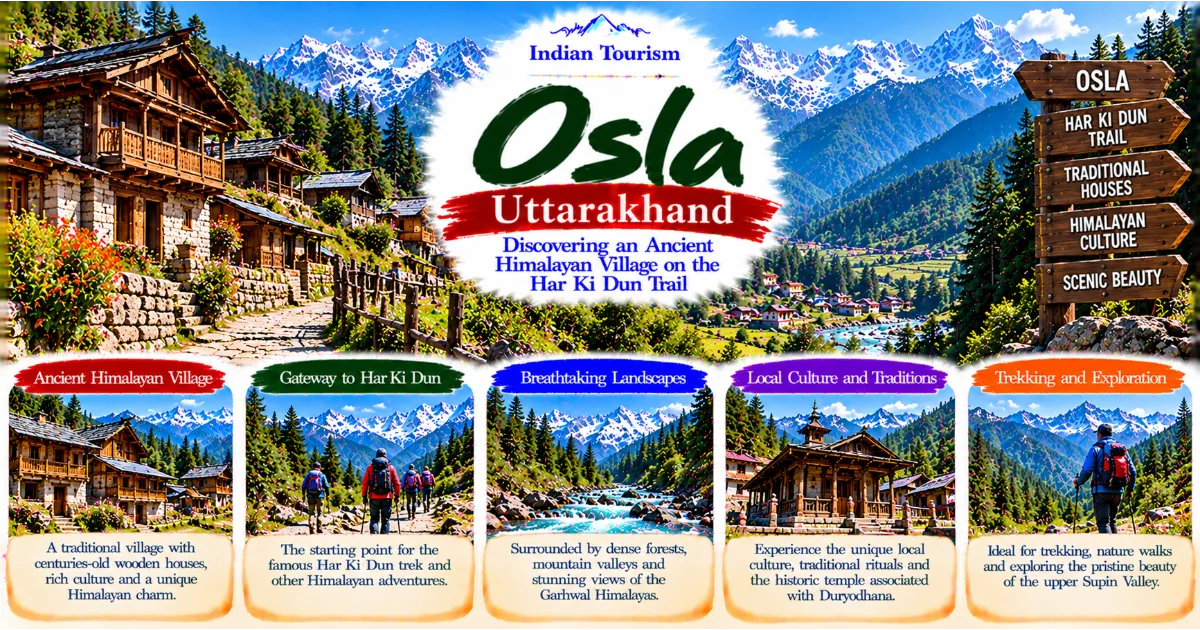
Deep within the western Garhwal Himalayas of Uttarakhand lies Osla, a traditional mountain village that offers travellers a glimpse into a quieter and less familiar side of Himalayan life. Far from the busy streets of popular hill stations, Osla is known for its wooden houses, terraced fields, mountain surroundings, and connection with the trekking routes of the Har Ki Dun region. Reaching the village requires more effort than visiting a conventional tourist destination, but that journey is part of what makes the experience distinctive.
Osla is located in Uttarkashi district, within the broader landscape associated with Govind Pashu Vihar National Park and Wildlife Sanctuary. The village is commonly visited by trekkers travelling from Sankri and Taluka towards Har Ki Dun. For many people, it becomes one of the most memorable stops along the route because it offers more than mountain scenery. It provides an opportunity to observe a settlement where traditional architecture, agriculture, community life, and the rhythms of the natural environment remain closely connected.
The first impression of Osla often comes from the relationship between its houses and the surrounding slopes. Buildings appear against a landscape of forested hills, cultivated terraces, and distant mountain ridges. Narrow paths connect homes and working areas, while the changing light gives the village a different appearance throughout the day. Depending on the season, visitors may encounter green fields, flowering vegetation, autumn colours, or snow in the surrounding mountains.
Osla is particularly attractive to travellers who want to combine nature with cultural exploration. Trekking enthusiasts can use the village as a resting point on the way to Har Ki Dun, while photographers may be drawn to its wooden architecture and dramatic setting. Travellers interested in rural life can learn about mountain agriculture, traditional homes, and the practical challenges of living in a relatively remote settlement.
However, Osla should not be treated simply as a picturesque backdrop. It is a living village where people maintain households, cultivate land, care for animals, and adapt to changing economic conditions. A meaningful visit requires respect for local customs, private property, and the environment.
For anyone exploring Uttarakhand beyond its well-known tourist centres, Osla offers an opportunity to discover how the cultural and natural landscapes of the Himalayas are inseparable.
Where Is Osla Located?
Osla is situated in the upper Supin Valley of Uttarkashi district in Uttarakhand. It lies along the trekking corridor connecting Sankri and Taluka with Har Ki Dun, a mountain valley celebrated for its scenery and access to the higher Himalayan landscape.
Sankri serves as the principal road-accessible base for many journeys into this region. From Sankri, travellers generally continue towards Taluka by road when conditions permit. The journey then continues on foot along established trekking routes through the valley. Osla is one of the settlements associated with this route, although the precise walking distance and time depend on the chosen trail, starting point, weather, and local conditions.
The surrounding landscape includes forested slopes, cultivated areas, streams, and mountain ridges. The Supin River forms an important geographical feature of the wider valley, helping shape the terrain and supporting the natural environment through which the trekking route passes.
Osla's location contributes significantly to its character. Unlike a village situated beside a major highway, it is reached through a journey that requires preparation and time. Visitors cannot always depend on the convenience of frequent public transport, extensive commercial services, or immediate access to urban facilities.
This relative remoteness has practical consequences for travel planning. Accommodation may be simple, supplies can be limited, and mobile connectivity may be inconsistent. Travellers should confirm arrangements in advance, particularly if visiting outside the main trekking periods.
The village is also part of a wider cultural landscape that includes settlements such as Gangad and Seema. Each has its own relationship with the surrounding terrain and the movement of people along the trekking corridor.
Osla is best understood not as an isolated attraction but as part of a network of Himalayan settlements whose lives are connected through paths, rivers, agriculture, religious traditions, and access to the surrounding mountains.
The Journey from Sankri to Osla
The journey towards Osla begins with reaching Sankri, a village widely known as a base for Himalayan trekking. Travellers usually arrange accommodation, transport, and trekking support there before continuing towards Taluka or the appropriate trailhead.
The road journey from Sankri to Taluka follows a mountain route through forested terrain. Road conditions can vary, and vehicle access should never be assumed to be guaranteed. Heavy rainfall, landslides, road repairs, or other local conditions may affect the journey. Travellers should check the current situation and follow local advice before setting out.
From Taluka, the journey continues on foot along the valley trail. The walk introduces visitors to the landscape gradually. Forests, streams, cultivated areas, and mountain slopes form part of the route, while the sound of flowing water may accompany sections of the journey.
The difficulty of the walk depends on the route and the traveller's fitness. Even when a trail is considered suitable for trekkers with moderate experience, it should not be approached casually. Walking for several hours on uneven terrain can be tiring, particularly when carrying a backpack or travelling in wet conditions.
Suitable footwear is essential. Visitors should carry drinking water, rain protection, sun protection, warm layers, and any personal medication they may need. A locally experienced guide can help with route decisions, weather awareness, and understanding the surrounding landscape.
The journey also requires a different attitude towards time. Travellers accustomed to driving directly to tourist attractions may initially find the slower pace unfamiliar. However, walking allows the landscape to be experienced more closely. Details that would pass unnoticed from a vehicle, such as small streams, changing vegetation, traditional fields, and the arrangement of village paths, become part of the journey.
Arriving in Osla after a mountain walk can make the settlement feel especially rewarding. The village is not simply a destination reached by transport. It is a place encountered through the landscape, and that experience forms an important part of its appeal.
Traditional Wooden Houses and Himalayan Architecture
One of the most distinctive features of Osla is its traditional wooden architecture. The village is known for houses that reflect the building practices and material choices associated with mountain communities in the western Himalayas.
Traditional construction in this region has been shaped by local resources, weather conditions, terrain, and the needs of households. Wood has historically played an important role in building practices, and older houses may display timber elements, carved details, and structural features that demonstrate local craftsmanship.
The architectural character of Osla is closely connected with its environment. Houses stand on sloping ground, paths follow the contours of the village, and buildings form part of a landscape in which cultivated terraces and forested hills remain visible. The arrangement reflects the practical requirements of daily life rather than the planned layout of a modern tourist settlement.
Visitors interested in architecture can learn a great deal by observing the details of the village. Roof shapes, wooden beams, doorways, balconies, and the relationship between buildings and the ground provide clues about how homes have been designed for local conditions.
However, not every house is identical, and the village should not be presented as a place where architecture has remained completely unchanged. Communities evolve, buildings require maintenance, and residents adapt their homes to modern needs. Older structures may stand alongside newer construction, reflecting the ongoing relationship between heritage and development.
It is important to remember that the houses are private homes. Travellers should not enter buildings or courtyards without permission, and photographs should be taken respectfully. A beautiful wooden doorway does not make a private residence a public attraction.
When possible, visitors can learn about local construction through conversations with residents or hosts who are willing to share their knowledge. Such exchanges can reveal the practical skills involved in maintaining a house in a mountain environment.
Osla's architecture is valuable not only because it looks distinctive in photographs, but because it reflects the accumulated knowledge of a community living in a demanding landscape.
The Village Temple and Its Cultural Significance
Osla is also associated with a distinctive local religious tradition connected with Duryodhana, a major character in the Mahabharata. In this part of Uttarakhand, local traditions surrounding figures from the epic can differ from the interpretations commonly encountered elsewhere in India.
The association is a reminder that the Mahabharata is not only a text interpreted through large temples and well-known pilgrimage centres. Its characters and stories have also become part of regional traditions, local identities, and community religious practices across the subcontinent.
The temple associated with Duryodhana in Osla is often discussed as one of the village's most distinctive cultural features. However, travellers should approach local religious history with care because oral traditions, regional narratives, and outside descriptions may differ in their details. The most respectful approach is to listen to local explanations rather than assume that one account captures every aspect of the tradition.
The temple is part of a living religious landscape. It may be associated with community gatherings, local observances, and customs that have meaning for residents. Visitors should observe the rules of the site, dress appropriately, and ask before photographing religious activities or entering restricted spaces.
It is equally important not to treat a local belief as an unusual spectacle. Religious traditions develop within specific historical and social contexts. Understanding them requires curiosity and respect rather than sensational descriptions.
Travellers who have grown up with familiar versions of the Mahabharata may find it interesting to learn how different communities understand its characters. Such encounters demonstrate the diversity of India's religious and cultural heritage.
A visit to Osla can therefore become more than a walk through a scenic mountain village. It can introduce visitors to the ways stories from Indian epics continue to shape local identity and community life.
Life in Osla: Agriculture, Livelihoods and Community
Life in Osla is shaped by the practical realities of living in a Himalayan village. The terrain, weather, availability of transport, and distance from larger service centres influence the ways households organise their daily activities.
Agriculture and livestock have traditionally played important roles in the livelihoods of communities in the wider region. Terraced fields allow cultivation on sloping land, while seasonal conditions influence planting, harvesting, and the availability of crops. The specific activities undertaken by individual households vary according to land, resources, and changing economic circumstances.
Livestock can also form part of rural life, providing household resources and contributing to agricultural practices. Caring for animals requires daily work and is closely connected with the availability of pasture, fodder, and water.
Life in a remote village involves more than farming. Residents also need access to education, healthcare, transport, communications, supplies, and opportunities to earn income. Some households may participate in tourism-related activities, including accommodation, food services, guiding, or support for trekkers.
Tourism can create additional income, but it can also introduce uncertainty. Demand changes with the season, weather can interrupt travel, and the number of visitors may vary from year to year. For this reason, tourism should be understood as one part of the wider local economy rather than the only activity that defines the village.
Visitors can gain a better understanding of Osla by paying attention to ordinary aspects of village life. A path leading between houses, fields arranged along a slope, a household preparing supplies, or residents travelling between settlements can reveal how people adapt to the environment.
Such observations should never become an excuse to intrude on private life. Travellers should ask before photographing people, avoid entering working areas without permission, and respect requests for privacy.
The most meaningful cultural experiences often come from simple conversations. When residents have time and are willing to share their experiences, visitors may learn about seasonal changes, traditional food, the challenges of mountain travel, and the ways tourism has affected local opportunities.
Osla's identity is shaped by its residents, and understanding their lives is essential to appreciating the village beyond its scenery.
The Natural Landscape Around Osla
The landscape surrounding Osla is one of its greatest attractions. The village lies within a mountain environment characterised by forests, steep slopes, streams, cultivated terraces, and access to higher Himalayan terrain.
The forests provide a visual and ecological connection between the village and the surrounding mountains. Vegetation changes with elevation, exposure, and season, creating a varied landscape along the trekking routes. Travellers may encounter shaded woodland sections, open clearings, and areas where views extend towards distant ridges.
The natural environment is not static. Rainfall changes the appearance of streams and slopes, while the transition between seasons affects vegetation, visibility, and the condition of paths. Spring and summer may bring greener scenery, autumn can provide clearer mountain views when weather conditions cooperate, and winter may introduce snow at higher elevations.
Visitors who enjoy nature photography can focus on the relationship between the village and the landscape. Traditional houses against a forested slope, cultivated terraces beneath a ridge, or a stream crossing a mountain path can convey the character of the area without requiring a dramatic summit view.
Nature observation is also possible at a slower pace. Travellers can pay attention to birds, plant life, changing cloud formations, and the sound of water along the trail. Wildlife sightings are never guaranteed, and animals should always be observed from a safe distance.
Osla's wider landscape is associated with the protected forests and mountain environments of Govind Pashu Vihar National Park and Wildlife Sanctuary. Visitors planning to explore protected areas should check current access rules, required permissions, route conditions, and any restrictions that apply.
The natural surroundings deserve careful treatment. Rubbish, loud music, careless fires, and damage to vegetation can affect the environment and the experience of other visitors. Travellers should carry their waste out, remain on suitable paths, and follow local instructions.
The beauty of Osla is inseparable from the health of its surrounding landscape. Protecting that environment is part of visiting responsibly.
Har Ki Dun: The Valley Beyond Osla
Osla is closely associated with the Har Ki Dun trekking route, one of the recognised mountain journeys in Uttarakhand. The valley is known for its forested approaches, high mountain surroundings, seasonal meadows, and connection with the wider upper Supin region.
For many trekkers, Osla forms an important cultural and geographical part of the journey towards Har Ki Dun. It offers a place to experience village life before continuing into the more remote mountain landscape.
The route beyond Osla passes through terrain where walking conditions, altitude, weather, and available facilities can change. Trekkers may encounter forest sections, streams, open ground, and mountain views, depending on the route and season. The journey requires preparation, particularly for those who have limited experience with multi-day trekking.
Har Ki Dun is often associated with stories from Indian mythology, including traditions connected with the Mahabharata. The landscape's dramatic setting has encouraged generations of travellers and local communities to connect the mountains with religious narratives and ideas about the journey towards the heavens.
These stories form part of the region's cultural appeal, but they should be understood as traditions rather than presented as verified historical accounts. Their importance lies partly in the way they shape local understanding of the landscape.
Trekkers should arrange the journey according to their fitness, available time, and the conditions expected on the route. A reliable operator or experienced local guide can help with planning, equipment, accommodation, and decisions about weather.
It is also important to understand that the Har Ki Dun route is not a casual extension of a village walk. Multi-day trekking involves sustained physical effort and exposure to changing mountain conditions. Visitors should allow enough time to complete the journey safely rather than trying to compress it into an unrealistic schedule.
For those who undertake it with proper preparation, the route can provide a rich experience of the western Garhwal Himalayas. Osla adds an important cultural dimension to that journey by connecting the natural landscape with the people who live within it.
Best Time to Visit Osla
The best time to visit Osla depends on the purpose of the journey, the condition of the trekking route, and the prevailing weather. Because the village is reached on foot from the road-accessible area, seasonal conditions should be taken seriously.
Spring can be attractive for travellers who want to experience the transition from winter towards warmer weather. Vegetation begins to change, and the surrounding countryside may appear increasingly green. However, temperatures can remain cold, particularly in the mornings and evenings, and higher sections of the route may still experience winter conditions.
Summer is often considered a suitable period for trekking in the region when routes are open and weather conditions are favourable. The landscape can be lush, and longer daylight hours provide more time for walking. Visitors should still prepare for rain, cool evenings, and changes in weather.
The monsoon season requires particular caution. Heavy rainfall can make paths slippery, raise stream levels, and increase the risk of landslides along mountain roads. Trekking conditions may change quickly, and some routes may be unsuitable at certain times. Travellers should follow current local guidance rather than relying only on general seasonal descriptions.
Autumn can offer attractive conditions when the weather is stable. Clearer skies may provide better views of surrounding peaks, while cooler temperatures make warm clothing essential. This period can suit trekkers who want to explore the valley and appreciate the landscape without the deepest winter conditions.
Winter can transform the surrounding mountains, but snow and cold may make access more difficult. Travellers should confirm whether the route is suitable for their experience and whether appropriate guides, equipment, and accommodation are available.
There is no single date range that guarantees ideal conditions every year. Weather patterns vary, and access can be affected by local events or infrastructure problems. Before travelling, confirm road access to Sankri and Taluka, the condition of the trekking route, accommodation availability, and any requirements for entering protected areas.
The best visit is one planned around current conditions rather than a fixed expectation. In the Himalayas, flexibility is an important part of responsible travel.
How to Reach Osla
Osla is reached through a combination of road travel and trekking. The first major step is travelling to Sankri, the principal base for many treks in the upper Tons and Supin region.
Travellers commonly reach Sankri from Dehradun by road. Dehradun can be accessed by rail and air, including through Jolly Grant Airport. From there, the onward journey follows mountain roads through the western Garhwal region.
Travel times vary according to traffic, weather, road conditions, and the starting point. Visitors should allow a substantial portion of the day for the journey to Sankri and avoid planning an immediate long trek after arriving late.
From Sankri, travellers generally continue towards Taluka by vehicle when the road is open and suitable. The route from Taluka towards Osla is then completed on foot. Exact distances and walking times depend on the selected route, the starting point, trail conditions, and the pace of the group.
Public transport and shared vehicles may operate in the wider region, but services can be limited or change seasonally. Confirm local transport arrangements before departure, particularly if travelling with a group or carrying substantial trekking equipment.
If you are visiting Osla as part of an organised trek, coordinate the journey with your guide or operator. They can advise on the current route, required equipment, accommodation, and any permissions or registrations that may apply.
Carry essential medicines, drinking water, warm clothing, rain protection, and enough cash for the journey. Mobile connectivity may be inconsistent, so keep important travel information available offline.
The route should be approached with patience. Reaching Osla is part of the adventure, and allowing enough time for the journey makes it easier to respond safely to changing conditions.
Accommodation and Facilities in Osla
Accommodation in Osla is generally simpler than in large tourist towns. Depending on the season and current local arrangements, visitors may find village homestays, basic guest accommodation, or trekking-related stays.
The experience can be rewarding for travellers who value local hospitality and a closer connection with the village environment. However, facilities should not be assumed to match those of a conventional hotel. Hot water, electricity, mobile connectivity, and meal options may vary.
Before travelling, confirm where you will stay, whether meals are included, what bedding is provided, and whether you need to carry particular supplies. Trekkers should also confirm how luggage will be managed and whether the accommodation is arranged for the expected arrival time.
Food options may be limited, particularly outside busy trekking periods. It is sensible to arrange meals in advance through the accommodation provider or trekking operator. Visitors with allergies or specific dietary needs should explain their requirements clearly.
Travellers should carry essential personal medication and any items that may be difficult to obtain in a remote village. Do not depend on finding a pharmacy, ATM, or extensive retail facilities after leaving Sankri.
Guests staying in homestays should respect household routines. Ask before using private spaces for photography, follow the host's guidance, and treat shared facilities carefully. A homestay is a household that welcomes visitors, not a hotel that exists solely for tourism.
The limited range of facilities is part of the practical reality of visiting a remote mountain settlement. Travellers who prepare well and approach the experience with realistic expectations can appreciate the village without placing unnecessary demands on local hosts.
Local Food and Mountain Hospitality
Food is an important part of experiencing life in the Himalayan villages around Osla. Meals in remote settlements are often practical and shaped by the availability of ingredients, seasonal conditions, and household traditions.
The broader Garhwali food tradition includes grains, lentils, legumes, vegetables, and preparations made from locally available ingredients. Dishes and cooking practices vary from one household to another, so travellers should not assume that every regional speciality will be served in Osla.
During a trekking journey, meals may be simple and designed to provide energy for walking. Rice, lentils, vegetables, flatbreads, and hot drinks can form part of the available menu, depending on the accommodation and season.
Eating with a local host can also create opportunities for conversation. Visitors may learn about household cooking practices, seasonal ingredients, and the relationship between food and agricultural life in the mountains.
Travellers should communicate dietary requirements in advance. Those with allergies should explain them clearly, and anyone who needs a specialised diet should carry suitable backup food if local availability cannot be guaranteed.
Food safety remains important. Follow guidance from your host or guide about drinking water, and avoid consuming untreated water from streams. Even clear mountain water may contain microorganisms that can cause illness.
Hospitality in a remote village should not be measured by the number of menu options or the formality of service. A warm meal after a long walk, a cup of tea, or a conversation with a host can become one of the most memorable parts of the journey.
Respect for local food traditions also means avoiding waste. Take only what you can eat, follow the household's arrangements, and appreciate the effort required to obtain supplies in a place reached on foot.
Photography and Cultural Exploration
Osla offers a range of photographic opportunities for visitors who want to document the relationship between village life and the Himalayan landscape. Wooden houses, narrow paths, terraced fields, forested slopes, and distant mountain views provide subjects throughout the settlement and along the approach trail.
Architectural photography can focus on the details of traditional construction, including timber elements, rooflines, and the way houses sit against the hillside. Landscape photography can explore the contrast between cultivated areas and the surrounding forests.
The best light depends on weather and season. Early morning may reveal quieter village scenes, while changing clouds can create different moods across the mountains. Visitors should remain flexible because mist, rain, and low visibility can affect the views.
Photography should always be guided by respect. Ask before photographing residents, particularly children and people engaged in private or religious activities. Do not enter homes or courtyards without permission simply to obtain a better image.
Religious sites deserve particular care. Follow any rules about photography and avoid interrupting ceremonies. If local residents explain a cultural tradition, listen carefully and avoid turning their beliefs into sensational captions or misleading social media posts.
Travellers should also take care of themselves while taking photographs. Avoid standing on unstable edges, crossing fast-moving streams for a better angle, or leaving established paths in unsafe conditions.
Cultural exploration is not limited to taking pictures. It includes listening, observing, asking respectful questions, and recognising when a moment should remain private.
A meaningful photographic record of Osla can include ordinary details as well as dramatic landscapes. The arrangement of homes, the shape of a footpath, the fields around the settlement, and the way the village changes with the weather can communicate the character of the place more effectively than a collection of isolated scenic images.
Responsible Tourism in Osla
Responsible tourism is particularly important in a village reached through a trekking route. The natural environment is sensitive, facilities may be limited, and local residents should not have to bear the costs of careless visitor behaviour.
Waste management is one of the most important responsibilities. Visitors should carry their rubbish back to appropriate disposal points and avoid leaving plastic packaging, bottles, or food waste along trails. Even biodegradable waste should not be discarded indiscriminately because it can attract animals and alter local conditions.
Water sources should be protected. Do not throw rubbish into streams, wash vehicles or equipment in drinking-water sources, or release harmful substances near the river. Follow local instructions about sanitation and waste disposal.
Travellers should avoid unnecessary noise, particularly in the evening and early morning. Loud music can disturb residents and wildlife, while a quieter approach allows visitors to appreciate the natural setting.
Supporting local businesses can help tourism contribute to village livelihoods. Where appropriate, choose local accommodation, purchase supplies from village shops, and use qualified local guides. These choices can help distribute tourism income beyond larger towns.
Cultural respect matters just as much as environmental care. Ask permission before photographing people or property, observe rules at religious sites, and do not enter private land without invitation.
Visitors should also respect local guidance about weather and trail conditions. If a guide advises changing the route or delaying the journey, take the advice seriously. The mountain environment can become dangerous quickly, and a planned itinerary should never take priority over safety.
Responsible tourism recognises that the purpose of visiting Osla is not to leave a mark on the village, but to appreciate it while helping preserve the conditions that make the experience meaningful.
A Suggested Three-Day Itinerary for Osla
A three-day plan can provide a basic framework for visiting Osla as part of a wider journey through the upper Supin Valley. The itinerary should be adjusted to current weather, route conditions, fitness levels, and the availability of local accommodation.
On the first day, travel to Sankri and stay overnight. Use the time to rest after the road journey, confirm arrangements for continuing towards Taluka, and check the equipment required for the trek. Speak with your guide or accommodation provider about current conditions and the expected walking time.
On the second day, travel towards Taluka when the road is accessible and begin the walk towards Osla. The day should be planned around the group's fitness and the condition of the trail. Take regular breaks, drink water, and avoid rushing through the route. After arriving, settle into your accommodation and explore accessible parts of the village respectfully.
On the third day, spend time learning about Osla's architecture and local cultural traditions before beginning the return journey or continuing towards Har Ki Dun as part of a longer trek. Visitors who intend to reach the valley should follow an appropriate multi-day itinerary rather than trying to complete the entire journey without adequate time.
This plan is a general framework, not a guarantee of travel times or route availability. The walk may take longer depending on weather, trail conditions, luggage, and the pace of the group. Travellers should avoid making tight onward transport connections on the same day as a long trek.
Anyone planning a longer journey should arrange accommodation and guides in advance, carry suitable equipment, and check any requirements for entering protected areas.
The most rewarding itinerary allows time to appreciate the village itself. Osla should not be treated merely as a stop between Sankri and Har Ki Dun. Its cultural character and mountain setting deserve attention in their own right.
Who Should Visit Osla?
Osla is particularly suitable for travellers who enjoy walking, nature, traditional architecture, and cultural exploration. Its location along the Har Ki Dun route makes it appealing to trekkers, while its village setting can attract photographers and travellers interested in rural Himalayan life.
People who enjoy discovering destinations beyond conventional tourist circuits may find Osla especially rewarding. The journey requires preparation, and the facilities are simpler than those in major towns, but the opportunity to experience a traditional mountain settlement can make the effort worthwhile.
Adventure travellers may use Osla as part of a longer trekking journey. Nature enthusiasts can appreciate the forests, streams, and changing mountain scenery. Cultural travellers may be interested in the village's architecture and its connection with regional religious traditions.
Families should carefully assess the demands of the journey before visiting. The approach involves walking, and the route may be unsuitable for people who cannot manage uneven terrain or several hours of trekking. Travellers with medical or mobility needs should seek appropriate advice before making arrangements.
Osla may not be ideal for visitors seeking luxury accommodation, extensive shopping, nightlife, or a destination that can be explored entirely by car. Its appeal lies in its relative remoteness and the opportunity to experience a different pace of travel.
The most suitable visitors are those who value the journey as much as the destination. They are prepared to walk, respect local customs, adapt to changing conditions, and appreciate the village without expecting it to provide the same services as a major tourist centre.
Final Thoughts: Discovering the Living Heritage of the Himalayas
Osla offers a distinctive experience of Uttarakhand by bringing together traditional village life, Himalayan architecture, cultural traditions, and access to one of the region's recognised trekking landscapes. Its location along the Har Ki Dun route makes it familiar to trekkers, but the village's significance extends beyond its role as an overnight stop.
The wooden houses, cultivated terraces, narrow paths, and surrounding forests reveal how communities have adapted to mountain conditions. The local religious traditions associated with the village demonstrate the diversity of India's cultural heritage and the continuing influence of epic narratives in regional life.
A visit to Osla requires preparation. The journey involves road travel and walking, services may be limited, and weather conditions can affect access. Visitors who plan carefully and remain flexible are better positioned to enjoy the experience safely.
Equally important is the responsibility to treat the village as a living community. Respect private homes, listen to local guidance, avoid leaving waste, and support local businesses where possible. The best travel experiences are those that create understanding without placing unnecessary pressure on the people and environment being visited.
For travellers exploring the western Garhwal Himalayas, Osla provides an opportunity to move beyond famous viewpoints and discover the human stories within the mountains. It reminds us that the Himalayas are not only dramatic landscapes of peaks, rivers, and forests. They are also home to communities whose traditions, livelihoods, and everyday experiences form an essential part of the region's identity.
As part of the Indian Tourism series, Osla deserves a place among Uttarakhand's culturally rich mountain destinations. Its beauty lies not only in what visitors can see, but in what they can learn when they travel slowly, observe respectfully, and allow the village to reveal its character.
#IndianTourism #OslaVillage #UttarakhandTourism #Uttarkashi #HarKiDun #GarhwalHimalayas #HimalayanVillages #VillageTourism #TraditionalArchitecture #ExploreUttarakhand #HimalayanTrekking #CulturalTourism #ResponsibleTravel #TravelIndia
