
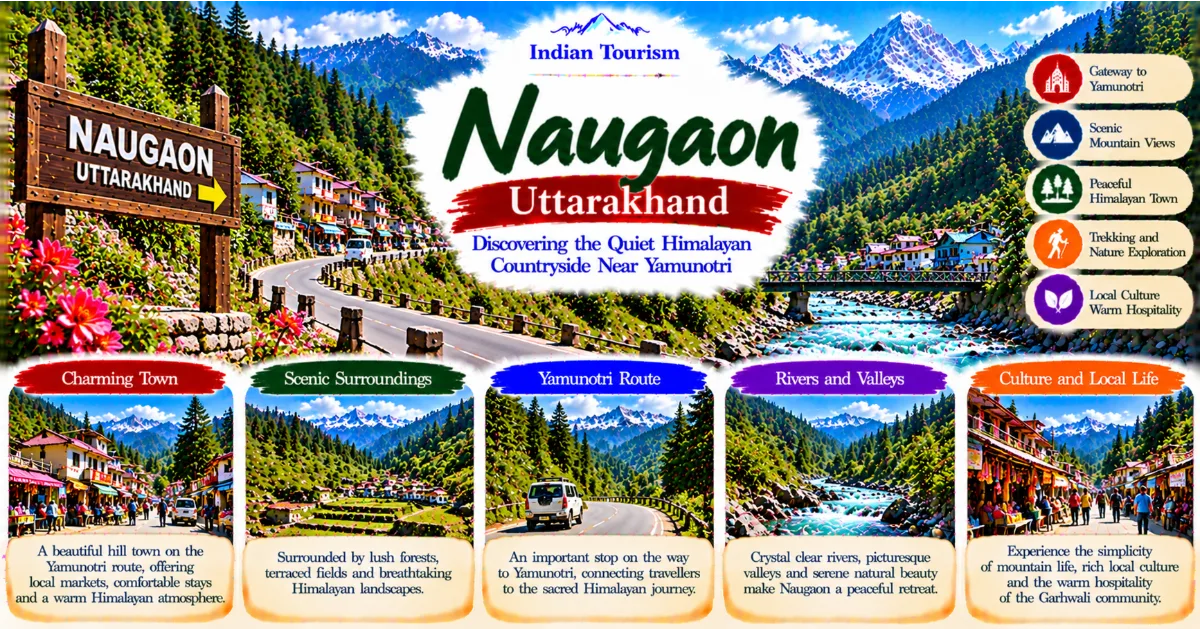
A Different Side of Uttarakhand
Uttarakhand is a state where the mountains shape more than the scenery. They influence the way people build their homes, cultivate their fields, travel between settlements, celebrate festivals, and organise their daily lives. While destinations such as Mussoorie, Auli, Nainital, Kedarnath, and Yamunotri attract widespread attention, the quieter towns and villages of the state reveal another side of Himalayan life. Naugaon, in Uttarkashi district, offers an opportunity to explore this less celebrated landscape and understand the countryside that surrounds one of Uttarakhand's most important pilgrimage routes.
Situated within the wider Garhwal Himalayan region, Naugaon is associated with the road network connecting the lower Himalayan areas with the Yamunotri region. Its surroundings reflect the character of the mountain countryside, where cultivated land, settlements, forested hills, streams, and winding roads create a landscape that changes with the seasons. For travellers interested in rural life, regional geography, and journeys beyond heavily promoted tourist destinations, the area can provide a useful perspective on Uttarakhand.
Naugaon is best approached as a small town and regional settlement rather than a conventional holiday resort. Its appeal lies in its location, its connection with surrounding communities, and the opportunity it provides to observe the everyday landscape of the Garhwal Himalayas. Travellers passing through the area may encounter markets, agricultural fields, local transport, roadside establishments, and views across the surrounding hills.
The wider region is also shaped by the movement of pilgrims travelling towards Yamunotri. This creates a connection between ordinary mountain life and religious tourism. The settlements along the route serve residents and visitors alike, while seasonal changes influence transport, accommodation demand, and the availability of services.
A journey through Naugaon can therefore be rewarding for people who appreciate places in their wider context. Instead of expecting a long list of major attractions within the settlement, visitors can use the area as an opportunity to understand the landscape, explore accessible surroundings, and appreciate how communities live within a mountainous environment.
As with any Himalayan journey, preparation is important. Road conditions, weather, transport schedules, and accommodation availability may change. Travellers should confirm the details of their intended route before departure and allow enough flexibility to respond to local conditions.
Where Is Naugaon Located?
Naugaon is located in Uttarkashi district of Uttarakhand, within the Garhwal region. It is associated with the road network serving the Yamunotri side of the district and the surrounding mountain settlements. Its geographical position makes it relevant to travellers exploring the countryside between the lower Himalayan approaches and the upper Yamuna valley.
Mountain geography influences how the area is connected to neighbouring settlements. Roads often follow river valleys, contour around slopes, and pass through areas where the terrain allows construction. Travel times can be affected by bends, gradients, traffic, weather, and maintenance work. A journey that appears short on a map may take longer than expected when the route crosses mountainous terrain.
The surrounding landscape contains a mixture of settlement areas, cultivated slopes, forested hills, and open sections where the terrain permits broader views. The balance between these features varies from one location to another, creating a changing experience for travellers moving through the region.
Naugaon's position also makes it relevant to the broader Yamunotri travel corridor. Visitors may pass through the area while travelling towards other settlements or while organising a journey to the pilgrimage region. However, travellers should confirm the exact route and destination rather than assuming that every place associated with the Yamunotri region lies directly along the same road.
It is also important to distinguish between a place that is useful as a transport stop and a destination with established visitor attractions. Naugaon's value may be more closely connected with its regional role and surroundings than with a concentrated collection of tourist facilities.
Before planning an overnight stay, confirm the location of the accommodation, available transport, and access to the particular places you want to visit. This is especially important when a travel listing uses a settlement's name to describe a property situated outside its main built-up area.
The Mountain Landscape Around Naugaon
The countryside around Naugaon reflects the varied geography of the Garhwal Himalayas. Sloping land, ridgelines, cultivated fields, scattered buildings, and forested sections combine to create a landscape that is both visually appealing and closely connected with everyday human activity.
Unlike the broad plains of northern India, where settlements and roads can spread across relatively level ground, the Himalayan landscape requires communities to adapt to limited flat land. Houses, shops, and public buildings occupy suitable sites, while agricultural plots may be shaped around the natural contours of the hills.
The result is a landscape in which human settlement and natural terrain are closely interwoven. A road may pass above a valley before descending towards a cluster of houses. Cultivated land may appear in patches where the slope is manageable, while steeper areas remain covered by vegetation or exposed rock.
The appearance of the countryside changes with weather and season. Clear conditions may reveal distant ridgelines, while clouds can soften the outlines of the hills. Rain can deepen the colour of vegetation and increase the flow of small streams. In winter, colder temperatures may influence the appearance of higher slopes and the comfort of travelling through the area.
For visitors, the journey offers opportunities to appreciate these changes without undertaking a demanding trek. A safe stopping place, a short walk along an established route, or a relaxed observation of the countryside can reveal details that are easy to overlook when travelling quickly.
Travellers should not assume that every attractive hillside is accessible. Private land, steep slopes, unstable ground, and narrow roads can create hazards. Stay on established paths, avoid climbing unfamiliar terrain, and choose viewpoints that can be reached safely.
Understanding the Agricultural Countryside
Agriculture has an important place in many rural parts of Uttarakhand. The amount and type of cultivation vary according to altitude, soil, rainfall, water availability, and the shape of the land. In mountainous areas, the availability of suitable agricultural ground can influence where settlements develop and how families organise their livelihoods.
Terraced fields are a familiar feature of many Garhwal landscapes. Where slopes are suitable, land may be arranged into stepped plots that make cultivation more practical. These terraces can reduce the difficulty of working on uneven terrain, although maintaining them requires effort and local knowledge.
Agricultural activity follows seasonal patterns. The timing of planting, growth, and harvesting depends on local conditions and the crops being cultivated. Travellers visiting at different times of year may therefore encounter noticeably different landscapes, from cultivated plots to areas showing fresh growth or recently harvested fields.
The countryside should not be treated simply as a scenic backdrop. Fields support households and local economies, and the work involved may be demanding. Visitors should avoid walking across cultivated land without permission, damaging crops, or interfering with irrigation channels.
A respectful visit can include observing agricultural patterns from public roads or established paths. Travellers interested in rural life can learn more through appropriate conversations with residents, provided they remain considerate of people's time and privacy.
The relationship between agriculture and tourism is also worth recognising. Some households may rely on farming, while others combine agricultural activity with transport, trade, accommodation, or seasonal tourism services. The economy of a mountain settlement is rarely explained by a single activity alone.
Naugaon and the Wider Yamunotri Travel Route
The Yamunotri region is one of the most significant pilgrimage landscapes in Uttarakhand. Yamunotri Temple, dedicated to Goddess Yamuna, is one of the four destinations associated with the traditional Char Dham pilgrimage of the state. The journey towards the temple passes through a network of roads and settlements that support both residents and pilgrims.
Naugaon belongs to the broader geographical and transport setting of Uttarkashi district. Travellers exploring the area may use it as part of a road journey towards other settlements connected with the Yamunotri route. The precise route depends on the starting point and destination, so visitors should verify their travel plans before departure.
The pilgrimage corridor is shaped by seasonal movement. During the main pilgrimage period, traffic and accommodation demand may increase as devotees travel towards the temple. Transport operators, small businesses, and accommodation providers may experience changing levels of activity as a result.
For travellers who are not undertaking the pilgrimage, the route can still offer opportunities to explore the mountain countryside. The journey provides a perspective on how settlements are connected through roads that follow the terrain and how local services support people moving through the region.
However, visitors should avoid treating every settlement along the wider corridor as an established tourist attraction. Some places are primarily residential or serve practical transport functions. Their importance may be cultural, geographical, or economic rather than based on a formal sightseeing infrastructure.
Before travelling, confirm current road conditions, official pilgrimage arrangements, and the access requirements for any specific destination. This is particularly important during the monsoon, when rainfall can affect mountain roads, and during periods of high visitor movement.
Exploring Local Settlement Life
Small mountain settlements often reveal their character through ordinary daily activity. Markets open and close according to local routines, vehicles transport residents and goods, and people move between homes, workplaces, schools, agricultural land, and nearby communities.
In and around Naugaon, travellers may observe the practical features of a regional settlement. Shops and roadside businesses serve local residents as well as people passing through the area. Transport connections help link communities, while public spaces provide places for everyday interaction.
The scale of a settlement can influence the visitor experience. Smaller places may not offer the variety of services found in larger towns, but they can provide a more direct view of how people live in the region. A short stop for tea, a meal, or essential supplies may reveal more about the local rhythm than a hurried visit focused only on photographs.
Visitors should remember that these are working communities. Roads may be narrow, public spaces may be busy, and local residents may need to carry out their daily responsibilities without obstruction. Parking should be arranged carefully, and visitors should avoid blocking shop entrances or access routes.
Photography should also be handled respectfully. Ask permission before photographing people, homes, or private activities. A village street may appear visually interesting, but it remains a public space used by people going about their lives.
Travellers who approach the area with curiosity and consideration may gain a deeper understanding of the relationship between geography, work, and community life in the Garhwal Himalayas.
Traditional Architecture and Settlement Patterns
The architecture of rural Uttarakhand reflects a combination of local resources, climate, terrain, and changing construction practices. Buildings in mountain settlements must respond to rainfall, temperature changes, sloping land, and the practical needs of households.
Traditional houses in some Himalayan areas have used locally available stone, timber, and other materials. Modern buildings may incorporate concrete, metal roofing, and manufactured construction products. The architecture visible in a particular settlement depends on its history, economic conditions, accessibility, and the preferences of individual households.
The arrangement of buildings can also reveal how people adapt to the landscape. Homes may cluster near roads or occupy small terraces cut into slopes. Paths and steps connect different levels, while fields and open spaces occupy areas where the terrain permits their use.
For visitors interested in architecture, these details provide an opportunity to observe the relationship between buildings and geography. Instead of searching only for grand monuments, travellers can pay attention to roof shapes, construction materials, building orientation, and the way homes relate to roads and cultivated land.
However, private property should always be respected. Do not enter courtyards, photograph interiors, or inspect buildings closely without permission. The fact that a house looks traditional or visually appealing does not make it a public attraction.
Responsible cultural exploration begins with understanding that architecture is part of everyday life. Buildings are homes, workplaces, and family spaces, not simply objects for visitors to document.
Local Culture and the Garhwali Identity
The cultural identity of Garhwal has developed through a long relationship between mountain geography, religious traditions, agricultural life, and regional history. Communities across the region share broad cultural connections while maintaining their own local practices, family traditions, and patterns of daily life.
Language is one important part of this identity. Garhwali and Hindi are used in different contexts across the region, alongside other languages and forms of communication. The language a visitor encounters will depend on the people they meet and the circumstances of the interaction.
Religious traditions also influence cultural life. Temples, local shrines, seasonal observances, and pilgrimage routes connect communities with a wider spiritual landscape. In the Yamunotri region, the traditions associated with Goddess Yamuna have particular importance.
Yet culture is not limited to formal religious events. It also appears in food preparation, agricultural routines, family gatherings, music, local celebrations, and the ways people support one another. Travellers who take time to observe everyday life may gain a more complete understanding of the region.
Visitors should avoid making assumptions about local practices or expecting residents to demonstrate cultural traditions on demand. Respectful conversation is welcome when people choose to engage, but privacy and personal boundaries remain important.
Supporting local businesses can be a practical way to contribute to the community. Buying from local shops, using locally operated services, and treating workers fairly help ensure that tourism provides benefits beyond the most heavily visited destinations.
Food and Regional Flavours
Food is one of the most accessible ways to understand a region's daily life. In and around Naugaon, travellers may encounter simple meals, tea, snacks, and familiar North Indian preparations at local establishments. The precise options depend on the business, season, and level of activity in the area.
The wider Garhwali food tradition reflects local agricultural practices, climate, and household customs. Regional preparations may use grains, pulses, vegetables, and ingredients that are suited to the conditions of the hills. However, visitors should not assume that every traditional dish will be available at every roadside restaurant.
For travellers, warm and practical meals can be especially welcome during long mountain journeys. Taking regular breaks for food and hydration helps reduce fatigue and makes the trip more comfortable.
Visitors interested in regional cuisine can ask local establishments whether Garhwali dishes are available. It is helpful to communicate dietary restrictions clearly and to carry suitable alternatives if particular ingredients must be avoided.
Food safety should remain a priority. Choose establishments where food is handled appropriately, and be cautious with unfamiliar items if storage or preparation conditions are uncertain. Carry drinking water and essential snacks when travelling through areas where services may be limited.
Respectful interaction with local food businesses can also improve the travel experience. A simple meal provides an opportunity to pause, observe the surrounding environment, and appreciate the role of small establishments in supporting both residents and visitors.
Nature, Forests, and Biodiversity
The landscape around Naugaon belongs to a wider Himalayan environment that supports forests, cultivated areas, streams, and a range of plant and animal life. The species present in a particular location depend on elevation, habitat, season, and local environmental conditions.
Forests are essential to the functioning of mountain ecosystems. They help protect soil, influence water movement, provide habitats for wildlife, and contribute to the stability of slopes. Their condition can affect the environment in which communities live and travel.
Travellers do not need to undertake an ambitious hike to appreciate the natural setting. A short walk on a safe, established path may reveal differences in vegetation, bird activity, or the transition between cultivated and forested land.
The experience is often more rewarding when visitors slow down and observe carefully. The shape of a tree, the sound of a stream, or the changing light across a slope can reveal details that might otherwise be overlooked.
Nature observation must be responsible. Avoid feeding wildlife, collecting plants, disturbing nests, or leaving rubbish behind. Food waste can attract animals towards settlements and roads, increasing the possibility of conflict.
Visitors should also recognise that mountain ecosystems can be vulnerable to erosion and disturbance. Stay on established routes, avoid unnecessary noise, and follow local restrictions in forested areas.
The goal of nature tourism should be to appreciate the environment while helping preserve the conditions that make it distinctive.
Photography in the Himalayan Countryside
Naugaon and its surroundings may appeal to travellers who enjoy photographing rural landscapes and mountain settlements. The countryside offers opportunities to capture cultivated slopes, winding roads, village scenes, forested hills, and changing weather.
A successful travel photograph does not always require a famous viewpoint. A composition showing the relationship between a road and a hillside settlement may communicate the character of the region more effectively than a distant landscape alone. Details such as terraced fields, traditional building materials, and roadside activity can also create a meaningful visual record.
Early morning and late afternoon may offer softer light, although the best conditions depend on cloud cover and the season. Mist can add atmosphere, while clear conditions may reveal distant ridgelines. Rain can deepen colours but may make walking surfaces slippery.
Safety should always come before photography. Do not stop in the middle of a narrow road, stand on unstable edges, or climb unfamiliar slopes for a better view. Use designated stopping places and follow local traffic instructions.
When photographing people, ask permission where appropriate. Be especially considerate around homes, schools, religious sites, and private activities. Some locations may have restrictions on photography, and these should be followed.
Drone use may be subject to aviation regulations, local restrictions, and permissions. Confirm current requirements before operating a drone.
A thoughtful photographic record should include both the natural landscape and the everyday life that gives the area its identity.
Best Time to Visit Naugaon
The best time to visit Naugaon depends on the purpose of the journey, the weather, and the condition of the surrounding roads. Travellers should consider both seasonal scenery and practical requirements when deciding when to travel.
Spring: A Fresh Mountain Landscape
Spring can bring fresh growth to the hills and more comfortable daytime conditions in many parts of the region. Travellers may appreciate the changing vegetation and the opportunity to explore accessible areas.
Visitors planning to continue towards Yamunotri should confirm the official opening schedule and current access arrangements for the relevant year. Conditions in one settlement do not necessarily reflect conditions at higher elevations.
Summer: Longer Days and Increased Travel
Summer is a major travel period in Uttarakhand. Longer daylight hours can make road journeys easier to organise, and the mountain environment may provide relief from the heat of the plains.
The season can also bring more traffic and greater demand for accommodation along pilgrimage routes. Travellers should book essential services in advance when possible and allow additional time for road journeys.
Monsoon: Greenery and Uncertain Access
The monsoon can make the countryside look especially green, but it is also a challenging period for Himalayan travel. Heavy rainfall can cause landslides, falling rocks, road damage, and temporary closures.
Check official weather warnings and road updates before setting out. If authorities advise against travel or the route becomes unsafe, postpone the journey rather than taking unnecessary risks.
Autumn: Pleasant Conditions in Favourable Weather
Autumn can offer attractive views when the skies are clear. The countryside may appear refreshed after the monsoon, and favourable conditions can make landscape photography particularly rewarding.
Weather remains variable, so visitors should continue to check forecasts and confirm the availability of transport and accommodation.
Winter: Cold Weather and Careful Preparation
Winter can bring low temperatures, frost, and difficult conditions in higher areas. Some services may operate on reduced schedules, and routes may become less convenient or temporarily inaccessible.
Travellers should carry suitable warm clothing, confirm road conditions, and allow flexibility in the itinerary. Do not rely on assumptions about facilities that have not been confirmed for the travel dates.
How to Reach Naugaon
The most suitable route to Naugaon depends on the starting point and the intended destinations within Uttarkashi district. Road travel is the main way to reach the area, with connections available through the wider transport network of Uttarakhand.
By Road
Travellers may reach Naugaon by private vehicle, hired taxi, or available public transport services. The route involves mountain roads, bends, elevation changes, and sections where traffic or weather may affect travel time.
Drivers should be comfortable with Himalayan road conditions. Avoid rushing, especially during rainfall, poor visibility, or periods of heavy traffic. Travellers unfamiliar with mountain driving may prefer an experienced local driver.
Before departure, confirm the route and the exact location of the intended destination. If the journey continues towards Yamunotri, check the latest information about road access and the arrangements required for the final approach.
By Train
Travellers arriving by train may use services to Haridwar, Rishikesh, or Dehradun before continuing by road. The most convenient connection depends on the departure city and current schedules.
Allow enough time for the road journey after arrival. A long transfer immediately after an overnight train journey can be tiring, so a rest stop may be helpful.
By Air
Visitors arriving by air may consider the airport serving Dehradun, depending on available flights and the wider itinerary. Road transport is then required to reach Naugaon.
Confirm onward transport in advance and allow time for possible delays. Mountain road journeys can take longer than expected, particularly when traffic or weather affects the route.
For all modes of travel, confirm accommodation and transport details before departure. The exact location of a property may affect the final travel arrangements, particularly if it is outside the main settlement.
Accommodation and Practical Travel Planning
Accommodation in smaller Himalayan settlements varies according to location, season, and visitor demand. Travellers should verify specific properties rather than assume that a particular type of lodging is available in Naugaon itself.
Before making a booking, confirm the property's exact location, room availability, heating, hot water, meals, parking, mobile connectivity, and cancellation conditions. These details are particularly important for visitors travelling during colder periods or planning to continue towards more remote areas.
Families with children or older relatives should consider accessibility, the distance to transport services, and the availability of suitable food. Travellers with medical requirements should carry necessary medicines and confirm where appropriate support can be obtained.
A practical travel kit may include warm layers, rain protection, comfortable walking shoes, personal medicines, a power bank, drinking water, snacks, and a small torch. The exact requirements depend on the season and the length of the journey.
Mobile connectivity can vary across mountain terrain. Do not depend entirely on continuous access to online maps or communication services. Save important travel details in advance and inform someone of the itinerary when travelling through areas with limited connectivity.
Flexibility is essential. A change in weather or road conditions may require travellers to modify their schedule, choose a different stopping point, or postpone a planned excursion.
Suggested Two-Day Itinerary
A two-day visit can provide a basic introduction to Naugaon and its surroundings, although the plan should be adapted to the actual route, transport arrangements, and current conditions.
Day One: Arrival and Countryside Exploration
Arrive in the area after travelling through the Garhwal region. Allow time to settle into the accommodation, have a meal, and rest after the road journey.
If conditions permit, explore accessible parts of the settlement and observe the surrounding countryside. A walk through a local market or a safe viewpoint may provide opportunities to appreciate the relationship between the built environment and the mountains.
Keep the schedule relaxed. The purpose of the first day should be to become familiar with the area rather than attempt to cover too many destinations.
In the evening, confirm the weather and road conditions for the next stage. If continuing towards Yamunotri, verify the route and current access arrangements.
Day Two: Explore the Wider Region
Use the second day to continue towards confirmed destinations in the wider Yamunotri corridor or to explore accessible countryside nearby. The exact route should be chosen according to the available time and current travel information.
Travellers planning a pilgrimage should prioritise the temple journey and allow adequate time for the final approach. Visitors interested primarily in local scenery may prefer a more relaxed road trip with safe stops along the way.
Before leaving, confirm the expected return time and avoid arranging onward travel too tightly. Delays are possible on mountain roads, and a flexible schedule can make the experience safer and more comfortable.
This itinerary is a general framework, not a guarantee of current access or facilities. Always adapt it to verified local information.
Responsible Tourism and Respect for Local Communities
Tourism can create economic opportunities for mountain communities, but it can also increase pressure on roads, water resources, waste collection, and fragile landscapes. Visitors can help reduce these pressures by making thoughtful choices throughout their journey.
Carry rubbish until it can be disposed of properly, and avoid leaving plastic bottles, food packaging, or other waste beside roads and streams. Use reusable items where practical and minimise unnecessary packaging.
Respect private property and local customs. Do not enter fields or homes without permission, and ask before photographing residents. Follow local instructions at religious sites and avoid obstructing roads or public access points.
Support local businesses when appropriate. Buying from small shops, choosing locally operated accommodation, and using local services can help distribute tourism income within the region.
Avoid disturbing wildlife or damaging vegetation. Stay on established paths and do not collect natural materials as souvenirs.
Most importantly, place safety above sightseeing plans. If heavy rainfall, landslides, road closures, or official warnings affect the area, change the itinerary. Responsible travel means recognising the limits imposed by the mountain environment.
Who Should Visit Naugaon?
Naugaon may appeal to travellers who want to understand the rural and geographical setting of Uttarkashi district. It can be relevant to people travelling towards the Yamunotri region, those exploring the Garhwal countryside, and visitors who appreciate smaller settlements rather than heavily commercialised tourist centres.
Nature lovers may enjoy observing the landscape, while photographers may find opportunities to document the relationship between mountain terrain and settlement life. Travellers interested in rural culture can learn about agriculture, architecture, transport, and the practical realities of living in a mountainous region.
Families may include the area in a wider Uttarakhand itinerary if the road journey, accommodation, and facilities suit their needs. Careful planning is advisable, especially when travelling with young children or older relatives.
Visitors seeking extensive entertainment facilities, nightlife, or a large resort environment may find that Naugaon offers a different experience. Its appeal lies in the countryside, regional connections, and the opportunity to observe everyday mountain life.
The area is best suited to travellers who appreciate patience and curiosity. By looking beyond a checklist of attractions, visitors can discover how the geography, economy, and culture of the Garhwal Himalayas are connected.
Conclusion: Discovering the Everyday Beauty of Uttarakhand
Naugaon provides a perspective on Uttarakhand that differs from the familiar image of major hill stations and famous pilgrimage temples. Its relevance comes from its position within the wider Garhwal landscape, its connection with surrounding settlements, and the opportunity it offers to observe the Himalayan countryside.
The area can be appreciated through its cultivated slopes, mountain roads, local markets, settlement patterns, and changing weather. These features reveal how people adapt to the physical demands of mountain life and how regional travel connects communities across the landscape.
For visitors exploring the Yamunotri corridor, Naugaon may form part of a wider journey through Uttarkashi district. However, careful planning is essential. Confirm the exact route, current road conditions, accommodation availability, and any pilgrimage arrangements before departure.
Responsible travel helps preserve the area's natural and cultural character. Respect local residents, support appropriate local businesses, avoid littering, and place safety above the desire to complete every planned stop.
Uttarakhand's quieter settlements remind travellers that the value of a journey is not measured only by the number of famous attractions visited. Sometimes, a better understanding of a place comes from observing its everyday life, appreciating the surrounding landscape, and recognising the communities that make the journey possible.
#IndianTourism #Naugaon #UttarakhandTourism #Uttarkashi #GarhwalHimalayas #Yamunotri #HimalayanCountryside #MountainTravel #RuralTourism #VillageLife #ExploreUttarakhand #ResponsibleTourism #IncredibleIndia
