
Discovering Naranag's Ancient Heritage
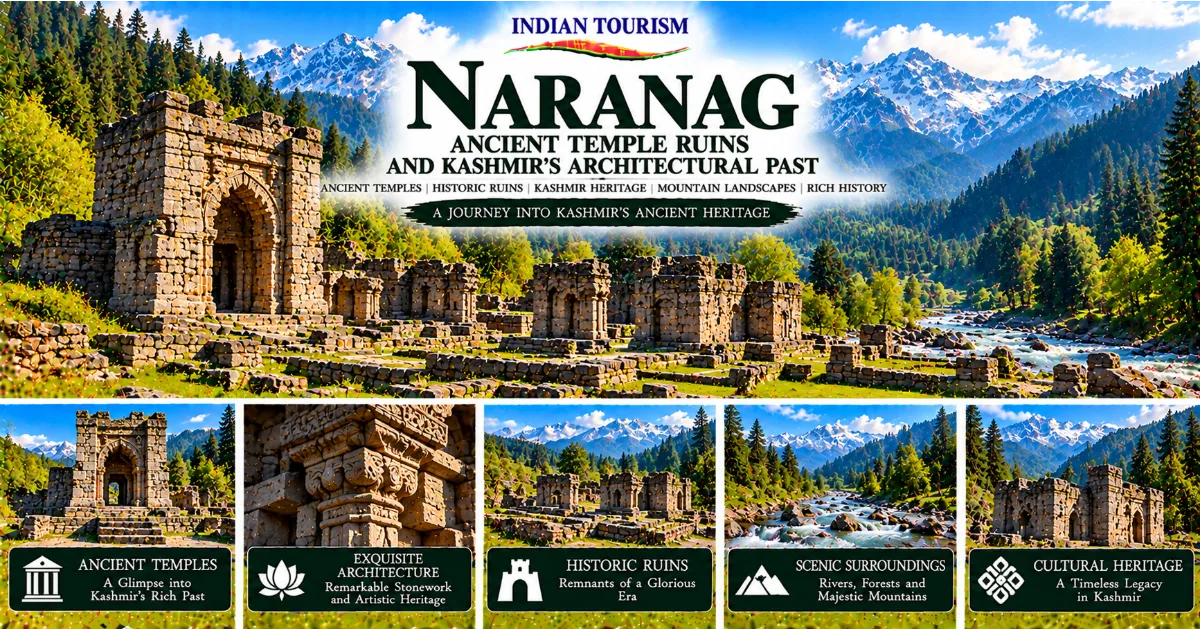
Naranag is one of Kashmir's remarkable heritage destinations for travellers interested in ancient architecture, religious history and the dramatic landscapes of the Himalayas. Located in the Ganderbal district of Jammu and Kashmir, this historic site is known for its ancient stone temple ruins, which stand against a striking backdrop of mountain slopes, forests and the wider Kashmir landscape. The remains offer a fascinating glimpse into a period when temple construction played an important role in the religious and cultural life of the region.
Unlike destinations celebrated mainly for lakes, gardens and modern tourist facilities, Naranag invites visitors to slow down and look closely at the evidence left behind by earlier generations. Massive stone blocks, surviving foundations, architectural fragments and the arrangement of the temple complex reveal the skill and planning involved in creating enduring structures in a mountain environment. Although the buildings have not survived completely, the remains continue to communicate something of the artistic ambition and religious traditions of their creators.
Kashmir's history cannot be understood through its natural beauty alone. The region has experienced centuries of political change, religious development, artistic achievement and cultural exchange. Its architecture reflects connections with the wider Indian subcontinent while also displaying characteristics influenced by local materials, geography and building practices. Naranag provides a physical connection to this history and offers an opportunity to explore the relationship between sacred architecture and the communities that supported it.
For travellers who enjoy historical exploration, Naranag can be a rewarding addition to a Kashmir itinerary. The experience combines the study of ancient structures with the opportunity to appreciate a mountain environment. A thoughtful visit also encourages questions about the people who built the temples, the religious traditions associated with them and the circumstances that allowed such structures to survive for centuries.
The site should be approached with curiosity and respect. Visitors should avoid disturbing the surviving architecture, follow local instructions and confirm current travel conditions before setting out. With appropriate preparation, Naranag offers a meaningful journey into Kashmir's architectural past.
1. Where Is Naranag?
Naranag is situated in the Ganderbal district of Jammu and Kashmir, in the mountain region northeast of Srinagar. It is associated with a landscape of forests, streams, mountain slopes and routes leading towards higher Himalayan terrain. This geographical setting contributes to the appeal of the destination and helps explain why a visit can feel different from exploring the busier urban and lakeside attractions of Kashmir.
The surrounding geography has influenced settlement and movement throughout the region. Mountain routes frequently follow valleys and waterways, while changes in elevation can make journeys longer than the distances shown on a map might suggest. Weather, road conditions and seasonal access can also affect travel, particularly when visitors move beyond major urban centres.
Naranag is widely known for its ancient Hindu temple remains, which are associated with Kashmir's early medieval architectural heritage. The complex is often discussed in connection with the period when regional rulers and religious patrons supported the construction of temples and other sacred structures. These buildings formed part of a wider cultural landscape in which religious institutions, artistic traditions and political authority were closely connected.
The location adds another dimension to the visit. The stone structures appear within a landscape dominated by mountains and vegetation, creating a powerful contrast between the work of human hands and the scale of the natural environment. The substantial masonry demonstrates the effort required to construct lasting buildings in a region where terrain and weather presented practical challenges.
Before travelling, visitors should confirm the current route, road conditions and access arrangements. Transport availability can vary, and the final approach may require local guidance. Planning ahead makes it easier to enjoy the destination without unnecessary delays.
2. Naranag and the Ancient History of Kashmir
Kashmir has a long and complex history shaped by regional kingdoms, religious traditions, literary activity and connections with neighbouring parts of the Himalayan world and the Indian subcontinent. Its geographical position allowed people, goods, artistic practices and ideas to move between different regions. These interactions contributed to a cultural environment in which architecture, religion and political life developed over many centuries.
Ancient and early medieval Kashmir was known for its intellectual and religious traditions. Hindu and Buddhist institutions played important roles during different periods, while later centuries brought further changes in religious practice, political authority and cultural expression. These developments were not isolated events. They formed part of a wider historical process influenced by local rulers, religious communities, trade connections and movement through mountain routes.
Naranag's temple complex belongs within this broader history. Its surviving structures provide material evidence of a period when temple architecture was an important expression of religious patronage and regional craftsmanship. The remains allow visitors to consider how sacred spaces were constructed, how stone was used as a building material and how architecture communicated religious significance.
The complex is commonly associated with the architectural traditions of Kashmir's early medieval period, including the era of the Karkota dynasty. However, precise dates, construction phases and the identity of individual patrons should be understood through reliable historical and archaeological research. Popular descriptions sometimes simplify complex monuments into a single date or story, overlooking the possibility that different parts of a site were constructed or modified at different times.
This distinction is important because archaeology depends on careful interpretation. The surviving stones are direct evidence that structures once existed, but understanding their original appearance, purpose and chronology requires additional information. Historical texts, inscriptions, architectural comparisons and archaeological findings can help establish a more complete picture.
For visitors, this makes Naranag more than a picturesque ruin. It becomes an opportunity to explore the wider history of Kashmir while recognising that some questions about the past require continued research.
3. The Temple Complex and Its Architectural Significance
Naranag is best known for its ancient stone temple complex, which preserves the remains of religious architecture associated with Kashmir's early medieval period. The structures are notable for their substantial masonry and the way their surviving forms sit within the surrounding mountain environment. Even where roofs and upper sections have disappeared, the remaining walls, foundations and architectural fragments allow visitors to appreciate the scale of the original building effort.
A temple complex is rarely just one building. It may include several shrines, platforms, courtyards and spaces associated with different aspects of religious activity. The arrangement of these structures can reflect ritual practices, movement through the sacred area and the relationship between individual shrines and the wider complex.
At Naranag, the surviving layout encourages visitors to think about how the site may have been organised when its buildings were complete. The placement of structures and the use of open spaces can prompt questions about how worshippers approached the shrines, how movement through the complex was managed and how different architectural elements related to one another. Such interpretations should be guided by documented research rather than speculation.
The stonework deserves particular attention. Large blocks were shaped and positioned with considerable care, requiring planning, labour and knowledge of construction techniques. Creating durable structures from heavy stone in a mountain environment demanded practical skill and the ability to organise materials and workers. The surviving remains provide evidence of that craftsmanship even though the original buildings are incomplete.
Centuries of weathering, environmental change and human activity have altered the appearance of the complex. Some structural elements have disappeared, while others remain in a condition that allows their form to be studied. The absence of a complete roof or an intact shrine does not diminish the value of the site. Archaeological remains often preserve important information through foundations, masonry patterns and fragments rather than through fully standing buildings.
Visitors should explore only accessible and permitted areas. Climbing on old walls, moving stones or entering unstable sections can damage the monument and create safety risks. Careful observation is the best way to appreciate the surviving architecture.
4. Understanding Kashmir's Distinctive Temple Architecture
The ancient architecture of Kashmir occupies an important place in the wider history of Indian temple building. While it shares broad religious and artistic connections with other regions of the subcontinent, it also developed characteristics influenced by local materials, climate, geography and cultural interaction.
Stone has an important place in Kashmir's architectural heritage. In mountainous areas, durable stone construction could create substantial buildings capable of withstanding demanding environmental conditions. Selecting suitable stone, shaping blocks, arranging masonry and creating stable openings required specialised skills and careful planning.
Historic temple architecture in Kashmir is often recognised for its strong structural forms and carefully arranged architectural elements. Surviving examples across the region display distinctive combinations of stonework, pillars, doorways and roof forms. Some temples feature sloping roof structures or carefully proportioned architectural components that differ from those found in other regional traditions.
The precise features vary from monument to monument, and visitors should not assume that every characteristic found elsewhere is necessarily present at Naranag. Each site has its own history, and its surviving architecture should be studied on its own evidence.
Architectural traditions also change over time. Builders may adapt familiar designs, incorporate new ideas or respond to the needs of a particular patron or location. As a result, a regional style is not always a single uniform system. It can include related approaches that developed through experimentation, continuity and cultural exchange.
At Naranag, visitors can examine the proportions of the surviving foundations, the arrangement of stone blocks and the relationship between individual structures. These observations help build an appreciation of how architecture reflects both technical knowledge and cultural choices.
For travellers who are not specialists, there is no need to identify every architectural feature by its technical name. Looking carefully at the remains and learning from reliable heritage information can make the visit informative without turning it into a formal academic exercise.
5. Religious Life and the Meaning of Sacred Architecture
Religious buildings are more than architectural objects. They are places created for worship, ritual, community gatherings and the expression of shared beliefs. In historical societies, the construction of a temple could also reflect the relationship between political authority, religious institutions and the people who supported them.
Hindu religious traditions formed an important part of Kashmir's cultural and intellectual history. Temples served as places of devotion and could be connected with festivals, offerings, religious learning and the activities of priests and other community members. Their construction required architectural skill as well as the resources needed to organise labour, obtain materials and maintain the buildings.
Naranag's temple remains provide a setting for considering the place of sacred architecture in this historical landscape. The surviving structures encourage visitors to imagine how a religious complex might have been experienced when its buildings were complete. Different spaces may have supported different ritual functions, although the purpose of individual remains should be established through archaeological evidence rather than assumption.
Religious patronage could also communicate political and social values. Rulers and wealthy patrons sometimes supported temples as expressions of devotion, public responsibility or status. Such projects could bring together artisans, builders, suppliers and religious specialists. The finished buildings then became part of the cultural landscape long after the people who commissioned them had passed away.
The religious significance of a site may also continue after its original structures have changed. A place can remain important in historical memory, local tradition or contemporary religious understanding even when its buildings are incomplete. Visitors should therefore approach Naranag with respect, recognising that its significance extends beyond the visual appeal of its stonework.
Respectful behaviour includes avoiding disruptive activities, following site instructions and not climbing on the ruins. Visitors should also refrain from moving objects or leaving offerings unless the site management explicitly permits them. Archaeological remains need protection from unnecessary interference.
Learning about religious heritage does not require visitors to share the beliefs associated with a monument. It requires a willingness to understand why the place mattered to the people who created it and why its preservation remains important today.
6. Naranag and Kashmir's Cultural Connections
Kashmir's historical development was shaped by its position between different geographical and cultural regions. Mountain routes connected the valley with neighbouring areas, allowing people, goods, artistic practices and religious ideas to move across the wider Himalayan world. These connections helped create a cultural landscape that cannot be explained through a single influence.
The architectural remains at Naranag form part of this larger story. Temple construction in Kashmir drew upon traditions related to broader developments in the Indian subcontinent while adapting to local conditions. The use of stone, the design of sacred structures and the organisation of religious complexes reflected the skills and choices of builders working in a distinctive environment.
Cultural exchange does not mean that every architectural feature originated outside the region. Local craftsmanship and established building practices were equally important. Traditions often develop through a combination of continuity and adaptation, with communities retaining familiar forms while responding to new ideas and changing circumstances.
The study of Naranag therefore encourages visitors to think about cultural history as a process rather than a list of isolated influences. Buildings are evidence of local choices, but they may also reveal wider networks of contact. To understand those connections, historians compare architectural forms, inscriptions, archaeological findings and written accounts from different places.
Visitors can develop this perspective by learning about other historic temple sites in Kashmir and comparing their settings, materials and architectural features. Such comparisons should be based on reliable information rather than visual resemblance alone. Two structures may share a broad design element without having been built at the same time or for the same purpose.
Naranag's importance lies partly in the way it connects visitors to these wider questions. It is a physical reminder that Kashmir's history includes artistic achievement, religious life and cultural interaction across many centuries.
7. The Natural Setting of Naranag
The natural environment is central to the experience of visiting Naranag. The site lies within a mountain landscape characterised by forested slopes, open areas, streams and views towards higher terrain. The combination of ancient stone architecture and dramatic scenery creates a setting that is memorable even for travellers who have visited other historic monuments.
The landscape also helps explain why access and travel conditions need careful planning. Mountain roads can be winding, and journey times depend on more than distance. Changes in elevation, road surfaces, traffic and weather may influence the trip. Rainfall can make outdoor surfaces slippery, while colder conditions may affect comfort and visibility.
The relationship between the ruins and the surrounding mountains is worth observing slowly. Look at how the stone structures contrast with vegetation and how the natural contours of the land shape the views around the complex. These details contribute to an understanding of the site as a place embedded within its environment rather than a monument separated from it.
The surrounding countryside may appeal to travellers who enjoy landscape photography and quiet outdoor observation. However, visitors should remain within appropriate paths and avoid entering sensitive or privately used areas. Natural scenery does not mean that every part of the landscape is freely accessible.
The environment should be treated with the same care as the archaeological remains. Carry waste away when suitable disposal facilities are not available, avoid damaging plants and do not disturb wildlife. Refrain from playing loud music or leaving rubbish near streams and open areas.
Naranag's landscape is part of its heritage experience. Preserving the natural setting helps maintain the atmosphere that makes the site distinctive and supports its long-term value for both residents and visitors.
8. Best Time to Visit Naranag
The best time to visit Naranag depends on weather, road access and the kind of experience you want. Because the site is in a mountain environment, conditions can differ from those in Srinagar and the lower parts of the Kashmir Valley.
Spring, from March to May, brings seasonal changes to the wider region. Depending on local conditions, the landscape may become greener as temperatures rise. Early spring can still be cold, and visitors should check whether the road and site are accessible before travelling. Carry layers because temperatures can change during the day.
Summer, from June to August, is often attractive for mountain sightseeing because daytime conditions in many parts of Kashmir are more comfortable than in the hottest parts of the Indian plains. Summer is also a busy travel period, so road traffic and accommodation availability may affect the itinerary. Rain can occur, and visitors should check the forecast before departure.
Autumn, from September to November, can offer clear views and changing colours across parts of the Kashmir landscape. The weather may be pleasant for sightseeing, although temperatures begin to fall as the season progresses. Shorter daylight hours later in autumn make it important to plan the return journey carefully.
Winter, from December to February, can bring cold conditions and, in higher or exposed areas, snow and difficult travel. Access should never be assumed. Check current road conditions, local advisories and site information before attempting a winter visit.
These are general seasonal guidelines, not guarantees of access or weather at Naranag. Conditions can change quickly in mountain regions. If the trip involves a long drive or a connection with other destinations, keep the schedule flexible and prioritise safety over completing every planned stop.
9. How to Reach Naranag
Naranag is generally approached by road from the Srinagar and Ganderbal side of the Kashmir Valley. The most suitable route and journey time depend on the starting point, current road conditions and any local restrictions. Visitors should verify the route before departure and ask locally about the best access arrangements.
Travellers arriving in Srinagar may arrange a taxi or private vehicle for the journey. This can be convenient for visitors who wish to explore at their own pace, particularly if they are combining Naranag with other destinations in the region. Agree on the return arrangements in advance, especially if travelling outside the busiest tourist period.
Those using public transport should establish the available connections towards Ganderbal and the onward options to Naranag. Services may not operate at the frequency visitors expect, and the final part of the journey may require a locally arranged vehicle. Confirm return transport before setting out rather than assuming that a ride will be immediately available.
The route through the valley and towards the mountain landscape is part of the experience, but it should not be treated as a reason to ignore road safety. Allow enough time for the journey, avoid rushing on narrow roads and follow local advice if weather conditions deteriorate.
Visitors should also check whether the site is accessible on the intended day. Conservation work, weather, local restrictions or other circumstances may affect entry. If access is restricted, respect the decision and consider an alternative activity rather than attempting to reach closed or unsafe areas.
Keep a charged phone, drinking water and essential personal items with you. If mobile connectivity is limited along parts of the route, having offline directions and clear transport arrangements can help avoid unnecessary difficulties.
10. What to Observe During Your Visit
A visit to Naranag becomes more rewarding when travellers give themselves time to observe the ruins rather than moving quickly from one photograph to another. The surviving structures contain details that are easy to miss if the visit is rushed.
Begin with the overall layout. Observe how the different remains occupy the available space and how the complex relates to the surrounding ground. The arrangement may provide clues about the organisation of the sacred area, although interpreting individual structures requires reliable historical and archaeological evidence.
Next, examine the stonework from safe, permitted areas. Look at the size of the blocks, the way the masonry is arranged and the visible condition of the surviving surfaces. Architectural details can help visitors appreciate the technical work involved in constructing the buildings.
Notice the contrast between the material remains and the natural environment. The stone structures may appear weathered, while the surrounding vegetation changes with the seasons. This contrast is part of the site's character and can help visitors reflect on the passage of time.
If interpretive information or a knowledgeable guide is available, use it to develop a better understanding of the complex. Ask which features are supported by documented evidence and whether there are uncertainties about particular buildings or construction phases. This approach encourages informed curiosity rather than relying on assumptions.
Photography is useful for recording the visit, but avoid climbing onto structures or moving stones for a better view. Fragile archaeological remains can be damaged by seemingly minor actions. Respect any boundaries or instructions in place and keep children close in areas with uneven ground.
Before leaving, take a final look at the complex from a suitable viewpoint. Consider how the site's architecture, religious associations and mountain setting combine to create its historical significance. That broader perspective often makes the visit more memorable than focusing on one individual feature.
11. Nearby Experiences and a Wider Kashmir Itinerary
Naranag can form part of a wider journey through the Kashmir Valley, but the best combination of destinations depends on the time available and the current condition of roads. Travellers should group places according to practical travel routes rather than assuming that every attraction can be reached quickly.
Srinagar may serve as a starting point for visitors interested in combining heritage with the region's well-known gardens, lakes, historic neighbourhoods and food traditions. Ganderbal and the surrounding area can also provide context for understanding the wider landscape through which travellers approach Naranag.
Visitors who enjoy mountain scenery may wish to include suitable viewpoints or other accessible outdoor destinations, provided conditions allow. The choice should be guided by current local information, especially if the itinerary involves higher elevations or roads that may be affected by weather.
A heritage-focused trip can also include time for learning about Kashmir's traditional crafts, architecture and cuisine. Local markets and workshops may provide opportunities to understand skills that have been passed between generations. When visiting workshops or private spaces, ask permission before taking photographs and respect any limits on access.
Avoid creating an itinerary that includes too many distant stops in one day. Mountain journeys can take longer than expected, and the value of visiting Naranag lies partly in having enough time to explore the ruins thoughtfully. A slower schedule also allows room for meals, rest and unexpected delays.
If travelling with family members or people who have mobility limitations, confirm the walking conditions and facilities in advance. Ancient sites may not have paved paths, accessible toilets or seating throughout the complex. Practical preparation can make the experience more comfortable for everyone.
12. Photography Tips for Naranag
Naranag is well suited to photography that combines architectural detail with landscape. The stone remains can be photographed as individual structures, but wide views are also important because they show how the ancient complex sits within its mountain environment.
Morning light can reveal the texture of stone without creating overly strong shadows. Late-afternoon light may add warmth to the masonry and bring out the contours of the surrounding landscape. The best time depends on the weather and the direction of the light on the day.
A useful photographic approach is to take three kinds of images. First, capture a wide view of the complex and its setting. Second, photograph individual structures or sections of masonry from permitted areas. Third, record smaller details that show the construction techniques and weathered surfaces.
Avoid relying heavily on digital zoom, which can reduce image quality. Instead, move to a safe and permitted viewpoint when a closer composition is possible. Do not climb on walls or enter restricted areas to improve an image.
Photographs shared online should represent the site honestly. Avoid editing the ruins to add architectural elements that are not present or presenting an artistic reconstruction as a photograph of the original complex. If you use a recreated image for a travel post, make its illustrative nature clear.
Respect other visitors and any people engaged in religious activities. Ask permission before taking identifiable portraits, and follow any photography restrictions. The purpose of a visit is to appreciate and preserve the site, not simply to produce images.
13. Responsible Tourism and Preservation
Naranag's surviving structures are part of Kashmir's archaeological heritage and deserve careful treatment. Ancient masonry can be vulnerable to weathering, vegetation growth and human interference. Visitors can help protect the site by avoiding actions that place additional pressure on the remains.
Never remove stones, fragments or other materials from the complex. Even an apparently ordinary piece may contribute to understanding the original structure. Avoid scratching names into surfaces, climbing on fragile walls or entering areas that have been marked unsafe.
Stay on appropriate paths and follow instructions from site authorities. Where boundaries are present, respect them. If there are no clearly marked paths, use caution and avoid areas where the ground or masonry appears unstable.
Carry waste away if bins are unavailable, and avoid leaving plastic packaging or food waste near the ruins. The surrounding environment is an important part of the visit, and litter can harm both the appearance of the landscape and its ecological value.
Support local communities by using local services where practical and treating residents with courtesy. If you arrange a guide, confirm the fee and the scope of the visit beforehand. Fair payment for local services can help create an incentive for preserving and sharing regional heritage.
Historical accuracy is another part of responsible tourism. Avoid repeating uncertain dates or legends as established fact. Use reliable sources when writing about the site, and acknowledge where the available evidence does not provide a definitive answer. Good interpretation helps visitors appreciate the monument without creating misleading claims about its past.
14. Why Naranag Matters Today
Naranag remains important because it connects present-day visitors with a period of Kashmir's history when temple architecture and religious patronage played significant roles in the region's cultural life. The surviving stonework offers a tangible record of the craftsmanship, resources and planning required to build substantial religious structures in a mountain environment.
The site also encourages a wider understanding of Kashmir's heritage. The region's story includes far more than scenic landscapes and modern tourism. It includes historic settlements, religious institutions, artistic traditions and centuries of interaction between communities and political powers.
For students of architecture, Naranag offers an opportunity to observe how building materials and structural forms reflect local conditions. For history enthusiasts, it provides a starting point for exploring early medieval Kashmir and the relationship between rulers, religious institutions and local communities. For general travellers, the combination of ruins and mountain scenery creates an experience that rewards curiosity and patience.
Its value does not depend on the buildings being completely preserved. Archaeological remains often communicate their importance through fragments and patterns rather than complete structures. The challenge is to interpret those fragments responsibly and recognise the difference between what is visible and what must be established through research.
Naranag deserves to be approached as both a historical site and a place within a living landscape. Protecting its remains, respecting local guidance and learning from reliable sources can help ensure that future visitors continue to appreciate its significance.
Conclusion: Exploring Kashmir Through Its Ancient Architecture
Naranag offers a compelling journey into Kashmir's architectural and religious past. Its ancient temple ruins preserve evidence of a rich building tradition and provide a setting for exploring the wider history of the Kashmir Valley. The stone structures, their arrangement and their relationship with the surrounding mountains make the site particularly rewarding for travellers who enjoy history, architecture and thoughtful outdoor exploration.
A successful visit begins with preparation. Check current access conditions, plan transport carefully and allow enough time to explore without rushing. Observe the remains from safe areas, respect the archaeological fabric and avoid treating the site as merely a photographic backdrop.
Most importantly, approach Naranag with curiosity and care. Its surviving architecture is a reminder that cultural heritage is both a record of the past and a responsibility for the present. By travelling respectfully and learning about the historical context, visitors can help preserve the value of this remarkable part of Kashmir's heritage.
#IndianTourism #Naranag #Kashmir #Ganderbal #JammuAndKashmir #AncientTemples #KashmirHeritage #TempleArchitecture #IndianHistory #ArchaeologicalHeritage #CulturalTourism #ExploreKashmir #HistoricPlaces #ResponsibleTourism #TravelIndia
