
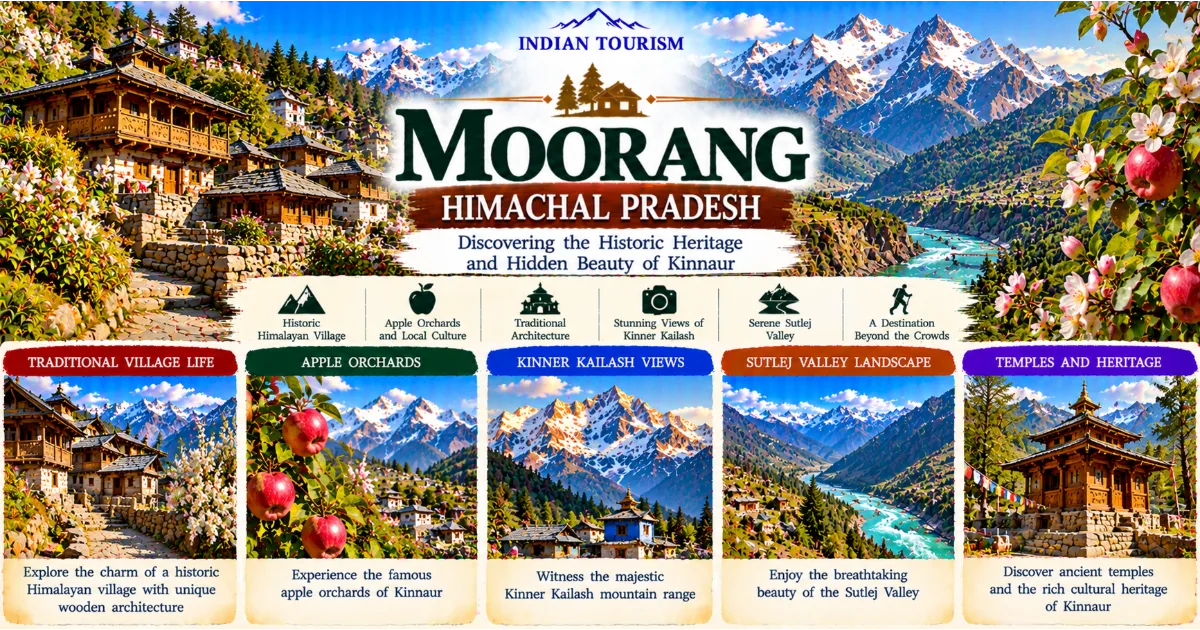
A Journey into the Lesser-Known Himalayas
The Himalayan region of Himachal Pradesh is filled with destinations that offer far more than dramatic mountain scenery. Across its valleys and high-altitude settlements, visitors can discover centuries of cultural exchange, traditional architecture, ancient places of worship and communities whose lives remain closely connected to the surrounding landscape. Moorang, a village in the Kinnaur district, is one such destination. Situated in the Sutlej Valley region, Moorang offers an opportunity to explore a quieter part of the Himalayas where history, local traditions and mountain geography come together.
Unlike popular destinations such as Shimla and Manali, Moorang does not depend on large tourist markets or extensive entertainment facilities. Its appeal lies in its historical character, its traditional settlement patterns and its position within the wider cultural landscape of Kinnaur. Travellers who enjoy discovering lesser-known villages may find the experience rewarding, particularly when they approach the destination with curiosity and respect for local life.
Kinnaur occupies a distinctive position in Himachal Pradesh. Its valleys connect different mountain environments, from areas with greener vegetation and cultivated slopes to landscapes that become increasingly rugged and dry at higher elevations. The Sutlej River has played an important role in shaping the region, providing a natural corridor through which people, goods and cultural influences have moved over time.
Moorang is part of this wider story. Its significance is connected with the historical settlements of Kinnaur, the architecture and religious traditions of the region, and the practical relationship between communities and their mountain environment. Visitors who explore the village thoughtfully can gain a broader understanding of the region beyond its most frequently photographed locations.
A journey to Moorang is best planned as part of a wider Kinnaur road trip rather than as an isolated visit. The region contains numerous villages, valleys and cultural sites, and combining them thoughtfully can provide a richer experience of Himalayan life. Travellers should check current road conditions, available accommodation and local access arrangements before setting out.
For those who value cultural discovery, quiet landscapes and the opportunity to travel beyond familiar tourist circuits, Moorang offers a different perspective on Himachal Pradesh. It reminds visitors that the character of the Himalayas is found not only in towering peaks, but also in the villages, traditions and everyday experiences of the people who call these mountains home.
Understanding Moorang and Its Location
Where Is Moorang Located?
Moorang is located in the Kinnaur district of Himachal Pradesh, within the wider Sutlej Valley region. The district lies in the eastern part of the state and shares its broader Himalayan geography with neighbouring regions that connect towards the Tibetan Plateau.
The landscape around Moorang is shaped by mountain slopes, river valleys, cultivated land and settlements that have developed where the terrain allows people to live and work. Like many villages in Kinnaur, its setting reflects the close relationship between geography and human activity.
Travelling through Kinnaur provides a sense of how settlements are distributed along valleys and mountain routes. Roads follow the terrain, connecting villages that may appear close on a map but can require considerable time to reach because of bends, narrow sections and changing road conditions.
Moorang is best considered as one stop within a broader exploration of Kinnaur. Reckong Peo and other regional settlements can help travellers organise transport, obtain supplies and gather information about local conditions. Before travelling, visitors should confirm the precise route, available services and any local restrictions that may affect their plans.
The Sutlej Valley and Its Influence
The Sutlej River is one of the major geographical features of Kinnaur. Flowing through a deep Himalayan valley, it has influenced settlement patterns, agriculture, transport and the development of communities across the region.
The valley creates a natural corridor through difficult mountain terrain. Over generations, routes along the river have helped connect settlements and facilitate movement between different parts of the western Himalayas. The landscape also reflects the powerful effects of erosion and geological processes that have shaped the mountains.
For visitors, the Sutlej Valley offers an opportunity to understand the relationship between natural geography and human settlement. Villages are positioned according to the availability of cultivable land, access to water and the practical demands of mountain travel.
The river is also part of a working environment. Water resources, roads, agricultural land and infrastructure all contribute to the region's economy and daily life. Visitors should appreciate the landscape as more than a scenic backdrop and recognise the importance of protecting it.
The Distinctive Character of Kinnaur
Kinnaur is known for its cultural diversity, traditional architecture, agricultural heritage and dramatic mountain scenery. Its geographical position has encouraged contact between different Himalayan communities, resulting in a distinctive mixture of local customs and regional influences.
The appearance of villages varies according to altitude, terrain and historical development. Some settlements are surrounded by orchards and cultivated slopes, while others occupy more rugged landscapes where the growing season is shorter and the environment is drier.
Moorang belongs to this diverse regional landscape. Its appeal is connected with the opportunity to explore a settlement whose identity is shaped by local history and geography rather than large-scale tourism.
Travellers can gain more from a visit by learning about the wider district. Understanding the agricultural calendar, architectural traditions and religious practices of Kinnaur helps place Moorang within a larger cultural context.
Historical Heritage of Moorang
Why Historic Villages Matter in Kinnaur
Historic villages preserve evidence of how communities have adapted to their surroundings over long periods. Their architecture, settlement layouts, places of worship and local traditions can reveal aspects of regional history that may not be obvious from a brief visit.
In Kinnaur, village heritage is closely connected with the practical realities of mountain living. Building materials, roof designs and the arrangement of houses often reflect the need to cope with cold weather, limited flat land and the availability of local resources.
Religious institutions have also played important roles in many Himalayan settlements. Temples, shrines and other sacred spaces can function as places of worship, centres of community activity and repositories of local memory.
Moorang can be explored within this wider context. Rather than assuming that every old structure has a single clearly documented history, visitors should pay attention to what is locally known and distinguish established information from oral tradition or popular interpretation.
Architecture as a Record of the Past
Traditional architecture offers one of the most visible connections between a village's past and present. Older buildings in Kinnaur may incorporate timber, stone and other materials chosen for their availability and suitability to the mountain environment.
The use of wood in structural and decorative elements reflects both practical knowledge and local craftsmanship. Stone can provide strength and durability, while the arrangement of doors, windows and roofs responds to the conditions in which people live.
Architecture also communicates cultural preferences. Carved details, building proportions and the relationship between domestic and religious structures can reflect local traditions that have developed over generations.
Visitors exploring Moorang should observe buildings respectfully from public paths and avoid entering private property without permission. Traditional structures may still be occupied or maintained by local families, and their historical value does not remove the residents' right to privacy.
Oral Traditions and Community Memory
In many remote Himalayan settlements, local stories and oral traditions contribute to the preservation of history. Residents may remember events, family connections, religious practices and changes in the village through accounts passed between generations.
Oral history can provide valuable insight into how a community understands its past. It may preserve details that are not recorded in formal publications, particularly concerning everyday life and local customs.
However, oral accounts and independently documented historical evidence are not always identical. Visitors should approach local stories with interest while recognising that some dates, interpretations or details may remain uncertain.
When residents are willing to share information, listening respectfully can make a visit more meaningful. The goal should be to understand the community's perspective rather than to demand a definitive answer to every historical question.
Traditional Architecture and Village Life
Building for the Himalayan Environment
The architecture of Kinnaur reflects the challenges of living in a mountainous region. Buildings must withstand seasonal temperature changes, occasional snowfall and other environmental pressures while making efficient use of limited space.
Traditional construction methods developed through experience with local materials and weather conditions. Timber and stone have been used in different combinations, while the arrangement of buildings often follows the shape of the available land.
In older settlements, houses may be grouped along narrow paths or positioned on slopes above cultivated areas. Such layouts reflect practical decisions about access, drainage, sunlight and the relationship between homes and agricultural land.
Modern construction has introduced new materials and designs, but traditional buildings remain an important part of the region's visual identity. They offer insight into local craftsmanship and the knowledge developed through generations of mountain living.
Daily Life in a Mountain Village
Daily life in Kinnaur is influenced by the seasons, agricultural work, household responsibilities and access to services. The demands of the mountain environment can make planning essential, particularly when weather affects travel or the availability of supplies.
Agriculture remains important to many households in the district. Where conditions permit, families cultivate land and manage orchards, while other sources of income may include local services, trade and tourism-related activities.
The village environment changes throughout the year. Warmer months generally provide more opportunities for outdoor work, while winter can bring colder conditions and adjustments to daily routines.
Visitors should remember that Moorang is a living settlement rather than an open-air attraction. Residents continue with their own responsibilities, and tourism should not interfere with ordinary village life.
Respecting Private Spaces
One of the most important principles of village tourism is respect for privacy. Homes, courtyards, agricultural plots and storage areas are private spaces, even when they appear visually interesting to visitors.
Ask permission before photographing residents, entering courtyards or taking close-up pictures of buildings that are clearly part of a private property. Avoid blocking narrow lanes or stopping vehicles in places that inconvenience local traffic.
Visitors should also be mindful of noise, particularly near homes and religious spaces. A quiet and considerate approach helps preserve the peaceful character that attracts people to lesser-known destinations.
Respectful behaviour creates a better experience for both travellers and residents. It also helps ensure that tourism remains a welcome activity rather than an additional burden for the community.
Religious and Cultural Traditions of Kinnaur
A Region of Interconnected Traditions
Kinnaur has a distinctive religious and cultural landscape shaped by Hindu and Buddhist traditions, alongside local customs that have developed within individual communities. The relationship between these traditions reflects the region's geographical position and long history of cultural exchange.
Religious sites may serve several roles, including worship, festivals, community gatherings and the preservation of local stories. Their importance is often connected with family histories and collective identity as well as formal religious practice.
Visitors should avoid assuming that every village follows the same customs. Practices can vary between settlements, and the meaning of a particular ritual or structure may be best explained by local residents or caretakers.
Exploring the cultural landscape requires patience and respect. Reading local information, asking appropriate questions and following instructions at places of worship can help visitors understand the region without making unsupported assumptions.
Temples, Shrines and Sacred Spaces
Temples and shrines are important features of many Kinnauri settlements. Their architecture and location can reveal aspects of local craftsmanship, religious identity and the historical development of a village.
Some structures may be old, while others have been repaired or rebuilt over time. Visitors should not assume that a building's present appearance represents a single historical period.
When visiting a religious site, follow instructions concerning footwear, photography, entry and behaviour. Some areas may be restricted during ceremonies or reserved for particular religious activities.
The most rewarding cultural visits are often those in which travellers take time to understand the role a place plays in the community. A sacred structure is not merely a photographic subject, but part of a living tradition.
Festivals and Community Gatherings
Festivals are important occasions in many Himalayan communities. They can bring together families, local residents and visitors through religious ceremonies, music, dance, traditional clothing and shared meals.
The timing and character of festivals vary between villages and may follow local calendars. Travellers should not assume that a particular celebration will occur on the same dates every year without confirming current information.
If a festival is taking place during a visit, observe respectfully and follow the guidance of organisers. Ask before photographing participants, particularly during private or religious moments.
Festivals can offer a valuable introduction to local culture, but visitors should remember that they are community events first and tourist attractions second. Respectful participation helps preserve the dignity and meaning of these traditions.
The Natural Landscape Around Moorang
Mountain Slopes and Valley Views
The landscape of Kinnaur is characterised by steep mountains, deep valleys and settlements positioned where the terrain allows habitation. Depending on the precise viewpoint and weather, visitors may see exposed rock, cultivated slopes, patches of vegetation and distant ridgelines.
The mountains change appearance throughout the day. Morning light can reveal details that become less distinct later, while evening shadows create strong contrasts between the valley and the higher slopes.
Travellers interested in photography should allow time to observe changing conditions rather than trying to capture every view in a hurried visit. The scenery may be especially rewarding when the air is clear, but mountain weather can change rapidly.
Safety should always take priority over photography. Avoid unstable slopes, unmarked tracks and roadside locations where stopping could create a traffic hazard.
The Geological Character of Kinnaur
The Himalayas are a young and geologically active mountain system shaped by the movement of tectonic plates, uplift and erosion. The terrain of Kinnaur reflects these processes through steep slopes, exposed rock formations and river-cut valleys.
Water and weather continue to shape the landscape. Rivers transport sediment, while seasonal changes contribute to erosion and the gradual alteration of mountain surfaces.
Visitors can observe the relationship between geology and settlement by noticing where roads follow the valley, where houses occupy flatter ground and where cultivated plots appear on suitable slopes.
These features reveal the practical challenges of living in a mountainous environment. The same terrain that creates spectacular scenery also influences transport, agriculture and the availability of land.
Seasonal Changes in the Landscape
The appearance of the region varies significantly through the year. Spring brings gradual changes in vegetation, while summer generally provides more favourable conditions for outdoor exploration.
Autumn may offer crisp air and clear mountain views, although temperatures begin to fall as winter approaches. Winter can bring snow and icy conditions, particularly at higher elevations.
The timing and intensity of seasonal changes vary from year to year. Travellers should check local forecasts and road conditions rather than relying entirely on general seasonal expectations.
A flexible itinerary allows visitors to appreciate the destination under different conditions without feeling pressured to complete activities that may be unsafe or unsuitable.
Agriculture and Local Livelihoods
Farming in the Mountains
Agriculture is an important part of life in many Kinnaur settlements. The combination of altitude, slope, water availability and temperature determines which crops can be grown and how land is used.
Cultivated plots are often located where the terrain allows access to sunlight and irrigation. Maintaining these areas can require considerable work because the growing season is relatively short and the landscape is uneven.
Agricultural practices are shaped by local knowledge accumulated over generations. Farmers understand the timing of seasonal work, the demands of their crops and the challenges posed by changing weather.
Visitors should respect fields and orchards as working land. Entering cultivated areas without permission, damaging plants or leaving waste can affect both livelihoods and the local environment.
Apples and Horticulture in Kinnaur
Kinnaur is well known for apple cultivation, which contributes significantly to the district's agricultural economy. Suitable climate conditions and elevation have helped orchard farming become important in many parts of the region.
Apple production involves much more than harvesting fruit. Farmers must maintain trees, manage irrigation, monitor pests and organise transport to markets. Weather conditions can influence the quality and quantity of each year's crop.
The orchard landscape changes throughout the seasons, from flowering and fruit development to harvest and winter dormancy. These changes are an important part of the region's agricultural identity.
If local growers offer fruit or other products for sale, purchasing directly from them can support the local economy. Visitors should not pick fruit or enter orchards without permission.
Tourism and Economic Opportunities
Tourism can create additional income for mountain communities through accommodation, transport, food services and guiding. In lesser-known villages, the scale of these opportunities may be limited by road access, available facilities and the length of the tourist season.
Responsible tourism can help distribute economic benefits by encouraging visitors to use local services where practical. However, tourism should complement existing livelihoods rather than displace them or interfere with agricultural activity.
Travellers can contribute positively by treating service providers fairly, respecting local arrangements and avoiding wasteful behaviour.
A thoughtful visit recognises that the community's economic life is more complex than what visitors see during a short stay. Agriculture, family responsibilities, local trade and tourism can all play different roles in household livelihoods.
Best Time to Visit Moorang
Spring: A Season of Transition
Spring brings a gradual transition from colder winter conditions towards warmer weather. Depending on the timing of the season, vegetation begins to change and agricultural activity increases.
This period can appeal to travellers who prefer quieter destinations and are comfortable with variable weather. Temperatures may remain low, particularly at night, and road conditions should be checked before departure.
Visitors should confirm accommodation availability and transport arrangements rather than assuming that all facilities operate throughout the year.
Spring is best approached with flexible plans, suitable clothing and a willingness to adjust activities according to the weather.
Summer: Practical Conditions for Exploration
Summer is generally a convenient season for exploring much of Kinnaur. Road access is often more favourable than during winter, and longer daylight hours allow visitors to travel and explore at a relaxed pace.
The region can still experience rain, road disruptions and sudden changes in temperature. Travellers should check local advisories before beginning a mountain journey.
Summer is suitable for visitors who want to explore villages, learn about local culture and combine Moorang with other destinations in Kinnaur.
Booking accommodation ahead of time is sensible during busy travel periods, particularly when the itinerary includes several remote settlements.
Autumn: Clear Views and Cooler Weather
Autumn can be rewarding for travellers who enjoy photography and mountain landscapes. Clear conditions may provide expansive views, while the cooler air creates a different atmosphere from the warmer months.
Temperatures decline as winter approaches, and daylight becomes shorter. Travellers should plan their journeys to avoid unnecessary driving after dark.
Before setting out, confirm road access and accommodation availability. Conditions can change quickly in the mountains, especially during the transition towards winter.
Winter: Cold Conditions and Travel Challenges
Winter can bring severe cold, snowfall and difficult road conditions in parts of Kinnaur. Some routes may be disrupted, and services in smaller settlements can be limited.
Visitors considering a winter trip should confirm current conditions with reliable local sources and ensure that accommodation, heating and transport arrangements are suitable.
Do not assume that a road is open simply because it was accessible during a previous visit. If authorities or local operators advise against travel, follow their guidance.
For travellers without experience of severe mountain conditions, the warmer months are generally more practical for exploring lesser-known villages.
How to Reach Moorang
Planning a Road Journey Through Kinnaur
Road travel is the principal way to explore many villages in Kinnaur. Travellers can approach the district through the mountain road network connecting Shimla and the Sutlej Valley, then plan local travel according to the destination and current conditions.
The journey requires patience because mountain roads include sharp bends, narrow sections and areas vulnerable to weather-related disruption. Distances on a map do not always reflect the time needed to travel between settlements.
Visitors should plan rest stops, carry essential supplies and avoid creating an itinerary that depends on reaching every destination at a fixed time.
Current route information is particularly important during periods of rain, snowfall or road maintenance. Local transport providers and accommodation staff may be able to advise travellers about recent conditions.
Using Reckong Peo as a Regional Base
Reckong Peo can serve as a practical base for organising travel around Kinnaur. It provides access to markets, transport services and essential supplies that may be harder to find in smaller villages.
Travellers can use the town to arrange local transport and confirm the most suitable route to Moorang. Depending on the available services, options may include taxis or public transport on relevant sections of the route.
Before leaving, confirm the return journey and the availability of transport at the intended time. Remote destinations should not be approached on the assumption that a vehicle will always be available at short notice.
Public Transport and Local Taxis
Public transport services in mountain districts may vary by route and season. Travellers should verify current schedules and connections before relying on a particular service.
Local taxis can offer greater flexibility, particularly for visitors who want to explore multiple settlements in one trip. Before hiring a vehicle, agree on the fare, waiting arrangements and intended stops.
If travelling by taxi, ask the driver about current road conditions and whether any parts of the route require additional caution.
A well-planned journey includes enough flexibility to accommodate delays without encouraging unsafe driving or unnecessary pressure on the driver.
Where to Stay During a Visit
Accommodation in the Wider Kinnaur Region
Accommodation options in Kinnaur vary by settlement and season. Visitors may find guesthouses, small hotels and homestays in larger regional centres, while smaller villages may have fewer facilities.
Travellers should confirm whether accommodation is available close to Moorang before planning an overnight stay there. If options are limited, staying in a nearby settlement with established services may be more practical.
Ask about heating, hot water, meals, parking and transport access before booking. These details are particularly important during colder months.
Advance arrangements can reduce uncertainty, especially for visitors travelling through several remote destinations.
The Value of Local Homestays
A locally operated homestay can provide a closer introduction to regional life. Hosts may share information about local food, agricultural practices, village history and cultural traditions.
Facilities may be simpler than those offered by larger hotels, so visitors should establish expectations before arrival. Respect household routines and remember that a homestay is also the host family's home.
Supporting local accommodation can help distribute tourism income within the community. Guests should treat hosts fairly, follow house rules and communicate clearly about meals and other requirements.
Choosing a Practical Base
The best accommodation arrangement depends on the length of the trip, available transport and the traveller's priorities. Some visitors may prefer to stay in a regional centre and explore Moorang as part of a wider excursion.
Others may wish to remain closer to the village to experience the surrounding landscape at a slower pace, provided suitable accommodation is available.
Avoid planning too many destinations into a single day. A more relaxed schedule allows time to appreciate the places visited and reduces the pressure associated with mountain travel.
Local Food and Culinary Experiences
Food in Kinnaur reflects the practical demands of mountain living and the ingredients available in the region. Visitors may encounter simple home-cooked meals, rice, lentils, seasonal vegetables, soups and other warming dishes.
The selection of food varies between establishments. Smaller villages may have limited dining options, particularly outside the main travel season, so travellers should confirm meal arrangements in advance.
Local produce is an important part of the regional food experience. Apples and other agricultural products contribute to the district's identity, while household cooking reflects local preferences and seasonal availability.
Visitors with dietary restrictions should ask about ingredients and preparation methods before ordering. Carrying suitable snacks can be useful during longer road journeys when shops and restaurants may be unavailable.
Eating at locally operated establishments, where available, helps support small businesses and gives visitors a chance to experience regional hospitality.
Travellers should avoid wasting food and dispose of packaging responsibly. In remote mountain environments, waste management can be more difficult than in larger towns, making individual responsibility particularly important.
Responsible Tourism in Moorang
Protecting the Environment
The natural environment of Kinnaur is both beautiful and vulnerable. Steep slopes, river valleys and cultivated areas require careful management, while waste can remain visible for long periods in remote locations.
Visitors should carry rubbish to suitable disposal points and avoid leaving plastic packaging, bottles or food waste along roadsides and village paths.
Do not damage vegetation, disturb wildlife or remove natural materials as souvenirs. The landscape should be left as undisturbed as possible for residents and future visitors.
Water should be used thoughtfully, particularly in areas where households and agriculture depend on limited local resources.
Respecting Cultural Heritage
Historic buildings, religious structures and traditional village spaces deserve careful treatment. Visitors should follow local rules, ask permission before entering private areas and avoid touching fragile architectural features.
Photography should be respectful, particularly when it involves residents, religious ceremonies or private property.
Local traditions may be unfamiliar to visitors, but curiosity should be expressed through thoughtful questions rather than assumptions. If a site is closed or access is restricted, respect the decision.
Preserving cultural heritage requires cooperation between residents, authorities and visitors. Responsible behaviour helps protect the places that make Kinnaur distinctive.
Supporting the Community
Tourism can support local livelihoods when visitors use local services and treat residents fairly. Accommodation, transport, meals and locally produced goods can all provide economic opportunities.
Where practical, choose locally operated businesses and honour agreed arrangements. Avoid pressuring residents to provide services or photographs without consent.
Responsible tourism also means recognising that the needs of local communities come first. Visitors should not obstruct roads, interfere with agricultural work or treat village life as a performance arranged for tourists.
A thoughtful approach allows travellers to learn from the destination while respecting the people who maintain it.
A Suggested Three-Day Kinnaur Itinerary Featuring Moorang
Day One: Arrive in the Sutlej Valley
Begin by travelling into Kinnaur and settling into suitable accommodation in a regional centre. Depending on your starting point, the journey may require a substantial part of the day.
Use the remaining time to rest, obtain essential supplies and confirm the current road conditions for the next stage.
If you arrive early enough, explore an accessible part of the settlement where you are staying. Avoid strenuous activities immediately after a long drive.
Day Two: Explore Moorang and Its Surroundings
Travel to Moorang after confirming the route and available local access. Explore accessible village paths, observe the settlement's architecture and learn about its relationship with the surrounding mountain environment.
If local residents or guides are willing to share information, ask respectful questions about the village's history and traditions. Distinguish established historical information from oral accounts when discussing particular events or structures.
Allow enough time to appreciate the landscape without rushing. Avoid entering private property or stopping vehicles in places that obstruct local traffic.
Return to your accommodation with sufficient daylight remaining and flexibility for unexpected delays.
Day Three: Continue Exploring Kinnaur
Depending on the available time and current road conditions, continue towards another destination in Kinnaur or return along your planned route.
Travellers may consider exploring a regional centre or including another village in the itinerary. The choice should be based on practical travel time rather than the number of locations that can be marked on a map.
Before departure, check weather and road information and confirm transport arrangements. Allow extra time for delays, particularly if the journey connects with a longer onward trip.
Who Should Visit Moorang?
Moorang is best suited to travellers who enjoy cultural exploration, historic settlements, mountain landscapes and quieter destinations. It may appeal to photographers, students of regional history, road-trip enthusiasts and visitors interested in understanding life in the western Himalayas.
The village can also be valuable for travellers who want to explore beyond the better-known destinations of Kinnaur. Spending time in lesser-known settlements can reveal how the district's culture and geography vary from place to place.
However, visitors should be prepared for limited tourist infrastructure and changing travel conditions. Anyone who requires extensive facilities or a highly structured sightseeing experience may prefer to use a larger town as a base.
Families and older travellers should consider road conditions, walking requirements and the availability of services when planning the trip.
The most rewarding visitors are those who travel patiently, respect local customs and value the experience of learning about a place rather than simply collecting photographs.
Conclusion: Why Moorang Deserves Attention in Himachal Pradesh Tourism
Moorang offers an opportunity to explore a lesser-known part of Kinnaur where mountain geography, traditional settlement patterns and local cultural heritage come together. Its value lies in the chance to understand the wider region beyond its most popular tourist stops.
The Sutlej Valley provides the geographical setting, while the architecture, agricultural landscape and community traditions reflect generations of adaptation to life in the Himalayas. A thoughtful visit can help travellers appreciate how the environment influences housing, transport, livelihoods and cultural identity.
Moorang is best included as part of a carefully planned journey through Kinnaur. Checking current road conditions, arranging suitable transport and confirming accommodation can make the trip safer and more comfortable. Respecting private property, religious spaces and the local environment is equally important.
The village may not offer the extensive attractions or facilities of a major tourist centre, but that is part of its appeal. It provides a quieter opportunity to observe the relationship between people and place in a mountain region shaped by history and geography.
For travellers seeking a deeper understanding of Himachal Pradesh, Moorang can be a worthwhile addition to a Kinnaur itinerary. It encourages visitors to look beyond famous viewpoints and recognise the cultural importance of the villages that give the Himalayas their enduring human character.
#IndianTourism #Moorang #HimachalPradesh #Kinnaur #SutlejValley #HimalayanVillages #ExploreHimachal #HimalayanCulture #MountainTravel #CulturalHeritage #VillageTourism #TravelIndia #ResponsibleTourism #HiddenDestinations #IncredibleIndia
