
Discovering the Ancient Heritage of Kashmir
Jammu and Kashmir is widely admired for its snow-covered mountains, green valleys, shimmering lakes and historic gardens. Yet the region’s cultural heritage extends far beyond its natural beauty. Scattered across the Kashmir Valley are monuments that reveal the influence of ancient kingdoms, religious traditions, architectural innovation and centuries of cultural exchange. Among the most remarkable of these heritage sites is the Martand Sun Temple, an ancient temple complex near Mattan in the Anantnag district of Jammu and Kashmir.
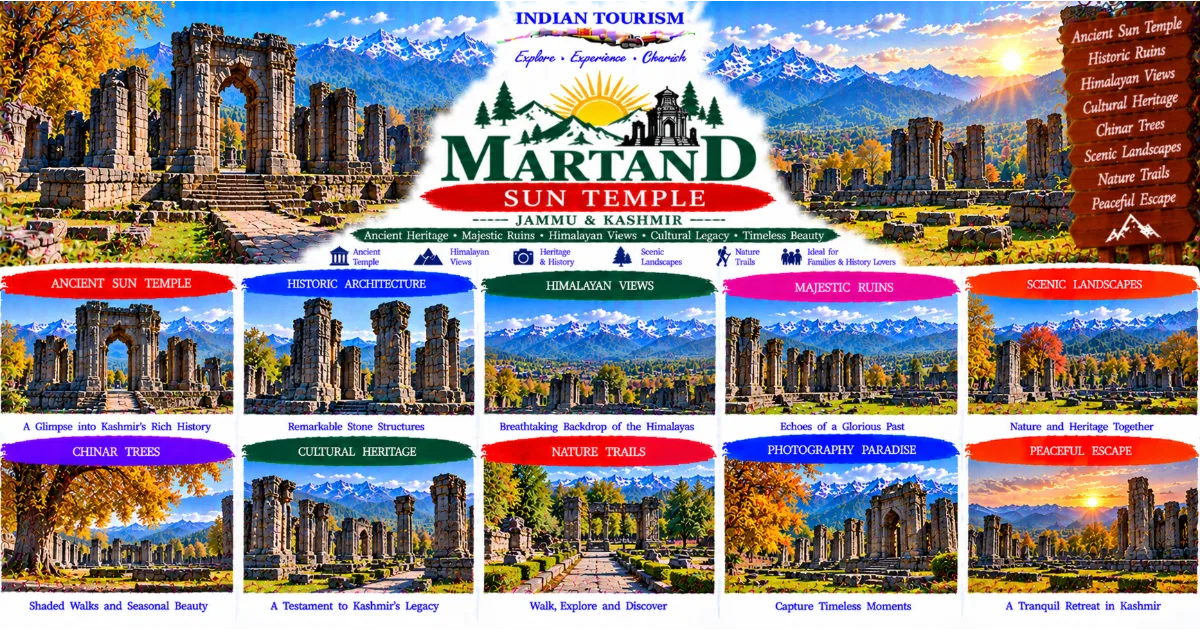
The Martand Sun Temple is one of the most significant surviving examples of early medieval temple architecture in Kashmir. Its ruined stone walls, imposing colonnades, monumental entrance and elevated setting create an atmosphere that is both dramatic and contemplative. Although the temple no longer survives as a complete place of worship, its remains offer valuable insight into the artistic ambition and religious life of an earlier period in the Valley’s history.
Unlike Kashmir’s famous gardens, which invite visitors to experience carefully maintained greenery and flowing water, Martand presents a different kind of beauty. Its landscape is defined by stone, open skies, broad views and the traces of a monumental structure that once occupied the site. The ruins encourage visitors to imagine the temple as it might have appeared centuries ago, when its halls, shrines and architectural details formed a more complete sacred complex.
The temple is particularly rewarding for travellers interested in history, archaeology, architecture, photography and the cultural diversity of India. It also fits naturally into a wider journey through South Kashmir, where visitors can explore historic sites, springs, traditional settlements and scenic countryside.
This guide covers the history of Martand Sun Temple, its architectural features, the best time to visit, travel planning, photography opportunities, nearby attractions and practical advice for exploring the site responsibly.
The Historical Background of Martand Sun Temple
The Meaning and Religious Significance of Martand
The name Martand is associated with the Sun in ancient Indian religious traditions. The temple was dedicated to Surya, the Hindu solar deity, who represents the life-giving power of sunlight and the rhythms of nature. Sun worship has a long history across the Indian subcontinent, and temples dedicated to Surya reflect the importance of the Sun in religious thought, agricultural life and the understanding of time.
The Sun occupies a distinctive place in Hindu traditions. It is associated with light, vitality, knowledge and the regular movement of the natural world. Daily rituals, prayers and festivals in different parts of India continue to reflect this importance. Ancient Sun temples demonstrate how religious devotion could be expressed through monumental architecture and carefully selected locations.
Martand is particularly important because it represents the development of temple architecture in Kashmir during the early medieval period. Its scale and layout suggest that the temple was designed as a major religious monument rather than a small local shrine. The remaining structures allow historians and visitors to appreciate the ambition of the builders even though much of the original complex has been lost.
The Reign of Lalitaditya Muktapida
Martand Sun Temple is traditionally associated with Lalitaditya Muktapida, a powerful ruler of the Karkota dynasty who governed Kashmir during the eighth century. Lalitaditya is remembered in historical traditions for his political ambitions, patronage and association with major building projects.
The temple is commonly dated to the eighth century, although the interpretation of early historical sources and the precise chronology of individual construction phases remain subjects for scholarly discussion. Its association with Lalitaditya places it within an important period of Kashmir’s political and cultural development.
Royal temple construction could serve several purposes. It expressed religious devotion, demonstrated the resources of a kingdom and established a lasting presence in the landscape. Monumental religious buildings also supported ritual activity and could become centres of local identity.
Martand’s size and architectural composition suggest that its builders sought to create a sacred place of considerable importance. The surviving remains provide a physical connection with the period in which Kashmir developed distinctive forms of temple architecture.
Kashmir During the Early Medieval Period
Kashmir occupied an important position within the cultural and political networks of the Himalayan region and the northern Indian subcontinent. Its mountain passes, fertile valley and established settlements connected it with wider movements of people, ideas, artistic traditions and religious practices.
During the early medieval period, Hindu and Buddhist traditions contributed to the region’s intellectual and artistic life. Temple building reflected both local forms of craftsmanship and broader developments in Indian religious architecture. Kashmir’s architectural heritage developed its own visual characteristics, shaped by the local environment, available materials and regional artistic preferences.
Martand offers an opportunity to understand this period through a surviving monument. The temple does not tell the entire story of early medieval Kashmir, but it provides tangible evidence of the craftsmanship, planning and resources invested in an important religious complex.
The Decline and Ruin of the Temple
Martand Sun Temple no longer survives as a complete structure. Over the centuries, the monument experienced major damage and the loss of much of its original architectural fabric. Historical accounts often connect its destruction with religious and political changes in Kashmir, but the precise sequence of events and the extent of different causes should be approached carefully.
Monuments can deteriorate through several processes, including deliberate damage, weathering, earthquakes, the reuse of building materials and the gradual weakening of exposed masonry. In many historic sites, the surviving condition reflects a long and complicated history rather than a single moment of destruction.
Today, Martand is valued as an archaeological monument. Its ruins preserve enough of the original design to reveal the scale of the complex and the relationship between its central shrine, surrounding structures and monumental enclosure.
Visitors should avoid treating the ruined condition as evidence for a simplistic account of the past. The temple is best understood within the broader history of Kashmir, including its changing political authorities, religious traditions and cultural interactions.
Architectural Features of Martand Sun Temple
The Monumental Layout
One of the most striking aspects of Martand Sun Temple is the overall scale of the complex. The surviving remains suggest a carefully organised plan centred on the principal shrine and surrounded by an enclosed arrangement of smaller shrines and architectural elements.
The layout demonstrates how a sacred complex could be organised to guide movement and focus attention on a central religious structure. The surrounding enclosure creates a sense of separation from the landscape beyond, while the open courtyard allows visitors to appreciate the monument’s dimensions.
The remaining walls and columns also reveal the importance of proportion and symmetry in the original design. Even in a ruined state, the relationship between the central structure and the surrounding spaces remains visible.
As you walk through the site, look beyond individual stones and try to understand how the different sections relate to one another. Observing the layout from several viewpoints helps convey the monument’s original scale more effectively than concentrating only on the most photographed façade.
The Central Shrine
The principal shrine was the focal point of the temple complex. Although much of its original superstructure has disappeared, the remaining stonework provides clues about its architectural form and the importance assigned to the sacred centre.
In Hindu temple design, the central shrine generally houses the principal deity and serves as the spiritual focus of the complex. Its architectural treatment can distinguish it from surrounding subsidiary shrines and open spaces.
At Martand, the remains of the main structure illustrate the builders’ use of substantial stone construction and carefully arranged architectural elements. The ruins invite visitors to consider the original relationship between the central sanctuary, the courtyard and the surrounding colonnade.
Because the temple is an archaeological site, visitors should not climb onto unstable masonry or cross protected areas to obtain a closer view. The structure is valuable precisely because its surviving features preserve evidence of the past.
The Colonnades and Surrounding Shrines
The surrounding colonnade is among the temple’s most recognisable features. Rows of stone pillars and openings create a strong visual rhythm around the courtyard. The repeated architectural forms also produce alternating patterns of light and shadow, which become especially noticeable when sunlight falls across the remains.
The colonnade helps visitors understand how the original temple complex may have framed the central shrine. It also demonstrates the builders’ ability to create an ordered architectural environment using repeated elements.
The subsidiary shrines around the main structure contribute to the overall plan. Their presence suggests a more complex sacred environment than a single isolated building. Each remaining foundation or fragment forms part of the larger architectural story.
For visitors interested in photography, the colonnade offers opportunities to capture depth, repetition and perspective. A photograph taken along the line of pillars can communicate the scale of the site, while a wider view can show the relationship between the columns and the open courtyard.
Stonework and Architectural Craftsmanship
The temple’s stone construction is central to its historical significance. Large blocks were shaped and assembled to create walls, pillars, openings and other structural elements. The surviving masonry reveals the skill required to build a monumental structure in a mountainous region during the early medieval period.
Observe the differences between larger structural blocks and smaller architectural details. Changes in surface texture, carving and the arrangement of stones can reveal how different elements contributed to the building’s appearance.
Weathering has affected exposed surfaces over many centuries. Some edges are worn, and some details have become difficult to distinguish. These changes are part of the monument’s history, but they also make conservation essential.
Do not scratch the stone, remove fragments or place objects on delicate surfaces. The site should be preserved for future visitors and researchers.
Kashmir’s Distinctive Temple Architecture
Martand is frequently discussed as an important example of Kashmiri temple architecture. Its design combines features associated with broader Indian temple traditions with a regional architectural character shaped by local conditions and artistic practices.
The temple’s monumental entrance, strong stone forms, colonnaded courtyard and distinctive structural arrangement distinguish it from many other temple complexes. Its design demonstrates that regional architecture was not simply a copy of styles found elsewhere. Local builders adapted established ideas to create structures that reflected their own artistic environment.
Comparing Martand with other historic temples in India can help visitors understand both shared religious concepts and regional variation. Differences in material, roof form, layout and ornamentation reveal how architecture responds to climate, geography, patronage and cultural context.
Martand’s value lies not only in its visual impact but also in what it contributes to the study of India’s architectural diversity.
What to See and Experience at Martand Sun Temple
The Main Entrance and First View
The approach to a historic monument shapes the visitor’s first impression. At Martand, the entrance and the transition into the main complex help communicate the scale of the site.
Pause before moving through the ruins. Observe how the entrance frames the spaces beyond and how the surrounding landscape appears in relation to the stone architecture. This first view provides a useful introduction to the layout.
The best way to appreciate the temple is to move through it slowly, looking at the structure from several angles. A hurried visit may capture a photograph but miss the relationships between the main shrine, colonnade and courtyard.
Walking Through the Courtyard
The open courtyard provides space to understand the arrangement of the surviving structures. From different points within the enclosure, the central shrine and surrounding architectural remains appear in changing relationships.
Take time to notice the rhythm of the columns, the varying heights of the walls and the way open spaces allow light to enter the complex. These details help explain how the monument functioned as a planned architectural environment.
Follow marked paths and local instructions. Some areas may be restricted for conservation or safety reasons, and visitors should not enter them simply to obtain a different view.
Appreciating the Mountain and Valley Setting
Martand’s setting contributes significantly to its atmosphere. The ruins stand within the wider landscape of South Kashmir, where open land, distant hills and changing skies create a dramatic backdrop.
The contrast between the weathered stone and the surrounding landscape is one of the site’s strongest visual qualities. In clear weather, the broader setting helps place the temple within the geography of the Kashmir Valley.
Rather than focusing exclusively on the ruins, look outward as well. The relationship between the monument and the land is part of its historical character. The elevated setting also helps explain why the temple can feel visually commanding even in its present condition.
A Place for Reflection and Learning
Martand is a meaningful destination for visitors who enjoy learning through observation. The ruins can prompt questions about ancient construction methods, religious patronage, the movement of artistic ideas and the changing history of Kashmir.
Families can use the visit to introduce children to archaeology and heritage conservation. Students of history and architecture may find the site particularly useful because its surviving plan makes it possible to discuss how buildings were organised and how monuments change over time.
The visit is most rewarding when curiosity is combined with respect. Avoid loud behaviour, littering or activities that interfere with other visitors. Remember that historic sites may also hold cultural and spiritual meaning for people who visit them.
Best Time to Visit Martand Sun Temple
Spring: Green Landscapes and Mild Weather
Spring can be a pleasant time to visit Martand. The landscape gradually becomes greener after winter, and the surrounding countryside may feature fresh vegetation and flowering plants. Temperatures are often more comfortable for walking than during colder winter periods.
Early spring can still be chilly, particularly in the morning, so carry a light jacket. Conditions vary from year to year, and rain may affect the appearance of the landscape or the comfort of walking around the ruins.
Spring is especially suitable for travellers who want to combine heritage sightseeing with visits to nearby gardens and springs.
Summer: Clear Views and Longer Days
Summer is a popular period for travel in Kashmir because the Valley generally offers a more comfortable climate than many hot regions of India. Longer daylight hours also provide flexibility for visiting several attractions.
At Martand, summer can be favourable for examining the architectural details and photographing the ruins under clear skies. However, open areas receive direct sunlight, and the stone surfaces can become warm during the middle of the day.
Consider visiting in the morning or later in the afternoon. Carry water, wear comfortable shoes and use sun protection. If the itinerary includes several destinations, allow enough time for road travel rather than trying to fit every attraction into a single day.
Autumn: Warm Colours and Clear Atmosphere
Autumn is a rewarding season for exploring the wider Kashmir Valley. Trees and agricultural landscapes may display warm seasonal colours, while the cooler air can make outdoor sightseeing comfortable.
The ruins at Martand provide a strong contrast with the changing countryside. Stone architecture, dry grasses, autumn foliage and open skies can combine to create distinctive photographic scenes.
The exact appearance of the landscape depends on local weather and vegetation. Visitors should dress in layers because mornings and evenings can be noticeably colder than midday.
Winter: Quiet Surroundings and Cold Conditions
Winter offers a different atmosphere. The surrounding landscape may appear more subdued, and the monument can feel especially quiet during periods of lower visitor activity. Snow or frost may occur depending on the weather, but visitors should not assume that the site will be covered in snow on a particular date.
Cold temperatures, wet stone and icy surfaces can make walking more difficult. Check current weather and road conditions before travelling, wear footwear with good grip and avoid approaching slippery or unstable areas.
If severe weather is forecast, consider postponing the visit. The safety of visitors and the protection of the monument should take priority over seasonal photography.
How to Reach Martand Sun Temple
Reaching the Site from Srinagar
Srinagar is a major starting point for travellers exploring Jammu and Kashmir. Visitors arriving by air can use the city as a base for a road journey into South Kashmir.
The drive towards the Anantnag area passes through the wider Kashmir Valley. The exact journey duration depends on the starting point, traffic, weather and road conditions. Travellers should confirm the route before departure and avoid relying on an overly precise estimate from older travel information.
A private taxi or hired vehicle provides flexibility, especially for visitors who plan to stop at additional attractions. Those using public transport should confirm current services and arrange the final part of the journey locally.
Reaching the Site from Anantnag
Anantnag is a useful regional base for exploring Martand and other attractions in South Kashmir. Staying in or near the town may reduce travel pressure for visitors who want to spend time at several historic and natural sites.
Local transport can often be arranged through accommodation providers or established transport operators. Confirm the return journey before setting out, particularly if you plan to visit additional attractions after Martand.
Allow extra time during busy travel periods, poor weather or road disruptions. A flexible schedule is more reliable than planning every movement around a fixed minute-by-minute timetable.
Choosing Suitable Transport
The best transport option depends on budget, group size, mobility requirements and the number of stops planned for the day. A private vehicle can be convenient for families and travellers interested in several destinations. Public transport may be more economical, but it can require additional transfers and waiting time.
If you are travelling with older adults or young children, consider the distance from the drop-off point, the condition of walking surfaces and the availability of rest breaks.
Use reliable transport providers and confirm arrangements in advance. Do not assume that a vehicle will always be immediately available near a smaller heritage site.
Nearby Attractions to Include in Your Journey
Achabal Mughal Garden
Achabal Mughal Garden offers a striking contrast to Martand Sun Temple. Associated with Mughal garden traditions, Achabal is known for its natural springs, landscaped areas, water channels and mature trees.
The two destinations represent different chapters of Kashmir’s cultural history. Martand is an ancient religious monument associated with early medieval temple architecture, while Achabal reflects the development of formal garden landscapes during the Mughal period.
Visitors interested in history can use the contrast to understand how different rulers and cultural traditions shaped the Valley. Allow sufficient time to appreciate both sites rather than treating them as brief photographic stops.
Kokernag
Kokernag is known for its springs and landscaped surroundings. It is an appealing destination for travellers who want to combine heritage exploration with peaceful outdoor scenery.
After walking among the stone ruins at Martand, the greenery and water features around Kokernag provide a different sensory experience. The combination can make a South Kashmir itinerary more varied.
Check current access arrangements and travel conditions before departure. If visiting multiple attractions, plan the order around the most practical route and the amount of time available.
Verinag
Verinag is another important spring destination with strong historical associations. Its setting and garden features make it especially attractive to travellers interested in the relationship between water, architecture and landscape.
Including Verinag in a wider itinerary allows visitors to explore the region’s varied heritage. Martand represents an ancient temple complex, while Verinag provides insight into the region’s later garden traditions and the importance of natural springs.
Do not assume that every attraction can be comfortably visited in a single day. Consider an overnight stay in the region if you want a more relaxed journey.
Pahalgam
Pahalgam is one of Kashmir’s best-known destinations for river scenery, mountain views and outdoor recreation. It can be added to a longer trip through South Kashmir, although it generally deserves more time than a short roadside stop.
Travellers who combine Martand with Pahalgam can experience both cultural heritage and dramatic natural landscapes. The contrast between ancient stone architecture and mountain scenery gives the journey a wider perspective on Kashmir’s attractions.
Check seasonal access, local transport arrangements and any restrictions that apply to particular activities before travelling.
Aharbal Waterfall
Aharbal Waterfall offers a more rugged landscape experience, with falling water and surrounding terrain that differs from Martand’s open archaeological setting.
It may appeal to travellers who enjoy combining heritage visits with natural attractions. However, waterfall areas can become slippery or hazardous, especially after rainfall or when water levels are high.
Follow local safety instructions and remain behind barriers. Avoid approaching the edge for photographs or entering restricted areas.
A Suggested One-Day Itinerary
Morning: Explore Martand Sun Temple
Begin the day early enough to reach the temple during comfortable morning conditions. Spend time understanding the overall layout before examining individual architectural features. Walk around the courtyard where permitted, observe the colonnade and consider how the central shrine related to the surrounding structures.
Allow approximately one to two hours, depending on your interest in history, photography and architecture. Visitors with a strong interest in archaeology may wish to spend longer studying the surviving stonework and the relationship between the monument and its setting.
Late Morning: Visit a Nearby Town or Heritage Stop
After leaving Martand, consider a brief stop in the surrounding area or a nearby town. This provides an opportunity to learn more about everyday life in South Kashmir and to take a break before continuing the journey.
If you plan to visit another major attraction, confirm the route and travel time first. Choose a destination that fits naturally into the day rather than selecting several places simply because they appear close together on a map.
Afternoon: Add a Garden or Spring Destination
Achabal or Kokernag can complement a visit to Martand, especially for travellers interested in both architectural heritage and natural landscapes. The contrast between stone ruins, flowing water and planted gardens creates a more complete picture of South Kashmir.
The choice should depend on weather, opening arrangements and how much time remains. Avoid arriving at an attraction so late that you have to rush through it.
Evening: Return with Time to Spare
Start the return journey early enough to accommodate traffic and changing conditions. If you are staying in the Anantnag area, an unhurried evening may be preferable to a long drive after a full day of sightseeing.
Keep your phone charged and confirm transport arrangements before leaving the final destination. A flexible return plan reduces unnecessary stress and allows the visit to remain enjoyable.
A Two-Day Heritage and Nature Itinerary
A two-day itinerary is ideal for travellers who want to explore Martand without rushing through the surrounding region.
On the first day, focus on Martand Sun Temple and Achabal Mughal Garden. Begin with the ancient temple, where the main experience centres on architecture, archaeology and the landscape. Continue to Achabal if time and road conditions permit, allowing enough time to appreciate the garden’s springs and planted spaces.
On the second day, explore Kokernag and Verinag, choosing the order that best fits your starting point and transport arrangements. These destinations provide a complementary experience centred on springs, garden heritage and the natural environment.
Travellers interested in waterfalls or mountain scenery may choose to replace one of the garden stops with a different attraction. Those who prefer a slower pace can spend longer at each location and include a meal or market visit along the way.
The itinerary should remain flexible. Seasonal conditions, travel delays and access restrictions can affect the practical order of visits, so confirm current information before departure.
Local Culture and Food Experiences
Understanding the Cultural Landscape of South Kashmir
A visit to Martand is an opportunity to appreciate Kashmir’s long and varied cultural history. The Valley has been shaped by different religious traditions, political authorities, artistic practices and patterns of exchange. Its monuments reflect these changes in ways that cannot be understood through architecture alone.
Visitors should approach the temple with respect for its historical and cultural importance. Learning about its background before arriving can make the experience more meaningful, particularly for those unfamiliar with early medieval Kashmir.
Conversations with local guides or knowledgeable residents may provide additional perspectives on the region. Ask questions politely and remain open to the fact that historical sites can be interpreted in different ways.
Exploring Kashmiri Food
Food can add another dimension to a trip through South Kashmir. Depending on the establishment, travellers may find traditional rice dishes, breads, vegetables, meat preparations and regional teas.
Rather than expecting every restaurant to serve the same menu, ask about local specialties and the dishes available that day. Travellers with dietary requirements should communicate them clearly before ordering.
Choose clean and reputable places to eat, especially during longer road journeys. Carry drinking water and allow time for meals instead of planning a schedule that leaves no room for a proper break.
Supporting Local Businesses
Purchasing refreshments, handicrafts or other locally made products can help support the regional economy. Availability varies by location, so visitors may find a wider selection in towns than immediately around the monument.
Ask about the materials and origins of handicrafts before purchasing. Bargaining should remain friendly and respectful, and visitors should avoid products made from protected wildlife or materials whose source is uncertain.
Responsible tourism is not limited to avoiding damage at the monument. It also involves treating local people fairly and making choices that contribute positively to the communities surrounding the destination.
Photography Guide for Martand Sun Temple
Capturing the Colonnade
The rows of pillars are among the most effective subjects for photography at Martand. Their repetition creates leading lines that guide the viewer’s eye through the composition. A view taken along the colonnade can convey depth, while a wider frame can show the relationship between the pillars and the courtyard.
Try photographing the architecture from several permitted viewpoints. Small changes in position can alter the way the columns overlap and reveal different layers of the structure.
Avoid climbing on masonry or entering restricted sections to obtain a particular angle. A photograph is never worth risking personal safety or damaging a historic monument.
Photographing Stone Textures and Details
Close-up photography can reveal the weathered surfaces, joints and carved details that are difficult to appreciate from a distance. These images are useful for documenting the craftsmanship and the passage of time.
Use soft light when possible, as it can reveal texture without creating excessively harsh shadows. Early morning and late afternoon may provide attractive conditions, although the best light depends on the weather and the orientation of the structure.
Do not apply substances to the stone or move fragments to improve a photograph. Leave the monument in the condition in which you found it.
Including the Landscape
The surrounding landscape is an essential part of the Martand experience. Wide photographs can show how the temple sits within the open countryside and how the architecture contrasts with the natural environment.
Clear days may provide more distant visibility, while changing clouds can add atmosphere to the scene. Seasonal vegetation also changes the character of the photographs, making repeated visits rewarding for travellers who enjoy landscape photography.
A balanced photo collection should include wide views, architectural details and the surrounding setting. This provides a more complete representation of the destination than a single image of the main ruins.
Responsible Photography
Visitors should respect other people at the site and avoid obstructing paths for long periods. Ask permission before photographing individuals, and follow any rules regarding commercial photography or special equipment.
Drones may be subject to legal and site-specific restrictions. Do not fly one without confirming the applicable permissions and safety requirements.
If sharing photographs online, provide an accurate description of the location and avoid spreading unsupported historical claims. Responsible storytelling helps protect the reputation and heritage of the destination.
Practical Travel Tips
Entry Fees and Opening Arrangements
Entry charges, visiting hours and access arrangements can change. Confirm the current details through a suitable official or local source before travelling. Do not rely exclusively on old information or assume that the site will follow the same schedule throughout the year.
Some areas may be restricted for conservation or safety reasons. Follow the instructions displayed at the site and respect any closures.
Clothing and Footwear
Wear comfortable shoes with good grip. Historic archaeological sites may contain uneven surfaces, loose stones or changes in ground level. Sandals or smooth-soled footwear may be less suitable for exploring the ruins.
Dress according to the season. Spring and autumn can bring cool mornings, summer requires sun protection, and winter calls for warm clothing. A light waterproof layer is useful when rain is possible.
Accessibility and Family Visits
Visitors with mobility requirements should check the current condition of the approach, pathways and accessible viewing areas before travelling. Historic ruins do not always provide the smooth surfaces or facilities found at modern attractions.
Families should supervise children around uneven masonry and avoid allowing them to climb on walls or pillars. The site can provide an educational experience, but children should be encouraged to observe the architecture safely.
If travelling with older adults, allow enough time for walking and resting. Choose a route that suits the group rather than attempting to cover every section.
Safety and Local Advisories
Check reliable local updates before departure, particularly during winter, periods of heavy rainfall or any situation that may affect road access. Use dependable transport arrangements and avoid unnecessary travel after dark in unfamiliar areas.
Carry essential medicines, drinking water and a charged phone. If visiting several destinations, share your general itinerary with someone you trust and confirm the return journey in advance.
Follow any instructions from site staff and local authorities. If conditions become unsafe, postpone the visit rather than taking unnecessary risks.
Heritage Conservation and Responsible Tourism
Why Preservation Matters
Martand Sun Temple is an important part of India’s architectural heritage. Its surviving walls, columns and foundations provide evidence of an earlier period that cannot be recreated once lost. Conservation helps ensure that future visitors, historians and researchers can continue learning from the monument.
Stone structures exposed to weather gradually deteriorate. Foot traffic, inappropriate handling and unauthorised climbing can add to the damage. Even seemingly minor actions, such as moving a fragment or scratching a surface, can affect the archaeological record.
Visitors can contribute to preservation by staying on permitted routes, avoiding contact with fragile features and following site regulations.
Respecting the Archaeological Setting
Archaeological sites are valuable because their physical arrangement preserves information about the past. A stone fragment may appear ordinary, but its position and relationship to other features can be important for understanding the original structure.
Never remove stones, carvings or other objects from the site. Do not dig, rearrange materials or attempt informal restoration. Such actions can destroy information that specialists need to interpret the monument.
If you notice damage or a safety concern, report it to the appropriate site staff rather than attempting to fix it yourself.
Encouraging Thoughtful Tourism
Responsible tourism involves more than visiting a destination and taking photographs. It includes learning about the site, respecting local communities, minimising waste and recognising that heritage places need long-term care.
Travellers can support these goals by hiring knowledgeable local guides where available, purchasing appropriate local products and avoiding activities that damage the environment.
A meaningful visit should leave the monument undisturbed and help visitors develop a deeper appreciation of Kashmir’s cultural heritage.
Why Martand Sun Temple Deserves a Place on Your Kashmir Itinerary
Martand Sun Temple stands out because it brings together history, architecture and landscape in a way that few destinations can replicate. Its monumental remains reveal the ambitions of early medieval Kashmir, while its setting gives visitors a strong sense of the relationship between architecture and the natural environment.
For history enthusiasts, the temple offers a connection with the Karkota period and the religious traditions associated with Surya. For architecture lovers, the central shrine, colonnade and surrounding structures provide a valuable example of regional temple design. For photographers, the contrast between stone ruins and open countryside creates opportunities to capture depth, texture and atmosphere.
The site also encourages visitors to look beyond Kashmir’s most familiar tourist attractions. Lakes, gardens and mountain valleys are central to the region’s appeal, but its archaeological monuments reveal another dimension of its identity. Exploring these places creates a more balanced understanding of the Valley’s past and present.
Martand can be combined with Achabal, Kokernag, Verinag and other destinations in South Kashmir. The best itinerary is one that allows sufficient time for each location and adapts to the season, weather and travel conditions.
Conclusion: Experience the Living Story of Kashmir’s Ancient Heritage
Martand Sun Temple is more than a collection of ruined stone walls. It is a powerful reminder of Kashmir’s early medieval history, its architectural creativity and the importance of religious patronage in shaping the landscape. Although the original temple has not survived intact, the remaining structures continue to communicate the scale and ambition of the builders.
A thoughtful visit offers time to observe the central shrine, the surrounding colonnade, the courtyard and the broader landscape. It also creates an opportunity to reflect on the responsibility of preserving historic places for future generations.
Whether you are travelling for history, architecture, photography or a broader exploration of Kashmir, Martand deserves consideration as part of a South Kashmir itinerary. Combine it with nearby gardens and springs, learn about the local context and travel with respect for both the monument and the communities around it.
The enduring value of Martand lies in its ability to connect visitors with a distant past while remaining firmly rooted in the landscape of Kashmir today.
#IndianTourism #MartandSunTemple #KashmirTourism #JammuAndKashmir #Anantnag #AncientIndia #IndianHistory #TempleArchitecture #HeritageTourism #ArchaeologicalHeritage #KashmirTravel #ExploreIndia #SouthKashmir #ResponsibleTourism
