
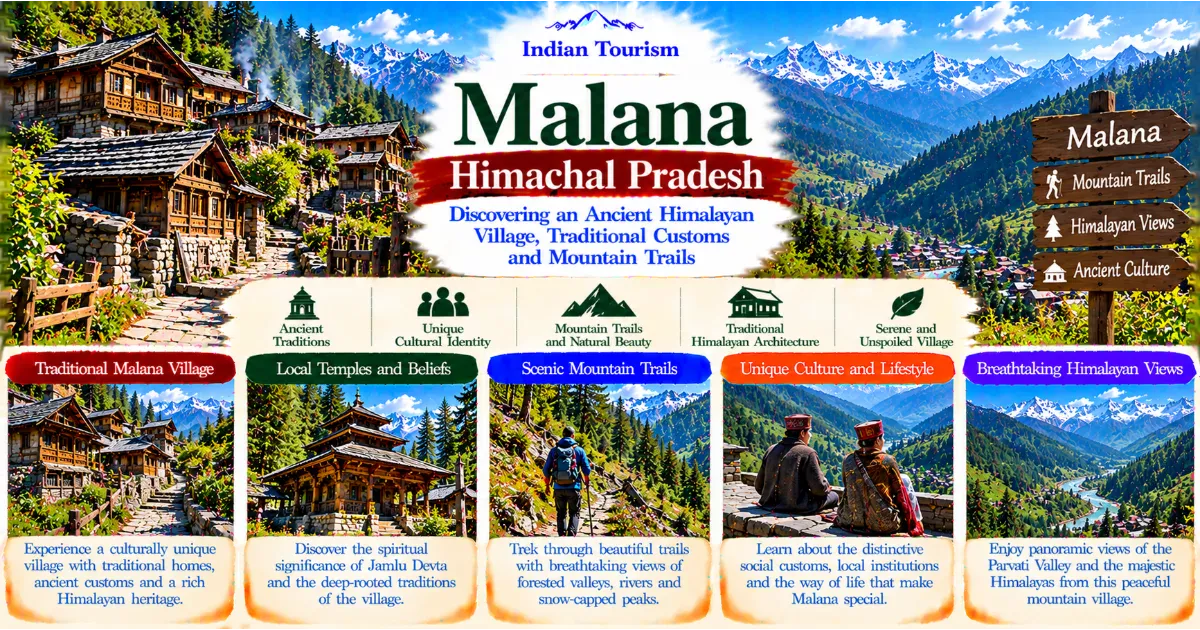
Introduction to Malana, a Village of Distinct Traditions
Himachal Pradesh is known for its spectacular mountains, green valleys, traditional temples and peaceful Himalayan settlements. Beyond its popular tourist destinations lies a remarkable collection of villages where geography, history and community traditions have shaped a distinctive way of life. Malana, situated in the Kullu district, is one of the most culturally distinctive settlements in the region. Surrounded by high mountains and dramatic landscapes, the village has attracted attention for its traditional social institutions, distinctive customs, ancient religious beliefs and relative isolation from the main centres of tourism.
For travellers interested in cultural tourism, Malana offers an opportunity to learn how a Himalayan community has maintained a strong sense of identity over generations. Its traditional houses, narrow paths, mountain setting and local institutions reveal a relationship between people and their environment that differs from the experience of larger commercial destinations. The journey towards the village also introduces visitors to the rugged terrain of the Parvati Valley region, where forested slopes, streams and high mountain landscapes create an atmosphere of remoteness.
Malana should not be approached simply as an unusual place to photograph. It is a living community with its own customs, religious practices and rules governing social interaction. Understanding these traditions requires sensitivity and respect. Visitors who arrive with curiosity, patience and a willingness to learn can gain a more meaningful appreciation of the village than those who treat its culture as a tourist spectacle.
The surrounding landscape adds another dimension to the experience. Mountain trails, forested hills and views of the high Himalayan terrain attract walkers and nature enthusiasts. However, access involves a mountain journey, and weather conditions can influence the difficulty of the route. Travellers should plan carefully, follow local guidance and avoid treating the journey as an effortless excursion.
Malana is best suited to visitors who appreciate cultural learning, mountain scenery and responsible travel. Its appeal lies not only in its unusual reputation but also in the opportunity to understand the diversity of Himalayan communities and the importance of protecting their cultural heritage.
Where Is Malana Located?
Malana is located in the Kullu district of Himachal Pradesh, in the mountainous region associated with the Parvati Valley and the surrounding Himalayan ranges. The village lies at a considerable elevation and is surrounded by steep slopes, forested hills and rugged terrain. Its geographical setting has contributed to its distinctive history and relative separation from larger settlements.
The approach to Malana differs from travelling to destinations with direct road access to their main attractions. Visitors generally travel towards the Malana access area and continue on foot along the designated route. The walking distance, time required and difficulty depend on the starting point, trail condition, weather and the physical ability of the traveller.
The surrounding mountains influence everyday life in several ways. They affect agricultural practices, access to markets, transport, seasonal movement and the availability of natural resources. In mountain communities, terrain is not merely scenery. It is an active factor in shaping settlement patterns, cultural connections and local economic activity.
The isolation associated with Malana has contributed to its reputation, but the village should not be considered entirely disconnected from the modern world. Residents interact with visitors and the wider region, and tourism has brought new opportunities as well as challenges.
Travellers should confirm current access arrangements and local requirements before visiting. Mountain paths may be affected by rainfall, snow, erosion or maintenance work. A route that is manageable in favourable conditions can become difficult when the weather changes.
The Historical Identity of Malana
Malana has a long-standing reputation for maintaining distinctive community traditions and social institutions. Its historical identity is closely associated with local religious beliefs, customary rules and a strong sense of collective belonging. These traditions have helped distinguish the village from other settlements in the Kullu region.
The precise origins of Malana's community and some of its historical claims have been interpreted in different ways. Popular accounts sometimes present simplified stories about its ancestry or ancient political connections, but such claims should be approached cautiously unless supported by reliable historical evidence. The village's cultural importance does not depend on proving every legend associated with it.
Like many Himalayan communities, Malana has developed traditions through a combination of religious belief, oral history, social organisation and interaction with the surrounding landscape. Customs passed between generations help maintain continuity and provide residents with a shared understanding of their community.
The village's historical identity is also reflected in its architecture and religious institutions. Traditional houses, communal spaces and sacred locations form part of a cultural landscape that connects the present with earlier generations.
For visitors, the most useful approach is to distinguish between documented historical information, local oral traditions and popular tourism narratives. Oral histories are valuable expressions of community memory, even when they do not provide the same kind of evidence as written historical records. Listening respectfully to local explanations can help travellers understand how people interpret their own past.
Malana's Traditional Social Organisation
One of the most discussed aspects of Malana is its traditional system of community governance. The village has historically maintained local institutions through which customary matters, religious responsibilities and community decisions are addressed.
Traditional social systems in Himalayan settlements often reflect long-standing relationships between households, religious institutions and shared resources. Local decision-making may involve customary procedures that have developed over generations. These institutions can influence how festivals are organised, how communal responsibilities are managed and how local disputes are approached.
Malana's social organisation is particularly important to understanding its identity. Visitors should not assume that the village's customs operate in exactly the same way as administrative systems elsewhere in India. Community practices may reflect local history, religious beliefs and rules that are meaningful within the settlement.
At the same time, it is important not to portray traditional governance as frozen in the past. Communities change as education, employment, transport, technology and contact with other regions influence everyday life. Cultural continuity and social change can exist together.
Travellers who want to learn about Malana's institutions should rely on respectful conversation and credible interpretation rather than sensational stories. The village is not a setting created for outsiders. Its social systems belong to the residents, and visitors should accept local decisions about access, photography and behaviour.
The Religious Significance of Jamlu Devta
Religious traditions play a central role in the cultural identity of Malana. Jamlu Devta, a local deity associated with the village, holds particular importance in community life. The religious practices connected with the deity reflect a wider Himalayan tradition in which local divine figures are closely linked to the identity and governance of individual communities.
Across parts of Himachal Pradesh, village deities have historically played roles that extend beyond private worship. Religious institutions may be associated with seasonal festivals, communal decisions, cultural performances and the management of shared responsibilities. The precise customs vary from one settlement to another, reflecting the diversity of the region.
In Malana, local religious traditions contribute to a strong sense of collective identity. Sacred places, customary practices and community gatherings connect residents with inherited beliefs and shared memories. These traditions help explain why certain locations and social practices may carry meanings that are not immediately apparent to visitors.
Tourists should approach religious spaces with respect. Appropriate behaviour may include following instructions about entry, removing footwear where required, dressing modestly and avoiding photography in restricted areas. Visitors should not assume that every sacred location is open for general sightseeing.
Learning about Jamlu Devta and the local religious tradition can provide insight into the broader cultural landscape of the Kullu region. It also encourages travellers to recognise that Himalayan religion is not limited to large temples or widely known pilgrimage sites. Local beliefs and community practices are equally important to the region's cultural heritage.
Traditional Architecture in Malana
Malana's traditional houses provide an opportunity to observe architectural practices developed for mountain conditions. Buildings in the village reflect the availability of local materials, the demands of the climate and the practical requirements of living on steep terrain.
Traditional Himalayan construction frequently combines timber and stone. These materials have been used in different arrangements according to local building traditions, structural requirements and the resources available to individual households. Wooden elements may be incorporated into balconies, roof structures and exterior details, while stone provides a durable foundation and wall material.
The arrangement of houses within a mountain settlement is also significant. Buildings often follow the contours of the land, with narrow paths connecting homes and communal spaces. This pattern reflects the need to make use of limited level ground while maintaining access between different parts of the village.
Architecture in Malana should be understood as part of a living environment rather than a collection of historic objects. Houses serve practical purposes, and their residents continue to use and maintain them according to changing needs.
Visitors should therefore avoid touching or damaging architectural features, entering private buildings without permission or blocking narrow pathways while taking photographs. Responsible observation allows travellers to appreciate traditional craftsmanship without interfering with everyday life.
The village's architectural character also provides lessons about sustainable building knowledge. Local materials and construction practices developed through experience with the surrounding environment. Although modern requirements and materials have changed, traditional buildings remain valuable examples of regional adaptation.
The Cultural Meaning of Village Lanes and Community Spaces
Walking through Malana introduces visitors to a settlement where narrow lanes, shared spaces and traditional houses form an interconnected environment. The layout of the village reflects both the physical limitations of mountain terrain and the social relationships that have developed within the community.
Community spaces can have different functions depending on local traditions. They may be used for meetings, religious gatherings, everyday conversations or seasonal activities. Their importance is not always obvious to someone visiting for the first time.
A respectful walk through the village allows visitors to observe the relationship between architecture and daily life. The sounds of household activity, the movement of residents along paths and the presence of traditional buildings reveal a community that continues to function beyond the tourism experience.
Visitors should remember that the village is home to families who may not wish to be photographed or observed closely. Asking permission before taking pictures of individuals or private spaces is an important part of responsible travel.
It is also essential to follow any local restrictions regarding particular structures, sacred locations or paths. Rules may differ from those in more commercial tourist destinations, and visitors should not assume that public visibility automatically means unrestricted access.
The best village walk is one that leaves the community undisturbed. Observing carefully, listening when appropriate and respecting boundaries can make the experience more meaningful than attempting to document every detail.
The Natural Landscape Surrounding Malana
The natural surroundings are a major part of Malana's appeal. The village lies amid steep Himalayan terrain, where forested slopes, mountain ridges, streams and changing vegetation create a dramatic landscape.
The surrounding environment changes with altitude. Lower slopes may support agricultural activity and woodland, while higher areas can contain different vegetation and exposed mountain terrain. These ecological variations contribute to the region's biodiversity and create distinct landscapes within relatively short distances.
The mountains also influence weather patterns. Conditions can change rapidly, with sunshine giving way to cloud, mist or rain. Temperature differences between sunny afternoons and shaded areas may be noticeable, particularly during spring and autumn.
Visitors interested in nature can appreciate the landscape through careful observation rather than attempting difficult hikes without preparation. The movement of clouds, the patterns of vegetation and the relationship between settlements and cultivated land all reveal aspects of the mountain environment.
The ecological value of the region also makes responsible behaviour essential. Littering, disturbing wildlife, damaging vegetation and creating unnecessary noise can affect both the environment and the experience of other visitors.
Travellers should carry reusable water bottles where practical, take their waste back to suitable disposal points and remain on appropriate paths. These simple actions help reduce the impact of tourism on fragile mountain landscapes.
Walking to Malana: Understanding the Journey
The journey to Malana is an important part of the travel experience. Unlike destinations reached directly by vehicle, the village generally requires visitors to continue on foot from the access area. The route passes through mountain surroundings and may include uneven surfaces, slopes and exposed sections.
The difficulty of the walk depends on several factors, including the chosen access point, trail conditions, weather, footwear and personal fitness. Travellers should not rely on a single estimated walking time without checking current local information.
Suitable footwear is essential. Shoes with good grip provide better stability on uneven or slippery ground than ordinary sandals or smooth-soled footwear. A light backpack, drinking water, weather-appropriate clothing and basic personal supplies can also make the journey more comfortable.
It is advisable to begin early enough to complete the walk in daylight. Visitors should avoid rushing, particularly when travelling with children or people who are unfamiliar with mountain terrain.
During or after rainfall, the path may become muddy or slippery. In winter, cold conditions and possible snow or ice can increase the difficulty. Visitors should check the weather and seek local advice before setting out.
The walk should be treated as a journey through a mountain environment rather than a race to reach a destination. Taking appropriate breaks and paying attention to surroundings can improve both safety and enjoyment.
Best Time to Visit Malana
Malana can be visited during different parts of the year, but seasonal conditions influence the landscape, walking experience and accessibility. Travellers should choose their dates according to their interests and their ability to manage mountain weather.
Spring: Fresh Vegetation and Pleasant Walking Conditions
Spring brings gradual changes to the surrounding landscape. Temperatures begin to rise after winter, and vegetation may become greener as the season progresses. The countryside can be attractive for photography and village exploration.
Spring is suitable for visitors who prefer moderate temperatures and wish to explore the cultural landscape without the warmer conditions that may occur later in the year. However, mornings and evenings can remain cold, so layered clothing is useful.
Travellers should check local conditions before beginning the walk to Malana, as lingering winter weather can affect higher areas.
Summer: Longer Days and Outdoor Exploration
Summer can offer favourable conditions for exploring the village and surrounding landscape. Longer daylight hours allow visitors more flexibility when planning the journey, while the countryside may display rich vegetation.
The broader Kullu region can become busy during holiday periods. Visitors should organise transport and accommodation ahead of time, particularly when combining Malana with other popular destinations.
Mountain weather can still change quickly during summer. Carrying a light jacket and waterproof layer is sensible even when the forecast suggests generally pleasant conditions.
Monsoon: Green Landscapes and Greater Caution
The monsoon season can bring lush vegetation, misty hills and dramatic cloud formations. These conditions may appeal to photographers, but rainfall can also make access more difficult.
Mountain paths can become slippery, and heavy rain may cause landslides or damage roads and trails. Visibility can decrease, while streams and drainage channels may carry more water than usual.
Visitors should check weather advisories and local access conditions before travelling. If authorities or local residents advise against the journey, postponing the visit is the safer decision.
Autumn: Clearer Views and Cooler Air
Autumn can be an appealing season for travellers seeking mountain scenery and comfortable walking conditions. Following the monsoon, periods of clearer weather may provide better views of the surrounding landscape.
The cooler atmosphere can make village exploration enjoyable, although temperatures may fall sharply after sunset. Travellers should carry warm clothing and plan to complete the walk during daylight.
Autumn is also a suitable time for visitors who want to combine Malana with cultural exploration elsewhere in the Kullu Valley.
Winter: Cold Weather and Possible Snow
Winter brings lower temperatures and potentially challenging access conditions. Snow and ice may affect higher or exposed sections of the surrounding terrain, depending on local weather.
Visitors considering a winter journey should confirm whether the route is accessible and whether conditions are suitable for their level of experience. Warm layers, gloves, suitable footwear and careful planning are essential.
Winter travel should never depend on the assumption that a route will remain open simply because it was accessible during another season. Local advice and current conditions should determine whether the journey proceeds.
How to Reach Malana
Travelling to Malana generally involves reaching the Kullu Valley region and then continuing by road towards the village's access area. The final approach is usually completed on foot.
By Air
Bhuntar Airport serves the Kullu region, although flight availability and schedules can be limited and may be affected by weather. Travellers should verify current services before booking.
From the airport, visitors can arrange road transport towards the Malana access area. The total journey time depends on traffic, road conditions and the exact destination used as the starting point for the walk.
Travellers arriving by air should allow sufficient time between their flight and the onward road journey. Mountain weather and transport conditions can introduce delays.
By Train
Malana does not have a railway station. Travellers using rail services must reach a suitable railhead elsewhere and continue by road towards the Kullu region.
The best option depends on the starting city, available connections and the total journey time. Visitors should consider the entire journey rather than choosing a station solely according to distance.
By Road
Road travel is the main way to reach the area around Malana. Visitors can travel from destinations within the Kullu Valley using private vehicles, taxis or locally available transport.
Road conditions may vary with weather and season. Narrow mountain roads, bends and changes in elevation require careful driving. Travellers unfamiliar with Himalayan roads may prefer an experienced local driver.
Before departure, confirm the current access point and any local instructions for the walk. Do not assume that a vehicle can travel all the way to the village itself.
How Many Days Should You Spend in Malana?
The amount of time required depends on whether Malana is a short excursion or a central part of the itinerary.
A day trip may be sufficient for visitors who want to experience the walk, observe the village and return to their base in the surrounding region. However, the schedule should allow enough time for the return journey and unexpected delays.
A two-day plan provides greater flexibility. Visitors can organise the journey without rushing and spend more time understanding the landscape and cultural setting. Staying nearby can also make it easier to adapt to weather conditions.
Travellers who want to explore the wider Kullu and Parvati Valley region may allocate additional days to nearby destinations. This approach reduces the pressure to combine several places into a single day and creates room for rest between mountain journeys.
The itinerary should be based on realistic walking ability and current access conditions. Completing every planned attraction is less important than making the journey safely and respectfully.
Local Food and Regional Cuisine
The wider Kullu region offers a variety of traditional Himachali foods influenced by local agricultural practices, climate and household traditions. Eating regional dishes can add an important cultural dimension to a visit.
Siddu is a well-known Himachali preparation made from fermented wheat dough and steamed before serving. It is often accompanied by ghee or other locally preferred accompaniments. Recipes and fillings can differ between households.
Madra is another recognised dish in Himachali cuisine. It is commonly prepared with legumes in a rich yoghurt-based gravy, although recipes vary by locality.
Visitors may also encounter rice, lentils, seasonal vegetables, beans and traditional breads. The availability of particular dishes depends on the establishment, season and local circumstances.
Because Malana is a small mountain community, travellers should not expect the same range of restaurants and services found in larger tourist centres. It is sensible to plan meals in advance and confirm available facilities before setting out.
Visitors with allergies or dietary requirements should explain them clearly before ordering. Choosing local food where available can help travellers appreciate the region's culinary traditions while supporting small businesses.
Where to Stay During a Visit
Accommodation arrangements for a visit to Malana require careful planning. Visitors may choose to stay in the wider Kullu Valley or nearby tourist areas and organise a day trip, depending on current access and accommodation availability.
Staying in a larger nearby centre can provide more choice in terms of transport, meals and other services. This can be particularly useful for families, first-time visitors and travellers who prefer predictable facilities.
Those seeking a closer experience of the mountain landscape may consider locally available accommodation, but they should verify whether overnight stays are permitted and what facilities are actually offered. Accommodation availability and local rules can change, so current confirmation is essential.
Before booking, travellers should check access, heating, hot water, meal arrangements, payment methods and mobile connectivity. These practical details can be especially important in remote mountain settings.
During peak holiday periods, booking in advance is advisable. Travellers should also avoid assuming that every property listed in a broad regional search is close to the village or accessible in all weather conditions.
Malana for Couples and Honeymoon Travellers
Malana may appeal to couples who value mountain scenery, cultural learning and outdoor exploration more than commercial entertainment. The journey and the village setting offer opportunities to share an experience that requires patience, preparation and curiosity.
Couples can include Malana in a broader itinerary through the Kullu Valley, combining the visit with more accessible scenic destinations and comfortable accommodation elsewhere in the region. This creates a balance between exploration and rest.
The best season depends on the couple's interests. Spring and autumn may offer pleasant conditions for walking, while summer provides longer daylight hours. Winter requires greater preparation and careful attention to access conditions.
Couples should consider their walking ability before including Malana in the itinerary. If either traveller is uncomfortable with uneven paths or steep terrain, a different cultural or scenic excursion may be more suitable.
A successful trip does not depend on reaching the most remote destination. It depends on choosing experiences that both travellers can enjoy safely and comfortably.
Malana for Families
Families can use a visit to Malana as an opportunity to discuss Himalayan geography, traditional architecture, community identity and the relationship between people and their environment.
The journey requires more preparation than a visit to a destination with direct road access. Parents should assess the route, walking distance, weather and the abilities of every family member before deciding whether to proceed.
Young children may find uneven terrain tiring, while older travellers may need additional time and rest. Suitable footwear, water, snacks and weather-appropriate clothing are important for everyone.
Families should also explain the importance of respecting local customs. Children should understand that homes, sacred places and community spaces are not simply tourist attractions.
If the conditions are unsuitable, families can explore other cultural destinations in the Kullu Valley that provide a similar opportunity to learn about regional heritage with easier access.
Malana for Solo Travellers
Solo travellers interested in culture and mountain landscapes may find Malana rewarding, provided they prepare carefully. The destination offers opportunities for independent exploration, observation and photography.
Solo visitors should check access conditions before setting out, share their itinerary with someone they trust and plan to complete the walk during daylight. They should avoid unfamiliar or isolated routes in poor visibility.
Arranging reliable transport for the return journey is important. Travellers should also carry sufficient water, suitable clothing and essential personal supplies rather than assuming that services will be available throughout the route.
Respectful engagement is especially important when travelling alone. Visitors should avoid intrusive photography, follow local guidance and recognise that some community spaces may have restrictions.
A well-planned visit can provide a valuable cultural experience while maintaining appropriate attention to safety and local expectations.
Photography and Responsible Observation
Malana's mountain setting, traditional houses and narrow pathways can be attractive to photographers. The surrounding terrain provides opportunities to capture forested slopes, changing light and the relationship between settlement and landscape.
However, photography should never override local privacy or cultural boundaries. Visitors should ask permission before photographing residents, private homes or religious activities. They should not assume that a visible structure or public path automatically permits unrestricted photography.
Drones should not be used without checking applicable regulations and obtaining any necessary permissions. Noise and intrusive equipment can disturb residents and other visitors.
Landscape photography can often be enjoyed from appropriate viewpoints without entering private property. Taking time to observe the surroundings also helps travellers appreciate the destination beyond individual images.
Responsible photography is based on consent, respect and an understanding that local residents have a right to decide how their homes and personal lives are represented.
Responsible Tourism and Respect for Local Customs
Responsible tourism is particularly important in Malana because its identity is closely connected with local customs and community institutions. Visitors should learn about relevant restrictions before arrival and follow instructions provided by residents or local authorities.
Some customs in Malana differ from those familiar to visitors elsewhere. Rather than treating these differences as entertainment, travellers should recognise them as expressions of a community's cultural identity.
Visitors should ask about restrictions concerning sacred places, buildings and pathways. They should never touch structures or objects when local rules prohibit it, and they should avoid entering private spaces without permission.
Waste management is another important consideration. Mountain settlements may have limited facilities for handling the waste generated by tourism. Visitors should carry their rubbish back to suitable disposal points and avoid leaving plastic bottles, wrappers or food waste along the route.
Supporting local livelihoods can also help make tourism more beneficial. Where appropriate services are available, travellers can use local transport providers, purchase permitted regional products and choose responsible accommodation in the surrounding area.
The central principle is simple: visitors should adapt to the destination rather than expect the destination to adapt entirely to them.
Travel Safety and Practical Preparation
A visit to Malana requires attention to mountain safety. Even when the weather appears pleasant, conditions can change quickly, and walking routes may become more difficult after rain or during colder periods.
Travellers should check local weather forecasts and access information before departure. If heavy rainfall, snowfall, landslide warnings or other hazards affect the route, postponing the visit is preferable to taking unnecessary risks.
Footwear with good grip is essential. Visitors should carry water, a fully charged phone, suitable clothing and basic personal supplies. Mobile coverage may be unreliable in some areas, so travellers should not depend entirely on their phones for navigation or emergency communication.
Walking alone in unfamiliar terrain during poor visibility is best avoided. Travellers should follow established routes and seek local guidance when uncertain about directions or conditions.
People with health conditions that affect mobility, balance or exercise tolerance should consider whether the route is suitable for them and seek appropriate medical advice if needed.
A responsible traveller recognises that changing plans is sometimes the best decision. The cultural and natural attractions of the region can be enjoyed without taking avoidable risks.
Suggested Two-Day Itinerary
Day One: Travel and Cultural Orientation
Begin the day by travelling towards the Malana access area after confirming road and weather conditions. Allow sufficient time for the journey and avoid scheduling another demanding activity immediately afterwards.
Once the walking route begins, maintain a comfortable pace and take breaks when necessary. Pay attention to the surrounding landscape, including forested slopes, mountain views and the changing terrain.
On reaching the village, focus on respectful observation and learning about its cultural identity. Follow local rules regarding access to buildings, sacred locations and community spaces. Ask permission before taking photographs of people or private property.
Return during daylight, allowing enough time for unexpected delays. After the excursion, rest and enjoy a meal at the accommodation or a suitable local establishment.
Day Two: Explore the Wider Kullu Valley
Use the second day to explore another accessible part of the surrounding region. Depending on personal interests and current conditions, this could include cultural attractions, traditional settlements, scenic viewpoints or a gentle nature walk.
A second day in the region allows travellers to compare different aspects of Himalayan life without rushing. It also provides flexibility if weather disrupts the original plan for Malana.
Before departure, review the journey ahead and confirm transport arrangements. Keeping the itinerary flexible helps ensure that the visit remains comfortable and safe.
Why Malana Deserves a Place on Your Himachal Pradesh Travel List
Malana offers a distinctive combination of cultural identity, traditional architecture and mountain scenery. Its importance lies not only in the stories associated with the village but also in the opportunity to understand how a community maintains its traditions within a changing world.
The surrounding landscape provides a memorable setting for the journey, while the village itself encourages visitors to think carefully about the relationship between tourism and cultural preservation. It is a destination where respectful observation is more valuable than rushing through attractions.
Malana is best suited to travellers who are willing to prepare for a mountain walk, accept local customs and approach the community with genuine curiosity. It may not be the most convenient destination for every visitor, but for those whose interests match its character, it can provide a meaningful experience.
Its place within a wider Himachal Pradesh itinerary also makes sense. The Kullu region contains a variety of landscapes and settlements, and exploring them at a thoughtful pace helps reveal the diversity of Himalayan life.
Conclusion
Malana is a mountain village whose identity is shaped by traditional customs, religious beliefs, community institutions and a dramatic natural setting. Its distinctive character makes it an important destination for travellers interested in the cultural diversity of Himachal Pradesh.
A visit requires preparation, particularly because the final approach involves walking and conditions can change with the weather. Travellers should check current access information, choose appropriate clothing and footwear, and follow local guidance throughout the journey.
The most rewarding experience comes from approaching Malana with respect. Rather than treating its traditions as a spectacle, visitors can learn from the village's history, appreciate its architecture and recognise the importance of protecting community privacy.
For travellers exploring the Kullu Valley, Malana offers an opportunity to look beyond familiar tourist centres and discover another dimension of Himalayan heritage. It reminds us that meaningful travel is not simply about reaching a destination. It is about understanding the place, respecting its people and leaving its cultural and natural environment undisturbed.
#IndianTourism #Malana #HimachalPradesh #KulluValley #HimalayanVillages #CulturalTourism #MountainTravel #HimachalTravel #ResponsibleTourism #HimalayanHeritage #VillageTourism #ExploreIndia #TravelIndia #NatureAndCulture #IncredibleIndia
