
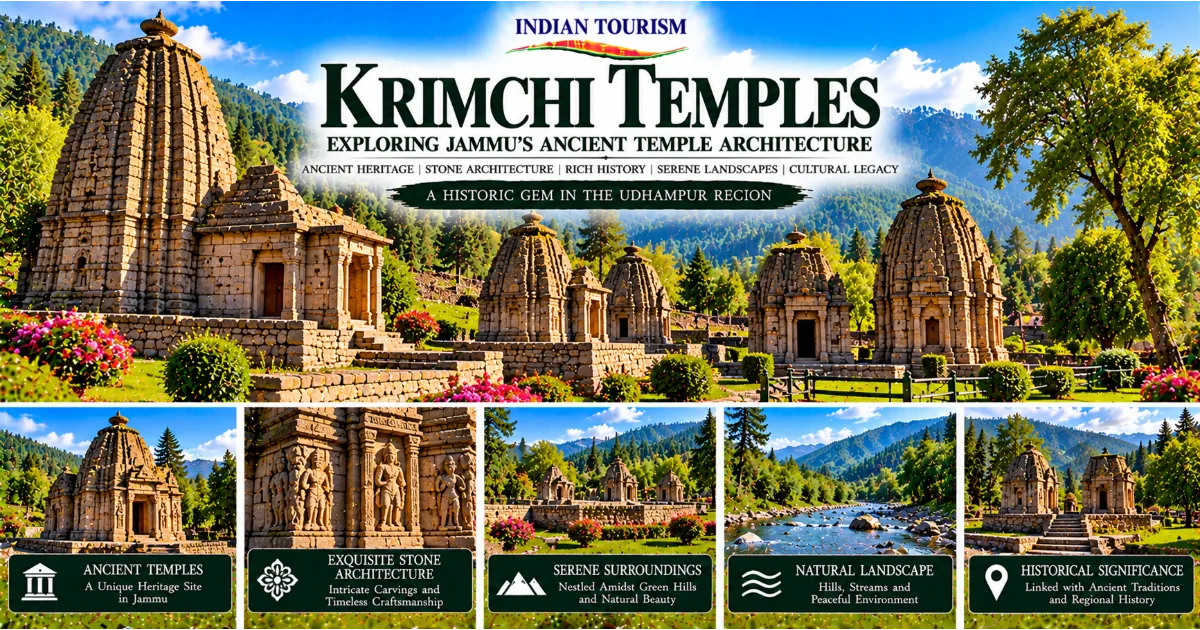
Discovering an Ancient Heritage Site in Jammu
Jammu and Kashmir is home to an extraordinary range of cultural and historical landmarks. While the region is widely known for its mountain scenery, pilgrimage destinations, and natural beauty, it also preserves architectural remains that reveal the development of religious traditions and artistic practices over many centuries. Among these important heritage sites are the ancient Krimchi Temples, located in the Udhampur district of the Jammu region.
Often known locally as the Pandava Temples, the Krimchi temple complex is an important destination for travellers interested in ancient architecture, regional history, and the cultural heritage of northern India. The complex stands in a peaceful landscape surrounded by green hills, with the nearby watercourses and natural setting adding to the atmosphere of the site. Unlike large modern temple complexes that attract enormous crowds, Krimchi offers an opportunity to observe historical structures in a relatively quiet environment.
The temples are generally believed to date from around the ninth to twelfth centuries, although popular tourism descriptions commonly associate them with the eleventh and twelfth centuries. Their architectural details distinguish them from many later temples in the region. Stone construction, rising temple towers, carved features, and carefully proportioned forms make the complex particularly valuable for anyone interested in the evolution of Hindu temple architecture.
Krimchi is also significant because it connects the visitor with several layers of regional history. Local traditions associate the site with the Pandavas of the Mahabharata, while historical accounts connect the wider area with the former principality of Bhuti. These stories belong to different categories of historical understanding, and they should be explored with care rather than treated as equally established facts.
For travellers exploring Jammu, Krimchi offers something different from a conventional hill station or pilgrimage itinerary. It combines heritage, landscape, architecture, and local memory in one destination. A visit can be particularly rewarding for students of history, architecture enthusiasts, photographers, families, and travellers who want to discover lesser-known cultural landmarks.
Where Are the Krimchi Temples Located?
The Krimchi temple complex is situated in a village in the Udhampur district of Jammu and Kashmir. The site lies in a hilly landscape north of Udhampur town, along the wider Udhampur-Lander road corridor. It can be included in a journey through the Jammu region, especially by travellers visiting Udhampur, Patnitop, or nearby heritage destinations.
The surrounding landscape is an important part of the experience. The temples stand on an elevated terrace near the Biru Nala, while the Krimchi watercourse and nearby streams contribute to the geography of the area. The green slopes and relatively peaceful surroundings create a setting that contrasts with the traffic and commercial activity of larger towns.
The location also helps explain why the complex deserves attention beyond its religious associations. Historical buildings often reflect the environment in which they were constructed. The availability of stone, the contours of the land, access to water, and connections with settlements all influence how a site develops over time.
For visitors, the setting creates opportunities to appreciate both architecture and landscape. Looking at the temples from different angles reveals how their structures rise above the surrounding ground and how the natural environment frames the complex.
Travellers should remember that the area is a living rural landscape, not simply an archaeological attraction. Respecting local residents, keeping the surroundings clean, and following site instructions are essential parts of a responsible visit.
The Historical Significance of Krimchi
Krimchi is recognised as one of the important ancient temple sites of the Jammu region. Government tourism descriptions identify the complex as a group of early medieval temples, and the district administration records the presence of five temples and two smaller shrines. The site is frequently included in discussions of Jammu's built heritage alongside other historic temples, forts, palaces, and archaeological remains.
The precise history of Krimchi is not completely documented in popular accounts. This makes it important to distinguish between architectural evidence, historical interpretations, and local traditions. The surviving structures provide direct evidence of an established temple-building tradition, while legends and regional histories offer additional perspectives on how the site has been remembered.
The temples are commonly dated to the early medieval period. Different descriptions place their construction within a broader period extending from the ninth to the twelfth centuries, while many tourism accounts emphasise the eleventh and twelfth centuries. Such differences are not unusual when discussing historic monuments, particularly where inscriptions or other definitive dating evidence are limited in widely available descriptions.
The complex nevertheless demonstrates that the Jammu region possessed a significant tradition of religious architecture long before the development of many modern towns and tourist centres. Its surviving stone structures indicate the investment of labour, materials, and architectural knowledge in the creation of places intended for worship.
Krimchi also contributes to the broader history of temple architecture in northern India. The region's religious monuments reflect interactions between local artistic practices and architectural ideas that travelled across different parts of the subcontinent. Studying the complex helps visitors recognise that Jammu's historical identity extends far beyond its more recent political and administrative history.
The Legend of the Pandavas
One of the most familiar traditions associated with Krimchi identifies the temples as the Pandava Temples. According to local belief, the Pandavas from the Mahabharata spent time in this area during their period of exile. Some versions of the story also associate the development of the settlement with Raja Kichak.
These traditions have contributed to the site's cultural identity and remain an important part of how many people understand Krimchi. In India, local legends often connect temples, hills, caves, rivers, and settlements with figures from the great epics. Such stories give landscapes a narrative meaning and help communities maintain a sense of continuity with their inherited traditions.
However, the association with the Pandavas should be understood as a local tradition rather than a confirmed archaeological date for the surviving temples. The structures are generally placed in the early medieval period, many centuries after the period traditionally associated with the Mahabharata.
This distinction does not diminish the cultural significance of the legend. Oral traditions can preserve information about how a community has interpreted and valued a place, even when they do not provide direct evidence for the construction date of a building.
For visitors, the legend adds another dimension to the experience. It invites reflection on the relationship between epic literature, regional identity, and sacred geography. A place can possess both a documented architectural history and a powerful traditional narrative.
The most meaningful approach is to appreciate both while recognising that they answer different questions. Architecture helps historians study the physical remains, while local stories explain the meanings and associations that generations of people have attached to the landscape.
The Former Principality of Bhuti
Another historical tradition links Krimchi and the surrounding area with Bhuti, a former principality associated with the political history of the Jammu region. The Udhampur district's official description records a tradition that Bhuti was among the principalities of the area and connects its rulers with a regional lineage remembered in local historical accounts.
The political history of the Himalayan foothills was shaped by small kingdoms, local chiefs, changing alliances, and connections with larger regional powers. Mountainous terrain could support relatively distinct political centres, while trade routes, agricultural land, and strategic passages influenced their relationships with neighbouring territories.
The story of Bhuti places Krimchi within this wider historical environment. It suggests that the area was remembered not only as a religious location but also as part of a region with its own political and social history.
Historical accounts concerning dynasties and local rulers should be approached carefully. Different narratives may preserve different versions of events, and popular summaries do not always provide enough evidence to resolve every question about chronology or political relationships.
Even so, the association with Bhuti is valuable because it encourages visitors to look beyond the temples themselves. Ancient and medieval religious sites often existed within broader settlements and political landscapes. Their history cannot be fully understood without considering the communities, rulers, and economic networks that sustained them.
A visit to Krimchi can therefore serve as an introduction to the wider heritage of Udhampur and the surrounding Jammu hills.
Understanding the Architecture of the Krimchi Temples
The architecture of the Krimchi complex is one of its most compelling features. The surviving temples are constructed primarily of stone and display forms associated with the northern Indian tradition of Hindu temple building.
The buildings are not identical in size or appearance. Their differences allow visitors to compare structural proportions, tower forms, entrances, and surviving decorative details. Such variation can provide clues about the development of the complex and the different phases of construction or modification that may have taken place.
The temples are often described as having architectural features comparable with the Orissan, or Odisha, style of temple architecture. This comparison concerns elements of form and design rather than suggesting that the buildings are identical to the major temple traditions of eastern India.
Architectural similarities across distant regions are an important subject of historical study. Temple builders could work within broader artistic traditions while adapting their designs to local materials, religious needs, available skills, and regional preferences. A shared architectural feature does not necessarily mean that a building was designed by the same workshop or constructed under the same ruler as a monument elsewhere.
At Krimchi, the overall forms of the temples reveal a strong emphasis on verticality. The structures rise above their bases, drawing the eye upwards and giving the complex a distinctive silhouette against the surrounding landscape.
The surviving stonework also allows visitors to observe how different parts of a temple fit together. The relationship between the base, walls, entrance, and upper structure is central to understanding the design.
Rather than looking only at the tallest temple, visitors can compare the surviving buildings and notice how repeated architectural principles are expressed in different ways.
The Shikhara: The Rising Form of the Temple Tower
One of the most recognisable elements of many northern Indian Hindu temples is the shikhara, the rising tower above the principal shrine. At Krimchi, the surviving temple forms illustrate the importance of vertical design in the regional temple-building tradition.
The tower is not merely a decorative feature. In Hindu temple architecture, the structure above the sanctum contributes to the building's symbolic and visual organisation. Its height helps distinguish the sacred centre from the surrounding space and creates a recognisable profile when viewed from a distance.
The design of a shikhara can vary considerably across regions and historical periods. Differences in curvature, projections, surface decoration, and the arrangement of architectural elements allow historians to compare temples and investigate their stylistic relationships.
At Krimchi, the towers should be examined alongside the rest of the buildings. Their appearance is shaped by the proportions of the temple below, the way the walls rise, and the relationship between the structure and its base.
Visitors may find that the towers appear different when viewed from various angles. Light and shadow emphasise the stonework differently throughout the day, while vegetation and the surrounding landscape create changing visual frames.
The surviving architecture is also a reminder that ancient temples were carefully planned structures. Their appearance depended on the knowledge of builders, the properties of the materials, and the ability to organise stone elements into stable forms.
Understanding the shikhara helps visitors appreciate the temples as works of architecture rather than viewing them only as old religious buildings.
Stone Construction and Craftsmanship
Stone is central to the character of the Krimchi temple complex. Its use gives the buildings a sense of permanence and allows architectural details to remain visible long after the original builders and patrons have disappeared.
Constructing a stone temple required considerable planning and skilled labour. Builders had to select suitable material, shape individual blocks, prepare stable foundations, and arrange the components so that the structure could support its own weight.
The process also required an understanding of proportion. Doors, walls, roof structures, and towers had to be coordinated so that the finished building appeared balanced while meeting the practical demands of construction.
Carved details added another level of complexity. Decorative elements required additional time and skill, and their placement influenced how visitors approached and perceived the building. Even where portions of the original decoration have been lost, surviving details can reveal aspects of the artistic tradition.
Weathering is a normal part of the life of historic stone structures. Rain, temperature changes, biological growth, and the gradual movement of water can affect the surface of stone. Human activity can create additional pressures through accidental damage, inappropriate cleaning, or unauthorised alteration.
For this reason, visitors should never scratch the stone, climb on fragile sections, remove fragments, or attempt to clean the surfaces themselves. A small action may cause damage that is difficult to reverse.
The best way to appreciate the craftsmanship is through careful observation. Looking at joints, changes in stone texture, and the relationship between structural and decorative elements can reveal the complexity of the buildings without placing them at risk.
Religious Traditions and the Deities Associated with Krimchi
The Krimchi temples are associated with Hindu religious traditions, and popular descriptions connect the complex with deities including Vishnu, Shiva, Ganesha, and Parvati. These associations help situate the site within the broader religious landscape of northern India.
Hindu temple complexes often reflect the presence of several devotional traditions within a shared sacred environment. Different shrines may be associated with different deities, while architectural forms and sculptural representations express religious ideas in material form.
Shiva is widely worshipped as a major deity associated with transformation, asceticism, and cosmic cycles. Vishnu is associated with preservation and the protection of cosmic order. Ganesha is commonly invoked at the beginning of important undertakings, while Parvati is revered in several forms connected with power, motherhood, and divine feminine energy.
The presence of these traditions in regional temple heritage illustrates the diversity of Hindu worship. Religious practices have developed across centuries through texts, ritual traditions, local customs, pilgrimage, and the activities of communities.
Visitors should not assume that every surviving structure remains in active ritual use or that every shrine has the same status today. The present condition and religious use of individual buildings may differ, and current site arrangements should guide visitors.
For people visiting as pilgrims, the experience may involve reflection, prayer, or an appreciation of the site's sacred associations. For those interested primarily in history or architecture, the same structures offer an opportunity to understand how religious beliefs influenced building design.
Both forms of interest can coexist, provided visitors behave respectfully and recognise the site's cultural importance.
The Natural Setting of the Temple Complex
Krimchi's natural surroundings contribute significantly to its atmosphere. The complex is situated in a landscape of green hills and watercourses, with the nearby Biru Nala and Krimchi stream forming part of the local geography. The district administration describes the temples as standing on an elevated terrace associated with the Biru Nala.
The relationship between architecture and landscape is important when studying historic sites. Temples were not constructed in isolation from their surroundings. Access to water, the shape of the land, connections with settlements, and the availability of building materials all influenced the choice and development of locations.
At Krimchi, the setting allows visitors to experience the monuments within a broader natural environment. The hills create a sense of enclosure, while the watercourses add another layer to the landscape.
The environment also affects how the structures are preserved. Rainwater movement, plant growth, and seasonal changes can influence the condition of stonework and the ground around the buildings. Responsible site management must therefore consider both the monuments and their immediate surroundings.
Visitors can appreciate the landscape by taking time to observe the relationship between the temples and the surrounding slopes. The view from a distance may reveal the overall composition of the complex, while closer inspection makes individual architectural details more visible.
The peaceful setting can make Krimchi especially appealing to travellers who prefer cultural destinations away from heavily commercialised tourist areas. However, visitors should not treat quiet surroundings as permission to wander into restricted areas or disturb nearby residents.
Protecting the environment is part of protecting the heritage. Littering, damaging vegetation, or altering the ground around an archaeological site can reduce its value for future generations.
Krimchi and the Wider Heritage of Udhampur
Udhampur district contains a variety of historical, religious, and natural attractions. Krimchi is one of the most significant examples of its early temple heritage, but it forms part of a wider cultural landscape that includes other shrines, traditional settlements, and historic routes.
The Jammu region's heritage reflects many different periods. Ancient archaeological remains, early medieval temples, later forts, palaces, and religious institutions all contribute to the area's historical identity. Government heritage descriptions specifically identify Krimchi and other temple sites as important parts of Jammu's built heritage.
Exploring this wider landscape helps visitors understand that regional history is not confined to major cities or famous pilgrimage centres. Smaller villages and less widely known monuments can preserve important evidence of architecture, settlement, artistic practices, and religious life.
Krimchi is particularly valuable because it encourages a closer look at the early medieval period. Many travellers are familiar with later Dogra architecture or the better-known Mughal heritage of northern India, but fewer have examined the earlier temple-building traditions of the Jammu hills.
A broader itinerary can therefore combine Krimchi with other destinations according to available time, transport, and current access conditions. Travellers should avoid trying to cover too many locations in one day, especially when unfamiliar roads or rural access routes are involved.
The most rewarding heritage trips allow time for observation and learning. Rather than treating every monument as a quick photograph stop, visitors can compare architectural forms, consider the historical setting, and reflect on how each site contributes to the wider story of the region.
Best Time to Visit Krimchi Temples
Krimchi can be considered for a visit during different seasons, but the best time depends on weather, road conditions, personal preferences, and the amount of time available for exploring the site.
Spring: Fresh Landscapes and Comfortable Exploration
Spring can bring fresh greenery to the surrounding hills and create a pleasant atmosphere for walking around the complex. Visitors interested in photography may enjoy the contrast between the stone structures and the vegetation.
Conditions can still vary, so it is sensible to check the forecast and carry suitable footwear. Rain can make uneven ground slippery, particularly around natural slopes and watercourses.
Summer: A Cultural Stop on a Wider Journey
Summer can be suitable for combining Krimchi with other destinations in the Udhampur and Jammu region. Visitors travelling towards Patnitop may consider including the temples as a heritage stop, provided sufficient time is available.
Daytime temperatures can be warm, so carrying drinking water, wearing comfortable clothing, and planning the visit during cooler parts of the day can improve the experience.
Autumn: A Quieter Heritage Experience
Autumn may offer pleasant conditions for exploring the complex and photographing its architecture. The changing light can create interesting contrasts across the stone surfaces.
Visitors should remain aware of shorter daylight hours as the season progresses and plan their onward journey accordingly.
Winter: Check Conditions Before Travelling
Winter conditions vary across the Jammu region. Even when the lower areas remain accessible, roads and walking surfaces may be affected by rain, cold, or other weather conditions.
Travellers should check current forecasts and road information before leaving. Warm clothing and suitable footwear are useful, and visitors should avoid entering areas where conditions are unsafe.
Regardless of the season, the most important consideration is to plan the journey realistically. A visit to an archaeological site should not depend on rushing through the complex or travelling in poor conditions.
How to Reach Krimchi Temples
Krimchi is located in Udhampur district and can be reached by road. The district administration describes the site as lying approximately twelve kilometres north of Udhampur along the Udhampur-Lander road, and lists Jammu Airport and Udhampur railway station among the relevant transport connections. Distances and journey times should be verified for the specific route being used.
Travellers arriving by train may use Udhampur railway station as a convenient starting point for the onward road journey. Those arriving by air can consider Jammu Airport and then continue by road, depending on their overall itinerary.
A taxi or private vehicle can offer flexibility, particularly for visitors planning to explore additional attractions in the area. Before departing, confirm the route, expected travel time, return transport, and any restrictions that might affect access.
Travellers using public transport should check current services and the distance between the nearest drop-off point and the temple complex. Availability may vary by day and season, and it is sensible to arrange the return journey in advance.
Road travel in hilly areas requires attention to weather, visibility, and road conditions. Drivers should avoid unsafe stopping places and should not assume that a route will remain unaffected by rain or maintenance.
Because transport services and access arrangements can change, confirm the latest practical details before travelling rather than relying exclusively on older travel descriptions.
A Suggested Day Trip to Krimchi
Krimchi can be included in a day trip from Udhampur or incorporated into a longer journey through the Jammu region. The most suitable itinerary depends on the starting point and the time available.
Begin the day with an early departure that allows enough time for travel without creating pressure to rush. On arrival, spend time viewing the complex from different angles before examining individual structures.
Start with the overall layout. Observe how the temples are positioned in relation to one another and how the elevated ground influences the appearance of the complex. Then move on to architectural details, including the tower forms, stonework, entrances, and any visible decorative features.
Visitors interested in history may wish to read about the early medieval temple-building traditions of northern India before the trip. This background can make the architectural differences easier to recognise and appreciate.
Allow time to observe the natural surroundings, but remain within permitted areas. The streams and landscape are part of the wider setting, yet not every area will necessarily be suitable for visitor access.
After exploring the complex, travellers may continue towards another destination if time and road conditions permit. However, it is better to choose a manageable itinerary than to attempt several distant attractions in a single day.
Before leaving, make sure that all waste has been carried away and that the site has been treated respectfully. A successful heritage visit should combine learning, enjoyment, and care for the place.
Photography at Krimchi Temples
Krimchi offers several opportunities for architectural and landscape photography. The stone temples provide strong geometric forms, while the surrounding hills and vegetation create a natural frame.
Wide photographs can show the relationship between the buildings and the landscape. Closer images can focus on stone joints, carved details, entrances, tower forms, and the textures created by weathering.
Light can change the appearance of the stonework. Softer light may help reveal surface details without creating strong shadows, while directional sunlight can emphasise the depth of architectural features. Visitors should take time to observe how the buildings appear from different positions.
Photographers should follow all rules governing the site. If restrictions apply to photography, tripods, drones, or particular areas, those rules should be respected. Drone use should never be assumed to be permitted at a heritage location.
Avoid climbing onto the structures or leaning equipment against fragile stonework. A photograph is not worth risking damage to a historic monument.
When photographing local people, ask permission and respect their response. The village surrounding the complex is part of a living community, and residents should not be treated as incidental subjects.
Thoughtful photography can help communicate the importance of Krimchi's heritage while encouraging greater appreciation of the Jammu region's lesser-known historical sites.
Responsible Tourism and Heritage Conservation
Ancient monuments survive because of the materials and skills used by their builders, but their continued survival depends on how they are treated today. Krimchi's stone structures are valuable historical resources, and visitors have a role in helping protect them.
The first rule is simple: do not touch, remove, scratch, or alter architectural features. Even small fragments may contain evidence that helps researchers understand the building's construction and history.
Visitors should not climb onto fragile walls, towers, or other structural elements. Such behaviour can create safety risks and accelerate damage to the monument.
Waste should be carried away and disposed of properly. Plastic packaging, bottles, and food waste can harm the natural environment and reduce the quality of the visitor experience.
Respect restricted areas and any instructions provided by site staff or local authorities. Historic buildings may contain unstable sections or areas that require protection from visitor movement.
Responsible tourism also involves supporting the local community. Where appropriate, travellers can use legitimate local transport and services, purchase refreshments from local businesses, and treat residents with courtesy.
Heritage conservation is not only the responsibility of archaeologists or government departments. Public awareness and considerate behaviour help ensure that monuments remain meaningful for future generations.
Krimchi's value lies in the combination of architecture, history, cultural traditions, and landscape. Protecting all these elements requires visitors to think beyond their own immediate experience.
Why Krimchi Deserves More Recognition
Krimchi does not always receive the same attention as the major pilgrimage centres and well-known tourist destinations of Jammu and Kashmir. Yet its historical and architectural value makes it worthy of a place in broader discussions of the region's heritage.
The complex offers a chance to explore early medieval temple architecture in a setting that is different from the crowded streets of a large city. Its stone structures invite visitors to examine craftsmanship, proportions, and design, while its local traditions provide insight into how communities have understood the site over time.
Krimchi also challenges the idea that Jammu and Kashmir should be experienced only through mountain scenery or modern tourist infrastructure. The region's cultural identity includes ancient monuments, local histories, religious traditions, and archaeological evidence that deserves careful attention.
For students, the site can serve as an introduction to the study of architecture and regional history. For families, it can create an opportunity to discuss how historic buildings survive and why they matter. For photographers and travellers, it offers a distinctive landscape in which stone architecture and natural surroundings complement one another.
Greater recognition should not mean uncontrolled tourism. The aim should be to encourage informed visits, improve awareness, and support conservation without damaging the qualities that make the place special.
Krimchi is most valuable when understood as a historical site rather than merely a scenic backdrop. Its story deserves to be explored with curiosity, accuracy, and respect.
Final Thoughts: A Journey into the Ancient Heritage of Jammu
The Krimchi Temples are among the important reminders of the Jammu region's early architectural and religious traditions. Their stone structures, rising temple forms, and natural setting create a distinctive heritage experience for visitors interested in history and culture.
The complex brings together several dimensions of the past. Its surviving architecture offers evidence of temple-building traditions, while the Pandava legend and the history associated with Bhuti reflect the ways in which local communities have remembered the area. These different perspectives enrich the visitor's understanding when they are considered carefully and distinguished from one another.
A visit to Krimchi can also encourage a wider exploration of Udhampur and the surrounding Jammu hills. The region contains many lesser-known historical places that reward travellers willing to look beyond the most famous destinations.
Plan the journey with attention to transport, weather, and available time. Observe the temples carefully, respect local traditions, and avoid any activity that could damage the structures or the surrounding environment.
For anyone interested in the cultural heritage of Jammu and Kashmir, Krimchi is more than an old temple complex. It is an opportunity to connect with the region's architectural past, explore its historical narratives, and appreciate the importance of preserving India's diverse heritage for future generations.
#IndianTourism #KrimchiTemples #Udhampur #JammuAndKashmir #AncientTemples #IndianHeritage #TempleArchitecture #HistoryOfIndia #CulturalTourism #ArchaeologicalHeritage #ExploreJammu #ResponsibleTourism
