
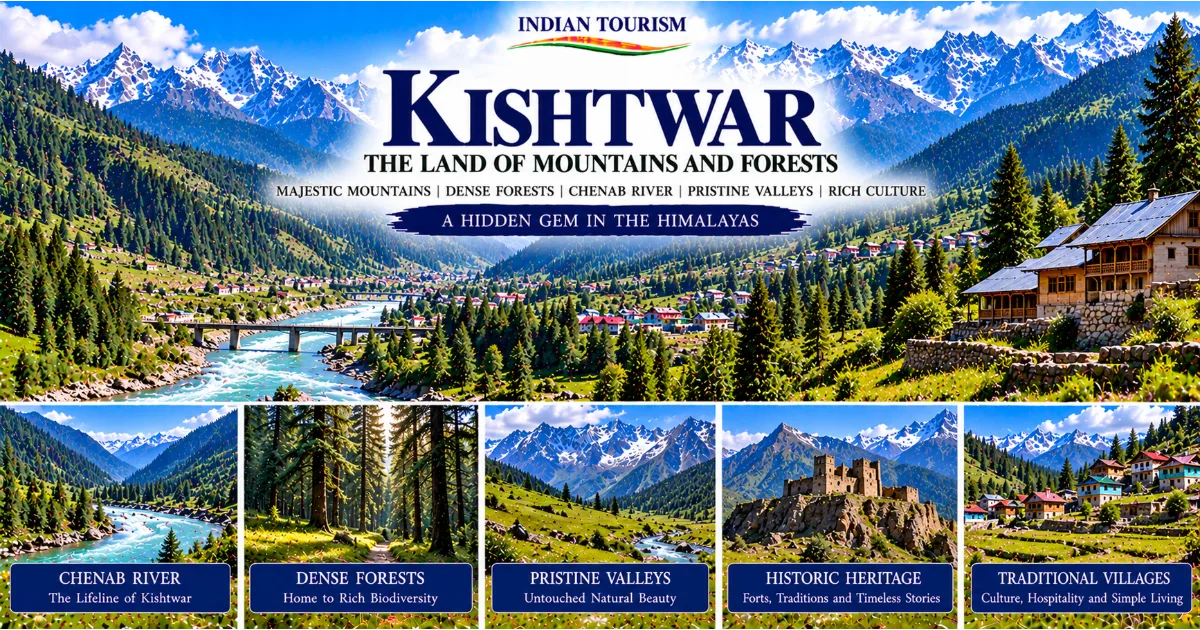
A Complete Travel Guide to Himalayan Valleys, Dense Forests, High Mountain Landscapes and Cultural Heritage
Exploring the Wild Beauty of Kishtwar
The Jammu region of Jammu and Kashmir contains some of India's most remarkable mountain landscapes, yet many of its destinations remain less familiar to travellers than the celebrated locations of the Kashmir Valley. Kishtwar is one such destination. Known for its dramatic mountain terrain, forested slopes, river valleys and traditional settlements, Kishtwar offers a distinctive experience for visitors interested in discovering the natural and cultural richness of the western Himalayas.
Located in the eastern part of the Jammu region, Kishtwar is associated with high mountains, deep valleys, thick forests and the Chenab River system. Its landscape changes considerably with elevation. Lower settlements are connected to agricultural land and river valleys, while higher areas contain rugged terrain, alpine environments and mountain routes that demand careful planning. This geographical diversity gives the district an appeal that extends from relaxed sightseeing to more adventurous outdoor exploration.
Kishtwar is also known for its forests and its association with the wider Himalayan ecological landscape. Forests cover substantial parts of the surrounding mountains, creating habitats for wildlife and supporting the natural systems on which local communities depend. River valleys, mountain streams and cultivated slopes contribute to the region's distinctive character.
For travellers, Kishtwar offers more than a collection of scenic viewpoints. Its towns and villages provide opportunities to understand regional culture, local food, traditional livelihoods and the relationship between people and their mountainous environment. The district's history is also connected to mountain routes, settlement patterns and the changing political geography of Jammu and Kashmir.
A visit to Kishtwar requires realistic expectations. Distances can be challenging, roads may be affected by weather and some mountain areas require specialised preparation or local guidance. Travellers should check current official advisories, road conditions and access restrictions before making plans. When approached responsibly, Kishtwar can provide a memorable introduction to a less familiar side of the Himalayan landscape.
1. Where Is Kishtwar Located?
Kishtwar is a district in the Jammu division of Jammu and Kashmir, India. It lies within a mountainous region shaped by the Chenab River and the surrounding Himalayan ranges. Its terrain includes deep valleys, steep slopes, forested mountains, agricultural areas and settlements connected by winding roads.
Kishtwar town serves as the principal urban centre and an important administrative and commercial hub for the district. It provides access to local services, markets, accommodation and transport connections. Visitors planning to explore the wider region often use the town as a starting point for organising their journeys.
The district's geography is one of its defining features. Mountain ranges create natural divisions between valleys, while rivers and streams shape the terrain and influence settlement patterns. Roads follow the available corridors through the mountains, sometimes winding along steep slopes or passing through narrow sections.
The wider Chenab Valley region is important to the geography of Jammu and Kashmir. The Chenab River and its tributaries have shaped the landscape over long periods, cutting through mountains and creating river corridors that connect communities. The river system also supports agriculture, water resources and other activities throughout the region.
Kishtwar's location gives it a different character from the more urbanised parts of Jammu. Travellers encounter a landscape where forests, mountains and rivers remain prominent elements of everyday life. The district's appeal lies partly in this relationship between natural geography and human settlement.
Visitors should remember that the district covers a large and varied area. Reaching Kishtwar town does not automatically mean that all surrounding attractions are easily accessible. Some destinations require additional driving time, local transport arrangements or specialist preparation.
2. Kishtwar Town: The Gateway to the District
Kishtwar town is the natural starting point for many journeys into the district. It offers a practical base for travellers who want to explore the surrounding landscapes while remaining close to shops, food services and local transport.
The town's everyday activity reflects its role as a centre for surrounding communities. Markets supply household goods, food, clothing and other necessities, while transport services connect residents with villages and neighbouring areas. Visitors can learn about the region simply by spending time in these public spaces and observing the rhythm of daily life.
Kishtwar's setting gives the town a mountain character. Surrounding slopes and valleys form part of the wider landscape, and the road network reflects the challenges of building connections through rugged terrain. The town is therefore both a destination in its own right and a practical starting point for excursions.
Travellers should allow time to explore the town instead of treating it only as a place to sleep before heading into the mountains. Local markets and eateries can provide an introduction to regional food and everyday customs. Conversations with hosts, shopkeepers and drivers may also help visitors understand seasonal conditions and suitable routes.
Kishtwar is a useful place to confirm travel arrangements before setting out. Visitors should ask about current road conditions, weather forecasts, the availability of local transport and any restrictions affecting their intended destination. Such information is particularly important when planning excursions into remote areas.
A relaxed first day can make a trip more comfortable. Travellers arriving after a long journey should prioritise rest, obtain essential supplies and confirm their plans before attempting longer mountain drives.
3. The Chenab River: A Defining Feature of the Landscape
The Chenab River is one of the most important geographical features of the wider Kishtwar region. Its waters pass through mountainous terrain, shaping valleys and creating a dramatic landscape of river corridors, steep slopes and rocky formations.
Rivers have influenced settlement patterns throughout the Himalayas. Communities have developed in relation to water availability, cultivated land and the routes that follow river valleys. In mountainous regions, the river corridor can also provide one of the few practical paths through difficult terrain.
For visitors, the Chenab adds a powerful visual element to the landscape. The river may appear between mountain slopes or follow a narrow channel through rugged country. Its character changes with location, season and water flow, making it an important part of the region's natural identity.
The river should also be treated with caution. Mountain rivers can have strong currents, rapidly changing water levels and unstable banks. Rainfall in upstream areas can affect conditions even when the weather appears clear nearby. Visitors should never enter unfamiliar water, stand on unstable edges or approach dangerous sections simply for photography.
The Chenab is also connected to wider questions of water resources, infrastructure and development in the Himalayan region. River systems provide essential resources but can also present environmental and engineering challenges. Their long-term management affects both local communities and the wider landscape.
Travellers interested in geography can use the river as a starting point for understanding how water, mountains and settlement interact. Its significance extends beyond scenery, linking the region's natural environment with everyday life and regional development.
4. Forests of Kishtwar: A Rich Natural Heritage
Kishtwar is known for its extensive forested landscapes, which form a major part of its natural appeal. Forests cover mountain slopes and contribute to the region's ecological diversity, creating habitats for wildlife and supporting the stability of the landscape.
The character of the forests changes according to elevation, exposure and local climate. Different areas may contain different combinations of trees and other vegetation. These variations create a layered landscape in which forested slopes alternate with open areas, rocky ridges and cultivated land.
Forests provide important environmental services. Tree cover helps protect soil, influences water movement and supports a wide range of living organisms. Forest ecosystems also contribute to the health of streams and watersheds, which are essential for people and agriculture in mountainous regions.
For travellers, forested areas offer opportunities to appreciate nature through permitted walks, scenic drives and observation of the surrounding landscape. The atmosphere can be especially peaceful where roads pass through wooded stretches and the sounds of traffic give way to birds, wind and flowing water.
However, forests should not be treated as unregulated recreational spaces. Some areas may be protected, difficult to access or subject to restrictions. Visitors should remain on suitable paths, follow local instructions and avoid disturbing wildlife.
Litter, uncontrolled fires and damage to vegetation can have lasting consequences. A responsible visitor carries waste back to appropriate disposal points, avoids unsafe fires and does not remove plants or other natural materials. Protecting the forest environment helps preserve the landscapes that make Kishtwar distinctive.
5. Kishtwar National Park and the Importance of Conservation
Kishtwar National Park is one of the district's most significant protected natural areas. It is associated with the high mountain environment of the region and contributes to the conservation of wildlife and fragile Himalayan ecosystems.
Protected areas are important because they help safeguard habitats that may be vulnerable to human disturbance, changing land use and environmental pressures. In mountain regions, the combination of steep terrain, seasonal weather and ecological variation creates specialised environments that require careful management.
Kishtwar National Park is often associated with rugged mountain scenery, forested slopes and high-altitude landscapes. Its ecological value extends beyond its visual appeal. Protected habitats can support wildlife, preserve plant communities and contribute to the long-term health of the surrounding environment.
Visitors should not assume that the park operates like a conventional urban attraction. Access, permissions, routes and visitor facilities may be limited or subject to specific rules. Anyone considering a visit should confirm current entry requirements, available guidance and the areas that are open to visitors.
Wildlife observation requires patience and respect. Animals should never be approached, chased or fed. Visitors should avoid loud behaviour, remain on authorised routes and follow the instructions of park personnel or authorised guides.
The conservation of a protected area depends on more than official designation. Responsible visitor behaviour, community participation and effective management all contribute to the protection of natural habitats.
For travellers interested in ecology, Kishtwar National Park offers a reason to look beyond scenic photography and consider how protected landscapes support biodiversity. Understanding this role can make a visit more meaningful and encourage a greater appreciation for conservation.
6. Mountain Valleys and Remote Settlements
Kishtwar's valleys are among its most distinctive geographical features. They contain settlements, cultivated areas, streams and forested slopes, often connected by winding mountain roads that follow the contours of the land.
Valleys have historically provided favourable locations for settlement because they may offer access to water, relatively level ground and routes through mountainous terrain. The exact conditions vary from one valley to another, but the relationship between geography and human activity remains central to the region.
Remote settlements can provide insight into mountain life. Houses, fields and village paths reflect local conditions, while farming, livestock care and other livelihoods follow seasonal patterns. These settlements are part of a living landscape rather than simply scenic stops for visitors.
Travellers interested in rural tourism should approach villages respectfully. Not every settlement has visitor facilities, and some roads may be unsuitable for ordinary vehicles. Before travelling to a remote area, confirm the route, expected journey time, availability of food and accommodation, and whether any restrictions apply.
Village visits can be rewarding when they are based on genuine interest in local life. Visitors may learn about agricultural practices, household traditions and the challenges of maintaining services in mountainous terrain. However, photographs should be taken with permission, and private homes or fields should not be entered without consent.
The region's valleys also demonstrate how geography influences connectivity. A place that appears close on a map may require a long journey because of steep terrain and winding roads. Travel plans should therefore be based on realistic road times rather than straight-line distances.
7. Warwan Valley: A Remote Himalayan Landscape
Warwan Valley is among the lesser-known high mountain landscapes associated with the broader Kishtwar region. It is known for its remote setting, dramatic scenery and communities living in a challenging Himalayan environment.
The valley's appeal comes from its combination of mountain slopes, open spaces, streams and settlements. Its relative remoteness can create a sense of distance from busy tourist centres, making it attractive to experienced travellers interested in less commercialised landscapes.
However, remoteness also brings practical challenges. Roads may be seasonal, services can be limited and weather can change quickly. A trip should never be planned solely on the basis of photographs or travel accounts that may not reflect current conditions.
Visitors considering Warwan Valley should obtain reliable local information before departure. Confirm whether the route is open, whether any permissions are needed and whether accommodation or food services will be available. Travellers should also consider whether their vehicle, fitness and experience are appropriate for the intended journey.
A remote valley is not necessarily a suitable destination for an unprepared traveller. The absence of extensive facilities means that visitors may need to carry essential supplies and have a clear plan for communication, transport and emergencies.
When conditions are suitable, the experience can be deeply rewarding. Travellers may appreciate the scale of the mountains, the quiet of the landscape and the opportunity to observe village life at a slower pace. The most important principle is to let safety and local guidance determine the itinerary.
8. Padder: Mountain Scenery and Traditional Life
Padder, also known as Paddar, is an important area associated with Kishtwar's mountainous geography. It is known for its rugged landscapes, villages and distinctive regional identity.
The area offers a perspective on how communities live in a terrain shaped by steep slopes, changing weather and limited transport corridors. Local settlements reflect generations of adaptation to mountain conditions, including the practical requirements of agriculture, household life and movement between villages.
Padder is also associated with natural resources and traditional livelihoods. The relationship between communities and their surroundings is complex, involving both the opportunities and the challenges of living in a mountainous environment.
For visitors, the area may offer scenic drives, cultural learning and an opportunity to appreciate a less familiar part of the Jammu region. However, access and facilities can vary, and travellers should not assume that every village or mountain route is suitable for tourism.
Before visiting, confirm road conditions, transport availability and any local restrictions. Travellers should allow sufficient time for the journey and avoid making tight connections with other travel arrangements.
A respectful visit should recognise that the area is a living community. Visitors can support local businesses where services are available, ask permission before photographing people and avoid disturbing agricultural work or daily activities.
Padder's appeal lies in the combination of mountain landscapes and human adaptation. It offers a reminder that the Himalayas are not only a destination for adventure but also a home for communities whose lives are closely connected to the land.
9. Waterfalls, Streams and Mountain Waterways
Water is a defining element of Kishtwar's natural environment. Rivers and streams flow through valleys and forests, while smaller watercourses appear along mountain routes and near settlements. Depending on rainfall, snowmelt and local geography, some locations may also feature seasonal cascades and waterfalls.
Waterways contribute to the region's visual beauty and ecological health. They support vegetation, provide resources for communities and connect different parts of the landscape. The sound of flowing water can also make a mountain stop particularly memorable.
Visitors should be careful when approaching streams and waterfalls. Rocks may be slippery, banks may be unstable and water levels can rise quickly after rain. A stream that appears shallow may have a strong current, particularly where the channel narrows.
Do not climb wet rocks or enter water without understanding the conditions. Children should remain under close supervision near rivers and streams, and visitors should avoid approaching the edge of steep falls.
The cleanliness of mountain waterways is equally important. Plastic, food waste and other rubbish can damage habitats and affect downstream communities. Travellers should carry waste away and avoid washing products or disposing of rubbish in natural water sources.
Waterfalls and streams are best appreciated from safe viewpoints. Visitors should follow local advice about access and avoid creating unofficial paths that damage vegetation or increase erosion.
10. Culture, Languages and Community Traditions
Kishtwar's cultural identity reflects its geographical position and the diversity of communities that have lived in the region over generations. Local traditions are influenced by language, religion, family practices, seasonal activities and contact with neighbouring areas.
The district's cultural life cannot be represented by a single custom. Different communities and settlements maintain their own traditions, and practices may vary between families. This diversity is part of the region's richness.
Language is an important part of cultural identity. Local speech and linguistic traditions reflect historical connections and the experience of communities living across the mountains. Visitors can show respect by listening carefully, asking questions politely and recognising that language is often closely connected to family and place.
Religious and community gatherings provide opportunities for people to maintain social relationships and pass traditions between generations. Visitors who encounter such occasions should observe respectfully and follow local expectations regarding dress, photography and participation.
Traditional knowledge also appears in agriculture, food preparation, craft practices and the management of household resources. These everyday activities can reveal how communities adapt to the seasons and make use of locally available materials.
Cultural tourism is most rewarding when it involves respectful interaction rather than simply observing people as part of a landscape. Travellers should ask permission before photographing residents and avoid entering private spaces without an invitation.
By learning about local traditions, visitors can appreciate Kishtwar as both a natural destination and a place with a distinct human history.
11. Local Food and Regional Flavours
Food is an important part of experiencing Kishtwar. Local meals reflect household traditions, seasonal ingredients and culinary influences shared across the wider Jammu region.
Travellers may encounter rice, breads, lentils, vegetables, dairy products and dishes prepared with regional spices. The exact menu varies between establishments and households, so visitors should ask about locally prepared food rather than expect every restaurant to offer the same specialities.
Traditional food is often closely connected to the availability of ingredients and the rhythms of everyday life. Seasonal vegetables, locally sourced products and family recipes contribute to the diversity of regional cuisine.
Small eateries can provide a practical introduction to local flavours. Visitors may also learn about food traditions through conversations with hosts or local residents, provided the interaction is respectful and convenient for them.
Travellers should plan food and water carefully when visiting remote areas. Services may be limited along mountain routes, so carrying drinking water and suitable snacks is sensible. Visitors should not assume that shops or restaurants will be open in every settlement.
People with dietary restrictions should explain their needs clearly before ordering. Recipes and preparation methods vary, and it is important to confirm ingredients rather than make assumptions.
Eating at locally operated establishments can help support the regional economy. Food is not merely a convenience during a trip; it is also a way to understand the traditions and everyday practices of the people who live in the mountains.
12. Adventure Tourism in Kishtwar
Kishtwar's mountainous terrain creates opportunities for outdoor recreation, but the suitability of each activity depends on the season, route, weather and experience of the traveller.
Nature Walks
Walking is one of the most accessible ways to appreciate the landscape. Suitable routes may pass through village surroundings, forest edges or open areas with mountain views. Even a short walk can reveal details that are easy to miss when travelling by vehicle.
Choose routes that match your fitness and experience. Ask locally about trail conditions, avoid unfamiliar paths in poor weather and carry drinking water, suitable footwear and warm clothing.
Trekking
Some areas in the wider Kishtwar region attract experienced trekkers because of their rugged terrain and high mountain environments. However, trekking should not be treated as a casual extension of sightseeing.
Before attempting a route, confirm whether it is open, whether permits or authorised guides are required and what equipment is necessary. Weather, altitude, terrain and limited services can create serious challenges.
Travellers without suitable experience should choose easier activities or arrange an appropriate guided experience rather than attempt a difficult route independently.
Photography
Kishtwar offers opportunities to photograph forests, rivers, mountain slopes, village settlements and changing weather. Morning and late afternoon can provide attractive light, although conditions vary with season and cloud cover.
Photography should never take priority over safety. Do not stop on narrow roads, stand on unstable edges or enter restricted areas for a better view. Seek permission before photographing people or private property.
Scenic Drives
Road journeys can be an important part of exploring Kishtwar. Mountain roads reveal changing views and provide access to settlements and landscapes that may otherwise be difficult to reach.
Drivers should check road conditions, avoid travelling too quickly and allow extra time for delays. During heavy rainfall, snowfall or poor visibility, postponing an excursion may be the safest decision.
Camping
Camping may be possible in selected areas where it is permitted and where suitable arrangements exist. Visitors should confirm land access, weather conditions, fire restrictions and waste management before planning an overnight stay.
Never assume that an open meadow or forest clearing is available for camping. Some land may be private, used for grazing or part of a protected area. A responsible outdoor experience respects both the environment and local communities.
13. Best Time to Visit Kishtwar
The best time to visit depends on the places travellers wish to explore and the type of experience they prefer. Because the district includes different elevations, conditions can vary considerably between town areas and higher mountain routes.
Spring: The Return of Greenery
Spring brings gradual changes in temperature and vegetation. Lower areas begin to look greener, and the countryside can be attractive for sightseeing and short walks.
Higher routes may remain cold or affected by snow. Visitors should check local conditions before planning travel into remote valleys or elevated areas.
Spring is suitable for travellers who prefer a balance of outdoor exploration and comfortable sightseeing. Layered clothing is useful because daytime and evening temperatures can differ.
Summer: A Popular Period for Exploration
Summer is often a practical season for exploring accessible parts of Kishtwar. Longer daylight hours can make it easier to plan road trips and outdoor activities.
However, rain can affect mountain roads, and travel times may be longer than expected. Travellers should confirm route access and avoid assuming that every destination is reachable in ordinary vehicles.
Accommodation and transport should be arranged in advance if the trip falls during a busy holiday period.
Autumn: A Quieter Mountain Experience
Autumn can offer opportunities for relaxed sightseeing, photography and cultural exploration. Some landscapes display seasonal changes in vegetation, while cooler temperatures create a different atmosphere from summer.
Visitors should prepare for colder evenings and check whether accommodation and transport services are available for their intended dates.
Winter: Cold Weather and Possible Snow
Winter brings colder conditions, and higher elevations may experience snowfall. Some roads can become difficult or temporarily inaccessible, and shorter daylight hours require careful planning.
Travellers should check current forecasts and official road advisories, carry appropriate clothing and avoid entering snow-covered terrain without suitable preparation.
Across all seasons, current local guidance should take priority over general travel descriptions. Weather and access can change quickly in mountainous areas.
14. How to Reach Kishtwar
Kishtwar is connected to the wider Jammu region by road. Travellers commonly combine rail or air travel to a larger transport centre with an onward road journey, depending on their starting point.
By Road
Road travel is the principal way to reach Kishtwar and explore its surrounding areas. The journey passes through mountainous terrain, so travel time depends on the starting location, road conditions, traffic and weather.
Before departure, check the route with reliable local sources. Roads may be affected by maintenance, landslides, snowfall or other restrictions. A navigation application should not be the only source of information for remote mountain travel.
Travellers unfamiliar with mountain driving may prefer an experienced local driver. Vehicles should be in good condition, and the itinerary should allow time for breaks and unexpected delays.
By Train
Visitors from other parts of India may consider rail services to Jammu before continuing by road. Train schedules, seat availability and onward transport should be checked for the intended dates.
Rail travel can be convenient for covering long distances, but the remaining road journey still requires sufficient time.
By Air
Travellers may investigate flights to Jammu and then arrange road transport to Kishtwar. The total journey depends on flight schedules, transfers and road conditions.
It is important to consider the complete journey rather than the flight duration alone. Delays and changes in mountain access may require additional time.
Local Transport
Local taxis and other transport services may be available for travel around Kishtwar. Availability can vary according to season and destination. Visitors planning to travel to remote areas should confirm the route, return arrangements and any local restrictions before setting out.
15. Where to Stay in Kishtwar
Kishtwar town can serve as a practical base for visitors who want access to local services and transport. Accommodation options may include hotels, guesthouses and other locally operated properties, depending on availability.
Staying in town can simplify meal arrangements, shopping and the organisation of day trips. Travellers planning to explore distant valleys should consider how much driving will be required from their chosen accommodation.
Rural stays may be available in some areas, but visitors should confirm facilities and access before making arrangements. Remote locations may have fewer services, limited connectivity or seasonal operating schedules.
Before booking, ask about room facilities, heating during colder months, hot water, parking and meal availability. Confirm cancellation terms and whether the property will be operating on the intended dates.
Families may prefer accommodation with convenient access and suitable room arrangements. Budget travellers can compare basic properties, while those planning long excursions should consider proximity to transport routes.
Choosing a local business where possible can help keep tourism spending within the community. Guests should conserve water and electricity, follow household rules and treat hosts and staff respectfully.
16. A Suggested Five-Day Kishtwar Itinerary
A five-day trip can provide a useful introduction to Kishtwar town and selected accessible areas of the district. The itinerary should be adjusted according to current road conditions, weather, travel time and local advice.
Day One: Arrive in Kishtwar Town
Arrive in Kishtwar and settle into your accommodation. Use the remaining time to explore suitable public areas, visit local markets and enjoy a regional meal.
Keep the day relaxed, particularly if the journey has been long. Confirm local transport arrangements and ask about conditions affecting the places you intend to visit.
Day Two: Explore the Town and Nearby Landscapes
Spend the second day becoming familiar with Kishtwar and its surroundings. Choose accessible viewpoints or short walks where local guidance indicates that conditions are suitable.
Allow time for local food and everyday cultural experiences. Avoid adding remote destinations without checking the route and return journey.
Day Three: Explore an Accessible Valley or Forest Area
Choose a permitted scenic excursion based on current conditions. The destination should be selected with attention to travel time, road access and available services.
Enjoy the landscape at a relaxed pace, take photographs from safe locations and return with sufficient daylight remaining.
Day Four: Focus on Nature and Local Culture
Use the fourth day for a nature walk, a visit to an accessible settlement or another locally recommended activity. Travellers interested in conservation may also seek reliable information about protected landscapes and the rules governing access.
Avoid treating remote areas as casual detours. If the weather or road conditions are unsuitable, choose a safer alternative closer to town.
Day Five: Relaxed Exploration and Departure
Use the final day for a short outing, a local meal or time in the town before departure. Avoid beginning a long excursion immediately before an onward train, flight or road journey.
This itinerary is a framework rather than a guarantee that all locations will be accessible. Local conditions should determine the final plan.
17. Kishtwar for Families, Couples and Solo Travellers
Kishtwar can appeal to different kinds of travellers when the itinerary is planned around their needs and experience.
Families may enjoy scenic drives, short walks and opportunities to learn about mountain environments. Parents should choose safe locations, supervise children near rivers and steep slopes, and ensure that transport and accommodation are suitable.
Couples may appreciate the quiet landscapes and opportunity to spend time away from busy urban areas. A relaxed schedule can be more rewarding than attempting to visit too many places in a short period.
Solo travellers may value the chance to explore regional culture and natural scenery. They should share their plans with someone they trust, confirm transport arrangements and avoid remote routes without adequate preparation.
Adventure enthusiasts should distinguish between ordinary sightseeing and activities that require specialist equipment or experience. Difficult treks and remote mountain journeys should be planned with appropriate guidance.
Regardless of travel style, visitors should remain flexible. Mountain weather, road conditions and local restrictions can affect plans, so a successful trip depends on preparation and sensible decisions.
18. Responsible Tourism and Environmental Protection
Kishtwar's forests, rivers and mountain landscapes are valuable environmental resources. Their protection requires responsible behaviour from visitors as well as effective conservation and local participation.
Travellers should carry waste back to appropriate disposal points rather than leaving bottles, wrappers or other rubbish in forests and along roads. Waste should never be thrown into streams or rivers.
Water conservation is important because local communities depend on mountain water sources for household use, agriculture and livestock. Visitors should avoid unnecessary waste and follow local guidance about sanitation.
Forests and wildlife require particular care. Do not feed wild animals, remove plants or damage trees. Avoid unsafe fires and follow restrictions in forested areas. Staying on suitable paths reduces damage to vegetation and helps prevent accidents.
Responsible tourism also involves respect for local people. Ask permission before photographing residents, avoid entering private property without consent and follow local customs at cultural and religious places.
Tourism can support livelihoods when visitors use local accommodation, eat at local establishments and purchase legitimate regional products. Spending locally can help distribute economic benefits to communities beyond the main towns.
Protecting the environment is essential to the future of tourism in Kishtwar. The landscape is not only a resource for visitors but also the home and livelihood of people who live there.
19. Practical Travel Tips for Visiting Kishtwar
Preparation is especially important for mountain travel. Check current weather forecasts and road advisories shortly before departure, and confirm that your intended destinations are accessible.
Pack clothing in layers. Conditions can vary between the town and higher elevations, and evenings may be cold even during warmer months. Waterproof outerwear and suitable footwear are useful when rain or muddy paths are possible.
Carry drinking water, snacks, essential medicines, a charged phone and a power bank. Mobile connectivity can vary in remote areas, so do not rely entirely on uninterrupted internet access.
Keep your schedule flexible. A sudden change in weather or road conditions may require you to replace a planned excursion with a safer activity closer to town.
Confirm transport and accommodation in advance, especially when visiting during busy periods or planning to travel beyond the main settlement. If hiring a vehicle for a full-day journey, discuss the route and return arrangements before leaving.
Respect official restrictions and local advice. Do not enter closed areas or take unnecessary risks for photography. A safe and thoughtful journey is more valuable than completing an ambitious itinerary.
Conclusion: Discover the Mountain Character of Kishtwar
Kishtwar is a distinctive destination in Jammu and Kashmir, offering a combination of forested mountains, river valleys, remote settlements and cultural traditions. Its connection with the Chenab River and the wider Himalayan landscape gives the district a strong geographical identity, while its towns and villages reveal the everyday life of mountain communities.
The district offers opportunities for scenic drives, nature walks, cultural exploration and carefully planned outdoor experiences. Protected landscapes and forested areas also provide reasons to think about conservation and the long-term health of Himalayan ecosystems.
The best way to explore Kishtwar is with patience, preparation and respect for local conditions. Mountain journeys require realistic travel times, flexible plans and attention to weather and road access. Visitors should follow official guidance, avoid restricted areas and make responsible choices around forests, rivers and villages.
For travellers looking beyond familiar destinations, Kishtwar provides a chance to experience a less familiar side of the Jammu region. Its mountains and forests are beautiful, but its deeper appeal lies in the relationship between the landscape, the communities who live there and the traditions that have developed across generations.
#IndianTourism #Kishtwar #JammuAndKashmir #ChenabValley #KishtwarNationalPark #HimalayanTravel #MountainTourism #NatureTourism #ForestLandscapes #ResponsibleTourism #ExploreJammu #HiddenGemsOfIndia #TravelIndia
