
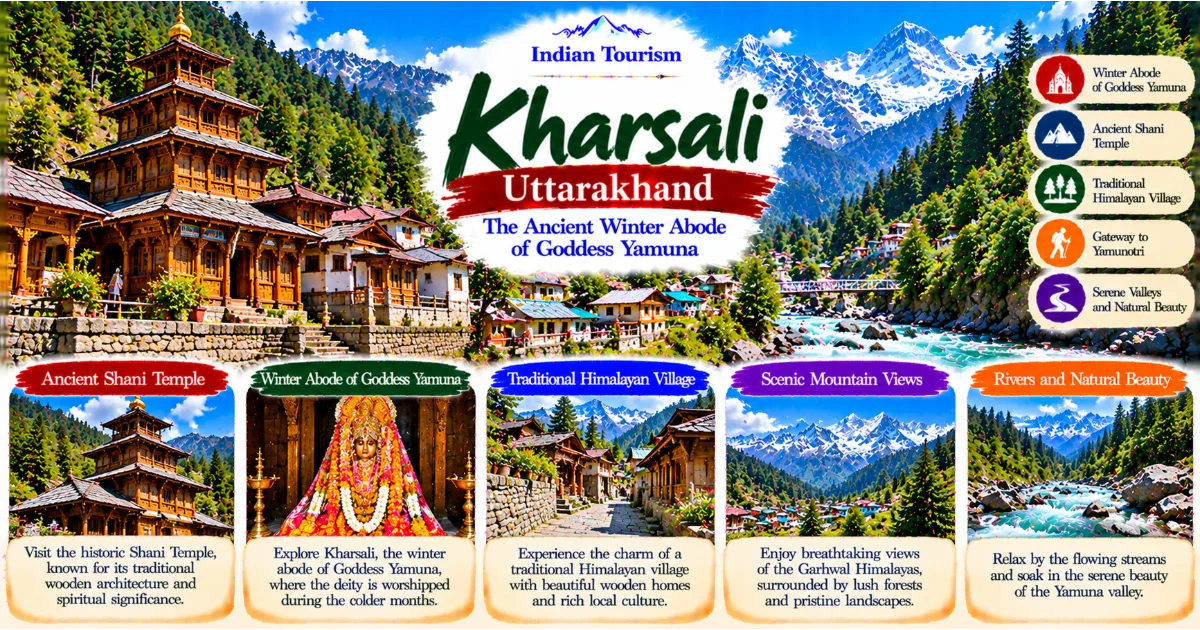
Discovering Kharsali, a Hidden Himalayan Village
Nestled among the mountains of Uttarkashi district in Uttarakhand, Kharsali is a small Himalayan village with a remarkable combination of spiritual significance, traditional architecture, and natural beauty. Located near the famous Yamunotri pilgrimage route, this peaceful settlement offers travellers an opportunity to explore the cultural heritage of the Garhwal Himalayas beyond the region's better-known temples and tourist destinations. Its ancient wooden structures, mountain surroundings, traditional village life, and deep connection with the worship of Goddess Yamuna make Kharsali a destination worth discovering.
Many visitors travel through the Yamuna valley with one principal objective: reaching the sacred Yamunotri Temple. However, the surrounding villages reveal a wider story of Himalayan faith, seasonal traditions, community life, and adaptation to a challenging mountain environment. Kharsali is one of the most meaningful places to experience this cultural landscape. It is widely known for its association with the winter worship of Goddess Yamuna, when the deity is brought from the high-altitude Yamunotri shrine to the village during the winter closure of the main temple.
This tradition makes Kharsali especially important in the religious life of the region. For devotees, the village is not simply a scenic settlement near a pilgrimage route. It is an important part of the annual cycle of worship that connects the high Himalayan shrine with the communities living in the valleys below.
Yet Kharsali has much to offer visitors who are interested in history, architecture, photography, rural tourism, and the natural environment. The village provides a glimpse into the traditional building practices of the region, where timber and stone have long been used to construct homes and religious structures suited to local conditions. Its narrow lanes, mountain views, and comparatively quiet atmosphere create an experience different from that of large commercial hill stations.
For travellers exploring Uttarakhand, Kharsali can be included in an itinerary covering Barkot, Hanuman Chatti, Janki Chatti, and Yamunotri. It is particularly rewarding for people who want to understand the cultural landscape surrounding one of the most important pilgrimage destinations in the Indian Himalayas.
Where Is Kharsali Located?
Kharsali is situated in Uttarkashi district of Uttarakhand, within the broader Yamuna valley and close to the route leading towards Yamunotri. The village lies in a mountainous region characterised by steep slopes, forested hills, flowing streams, and settlements connected by winding roads.
The geographical setting has influenced the development of the village over generations. Mountain terrain limits the availability of flat land, while changing weather conditions influence construction, agriculture, transport, and everyday activities. Traditional settlements in this part of Uttarakhand have developed in response to these practical realities.
Kharsali is particularly associated with the Yamunotri pilgrimage circuit. The village is near Janki Chatti, which serves as the principal roadhead for the final trek to Yamunotri under the usual pilgrimage arrangements. Its position makes it a useful destination for travellers who want to explore the religious and cultural heritage of the area without limiting their visit to the temple itself.
The surrounding landscape changes with elevation and season. Lower areas may display green vegetation and agricultural plots during warmer months, while the higher mountains provide a dramatic backdrop. The weather can shift rapidly, especially when rain clouds gather over the valley, and winter conditions may affect accessibility.
Visitors should distinguish Kharsali from Hanuman Chatti, Barkot, and Janki Chatti. These settlements occupy different positions within the wider Yamunotri travel corridor and serve different purposes for travellers. Understanding their locations helps visitors create a realistic itinerary rather than treating every place along the route as interchangeable.
Kharsali's greatest geographical advantage is its connection to both the natural environment and the sacred landscape of Yamuna worship. It offers a chance to experience the mountain village culture that supports and surrounds the pilgrimage tradition.
The Spiritual Importance of Kharsali
Kharsali holds a special place in the religious traditions associated with Goddess Yamuna. In Hindu belief, Yamuna is revered as a sacred river goddess whose waters have sustained communities and inspired devotional traditions for centuries. She is also closely associated with the broader religious geography of northern India.
The Yamunotri Temple, located higher in the Himalayas, is one of the four principal pilgrimage destinations of the Char Dham circuit in Uttarakhand. It is traditionally associated with the origin region of the Yamuna River and attracts devotees during its annual pilgrimage season.
However, the high-altitude location of Yamunotri makes year-round worship at the main temple difficult. Snow, cold temperatures, and challenging mountain conditions influence the seasonal operation of the shrine. During the winter closure, the worship of Goddess Yamuna continues at Kharsali, where the deity is brought for the winter period according to local religious tradition.
This arrangement demonstrates how Himalayan religious practices adapt to the natural environment. Rather than viewing seasonal closure as the end of worship, the community maintains continuity by transferring the deity to a more accessible location. The village therefore becomes an important centre of devotion during the colder months.
For pilgrims, visiting Kharsali can offer a different perspective on the Yamunotri pilgrimage. The experience is not limited to the dramatic mountain setting of the main temple. It also includes the village institutions, rituals, and community relationships that preserve the tradition throughout the year.
The spiritual significance of Kharsali is best understood through its living traditions. Religious practices are not merely historical attractions but part of the community's identity. Visitors should therefore approach temples and rituals respectfully, follow local guidance, and recognise that the village is a place of worship as well as a destination for travellers.
The Ancient Shani Temple of Kharsali
One of the most notable religious landmarks associated with Kharsali is its ancient Shani Temple, traditionally linked to Shani Dev, the deity associated with the planet Saturn in Hindu astrology and religious belief. The temple is especially interesting because of its traditional Himalayan architectural character.
The structure is known for its use of wood and stone, materials that have long played an important role in mountain construction. In regions where timber was historically available and stone could be gathered locally, builders developed methods that balanced practical requirements with religious and aesthetic considerations.
Traditional Himalayan temples often differ considerably from the large stone temple complexes found in the plains. Their forms reflect local building techniques, available resources, climatic conditions, and regional artistic traditions. Wooden elements may support upper levels, while stone provides a sturdy base. Sloping roofs and layered construction can help buildings respond to rainfall and snowfall, although the precise design varies from one structure to another.
Kharsali's Shani Temple is widely noted for its traditional multi-storeyed appearance and wooden construction. It offers visitors an opportunity to observe the architectural heritage of the region and appreciate the craftsmanship that has preserved religious buildings through changing seasons.
The temple also demonstrates how architecture can communicate cultural identity. A building is not only a physical shelter for religious practice. Its proportions, materials, decorative details, and location may reflect the traditions of the community that maintains it.
Visitors interested in architecture should take time to observe the structure carefully rather than treating it only as a photographic backdrop. Details such as timber joinery, carved elements, stone foundations, and roof forms can reveal aspects of traditional construction that are easily overlooked during a hurried visit.
Because the building is a religious site and a heritage structure, visitors should avoid touching fragile elements, climbing onto restricted sections, or using equipment in ways that could cause damage. Photography should follow local rules, and any restrictions imposed by temple authorities should be respected.
Traditional Himalayan Architecture: Wood, Stone, and Local Craftsmanship
Kharsali offers a valuable introduction to the traditional architecture of the Garhwal Himalayas. In mountain villages, building design has historically been shaped by climate, terrain, the availability of materials, and the need to protect families and stored resources through difficult winters.
Wood has played an important role in many traditional buildings across the Himalayan region. It can be used for beams, columns, balconies, door frames, roof structures, and decorative elements. Skilled carpenters developed construction methods suited to local materials and the dimensions of available timber.
Stone is another important component. It can provide a stable foundation and contribute to the strength of walls. In some traditional buildings, timber and stone are combined to create a structure that reflects both practical requirements and local aesthetic preferences.
The exact design of a building depends on its age, purpose, location, and the resources available when it was constructed. It would therefore be inaccurate to assume that every traditional building in Kharsali follows one standard architectural plan. Nevertheless, the village's surviving religious architecture provides an opportunity to appreciate the wider building traditions of the region.
Traditional construction also reflects an understanding of seasonal conditions. Roof shape, drainage, the positioning of openings, and the selection of materials can all influence how a building responds to rain, cold, and snow. Local builders historically relied on accumulated experience to make decisions appropriate to their environment.
Modern construction has introduced new materials and building methods to Himalayan settlements. Concrete structures and contemporary designs now appear alongside older forms in many villages. While modern materials can provide benefits, traditional buildings remain important records of regional knowledge and craftsmanship.
For travellers, the value of Kharsali lies partly in observing this architectural transition. The village provides an opportunity to think about how communities preserve their cultural identity while responding to changing economic conditions and modern expectations.
Heritage tourism can support preservation when it encourages appreciation, maintenance, and responsible investment. However, the long-term survival of traditional structures depends on local priorities, skilled repair work, and suitable conservation practices rather than tourism alone.
The Winter Worship of Goddess Yamuna
The winter worship of Goddess Yamuna is one of the defining traditions associated with Kharsali. The annual movement of the deity between the high-altitude Yamunotri shrine and the village reflects the relationship between religious practice and Himalayan seasonal conditions.
During the pilgrimage season, devotees travel towards Yamunotri to offer prayers at the main temple. As the weather becomes unsuitable for regular access to the high-altitude shrine, the temple closes for winter according to the established religious calendar. The deity is then brought to Kharsali, where worship continues during the colder period.
This tradition provides continuity to the religious life of the region. The seasonal movement does not represent an interruption in devotion but a change in the place where worship is conducted. The village becomes a focal point for devotees who wish to offer prayers during the winter months.
The precise dates of the seasonal ceremonies depend on the religious calendar and announcements made by the relevant temple authorities. Visitors planning a trip specifically to attend a ceremony should verify the current year's schedule rather than relying on dates from previous years.
The ceremonies may involve priests, local residents, pilgrims, and people responsible for maintaining the religious traditions. The atmosphere can be especially meaningful for those interested in the living culture of the Garhwal Himalayas.
Visitors should remember that religious ceremonies are not performances staged for tourists. They are important occasions for the people who participate in them. Anyone attending should behave respectfully, avoid interrupting rituals, and follow instructions concerning photography, movement, and access.
The winter tradition also highlights the practical knowledge of Himalayan communities. For generations, people have adapted travel, worship, and daily life to seasonal changes. Kharsali's role in maintaining worship during winter is a powerful example of how cultural traditions continue within a challenging natural environment.
Kharsali and the Yamuna River Tradition
The identity of Kharsali is closely connected with the wider religious and cultural significance of the Yamuna River. Across northern India, the Yamuna is revered not only as a source of water but also as a sacred presence associated with devotion, mythology, and community life.
The river's upper Himalayan region has a distinctive place within this tradition. Here, the surrounding mountains, high-altitude pilgrimage routes, and seasonal movement of people contribute to a religious landscape that differs from the more densely populated areas farther downstream.
For pilgrims, the journey towards Yamunotri is often understood as an opportunity to connect with the sacred geography of the river. The landscape becomes part of the spiritual experience. Mountains, springs, streams, and temples are interpreted through stories and traditions passed down across generations.
Kharsali adds another dimension to this relationship because it helps maintain the worship of Goddess Yamuna when the high-altitude shrine is closed for winter. The village illustrates how the cultural significance of a river can be sustained through community institutions and religious practices, even when physical access to the upper valley becomes difficult.
Visitors should also recognise the environmental importance of the river system. Mountain streams and rivers support settlements, agriculture, wildlife, and downstream communities. Pollution, litter, poorly managed construction, and careless tourism can damage these fragile environments.
Responsible travellers should avoid disposing of waste near watercourses and should never assume that a clear mountain stream is automatically safe to drink. Water quality can vary, and untreated water may carry microorganisms even when it appears clean.
Understanding the Yamuna tradition therefore involves appreciating both its religious importance and its ecological significance. The cultural landscape of Kharsali is inseparable from the natural systems that sustain life throughout the valley.
Natural Beauty Around Kharsali
Although Kharsali is best known for its religious heritage, the surrounding landscape is an important part of its appeal. The village lies within a Himalayan environment characterised by mountain slopes, forested areas, narrow valleys, and changing seasonal colours.
The scenery varies according to the time of year. During spring, vegetation begins to recover from winter, and the landscape may display fresh growth. Summer can bring greener surroundings and longer daylight hours. The monsoon intensifies the colours of the hills but can also bring heavy rain and dangerous travel conditions. Autumn often offers clearer views, while winter introduces colder temperatures and the possibility of snow in the wider region.
The mountain setting creates opportunities for quiet observation and photography. Travellers can appreciate the relationship between the settlement and the surrounding slopes, notice the changing light across the valley, and observe how homes and religious structures occupy the available land.
The village environment is also shaped by human activity. Agricultural plots, paths, buildings, and local roads reveal how people have adapted to the terrain. These features add cultural depth to the landscape and help visitors understand that the area is not simply a wilderness but a lived-in environment.
Walking around the village can be rewarding, provided visitors remain on accessible routes and respect private property. The terrain may be uneven, and paths can become slippery after rain. Anyone unfamiliar with the area should ask local residents about suitable walking routes rather than following unmarked trails.
Kharsali is particularly appealing to travellers who prefer understated beauty to heavily developed tourist attractions. Its value lies in the combination of natural surroundings and cultural heritage, allowing visitors to experience several dimensions of Himalayan life within a relatively small area.
Village Life and the Culture of Garhwal
The culture of Kharsali forms part of the wider heritage of Garhwal, a region known for its mountain communities, religious traditions, local languages, folk practices, and strong connections between people and their environment.
Life in a Himalayan village often requires careful adaptation to geography and climate. The availability of cultivable land can be limited, transport may depend on narrow roads, and changing weather can influence daily activities. Families organise work and household responsibilities around these practical conditions.
Religious institutions play an important role in many villages across Uttarakhand. Temples can serve as centres of worship and as places where community traditions are maintained. Annual ceremonies, seasonal observances, and local gatherings help preserve cultural continuity across generations.
The presence of pilgrims can also influence local economic activity. Small businesses may provide refreshments, accommodation, transport assistance, or other services to visitors. These activities can contribute to household income, particularly during the pilgrimage season.
At the same time, tourism creates responsibilities. Increased visitor numbers can place pressure on roads, waste-management systems, water resources, and traditional buildings. Sustainable tourism requires a balance between economic opportunity and the protection of the village's cultural and natural environment.
Visitors can support this balance by buying local products when available, using locally operated services, asking permission before photographing residents, and avoiding behaviour that disrupts everyday life.
Learning a few polite local expressions, greeting residents respectfully, and showing interest in the village's traditions can also make travel more meaningful. The aim should not be to treat the community as a spectacle but to understand the place on its own terms.
Kharsali's cultural importance lies in the continued relationship between its people, religious practices, traditional architecture, and surrounding landscape. A thoughtful visit can help travellers appreciate these connections rather than viewing the village as just another stop on a sightseeing route.
Best Things to Do in Kharsali
Visit the Shani Temple
The Shani Temple is one of the principal attractions for visitors interested in the village's religious and architectural heritage. Its traditional wooden construction and distinctive form make it an important place to observe regional craftsmanship.
Visitors should allow time to appreciate the building's materials and proportions. If access to particular areas is restricted, those restrictions should be respected. The temple's significance for worshippers should remain the priority during any visit.
Learn About the Winter Worship Tradition
Kharsali's role as the winter abode of Goddess Yamuna offers an opportunity to understand how religious practices adapt to the seasonal conditions of the Himalayas.
Travellers who are particularly interested in this tradition can plan their visit around the relevant ceremonies, provided they confirm the current schedule with appropriate local sources. The experience can offer insight into the community's religious calendar and the relationship between the village and Yamunotri.
Explore Traditional Village Architecture
Walking through accessible parts of Kharsali can reveal traditional homes, local building methods, and the way structures fit into the mountain environment.
Visitors should distinguish between publicly accessible areas and private residential spaces. Photographing houses or residents without permission can be intrusive, so a respectful approach is essential.
Enjoy the Mountain Views
The natural setting provides opportunities for photography and quiet observation. Travellers can look for safe viewpoints, observe the changes in light, and appreciate the contrast between village buildings and the surrounding mountains.
There is no need to attempt difficult climbs to enjoy the landscape. Safe, accessible locations often provide excellent views without unnecessary risk.
Experience a Slower Style of Travel
Kharsali is well suited to travellers who enjoy exploring a place at a relaxed pace. Rather than rushing from one attraction to another, spend time learning about the village's heritage and observing its everyday environment.
A slower approach allows visitors to notice details that might otherwise be missed, including traditional construction, local customs, and the influence of the surrounding landscape on village life.
Best Time to Visit Kharsali
The best time to visit Kharsali depends on the type of experience you want. Travellers interested in the Yamunotri pilgrimage may prefer the main pilgrimage season, while those interested in winter worship may plan a visit around the winter religious calendar.
Spring: March and April
Spring marks the transition from winter towards warmer weather. Conditions can vary significantly according to elevation, and cold mornings are still possible. Some routes in the wider Himalayan region may remain affected by winter conditions.
Spring can be attractive for visitors who want to experience the village before the busiest pilgrimage period. However, travellers should verify the status of the Yamunotri route and the availability of local services before departure.
Summer: May and June
May and June are generally important months for travel in the Yamunotri region. The pilgrimage season brings increased movement along the route, and local services may become more active.
The surrounding landscape can be appealing during this period, with relatively longer daylight hours making it easier to organise travel. However, visitor numbers may also increase, so accommodation and transport should be planned in advance.
Travellers should be prepared for changing temperatures and should carry suitable clothing for mountain conditions.
Monsoon: July to September
The monsoon brings heavy rainfall to many parts of Uttarakhand. Kharsali's landscape can become lush and green, but the season also increases the risk of landslides, road closures, falling rocks, and transport delays.
A monsoon visit requires careful planning and flexibility. Check current weather forecasts and local road advisories, and avoid travelling through unsafe areas simply to maintain a schedule.
Visitors who are unfamiliar with Himalayan monsoon conditions may find another season more convenient.
Autumn: October to November
Autumn can offer clearer views and comfortable daytime conditions, although temperatures gradually fall as winter approaches. It is often a rewarding period for travellers interested in mountain scenery and cultural exploration.
The pilgrimage calendar should be checked carefully because the Yamunotri Temple generally closes for winter according to an established religious schedule. Kharsali's importance may become especially relevant around the transition to winter worship.
Winter: December to February
Winter brings cold conditions to the region, and snow or ice may affect parts of the wider mountain route. Kharsali is particularly significant during this season because of its association with the winter worship of Goddess Yamuna.
Visitors interested in the winter tradition should confirm ceremony dates, access conditions, accommodation availability, and local transport before travelling. They should also carry warm clothing and prepare for short daylight hours and possible travel disruptions.
Winter can provide a culturally distinctive experience, but it requires more careful planning than a routine summer visit.
How to Reach Kharsali
Kharsali can be reached by road through the Yamunotri region of Uttarakhand. The precise route depends on the starting point and current road conditions, so travellers should confirm the latest access arrangements before departure.
By Road
Road travel is the principal way to reach Kharsali. Visitors commonly travel through Dehradun or other suitable entry points into Uttarakhand before continuing towards Barkot and the Yamunotri valley.
Barkot is an important town for planning a journey through this region. From there, travellers can continue towards the Yamunotri route and the nearby settlements, including Kharsali and Janki Chatti, depending on current access arrangements.
Mountain driving requires patience. Roads can be winding, visibility can change quickly, and traffic may increase during pilgrimage periods. Travellers should allow additional time and avoid attempting to cover long distances at night.
Before setting out, check whether recent rainfall, landslides, roadworks, or seasonal restrictions affect the planned route.
By Train
Kharsali does not have its own railway station. Travellers arriving by train can use an accessible railway hub such as Dehradun, depending on their route and the trains available from their city.
The onward journey is completed by road. Visitors should consider the time required for the mountain drive when booking train arrivals and arranging accommodation.
By Air
Jolly Grant Airport near Dehradun is commonly used by travellers flying into the region. From the airport, the journey continues by road towards Barkot and the Yamunotri valley.
Because the road journey is substantial, visitors should avoid making tightly scheduled connections that leave no room for delays. If arriving late in the day, an overnight stop at a suitable town may be more comfortable and practical.
Local Transport
Taxis and locally operated vehicles can be useful for exploring the area. Before hiring a vehicle, confirm the fare, route, expected duration, luggage arrangements, and any restrictions that may apply during the pilgrimage season.
Travellers should also check whether the vehicle can reach their intended stopping point. Road access arrangements can change, and the final approach to Yamunotri involves a separate trekking stage from the applicable roadhead.
Accommodation and Food Options
Kharsali is a relatively small village, so accommodation and dining options may be more limited than in major tourist centres. The availability of rooms, guesthouses, and food services can vary by season and pilgrimage demand.
Travellers should confirm their accommodation before arriving, particularly if they plan to visit during a religious ceremony or the busiest part of the pilgrimage season. It is important to check facilities such as heating, hot water, bathroom arrangements, electricity, and access for older travellers.
Some visitors may prefer to stay in a larger settlement along the route and explore Kharsali as part of a day trip. Barkot can be a useful base for planning a broader itinerary, depending on transport and current conditions.
Food options in the wider region may focus on simple Indian meals, refreshments, and locally operated eateries. Travellers should not assume that every establishment will remain open throughout the year.
Carrying a few essential snacks and drinking water can be helpful, especially during long road journeys. Use safe drinking water and dispose of waste responsibly.
Supporting local accommodation providers and small businesses can contribute to the regional economy. However, travellers should maintain realistic expectations and remember that services in remote mountain villages may be affected by weather, supply difficulties, and seasonal demand.
A One-Day Itinerary for Kharsali
A one-day visit to Kharsali can be included in a broader journey through the Yamunotri region. The most suitable schedule depends on where you are staying and whether your main interest is architecture, religious traditions, or the surrounding landscape.
Begin the day early from your overnight base. If you are travelling from Barkot or another settlement along the route, check the road conditions before departure and allow sufficient time for the drive.
After arriving, explore the accessible parts of the village and visit the Shani Temple if it is open to visitors. Spend time observing the traditional construction and learning about the temple's religious significance.
You can then learn more about Kharsali's connection with the winter worship of Goddess Yamuna. If a religious ceremony is taking place, follow local instructions and avoid interrupting the proceedings.
Allow time for a walk through appropriate public areas, taking care not to intrude on private property. The village's traditional architecture and mountain surroundings can provide excellent opportunities for photography.
Take a break at a suitable local establishment if services are available. Use the opportunity to rest and ask local residents for information about the village's traditions, provided they are willing to share.
Before returning, check the time and road conditions. Avoid extending the visit into an unnecessarily late drive through unfamiliar mountain roads.
If you are also planning to visit Yamunotri, treat the pilgrimage as a separate activity that requires its own schedule and preparation.
A Two-Day Kharsali and Yamunotri Itinerary
A two-day itinerary allows visitors to explore the wider region without rushing.
On the first day, travel towards Barkot and the Yamuna valley. Depending on your starting point, the journey may take much of the day. Settle into your accommodation and confirm the following day's transport arrangements.
If time and road conditions permit, you may be able to explore part of the surrounding area. However, it is better to keep the schedule flexible than to add several destinations after a long drive.
On the second day, visit Kharsali to explore its religious heritage and traditional architecture. If your primary objective is Yamunotri, confirm the current route arrangements and allow enough time for the trek from the designated roadhead.
The final journey to Yamunotri can involve considerable physical effort. Travellers should take account of fitness, weather, altitude, and the needs of children or older family members. If the plan includes both Kharsali and Yamunotri, avoid assuming that every activity can be completed comfortably within a fixed number of hours.
An alternative is to devote the second day entirely to Kharsali and nearby destinations, leaving Yamunotri for another visit. This is particularly sensible for visitors whose main interests are architecture, religious history, and village culture.
Practical Travel Tips for Visitors
A successful visit to Kharsali begins with realistic planning. Mountain destinations are affected by seasonal conditions, and travel times can be difficult to predict precisely.
Carry warm clothing even during warmer months. Temperatures can fall in the evening, and weather may change quickly. A waterproof jacket and comfortable footwear are useful additions.
Keep essential medicines and personal documents accessible. Travellers with medical conditions should consider whether long road journeys, altitude changes, and limited access to major medical facilities are appropriate for them.
Check weather forecasts and local road advisories before travelling. During the monsoon and winter, be prepared to change the itinerary if conditions deteriorate.
Carry cash because digital payment facilities may not be consistently available. Mobile connectivity can vary, so save important travel details offline and let someone know your plans if you will be exploring unfamiliar areas.
Respect religious customs and follow instructions at temples. Dress appropriately for places of worship, ask before taking photographs, and avoid touching objects that are part of religious ceremonies.
If you plan to attend the winter worship of Goddess Yamuna, confirm the dates and arrangements with the relevant local authorities or temple representatives. The timing can vary according to the religious calendar.
Finally, remember that Kharsali is a living village. Keep noise levels reasonable, avoid littering, and treat residents with consideration.
Responsible Tourism and Heritage Preservation
Kharsali's appeal depends on the continued preservation of its religious traditions, traditional architecture, and natural surroundings. Tourism can provide economic opportunities, but unmanaged visitor activity can also place pressure on a small settlement.
Traditional wooden structures require appropriate care. Visitors should avoid climbing on buildings, leaning equipment against fragile surfaces, or touching decorative elements unnecessarily. Conservation work should be guided by people with suitable knowledge of traditional materials and local heritage.
Waste management is another important concern. Plastic bottles, wrappers, and food packaging should never be left along village paths or near streams. Visitors should carry waste until they can dispose of it properly.
Water resources should be treated with care. Do not throw rubbish or wastewater into streams, and avoid activities that may contaminate sources used by local communities.
Supporting local businesses can help ensure that some tourism income remains within the village. Purchasing locally made products where available and using local services can be more beneficial than relying entirely on outside providers.
Respectful behaviour is equally important. Ask permission before photographing residents, do not enter private homes without an invitation, and follow local guidance during religious ceremonies.
Heritage preservation is most effective when it reflects the needs and priorities of the people who live in a place. Visitors can contribute by showing appreciation for local traditions without assuming that every aspect of village life should be adapted for tourism.
Responsible travel allows Kharsali to remain both a meaningful destination for visitors and a valued home for its residents.
Who Should Visit Kharsali?
Kharsali is especially suitable for travellers interested in religious heritage, traditional architecture, rural culture, and the quieter side of the Himalayas.
Pilgrims visiting the Yamunotri region may find the village particularly meaningful because of its role in the winter worship of Goddess Yamuna. The connection between the village and the high-altitude shrine adds cultural depth to the pilgrimage.
History and architecture enthusiasts can appreciate the traditional Shani Temple and the wider building traditions of the Garhwal region. Those interested in rural tourism may enjoy observing the relationship between village life and the mountain environment.
Photographers can find opportunities to document the landscape, traditional structures, and seasonal atmosphere. Nature lovers may appreciate the mountain setting and the opportunity to explore a settlement that has not developed into a large commercial tourist centre.
Families can include Kharsali in a wider Uttarakhand itinerary, provided they account for road conditions, accommodation, and the comfort of every traveller. Older visitors and people with limited mobility should confirm access arrangements in advance.
Kharsali may be less suitable for travellers seeking luxury resorts, extensive shopping, nightlife, or a large number of organised recreational activities. Its appeal is cultural and geographical rather than commercial.
Visitors who approach the village with curiosity, patience, and respect are likely to gain the most from the experience.
Final Thoughts: Kharsali, Where Faith and Himalayan Heritage Meet
Kharsali is one of the most culturally distinctive destinations in the Yamunotri region of Uttarakhand. Its traditional architecture, association with the winter worship of Goddess Yamuna, and peaceful mountain setting make it an important place for understanding the relationship between Himalayan communities and their religious traditions.
The village demonstrates how faith adapts to geography. When winter conditions make the high-altitude Yamunotri shrine inaccessible, worship continues at Kharsali. This seasonal movement reflects the practical knowledge, devotion, and community relationships that have sustained religious life in the Garhwal Himalayas.
The ancient Shani Temple adds another dimension to the experience. Its traditional construction offers a glimpse into regional craftsmanship and the ways in which architecture responds to local materials and climatic conditions.
Beyond the temples, Kharsali invites travellers to appreciate the quieter aspects of mountain life. The surrounding slopes, traditional homes, village paths, and everyday activities reveal a cultural landscape that cannot be understood through a temple visit alone.
For visitors exploring Uttarakhand, Kharsali is an opportunity to slow down and look beyond the best-known attractions. It encourages a deeper understanding of the people, traditions, and landscapes that give the Yamunotri region its identity.
A thoughtful journey to Kharsali can become more than a sightseeing excursion. It can be an opportunity to learn about living heritage, appreciate traditional craftsmanship, and understand how communities preserve their identity while adapting to the demands of the modern world.
The village reminds us that the Himalayas are not defined only by their highest peaks or most famous pilgrimage destinations. Their cultural richness is also preserved in small settlements where traditions continue across generations, and where the landscape remains closely connected to everyday life.
#Kharsali #UttarakhandTourism #IndianTourism #Yamunotri #GoddessYamuna #GarhwalHimalayas #Uttarkashi #HimalayanVillages #ShaniTemple #CharDhamYatra #HimalayanHeritage #TraditionalArchitecture #CulturalTourism #ExploreUttarakhand #TravelIndia
