
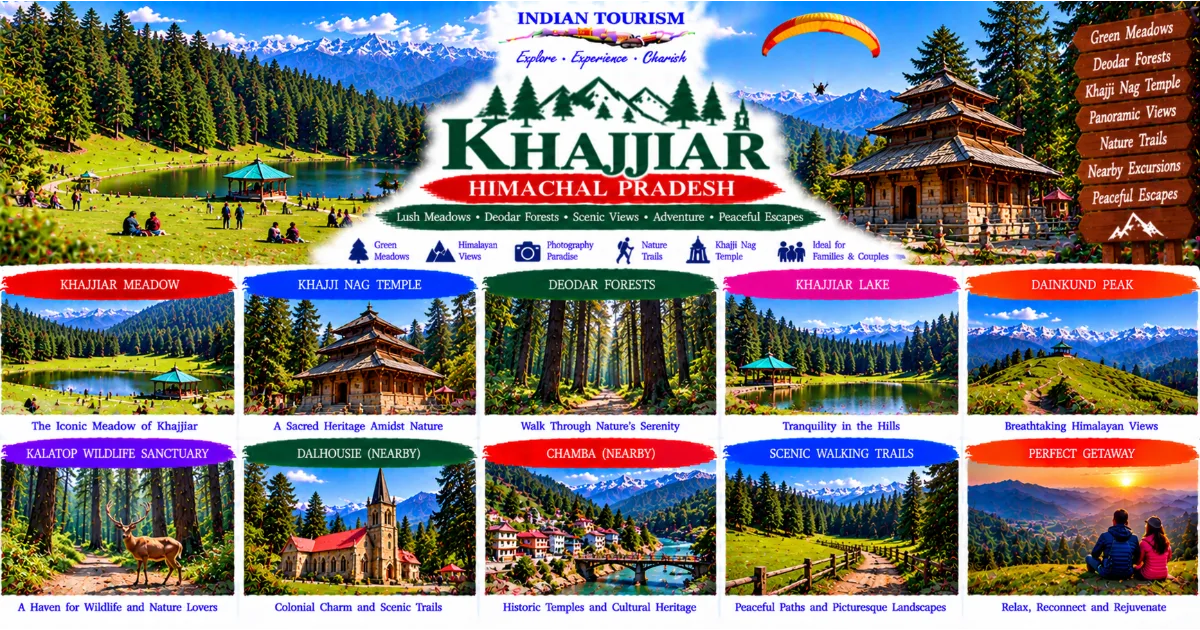
Discover the Enchanting Landscape of Khajjiar
Khajjiar is one of the most picturesque destinations in Himachal Pradesh, celebrated for its expansive green meadow, towering deodar trees, surrounding mountain slopes and peaceful Himalayan atmosphere. Located in the Chamba district, this small hill destination offers a refreshing escape for travellers who enjoy open landscapes, scenic walks, photography and the simple pleasure of spending time in nature. Often described as the Mini Switzerland of India, Khajjiar has earned a reputation for its distinctive combination of meadow, forest and mountain scenery. Yet its appeal goes beyond comparisons with other destinations. Its natural surroundings, cultural connections and location within the western Himalayas make it a memorable place in its own right.
Unlike large hill stations filled with busy markets and extensive commercial development, Khajjiar is known primarily for its open landscape. The central meadow forms the heart of the destination, surrounded by dense forest and rolling hills. On a clear day, visitors can enjoy wide views of the mountains, while misty conditions create a quieter and more atmospheric setting. Seasonal changes transform the landscape, bringing fresh greenery during warmer months and colder, sometimes snowy conditions during winter.
Khajjiar is an excellent choice for couples, families, nature lovers, photographers and travellers exploring the wider Chamba region. It can be visited as a day trip from Dalhousie or included in a longer itinerary covering Chamba, Bharmour and other destinations in Himachal Pradesh. Visitors can spend time walking around the meadow, exploring nearby forest paths, visiting the local temple and enjoying the surrounding countryside.
The destination is also valuable because it encourages a slower style of travel. Rather than moving rapidly between monuments, visitors can appreciate the changing light, observe the forest, enjoy a picnic in an appropriate designated area and take photographs without rushing. A visit becomes more rewarding when travellers understand the landscape, respect its ecological sensitivity and allow enough time to experience the surroundings.
Khajjiar is not a place where every activity needs to be organised in advance. Its greatest attraction is often the setting itself. However, understanding the best season, transport options, nearby attractions and practical considerations can help you plan a comfortable and responsible trip.
Understanding Khajjiar: A Meadow in the Western Himalayas
Khajjiar lies in the Chamba district of Himachal Pradesh, in a mountainous landscape shaped by forests, valleys and elevated grasslands. Its central meadow is the destination's most recognisable feature. The open grassy area contrasts with the surrounding deodar forest, creating a landscape that feels spacious despite being enclosed by hills.
The geography of Khajjiar is part of what makes it so attractive. Forested slopes rise around the meadow, while the surrounding mountains create a natural backdrop that changes with the weather. On bright days, the landscape appears vivid and sharply defined. When clouds move across the hills, the same area can become misty and dramatic.
The meadow is a natural environment rather than a landscaped urban park. Its grassland, surrounding trees and local wildlife form part of a wider ecological system. Visitors should therefore treat the area carefully, avoid damaging vegetation and follow any restrictions intended to protect the landscape.
Khajjiar's setting also reflects the broader relationship between mountain communities and their environment. The surrounding region contains settlements, agricultural areas, forested slopes and routes connecting different parts of the Chamba district. Travelling through the region reveals how the landscape influences roads, livelihoods, architecture and daily life.
The best way to appreciate Khajjiar is to see it as more than a photograph-friendly meadow. Its beauty depends on the interaction between open grassland, forest, mountain weather and the communities that live in the surrounding region.
Why Is Khajjiar Called the Mini Switzerland of India?
Khajjiar is popularly known as the Mini Switzerland of India because its central meadow, surrounding forests and mountain scenery remind some visitors of landscapes associated with Switzerland. The comparison has helped attract attention to the destination and made it widely recognisable among travellers exploring Himachal Pradesh.
However, Khajjiar has its own distinctive character. Its landscape belongs to the western Himalayas, and its natural setting is connected to the climate, vegetation and geography of northern India. The meadow is surrounded by deodar forests and mountain terrain that give it a unique appearance.
The nickname should be understood as a description of visual resemblance rather than a claim that the two destinations are identical. Khajjiar offers a different cultural context, local traditions, regional food and mountain environment. These qualities are part of its appeal and deserve attention alongside the scenic comparisons.
Visitors who arrive expecting only a foreign landscape may overlook what makes Khajjiar special. Taking time to explore the surroundings, understand the regional context and appreciate the local environment creates a more meaningful experience.
The meadow is beautiful in its own right, and its value does not depend on resemblance to another country. Its peaceful atmosphere, forested setting and place within the Chamba region are sufficient reasons to visit.
Best Places to Visit in Khajjiar
1. Khajjiar Meadow
Khajjiar Meadow is the main attraction and the reason most travellers visit the destination. The open grassy landscape is surrounded by tall trees and mountain slopes, creating a scenic setting for walking, photography and relaxation.
The meadow looks different throughout the year. During warmer months, the grass becomes greener and the surrounding vegetation appears lush. In cooler periods, the landscape may become muted, misty or snow-covered depending on the weather. These seasonal changes make repeat visits worthwhile for travellers who enjoy nature photography.
Visitors can walk around the meadow and choose a comfortable place to enjoy the views. It is important to follow any local rules about access, particularly where the grassland is sensitive or certain areas are reserved for conservation. Avoid leaving food packaging, plastic bottles or other rubbish behind.
The meadow is suitable for families and travellers who prefer a relaxed outing rather than a demanding trek. However, the ground can become muddy or slippery after rain, and winter conditions may require suitable footwear. Visitors should remain cautious around wet areas and avoid walking onto unfamiliar ground.
The most rewarding experience is often to spend enough time simply observing the surroundings. Watch how sunlight moves across the hills, notice the contrast between the grassland and forest, and enjoy the changing atmosphere rather than rushing away after a few photographs.
2. Khajji Nag Temple
Khajji Nag Temple is one of the area's important cultural landmarks. The temple is traditionally associated with Khajji Nag, a local serpent deity, and reflects the religious traditions of the Chamba region. Its presence provides an important contrast to the open natural landscape surrounding it.
The temple is known for its traditional wooden architectural elements and historic character. Its design reflects the local building traditions that developed in the western Himalayan environment. Religious structures in mountain regions often use materials and techniques suited to the climate, while decorative details express the beliefs and artistic skills of local communities.
A visit to the temple allows travellers to understand that Khajjiar is not simply a scenic meadow. It is also a place with cultural and religious significance. Local traditions remain part of the identity of the area, and the temple provides a connection between the natural setting and the history of the surrounding community.
Visitors should dress respectfully, observe any instructions and ask before photographing worshippers or religious activities. Avoid touching or damaging historic elements. If a ceremony is taking place, give worshippers space and keep noise to a minimum.
The temple can be included in a short walk around the meadow, making it easy to combine natural scenery with cultural exploration.
3. The Deodar Forests
The deodar forests surrounding Khajjiar are among its most attractive natural features. Tall evergreen trees create a dramatic frame around the meadow and provide a strong sense of the Himalayan landscape. Their dense branches, textured trunks and shaded surroundings make the forest visually distinctive.
Walking near the forest can be a peaceful experience, especially when the area is quieter. The changing light between the trees creates opportunities for photography, while the sound of wind moving through the branches adds to the atmosphere.
Visitors should remain on established paths where access is permitted. Forest environments are important habitats, and unnecessary disturbance can affect wildlife and vegetation. Avoid lighting fires, damaging trees or leaving food waste behind.
The forest is not simply a decorative background for the meadow. It forms part of the wider ecosystem and contributes to soil stability, water regulation and habitat protection. Treating it carefully helps preserve the natural character that attracts visitors to Khajjiar.
Those interested in birdwatching may enjoy observing the trees and listening for bird calls. Sightings depend on season, weather and local conditions, so patience is more useful than expecting particular species.
4. Khajjiar Lake
A small lake is located within the meadow area and contributes to the destination's distinctive scenery. Surrounded by grassland and forest, the water adds another visual element to the landscape and is a popular feature in photographs.
The lake's appearance can vary according to rainfall, seasonal conditions and the surrounding vegetation. Visitors should observe it from appropriate areas and follow any local restrictions. Wet ground around water can be slippery, and entering the water or approaching unstable edges should be avoided.
The lake is also part of the wider natural setting, so visitors should not throw rubbish into it or feed animals with unsuitable food. Maintaining clean water and protecting surrounding vegetation are important for the long-term health of the environment.
For photographers, the lake can provide attractive compositions with the meadow, trees and mountains reflected in the water when conditions are suitable. Early and late daylight may create softer lighting, although the result depends on cloud cover and visibility.
5. Kalatop Wildlife Sanctuary
Kalatop Wildlife Sanctuary is located in the wider Dalhousie and Khajjiar region and is an excellent excursion for travellers interested in forests and wildlife. The sanctuary protects forest habitats and offers a chance to experience the natural environment beyond the meadow.
The landscape includes wooded slopes and mountain scenery, with opportunities to observe vegetation and birds. Wildlife sightings are possible but never guaranteed, and visitors should approach the sanctuary as a natural habitat rather than a place where animals are expected to appear on demand.
Walking routes and access arrangements can vary, so visitors should check current local guidance before planning a hike. Remain on permitted paths, avoid loud noises and never attempt to feed, chase or approach wild animals.
A visit to the sanctuary can be combined with a broader itinerary that includes Dalhousie or Khajjiar. However, travellers should allow sufficient time for road travel and walking rather than trying to fit too many distant places into one day.
6. Dainkund Peak
Dainkund Peak is another scenic attraction in the wider region. It is known for elevated viewpoints and panoramic mountain scenery, making it popular with visitors who enjoy photography and walking.
The journey to the peak provides a different experience from spending time in Khajjiar's meadow. At higher elevations, the views open across the surrounding hills and valleys, and the landscape may appear especially dramatic when visibility is clear.
Travellers should check road and trail conditions before setting out. Mountain weather can change rapidly, and cloud cover may reduce visibility. Suitable footwear, water and warm clothing are recommended, even when the weather appears pleasant at the start of the journey.
Dainkund is better treated as a separate excursion rather than an attraction to rush through between brief stops. Visitors should allow time for the walk and the return journey, particularly if travelling with children or older family members.
7. Dalhousie
Dalhousie is one of the most convenient bases for visiting Khajjiar. The hill station is known for colonial-era churches, pine and deodar forests, scenic roads and a relaxed atmosphere. Its historic character provides a contrast to Khajjiar's open meadow.
Travellers can explore Gandhi Chowk, visit historic churches and enjoy the central market before or after a day trip to Khajjiar. Those staying for several days can combine the two destinations without needing to change accommodation.
Dalhousie also offers a wider range of visitor services than a small meadow destination, including restaurants, hotels and transport options. The best arrangement depends on the travel season, budget and preferred level of comfort.
Visitors should not assume that the road journey will always take the same amount of time. Traffic, weather and road conditions can affect travel, so allow a reasonable buffer when planning the day.
8. Chamba Town
Chamba is a historic town in the district and an important destination for travellers interested in temples, art and traditional culture. It is known for the Lakshmi Narayan Temple Complex, the Bhuri Singh Museum, historic buildings and regional handicrafts.
A visit to Chamba adds cultural depth to a Khajjiar holiday. While the meadow offers natural scenery, Chamba reveals the artistic and historical traditions of the region. The town's temples and museum help visitors understand the wider cultural setting in which Khajjiar exists.
Travellers with limited time may choose a separate day for Chamba rather than trying to combine every attraction in a single outing. The road journey and time needed to explore the town should be included in the plan.
9. Bharmour
Bharmour is an important destination in the Chamba district, known for its historic temples and connections with Himalayan pilgrimage traditions. Its Chaurasi Temple Complex contains shrines associated with local religious life and the region's cultural heritage.
Bharmour is farther from Khajjiar than the immediate surrounding attractions and is better suited to travellers who have additional time. It offers a different landscape and cultural experience, particularly for those interested in temple architecture and mountain communities.
Travel to Bharmour requires attention to road conditions and realistic journey planning. Visitors intending to continue towards high-altitude pilgrimage routes should make separate preparations and understand the physical and environmental challenges involved.
Nature and Outdoor Experiences in Khajjiar
Walking Around the Meadow
A relaxed walk around the meadow is one of the simplest and most enjoyable ways to experience Khajjiar. The open space allows visitors to appreciate the landscape from different angles, while the surrounding trees provide changing views as the route unfolds.
There is no need to turn the walk into a strenuous activity. Families and casual travellers can take their time, stop for photographs and enjoy the scenery. Visitors should choose paths that are appropriate for their fitness and follow any restrictions designed to protect the grassland.
The experience can be especially pleasant when the meadow is relatively quiet. Early visits may provide more space to walk and photograph the landscape before the busiest periods arrive.
Photography and Landscape Observation
Khajjiar is well suited to landscape photography because the meadow, forest and mountains create several layers within a single view. Photographers can experiment with wide compositions, details of the grassland and trees, and images that show the scale of the surrounding hills.
Changing weather can produce dramatically different results. Bright sunlight brings vivid greens and strong contrast, while mist softens the scene. After rainfall, the landscape may appear especially fresh, although wet paths require care.
Visitors should avoid stepping into sensitive areas solely to obtain a photograph. Do not disturb wildlife, damage plants or obstruct other visitors. The best photographs should come from respecting the landscape rather than altering it.
Birdwatching
The surrounding forests provide opportunities for observing birds and other elements of the local ecosystem. Travellers interested in birdwatching should move quietly, bring binoculars if available and allow time to observe the environment.
Bird activity varies with season, weather and habitat conditions. Visitors should not expect guaranteed sightings or use recorded calls and other methods that may disturb wildlife. A patient approach is more rewarding and more respectful of the forest.
Snow and Winter Landscapes
During winter, Khajjiar may experience snowfall or very cold conditions, depending on the weather. When snow covers the meadow and surrounding trees, the landscape can look dramatically different from its green summer appearance.
Snowfall is not guaranteed on any particular date, and road access can be affected by winter weather. Travellers should check current conditions before leaving Dalhousie or another base. If snow or ice is present, suitable footwear and warm clothing become essential.
Visitors should avoid walking onto frozen or unstable water, entering closed areas or driving into conditions that exceed their experience. A winter visit can be beautiful, but safety and flexibility should take priority over chasing a particular photograph.
Local Food: What to Eat During a Khajjiar Trip
Khajjiar is a small destination, so food choices may be more limited than in larger hill stations. Visitors can often find simple meals, snacks, tea and familiar dishes, while a wider range of restaurants is available in nearby Dalhousie and other towns.
Himachali Dham
Dham is a traditional festive meal associated with Himachal Pradesh. It is commonly served during weddings and other important occasions, and its dishes vary across regions. Depending on local tradition, the meal may include rice, lentils, yoghurt-based preparations and other regional specialties.
Dham is important because it reflects hospitality and community celebration. Travellers interested in authentic local cuisine should ask whether a traditional preparation is available, rather than assuming every restaurant offers the same version.
Madra
Madra is a well-known dish in Himachali cuisine, often prepared with chickpeas or other legumes in a yoghurt-based gravy. It is associated with festive meals and has a rich flavour.
Availability depends on the restaurant and the season. Visitors may have better opportunities to find traditional regional dishes in larger nearby towns, where more dining options are available.
Siddu
Siddu is a steamed bread associated with parts of Himachal Pradesh. It may contain a filling and is served with different accompaniments according to local practice. Its preparation varies between communities.
Travellers should ask about regional dishes at local establishments and remain flexible if a particular specialty is not available. Exploring food is part of understanding a destination, but no single dish represents the entire region.
Tea, Snacks and Simple Mountain Meals
Tea and simple snacks are convenient during a day trip, particularly in cold or misty weather. Visitors may find basic meals and refreshments near popular visitor areas, although availability and opening hours can change.
Travellers should carry water and any snacks needed for children or people with dietary requirements. If visiting during quieter seasons, do not assume that every food outlet will be open throughout the day.
Shopping and Souvenirs Near Khajjiar
Khajjiar is primarily known for its natural scenery rather than large shopping districts. Visitors may find small stalls selling snacks, souvenirs and items intended for tourists. For a broader selection of handicrafts and regional products, nearby Dalhousie and Chamba offer more options.
Chamba is particularly associated with Chamba rumal, a traditional embroidered textile known for its detailed designs. The region is also connected with Pahari painting traditions and other local crafts. These products provide a more meaningful connection to the area's cultural heritage than generic souvenirs.
When buying handmade items, ask about the materials, techniques and place of production. A product sold in a tourist destination is not automatically locally made. Supporting genuine artisans can help preserve traditional skills and provide income for local communities.
Visitors should also consider whether they will be able to transport purchases safely. Fragile objects and textiles should be packed carefully, and travellers should avoid buying items that they do not need simply because they are available.
Best Time to Visit Khajjiar
Khajjiar can be visited during different seasons, but the experience changes with the weather. The best time depends on whether you prefer green meadows, comfortable walking conditions, misty scenery or possible snowfall.
Spring: March to April
Spring brings gradually warmer temperatures and renewed greenery to the region. The meadow begins to look fresher, while the surrounding forest provides an attractive setting for walking and photography.
Evenings can remain cold, and weather at higher elevations may change quickly. Visitors should carry warm layers and check road conditions before travelling from Dalhousie.
Spring is suitable for travellers who want to explore the meadow and nearby attractions without the busiest summer crowds, although conditions vary from year to year.
Summer: May to June
Summer is one of the most popular periods to visit Khajjiar. The meadow is often green, the weather is generally more comfortable for outdoor sightseeing and the destination provides a pleasant escape from the heat of the plains.
Weekends, public holidays and school vacations can bring larger crowds. Travellers who prefer a quieter experience should consider arriving early and booking accommodation in advance if staying nearby.
Summer is suitable for families, couples and visitors who want to combine Khajjiar with Dalhousie and Chamba.
Monsoon: July to September
The monsoon can make the landscape especially lush, with mist moving across the hills and fresh greenery throughout the region. However, heavy rainfall can also create practical difficulties.
Roads may be affected by landslides, visibility can be poor and paths may become slippery. Visitors should monitor local weather information, avoid walking in unsafe conditions and keep their itinerary flexible.
The monsoon can be rewarding for travellers who enjoy atmospheric landscapes, but it is not ideal for those who need a tightly scheduled journey.
Autumn: October to November
Autumn can offer clear mountain views and comfortable conditions for walking. The landscape gradually changes as temperatures fall, and the atmosphere may feel calmer after the main summer travel period.
Travellers should carry warm clothing, particularly for mornings and evenings. Autumn is a good option for photography and relaxed exploration when road and weather conditions are favourable.
Winter: December to February
Winter can transform Khajjiar into a cold mountain landscape, with the possibility of snowfall. The meadow may look especially beautiful when snow covers the grass and trees, but snowfall is not guaranteed.
Road conditions can change quickly, and travel may become difficult during heavy snow or freezing weather. Visitors should confirm whether roads are open before leaving their accommodation and should not attempt unsafe journeys in pursuit of snow.
For most first-time visitors who want to enjoy the green meadow and walk comfortably, late spring and early summer are practical choices. Autumn is also attractive for travellers who prefer clearer views and cooler weather.
How to Reach Khajjiar
By Road
Road travel is the main way to reach Khajjiar. The destination is connected to Dalhousie, Chamba and other towns in the region through mountain roads. Many visitors travel by taxi or private vehicle, while bus services may be available for parts of the wider journey.
The route includes mountain curves, and journey times depend on weather, traffic and road conditions. Visitors should allow extra time and avoid assuming that a short distance on a map means a quick drive.
If hiring a taxi, confirm the fare, waiting time and return arrangements before starting the journey. Travellers planning several stops should discuss the complete itinerary with the driver.
By Train
Khajjiar does not have a railway station. Visitors travelling by train need to reach a suitable railway station elsewhere in the region and continue by road. The best station depends on the origin of the trip and available train services.
It is important to calculate the complete journey, including the road transfer. Mountain roads can take longer than expected, particularly during busy periods or when weather conditions are poor.
By Air
The nearest practical airport depends on current flight schedules and the overall route. Kangra's Gaggal Airport may be considered for some itineraries, while larger airports farther away may offer more convenient connections. Road travel is required after landing.
Travellers should compare flight availability, road journey time and transfer arrangements before booking. Weather can affect both flights and mountain roads, so allow a reasonable buffer if connecting to another service.
Getting Around Khajjiar
Khajjiar is compact enough for visitors to explore the central meadow on foot, although the surrounding area includes slopes and uneven ground. Comfortable walking shoes are recommended, especially after rain or during winter.
Taxis are useful for reaching Khajjiar from Dalhousie and for continuing to nearby attractions. If visiting several places in one day, agree on the route and waiting time in advance.
Public transport may serve parts of the wider region, but services and schedules can vary. Visitors who depend on public transport should confirm the latest arrangements locally and leave enough time for the return journey.
Travellers with limited mobility should check access conditions before visiting. Not every path around the meadow is necessarily suitable for wheelchairs or visitors who have difficulty walking on uneven ground.
Suggested Khajjiar Itinerary
One Day in Khajjiar
Begin with an early journey from Dalhousie or your chosen base. Spend the morning exploring Khajjiar Meadow, enjoying the views and taking photographs. Visit Khajji Nag Temple and observe the surrounding forest at a comfortable pace.
After lunch, spend additional time near the meadow or take a short walk where access is permitted. If weather and transport arrangements allow, you may include another nearby stop before returning to your accommodation.
This itinerary focuses on the central attractions and leaves room to enjoy the landscape rather than rushing between distant places.
Two Days in Khajjiar and the Surrounding Region
Spend the first day exploring Khajjiar Meadow, Khajji Nag Temple and the nearby forest environment. Enjoy a relaxed afternoon and stay in suitable accommodation nearby or return to Dalhousie.
Use the second day for a planned excursion to Dalhousie, Kalatop or Dainkund Peak, depending on your interests and current conditions. Travellers interested in heritage may prefer to explore Chamba on a separate day if enough time is available.
Three Days Exploring Khajjiar, Dalhousie and Chamba
A three-day itinerary allows visitors to experience natural scenery and cultural heritage without excessive rushing. Spend the first day in Khajjiar, focusing on the meadow, temple and surrounding landscape.
Dedicate the second day to Dalhousie's historic churches, central market and forested viewpoints. Use the third day to explore Chamba's temples, museum and traditional markets.
This itinerary offers a balanced introduction to the region. Visitors with additional time can consider Bharmour or Chamera Lake, but should account for the longer road journeys involved.
Where to Stay When Visiting Khajjiar
Accommodation options in Khajjiar and the surrounding region may include small hotels, guesthouses and other properties suited to different budgets. Availability and facilities vary, so travellers should check current options before deciding where to stay.
Staying close to the meadow can make early morning and evening visits more convenient. However, a wider range of restaurants, shops and accommodation may be available in Dalhousie. The best choice depends on whether you prefer immediate access to nature or the services of a larger hill station.
During summer holidays and long weekends, accommodation can become busy. Booking ahead is sensible, especially for families or travellers who need particular facilities.
Before confirming a stay, check the property's location, road access, heating arrangements during winter, meal availability and cancellation policy. Travellers should also ask about parking and transport if they plan to visit several nearby destinations.
Khajjiar for Couples, Families and Solo Travellers
Khajjiar for Couples
Khajjiar is well suited to couples who enjoy peaceful landscapes, scenic walks and photography. The meadow offers space to relax, while the surrounding forest and mountain views provide a beautiful setting for a quiet day together.
Couples can combine a visit with Dalhousie's cafés and heritage streets. A relaxed itinerary is often more enjoyable than trying to cover too many attractions in a short period.
Khajjiar for Families
Families can enjoy the meadow, temple and nearby scenery without needing to undertake a strenuous hike. Children may enjoy the open landscape, but parents should supervise them carefully around water, slopes and road edges.
Weather-appropriate clothing, snacks and comfortable shoes can make the visit easier. Families should also allow rest breaks and avoid travelling to distant attractions too late in the day.
Khajjiar for Solo Travellers
Solo travellers may appreciate Khajjiar's peaceful atmosphere and opportunities for photography and walking. The central area is suitable for a relaxed visit, while longer walks should be planned according to fitness and current conditions.
Before setting out on an unfamiliar route, ask locally about access and safety. Carry a charged phone, keep track of daylight and avoid isolated or unfamiliar paths after dark.
Responsible Tourism: Protecting Khajjiar's Natural Beauty
Khajjiar's meadow and forests are the foundation of its tourism appeal. Protecting them requires care from visitors, local businesses and everyone involved in the area's tourism activities.
Visitors should carry their waste back to appropriate disposal points and avoid leaving plastic bottles, food packaging or disposable items on the grassland. Waste can damage the landscape, affect wildlife and make the destination less attractive for future visitors.
Stay on permitted paths and avoid damaging the meadow's vegetation. Do not carve names into trees, break branches or disturb animals. The forest should be treated as a living habitat rather than a recreational backdrop.
At Khajji Nag Temple, dress respectfully and follow local instructions. Ask before taking photographs of worshippers or religious ceremonies, and avoid interfering with cultural activities.
Supporting local businesses can help communities benefit from tourism. Choose local restaurants and shops, pay fair prices for handmade products and consider using local drivers or guides. Responsible spending can contribute to livelihoods while helping preserve the area's cultural character.
Visitors should also respect the experience of other travellers. Keep noise at reasonable levels, avoid obstructing paths for photographs and leave the meadow in a condition that others can enjoy.
Practical Travel Tips for Khajjiar
Carry comfortable shoes with good grip, as the ground can be uneven or slippery after rainfall. Bring warm clothing even during summer, because mountain temperatures can fall quickly in the evening.
Keep drinking water and any essential medication with you. Food and service availability may be more limited than in a large town, particularly during quieter seasons.
Check weather and road conditions before leaving Dalhousie or another base. During the monsoon, landslides and heavy rain can disrupt travel. In winter, snow or ice may affect road access and walking conditions.
If travelling with children or older family members, avoid overloading the itinerary. The meadow is best enjoyed when there is enough time to walk, rest and appreciate the landscape.
Carry some cash for small purchases and local transport. Digital payments may be accepted in some places, but availability can vary.
Finally, treat the destination with care. The natural landscape is the main attraction, and responsible behaviour helps preserve it for local communities and future travellers.
Why Khajjiar Deserves a Place on Your Himachal Pradesh Itinerary
Khajjiar is one of the most distinctive natural destinations in Himachal Pradesh because it brings together an open meadow, dense deodar forests and surrounding Himalayan scenery in a compact and accessible setting. Its beauty changes with the seasons, offering green grassland in warmer months, misty landscapes during unsettled weather and the possibility of snow in winter.
The destination is also a useful part of a wider regional itinerary. Dalhousie provides colonial heritage and a range of visitor services, while Chamba offers historic temples, museums and traditional crafts. Nearby forest areas and mountain viewpoints add opportunities for nature walks and photography.
Khajjiar is especially rewarding for travellers who appreciate unhurried experiences. A simple walk across the meadow, a visit to Khajji Nag Temple or a quiet moment beside the lake can be as memorable as a longer excursion. The setting encourages visitors to notice details and enjoy the landscape rather than focusing only on a checklist of attractions.
Its popularity also makes responsible travel important. By avoiding litter, respecting local traditions and supporting local businesses, visitors can help protect the destination's character and contribute positively to the surrounding community.
Conclusion
Khajjiar is a memorable Himalayan destination where natural scenery, forest landscapes and local cultural traditions come together. Its famous meadow, Khajji Nag Temple, deodar forests and nearby attractions create a varied experience for families, couples, photographers and nature lovers.
Plan your visit according to the season, confirm current road conditions and allow enough time to appreciate the landscape without rushing. Combine Khajjiar with Dalhousie or Chamba if you want to explore the region's wider cultural and historical heritage. Most importantly, travel responsibly and help preserve the natural environment that makes Khajjiar special.
For anyone exploring Himachal Pradesh, Khajjiar offers an opportunity to slow down, enjoy the outdoors and discover the quiet beauty of the western Himalayas.
#IndianTourism #Khajjiar #KhajjiarTourism #HimachalPradesh #MiniSwitzerlandOfIndia #ExploreIndia #HimalayanTravel #NatureTourism #Dalhousie #Chamba #KhajjiNagTemple #DeodarForests #MountainGetaway #IndianTravel #ResponsibleTourism
