
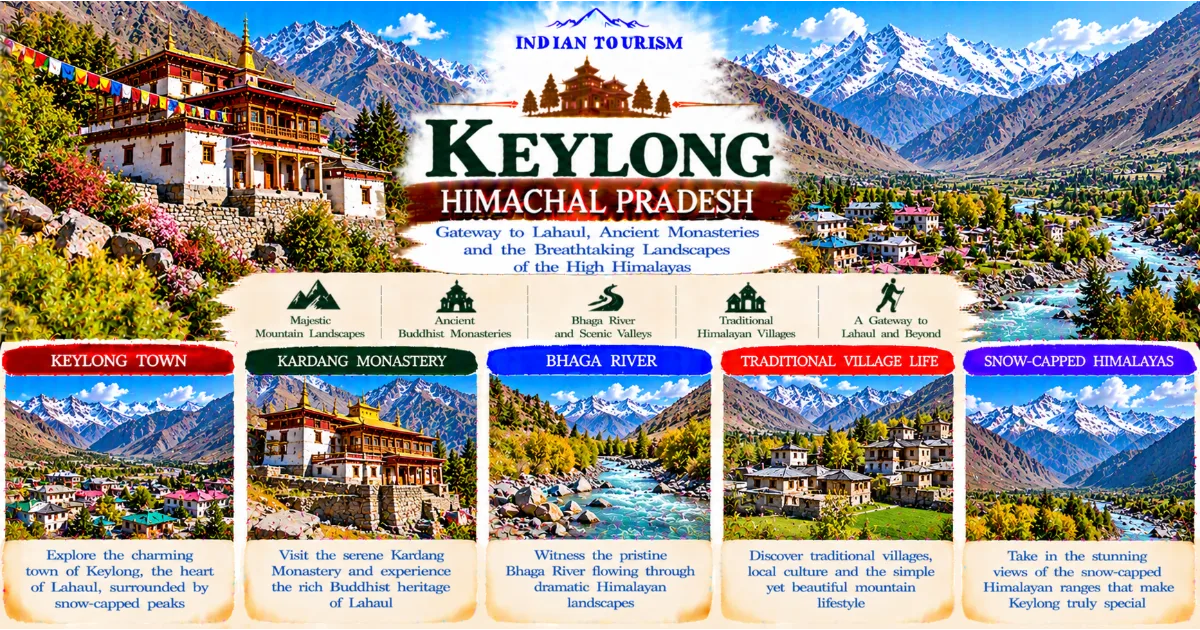
Welcome to Keylong, the Heart of Lahaul
High in the mountains of Himachal Pradesh, surrounded by rugged peaks, deep valleys, glacial streams and traditional Himalayan settlements, lies Keylong, the administrative headquarters of Lahaul and Spiti district. Often written as Kyelang, Keylong is one of the most important settlements in the Lahaul region and an appealing destination for travellers who want to experience a quieter, less commercialised side of the Himalayas. Its location along the Manali to Leh corridor has made it a familiar stop for mountain travellers, but Keylong offers much more than a place to rest during a long road journey.
The town provides a window into the culture, architecture, religious traditions and everyday life of Lahaul. Buddhist monasteries stand among mountain villages, cultivated fields occupy relatively level areas, and rivers carry water through landscapes shaped by glaciers and erosion. The surrounding mountains create a dramatic setting that changes with the seasons, from green patches of summer vegetation to snow-covered slopes during winter.
Keylong is particularly attractive to travellers interested in Himalayan culture, scenic road journeys, photography, short walks and village exploration. It is also a useful base for understanding the geography of Lahaul before continuing towards other destinations in the region. Unlike some heavily promoted tourist centres, the town retains a practical character. Government offices, local shops, schools, accommodation providers and everyday services form part of its identity.
The town's position is important because Lahaul lies between the greener Himalayan slopes towards Manali and the drier mountain environments extending towards Spiti and Ladakh. This transition is visible in the landscape, vegetation, architecture and agricultural practices. Travelling around Keylong allows visitors to observe how geography influences the way communities live.
A successful visit requires preparation. Keylong lies at a high elevation, and the weather can change quickly. Mountain roads may be affected by snowfall, landslides and maintenance work, while some attractions and accommodation options operate differently according to the season. Travellers should allow time for acclimatisation and avoid treating the region as an ordinary lowland road trip.
For anyone planning to explore Himachal Pradesh beyond its familiar hill stations, Keylong offers a meaningful combination of mountain scenery, cultural heritage and insight into life in the high Himalayas.
Where Is Keylong Located?
Keylong is located in the Lahaul region of Himachal Pradesh, in the upper Chandra and Bhaga river landscape. The settlement serves as the administrative headquarters of Lahaul and Spiti district and occupies an important position along the road network connecting the region with Manali and the high mountains beyond.
The town lies at an elevation of approximately 3,080 metres above sea level. This altitude influences the climate, vegetation and pace of travel. Visitors coming directly from much lower elevations should take time to adjust rather than immediately undertaking strenuous activities.
Keylong is surrounded by mountain slopes, cultivated terraces and settlements that reflect the practical demands of living in a high-altitude environment. The area receives more snow than many lower parts of Himachal Pradesh, while the wider Lahaul landscape varies according to elevation and exposure.
The town is associated with the Bhaga River valley and the surrounding mountain routes. Its position has made it a significant stopping point for travellers heading towards Ladakh when the relevant roads are open. It is also a useful location for exploring monasteries and villages in the nearby region.
Although Keylong is often described as a gateway destination, it deserves time in its own right. Travellers who stay for a day or two can explore local heritage, observe village life and appreciate the landscape without rushing onward.
The Natural Beauty of the Lahaul Valley
The landscape around Keylong is defined by steep mountains, open slopes, river valleys and settlements built wherever terrain and water allow. The scenery differs from the forested hills of southern Himachal Pradesh, creating an atmosphere that feels more open, rugged and alpine.
Mountain ridges rise above the town, while the river valleys provide corridors for roads, agriculture and settlement. During the warmer months, cultivated areas and patches of vegetation add colour to the otherwise rocky environment. Higher slopes may retain snow for longer, depending on the season.
The changing light is one of the region's greatest attractions. Early mornings can reveal clear mountain outlines, while afternoon clouds may transform the appearance of distant peaks. Travellers who enjoy photography will find opportunities to capture broad landscapes as well as smaller details such as stone walls, traditional homes and irrigation channels.
The natural environment also supports local livelihoods. Water from mountain streams and rivers is essential for agriculture and household use. The distribution of settlements reflects the availability of relatively level ground, water and access routes.
Visitors should remember that the landscape is not simply a scenic backdrop. It is a living environment with fragile soils, seasonal hazards and ecological systems that can be affected by careless tourism.
Stay on established paths where possible, avoid disturbing vegetation and carry rubbish back to appropriate disposal points. Respect agricultural land and private property, especially when exploring villages outside the main town.
Bhaga River and the Waterways Around Keylong
The Bhaga River is an important feature of the wider Lahaul landscape. Its waters flow through a dramatic mountain environment, connecting settlements and shaping the geography of the valley.
The river's character changes with season, snowmelt and rainfall. In warmer months, melting snow can contribute to stronger flows, while winter conditions may bring ice and extremely cold temperatures. The riverbanks can be unstable, and currents may be stronger than they appear.
For visitors, the river offers opportunities for landscape photography and quiet observation from safe locations. The contrast between moving water, rocky terrain and distant mountains provides a strong sense of the region's natural character.
However, river access should always be approached cautiously. Do not enter fast-flowing water, attempt to cross at unmarked locations or walk on slippery rocks. Heavy rainfall and changing water levels can create hazards even when the weather appears clear nearby.
Water is also essential to the communities of Lahaul. Irrigation channels and local water-management practices help support agriculture in a region where the growing season is limited.
Travellers should avoid wasting water at accommodation and should not pollute streams or riverbanks. In a high-altitude environment, responsible water use is part of respecting the local community and ecosystem.
Kardang Monastery: A Major Buddhist Landmark Near Keylong
Kardang Monastery is one of the best-known religious and cultural landmarks associated with Keylong. Located across the Bhaga River valley, the monastery is connected with the Drukpa Kagyu tradition of Tibetan Buddhism and has played an important role in the religious life of Lahaul.
The monastery occupies a scenic position in the mountain landscape. Its buildings and surrounding terrain create an atmosphere that encourages visitors to slow down and observe the relationship between religious architecture and the environment.
Kardang is not merely an architectural attraction. It is part of a living religious tradition, and its continued significance depends on the people who maintain its practices, buildings and community connections.
Visitors may have opportunities to observe religious architecture, learn about local Buddhist traditions and appreciate the monastery's setting. Access to particular rooms or religious activities may be restricted, so instructions from monastery staff should always be followed.
Dress modestly, speak quietly and ask before taking photographs. Avoid touching ritual objects, paintings or sculptures. Religious sites deserve the same respect as places of worship elsewhere in the world.
The monastery can also provide insight into the broader cultural landscape of Lahaul, where Buddhist institutions and local traditions have shaped community life for generations.
Before visiting, confirm local access arrangements and transport conditions. The road or walking approach may be affected by weather, and visitors should allow sufficient time for the return journey.
Shashur Monastery: History and Spirituality in the Mountains
Shashur Monastery is another important religious site near Keylong. Associated with the Drukpa Kagyu school of Tibetan Buddhism, it is known for its spiritual significance and its position amid the mountain landscape.
The monastery's name is commonly connected with the local word for blue pine, reflecting the vegetation found in parts of the surrounding region. The relationship between the monastery and its natural setting contributes to the experience of visiting.
Shashur is particularly interesting for travellers who want to explore the religious heritage of Lahaul beyond the main town. Its setting provides an opportunity to appreciate how monasteries were established in mountain communities where access, climate and available resources shaped daily life.
Religious institutions in the Himalayas have traditionally served several purposes. In addition to worship, monasteries may support education, preserve religious texts and artistic traditions, and provide places for community gatherings and ceremonies.
Visitors should not assume that every part of a monastery is open to tourists. Some spaces may be used for religious activities or may contain fragile heritage materials. Follow local guidance and avoid interrupting prayers or ceremonies.
The monastery's architecture, religious atmosphere and surrounding landscape make it a valuable addition to a cultural itinerary around Keylong.
Tayul Monastery and the Buddhist Heritage of Lahaul
Tayul Monastery is another notable religious destination in the wider Keylong area. It is associated with the Nyingma tradition of Tibetan Buddhism and forms part of the region's wider network of monasteries and sacred places.
The monastery reflects the diversity of Buddhist traditions found across the western Himalayas. Different schools have their own histories, teachings and religious practices, although they share broader connections within Tibetan Buddhist culture.
For visitors, exploring monasteries around Keylong can provide a richer understanding of Lahaul than visiting a single religious site. Each location has its own setting, history and relationship with nearby communities.
Tayul's mountain environment is also part of its appeal. The surrounding slopes and valleys provide a striking backdrop for the monastery and help illustrate how religious institutions are integrated into the physical landscape.
When visiting, dress appropriately and behave respectfully. Ask before photographing people or religious objects, and observe any restrictions on entry.
The monasteries of Lahaul are not interchangeable attractions. Each represents a distinct religious and community history, and visitors should approach them with curiosity rather than assuming that every site offers the same experience.
Exploring the Villages Around Keylong
The villages around Keylong provide opportunities to understand the region's traditional architecture, agriculture and daily life. Settlements are often located on slopes or terraces where access to water and relatively level ground makes cultivation possible.
Traditional homes in Lahaul may incorporate stone, timber and earth-based materials, depending on local building practices and the age of the structure. Roofs, walls and storage areas reflect the need to withstand cold winters and seasonal weather changes.
Village life is closely connected with agriculture and livestock. During the warmer months, residents may be busy cultivating fields, managing animals and preparing for the colder season. These routines remain important even as tourism provides additional income opportunities.
Visitors can explore publicly accessible roads and paths, but they should remember that villages are private residential spaces. Ask permission before entering courtyards or photographing residents.
Walking through a village can reveal details that are easy to miss when travelling by vehicle. Irrigation channels, field boundaries, small shrines and the arrangement of houses provide insight into how communities organise their surroundings.
Supporting local shops, homestays and food businesses can help tourism contribute to the local economy. Treat local residents respectfully and avoid disrupting agricultural work.
Village exploration is most rewarding when approached as an opportunity to learn rather than as a search for photographs alone.
Agriculture and Traditional Livelihoods in Lahaul
Agriculture remains an important part of life in the Lahaul region. The growing season is relatively short because of the high elevation and cold winter conditions, so farming activities are organised around the available warmer months.
Barley, peas, potatoes and other crops have traditionally formed part of agricultural production in the wider region. Crop choices vary according to elevation, soil, water availability and changing market conditions.
In suitable areas, cultivation depends on irrigation because rainfall is limited compared with many other parts of Himachal Pradesh. Water channels and local management practices help distribute water to fields during the growing season.
Livestock also contributes to household livelihoods. Animals may provide milk, meat, manure and other resources, while grazing practices depend on seasonal availability and local conditions.
Modern agriculture and market connections have changed aspects of life in Lahaul. Roads have made it easier to transport produce and access supplies, while tourism has created additional opportunities for some households.
Visitors should respect cultivated fields and avoid walking through crops. Do not disturb irrigation channels or interfere with farm work.
Understanding agriculture adds depth to a visit because the valley's scenery is closely connected with the labour required to sustain mountain communities. The green patches visible during summer are not simply decorative features. They represent carefully managed resources in a demanding environment.
Keylong and the Manali to Leh Highway
Keylong is closely associated with the road corridor connecting Manali with Leh. This route is important for regional travel and is popular among people undertaking long Himalayan journeys by car, motorcycle, bicycle or organised transport.
The journey offers dramatic changes in landscape, from forested mountain approaches to high-altitude valleys and barren terrain. Keylong provides a useful place to pause, rest and learn about the Lahaul region before continuing farther into the mountains.
However, the highway is seasonal in character. Snowfall, landslides, road repairs and other conditions can affect access, particularly at high passes. The route should never be treated as guaranteed to remain open throughout the year.
Travellers should check current road advisories before departure and carry appropriate clothing, water, food and essential supplies. Fuel availability and vehicle services may be limited on some stretches, so planning is important.
Motorcyclists and drivers should avoid overestimating their ability to travel quickly on mountain roads. Sharp bends, loose surfaces, steep gradients and changing weather require attention and patience.
Keylong can also serve as a place to reconsider plans if weather conditions deteriorate. Delaying a journey may be safer than attempting to cross a high pass in unsuitable conditions.
The road connection has helped bring more visitors to Lahaul, but it does not remove the challenges of mountain travel. Preparation remains essential.
Best Time to Visit Keylong
The best time to visit Keylong depends on the purpose of the journey, road access and personal tolerance for cold weather.
Spring: April to May
Spring brings a gradual transition from winter conditions, although snow and ice can remain in some areas. Temperatures may vary considerably between daytime and night.
Visitors should check the status of access roads and prepare for cold conditions. Some services may still be operating on reduced schedules after winter.
Summer: June to August
Summer is generally one of the most practical periods for exploring Keylong and the surrounding region. Roads are more likely to be accessible, and daytime temperatures can be suitable for village walks and sightseeing.
The landscape may become greener in cultivated areas, creating a contrast with the surrounding mountains. This is also a busy travel period, especially for people journeying along the Manali to Leh corridor.
Weather can still change rapidly, and heavy rainfall may affect roads. Travellers should check local conditions before setting out.
Autumn: September to October
Autumn can offer clear mountain views and cooler temperatures. It may be a rewarding period for photography and cultural exploration, although nights become colder.
As the season progresses, visitors should confirm accommodation availability and the status of roads leading towards higher passes.
Winter: November to March
Winter brings very cold temperatures and substantial snowfall in parts of the region. Road access may be restricted, and some travel routes can become difficult or inaccessible.
Winter travel requires careful planning, reliable local information and suitable equipment. Visitors should not assume that services available in summer will remain open.
For most travellers seeking a straightforward sightseeing trip, summer and early autumn are often the most practical periods. The final decision should always be based on current weather, road conditions and local advice.
How to Reach Keylong
Keylong can be reached by road, but travel times vary according to the starting point, road conditions and season.
By Road from Manali
The road journey from Manali to Keylong uses the route through the Atal Tunnel and the Lahaul region when access conditions permit. The tunnel has improved connectivity, but the journey still involves mountain roads and can be affected by weather or maintenance.
Travellers should check official road information before departure and avoid beginning the journey without suitable clothing and essential supplies.
By Road from Other Parts of Himachal Pradesh
Keylong can be included in a longer journey through Mandi, Kullu and Lahaul, depending on the route and current road access. Travellers should allow sufficient time and avoid planning overly ambitious daily distances.
By Bus
Bus services may connect Keylong with other towns and regional destinations, but schedules can vary according to season and road conditions. Confirm current services before travelling.
By Train
Keylong has no railway station. Visitors arriving by train must continue by road from a suitable rail connection as part of their wider itinerary.
By Air
There is no airport in Keylong. Travellers arriving by air need to arrange onward road transport from an airport suitable for their journey.
Local Transport
Taxis and other local transport may be available, although options can be limited outside the main travel season. Agree on fares and return arrangements before beginning an excursion.
Mountain journeys should include a time buffer. Road delays can occur, and travelling safely is more important than keeping to a rigid schedule.
Where to Stay in Keylong
Keylong offers accommodation options that may include guesthouses, small hotels, homestays and other locally operated properties. Facilities vary, so visitors should confirm details before booking.
Ask about heating, hot water, meals, parking and access to essential services. These details are particularly important during colder months.
Homestays can provide an opportunity to learn about local food and daily life. Visitors should communicate their requirements clearly and respect household routines.
During the main summer travel period, advance booking is sensible, particularly for travellers following a fixed itinerary. Outside the main season, confirm that the property is open and that transport access is available.
If you are travelling with older adults or people who have difficulty walking, ask about stairs, room location and the distance to nearby services.
Keylong is a practical mountain town rather than a luxury resort destination. Travellers who appreciate local hospitality, cultural exploration and mountain scenery are likely to find the experience rewarding.
Food and Local Cuisine
Food options in Keylong reflect the region's mountain environment and cultural influences. Visitors may find traditional Himalayan dishes alongside familiar North Indian meals.
The wider Lahaul region has food traditions influenced by Tibetan and other Himalayan cultures. Depending on the establishment, meals may include soups, noodles, rice, vegetables, breads and warming beverages.
Local menus vary according to season and supply availability. Travellers should not expect every restaurant to offer an extensive choice, particularly outside the busiest travel months.
If you have dietary restrictions or allergies, explain them clearly before ordering. Carry snacks for longer road journeys because food options may be limited between settlements.
Drink safe water and avoid assuming that untreated water from streams is suitable for consumption. The dry mountain climate can increase the need for regular hydration.
Eating at local establishments is one way to support small businesses and experience the hospitality of the region. Visitors should also be mindful of food waste and avoid leaving packaging in natural areas.
A Three-Day Keylong Itinerary
A three-day visit can provide a relaxed introduction to Keylong and its surroundings.
On the first day, arrive in Keylong and allow time to rest after the mountain journey. Explore the accessible parts of town and enjoy the surrounding landscape from safe viewpoints.
On the second day, plan a cultural excursion to one or more nearby monasteries, depending on access and local conditions. Kardang, Shashur and Tayul are associated with the wider religious heritage of the region. Confirm transport arrangements and opening or access conditions before setting out.
On the third day, explore a nearby village or enjoy a gentle walk in an accessible area. Ask locally about suitable routes and avoid venturing into remote terrain without proper preparation.
This itinerary should remain flexible. Travellers who have recently arrived at high elevation should prioritise acclimatisation and avoid strenuous activity if they feel unwell.
A Five-Day Journey Through Lahaul
A five-day trip allows visitors to explore Keylong at a slower pace and include additional destinations in the wider region.
Spend the first day travelling to Keylong and resting after arrival. Keep activity light and become familiar with local services.
Use the second day to explore the town and the Bhaga River landscape from safe locations. Learn about the region's geography and the role of agriculture in local livelihoods.
On the third day, visit accessible monasteries and learn about the religious traditions of Lahaul. Respect rules governing photography and entry.
On the fourth day, consider a local village excursion or another destination that is accessible under current road conditions. Ask local accommodation providers for up-to-date advice.
On the fifth day, continue towards your next destination or begin the return journey. Allow enough time for possible road delays and avoid travelling through high mountain areas in unsuitable conditions.
This itinerary is a framework rather than a fixed schedule. Road access, weather, altitude and personal comfort should determine the final plan.
Photography in Keylong
Keylong offers a wide range of photographic subjects, from mountain panoramas and river valleys to monasteries, village architecture and cultivated fields.
Morning and late-afternoon light can create strong contrasts across the mountain slopes. The changing weather may reveal different layers of the landscape, although clouds can also reduce visibility.
Photographers should choose safe locations and avoid stopping vehicles on narrow roads or blind bends. Do not approach unstable edges or riverbanks simply to capture a dramatic image.
When photographing monasteries, follow the rules governing interior photography and ask permission before taking pictures of religious practitioners or visitors.
Village photography should be respectful. Ask before photographing residents and avoid entering private property without permission.
Protect cameras and phones from cold, dust and moisture. Spare batteries may be useful because cold conditions can reduce battery performance.
The most memorable images of Keylong often show the relationship between people and landscape. A cultivated field beneath a mountain ridge or a monastery within a broad valley can communicate more about the region than a photograph of a distant peak alone.
Responsible Tourism in Keylong
Responsible tourism helps protect the natural environment and cultural heritage of Lahaul.
Carry rubbish back to appropriate disposal points and avoid leaving plastic, bottles or food packaging along roads, rivers and walking routes.
Respect monasteries as active religious institutions. Dress modestly, speak quietly, follow instructions and avoid touching sacred objects.
Ask permission before photographing residents or entering private courtyards. Respect agricultural land and do not interfere with irrigation channels or farm activities.
Use water carefully and avoid unnecessary waste. Water resources are important to mountain communities, especially in areas where rainfall is limited.
Support local accommodation, restaurants and transport providers when possible. Tourism can provide income, but its benefits are strongest when visitors respect local customs and livelihoods.
Follow local advice around rivers, mountain roads and weather hazards. Do not attempt to cross flooded streams or continue into areas affected by unsafe conditions.
Responsible travel allows visitors to appreciate Keylong while helping preserve the landscape and community for future generations.
High-Altitude Safety and Practical Advice
Keylong's elevation means that visitors should pay attention to altitude. Some travellers may experience headaches, nausea, dizziness, fatigue or difficulty sleeping after arriving from lower areas.
Allow time to acclimatise, avoid strenuous exercise immediately after arrival and pay attention to how you feel. Severe or worsening symptoms, including breathlessness at rest, confusion or difficulty walking normally, require urgent medical attention and appropriate descent.
Carry essential medication and know how to seek help if needed. Medical services may be limited compared with major cities.
Mountain weather can change quickly. Carry warm layers even during summer and protect yourself from strong sunlight.
Check road conditions before departure, especially when travelling towards high passes. Carry drinking water, snacks and essential supplies in case of delays.
Avoid unnecessary night driving on unfamiliar mountain roads. Use experienced drivers where appropriate and always wear seat belts.
Keep your itinerary flexible. Delaying a journey because of unsafe conditions is preferable to taking risks in a remote environment.
Conclusion: Why Keylong Deserves a Place on Your Himachal Pradesh Itinerary
Keylong offers a distinctive experience of the Himalayas through its mountain scenery, Buddhist heritage, village life and connection with the wider Lahaul region. It is both an important regional town and a valuable destination for travellers who want to explore beyond Himachal Pradesh's more familiar hill stations.
The monasteries of Kardang, Shashur and Tayul provide insight into the religious traditions of the region, while the Bhaga River valley reveals the relationship between geography, agriculture and settlement. The surrounding mountains offer opportunities for photography and quiet exploration, provided visitors respect the environment and prepare for changing conditions.
Keylong is also an important stopping point for journeys along the Manali to Leh corridor. However, travellers should not treat it merely as a place to spend the night before continuing elsewhere. Taking time to explore the town and its surroundings can turn a transit stop into a meaningful cultural experience.
The high elevation, seasonal road access and limited services require careful planning. Check current conditions, allow time for acclimatisation and respect local guidance.
For travellers who value mountain landscapes, living heritage and quieter destinations, Keylong offers a rewarding introduction to Lahaul. It is a place where the dramatic scale of the Himalayas meets the everyday resilience of the communities that call these mountains home.
#IndianTourism #Keylong #Lahaul #HimachalPradesh #KardangMonastery #ShashurMonastery #TayulMonastery #BhagaRiver #HimalayanTravel #MountainTourism #CulturalTourism #ExploreHimachal #ResponsibleTourism #IncredibleIndia
